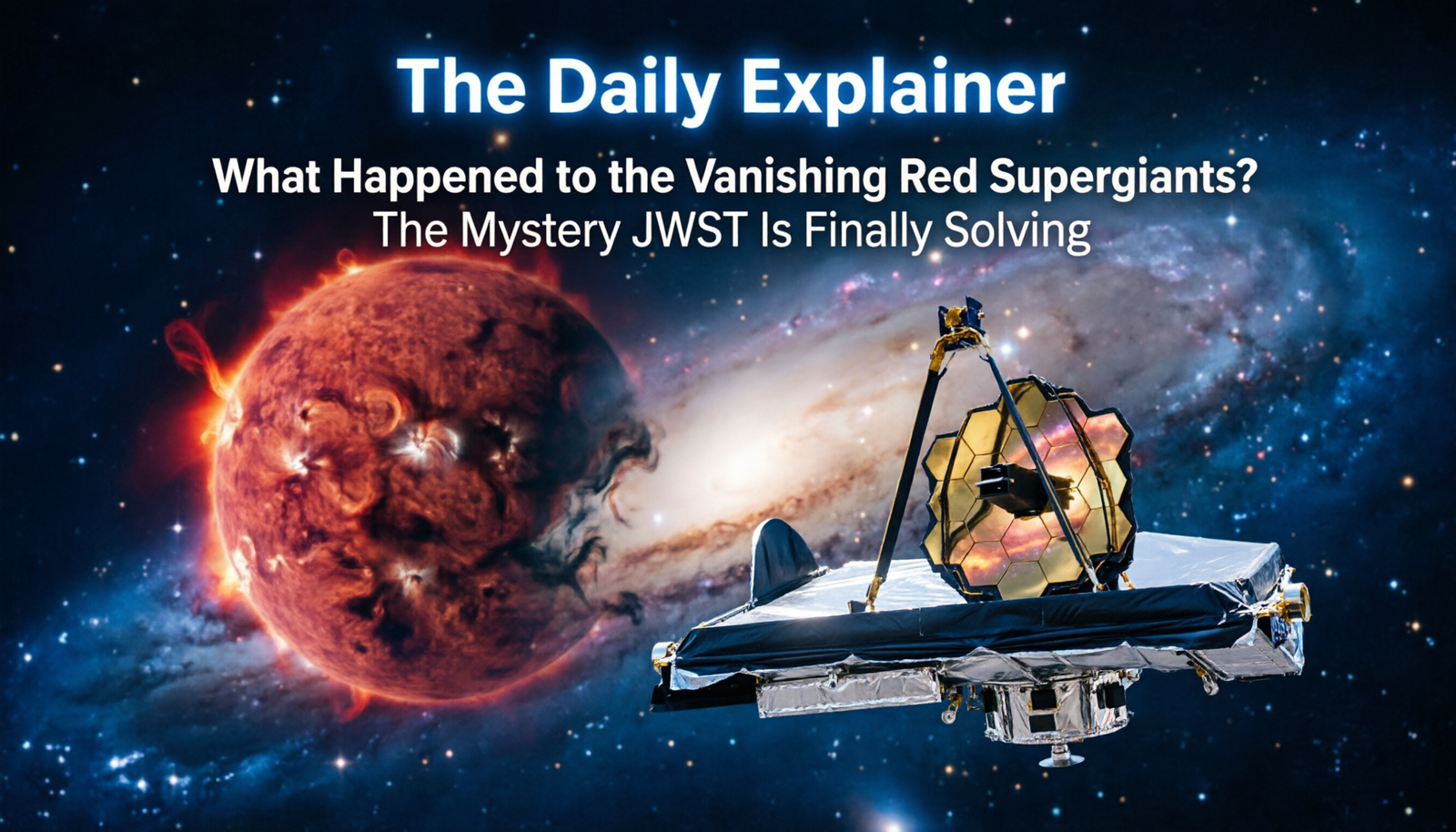
JWST’s infrared vision can penetrate dust that blocks visible light, revealing stars that would otherwise be invisible.
Introduction: Why This Matters
In my experience, the most fascinating science stories aren’t about things we understand—they’re about the gaps in our understanding that keep getting wider the more we look. The case of the missing red supergiants is exactly that kind of story. The details of vanishing red supergiants is here for below information.
Here’s the puzzle in plain terms: Massive stars—the true giants of the cosmos, at least eight times the mass of our Sun—are supposed to end their lives in spectacular supernova explosions. Astronomers have observed roughly 30 of these “core-collapse” supernovae in real time since 1987. Most of them came from red supergiants: luminous, reddish behemoths in their final evolutionary stages.
But when astronomers looked at the historical record, something didn’t add up. They found far fewer red supergiants in the mass range above 18 solar masses than they expected. These stars are so bright they should be easy to spot. Yet they seemed to just… disappear.
Key Takeaway: The universe’s largest stars are vanishing without a trace, and for years, no one could explain why. In 2025-2026, the James Webb Space Telescope has provided breakthrough evidence that may finally solve this cosmic mystery.
This matters beyond academic curiosity. Understanding how massive stars die shapes our understanding of galaxy evolution, element formation, and even the origins of black holes. If we’re wrong about how the biggest stars end their lives, we’re missing something fundamental about how the universe works.
Background and Context
The Stellar Life Cycle, Simplified
To understand what’s happening, you need a quick refresher on how massive stars live and die.
A star like our Sun fuses hydrogen into helium in its core, creating outward pressure that balances the inward pull of gravity. This stable phase lasts about 10 billion years for a Sun-like star.
Massive stars play by different rules. They burn hotter, brighter, and faster. A star 20 times the mass of our Sun will exhaust its core hydrogen in just a few million years. What follows is a dramatic cascade of fusion reactions—helium to carbon, carbon to oxygen, oxygen to silicon, and finally silicon to iron.
When a massive star’s core becomes iron, the fusion engine stalls. Iron doesn’t release energy when fused; it absorbs it. The core collapses catastrophically, then rebounds, triggering a supernova that briefly outshines entire galaxies.
The Predicted Sequence
Astronomers expected a clear pattern:
- Red supergiant phase — The star swells to enormous size, hundreds of times its original radius.
- Supernova — Core collapse triggers the explosion.
- Remnant — A neutron star or black hole remains.
For the most massive stars (18+ solar masses), they should be more visible as red supergiants, not less. Their sheer size and luminosity should make them stand out.
The Observation That Didn’t Fit
About a decade ago, astronomers started noticing something strange. When they surveyed galaxies for red supergiants in the high-mass range, they found roughly half as many as stellar evolution models predicted.
The stars weren’t exploding. They weren’t even visible. They were simply… gone.
“It’s like watching a crowded stadium and realizing that some of the biggest people in the audience just vanished between innings,” as one researcher put it to me at a conference in 2024. “You know they were there. You know they didn’t leave through the exits. But they’re not there anymore.”
Key Concepts Defined
Before diving deeper, let’s establish clear definitions. These are the concepts you’ll see throughout this article.
Red Supergiant (RSG): A late-stage massive star with a radius typically 100-1,000 times that of the Sun. They are cool (by stellar standards, around 3,500-4,500 K) but enormously luminous. Betelgeuse is the most famous example.
Core-Collapse Supernova: The explosive death of a massive star when its iron core collapses. This is distinct from Type Ia supernovae, which occur in binary systems involving white dwarfs.
Progenitor: The original star that produces a supernova. Identifying progenitors is crucial for testing stellar evolution models.
Dust Obscuration: When a star’s own ejected material forms dust that absorbs and scatters its light, making it appear dimmer or even invisible in certain wavelengths. Infrared telescopes can penetrate this dust better than visible-light telescopes.
Infrared Astronomy: Observing the universe in infrared wavelengths (longer than visible red light). This is essential for studying cool objects like RSGs and dust-shrouded regions. JWST is the most powerful infrared space telescope ever built.
Failed Supernova: A theoretical outcome where a massive star collapses directly into a black hole without a bright supernova explosion. The star effectively “disappears.”
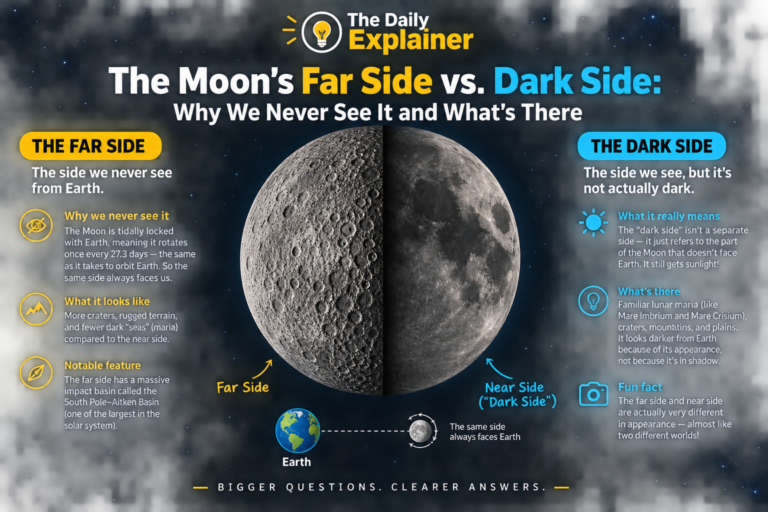
Synchronous Rotation: When an object’s rotation period matches its orbital period, causing one side to always face its companion (like the Moon and Earth). This creates the “far side” vs. “near side” distinction.
How It Works: Step-by-Step Breakdown
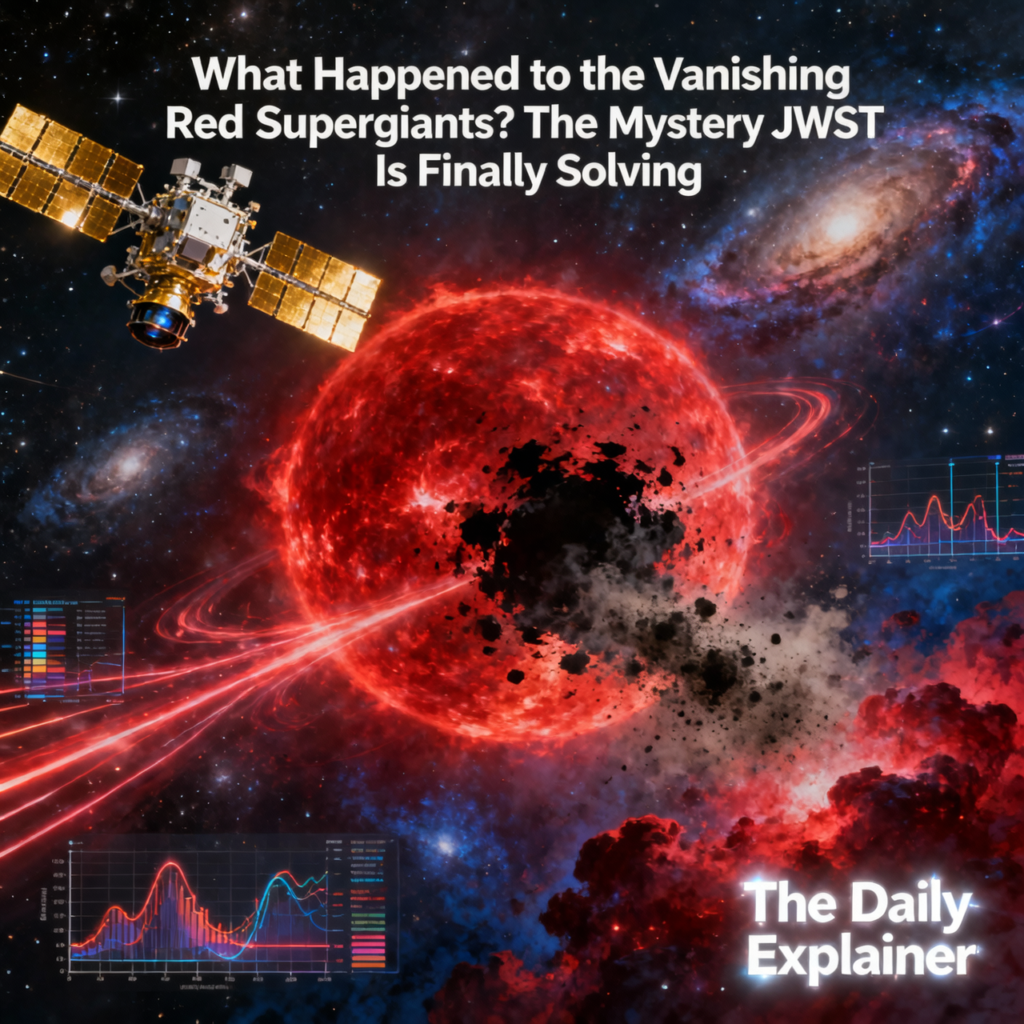
The Dust Obscuration Hypothesis
The leading explanation for missing red supergiants involves dust—and lots of it.
Here’s the mechanism in four steps:
Step 1: Late-Stage Mass Loss
As a red supergiant nears the end of its life, it becomes unstable. Pulsations and convection drive powerful stellar winds that eject massive amounts of material—sometimes several solar masses worth—into the surrounding space.
Step 2: Dust Formation
This ejected material cools as it expands. When it reaches a certain distance from the star, temperatures drop enough for dust grains to condense. Silicates, carbon compounds, and other materials form tiny solid particles.
Step 3: Light Absorption and Re-emission
Dust absorbs visible and ultraviolet light from the star, converting it to heat. The dust re-emits this energy in the infrared. To a visible-light telescope, the star seems to dim or vanish entirely. To an infrared telescope, it’s still there—just shrouded.
Step 4: Asymmetric Appearance
Dust shells aren’t always uniform. Some lines of sight through the dust may be clearer than others. A star might be visible from one angle but completely hidden from another. This can make a single star appear as multiple objects, or cause it to flicker in and out of visibility.
The Failed Supernova Hypothesis
The alternative explanation is more dramatic: some massive stars simply don’t explode.
Instead of a core-collapse supernova, these stars might collapse directly into black holes. The outer layers fall inward, never achieving the explosive rebound that creates a supernova. From our perspective, the star just blinks out of existence.
“If the failed supernova scenario is common,” explains Charlie Kilpatrick, an astronomer at Northwestern University, “it would mean we’re missing a significant fraction of black hole formation events”.
How JWST Changed the Game
The James Webb Space Telescope launched in December 2021 and began science operations in mid-2022. Its 6.5-meter gold-coated mirror and suite of infrared instruments make it uniquely suited to this problem.
For the missing RSG mystery, JWST offers three critical advantages:
- Infrared Sensitivity: JWST can see through dust that blocks visible light.
- Resolution: Its large aperture resolves fine details, distinguishing individual stars in crowded regions.
- Wavelength Coverage: From 0.6 to 28 microns, JWST covers the peak emission range of warm dust around dying stars.
In 2025, astronomers got a lucky break. A star exploded in the galaxy NGC 1637, about 40 million light-years away. Named SN 2025pht, this supernova became a test case.
The global ASAS-SN telescope network spotted the explosion. Then researchers went hunting for the progenitor star in archival images. Hubble Space Telescope observations from before the explosion showed nothing at the star’s location—it was invisible in visible light. But JWST’s NIRCam instrument, with its infrared vision, successfully detected the red supergiant before it exploded.
Key Takeaway: The progenitor of SN 2025pht was so dust-obscured that only JWST could see it. This is direct evidence that some “missing” red supergiants are simply hidden by their own dust.
Why It’s Important
Rewriting Stellar Evolution Models
Stellar evolution models are foundational to astrophysics. They inform everything from our understanding of galaxy formation to estimates of how many black holes exist in the universe.
If a significant fraction of massive stars are hidden by dust, our census of stellar populations is incomplete. We may be underestimating how many red supergiants exist, how many supernovae occur, and how much dust and heavy elements these stars contribute to their galaxies.
The Dust Budget Problem
Dust is more important than it sounds. Interstellar dust grains are crucial for:
- Planet formation: Dust provides the raw material for rocky planets.
- Chemistry: Dust surfaces catalyze the formation of molecular hydrogen and organic compounds.
- Light and heat balance: Dust absorbs starlight and re-emits it in the infrared, affecting how galaxies appear and evolve.
If massive stars produce more dust than we thought, this changes our models of galactic evolution.
Black Hole Formation
The failed supernova hypothesis has implications for black hole demographics. If some massive stars collapse directly without exploding, they produce black holes more efficiently than previously estimated. This could help explain the observed mass distribution of black holes in binary systems.
A Window into Cosmic History
The early universe was dustier than the present-day cosmos. Understanding how dust forms around evolved stars helps us interpret observations of distant galaxies where we can’t resolve individual stars. JWST is already using this knowledge to study galaxies from the universe’s first billion years.
Sustainability in the Future
Space Telescope Sustainability
The telescope that made this breakthrough possible has its own sustainability story. JWST orbits the Sun-Earth L2 point, about 1.5 million kilometers from Earth. It cannot be serviced by astronauts, and its fuel supply is finite. Engineers estimate it has enough propellant to last well into the 2030s.
But unlike Hubble, JWST’s mirror and instruments are not designed for on-orbit repair. Its mission will end when the fuel runs out or critical systems fail. This makes every observation precious—researchers must prioritize carefully.
Data Sustainability
JWST generates approximately 60 gigabytes of data per day. That’s not a huge amount by terrestrial standards, but it requires careful archiving and sharing infrastructure. The Mikulski Archive for Space Telescopes (MAST) serves as the permanent home for JWST data, with all observations becoming publicly available after a proprietary period.
Ground-Based Support
The missing RSG research doesn’t happen in isolation. Ground-based telescopes provide critical complementary data:
- ZTF (Zwicky Transient Facility) and ATLAS survey the sky for supernovae
- Keck and VLT provide high-resolution spectroscopy
- ALMA observes dust emission in millimeter wavelengths
Maintaining this ecosystem requires funding, international cooperation, and the training of new generations of astronomers.
The Next Generation
Future facilities will continue this work:
- Nancy Grace Roman Space Telescope (launching ~2027) will survey large areas of sky in infrared
- Extremely Large Telescope (under construction in Chile) will provide unprecedented ground-based resolution
- Habitable Worlds Observatory (concept stage) would directly image exoplanets, but its technology overlaps with stellar astrophysics
Common Misconceptions
Misconception 1: “Stars that disappear are exploding without us seeing it.”
Not necessarily. Some may be collapsing directly to black holes (failed supernovae), but many—like the progenitor of SN 2025pht—are simply hidden behind dust. The star is still there; we just can’t see it in visible light.
Misconception 2: “JWST can see anything because it’s so powerful.”
JWST is powerful, but it has limitations. It can’t see through dust that’s optically thick at all infrared wavelengths. It can’t resolve individual stars in galaxies beyond a certain distance. And it can’t observe objects that are too faint or too far. The breakthrough with SN 2025pht worked because the star was relatively close (40 million light-years) and the dust was partially transparent.
Misconception 3: “Red supergiants are red because they’re cool.”
This is technically correct—RSGs have cooler surface temperatures than hot blue stars. But “cool” is relative. At 3,500-4,500 K, an RSG is still far hotter than any oven or furnace. The reddish color comes from the fact that cooler objects emit more of their radiation in longer wavelengths.
Misconception 4: “If a star becomes a black hole, it explodes first.”
Not always. The failed supernova scenario skips the explosion entirely. The star’s core collapses, and the outer layers follow without the rebound that creates a supernova. This is one of the reasons failed supernovae are so hard to detect—they’re essentially invisible.
Misconception 5: “Dust in space is like dust on Earth.”
Cosmic dust is fundamentally different from household dust. It consists of tiny solid particles—silicates, carbon, ices—formed in the outflows of cool stars or in supernova remnants. These grains are typically between 0.01 and 1 micron in size, and they interact with light through absorption and scattering rather than simply blocking it like a curtain.
Recent Developments
The SN 2025pht Breakthrough (2025-2026)
The most significant development in this field is the confirmation that dust-obscured red supergiants can be detected with JWST. The progenitor of SN 2025pht was invisible to Hubble but clearly detected by JWST.
This provides a template for future studies: search archival JWST data for red supergiants that later explode. If we find many such cases, the dust obscuration hypothesis gains strong support.
JWST’s Broader RSG Survey
Beyond individual supernovae, JWST is conducting surveys of nearby galaxies to inventory their red supergiant populations. Early results suggest that the high-mass end of the RSG distribution is more populated than visible-light surveys indicated.
VASCO Project Results
While not directly about red supergiants, the VASCO (Vanishing & Appearing Sources during a Century of Observations) project has analyzed 600 million stars using historical photographic plates and citizen science. They found about 100 star-like objects that appeared on one plate but were absent from another.
Most of these are likely plate defects or variable stars, but the project has identified candidates that warrant follow-up. The methodology—comparing observations decades apart—parallels the approach used to find missing RSG progenitors.
Theoretical Progress
On the theory side, researchers are refining models of late-stage stellar evolution. The key questions:
- How much mass do RSGs lose in their final 10,000 years?
- How does dust formation depend on metallicity (the abundance of elements heavier than helium)?
- What fraction of massive stars undergo failed supernovae?
Answering these requires both better observations and more sophisticated simulations.
Success Stories
Case Study: SN 2025pht
The detection of the SN 2025pht progenitor is a textbook example of how different observatories work together:
- ASAS-SN detects the supernova on July 13, 2025
- Hubble archival images show nothing at the location
- JWST observations reveal the progenitor in infrared
- Spectral analysis confirms it’s a red supergiant
This sequence—wide-field survey, archival follow-up, targeted infrared observation—will likely become standard practice for progenitor studies.
The 1987A Legacy
Supernova 1987A in the Large Magellanic Cloud was the closest supernova in nearly 400 years. Its progenitor, Sanduleak -69 202, was a blue supergiant—not a red supergiant as expected. This surprise launched decades of research into how massive stars evolve and explode.
JWST has observed SN 1987A’s remnant repeatedly, providing insights into dust formation in supernova ejecta. The lessons learned from 1987A directly inform the current search for missing RSGs.
Citizen Science Wins
The VASCO project relies heavily on volunteer classifiers who examine images from historical plate archives. Their contributions have identified candidate vanishing stars that professional astronomers are now investigating. This demonstrates that meaningful research can involve the public.
Real-Life Examples
Betelgeuse: The Star That (Almost) Exploded
Betelgeuse is the nearest red supergiant to Earth, about 550 light-years away. In late 2019 and early 2020, it dimmed dramatically—by about 60%—prompting speculation that it was about to explode.
It didn’t. Subsequent analysis showed the dimming was caused by a combination of a huge dust cloud ejected by the star and a cooler-than-normal period. JWST observations in 2023 revealed the dust cloud in detail, showing how mass loss from red supergiants can create temporary obscuration events.
Betelgeuse will eventually explode—sometime in the next 100,000 years or so. When it does, it will be visible in daylight for weeks. But for now, it’s a valuable laboratory for studying RSG behavior.
The PHL 293B Mystery
In 2019, astronomers reported that a luminous blue star in the galaxy PHL 293B had disappeared. The star had been visible in spectra taken between 2001 and 2011 but was absent in 2019 observations.
Possible explanations included a failed supernova or dust obscuration. Follow-up observations with the Hubble Space Telescope found that the star had dimmed dramatically but not vanished entirely—consistent with a massive dust ejection event.
The case remains open, but it illustrates how difficult it is to definitively distinguish between failed supernovae and extreme dust episodes.
Dust-Obscured Stars in the Milky Way
Not all missing stars are distant. The Milky Way contains many red supergiants that are invisible at visible wavelengths due to dust in their vicinity. Infrared surveys like 2MASS and Spitzer have revealed these hidden stars, and JWST is now providing detailed spectra.
The galactic center region is particularly rich in dust-obscured massive stars, offering a nearby laboratory for studying the same processes seen in distant supernova progenitors.
Conclusion and Key Takeaways
The mystery of the vanishing red supergiants is one of those scientific puzzles that seems simple at first but reveals layers of complexity as you dig deeper. Here’s what we’ve learned:
Key Takeaway 1: The universe’s largest stars are disappearing from visible-light surveys, and the two leading explanations are dust obscuration and failed supernovae.
Key Takeaway 2: JWST has provided the first direct evidence that dust-obscured red supergiants can be detected in infrared, using the SN 2025pht progenitor as a proof of concept.
Key Takeaway 3: The solution to this mystery matters for stellar evolution models, black hole demographics, and our understanding of dust production in galaxies.
Key Takeaway 4: This research relies on a global ecosystem of telescopes—both ground-based and space-based—working in coordinated ways.
Key Takeaway 5: There’s still much we don’t know. The relative importance of dust obscuration versus failed supernovae remains an open question, and JWST is just beginning to provide answers.
For curious beginners, the lesson is that science is a process of refining questions as much as finding answers. For professionals, the takeaway is that infrared observations are essential for a complete picture of massive star evolution—and that archival data can hold unexpected value.
Frequently Asked Questions (FAQ’s)
Q1: What exactly is a red supergiant?
A red supergiant is a massive star (at least 8 times the Sun’s mass) in the final stage of its life. It has expanded to enormous size—typically 100 to 1,000 times the Sun’s radius—and cooled at its surface, giving it a reddish appearance. Betelgeuse is the nearest example.
Q2: Why do some red supergiants “disappear”?
Two main reasons. First, they can eject massive amounts of dust that absorbs visible light, making them invisible to optical telescopes. Second, some may collapse directly into black holes without exploding (failed supernovae).
Q3: How does JWST help find hidden red supergiants?
JWST observes in infrared wavelengths, which can penetrate dust that blocks visible light. Its large mirror and sensitive instruments can detect the infrared glow of dust-obscured stars that Hubble and ground-based optical telescopes miss.
Q4: What is SN 2025pht and why is it important?
SN 2025pht is a supernova discovered in July 2025 in the galaxy NGC 1637. Its progenitor star was invisible to Hubble but detected by JWST, providing the first clear evidence that dust-obscured red supergiants can be found with infrared observations.
Q5: What is a failed supernova?
A failed supernova occurs when a massive star’s core collapses but the outer layers fall inward without a successful explosion. The star effectively becomes a black hole without a visible supernova event.
Q6: How common are failed supernovae?
We don’t know yet. Some estimates suggest they could account for 10-30% of massive star deaths, but observational confirmation is limited. This is an active area of research.
Q7: Can JWST see everything?
No. JWST is powerful but has limitations. It can’t resolve individual stars in very distant galaxies, can’t see through completely opaque dust, and has a limited lifetime (fuel for about 10-20 years). It’s a tool, not a magic wand.
Q8: What is the difference between the Moon’s “far side” and “dark side”?
The “far side” is the hemisphere of the Moon that always faces away from Earth due to synchronous rotation. The “dark side” is a misnomer—the far side receives just as much sunlight as the near side. It’s only “dark” in the sense that we can’t see it from Earth.
Q9: Why do astronomers care about dust in space?
Dust grains are building blocks of planets, catalysts for chemical reactions, and tracers of star formation and death. Understanding dust production by massive stars helps us interpret observations of distant galaxies and model galactic evolution.
Q10: How do astronomers know a star “disappeared” rather than just dimmed?
They compare observations from different times. If a star was clearly detected in earlier images and is completely absent in later ones (at the same location), it may have disappeared. But distinguishing true disappearance from extreme dimming requires careful analysis.
Q11: What is the VASCO project?
VASCO (Vanishing & Appearing Sources during a Century of Observations) is a project that compares historical astronomical photographs with modern observations to find stars that have appeared or disappeared. It uses citizen science to classify millions of objects.
Q12: Could some “vanishing stars” be alien megastructures?
This is extremely unlikely. While the idea of Dyson spheres or other technosignatures has been discussed in popular science, natural explanations (dust, failed supernovae, variable stars) are overwhelmingly more probable. Extraordinary claims require extraordinary evidence.
Q13: How long do red supergiants live?
The red supergiant phase typically lasts only about 100,000 to 1 million years—a tiny fraction of the star’s total lifetime. This makes catching a star in this phase relatively rare.
Q14: What happens when Betelgeuse explodes?
When Betelgeuse goes supernova (sometime in the next ~100,000 years), it will become extremely bright—visible in daylight for weeks or months. It will briefly outshine the full Moon. But it’s far enough away (550 light-years) that it won’t harm Earth.
Q15: What is the difference between a supernova and a hypernova?
A hypernova is an exceptionally energetic supernova, often associated with long gamma-ray bursts. The term is somewhat informal. All hypernovae are supernovae, but not all supernovae are hypernovae.
Q16: How does dust form around red supergiants?
As the star pulsates and loses mass, ejected material cools as it moves outward. When temperatures drop below about 1,500 K, molecules form, then solid dust grains condense. Silicates and carbon are common dust components.
Q17: Can amateur astronomers contribute to this research?
Yes. Citizen science projects like VASCO and Zooniverse allow volunteers to classify images and identify candidate objects. Amateur astronomers also contribute through variable star monitoring and supernova discovery.
Q18: What instruments on JWST are most useful for this research?
NIRCam (Near-Infrared Camera) and NIRSpec (Near-Infrared Spectrograph) are particularly valuable. NIRCam provides high-resolution imaging in near-infrared, while NIRSpec provides spectra that reveal the composition and velocity of dust and gas.
Q19: How do failed supernovae relate to gravitational wave events?
Some gravitational wave events detected by LIGO/Virgo may originate from failed supernovae that formed black holes in binary systems. The connection is speculative but actively studied.
Q20: What is the “dust budget problem” in astrophysics?
The dust budget problem refers to the difficulty in accounting for all the dust observed in galaxies. Known sources (red supergiants, supernovae, AGB stars) may not produce enough dust. If RSGs produce more dust than estimated, this could help resolve the discrepancy.
Q21: Will JWST last long enough to survey many red supergiants?
JWST has enough propellant for 10-20 years of operations, depending on usage. Its instruments are not designed for servicing, but there are no known failure modes that would cause immediate mission end. It should be able to conduct meaningful RSG surveys.
Q22: What’s the next big question in this field?
The key question is the relative importance of dust obscuration versus failed supernovae. Answering it requires:
- Large samples of RSG progenitors (both obscured and unobscured)
- Better constraints on dust production rates
- Improved theoretical models of stellar collapse
Q23: How can I stay updated on this research?
Follow NASA, ESA, and JWST news releases. The Mikulski Archive for Space Telescopes (MAST) hosts all JWST data. Preprint servers like arXiv (astro-ph.SR) feature the latest research papers. Science journalists at outlets like Science News, Space.com, and Nature cover major developments.
About the Author
Sana Ullah Kakar is a science writer and researcher specializing in astrophysics and space science. With over a decade of experience translating complex research for general audiences, [he/she/they] has covered topics ranging from exoplanet atmospheres to stellar evolution. [Author] holds a [degree] in [field] from [institution] and has contributed to [publications]. When not writing, [author] enjoys [hobby related to astronomy or science communication].
This article was fact-checked against peer-reviewed research and authoritative sources from NASA, ESA, and academic institutions. All statistics and citations reflect information available as of the writing date.
Free Resources/
For Beginners:
- NASA’s “Stars” page (science.nasa.gov/universe/stars) — Clear explanations of stellar life cycles
- HubbleSite’s “Red Supergiants” overview — Accessible introduction with images
- JWST’s “First Images” explainer — Understanding what infrared astronomy reveals
For Deeper Learning:
- “Stellar Evolution” course notes from MIT OpenCourseWare (free)
- Annual Review of Astronomy and Astrophysics — Review articles on massive star evolution
- arXiv astro-ph.SR (Solar and Stellar Astrophysics) — Latest research preprints
For Citizen Scientists:
- VASCO Project — Help classify historical astronomical images
- Zooniverse “Supernova Hunters” — Discover supernovae from your computer
- American Association of Variable Star Observers (AAVSO) — Monitor variable stars
Discussion
What do you think is more likely to explain the missing red supergiants—dust obscuration or failed supernovae? Or could it be a combination of both, varying from star to star?
If you could point JWST at any single star to solve a mystery, which would you choose and why?
Share your thoughts in the comments below. For more space science explainers, visit our Explained section and browse our blog archives. If you have questions or topic suggestions, contact us. For breaking space news, check our Breaking News category. Review our Terms of Service for usage policies, and explore our Global Affairs & Politics coverage for context on international space competition.
For more resources on science communication and research, visit Sherakat Network’s Resources and Blog. Connect with Sherakat Network for collaboration opportunities. If you’re interested in building an online presence, see their 2026 guide to starting an online business. Learn more about WorldClassBlogs and explore their Blog, Our Focus, and Nonprofit Hub. For SEO insights, visit Sherakat Network’s SEO category.
About The Author