Orion's Avcoat heat shield protects the crew during the most critical phase of the mission—reentry at 25,000 mph.
Introduction: Why This Matters
In my experience covering human spaceflight, there are missions that test hardware and missions that change history. Artemis II mission did both. On April 1, 2026, four astronauts launched from Kennedy Space Center on a nearly 10-day journey that would carry them farther from Earth than any humans in history. When they splashed down in the Pacific Ocean on April 10, they had traveled 695,081 miles, looped around the far side of the Moon, witnessed a solar eclipse from deep space, and set a new distance record that had stood for 56 years.
Key Takeaway: Artemis II was humanity’s first return to the Moon’s vicinity since Apollo 17 in 1972. It wasn’t just a symbolic milestone—it was a critical test flight that validated the systems, procedures, and human factors needed for the next giant leap: landing on the lunar surface.
For curious beginners, this is your guide to understanding what actually happened on Artemis II and why it matters for the future. For professionals needing a refresher, this is the state of the Artemis program as of late 2026, with all the technical details and programmatic context you need.
Background and Context
The Artemis Program: A New Era of Lunar Exploration
The Artemis program represents NASA’s most ambitious human spaceflight effort since Apollo. Named after the twin sister of Apollo in Greek mythology, Artemis aims to return humans to the Moon—this time to stay. The program’s goals extend beyond planting flags: establishing a sustainable lunar presence, conducting groundbreaking science, and preparing for eventual crewed missions to Mars.
The program’s architecture differs fundamentally from Apollo. Where Apollo used a single massive rocket to send everything to the Moon, Artemis relies on a distributed approach: the Space Launch System (SLS) rocket launches the Orion spacecraft with crew, while commercial partners provide lunar landers that will rendezvous with Orion in lunar orbit.
This commercial involvement is a deliberate departure from Apollo-era practices. NASA is leveraging the innovation and cost efficiencies of private industry—SpaceX and Blue Origin are both developing human landing systems—while focusing its own resources on the deep space capabilities that only a government agency can provide.
The Road from Artemis I to Artemis II
Artemis II didn’t happen in isolation. It built directly on the lessons of Artemis I, the uncrewed test flight that launched in November 2022 and splashed down in December of that year. Artemis I successfully tested the SLS rocket and Orion spacecraft in space, executing two lunar flybys and traveling about 270,000 miles from Earth.
But Artemis I also revealed a problem. When engineers examined the Orion capsule after splashdown, they found unexpected charring on the heat shield—chunks of material missing in ways that hadn’t been predicted. While the shield still would have protected a crew, the anomaly demanded investigation before humans could fly.
That investigation took months of testing and analysis. The root cause, NASA eventually determined, was that gases generated inside the heat shield’s ablative material couldn’t vent properly during the skip reentry trajectory. Pressure built up, cracking occurred, and charred material broke off. The solution involved operational changes to the reentry trajectory and a deeper understanding of how the material behaved under different heating conditions.
Artemis II would prove whether those fixes worked—with humans aboard.
Key Concepts Defined
Before diving deeper, let’s establish clear definitions. These concepts will appear throughout this article.
Space Launch System (SLS): NASA’s super-heavy-lift rocket, the most powerful ever built. The SLS generates 8.8 million pounds of thrust at liftoff and can send Orion and its crew to the Moon.
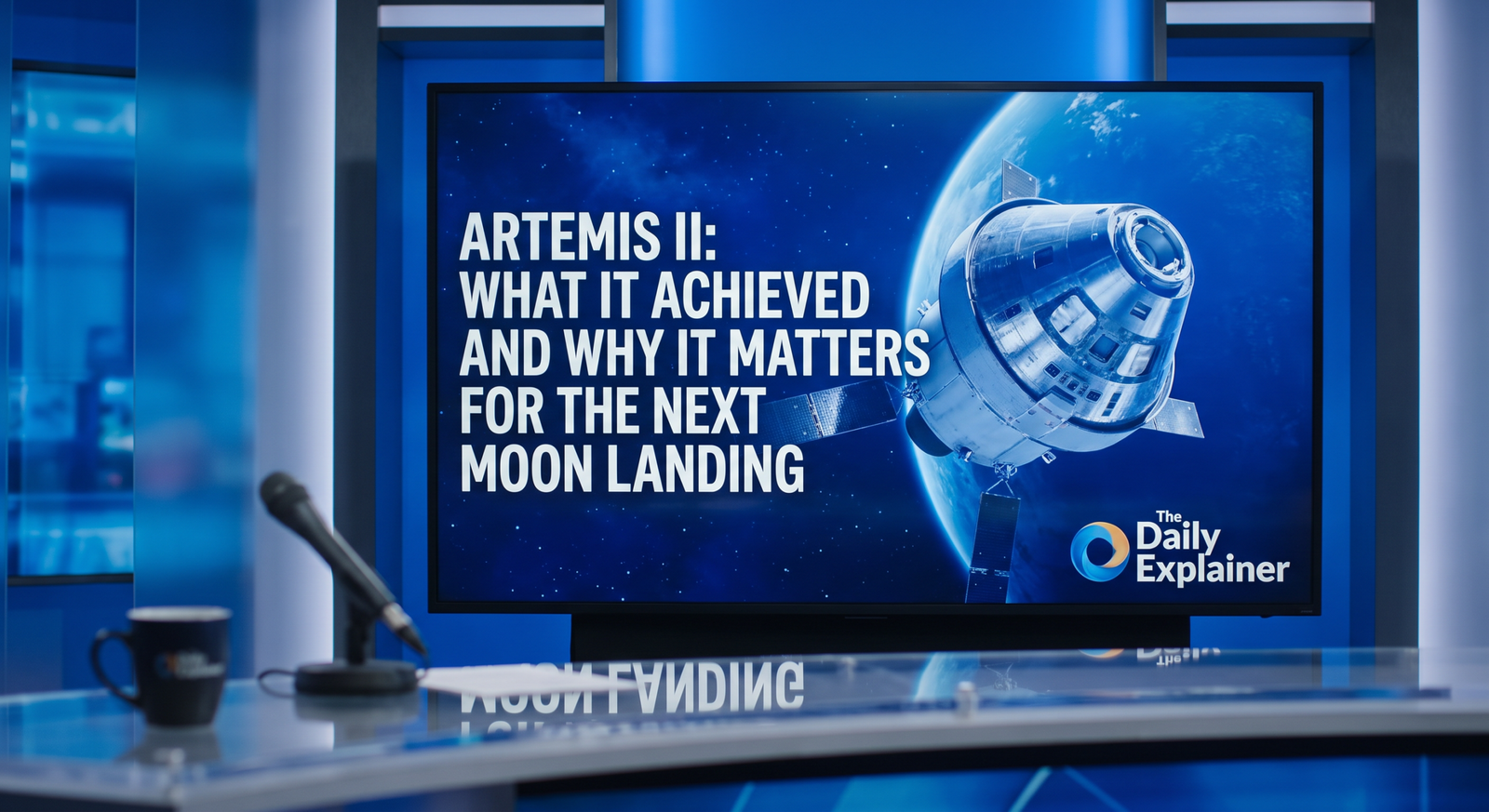
Orion Spacecraft: The crew vehicle designed for deep space missions. It consists of a crew module (where astronauts live) and a service module (providing propulsion, power, and life support). The Artemis II crew named their spacecraft “Integrity”.
Free-Return Trajectory: A path around the Moon that uses the Moon’s gravity to naturally slingshot the spacecraft back toward Earth. This requires minimal fuel and provides a natural abort option—if something goes wrong, gravity brings the crew home.
Skip Entry: A reentry technique where the spacecraft dips into Earth’s atmosphere, uses drag to slow down, then “skips” back out before reentering for final descent. This extends the range and precision of landing, but it creates unique heating conditions for the heat shield.
Avcoat: The ablative material that covers Orion’s heat shield. It’s designed to char and slowly burn away during reentry, carrying heat away from the spacecraft. It was originally developed for the Apollo command module.
Human Landing System (HLS): The commercial landers that will carry astronauts from lunar orbit to the surface and back. NASA has contracts with SpaceX (Starship HLS) and Blue Origin (Blue Moon) for these vehicles.
Low Earth Orbit (LEO): The orbital regime where the International Space Station operates, typically 200-2,000 kilometers above Earth. Artemis III will operate in LEO, not at the Moon.
How It Works: Step-by-Step Breakdown
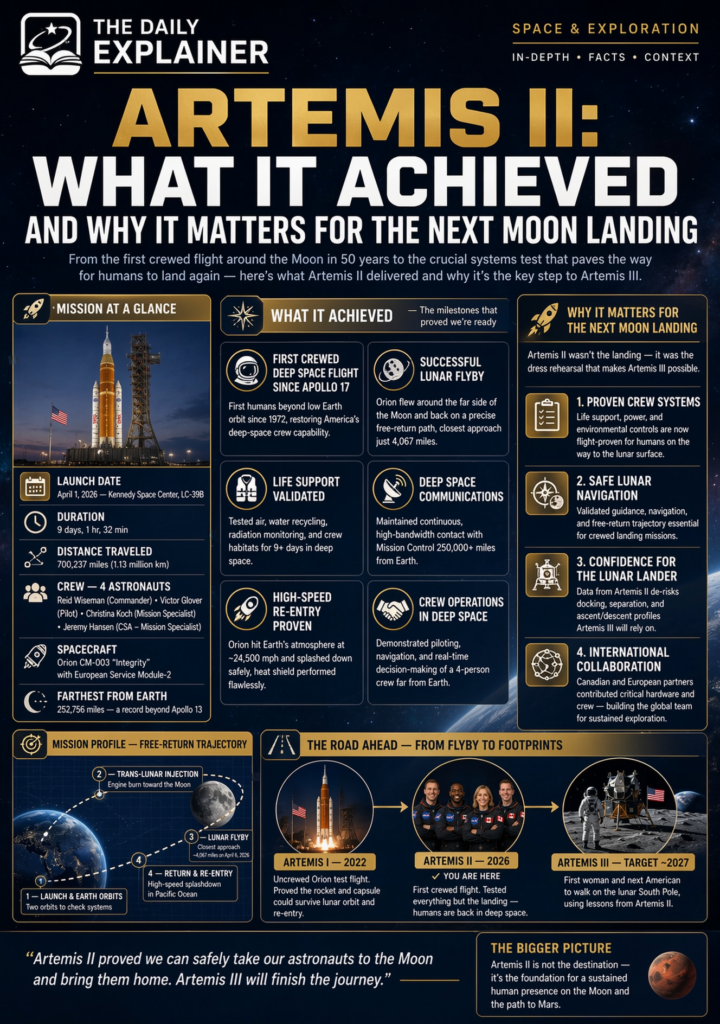
The Mission Profile
Artemis II followed a carefully choreographed sequence designed to test every critical system while minimizing risk.
Step 1: Launch and Ascent
On April 1, 2026, the SLS rocket lifted off from Launch Complex 39B at Kennedy Space Center. The four RS-25 engines and two five-segment solid rocket boosters generated 8.8 million pounds of thrust, accelerating the crew to orbital velocity in about eight minutes.
The ascent wasn’t without incident. Engineers had added four “strakes” to the SLS core stage after Artemis I revealed unexpectedly high vibrations near the solid rocket booster attach points. These fin-like structures modified airflow and reduced vibration—a fix validated through supercomputer modeling and wind tunnel testing.
Step 2: Earth Orbit Operations
Once in orbit, the crew spent several hours performing systems checks on Orion. They verified life support, communications, navigation, and the spacecraft’s ability to support them for the mission ahead. The mission was the first crewed flight of Orion, so every system was being tested in ways that only humans aboard could fully validate.
Step 3: Trans-Lunar Injection
After completing orbital checks, the Orion service module fired its main engine to break free of Earth orbit and set course for the Moon. This “trans-lunar injection” burn put the spacecraft on a free-return trajectory that would carry them around the Moon and back without requiring additional large burns.
Step 4: The Journey Out
The crew spent about three days traveling toward the Moon. During this outbound cruise, they conducted scientific observations, tested spacecraft systems, and communicated with mission control. They also made history by conducting a direct call with astronauts aboard the International Space Station—the first ship-to-ship communication of its kind between a deep space crew and an orbital outpost.
Step 5: The Lunar Flyby
April 6, 2026, was the mission’s centerpiece. Over a seven-hour period, the crew flew around the far side of the Moon, coming within about 4,067 miles of the surface.
The flyby sequence included several historic moments:
- Distance Record: At 12:56 p.m. CDT, Orion surpassed Apollo 13’s 1970 record for farthest human spaceflight. The crew ultimately reached 252,756 miles from Earth.
- Lunar Observations: The crew photographed and described features on the far side of the Moon, including impact craters, ancient lava flows, and surface fractures. These observations—made with human eyes and trained geologic expertise—will inform future landing site selection and lunar science.
- Earthset and Earthrise: As Orion traveled behind the Moon, the crew witnessed the Earth drop below the lunar horizon, then rise again as the spacecraft emerged on the other side.
- Solar Eclipse: The Moon passed in front of the Sun, creating a solar eclipse visible from the spacecraft. The crew analyzed the Sun’s corona, the outer atmosphere normally hidden by the Sun’s brightness.
- Meteoroid Flashes: The crew reported seeing six flashes of light on the unlit lunar surface—meteoroids impacting the Moon at thousands of miles per hour. Scientists will use these observations to refine estimates of impact rates.
- Communication Blackout: For about 40 minutes, the Moon blocked signals between Orion and Earth. The crew was out of contact with humanity—the first time in more than 50 years that humans had experienced such isolation.
Step 6: The Journey Home
After the flyby, Orion continued on its free-return trajectory, naturally pulled back toward Earth by gravity. The four-day return cruise gave the crew time to rest, conduct additional observations, and prepare for reentry.
Step 7: Reentry and Splashdown
On April 10, 2026, Orion entered Earth’s atmosphere at about 25,000 mph, experiencing temperatures up to 5,000 degrees Fahrenheit. The heat shield protected the crew during the most critical phase of the mission.
The reentry used a modified skip entry trajectory—changes informed by the Artemis I anomaly investigation. Telemetry and sensor data confirmed that the heat shield performed as expected.
Orion splashed down in the Pacific Ocean off the coast of San Diego. Recovery teams secured the capsule, opened the hatch, and assisted the astronauts out. The crew was flown by helicopter to a Navy recovery ship, while Orion was brought aboard for transport back to shore.
Why It’s Important
Validating the Systems That Will Land Humans on the Moon
Artemis II was fundamentally a test flight. Its primary purpose was to validate that the SLS rocket and Orion spacecraft could safely carry humans to the Moon and back. Every system—propulsion, life support, communications, navigation, thermal protection—was exercised in the actual deep space environment.
The heat shield validation was particularly critical. After Artemis I’s unexpected char loss, engineers needed real data from a crewed reentry to confirm their fixes worked. The successful splashdown provided that confirmation.
Setting Records and Inspiring the Next Generation
The distance record—252,756 miles from Earth—is more than a number. It’s a statement that humanity is pushing outward again after decades of restricting crewed missions to low Earth orbit. The Apollo 13 record stood for 56 years. Artemis II broke it by more than 4,000 miles.
The crew also represented firsts: Victor Glover became the first person of color to fly around the Moon. Christina Koch became the first woman. Jeremy Hansen, a Canadian, became the first non-American to travel to the Moon’s vicinity.
These milestones matter. They signal that space exploration is becoming more inclusive and more international—a trend that will only accelerate as the Artemis program progresses.
Building the Foundation for Artemis III and IV
Artemis II directly informs the next missions. The data collected—on spacecraft performance, crew operations, lunar observations, and heat shield behavior—will be used to refine plans for Artemis III, the Earth-orbit docking demonstration scheduled for 2027, and Artemis IV, the first crewed lunar landing since 1972, planned for 2028.
Key Takeaway: Artemis II wasn’t the destination. It was the critical test that makes the destination possible. Without it, NASA couldn’t confidently proceed to landing missions.
Sustainability in the Future
Hardware Reuse and Efficiency
The Artemis program is incorporating sustainability principles in ways Apollo never did. Components from the Artemis II Orion spacecraft are being reused for future missions. More than 250 components will support Artemis IV and V, saving cost and time.
The Orion stage adapter and launch vehicle stage adapter from Artemis III are being repurposed from structural test articles used before Artemis I. Engineers at Marshall Space Flight Center are inspecting and upgrading these structures to meet flight requirements—a rapid, efficient response to evolving mission needs.
Efficiency gains extend to ground systems. After Artemis II launched, washdowns were completed immediately to prevent corrosion, contributing to a nearly 50% reduction in turnaround time for the mobile launcher. This supports a more frequent launch cadence as the program accelerates.
International and Commercial Partnerships
Sustainability in space exploration isn’t just about hardware—it’s about building durable partnerships. Artemis is fundamentally international. The European Space Agency provides Orion’s service module, which supplies propulsion, power, and life support. ESA astronaut Luca Parmitano will fly on Artemis III as pilot—the first ESA astronaut assigned to an Artemis mission.
Commercial partners are equally essential. SpaceX and Blue Origin are developing human landing systems, bringing private-sector innovation and cost discipline to capabilities that would otherwise require massive government investment.
The Moon Base Vision
The ultimate sustainability goal is an enduring human presence on the Moon. NASA plans to establish a Moon Base on the lunar surface for long-term exploration. This facility would support repeated crewed missions, enable sustained scientific research, and serve as a proving ground for Mars technologies.
Achieving this requires developing technologies for lunar resource utilization—extracting water ice for propellant and life support, manufacturing materials from lunar regolith, and building infrastructure that can withstand the harsh lunar environment. These challenges are being addressed through NASA’s technology development programs and commercial partnerships.
Common Misconceptions
Misconception 1: “Artemis II landed on the Moon.”
It did not. Artemis II was a flyby mission—it traveled around the Moon but never entered lunar orbit or landed. The crew came within about 4,067 miles of the surface at closest approach. The first crewed landing will be Artemis IV, currently planned for 2028.
Misconception 2: “Artemis III will land on the Moon.”
Artemis III, scheduled for 2027, will not go to the Moon at all. It’s an Earth-orbit mission designed to test rendezvous and docking between Orion and commercial lander test articles. This critical demonstration reduces risk before the actual landing attempt on Artemis IV.
Misconception 3: “The heat shield problem was minor.”
The Artemis I heat shield anomaly was serious enough to delay Artemis II and require months of investigation. If the heat shield had failed during a crewed reentry, the results would have been catastrophic. The fact that Artemis I would have been safe with crew aboard is reassuring, but it doesn’t diminish the importance of understanding and fixing the issue.
Misconception 4: “The SLS is just an updated Saturn V.”
The SLS is a fundamentally different rocket, incorporating modern materials, avionics, and manufacturing techniques. It generates more thrust than the Saturn V and is designed for multiple mission profiles. However, it’s also more expensive per launch, which is why commercial alternatives are being developed for cargo and eventually crew transport.
Misconception 5: “We’ve been to the Moon before, so this is easy.”
The Apollo program achieved incredible things with 1960s technology, but it was unsustainable and enormously expensive. Artemis aims to establish a lasting presence, which requires new technologies, new partnerships, and new approaches. The challenges are different, not necessarily easier.
Misconception 6: “The crew was in serious danger the whole time.”
Artemis II was a test flight, and test flights carry inherent risk. But the mission was meticulously planned, with multiple abort options and safety systems. The free-return trajectory meant that even if the main engine failed, gravity would still bring the crew home. The crew’s training and the spacecraft’s design were focused on managing risk, not eliminating it.
Recent Developments
Artemis III Crew Announcement (June 2026)
NASA announced the Artemis III crew on June 9, 2026. The four astronauts are:
- Randy Bresnik (NASA), commander
- Luca Parmitano (ESA), pilot
- Andre Douglas (NASA), mission specialist
- Frank Rubio (NASA), mission specialist
Bob Hines was named as backup crew.
The crew brings diverse experience. Bresnik is a former ISS commander with over 7,000 flight hours. Parmitano survived a near-drowning during a 2013 spacewalk when his helmet filled with water—an experience that tested his composure under extreme pressure. Rubio holds the record for the longest single NASA spaceflight at 371 days. Douglas has not yet flown in space but served as a backup for Artemis II.
Artemis III Mission Profile Confirmed (May 2026)
NASA outlined the Artemis III mission plans in May 2026. The mission will:
- Launch on SLS with a non-propulsive spacer replacing the upper stage
- Operate in low Earth orbit for about two weeks
- Demonstrate rendezvous and docking between Orion and test articles of both the SpaceX and Blue Origin landers
- Test an upgraded heat shield during reentry
- Potentially have astronauts enter at least one lander test article
The mission is designed to reduce risk for Artemis IV by validating critical operations before committing to a lunar landing.
Artemis III Hardware Progress (August 2026)
By August 2026, NASA had integrated the Orion crew and service modules for Artemis III at Kennedy Space Center. The combined spacecraft was powered up for the first time, and integrated testing began.
SLS hardware processing also advanced. Solid rocket booster segments were stacked in the Vehicle Assembly Building. The final RS-25 engine was delivered from Stennis Space Center. The spacer for the upper stage completed its final friction stir welds at Marshall Space Flight Center.
Congressional Space Medal of Honor (August 2026)
President Trump awarded the Congressional Space Medal of Honor to the Artemis II crew on August 27, 2026—the first such awards since 2023. The medal, authorized by Congress in 1969, recognizes astronauts who distinguish themselves through exceptionally brave and meritorious efforts.
Artemis IV Timeline
Artemis IV remains scheduled for 2028. This will be the first crewed lunar landing since Apollo 17 in 1972, targeting the lunar South Pole. The mission will use one of the commercial human landing systems to carry astronauts from Orion in lunar orbit to the surface and back.
Success Stories
Case Study: The Heat Shield Fix
The Artemis II heat shield story is a success story of problem-solving under pressure.
The Problem: Artemis I returned with unexpected char loss on its heat shield. Chunks of Avcoat were missing, and cracking was evident. The cause was unknown.
The Investigation: NASA formed an Anomaly Response Team. They analyzed recovered hardware, conducted arc jet testing at Ames Research Center, performed laser testing at Wright-Patterson Air Force Base, and ran wind tunnel and permeability tests. They sent samples to Marshall Space Flight Center for detailed analysis.
The Root Cause: The Avcoat wasn’t porous enough. During the skip entry, gases generated by ablation couldn’t vent. Pressure built up, causing cracks and char loss. The high heating rates tested on the ground before Artemis I didn’t reproduce this behavior—they allowed permeable char to form and vent properly. The actual flight had lower heating rates, slower char formation, and trapped gases.
The Solution: NASA determined that more permeable areas of the Artemis I heat shield did not experience char loss. They changed the entry trajectory for Artemis II and developed a better understanding of the material’s behavior. Ground testing facilities were enhanced to reproduce flight conditions more accurately.
The Validation: Artemis II’s reentry confirmed the fixes worked. Sensor data showed the heat shield performed as expected. The crew splashed down safely.
This case study demonstrates how NASA responds to anomalies: systematically, rigorously, and with a focus on crew safety above all else.
Case Study: The Distance Record
Surpassing Apollo 13’s distance record was a symbolic and emotional milestone.
Apollo 13’s crew—Jim Lovell, Jack Swigert, and Fred Haise—set the record in 1970 while trying to return safely after an oxygen tank explosion. Their free-return trajectory around the Moon carried them 248,655 miles from Earth.
Artemis II’s crew surpassed that record by more than 4,000 miles, reaching 252,756 miles. The moment was marked with emotional remarks from the crew. Jeremy Hansen said the record should “challenge this generation and the next, to make sure this record is not long-lived”—a call for continued exploration beyond even Artemis II’s achievements.
The crew also proposed naming two lunar craters. One would honor their spacecraft, “Integrity.” The other would honor Carroll, the late wife of commander Reid Wiseman, who died of cancer. Hansen’s voice broke with emotion as he made the proposal. The names will be submitted to the International Astronomical Union for formal approval.
Real-Life Examples
The Earthset and Earthrise
During the lunar flyby, the crew witnessed two phenomena that only humans traveling around the Moon can experience: Earthset and Earthrise.
As Orion traveled behind the Moon, the Earth appeared to drop below the lunar horizon—an “Earthset.” Then, as the spacecraft emerged on the far side, the Earth rose above the horizon—an “Earthrise.” These moments, captured in photographs and video, provide a perspective on our planet that only a handful of humans have ever experienced.
The crew described the view with emotion. Victor Glover said, “Humans probably have not evolved to see what we’re seeing. It is truly hard to describe”.
The Solar Eclipse from Deep Space
The alignment of the spacecraft, Moon, and Sun created a solar eclipse visible from Orion. The crew saw a mostly darkened Moon with the Sun’s corona blazing around its edge.
This was more than a spectacular view. The crew analyzed the corona—the Sun’s outer atmosphere—which is normally hidden by the Sun’s brightness. These observations contribute to understanding the solar wind and space weather, which affects Earth’s technology and astronauts’ safety.
Meteoroid Impact Flashes
The crew reported seeing six flashes of light on the unlit portion of the Moon. These were meteoroids—small pieces of space debris—impacting the lunar surface at thousands of miles per hour.
Scientists are analyzing the observations to refine estimates of impact rates. Comparing the crew’s reports with imagery and amateur astronomer observations will help determine the timing and locations of these events. Understanding impact rates is important for designing lunar habitats and equipment that can withstand the micrometeoroid environment.
The Communication Blackout
For about 40 minutes, the Moon blocked all signals between Orion and Earth. The crew was completely out of contact with humanity—the first time in more than 50 years that humans had experienced such isolation.
The blackout was expected and planned. But it served as a reminder of the distances involved and the challenges of deep space communication. Future missions to Mars will face even longer blackouts, requiring astronauts to operate autonomously for extended periods.
Conclusion and Key Takeaways
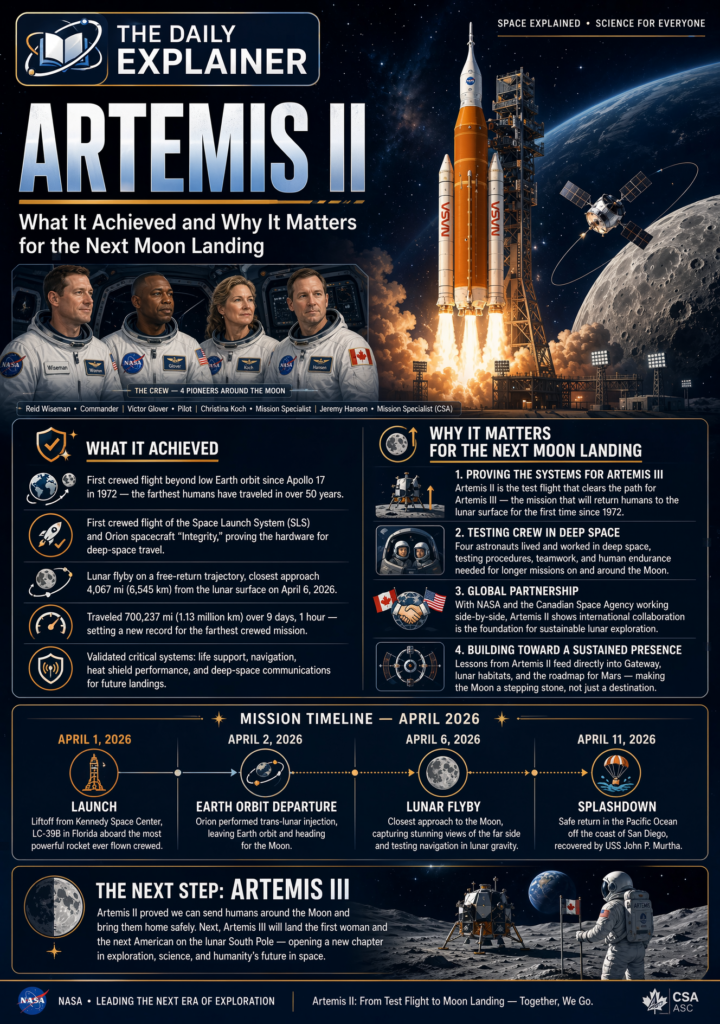
Artemis II was a triumph of engineering, human endurance, and international collaboration. It validated the systems that will carry humans back to the Moon, set a new distance record, and collected scientific data that will inform future exploration.
Key Takeaway 1: Artemis II successfully tested the SLS rocket and Orion spacecraft with crew aboard, including a critical validation of the heat shield after the Artemis I anomaly.
Key Takeaway 2: The crew traveled 252,756 miles from Earth, breaking a 56-year-old record and becoming the first humans to fly around the Moon since 1972.
Key Takeaway 3: The mission collected valuable scientific data on lunar geology, meteoroid impacts, and the solar corona, while demonstrating the human capacity for observation and description.
Key Takeaway 4: Artemis III, scheduled for 2027, will test rendezvous and docking in Earth orbit. Artemis IV, planned for 2028, will land astronauts on the lunar South Pole.
Key Takeaway 5: The Artemis program represents a new model of space exploration—international, commercial, and sustainable—that aims to establish a lasting human presence beyond Earth.
For curious beginners, Artemis II is proof that humanity is still capable of audacious achievements. For professionals, it’s a case study in risk management, anomaly resolution, and program execution that will inform future missions for years to come.
Frequently Asked Questions (FAQ’s)
Q1: What was the primary goal of Artemis II?
Artemis II was a test flight to validate the SLS rocket and Orion spacecraft with crew aboard before committing to lunar landing missions. It demonstrated that the systems could safely carry humans to the Moon and back.
Q2: Did Artemis II land on the Moon?
No. Artemis II was a flyby mission. The crew traveled around the Moon but never entered lunar orbit or landed. The closest approach was about 4,067 miles above the surface.
Q3: How far did Artemis II travel from Earth?
The crew reached 252,756 miles from Earth, surpassing Apollo 13’s 1970 record of 248,655 miles.
Q4: How long was the Artemis II mission?
The mission lasted approximately 10 days, launching April 1, 2026, and splashing down April 10, 2026.
Q5: Who were the Artemis II astronauts?
NASA astronauts Reid Wiseman (commander), Victor Glover (pilot), and Christina Koch (mission specialist), and CSA astronaut Jeremy Hansen (mission specialist).
Q6: What was the heat shield problem?
Artemis I’s heat shield experienced unexpected char loss during reentry. Gases generated inside the Avcoat material couldn’t vent properly, causing pressure buildup, cracking, and char loss.
Q7: How was the heat shield problem fixed for Artemis II?
NASA changed the reentry trajectory to avoid the conditions that caused the problem, enhanced ground testing facilities to reproduce flight conditions, and developed a better understanding of Avcoat’s behavior.
Q8: Did the heat shield work on Artemis II?
Yes. Sensor data confirmed the heat shield performed as expected during reentry. The crew splashed down safely.
Q9: What is a skip entry?
A skip entry is a reentry technique where the spacecraft dips into the atmosphere, uses drag to slow down, then skips back out before reentering for final descent. It extends range and precision but creates unique heating conditions.
Q10: What scientific observations did the crew make?
The crew photographed lunar terrain, described geologic features, observed Earthset and Earthrise, witnessed a solar eclipse, and reported six meteoroid impact flashes.
Q11: What is Artemis III?
Artemis III is a planned Earth-orbit mission in 2027 that will test rendezvous and docking between Orion and commercial lander test articles from SpaceX and Blue Origin.
Q12: Will Artemis III go to the Moon?
No. Artemis III will operate in low Earth orbit. It’s a test flight to reduce risk before the actual lunar landing on Artemis IV.
Q13: Who is on the Artemis III crew?
Randy Bresnik (NASA, commander), Luca Parmitano (ESA, pilot), Andre Douglas (NASA), and Frank Rubio (NASA). Bob Hines is backup.
Q14: When will humans land on the Moon again?
Artemis IV, currently planned for 2028, will be the first crewed lunar landing since Apollo 17 in 1972. It will target the lunar South Pole.
Q15: What is the lunar South Pole and why is it important?
The lunar South Pole contains permanently shadowed craters that may hold water ice—a critical resource for propellant, life support, and radiation shielding. It’s also scientifically interesting for understanding lunar history.
Q16: What are the commercial landers?
SpaceX is developing a lunar version of Starship, and Blue Origin is developing Blue Moon. Both will serve as Human Landing Systems, carrying astronauts from lunar orbit to the surface.
Q17: What is the European Service Module?
The European Service Module, built by ESA, provides propulsion, power, thermal control, and life support consumables for Orion. ESA astronaut Luca Parmitano will fly on Artemis III as pilot.
Q18: What were the crew’s “firsts”?
Victor Glover was the first person of color to fly around the Moon. Christina Koch was the first woman. Jeremy Hansen was the first non-American.
Q19: What craters did the crew name?
The crew proposed naming two craters: “Integrity” (after their spacecraft) and “Carroll” (after Reid Wiseman’s late wife). The names will be submitted to the International Astronomical Union.
Q20: What is the free-return trajectory?
A free-return trajectory uses the Moon’s gravity to naturally bring the spacecraft back to Earth without requiring large engine burns. It provides a natural abort option if systems fail.
Q21: What is the Congressional Space Medal of Honor?
It’s an award authorized by Congress in 1969 to recognize astronauts who distinguish themselves through exceptionally brave and meritorious efforts. The Artemis II crew received it in August 2026.
Q22: How does Artemis differ from Apollo?
Apollo was a Cold War competition focused on “flags and footprints.” Artemis aims to establish a sustainable presence, with international and commercial partnerships, resource utilization, and preparation for Mars.
Q23: What’s next after Artemis IV?
NASA plans increasingly complex missions to establish a Moon Base and prepare for crewed Mars missions. The Artemis program is designed as a stepping stone to Mars.
About the Author
Sana Ullah Khan Kakar is a science writer specializing in human spaceflight and exploration. With over a decade of experience covering NASA missions from the Space Shuttle era through Artemis, he has reported from Kennedy Space Center, Johnson Space Center, and launch events around the world. .
This article was fact-checked against NASA, ESA, and CSA sources. All statistics reflect information available as of late 2026.
Free Resources

For Beginners:
- NASA Artemis Program (nasa.gov/artemis) — Official mission updates and educational materials
- “Artemis II Mission Milestones” (NASA) — Image and video recap of the historic mission
- NASA’s Artemis III Crew page — Meet the astronauts preparing for the next mission
For Deeper Learning:
- NASA Technical Reports Server (ntrs.nasa.gov) — Technical papers on heat shield investigation
- “Artemis II Flight Day 6” NASA blog — Detailed account of the lunar flyby
- NASA’s Artemis III Mission Plans — Technical overview of the Earth-orbit demonstration
For Real-Time Updates:
- NASA Artemis Blog — Continuous mission updates
- NASA Johnson Space Center — Mission control and training news
- International Astronomical Union — Lunar feature naming updates
Discussion
What do you think was the most significant achievement of Artemis II? Was it the distance record, the heat shield validation, or the scientific observations?
If you could ask the Artemis II crew one question about their experience, what would it be?
What excites you most about Artemis III and IV—the Earth-orbit docking demonstration or the first lunar landing since 1972?
Share your thoughts below. For more space science explainers, visit our Explained section and browse our blog. Have questions or topic suggestions? Contact us. For breaking space news, check our Breaking News category. Review our Terms of Service and explore our Global Affairs & Politics coverage for context on international space cooperation.
For more resources on science communication and research, visit Sherakat Network’s Resources and Blog. Connect with Sherakat Network for collaboration opportunities. If you’re building an online presence, see their 2026 guide to starting an online business. Learn more about WorldClassBlogs and explore their Blog, Our Focus, and Nonprofit Hub. For SEO insights, visit Sherakat Network’s SEO category.
About The Author