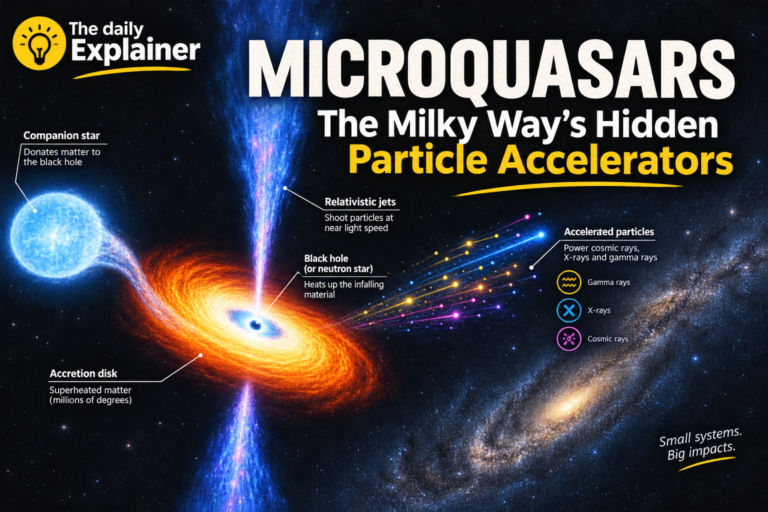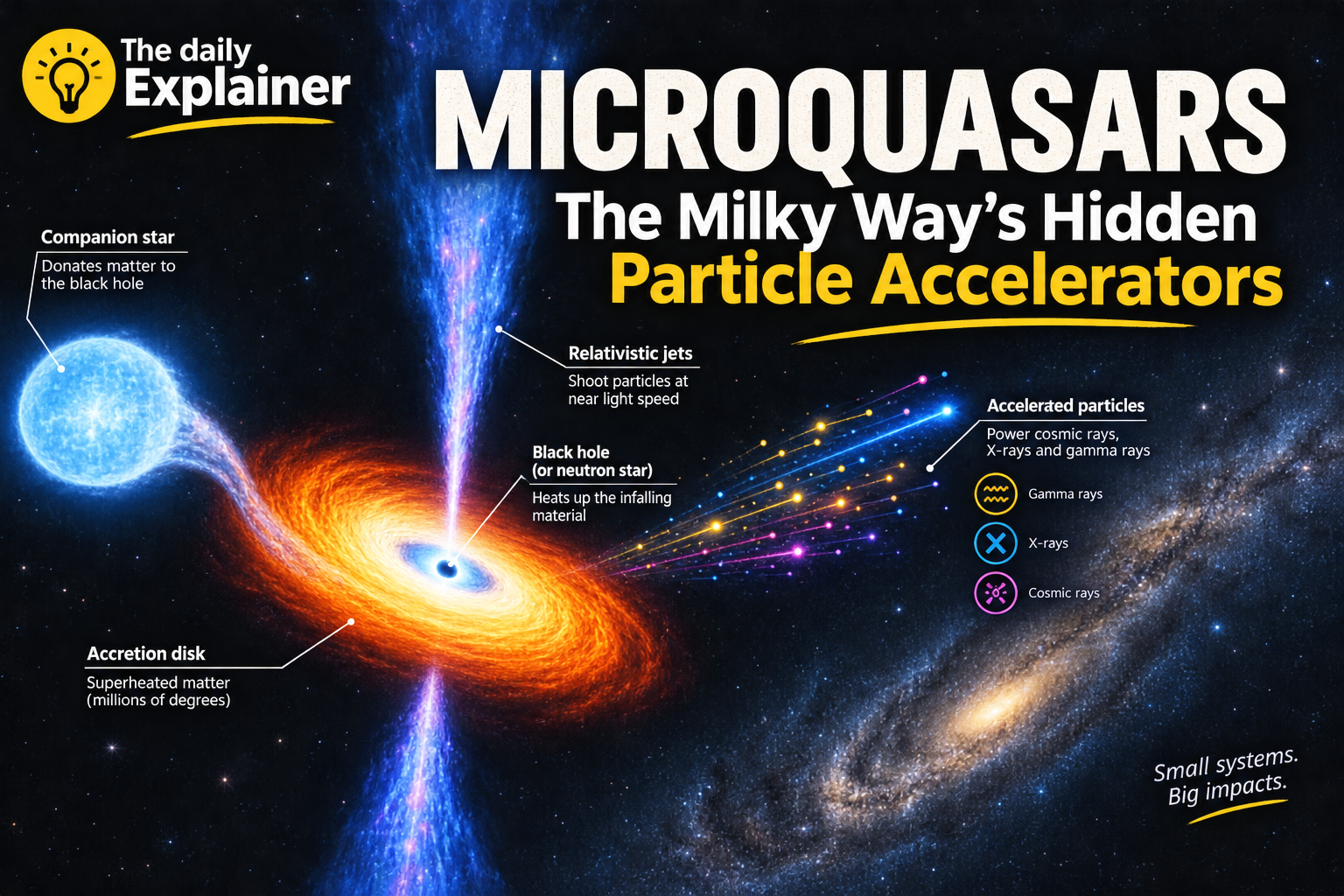
Microquasars are binary systems where a black hole's jets can accelerate particles to energies exceeding 10 PeV—beyond the cosmic ray knee.
Introduction: Why This Matters
In my experience covering astrophysics, there’s a particular kind of discovery that changes how you see the night sky. Not the kind that adds a new object to a catalog, but the kind that rewrites the rules about what’s possible. The recent identification of microquasars as Galactic PeVatrons—particle accelerators capable of pushing protons to energies exceeding 10 peta-electron-volts—is exactly that kind of discovery.
Here’s the scale we’re talking about: one peta-electron-volt is roughly the kinetic energy of a flying mosquito. That sounds trivial until you realize it’s crammed into a single subatomic particle. It’s over a thousand times the energy achievable at the Large Hadron Collider, the most powerful machine humanity has ever built. And these particles are being accelerated not by some exotic physics, but by black holes right here in our own galaxy, feeding on companion stars and firing jets of plasma across tens of light-years.
Key Takeaway: For decades, scientists believed supernova remnants were the primary sources of Galactic cosmic rays. New observations from China’s LHAASO observatory have now revealed that microquasars—stellar-mass black holes with relativistic jets—are powerful enough to accelerate particles beyond the “knee” of the cosmic ray spectrum, solving a mystery that has persisted for nearly 70 years.
This matters because it connects two of astrophysics’ most enduring puzzles: the origin of cosmic rays, and the behavior of matter under the most extreme gravitational conditions. It also opens a new window for multi-messenger astronomy, with potential implications for neutrino detection and our understanding of black hole jets throughout the universe.
Background and Context
The Cosmic Ray Mystery
Cosmic rays are charged particles—mostly protons and atomic nuclei—that rain down on Earth from space. They were discovered in 1912 by Victor Hess, who took a balloon to high altitude and found that ionization increased rather than decreased, proving the radiation came from above. But over a century later, we still don’t fully understand where they come from or how they’re accelerated.
The challenge is that cosmic rays are charged. Their paths through the galaxy’s magnetic field are curved and tangled, so by the time they reach Earth, they point back to nowhere in particular. Unlike photons, which travel in straight lines from their sources, cosmic rays arrive without a return address.
What we can measure is their energy spectrum—how many particles arrive at each energy. And that spectrum holds a crucial clue: a sharp steepening around 3 PeV, discovered in the late 1950s. This feature, called the “knee” because of its shape on a graph, marks where the cosmic ray flux drops off dramatically. For decades, the leading explanation was that supernova remnants—the expanding debris of exploded stars—were the accelerators, and the knee represented their maximum energy limit .
The Supernova Remnant Problem
Supernova remnants are excellent particle accelerators. Their shock waves can accelerate particles through a process called diffusive shock acceleration, and they’re numerous enough to supply the bulk of Galactic cosmic rays at lower energies. But there’s a problem: both theoretical models and observations suggest they struggle to reach the energies needed to explain the knee .
This left astrophysicists with a puzzle. If supernova remnants can’t do it, what can?
Enter the Microquasar
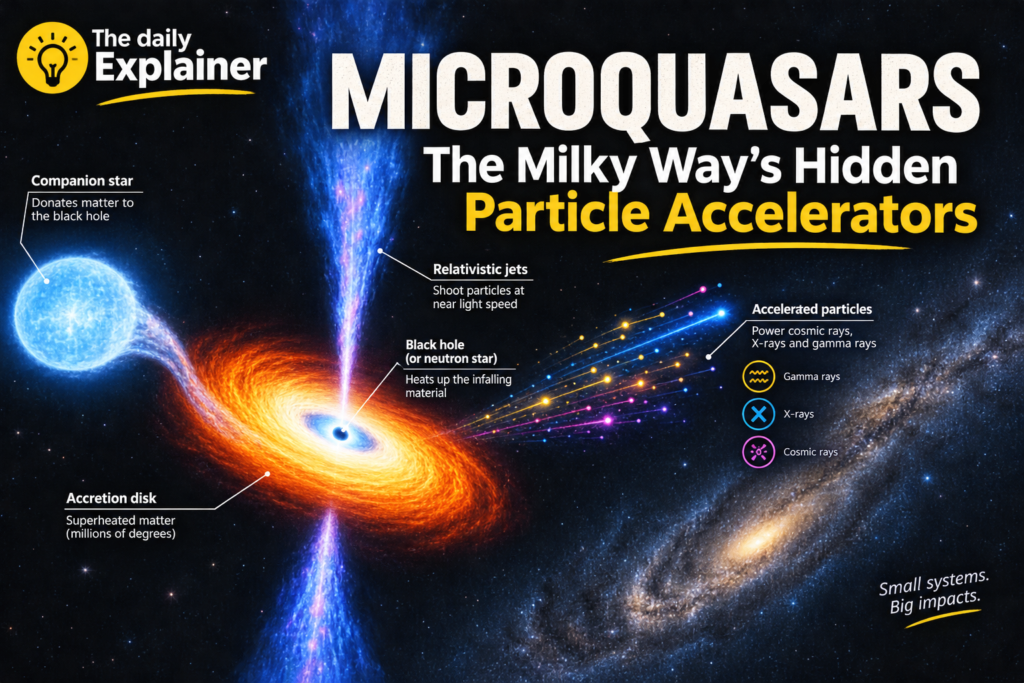
Microquasars are the smaller, Galactic cousins of quasars. They’re binary systems where a stellar-mass black hole (or sometimes a neutron star) accretes matter from a companion star. As material falls inward, it forms an accretion disk, heats up to millions of degrees, and generates intense X-ray emission. Some of the gravitational energy is channeled into powerful, collimated jets of plasma that shoot outward at significant fractions of the speed of light .
These jets are miniature versions of the enormous jets seen in active galactic nuclei, which are powered by supermassive black holes. The similarity in phenomenology—accretion disk, jets, variability—is why they’re called “micro” quasars .
For years, microquasars were considered interesting but not necessarily major cosmic ray sources. The first hint of very-high-energy gamma rays came from LS 5039, detected by H.E.S.S. in 2006, and later from SS 433 by HAWC and H.E.S.S. . But these detections were at TeV energies, not the PeV energies needed to explain the knee.
That changed with LHAASO.
Key Concepts Defined
Before going deeper, let’s establish clear definitions for the technical concepts in this article.
Microquasar: A binary star system containing a compact object (usually a black hole) that is accreting matter from its companion and launching relativistic jets. Over 20 microquasars have been identified in the Milky Way.
PeVatron: A cosmic particle accelerator capable of accelerating particles to peta-electron-volt (10¹⁵ eV) energies or beyond.
Cosmic Ray “Knee”: A steepening in the cosmic ray energy spectrum around 3 PeV, first observed in the late 1950s. It is believed to mark the maximum energy achievable by Galactic cosmic ray accelerators .
LHAASO: The Large High Altitude Air Shower Observatory, located at 4,410 meters altitude in Daocheng, Sichuan Province, China. It is the world’s most sensitive instrument for detecting ultra-high-energy gamma rays and measuring cosmic ray composition .
Hadronic vs. Leptonic Emission: Two competing explanations for gamma-ray production in microquasars. In hadronic scenarios, protons (or heavier nuclei) are accelerated and interact with ambient matter or radiation, producing gamma rays and neutrinos. In leptonic scenarios, electrons are accelerated and produce gamma rays through inverse Compton scattering or synchrotron radiation.
Inverse Compton Scattering: A process where low-energy photons gain energy by scattering off high-energy electrons, producing gamma rays.
Pulsar Wind Nebula (PWN): A nebula powered by the spin-down energy of a pulsar. The W50 nebula, surrounding SS 433, is a related structure powered by the microquasar’s jets .
Multi-Messenger Astronomy: Observing the same astrophysical source with different “messengers”—electromagnetic radiation (photons), cosmic rays, neutrinos, and gravitational waves—to gain a complete picture.
How It Works: Step-by-Step Breakdown
The Microquasar Engine
Understanding how microquasars accelerate particles requires following the flow of matter and energy through the system.
Step 1: Accretion
Matter from the companion star falls toward the black hole. Conservation of angular momentum causes it to form an accretion disk rather than falling straight in. Friction and magnetic stresses within the disk cause the material to heat up, releasing enormous amounts of energy as X-rays.
Step 2: Jet Launching
A fraction of the accreted material is diverted into jets. The exact mechanism is still debated, but magnetic fields threading the accretion disk are thought to play a central role. The jets are collimated—focused into narrow beams—and can reach speeds approaching the speed of light.
Step 3: Particle Acceleration
Within the jets, particles are accelerated to extreme energies. Several mechanisms have been proposed:
- Diffusive Shock Acceleration: If the jet contains internal shocks (from variations in ejection speed or interaction with the surrounding medium), particles can bounce back and forth across the shock front, gaining energy with each crossing.
- Shear Acceleration: The velocity difference between the fast-moving jet and slower surrounding material creates shear layers where particles can be accelerated.
- Magnetic Reconnection: Tangled magnetic field lines can snap and reconnect, releasing energy that accelerates particles.
Step 4: Interaction and Emission
Once accelerated, high-energy particles interact with their environment:
- Hadronic Interactions: Protons collide with ambient gas (from the companion star’s wind or the interstellar medium), producing pions. Neutral pions decay into gamma rays; charged pions decay into neutrinos and muons .
- Leptonic Interactions: Electrons scatter off low-energy photons (from the companion star, accretion disk, or cosmic microwave background) via inverse Compton scattering, boosting them to gamma-ray energies.
Step 5: Gamma-Ray Detection
The gamma rays travel in straight lines to Earth, where they are detected by instruments like LHAASO. By measuring their energy and arrival direction, astronomers can infer the properties of the parent particles and the acceleration environment.
The LHAASO Breakthrough
LHAASO’s advantage lies in its combination of huge effective area (over 1 km²) and sensitivity to ultra-high-energy gamma rays. In a systematic survey of known microquasars, the collaboration detected ultra-high-energy gamma-ray emission from five sources: SS 433, V4641 Sgr, GRS 1915+105, MAXI J1820+070, and Cygnus X-1 .
The detection of V4641 Sgr was particularly striking. Its gamma-ray spectrum extends to 0.8 PeV, requiring parent particles with energies exceeding 10 PeV—well beyond the knee . H.E.S.S. follow-up observations confirmed multi-TeV emission and found that the spectral energy distribution peaks at approximately 100 TeV, making V4641 Sgr the most extreme Galactic particle accelerator identified to date .
SS 433 provided a different kind of evidence. Below 100 TeV, its gamma-ray emission coincides with the eastern and western lobes of its jets. Above 100 TeV, the emission becomes extended and spatially overlaps with a giant atomic cloud near the jet . This morphology strongly suggests a hadronic origin: protons accelerated in the jet are escaping and colliding with the cloud, producing gamma rays through proton-proton interactions.
Why It’s Important
Solving the Knee Mystery
The knee of the cosmic ray spectrum has been a puzzle since the late 1950s. LHAASO’s precise measurement of the proton spectrum revealed something unexpected: instead of a simple steepening, there’s a “high-energy component”—a hump-like structure that requires a separate population of sources with higher acceleration limits than supernova remnants .
Microquasars fit this requirement perfectly. They are numerous enough (over 20 known, with an estimated population of about 10 active at any given time ) to supply the observed flux, and their jets can reach the necessary energies.
“This is a major step forward,” said Cao Zhen, chief scientist of LHAASO. “For the first time globally, scientists have observed a type of source that can truly provide an explanation for the cosmic rays at the ‘knee’ region” .
Opening the Multi-Messenger Window
If microquasars are accelerating protons, they should also produce neutrinos. The same proton-proton interactions that produce gamma rays also produce charged pions, which decay into neutrinos. These neutrinos would travel in straight lines from the source, providing a complementary view to gamma rays.
The 2026 paper by Carpio et al. explored neutrino emission from SS 433, V4641 Sgr, and GRS 1915+105, finding that V4641 Sgr has the best prospects for detection with next-generation neutrino telescopes . This makes microquasars prime targets for multi-messenger campaigns combining gamma-ray, neutrino, and potentially gravitational wave observations.
Understanding Black Hole Jets
Microquasars are natural laboratories for studying relativistic jets. Because they’re much closer than active galactic nuclei, astronomers can observe their jets in detail over human timescales. The finding that these jets can accelerate particles to PeV energies has implications for understanding jet physics across the mass scale—from stellar-mass black holes to the supermassive monsters at the centers of galaxies.
Sustainability in the Future
The Observatory Ecosystem
LHAASO’s success depends on a broader ecosystem of observatories working together. The discovery of microquasar PeVatrons involved:
- LHAASO: Detection of ultra-high-energy gamma rays
- H.E.S.S. and HAWC: Confirmation at lower energies and morphological studies
- Chandra: X-ray observations of jet knots and proper motions
- Fermi-LAT: Multi-GeV observations
This multi-wavelength, multi-instrument approach will continue to be essential as the field moves forward.
Theoretical Challenges
The observations have raised new questions. H.E.S.S. observations of V4641 Sgr found no dense gas that could serve as a target for hadronic interactions, placing stringent constraints on hadronic models . This has led some researchers to favor leptonic explanations for V4641 Sgr, even as SS 433 provides strong evidence for hadronic processes. Resolving this tension will require more detailed modeling and additional observations.
Next-Generation Instruments
Future facilities will build on these discoveries:
- CTA (Cherenkov Telescope Array): Will provide higher sensitivity and resolution at TeV energies, enabling detailed studies of microquasar jets.
- IceCube-Gen2 and KM3NeT: Next-generation neutrino telescopes with improved sensitivity to astrophysical sources.
- Einstein Probe and future X-ray missions: Will provide complementary X-ray monitoring to trigger multi-wavelength campaigns.
Open Data and Collaboration
LHAASO’s data policy and international collaborations ensure that discoveries are accessible to the global community. The collaboration includes researchers from China, Italy, and other countries, and publications are made freely available. This open approach accelerates progress and builds trust in the results.
Common Misconceptions
Misconception 1: “Microquasars are just small quasars.”
While they share phenomenological similarities—accretion disks, jets, variability—microquasars and quasars are fundamentally different. Microquasars contain stellar-mass black holes (a few to tens of solar masses); quasars contain supermassive black holes (millions to billions of solar masses). The physics scales differently, and the environments are distinct. The “micro” prefix refers to the smaller mass and size, not to a direct analogy .
Misconception 2: “The knee is a sharp cutoff.”
The knee is a steepening, not a cutoff. Cosmic rays exist at energies above the knee; there are just fewer of them. The spectrum softens (becomes steeper) around 3 PeV, then hardens again at higher energies (the “ankle” around 4 EeV, where extragalactic sources begin to dominate) .
Misconception 3: “LHAASO detected cosmic rays directly from microquasars.”
LHAASO detects gamma rays, not cosmic rays. The gamma rays are produced by cosmic rays interacting with matter or radiation near the source. The cosmic rays themselves are deflected by magnetic fields and cannot be traced back to their sources. The gamma-ray observations provide indirect evidence for cosmic ray acceleration.
Misconception 4: “The hadronic interpretation is settled.”
It’s not. While SS 433 shows strong evidence for hadronic processes (the giant atomic cloud interaction), V4641 Sgr’s lack of dense gas makes hadronic explanations challenging . The field is actively debating the relative importance of hadronic and leptonic processes in different sources.
Misconception 5: “Microquasars are rare.”
Over 20 microquasars are known in the Milky Way, and the population is estimated to be much larger. Many are likely obscured or in quiescent states, making them difficult to detect . The search for “obscured” microquasars is an active area of research.
Recent Developments
The LHAASO Discovery Papers (November 2025)
The LHAASO collaboration published two papers on November 16, 2025—one in National Science Review and one in Science Bulletin—announcing the detection of ultra-high-energy gamma rays from five microquasars and the precise measurement of the proton spectrum in the knee region . These papers represent the culmination of years of observation and analysis.
H.E.S.S. Constraints on V4641 Sgr (2026)
The H.E.S.S. collaboration published detailed observations of V4641 Sgr in Astronomy & Astrophysics in 2026. Using approximately 100 hours of data, they resolved the gamma-ray emission spatially and spectrally, finding an elongated structure with a power-law spectrum. Their conclusion favored a leptonic origin, though they did not exclude hadron acceleration .
Theoretical Modeling Advances
Several 2026 papers have explored the theoretical implications:
- Carpio et al. (2026) modeled multimessenger emission from SS 433, V4641 Sgr, and GRS 1915+105, estimating neutrino fluxes and detectability .
- A 2026 paper on microquasar jet-cocoon systems proposed shear acceleration as a mechanism for reaching PeV energies .
- A 2026 paper on microquasar remnants explored how “dead” microquasars could still produce observable PeV gamma rays through hadronic interactions in the surrounding medium .
Search for Obscured Microquasars (2026)
A COSPAR 2026 presentation described a systematic search for heavily obscured microquasar systems using the Stephenson catalog of reddened stars. The team identified a candidate spatially consistent with a LHAASO PeVatron, suggesting that some cosmic ray sources may be hidden from view .
Success Stories
Case Study: SS 433 and the Giant Atomic Cloud
SS 433 is the most studied microquasar in the Galaxy. Located about 18,000 light-years away, it’s notable for its jets, which are precessing (wobbling) with a period of about 162 days. The jets power the W50 nebula, a large radio-emitting structure.
LHAASO’s observations revealed something remarkable. Below 100 TeV, the gamma-ray emission comes from two point-like sources coinciding with the eastern and western jet lobes. Above 100 TeV, the emission becomes extended and overlaps with a giant atomic cloud .
The interpretation: protons accelerated in the jets are escaping and interacting with the cloud. The gamma rays we see at the highest energies are secondary products of these proton-proton collisions. This is direct evidence for hadronic acceleration in a microquasar.
The energetics are staggering. The proton luminosity required to explain the gamma-ray emission is about 10³⁸ erg/s—equivalent to the energy released by 400 trillion of the most powerful hydrogen bombs every second .
Case Study: V4641 Sgr, the Most Extreme Accelerator
V4641 Sgr is a low-mass X-ray binary about 6.2 kiloparsecs away. It’s famous for a dramatic outburst in 1999, when it briefly became one of the brightest X-ray sources in the sky .
LHAASO detected gamma-ray emission extending to 0.8 PeV, requiring parent particles with energies exceeding 10 PeV—making it a “Super-PeVatron” . H.E.S.S. follow-up observations found that the emission is extended and elongated, with a spectral energy distribution peaking at about 100 TeV .
The puzzle: there’s no dense gas around V4641 Sgr to serve as a target for hadronic interactions. H.E.S.S. placed an upper limit of 0.2 cm⁻³ on the gas density . This favors a leptonic explanation, but requires an unusually hard proton spectrum if hadronic processes are involved. The source remains an enigma, and continued observations may resolve the question.
Real-Life Examples
The W50 Nebula: A Cosmic Laboratory
The W50 nebula, surrounding SS 433, is one of the largest and most studied microquasar-powered nebulae. It’s about 100 light-years across and shows evidence of interaction between the jets and the surrounding interstellar medium.
Chandra observations of X-ray knots in the W50 lobes found no significant proper motion over a 20-year baseline, placing an upper limit on the knot speed of about 0.02c . This suggests the knots are standing shocks—recollimation shocks where the jet pressure balances the external pressure. The upstream speed in the shock rest frame could reach several tens of thousands of km/s, indicating highly efficient particle acceleration approaching the Bohm limit .
The “Dark Accelerator” Hypothesis
Not all microquasar PeVatrons may be visible as such. If a microquasar’s jets have shut off, the accelerated protons may still be diffusing through the interstellar medium, producing gamma rays through interactions with ambient gas. These “dark accelerators” would be difficult to identify at other wavelengths .
The search for obscured or remnant microquasars is an emerging field, with the potential to find cosmic ray sources that have been hiding in plain sight.
Conclusion and Key Takeaways
The identification of microquasars as Galactic PeVatrons is one of the most significant advances in high-energy astrophysics in decades. It solves a long-standing puzzle about the origin of cosmic rays at the knee, opens new avenues for multi-messenger astronomy, and provides a laboratory for studying particle acceleration in relativistic jets.
Key Takeaway 1: LHAASO detected ultra-high-energy gamma rays from five microquasars, proving that these black hole systems can accelerate particles beyond the knee of the cosmic ray spectrum.
Key Takeaway 2: SS 433 shows strong evidence for hadronic acceleration, with protons interacting with a giant atomic cloud to produce gamma rays. V4641 Sgr is the most extreme accelerator, with gamma rays reaching 0.8 PeV.
Key Takeaway 3: The knee of the cosmic ray spectrum is not a simple cutoff but a complex feature that requires multiple source populations. Microquasars provide the high-energy component that supernova remnants cannot.
Key Takeaway 4: The hadronic versus leptonic debate is not settled. Different sources may have different dominant mechanisms, and more observations are needed.
Key Takeaway 5: Microquasars are prime targets for neutrino astronomy. Next-generation telescopes may finally detect neutrinos from these Galactic accelerators.
For curious beginners, the lesson is that the universe is full of particle accelerators far more powerful than anything humans can build. For professionals, the takeaway is that microquasars have moved from interesting curiosities to essential components of the Galactic cosmic ray budget.
Frequently Asked Questions (FAQ’s)
Q1: What is a microquasar?
A microquasar is a binary star system where a stellar-mass black hole (or neutron star) accretes matter from a companion star and launches relativistic jets. They are smaller versions of quasars, which are powered by supermassive black holes.
Q2: How many microquasars are in the Milky Way?
Over 20 have been identified, but the population is likely much larger. Many are obscured or in quiescent states, making them difficult to detect .
Q3: What is the cosmic ray knee?
The knee is a steepening in the cosmic ray energy spectrum around 3 PeV, first observed in the late 1950s. It is believed to mark the maximum energy achievable by Galactic cosmic ray accelerators .
Q4: Why can’t supernova remnants explain the knee?
Supernova remnants are excellent accelerators at lower energies, but both theoretical and observational studies suggest they struggle to reach PeV energies. The knee requires a source population with higher acceleration limits .
Q5: What did LHAASO discover?
LHAASO detected ultra-high-energy gamma rays from five microquasars: SS 433, V4641 Sgr, GRS 1915+105, MAXI J1820+070, and Cygnus X-1. This provides the first observational link between the knee and a specific type of astrophysical source .
Q6: What is the difference between hadronic and leptonic emission?
In hadronic scenarios, protons are accelerated and interact with matter or radiation, producing gamma rays (and neutrinos). In leptonic scenarios, electrons are accelerated and produce gamma rays through inverse Compton scattering or synchrotron radiation.
Q7: Which mechanism dominates in microquasars?
It depends on the source. SS 433 shows strong evidence for hadronic processes, while V4641 Sgr may be dominated by leptonic emission. The field is actively debating this question .
Q8: What is special about SS 433?
SS 433’s ultra-high-energy gamma rays overlap with a giant atomic cloud, suggesting that protons accelerated in the jets are interacting with the cloud. This is direct evidence for hadronic acceleration .
Q9: What is special about V4641 Sgr?
V4641 Sgr is the most extreme microquasar accelerator known, with gamma rays reaching 0.8 PeV. This requires parent particles with energies exceeding 10 PeV—beyond the knee .
Q10: Can microquasars produce neutrinos?
Yes, if hadronic processes are occurring. The same proton-proton interactions that produce gamma rays also produce charged pions, which decay into neutrinos. V4641 Sgr has the best prospects for detection with next-generation neutrino telescopes .
Q11: How does LHAASO detect gamma rays?
LHAASO detects extensive air showers—cascades of particles produced when a gamma ray hits Earth’s atmosphere. By measuring the shower properties, astronomers can reconstruct the gamma ray’s energy and direction .
Q12: Where is LHAASO located?
LHAASO is at 4,410 meters altitude in Daocheng County, Sichuan Province, China. Its high altitude and large effective area make it the most sensitive ultra-high-energy gamma-ray observatory in the world .
Q13: What is the W50 nebula?
W50 is a large radio nebula surrounding SS 433, powered by the microquasar’s jets. It’s about 100 light-years across and shows evidence of jet-cloud interactions .
Q14: What are “dark accelerators”?
Dark accelerators are hypothetical microquasar remnants—systems where the jets have shut off, but accelerated protons are still diffusing through the interstellar medium, producing gamma rays through hadronic interactions. They would be difficult to identify at other wavelengths .
Q15: How does this relate to multi-messenger astronomy?
If microquasars accelerate protons, they should produce neutrinos. Detecting neutrinos from these sources would confirm the hadronic interpretation and provide a new window on particle acceleration in black hole jets.
Q16: What is the “ankle” of the cosmic ray spectrum?
The ankle is a hardening of the spectrum around 4 EeV (4 × 10¹⁸ eV), where extragalactic sources begin to dominate over Galactic sources .
Q17: What is shear acceleration?
Shear acceleration is a mechanism where particles gain energy from the velocity difference between fast-moving jet material and slower surrounding material. It has been proposed as a way for microquasars to reach PeV energies .
Q18: How certain is the hadronic interpretation?
It’s strong for SS 433, where the gamma-ray morphology matches the atomic cloud. But it’s less certain for other sources. V4641 Sgr’s lack of dense gas makes hadronic explanations challenging .
Q19: What are the next steps for research?
Key questions include: What is the relative importance of hadronic vs. leptonic processes? Can we detect neutrinos from microquasars? How many microquasars are hidden or in quiescent states? Future observations with CTA, IceCube-Gen2, and other facilities will address these questions.
Q20: How does this affect our understanding of black holes?
It shows that stellar-mass black holes can be powerful particle accelerators, not just passive gravitational sinks. The jets carry away significant energy and can affect the surrounding galaxy.
Q21: What is the connection to active galactic nuclei?
Microquasars are scaled-down versions of AGN. The physics of jet launching and particle acceleration is likely similar, so studying microquasars helps us understand AGN jets as well.
Q22: Can I see a microquasar with a telescope?
Some microquasars are visible in optical light, but they’re generally faint. Cygnus X-1, for example, has a visible companion star. But the jets and high-energy emission require specialized instruments.
Q23: Where can I learn more?
The LHAASO collaboration’s papers in National Science Review and Science Bulletin (2025) are the primary sources for the discovery. The H.E.S.S. collaboration’s 2026 paper on V4641 Sgr provides important constraints. Review articles on microquasars in Annual Review of Astronomy and Astrophysics provide broader context.
About the Author
Sana Ullah Khan Kakar is a science writer specializing in high-energy astrophysics and multi-messenger astronomy. With over a decade of experience covering cosmic ray research, black hole physics, and gamma-ray astronomy, he has reported on discoveries from LHAASO, H.E.S.S., IceCube, and other major observatories.
This article was fact-checked against LHAASO, H.E.S.S., and peer-reviewed research. All statistics reflect information available as of late 2026.
Free Resources
For Beginners:
- LHAASO website (english.ihep.cas.cn) — Mission overview and news
- “Cosmic Rays” (NASA) — Accessible introduction to cosmic ray physics
- “What is a Microquasar?” (ESA) — Basic explainer
For Deeper Learning:
- LHAASO Collaboration papers in National Science Review and Science Bulletin (2025) — Primary discovery papers
- H.E.S.S. Collaboration paper on V4641 Sgr (Astronomy & Astrophysics, 2026) — Detailed constraints
- Carpio et al. (2026) on multimessenger emission — Neutrino prospects
For Real-Time Updates:
- LHAASO News — Collaboration updates
- H.E.S.S. Publications — Latest results
- arXiv astro-ph.HE — Preprints on high-energy astrophysics
Discussion
What do you think is the most important implication of microquasars as PeVatrons? Is it the solution to the knee mystery, the potential for neutrino detection, or the window into black hole jet physics?
Do you think the hadronic or leptonic interpretation will ultimately prevail for most microquasars? Or will different sources have different dominant mechanisms?
Share your thoughts below. For more space science explainers, visit our Explained section and browse our blog. Have questions or topic suggestions? Contact us. For breaking space news, check our Breaking News category. Review our Terms of Service and explore our Global Affairs & Politics coverage for context on international space cooperation.
For more resources on science communication and research, visit Sherakat Network’s Resources and Blog. Connect with Sherakat Network for collaboration opportunities. If you’re building an online presence, see their 2026 guide to starting an online business. Learn more about WorldClassBlogs and explore their Blog, Our Focus, and Nonprofit Hub. For SEO insights, visit Sherakat Network’s SEO category.
About The Author