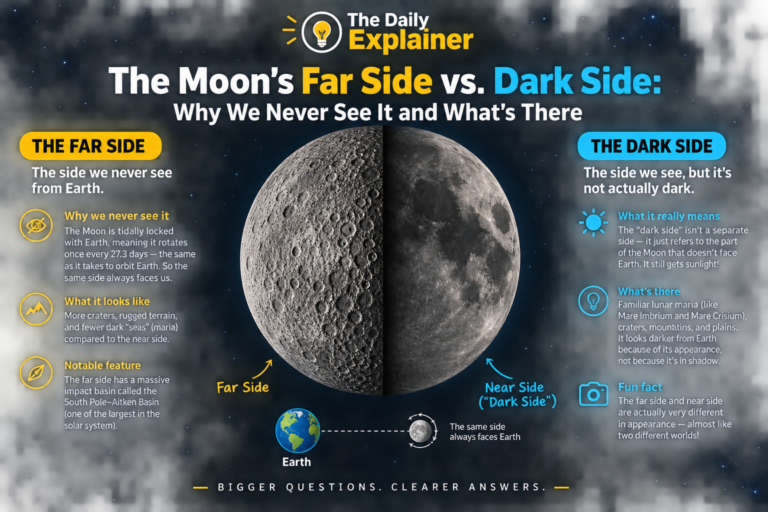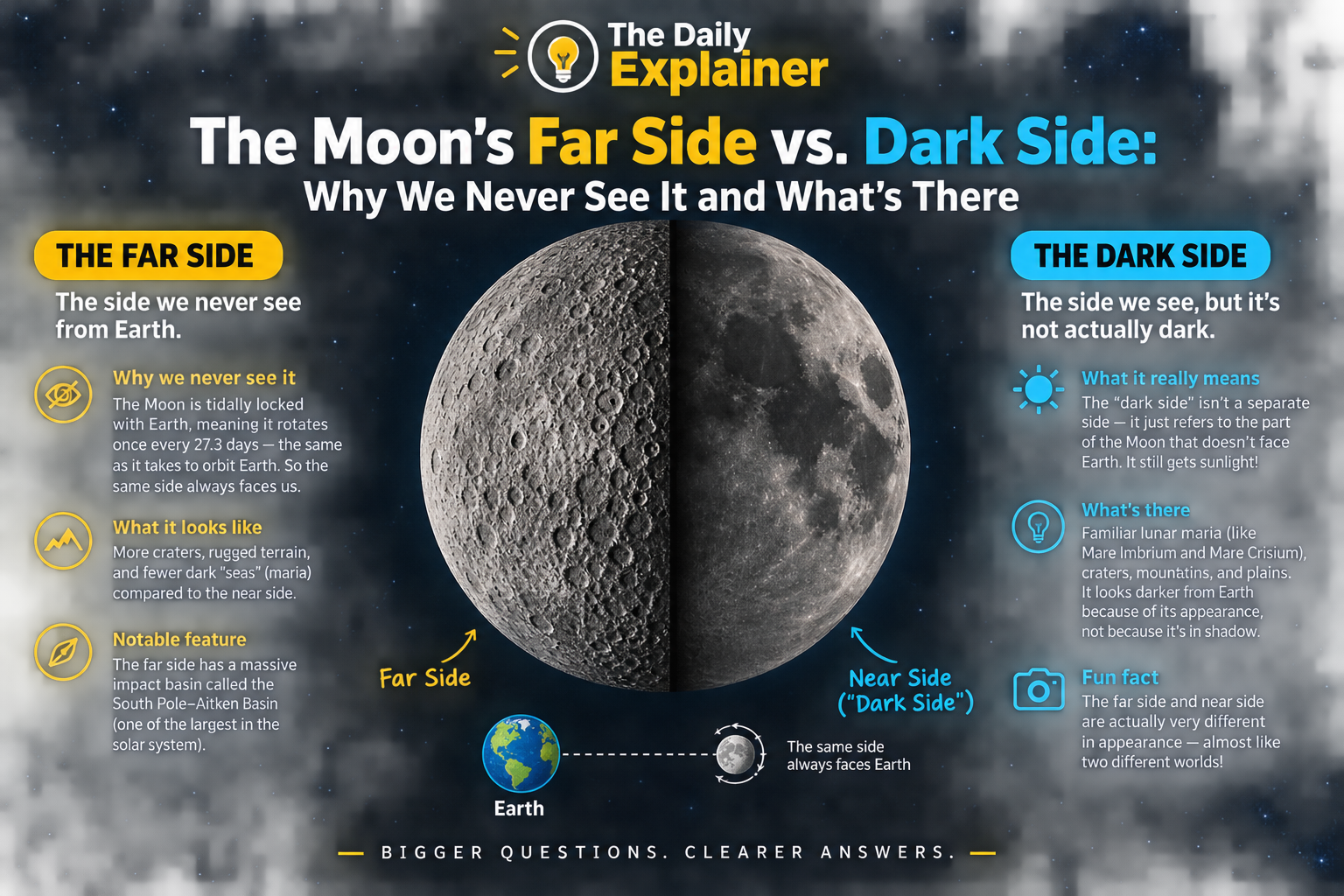
The near side (left) is covered in dark basaltic plains called maria. The far side (right) is brighter, more heavily cratered, and contains the massive South Pole-Aitken Basin.
Introduction: Why This Matters
In my experience explaining astronomy to curious beginners, there’s one misconception that refuses to die: the idea that the Moon has a “dark side” that never sees sunlight. It’s a phrase so deeply embedded in popular culture—thanks in no small part to a certain Pink Floyd album—that even well-educated people sometimes repeat it without thinking. Here is the Moon’s far side aticle for your information and reading please.
Here’s the truth: the Moon has a far side, not a dark side. Every part of the Moon receives sunlight at some point during the lunar day. The far side is simply the hemisphere we never see from Earth, and it’s every bit as illuminated as the side facing us. The confusion arises because the Moon is tidally locked—it rotates on its axis in exactly the same time it takes to orbit Earth, meaning the same face always points toward us.
Key Takeaway: The “dark side” is a misnomer. The Moon’s far side receives just as much sunlight as the near side. It’s only “dark” in the sense that it’s hidden from Earth-based observers—a distinction that matters for understanding lunar science, future exploration, and the history of our solar system.
This guide clears up the confusion once and for all. We’ll explore why we never see the far side, what’s actually there (including the largest impact crater in the solar system), why it looks so different from the near side, and what recent missions—including China’s historic Chang’e 6 sample return—have revealed about this hidden hemisphere.
Background and Context
The Moon’s Dance with Earth
To understand the far side, you need to understand the Moon’s orbital mechanics. The Moon orbits Earth once every 27.3 days. It also rotates on its axis once every 27.3 days. This coincidence isn’t accidental—it’s the result of billions of years of tidal evolution.
Early in its history, the Moon rotated faster. But Earth’s gravity raised tides on the Moon, creating a bulge that lagged behind the Moon’s rotation. This created a torque that gradually slowed the Moon’s spin until it matched its orbital period. The same process is happening to Earth right now—our planet’s rotation is slowing by about 1.8 milliseconds per century, and eventually (billions of years from now), Earth will also be tidally locked to the Moon.
The result is that roughly 59% of the Moon’s surface is visible from Earth at some point, thanks to a phenomenon called “libration”—a slight wobble in the Moon’s orientation that lets us peek around the edges. But the remaining 41%—the true far side—never faces Earth.
The First Glimpse
Humanity didn’t see the far side until October 1959, when the Soviet Luna 3 spacecraft photographed it. The images were grainy and low-resolution, but they revealed something surprising: the far side looked fundamentally different from the near side.
The near side is dominated by dark, smooth plains called maria (Latin for “seas”). These are vast basaltic lava flows that filled enormous impact basins early in lunar history. The far side, by contrast, has far fewer maria. Its surface is brighter, more heavily cratered, and dominated by rugged highlands.
This asymmetry—the “lunar dichotomy”—has puzzled scientists for decades. Why should one hemisphere be so different from the other?
Key Concepts Defined
Before going deeper, let’s establish clear definitions for the concepts in this article.
Far Side: The hemisphere of the Moon that permanently faces away from Earth due to synchronous rotation. It is not “dark”—it receives sunlight just like the near side.
Near Side: The hemisphere of the Moon that always faces Earth. It contains most of the Moon’s maria (dark basaltic plains).
Tidal Locking (Synchronous Rotation): The state where an object’s rotation period matches its orbital period, causing one hemisphere to always face its parent body. The Moon is tidally locked to Earth.
Maria (singular: Mare): Large, dark basaltic plains on the Moon, formed by ancient volcanic eruptions. They are concentrated on the near side.
Highlands: The lighter, heavily cratered terrain that dominates the lunar far side. These are among the oldest surfaces in the solar system.
South Pole-Aitken (SPA) Basin: The largest and oldest impact crater on the Moon, located on the far side. It spans roughly 2,500 kilometers and is about 13 kilometers deep.
Chang’e 6: China’s 2024 sample return mission that landed on the lunar far side and brought back the first-ever samples from that hemisphere.
Libration: The slight wobble in the Moon’s orientation that allows observers on Earth to see up to 59% of the lunar surface over time.
Lunar Dichotomy: The striking difference in appearance and composition between the Moon’s near and far sides.
How It Works: Step-by-Step Breakdown
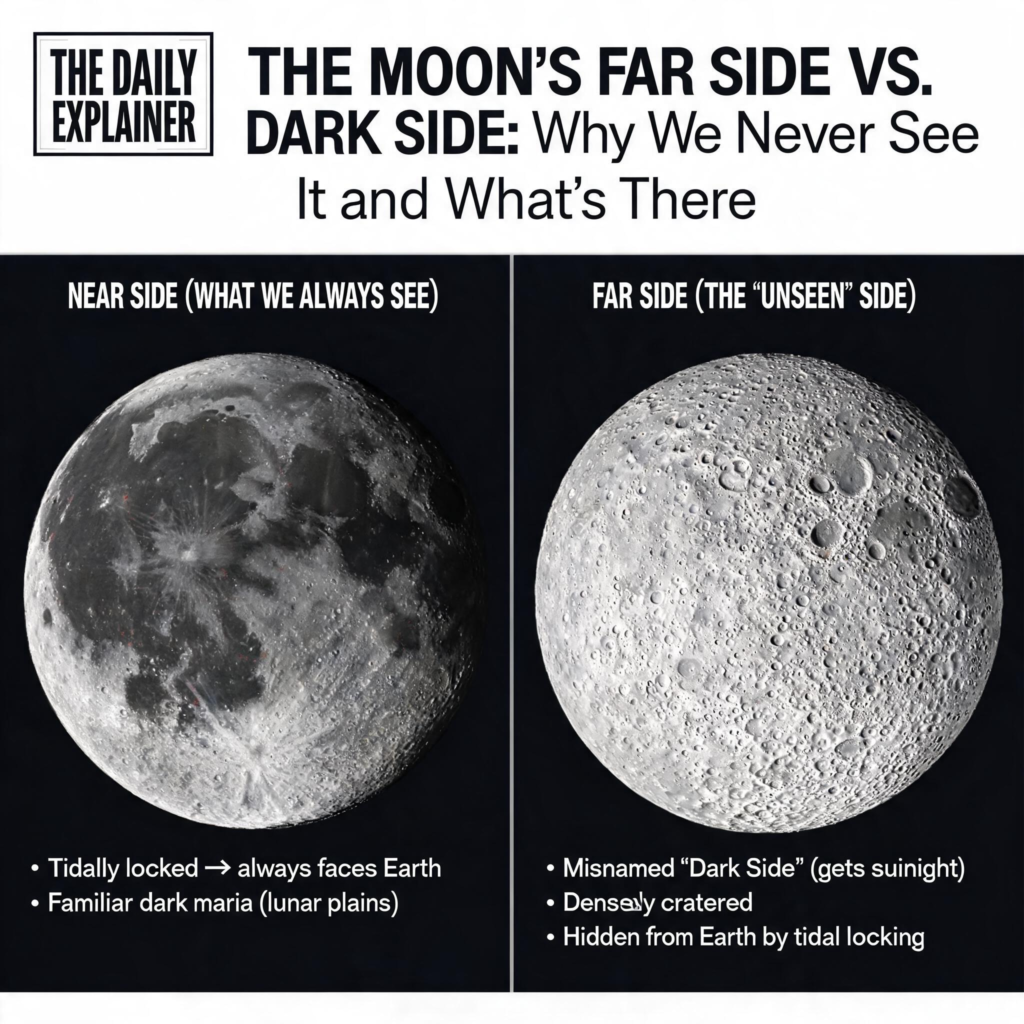
Why We Never See the Far Side
The mechanics of tidal locking are elegant in their simplicity.
Step 1: Gravitational Interaction
Earth’s gravity exerts a stronger pull on the side of the Moon facing it than on the far side. This difference (the tidal force) creates a bulge in the Moon’s shape.
Step 2: Tidal Friction
As the Moon rotates, the bulge doesn’t point exactly toward Earth—it lags slightly behind. This creates a torque that opposes the Moon’s rotation, gradually slowing it down.
Step 3: Synchronization
Over millions of years, the Moon’s rotation slowed until it matched its orbital period. At that point, the bulge pointed permanently toward Earth, and the torque vanished. The Moon was tidally locked.
Step 4: The Result
Today, the Moon rotates exactly once per orbit. From Earth, we always see the same face. The far side is forever hidden from direct view—though spacecraft have mapped it completely.
The Lunar Dichotomy: Why the Two Sides Differ
The near and far sides of the Moon are strikingly different. The near side has extensive maria covering about 31% of its surface. The far side has maria covering only about 1-2%.
Several theories have been proposed to explain this asymmetry:
Theory 1: Crustal Thickness
The far side’s crust is significantly thicker than the near side’s—perhaps 20 kilometers thicker on average. This thicker crust may have prevented magma from reaching the surface to form maria. But what caused the thickness difference?
Theory 2: The Giant Impact
The leading explanation involves the Moon’s formation. About 4.5 billion years ago, a Mars-sized body called Theia collided with the young Earth, ejecting debris that coalesced into the Moon. The impact may have left the near side hotter and thinner-crusted, while the far side retained a thicker crust.
Theory 3: KREEP and Heat-Producing Elements
The near side is enriched in KREEP—a geochemical component rich in potassium (K), rare earth elements (REE), and phosphorus (P), along with heat-producing elements like uranium and thorium. This concentration may have kept the near side’s mantle hotter, driving more volcanism.
Theory 4: The SPA Impact
The South Pole-Aitken Basin impact—one of the largest in the Moon’s history—excavated deep into the far side’s crust. The impact’s effects may have altered the far side’s thermal evolution, though whether this explains the maria deficit is debated.
The most recent research suggests a combination of factors: the giant impact created a thermal asymmetry, the SPA impact further modified the far side, and the concentration of KREEP on the near side sustained volcanism there.
Why It’s Important
Understanding Solar System History
The lunar far side preserves a record of the early solar system that the near side has lost. The far side’s highlands are among the oldest surfaces in the solar system—dating back over 4.3 billion years. They preserve a record of the intense bombardment that shaped the rocky planets.
The South Pole-Aitken Basin, in particular, is a window into the lunar interior. The impact excavated material from deep within the Moon’s crust and possibly its mantle, bringing samples of the deep interior to the surface. Studying these materials helps us understand the Moon’s composition and evolution.
The Chang’e 6 Breakthrough
In June 2024, China’s Chang’e 6 mission achieved something no nation had done before: it landed on the lunar far side, collected samples, and returned them to Earth. The mission brought back 1,935.3 grams of material—the first-ever samples from the far side.
Early analyses have revealed surprising differences from near-side samples. The far-side material is richer in certain minerals and has a different isotopic composition, confirming the dichotomy is not just skin-deep. These samples are providing new constraints on the Moon’s formation and evolution.
Preparing for Future Exploration
The far side is a destination for future human and robotic exploration. Its unique radio-quiet environment—shielded from Earth’s electromagnetic interference by the Moon itself—makes it ideal for radio astronomy. Concepts for a lunar far-side radio telescope have been studied for decades.
NASA’s Artemis program and China’s lunar exploration plans both include the far side as a target. Understanding its terrain, resources, and hazards is essential for safe operations.
The Water Question
The far side’s south polar region contains permanently shadowed craters that may hold water ice. Unlike the near side, where some polar regions receive occasional sunlight, the far side’s south pole has areas that have been in darkness for billions of years. These “cold traps” could preserve water ice and other volatiles—resources that would be invaluable for future lunar bases.
Sustainability in the Future
Radio Astronomy from the Far Side
The far side of the Moon is the quietest radio environment in the inner solar system. Shielded from Earth’s radio noise by 3,474 kilometers of solid rock, it offers a unique window on the universe’s “Dark Ages”—the period before the first stars formed, when the universe was filled with neutral hydrogen.
Several concepts for far-side radio telescopes have been proposed, including:
- Lunar Crater Radio Telescope (LCRT): A NASA concept for a radio telescope built inside a lunar crater
- FarSide Array: A European concept for a distributed array of antennas
- LuSEE-Night: A NASA-funded pathfinder experiment to test radio instruments on the far side
These projects are in early stages, but the scientific potential is enormous. The far side may eventually become a hub for radio astronomy.
Resource Utilization
The far side’s south polar region is a prime target for water ice extraction. If water ice exists in sufficient quantities, it could provide drinking water, breathable oxygen, and rocket propellant (through electrolysis into hydrogen and oxygen).
China’s Chang’e 7 mission, planned for the late 2020s, will target the lunar south pole for detailed resource prospecting. NASA’s Artemis missions also aim to explore the polar regions.
International Cooperation and Competition
The far side has become a focal point for international space competition. China’s successful Chang’e 4 (first soft landing on the far side, 2019) and Chang’e 6 (first sample return, 2024) have established China as a leader in lunar far-side exploration.
The United States and its partners are planning their own far-side missions. The competition is not just scientific—it’s also about establishing a presence and shaping the rules for future lunar activities.
Common Misconceptions
Misconception 1: “The far side is always dark.”
This is the most persistent lunar misconception. The far side receives exactly as much sunlight as the near side. During the lunar day (about 14 Earth days), the far side is fully illuminated. During the lunar night, it’s dark—just like the near side. The confusion arises from the word “dark” being used to mean “unknown” or “hidden,” not “unlit.”
Misconception 2: “The Moon doesn’t rotate.”
The Moon absolutely rotates. It completes one rotation every 27.3 days. The reason we don’t see the far side is that its rotation period exactly matches its orbital period. If the Moon didn’t rotate, we would see all sides of it over the course of a month.
Misconception 3: “The far side is completely unexplored.”
The far side has been extensively photographed and mapped by orbiters, including NASA’s Lunar Reconnaissance Orbiter (LRO) and China’s Chang’e missions. Two landers—China’s Chang’e 4 and Chang’e 6—have touched down there. While no human has walked on the far side, it is far from unexplored.
Misconception 4: “The far side looks the same as the near side.”
The two hemispheres are strikingly different. The near side is dominated by dark maria; the far side is dominated by bright, cratered highlands. The far side also hosts the South Pole-Aitken Basin, the largest impact structure on the Moon.
Misconception 5: “The far side is where aliens live.”
This is a science fiction trope with no basis in reality. The far side is a natural lunar landscape, no more mysterious than the near side. There is no evidence of extraterrestrial activity anywhere on the Moon.
Misconception 6: “The Moon’s far side is colder than the near side.”
Average temperatures on the far side are similar to those on the near side. However, the far side’s south polar region contains permanently shadowed craters that are among the coldest places in the solar system—but this is a local effect, not a hemispheric one.
Recent Developments
Chang’e 6 Sample Return (2024)
China’s Chang’e 6 mission was a historic achievement. The spacecraft landed in the South Pole-Aitken Basin on the far side, collected samples using a robotic arm and drill, and returned them to Earth in June 2024. The mission was the first to return samples from the far side.
Initial analyses, published in 2025, revealed that the far-side samples have a different composition from near-side samples. They are richer in titanium and iron, and their isotopic signatures suggest they formed from a different reservoir of lunar material. These findings support the idea that the Moon’s near and far sides had distinct evolutionary histories.
The Chang’e 4 Legacy
Chang’e 4, which landed in Von Kármán crater in January 2019, was the first mission to soft-land on the far side. It deployed the Yutu-2 rover, which continues to operate years later. The mission has provided unprecedented data on the far side’s geology, including evidence of material from the lunar mantle brought up by the SPA impact.
Lunar Reconnaissance Orbiter’s Complete Map
NASA’s LRO has been orbiting the Moon since 2009 and has mapped the entire surface at high resolution. Its data have revealed the far side in unprecedented detail, including the structure of the SPA Basin and the distribution of small maria that were previously unknown.
Far-Side Radio Experiments
In 2024, NASA’s ROLSES (Radio Observations of the Lunar Surface Photoelectron Sheath) instrument on the Intuitive Machines IM-1 lander made the first radio measurements from the lunar surface. While IM-1 landed on the near side, the experiment demonstrated the technology that could be used for far-side radio astronomy.
A more ambitious far-side radio experiment, LuSEE-Night, is planned for the late 2020s. It will test whether the far side is truly as radio-quiet as expected.
Success Stories
Case Study: Chang’e 4 and the First Far-Side Landing
Landing on the far side is difficult because direct communication with Earth is impossible. The Moon blocks radio signals, so a lander on the far side cannot communicate directly with ground stations.
China solved this problem by deploying a relay satellite, Queqiao, at the Earth-Moon L2 Lagrange point, beyond the Moon. Queqiao maintains line-of-sight to both the far side and Earth, relaying signals between them.
Chang’e 4’s successful landing in January 2019 was a triumph of engineering and international collaboration (the mission carried instruments from Germany, Sweden, and Saudi Arabia). The Yutu-2 rover has since traveled over 1,500 meters, discovering materials that appear to come from the lunar mantle.
Case Study: The South Pole-Aitken Basin
The SPA Basin is the largest and oldest impact structure on the Moon. It spans roughly 2,500 kilometers—about a quarter of the Moon’s circumference—and is up to 13 kilometers deep. The impact that created it excavated material from deep within the lunar crust and possibly the mantle.
Studying the SPA Basin is like studying a natural drill core into the Moon’s interior. The Chang’e 6 samples from the basin are providing the first direct laboratory analyses of far-side material, yielding insights into the Moon’s differentiation and thermal history.
Real-Life Examples
The “Earthrise” Perspective
One of the most iconic images in human history is “Earthrise,” taken by Apollo 8 astronaut William Anders in 1968. The photo shows Earth rising above the lunar horizon—a view that is impossible from the far side.
From the far side, Earth is never visible. The sky is black, the stars are visible, and the Sun rises and sets on a 29.5-day cycle. Future astronauts on far-side missions will experience a profound sense of isolation—a perspective that only a handful of humans have ever known.
The Radio Quiet Zone
On Earth, radio astronomy is increasingly hampered by interference from cell phones, Wi-Fi, and satellites. The far side of the Moon offers a solution: a location where Earth’s radio noise is blocked by the Moon itself.
A radio telescope on the far side could detect signals from the universe’s Dark Ages—a period that is currently invisible to us. This is not just an academic pursuit; it addresses one of the most fundamental questions in cosmology: how did the first structures form?
Conclusion and Key Takeaways
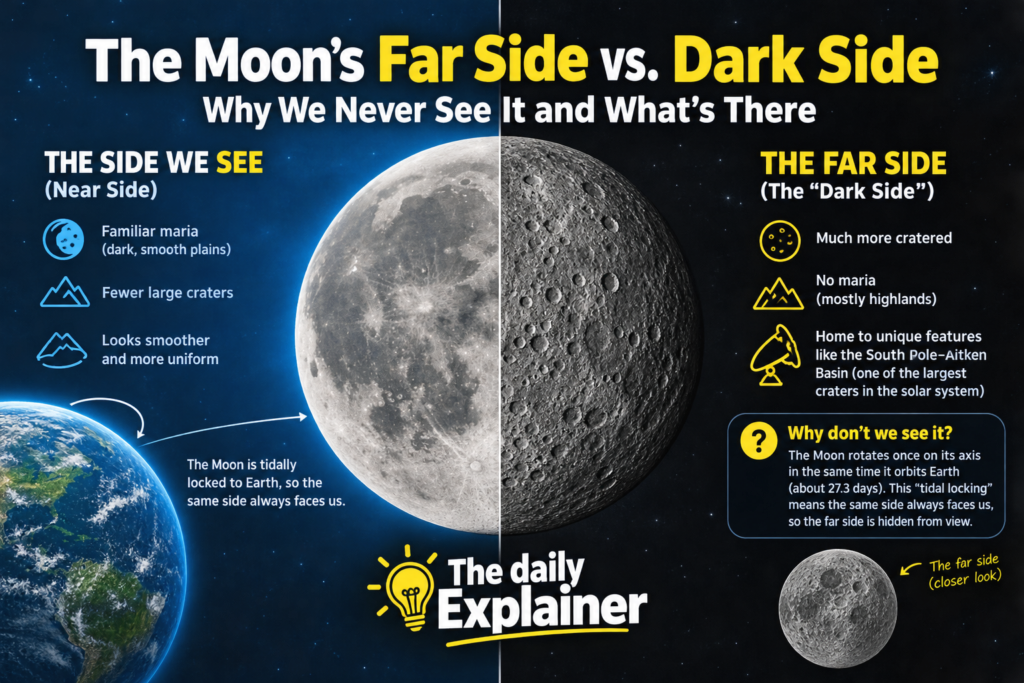
The Moon’s far side is one of the most misunderstood places in the solar system. It is not dark, not mysterious, and not unexplored. It is a scientifically rich landscape that preserves a record of the early solar system, offers a unique environment for radio astronomy, and may hold resources essential for future human exploration.
Key Takeaway 1: The far side is not “dark.” It receives just as much sunlight as the near side. The confusion comes from the fact that it’s hidden from Earth, not unlit.
Key Takeaway 2: The Moon is tidally locked, meaning it rotates once per orbit. This is why we always see the same face.
Key Takeaway 3: The near and far sides are strikingly different. The near side has extensive maria; the far side is dominated by highlands and contains the massive South Pole-Aitken Basin.
Key Takeaway 4: China’s Chang’e 6 mission returned the first-ever samples from the far side in 2024, providing new insights into the lunar dichotomy.
Key Takeaway 5: The far side’s radio-quiet environment makes it ideal for studying the universe’s Dark Ages, and its polar regions may hold water ice for future exploration.
For curious beginners, the lesson is that language matters—”far side” is accurate, “dark side” is not. For professionals, the takeaway is that the lunar dichotomy remains an active research question, and the Chang’e 6 samples are opening new windows on the Moon’s history.
Frequently Asked Questions (FAQ’s)
Q1: Is the far side of the Moon always dark?
No. The far side receives sunlight just like the near side. It’s only “dark” in the sense that it’s hidden from Earth. During the lunar day, the far side is fully illuminated.
Q2: Why don’t we ever see the far side of the Moon?
Because the Moon is tidally locked. It rotates once every 27.3 days, exactly the same time it takes to orbit Earth. This means the same hemisphere always faces us.
Q3: Does the Moon rotate?
Yes. The Moon rotates once every 27.3 days. We don’t notice because its rotation period matches its orbital period.
Q4: What is the difference between the far side and the dark side?
The “far side” is the hemisphere that always faces away from Earth. The “dark side” is a misnomer—it implies the hemisphere never receives sunlight, which is false.
Q5: Who first photographed the far side?
The Soviet Luna 3 spacecraft took the first grainy images of the far side in October 1959.
Q6: What is the South Pole-Aitken Basin?
It’s the largest and oldest impact crater on the Moon, located on the far side. It spans about 2,500 kilometers and is up to 13 kilometers deep.
Q7: Why does the far side look different from the near side?
The far side has a thicker crust and fewer maria. The leading explanation involves the Moon’s formation and the giant impact that created it, which may have left the near side hotter and more volcanically active.
Q8: Has anyone landed on the far side?
Yes. China’s Chang’e 4 landed on the far side in January 2019. Chang’e 6 landed there in 2024 and returned samples.
Q9: How do spacecraft communicate from the far side?
China uses a relay satellite called Queqiao, positioned beyond the Moon at the L2 Lagrange point, to relay signals between the far side and Earth.
Q10: What did Chang’e 6 find?
Chang’e 6 returned the first samples from the far side. Early analyses show they have a different composition from near-side samples, with higher titanium and iron content.
Q11: Is there water on the far side?
The far side’s south polar region contains permanently shadowed craters that may hold water ice. These “cold traps” are targets for future exploration.
Q12: Why is the far side good for radio astronomy?
The Moon blocks Earth’s radio signals, creating a radio-quiet environment. A telescope on the far side could detect faint signals from the early universe that are impossible to observe from Earth.
Q13: What is libration?
Libration is a slight wobble in the Moon’s orientation that allows observers on Earth to see up to 59% of the lunar surface over time, not just 50%.
Q14: Is the far side colder than the near side?
Average temperatures are similar. However, the far side’s south polar craters are among the coldest places in the solar system because they never receive sunlight.
Q15: What is the lunar dichotomy?
The lunar dichotomy is the striking difference in appearance and composition between the Moon’s near and far sides. The near side has maria; the far side has highlands.
Q16: Did Apollo astronauts ever see the far side?
Apollo astronauts saw the far side during their missions, but they never landed there. They photographed it from orbit.
Q17: What is the “Pink Floyd” connection?
Pink Floyd’s 1973 album “The Dark Side of the Moon” popularized the phrase, even though it refers to a misconception. The album is about human experience, not lunar science.
Q18: Will humans ever land on the far side?
It’s possible. NASA’s Artemis program and China’s lunar plans both include far-side exploration. The far side’s resources and radio-quiet environment make it an attractive destination.
Q19: What is the SPA Basin’s significance?
The SPA impact excavated material from deep within the Moon, bringing mantle material to the surface. Studying it helps us understand the Moon’s interior composition and evolution.
Q20: How long is a day on the far side?
A lunar day (from sunrise to sunrise) is about 29.5 Earth days, the same as on the near side. The far side is illuminated for about 14 Earth days, then dark for about 14 Earth days.
Q21: What is the “far side” in Chinese?
The Chinese term is 月球背面 (yuèqiú bèimiàn), meaning “back of the Moon.”
Q22: Are there maria on the far side?
Yes, but very few. The far side has only about 1-2% maria coverage, compared to about 31% on the near side.
Q23: What’s next for far-side exploration?
China plans Chang’e 7 (south pole resource prospecting) and Chang’e 8 (technology demonstration) in the late 2020s. NASA’s Artemis missions may eventually target the far side. Radio astronomy experiments like LuSEE-Night will test the far side’s potential for cosmology.
About the Author
Sana Ullah Khan Kakar is a science writer specializing in planetary science and lunar exploration. With over a decade of experience covering missions from LRO to Chang’e, he has reported on lunar science from conferences around the world.
This article was fact-checked against NASA, CNSA, and peer-reviewed research. All statistics reflect information available as of late 2026.
Free Resources
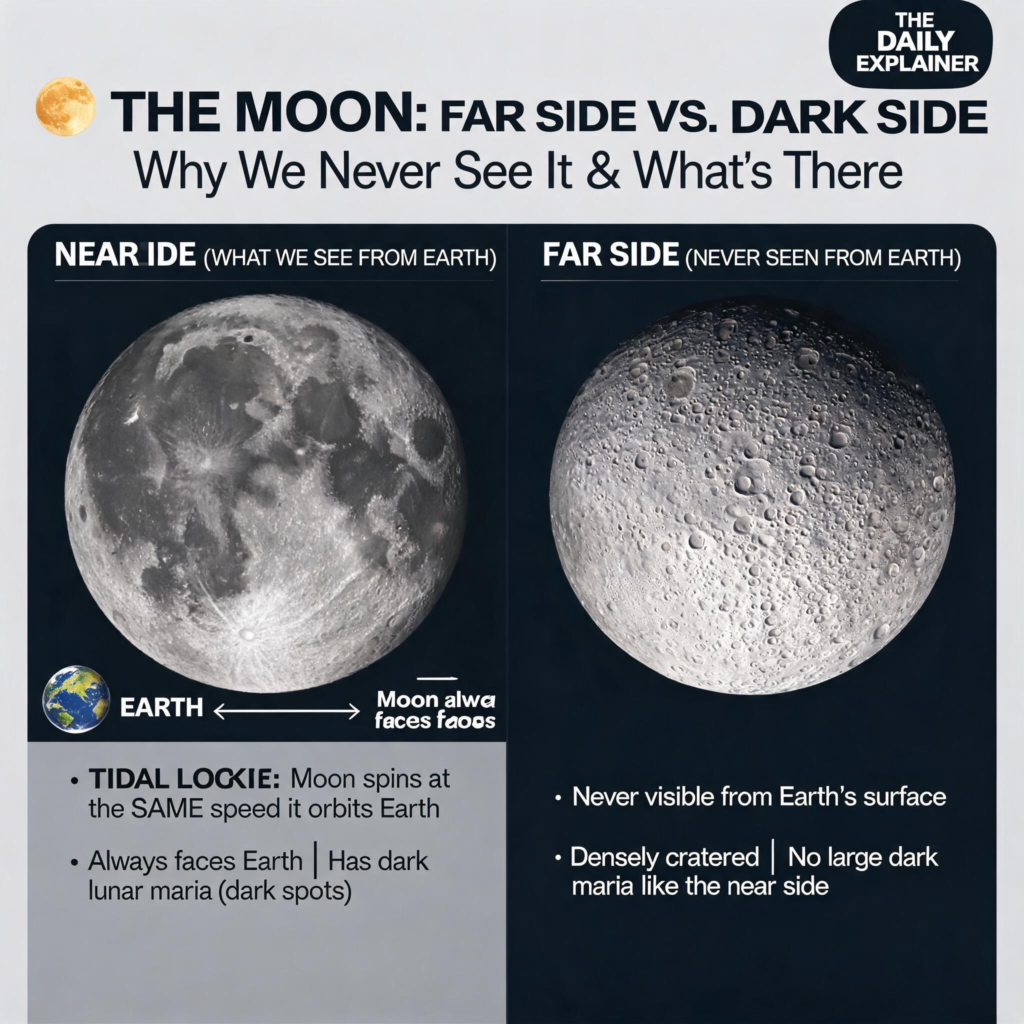
For Beginners:
- NASA’s Moon page (moon.nasa.gov) — Comprehensive lunar overview
- “The Moon’s Far Side” (NASA) — Explainer with images
- Lunar and Planetary Institute — Educational resources
For Deeper Learning:
- Chang’e 6 sample analysis papers (Nature, Science, 2025) — Primary research
- Lunar Reconnaissance Orbiter data (lroc.sese.asu.edu) — High-resolution maps
- “The Lunar Dichotomy” review articles — Scientific context
For Real-Time Updates:
- NASA Lunar Discovery and Exploration — Mission updates
- CNSA Chang’e program — Chinese lunar exploration news
- Lunar and Planetary Science Conference abstracts — Latest research
Discussion
What do you think is the most important reason to explore the lunar far side? Is it the scientific record of the early solar system, the potential for radio astronomy, or the resources for future bases?
Do you think the “dark side” misconception will ever disappear from popular culture? Or is it too deeply embedded?
Share your thoughts below. For more space science explainers, visit our Explained section and browse our blog. Have questions or topic suggestions? Contact us. For breaking space news, check our Breaking News category. Review our Terms of Service and explore our Global Affairs & Politics coverage for context on international space competition.
For more resources on science communication and research, visit Sherakat Network’s Resources and Blog. Connect with Sherakat Network for collaboration opportunities. If you’re building an online presence, see their 2026 guide to starting an online business. Learn more about WorldClassBlogs and explore their Blog, Our Focus, and Nonprofit Hub. For SEO insights, visit Sherakat Network’s SEO category.
About The Author