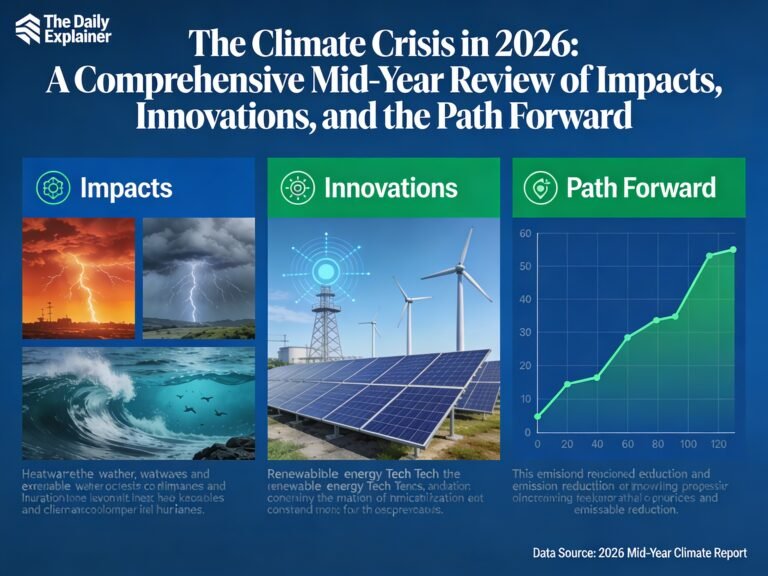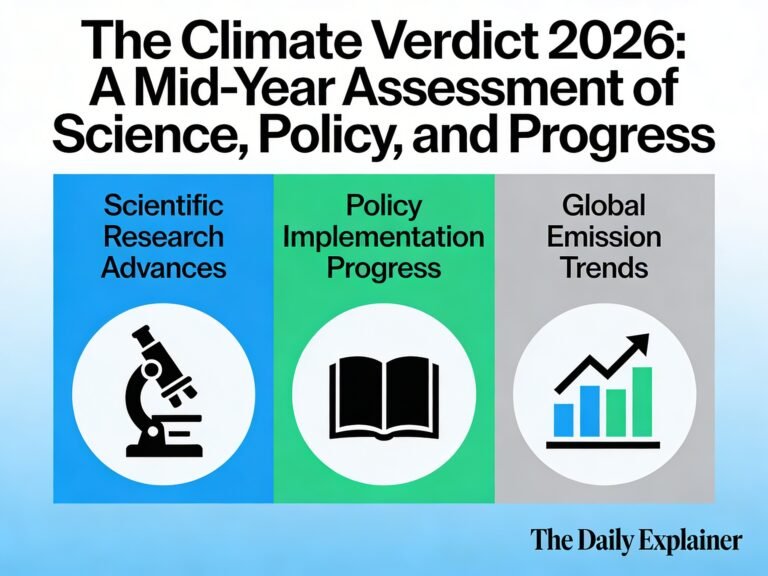
March 2026 presents a mixed verdict: the science continues to sound alarms with record-breaking temperatures and extreme events, but policy and technology are responding with unprecedented ambition and scale.
Introduction – Why This Matters
In my years of tracking climate science and policy, I’ve learned that the most dangerous temptation is to look for simple answers. Is the climate crisis accelerating or stabilizing? Are we making progress or falling further behind? The truth, as always, is more complicated.
What I’ve found is that the first quarter of 2026 presents a deeply ambivalent picture. On one hand, the scientific data continues to sound alarms that cannot be ignored. February 2026 was the fifth warmest February on record globally, with temperatures soaring 1.49°C above pre-industrial levels. Western Europe was drenched by exceptional rainfall and widespread flooding, driven by atmospheric rivers that scientists at the World Weather Attribution network confirmed were intensified by human-driven climate change. Arctic sea ice extent was the third lowest for February.
On the other hand, the policy and technology landscape is showing unprecedented signs of maturity. China’s 15th Five-Year Plan, finalized in March 2026, introduces binding carbon intensity targets and a sophisticated green finance architecture. Experts are outlining what credible fossil fuel transition roadmaps should include, turning the COP30 commitment into practical guidance. Breakthrough technologies like sodium-ion batteries are entering mass production, and next-generation nuclear reactors are breaking ground.
This article is the mid-year assessment. We will synthesize the latest data from the Copernicus Climate Change Service, the World Meteorological Organization, and the World Weather Attribution network. We will analyze the policy developments from Beijing to Brasília to Brussels. We will track the progress of breakthrough technologies and the sobering reality of continued extreme events. Because only by holding both truths—the urgency of the science and the momentum of the response—can we navigate the path forward.
Background / Context
To understand where we are in March 2026, we must understand the journey that brought us here. The past year has been a watershed in climate science, policy, and technology.
The Scientific Trajectory: The year 2024 was officially the hottest on record, with annual temperatures exceeding 1.5°C above pre-industrial levels for the first time. While this single-year breach does not mean the 1.5°C Target is permanently lost—the target refers to a multi-decade average—it was a profound psychological and symbolic shock. The World Meteorological Organization confirmed that 2025 continued the warming trend, with global average temperatures remaining above 1.4°C. The UK Met Office projects that 2026 will be the fourth consecutive year with warming exceeding 1.4°C.
The Policy Landscape: COP30 in Belém, Brazil, marked a decisive shift from negotiation to implementation. The Global Mutirão Decision, the commitment to triple adaptation finance by 2035, and the mandate to develop fossil fuel transition roadmaps created a new architecture for action. The International Court of Justice’s landmark advisory opinion, and the pending UN resolution to operationalize it, added legal teeth to climate obligations.
The Technology Revolution: The cost of solar and wind power has continued its exponential decline. But 2025 and 2026 have seen the maturation of next-generation technologies. Sodium-ion batteries are now in mass production, offering a cheaper, safer alternative to lithium for grid storage. Next-generation nuclear reactors are moving from blueprints to construction. And the policy frameworks to support them—from China’s green finance architecture to the EU’s Carbon Border Adjustment Mechanism—are taking shape.
As the S&P Global Sustainability Trends to Watch in 2026 report notes, companies and investors are entering an “inflection point,” caught between immediate priorities like energy security and the scientific reality of climate change. This is the context for our mid-year assessment.
Key Concepts Defined
To understand the state of play in March 2026, we need a clear vocabulary that captures the latest developments.
- Carbon Intensity: The amount of carbon dioxide emitted per unit of economic output (typically per unit of GDP). China’s 15th Five-Year Plan sets a binding target to reduce carbon intensity by 17% by 2030 and approximately 3.8% in 2026 alone.
- Carbon Border Adjustment Mechanism (CBAM): The EU’s new policy, which took effect on January 1, 2026, imposing costs on imports based on their carbon intensity. It aims to prevent “carbon leakage” and incentivize global emissions reductions.
- Fossil Fuel Transition Roadmaps: Comprehensive national plans for transitioning away from fossil fuels, mandated by COP30. According to a new policy brief by IISD, E3G, and others, credible roadmaps must align with climate science, address both production and consumption, embed justice, ensure national ownership, and be backed by international finance.
- Atmospheric River: Narrow bands of very moist air that can transport huge amounts of water vapor. In January-February 2026, atmospheric rivers caused record rainfall and widespread flooding across Spain, Portugal, and Morocco.
- Just Energy Transition Partnerships (JETPs): International financing partnerships to support developing countries’ transitions away from coal. The brief draws on case studies from South Africa, Indonesia, Viet Nam, and Senegal.
- Green Finance Endorsed Project Catalogue (2025 Edition): China’s updated framework for defining eligible green investments, adopted in 2025, which standardizes definitions and improves comparability.
- Hyperscale Data Centers: Massive data centers built to power AI and cloud computing, requiring up to a gigawatt or more of power. Their rapid expansion is driving electricity demand and raising new scrutiny on emissions and water use.
How It Works (A Step-by-Step Breakdown of the 2026 Climate Landscape)
The climate landscape in March 2026 is not a single story but a convergence of multiple trends. Here is a step-by-step breakdown of how science, policy, technology, and finance are interacting.
Part 1: The Scientific Reality
Step 1: February 2026 Data
The Copernicus Climate Change Service released its monthly report on March 9, 2026. The findings are stark:
- Global temperatures last month were 1.49°C above pre-industrial levels.
- February was the fifth-warmest February on record globally.
- Sea surface temperatures were the second-highest for February.
- Arctic sea ice extent was the third lowest for February, at 5% below average.
Step 2: Extreme Events
February 2026 was marked by dramatic contrasts:
- Western Europe experienced exceptional rainfall and widespread flooding, driven by atmospheric rivers. The floods killed dozens and displaced thousands across Spain, Portugal, and Morocco.
- The World Weather Attribution network confirmed that human-driven climate change intensified these downpours.
- Meanwhile, the United States, northeast Canada, the Middle East, Central Asia, and eastern Antarctica recorded warmer-than-average temperatures.
- In Europe as a whole, the average temperature was slightly below average, but western, southern, and southeastern Europe were warmer than average, while Scandinavia and northwest Russia were colder.
Step 3: The 2026 Projection
The UK Met Office projects that 2026 will be the fourth consecutive year with global warming exceeding 1.4°C above pre-industrial levels. A weak La Niña may provide a temporary cooling effect, but it will not reverse the long-term warming trend.
Part 2: The Policy Response
Step 1: Fossil Fuel Transition Roadmaps
Following the COP30 mandate, experts are now defining what credible roadmaps should include. A new policy brief from IISD, E3G, ECCO, Observatório do Clima, and SEFIA outlines five core tests :
- Alignment with climate science and established pathways.
- Addressing both fossil fuel production and consumption, not just demand.
- Embedding procedural and distributive justice through inclusive planning and worker protections.
- Ensuring national ownership across ministries and economic portfolios.
- Backing by coordinated international finance, shared standards, and robust monitoring systems.
At least 46 countries already have plans to decarbonize their power sectors. Several—including the UK and Colombia—are developing plans to reduce fossil fuel production.
Step 2: China’s 15th Five-Year Plan
In March 2026, China finalized its 15th Five-Year Plan (2026-2030), marking a significant maturation of its climate strategy :
- Binding target: Reduce CO2 emissions per unit of GDP by 17% through 2030, listed among the plan’s 20 headline indicators. For 2026, the target is approximately 3.8% reduction.
- Energy efficiency: Reduce energy consumption per unit of GDP by around 10% over the five-year period.
- Green finance: Green loans reached 44.8 trillion yuan ($6.47 trillion) by the end of 2025, with the share of total lending surging from 6.7% to 16.2% during the 14th Five-Year Plan period.
- Carbon market expansion: Steel, cement, and aluminum smelting are now incorporated into the national emissions trading system alongside power generation.
Step 3: The EU’s CBAM Takes Effect
January 1, 2026, marked the implementation of the EU’s Carbon Border Adjustment Mechanism (CBAM) . It imposes costs on imports based on carbon intensity, aiming to prevent carbon leakage and incentivize global emissions reductions. S&P Global analysis indicates at least $15 billion in added import costs for goods originating in more carbon-intensive countries.
Part 3: The Technology Breakthroughs
Step 1: Sodium-Ion Batteries Scale Up
After years of development, sodium-ion batteries are now in mass production. Chinese battery giant CATL announced it started manufacturing these batteries at scale in 2025. They offer a cheaper, safer, and more abundant alternative to lithium-ion, particularly valuable for grid storage.
Step 2: Next-Generation Nuclear Advances
Kairos Power became the first US company to receive approval to begin construction on a next-generation reactor to produce electricity. China is also advancing several next-gen reactors. These smaller, advanced designs aim to overcome the cost and delay problems of traditional nuclear.
Step 3: Hyperscale Data Centers Reshape Energy Demand
The AI boom is driving a wave of massive data centers requiring a gigawatt or more of power—comparable to the output of an entire conventional nuclear power plant. S&P Global projects data center electricity consumption could top 2,200 TWh by 2030, comparable to India’s power usage. This is creating new pressure on grids and water resources.
Part 4: The Financial Architecture
Step 1: Green Finance Matures
China’s green finance system has reached systemic scale. The adoption of the Green Finance Endorsed Project Catalogue (2025 Edition) standardizes definitions, improving comparability and credibility. The People’s Bank of China frames the 15th Five-Year Plan years as the critical window for developing carbon accounting standards and sustainability disclosure.
Step 2: Adaptation Planning Gains Ground
S&P Global Energy data shows that in 2025, 42% of companies across sectors disclosed a climate adaptation plan describing how they will prepare physical assets for climate risks such as drought or extreme heat .
Step 3: The Fragmentation Challenge
The S&P Global Sustainability Trends report notes that sustainability action is fragmenting into regional approaches as major economies pursue divergent climate, trade, and energy priorities. The “two-speed multilateralism” of the post-COP30 era is both a response to and a reflection of this fragmentation.
Key Takeaways Box:
- The science is unambiguous: February 2026 was 1.49°C above pre-industrial levels, the fifth warmest February on record, with extreme flooding in Europe intensified by climate change .
- Policy is maturing: China’s 15th Five-Year Plan introduces binding carbon intensity targets and a sophisticated green finance architecture . Fossil fuel transition roadmaps are being defined with rigor .
- Technology is scaling: Sodium-ion batteries are in mass production, next-generation nuclear is breaking ground, and the AI boom is reshaping energy demand .
- Finance is adapting: The EU’s CBAM is now in effect, green finance standards are converging, and adaptation planning is becoming mainstream .
Why It’s Important
The mid-year assessment of 2026 is not an academic exercise. It has profound implications for every aspect of climate action.
- It informs the Ambition Gap: The UNFCCC process relies on five-year ambition cycles. The data from 2026—both on emissions trajectories and on policy implementation—will directly inform the next round of Nationally Determined Contributions (NDCs) and the second Global Stocktake. If we are falling behind, we must know by how much.
- It Guides Investment Decisions: The maturation of China’s green finance architecture and the implementation of the EU’s CBAM are reshaping global investment flows. Companies and investors need to understand where the regulatory and market signals are pointing.
- It Tests the Credibility of Commitments: The COP30 mandate to develop fossil fuel transition roadmaps is now being tested. The IISD/E3G policy brief provides a framework for assessing whether these roadmaps are credible. The world is watching to see if countries like Colombia, the UK, and Brazil can deliver.
- It Reveals the Human Cost: The February 2026 floods in Western Europe and North Africa, which killed dozens and displaced thousands, are a reminder that climate impacts are not a future abstraction. The World Weather Attribution network’s confirmation that climate change intensified these events underscores the urgency of both mitigation and adaptation.
- It highlights the Interconnections: As the S&P Global report notes, water stress, extreme weather, and ecosystem strain are intensifying business risk across supply chains. The expansion of hyperscale data centers is creating new pressure on water resources in regions like China and the US, where 60% and 38% of assets, respectively, are projected to be exposed to high water stress this decade.
Sustainability in the Future
A sustainable future depends on the trends of 2026 continuing and accelerating. Here’s what that future looks like.
- Integrated, Credible National Planning: The fossil fuel transition roadmaps being developed in 2026 must become the template for all national climate action. They must integrate production and consumption, embed justice, and be backed by international finance. Germany’s coal commission, which translated stakeholder negotiation into binding legislation, offers a model.
- A Mature, Standardized Green Finance System: China’s progress on carbon accounting standards, sustainability disclosure, and carbon market expansion points toward a future where green finance is evaluated by standardized eligibility, disclosure comparability, and tradable market infrastructure—not by labels alone. This is essential for scaling finance to the trillions needed.
- A Managed, Orderly Energy Transition: The IISD brief warns that without coherence, volatility increases. A sustainable future requires predictable pathways and international coordination so that countries willing to transition are not left to face the risks alone. The Colombia–Netherlands-led conference in Santa Marta in April 2026 is a step toward that coordination.
- Resilient Infrastructure and Supply Chains: With 42% of companies now disclosing adaptation plans, the private sector is beginning to build climate resilience into core business strategy. This must become universal. The ISO 14092:2026 standard for local adaptation planning provides a framework.
- A New Balance Between Energy Security and Decarbonization: The AI boom and the resurgence of data center demand are creating new tensions between energy security and climate goals. A sustainable future requires managing these tensions through accelerated renewable deployment, grid flexibility, and energy efficiency.
Common Misconceptions
The mid-year assessment of 2026 challenges several common misconceptions.
Misconception 1: “Climate action is slowing down.”
The data suggests otherwise. While geopolitical tensions and energy security concerns have created new challenges, the underlying momentum of climate policy and technology is accelerating. China’s 15th Five-Year Plan, the EU’s CBAM, and the mass production of sodium-ion batteries all point to a maturing, scaling response .
Misconception 2: “The 1.5°C target is already dead.”
February 2026’s 1.49°C anomaly is a stark warning, but the 1.5°C target refers to a multi-decade average, not a single month or year. The target is on life support, but it is not dead. The question is whether the policy momentum of 2026 can translate into the emissions reductions needed to keep it alive.
Misconception 3: “China is not serious about climate action.”
China’s 15th Five-Year Plan tells a different story. Binding carbon intensity targets, a mature green finance system, carbon market expansion, and massive investment in renewables all demonstrate a serious, systemic approach. The challenge is implementation, not ambition.
Misconception 4: “Extreme weather events are just bad luck.”
The February 2026 floods in Europe and North Africa were not random. The World Weather Attribution network confirmed that human-driven climate change intensified the atmospheric rivers that caused them . Attribution science is making it possible to quantify the climate signal in extreme events.
Misconception 5: “Technology will save us without policy.”
The breakthrough technologies of 2026—sodium-ion batteries, next-generation nuclear—are the result of decades of policy support, public investment, and regulatory frameworks. They did not emerge in a vacuum. Technology and policy are complementary, not competing.
Recent Developments (January-March 2026)
The first quarter of 2026 has been packed with major developments across science, policy, and technology.
- February 2026 Climate Data (March 9, 2026): The Copernicus Climate Change Service released its monthly report, showing February as the fifth warmest on record globally (1.49°C above pre-industrial), with extreme rainfall and flooding in Western Europe. Sea surface temperatures were the second highest for February, and Arctic sea ice was the third lowest .
- Fossil Fuel Transition Roadmap Framework (March 10, 2026): A new policy brief by IISD, E3G, ECCO, Observatório do Clima, and SEFIA set out what credible fossil fuel transition roadmaps should include, providing a framework for the 46+ countries developing such plans.
- China’s 15th Five-Year Plan Finalized (March 2026): The plan includes binding carbon intensity targets (17% reduction by 2030), a mature green finance framework (44.8 trillion yuan in green loans), and expansion of the national carbon market to cover steel, cement, and aluminum.
- EU CBAM Takes Effect (January 1, 2026): The Carbon Border Adjustment Mechanism is now operational, imposing costs on imports based on carbon intensity.
- S&P Global Sustainability Trends Report (January 14, 2026): The report identified 10 key trends for 2026, including the fragmentation of sustainability action, the rise of climate adaptation planning (42% of companies now disclose plans), and the water stress implications of the data center boom.
- MIT Technology Review Breakthrough Technologies (January 15, 2026): The annual list highlighted sodium-ion batteries, next-generation nuclear, and hyperscale data centers as key technologies to watch in 2026.
- Atmospheric River Flooding in Europe and North Africa (January-February 2026): Exceptional rainfall and widespread flooding hit Spain, Portugal, and Morocco, killing dozens and displacing thousands. The World Weather Attribution network confirmed that climate change intensified the events.
Real-Life Examples
These examples bring the 2026 climate verdict to life.
1. The February Floods in Valencia, Spain
In early February 2026, the Spanish city of Valencia was hit by catastrophic flooding as an atmospheric river dumped record rainfall. Rivers burst their banks, streets became torrents, and homes were destroyed. Dozens died, and thousands were displaced. The World Weather Attribution network’s rapid analysis confirmed that human-driven climate change made the downpours significantly more intense. For the people of Valencia, this was not an abstract statistic; it was the destruction of their lives and livelihoods.
2. CATL’s Sodium-Ion Battery Factory, China
In a factory in China, CATL is now manufacturing sodium-ion batteries at scale. These batteries, made from abundant sodium rather than scarce lithium, are cheaper and safer. They will be deployed in grid storage projects, storing solar power generated during the day for use at night. This is a tangible example of the technology revolution that is making the energy transition possible.
3. China’s Carbon Market Expansion
A steel plant in Hebei province, China’s largest steel-producing region, is now covered by the national emissions trading system. The plant must monitor and report its emissions, purchase allowances, and face compliance deadlines extending through 2026-2027. This is not a symbolic gesture; it is a binding constraint that will drive investment in efficiency and decarbonization. As the 15th Five-Year Plan signals, the focus has moved beyond pledges into the “hard infrastructure of implementation”.
4. The Santa Marta Conference Preparations
In Bogotá, Colombia, government officials are preparing for the April 2026 conference on fossil fuel transition roadmaps, co-hosted with the Netherlands. They are drawing on the new IISD/E3G framework to shape their national plan, consulting with workers, businesses, and communities. This is the “how” of the energy transition—the messy, complex, essential work of turning global commitments into national reality.
Success Stories
Despite the sobering science, there are genuine successes in the first quarter of 2026.
- China’s Green Finance Maturation: The scale and sophistication of China’s green finance system are a major success. Green loans reached 44.8 trillion yuan by the end of 2025, with the share of total lending surging to 16.2%. The adoption of standardized definitions and the push for carbon accounting are creating a credible, investable framework that can channel capital at the scale needed.
- The EU’s CBAM Implementation: Despite political controversy, the EU succeeded in implementing the world’s first carbon border adjustment mechanism on January 1, 2026. This is a major policy innovation that could reshape global trade and incentivize emissions reductions worldwide.
- The Growth of Corporate Adaptation Planning: S&P Global’s finding that 42% of companies now disclose climate adaptation plans is a significant shift. It means that climate resilience is moving from a niche concern to a mainstream business practice, building the foundation for a more resilient economy.
- The Breakthrough of Sodium-Ion Batteries: After years of development, sodium-ion batteries are finally in mass production. This is a classic example of patient research and development paying off, creating a cheaper, more abundant alternative to lithium that can accelerate the energy transition.
Conclusion and Key Takeaways
The climate verdict of March 2026 is not a simple one. It is a story of stark contrasts and competing truths.
The science continues to sound alarms that cannot be ignored. February 2026 was 1.49°C above pre-industrial levels, the fifth warmest February on record . Extreme flooding in Europe, intensified by climate change, killed dozens and displaced thousands . Arctic sea ice is disappearing, and sea surface temperatures remain near record highs .
But the policy and technology response is also accelerating. China’s 15th Five-Year Plan introduces binding carbon intensity targets and a mature green finance architecture. The EU’s CBAM is now in effect, reshaping global trade. Fossil fuel transition roadmaps are being developed with unprecedented rigor. Sodium-ion batteries are in mass production, and next-generation nuclear is breaking ground.
As we’ve seen throughout this series—from the melting cryosphere to the burning forests, from the urgent need for adaptation to the reality of compound disasters, from the hope of breakthrough technologies to the human toll of climate grief, from the mechanics of climate finance to the architecture of the post-COP30 era and the movement of climate migrants—the climate crisis is a test of our collective capacity to hold two truths at once: the severity of the threat and the possibility of the response.
The verdict of March 2026 is that the threat is real and accelerating. But so is the response.
Key Takeaways:
- The science is unequivocal: February 2026 was 1.49°C above pre-industrial, the fifth warmest February on record. Extreme flooding in Europe was intensified by climate change.
- Policy is maturing: China’s 15th Five-Year Plan introduces binding carbon intensity targets and a sophisticated green finance system. Fossil fuel transition roadmaps are being defined with rigor.
- Technology is scaling: Sodium-ion batteries are in mass production, next-generation nuclear is advancing, and the AI boom is reshaping energy demand.
- Finance is adapting: The EU’s CBAM is now in effect, green finance standards are converging, and adaptation planning is becoming mainstream.
- The window is narrowing, but it is not closed: The policy and technology momentum of 2026 must translate into the emissions reductions needed to keep the 1.5°C target alive. The next few years will determine the outcome.
FAQs (Frequently Asked Questions)
- What was the global temperature in February 2026?
February 2026 was 1.49°C above pre-industrial levels (1850-1900), making it the fifth warmest February on record globally, according to the Copernicus Climate Change Service. - What extreme weather events happened in February 2026?
Western Europe experienced exceptional rainfall and widespread flooding, driven by atmospheric rivers. The floods killed dozens and displaced thousands across Spain, Portugal, and Morocco. Other regions, including Australia, Mozambique, and Botswana, also experienced floods. - Did climate change cause the February 2026 floods in Europe?
The World Weather Attribution network confirmed that human-driven climate change intensified the downpours that caused the flooding. - What is the state of Arctic sea ice in early 2026?
In February 2026, Arctic sea ice extent was the third lowest for the month, at about 5% below average. - What are the key climate targets in China’s 15th Five-Year Plan?
The plan, finalized in March 2026, sets a binding target to reduce CO2 emissions per unit of GDP by 17% through 2030, with an approximate 3.8% reduction targeted for 2026. It also aims for around 10% reduction in energy consumption per unit of GDP over the five-year period. - What is the state of green finance in China?
By the end of 2025, green loans reached 44.8 trillion yuan ($6.47 trillion), with the share of total lending surging from 6.7% to 16.2% during the 14th Five-Year Plan period. Green bonds outstanding reached approximately 2.4 trillion yuan. - What is the EU’s Carbon Border Adjustment Mechanism (CBAM)?
It’s a new EU policy that took effect on January 1, 2026, imposing costs on imports based on their carbon intensity. It aims to prevent “carbon leakage” and incentivize global emissions reductions. - What are fossil fuel transition roadmaps?
Comprehensive national plans for transitioning away from fossil fuels are mandated by COP30. A new policy brief by IISD, E3G, and others outlines five core tests for credibility: alignment with science, addressing both production and consumption, embedding justice, national ownership, and backing by international finance. - How many countries are developing fossil fuel transition plans?
At least 46 countries already have plans to decarbonize their power sectors. Several, including the UK and Colombia, are developing plans to reduce fossil fuel production. - What is the status of sodium-ion batteries in 2026?
Chinese battery giant CATL announced it started manufacturing sodium-ion batteries at scale in 2025. They offer a cheaper, safer, and more abundant alternative to lithium, particularly valuable for grid storage. - What is happening with next-generation nuclear power?
Kairos Power became the first US company to receive approval to begin construction on a next-generation reactor to produce electricity. China is also advancing several next-gen reactors. - How are hyperscale data centers affecting climate and energy?
The AI boom is driving a wave of massive data centers requiring a gigawatt or more of power. S&P Global projects data center electricity consumption could top 2,200 TWh by 2030, comparable to India’s power usage, creating new pressure on grids and water resources. - What are the top sustainability trends for 2026 according to S&P Global?
Key trends include the fragmentation of sustainability action, the rise of climate adaptation planning, the energy transition amid rising power demand, the impact of AI and data centers on water and emissions, and the implementation of the EU CBAM. - What percentage of companies have climate adaptation plans?
S&P Global Energy data shows that in 2025, 42% of companies across sectors disclosed a climate adaptation plan describing how they will prepare physical assets for climate risks. - What is the projected global temperature for 2026?
The UK Met Office projects that 2026 will be the fourth consecutive year with global warming exceeding 1.4°C above pre-industrial levels. - What is a La Niña, and how might it affect 2026 temperatures?
La Niña is a natural climate pattern that can temporarily cool global average temperatures. A weak La Niña may affect 2026, but it will not reverse the long-term warming trend. - What is the World Weather Attribution network?
An international network of climate scientists that conducts rapid attribution studies to determine the role of climate change in extreme weather events. They confirmed that climate change intensified the February 2026 floods in Europe. - How is China’s carbon market evolving?
In March 2025, China formally published its work plan to bring steel, cement, and aluminum smelting into the national emissions trading system alongside the power generation sector. Annual trading volumes reached 235 million tons in 2025. - What is the significance of the Colombia-Netherlands conference in April 2026?
The conference in Santa Marta, Colombia, co-hosted with the Netherlands, aims to advance credible national roadmaps for transitioning away from fossil fuels, deepening dialogue, and international coordination. - Where can I find reliable, up-to-date climate data for 2026?
The Copernicus Climate Change Service, World Meteorological Organization, UK Met Office, and NOAA are authoritative sources. For policy analysis, the IISD, E3G, S&P Global, and MIT Technology Review provide excellent coverage. For more explainers, visit our Explained section and our blog.
About Author
*This article was written by the editorial team at The Daily Explainer, as the eighth in our comprehensive series on climate change. We have explored the Cryosphere Crisis, the Nature-Climate Feedback Loop, the need for Climate Adaptation vs. Mitigation, the reality of Compound Climate Disasters, the urgency of the 1.5°C Target, the hope offered by the Circular Economy and Breakthrough Climate Technologies, the human toll of Climate Grief, the mechanics of Climate Finance, the architecture of the Post-COP30 Implementation Era, and the movement of Climate Migrants. This piece synthesizes the latest data from March 2026 to provide a mid-year assessment. We draw on reports from the Copernicus Climate Change Service, the World Weather Attribution network, the IISD, E3G, S&P Global, MIT Technology Review, and official Chinese government documents. For any questions or feedback, please feel free to contact us.*
Free Resources
- Copernicus Climate Change Service: Monthly climate bulletins and data.
- World Weather Attribution: Rapid attribution studies on extreme weather events.
- IISD Policy Brief on Fossil Fuel Transition Roadmaps: The full March 2026 report.
- S&P Global Sustainability Trends to Watch in 2026: The complete report.
- MIT Technology Review’s 10 Breakthrough Technologies 2026: The full list and analysis.
Discussion
What do you make of the climate verdict for early 2026? Are you encouraged by the policy and technology momentum, or alarmed by the continuing scientific warnings? How do you hold both truths together? Share your thoughts and questions in the comments below. For more articles and insights, visit our blog and our Explained section. Your voice matters in this global conversation.
About The Author