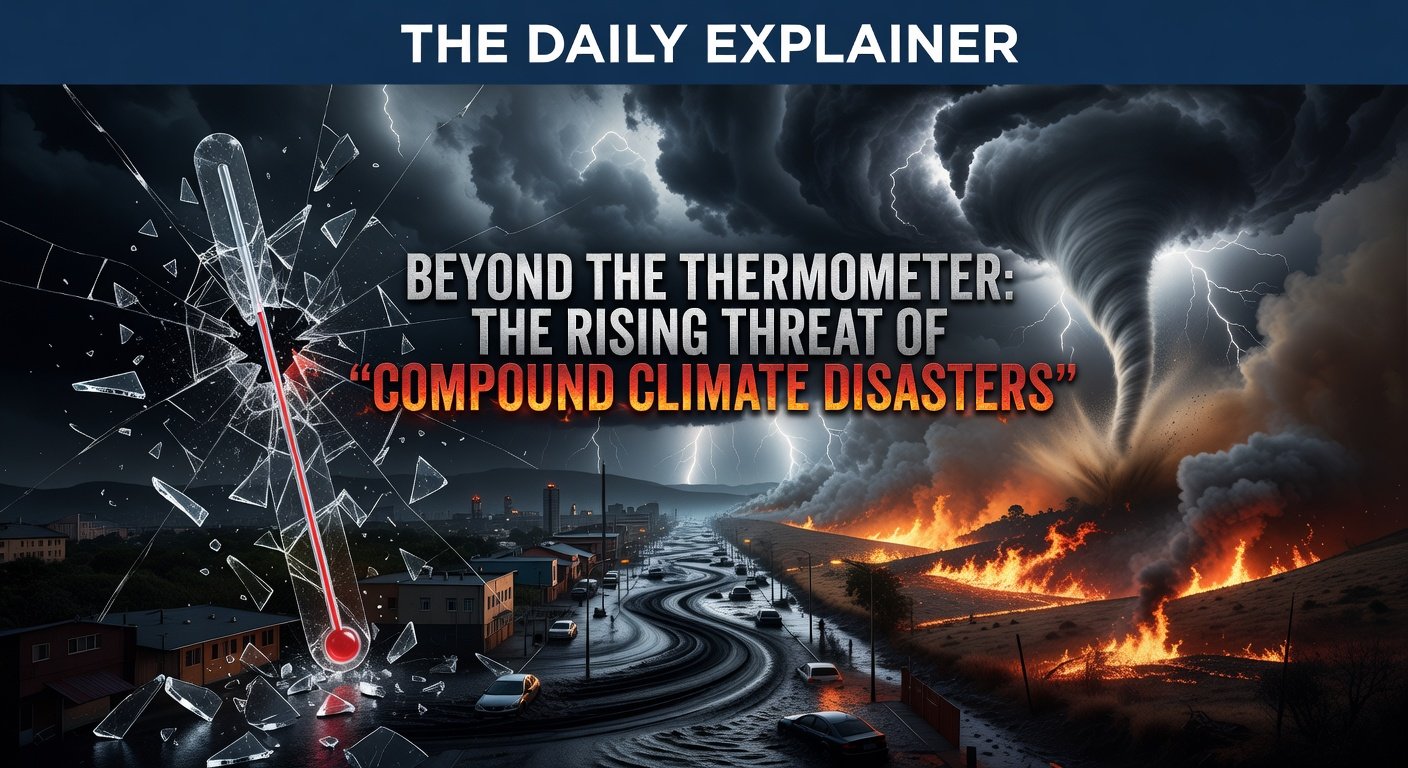
In 2026, climate disasters are no longer isolated events. Heatwaves, fires, floods, and storms are increasingly striking in combination, creating cascading failures that overwhelm communities and infrastructure.
Introduction – Why This Matters
In my years of covering climate issues, I’ve noticed that we tend to think of disasters in neat, separate boxes. A flood is a flood. A heatwave is a heatwave. A wildfire is a wildfire. We have different government agencies, different response protocols, and different insurance products for each one. What I’ve found is that this siloed thinking is becoming dangerously obsolete.
The reality of 2026 is that climate disasters no longer arrive politely, one at a time, with a clear beginning and end. They come in waves. They cluster. They cascade. A heatwave dries out the land, then a fire ignites, then the fire destroys power lines, then a storm hits the burned hillsides, triggering massive mudslides. Each disaster creates the conditions for the next, and the combined impact is far worse than if each had occurred in isolation.
This is the world of compound climate disasters, and it is the new normal. As we explored in our previous articles on the Cryosphere Crisis, the Nature-Climate Feedback Loop, and the critical need for Climate Adaptation vs Mitigation, the systems of our planet are interconnected. Now, we must confront the terrifying implication of that interconnectivity: when one system fails, it can trigger a domino effect across many others. Understanding compound disasters isn’t just an academic exercise; it’s essential for survival in the decades ahead.
Background / Context
The term “compound event” might sound like technical jargon, but the concept is as old as disaster itself. Historically, societies have faced situations where multiple hazards converged. What’s new is the frequency, intensity, and scale at which these events are now occurring due to human-caused climate change.
The scientific community has been sounding the alarm for years. The Intergovernmental Panel on Climate Change (IPCC) has consistently highlighted compound events as a critical and understudied risk in its assessment reports. The COST Action DAMOCLES (Understanding and modeling compound climate and weather events) was a major European research effort dedicated entirely to this topic. Its work has been instrumental in creating a framework for defining and analyzing these complex events .
The World Economic Forum’s Global Risks Report 2026 now explicitly warns of “cascading climate-environmental systemic failures” . The report notes that we are seeing a marked increase not only in the number of extreme weather events, but in their interplay with critical infrastructure vulnerabilities. Transport networks, utilities, and cities are now grappling with simultaneous pressures, heightening the chances of cascading failures.
January 2026 alone provided a global snapshot of this new reality. According to the World Meteorological Organization, the first month of the year saw simultaneous extremes across the planet: record-breaking heatwaves and wildfires in Australia and South America, devastating cold snaps and winter storms across North America, and catastrophic flooding in Africa and Europe. These weren’t separate stories; they were different symptoms of the same destabilized climate system.
Key Concepts Defined
To understand the complexity of modern climate disasters, we need a precise vocabulary. These terms are essential for grasping how risks combine and escalate.
- Compound Event: An extreme event that results from the combination of multiple drivers or hazards that occur simultaneously or in close succession. The combined impact is often greater than the sum of its parts .
- Example: A coastal city hit by both a storm surge and heavy rainfall at the same time, leading to catastrophic flooding that neither event alone would have caused.
- Cascading Disaster: A sequence of events where one extreme event triggers or exacerbates subsequent failures in interconnected systems, such as infrastructure, supply chains, or ecosystems.
- Example: An earthquake triggers a tsunami, which floods a nuclear power plant, causing a meltdown and radiation release (Fukushima, 2011).
- Concurrent Hazards: Two or more hazardous events occurring in the same geographic area at the same time.
- Example: A heatwave and a drought occurring simultaneously, which together create extreme fire risk.
- Successive Hazards: Hazardous events occurring one after another in the same area, before recovery from the first event is complete.
- Example: A hurricane hits, and less than two weeks later, before power is restored, another hurricane strikes the same region.
- Compounding Impacts: The worsening of effects when hazards interact with pre-existing vulnerabilities, such as poverty, aging infrastructure, or environmental degradation.
- Tipping Point: A threshold beyond which a system undergoes a significant, often irreversible, change. Some scientists suggest that the rise of compound disasters may itself indicate we have crossed a dangerous tipping point in Earth’s systems.
- Downward Counterfactual: A risk analysis method that explores how historical events could have been worse under slightly different conditions, helping identify potential tipping points for future disasters.
How It Works (Step-by-Step Breakdown of a Compound Disaster)
Compound disasters are not random chaos. They follow logical, predictable pathways. Understanding these pathways is the first step toward breaking them. Here is a step-by-step breakdown using a common and deadly scenario: the heatwave-fire-flood cascade.
Step 1: The Initial Stressor – Prolonged Heatwave and Drought
The disaster begins not with a dramatic event, but with a slow-building stressor. A region experiences an extended period of above-average temperatures and below-average rainfall. This is not just uncomfortable for people; it fundamentally alters the landscape. Soils dry out. Vegetation loses moisture and becomes brittle. Rivers and reservoirs drop. The land is primed for disaster. As the World Weather Attribution service found, climate change is making such “fire weather” conditions significantly more likely .
Step 2: The Trigger Event – Ignition
A spark—from a lightning strike, a downed power line, or human activity—ignites the tinder-dry landscape. Because of the preceding drought and heat, the fire spreads with explosive speed. It becomes a megafire, burning with such intensity that it creates its own weather patterns, generating fire tornadoes and spotting embers miles ahead of the main front. This was the case in the devastating January 2026 fires in Chile and Argentina, where climate change made the hot, dry, and windy conditions three times more likely .
Step 3: The Immediate Cascading Impact – Infrastructure Failure
The fire doesn’t just burn trees and homes. It attacks critical infrastructure. Flames melt power lines and destroy substations, causing widespread blackouts. It damages roads and railways, cutting off evacuation routes and supply lines. It can even contaminate water supplies. The loss of power then has its own cascading effects: water treatment plants stop working, gas stations can’t pump fuel, and cell phone towers go dark, hampering communication and coordination. As the 2026 Global Risks Report notes, this is the reality of “Infrastructure Endangered” .
Step 4: The Secondary Hazard – Post-Fire Debris Flows
The fire is eventually contained, but the danger is far from over. The intense heat has burned away vegetation and baked the soil, creating a hydrophobic (water-repellent) layer. Months or even weeks later, a heavy rainstorm arrives. With no plants to hold the soil and the ground unable to absorb water, torrents of mud, ash, and debris race down hillsides into the burned area. These post-fire debris flows can be incredibly destructive, burying homes and roads that survived the fire. This is a classic example of a compound event where the primary hazard (fire) creates the conditions for a secondary hazard (flood/mudslide).
Step 5: The Long-Term Socioeconomic Cascade
The impacts ripple outward. The combined disaster destroys crops and grazing land, leading to food price spikes. It destroys tourism, a key economic driver for many regions. It displaces populations, creating housing crises and straining social services in unaffected areas. Insurers face massive payouts, leading them to raise premiums or withdraw coverage from high-risk areas altogether, creating an “insurance spiral” that makes recovery even harder. The mental health toll is immense, as communities face repeated trauma with no time to recover.
Key Takeaways Box:
- Disasters don’t happen in a vacuum: They interact with each other and with vulnerable infrastructure.
- The whole is greater than the sum of its parts: A compound event’s impact is far worse than if the hazards occurred separately.
- Cascades can cross sectors: A weather event can trigger failures in energy, water, transport, and health systems simultaneously.
- Recovery is the new vulnerability: When the next disaster strikes before a community has recovered, the impact is compounded.
Why It’s Important
The rise of compound climate disasters fundamentally challenges how we have organized our society to manage risk. Our systems—from emergency response to insurance to infrastructure planning—were built for a different, more stable world. They are not equipped for this new reality.
- Overwhelming Emergency Response: First responders and disaster relief systems are designed for single, contained events. When a heatwave, fire, and flood strike in quick succession, resources are stretched thin, and responders become exhausted. The Red Cross Climate Centre has documented how events like Pakistan’s 2022 “double jeopardy” of heatwave then flood overwhelmed national and international response capacity .
- Exposing Critical Infrastructure Vulnerabilities: Modern society runs on interconnected systems. A power plant needs water for cooling; a water treatment plant needs power to run; both need transportation networks for fuel and supplies. A compound event can sever these connections, causing system-wide failure. The 2021 Texas winter storm, which knocked out power and water for millions, was a stark warning of what cascading infrastructure failure looks like .
- Unraveling the Social Fabric: Repeated, compounding disasters erode community resilience. People who lose their homes, livelihoods, and loved ones multiple times in a short period face severe mental health challenges. Trust in institutions erodes if they are seen as unable to protect citizens or help them recover. This can lead to social instability and, as noted in the ACAPS report on West Asia, even community-level tensions and conflicts over dwindling resources like water .
- Making Places Uninhabitable: When a region is hit by repeated, compounding disasters, the cumulative damage can make it impossible to rebuild. Insurance becomes unaffordable or unavailable. Businesses leave. People migrate away. This is the ultimate expression of “loss and damage”—the point where adaptation is no longer possible. As the New Scientist asks, are we witnessing the first climate tipping points being crossed before our eyes?
Sustainability in the Future
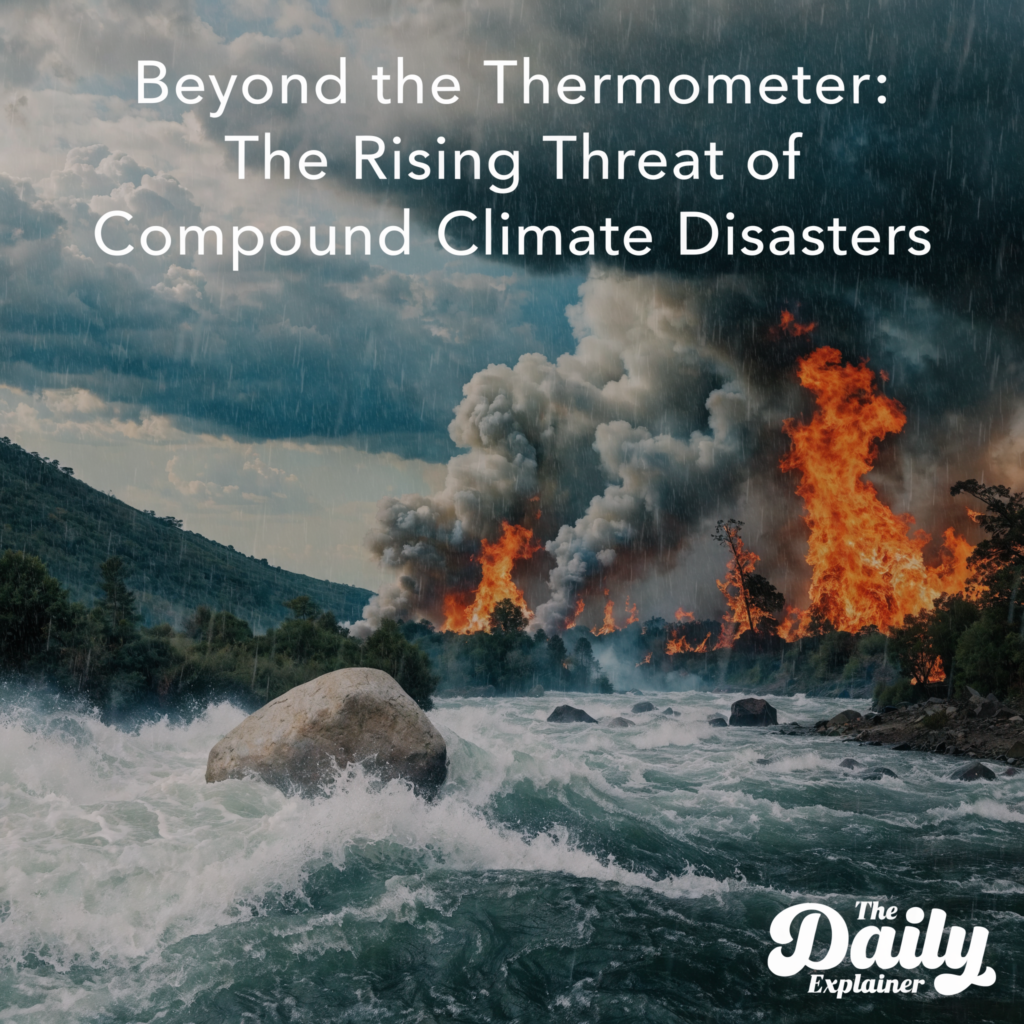
Building a sustainable future in an era of compound disasters requires a fundamental rethink of resilience. We cannot simply build back the same way; we must build back better, and differently.
- Multi-Hazard Risk Assessment: The old model of assessing risks one hazard at a time is obsolete. Future planning must use multi-hazard approaches that consider how different threats can combine and cascade . This means running scenarios that ask not just “what if there’s a flood?” but “what if a flood hits during a heatwave, while the power grid is already down?”
- Resilient and Redundant Infrastructure: We need to build infrastructure that is robust to cascading failures. This means redundancy—having backup systems for critical services. It means hardening key assets against multiple threats. And it means smart design, such as burying power lines in fire-prone areas or building hospitals with on-site power and water that can operate independently for weeks.
- Nature-Based Solutions as Buffers: Healthy ecosystems are our first line of defense against compound disasters. Wetlands absorb floodwaters and storm surges. Healthy forests and controlled burns reduce the risk of megafires. Mangroves protect coasts from both storm surge and erosion. Investing in nature is one of the most cost-effective ways to build resilience against multiple hazards simultaneously .
- Community-Led Resilience: Top-down plans are not enough. Communities on the front lines must be empowered with the knowledge, resources, and decision-making power to prepare for compound events. This includes early warning systems that are accessible to all, community emergency response teams, and social safety nets that can catch people when disaster strikes repeatedly .
Common Misconceptions
The complexity of compound disasters leads to several common misunderstandings.
Misconception 1: “A cold snap in one place disproves global warming.”
This was powerfully addressed by climate scientist Robert Kopp in a recent CNN interview, as mentioned in our first article. A winter storm in Texas does not cancel out a heatwave in Australia. In fact, as the World Meteorological Organization explained in January 2026, the weakening and distortion of the polar vortex—a phenomenon linked to a warming Arctic—can actually drive frigid air southward, causing severe winter weather in mid-latitudes even as the planet overall warms . Weather is local and variable; climate is global and trending upward.
Misconception 2: “We just need to strengthen each system individually.”
Hardening a power plant against flooding is good, but it’s not enough if the roads leading to it wash out, or if the fuel supply is disrupted by a separate event. Compound disasters require systems thinking. The goal is not just to make individual components stronger, but to ensure the entire network of systems can function even when parts of it fail.
Misconception 3: “These are just freak, one-off events.”
When Hurricane Ida hit Louisiana in 2021, it was followed just over two weeks later by another major storm, Nicholas. Back-to-back hurricanes were once a “once-a-century” event on the US Gulf Coast. Research now shows they could become a “once-every-two-years” event by the end of this century . This is not a freak occurrence; it’s a statistical trend driven by a warming climate.
Misconception 4: “If we cut emissions, we can stop compound disasters.”
Cutting emissions (mitigation) is absolutely essential to prevent the worst-case scenarios. However, as we discussed in our article on adaptation vs. mitigation, some level of compound disasters is now locked in due to the warming that has already occurred. We must simultaneously cut emissions and prepare for a world with more compound events.
Recent Developments (2025-2026)
The past 12 months have provided a brutal education in compound disasters, with events on nearly every continent.
- January 2026: A Month of Global Extremes: The World Meteorological Organization documented an astonishing array of simultaneous and successive disasters in a single month .
- North America: A massive winter storm, fueled by a disrupted polar vortex, brought record cold and snow, causing power outages and deaths across Canada and the US.
- South America: Simultaneously, Chile and Argentina were battling devastating wildfires, with temperatures in some areas exceeding 45°C. The World Weather Attribution study later confirmed climate change made these “fire weather” conditions three times more likely .
- Africa: Southeastern Africa, particularly Mozambique and South Africa, was deluged by catastrophic floods, displacing hundreds of thousands.
- Australia: The country endured its second major heatwave in a month, with temperatures hitting 49.5°C in South Australia.
- The Chile-Argentina Fires (January 2026): This event was a textbook compound disaster. A prolonged drought and heatwave created bone-dry conditions. When fires ignited, they were spread by extreme winds. The fires then threatened critical infrastructure, including power lines and roads, and blanketed cities in toxic smoke for weeks. The disaster exposed deep vulnerabilities, including budget cuts to fire management services in Argentina and the spread of highly flammable non-native pine plantations in Chile .
- The West Asia Water Crisis (Ongoing): The La Niña event that began in late 2025 has brought below-average rainfall to Iraq, Jordan, Lebanon, Palestine, and Syria. This is compounding existing water scarcity and drought conditions. The ACAPS anticipatory report warns that even with normal spring rains, water reserves may not fully recover, threatening agriculture, drinking water supplies, and even regional stability as water-related protests increase.
Real-Life Examples
These case studies illustrate how compound disasters unfold in practice.
1. Pakistan 2022: The Double Jeopardy of Heatwave and Flood
In the spring of 2022, Pakistan experienced a record-breaking heatwave, with temperatures soaring above 49°C in some areas. This extreme heat, made 30 times more likely by climate change according to WWA, melted glaciers in the north and dried out soils. Then, in the summer, unprecedented monsoon rains fell—a 500-year event made heavier by warming. The parched ground could not absorb the intense rainfall, triggering catastrophic flooding that submerged a third of the country, displaced 33 million people, and caused over $30 billion in damages . This is a perfect example of one hazard (heatwave) directly exacerbating the impact of a subsequent hazard (flood).
2. Hurricane Beryl and the Texas Heatwave (July 2024)
When Hurricane Beryl struck Texas in July 2024, it caused extensive flooding and, critically, widespread power outages. As recovery efforts were just beginning, a severe heatwave descended, with temperatures approaching 38°C. The lack of electricity meant that air conditioning and cooling centers were unavailable for millions of residents. Hospitals were quickly overwhelmed, not just by heat stress cases, but by carbon monoxide poisoning from people running generators unsafely in their homes . The compound event—flooding followed by a power outage during a heatwave—created a public health crisis far worse than any of the individual hazards would have alone.
3. The PG&E Bankruptcy and California Wildfires (2017-2019)
This example, highlighted in a study by risk analyst Gordon Woo, shows how natural hazards and human systems can combine in a downward counterfactual spiral . In 2017, the utility Pacific Gas & Electric (PG&E) narrowly avoided liability for the Tubbs Fire in Northern California. If they had heeded this warning and increased inspection of their aging power lines, they might have prevented future disasters. Instead, the following year, the Camp Fire—the deadliest and most destructive in California’s history—was sparked by PG&E equipment. The company, facing billions in liability, was forced to file for bankruptcy. This is a cascading disaster that moved from a natural hazard (fire) to corporate failure (bankruptcy) to systemic impact (unpaid claims, disrupted power for millions).
Success Stories
While the news is daunting, there are examples of communities and organizations successfully preparing for and responding to compound events.
- Bangladesh’s Multi-Hazard Early Warning System: As mentioned in our adaptation article, Bangladesh has invested heavily in cyclone preparedness. But they have also expanded their systems to include flood, drought, and heatwave warnings. These systems are linked to community-level response plans and thousands of multi-purpose shelters. This integrated, multi-hazard approach saves countless lives each year.
- The Netherlands’ “Room for the River” as a Multi-Solution: The Dutch program, also mentioned previously, is a prime example of using nature-based solutions to address multiple hazards. By giving rivers more space, they reduce flood risk from both heavy rainfall and upstream snowmelt. The newly created parks and green spaces also help cool cities during heatwaves and provide recreational areas, enhancing quality of life.
- The DAMOCLES Research Network: The COST Action DAMOCLES itself is a success story. By bringing together climate scientists, hydrologists, statisticians, and impact modelers, they created a new scientific framework for understanding compound events. This work is now informing IPCC reports and helping practitioners on the ground conduct more accurate risk assessments. As Bart van den Hurk of Deltares Institute noted, this research directly helped a client make an informed, multi-million-dollar decision to invest in flood infrastructure .
Conclusion and Key Takeaways
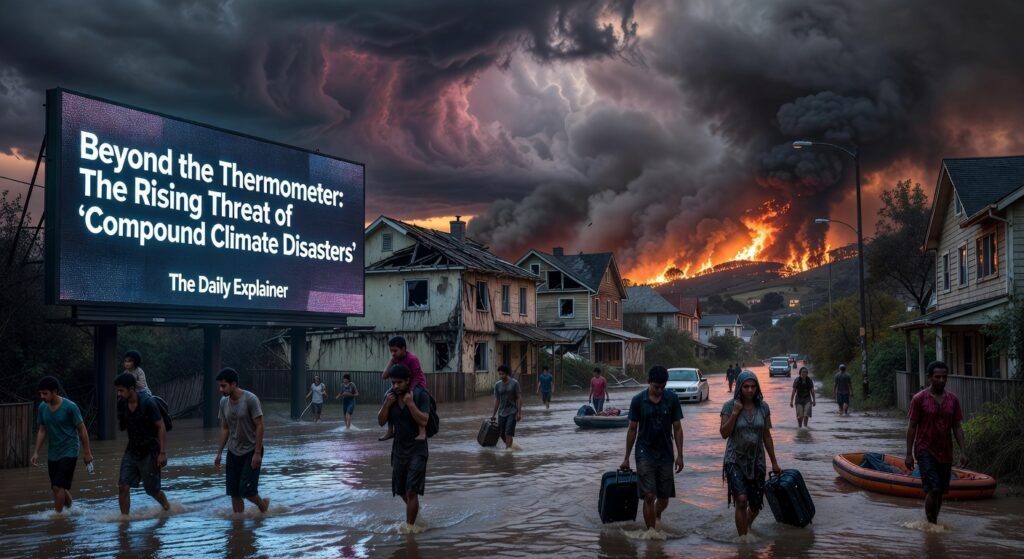
The era of the single, simple disaster is over. We have entered the age of the compound event, where hazards overlap, cascade, and amplify each other. The same January week that brought deadly fires to Chile brought paralyzing snow to North America and devastating floods to Africa. This is not a coincidence; it is the signature of a destabilized climate system.
Our previous articles explored the mechanisms of this destabilization: the melting cryosphere, the burning forests, and the urgent need for a dual strategy of mitigation and adaptation. This article adds the final, critical layer: understanding that these threats do not arrive in isolation. They come in waves, and our defenses must be built to withstand the full force of the storm.
The challenge is immense, but it is not insurmountable. It requires a shift in thinking: from silos to systems, from single hazards to multi-hazards, from reactive response to proactive resilience. The cost of inaction is measured not just in dollars, but in lives, communities, and the stability of our civilization.
Key Takeaways:
- Disasters are now compound: Heatwaves, fires, floods, and storms increasingly occur simultaneously or in rapid succession, creating impacts far worse than individual events.
- Cascades are the new normal: A failure in one system (e.g., power grid) can trigger failures in others (e.g., water, healthcare, transport), leading to societal breakdown.
- Infrastructure is endangered: Our roads, power lines, and water systems, built for a past climate, are dangerously vulnerable to compound shocks.
- Recovery windows are shrinking: When the next disaster strikes before a community has recovered from the last, the cumulative impact can be devastating and permanent.
- Solutions must be multi-hazard: We must plan for the worst-case combination of events, using nature-based solutions, resilient infrastructure, and empowered communities to build a buffer against the coming storms.
FAQs (Frequently Asked Questions)
- What is a compound climate disaster?
It’s an extreme event caused by multiple hazards occurring at the same time or in close succession, or a single hazard that triggers cascading failures across different systems, resulting in impacts that are greater than the sum of their parts. - How is a compound disaster different from a regular natural disaster?
A regular disaster, like a flood, is typically a single hazard. A compound disaster involves interacting hazards—for example, a hurricane that causes both a storm surge and inland flooding, followed by a power outage and then a heatwave. - Is climate change making compound disasters more common?
Yes. The World Meteorological Organization and the IPCC confirm that human-caused climate change is increasing the frequency and intensity of extreme weather events, which in turn makes it more likely that they will overlap and interact. - What happened in January 2026 that was so significant?
January 2026 saw a remarkable array of simultaneous extremes: record heat and fires in Australia and South America, a brutal winter storm in North America, and catastrophic flooding in Africa and Europe, all within the same month. - What were the causes of the 2026 Chile and Argentina wildfires?
A combination of factors: a prolonged drought, a severe heatwave, and strong winds. A rapid attribution study by World Weather Attribution found that climate change made these “fire weather” conditions about three times more likely. - What is a “cascading failure”?
A cascading failure is when the impact of a disaster spreads from one system to another. For example, a storm knocks out power lines, which shuts down water pumps, which stops the flow of water needed to fight fires or cool a hospital. - Can compound disasters cause a mental health crisis?
Experts believe so. When communities are hit by disaster after disaster with little time to recover, the cumulative stress and trauma can overwhelm coping mechanisms, leading to widespread anxiety, depression, and post-traumatic stress. - What is the “double jeopardy” of heatwaves and floods?
This refers to a situation where a heatwave bakes the soil, making it hard and unable to absorb water, followed by intense rainfall that then runs off rapidly, causing flash floods, as happened in Pakistan in 2022 . - What happened in Texas after Hurricane Beryl in 2024?
Hurricane Beryl caused flooding and widespread power outages. Immediately afterward, a severe heatwave struck. With no power for air conditioning, millions were exposed to dangerous heat, leading to hospitalizations and deaths. - How does the polar vortex cause cold snaps in a warming world?
A warming Arctic can destabilize the polar vortex, the ring of cold air normally trapped around the North Pole. This can cause it to weaken and wobble, sending frigid air southward into North America, Europe, and Asia, even as the global average temperature rises. - What is the “Global Risks Report 2026” saying about this?
The WEF report highlights that we are seeing a “weak but growing signal of systemic risk cascading across multiple sectors,” driven by the interplay of extreme weather and vulnerable infrastructure. - What are “downward counterfactuals” in risk analysis?
It’s a method of analyzing past disasters by asking, “How could this have been even worse?” This helps identify hidden vulnerabilities and potential tipping points, like how the 2017 Tubbs Fire could have been a warning that, if heeded, might have prevented the 2018 Camp Fire. - What is being done to study compound events?
Major research initiatives like the COST Action DAMOCLES have brought together scientists to create a framework for understanding and modeling compound events, and their findings are now being incorporated into IPCC reports. - How can cities prepare for compound disasters?
Cities need to adopt multi-hazard approaches, invest in resilient and redundant infrastructure (like backup power for water pumps), use nature-based solutions (like parks that absorb floodwater and cool the air), and empower communities with early warning and response plans. - What is a “tropical cyclone-deadly heat compound hazard”?
This is a scenario where a hurricane or cyclone knocks out power, and is then followed within days by a severe heatwave. Without power for air conditioning, millions are exposed to potentially fatal heat. Once vanishingly rare, this could become a regular threat under 2°C of warming. - How does La Niña contribute to compound risks?
La Niña is a natural climate pattern that can cause specific regional anomalies, like drought in West Asia. When these natural variations combine with the long-term trend of human-caused warming, they can create compound risks, such as a drought that is both more severe and more likely to be followed by extreme heat. - What role does infrastructure play in cascading failures?
A massive one. Aging and underfunded infrastructure is highly vulnerable. A report from Oak Ridge National Laboratory warned that climate-fueled events could cause “cascading system failures” in energy and transport networks, with knock-on effects across the entire economy. - What happened in Libya in 2023 that is relevant?
In September 2023, Storm Daniel caused the collapse of two dams near Derna, Libya, leading to a catastrophic flood that killed thousands. A downward counterfactual analysis later revealed that a hydrologist had warned in 2022 that a storm like that would cause the dams to fail. - Can insurance handle compound disasters?
The insurance industry is under immense pressure. Catastrophic seasons are pushing insurers to reassess risk models and raise premiums. In some high-risk areas, insurance is becoming unaffordable or unavailable, which could lead to a broader financial crisis. - Where can I learn more about climate resilience strategies?
For more in-depth explanations on climate adaptation and other related topics, you can explore our Explained section and our blog. For global perspectives, resources like the Sherakat Network’s resources page and the WorldClassBlogs “Our Focus” page offer valuable insights. - How do compound disasters affect food security?
A drought can kill crops, a flood can wash them away, and a heatwave can reduce yields. When these happen in succession or in different breadbasket regions at the same time, it can lead to global food price spikes and shortages, as we saw in 2022. - What is the single most important thing to do to prepare for compound disasters?
Recognize that they are coming. Shift from a single-hazard mindset to a multi-hazard, systems-thinking approach in all planning—from personal emergency kits to national infrastructure investment. Advocate for policies that fund both mitigation and adaptation.
About Author
This article was written by the editorial team at The Daily Explainer, building on our previous in-depth analysis of the Cryosphere Crisis, the Nature-Climate Feedback Loop, and the critical need for Climate Adaptation vs. Mitigation. We synthesize reports from the World Meteorological Organization, the World Economic Forum, the Red Cross Climate Centre, and peer-reviewed scientific literature to provide clear, actionable insights on the planet’s most pressing environmental challenges. For any questions or feedback, please feel free to contact us.
Free Resources
- WMO State of the Global Climate: Annual reports from the World Meteorological Organization providing authoritative updates on the climate system.
- PreventionWeb: A knowledge platform for disaster risk reduction, run by the UN Office for Disaster Risk Reduction (UNDRR), with extensive resources on compound events.
- Red Cross Climate Centre: Provides excellent resources on the humanitarian impacts of climate change, including compound and cascading disasters.
- DAMOCLES Research Network Publications: For those seeking deeper scientific understanding, the publications from the COST Action DAMOCLES are foundational reading.
Discussion
Have you or your community experienced a compound disaster? A flood after a fire? A heatwave during a blackout? How did you cope, and what do you wish you had known beforehand? Share your experiences and insights in the comments below—your story can help others prepare. For ongoing discussions and more articles, visit our blog or check out the latest in Global Affairs & Politics.
About The Author

4 thoughts on “Beyond the Thermometer: The Rising Threat of “Compound Climate Disasters”