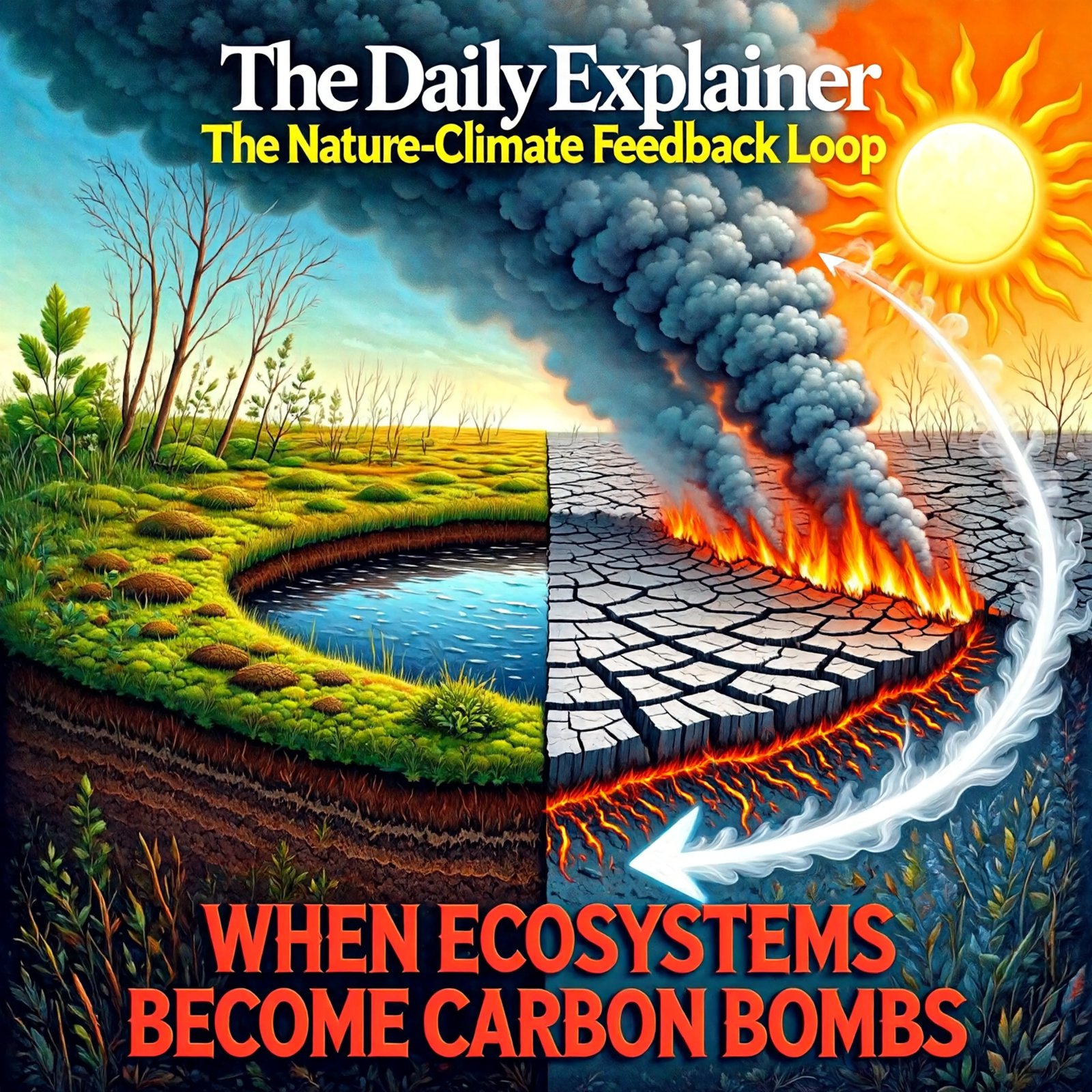
Wildfires, intensified by climate change, are transforming forests from carbon sinks into major emission sources, accelerating global warming in a dangerous feedback loop.
Introduction – Why This Matters
In my experience covering environmental policy, I’ve noticed a comforting idea that many of us hold: that nature is on our side in the fight against climate change. We plant trees to offset our carbon footprint. We protect rainforests because they are the “lungs of the world.” What I’ve found is that this relationship is becoming dangerously unstable. The very ecosystems we rely on to absorb our carbon pollution are themselves becoming victims of climate change. And when they turn, they don’t just stop absorbing—they start emitting, often on a catastrophic scale.
This is the nature-climate feedback loop. It’s the process where a warming planet damages ecosystems—through fire, drought, pests, and storms—causing them to release vast stores of carbon. This released carbon then fuels further warming, which damages more ecosystems. It’s a vicious cycle that transforms our greatest natural allies into massive “carbon bombs.” Understanding this loop is critical because it challenges our assumptions about carbon budgets and reveals a ticking clock we cannot afford to ignore.
Background / Context
For most of human history, the Earth’s land and ocean ecosystems have been a net “carbon sink.” They have absorbed about half of the carbon dioxide we’ve emitted from burning fossil fuels and deforestation. Forests alone have absorbed a net 7.6 billion metric tonnes of CO2 per year between 2001 and 2019. This natural carbon absorption has been a silent hero, significantly slowing the pace of climate change.
But this hero is under immense stress. The conditions that allow ecosystems to thrive and store carbon—stable temperatures, predictable rainfall, and natural disturbance regimes—are being destabilised by global warming. The Intergovernmental Panel on Climate Change (IPCC) has warned for years that the risk of “feedback loops” could push the planet past critical tipping points.
We are now seeing those warnings come to life. The past five years have seen unprecedented wildfires from the Arctic to Australia, record-breaking droughts in the Amazon and Europe, and massive tree die-offs from pest infestations that thrive in warmer winters. These aren’t isolated events; they are symptoms of a systemic shift. As of early 2026, data from the World Resources Institute and global forest monitoring services confirm that some of the world’s most critical carbon sinks are showing signs of saturation and, in some cases, are becoming net emitters.
Key Concepts Defined
To grasp the nature-climate feedback loop, we need a clear understanding of the terms that describe this fragile balance and its breakdown.
- Carbon Sink: A natural or artificial reservoir that absorbs and stores carbon from the atmosphere. Forests, oceans, and soil are the primary natural carbon sinks.
- Carbon Source: Anything that releases more carbon into the atmosphere than it absorbs. A burning forest, a thawing peatland, or a fossil fuel power plant are all carbon sources.
- Feedback Loop: A process where an initial change triggers processes that either amplify (positive feedback) or diminish (negative feedback) that initial change. The nature-climate loop is a dangerous positive feedback.
- Tipping Point: A threshold beyond which a system undergoes a significant, often irreversible, change. For an ecosystem, this could mean a forest turning into a savanna that cannot store the same amount of carbon.
- Megafire: An immense wildfire, typically over 40,000 hectares (100,000 acres), that burns with extreme intensity and is often unstoppable by conventional firefighting methods. These are fueled by climate change.
- Die-off: Widespread mortality of trees in a forest due to stressors like drought, heat, or pests. This turns a living, carbon-storing forest into a dry, carbon-emitting fuel load.
- Peatland: A type of wetland that accumulates partially decayed vegetation (peat), which is a highly effective carbon store. Peatlands cover only 3% of the Earth’s land but store nearly 30% of all soil carbon .
- Bark Beetle Infestation: A natural forest disturbance that has become a major climate-driven threat. Warmer winters allow beetle populations to explode, killing vast swathes of forest and turning them into tinderboxes.
How It Works (Step-by-Step Breakdown)
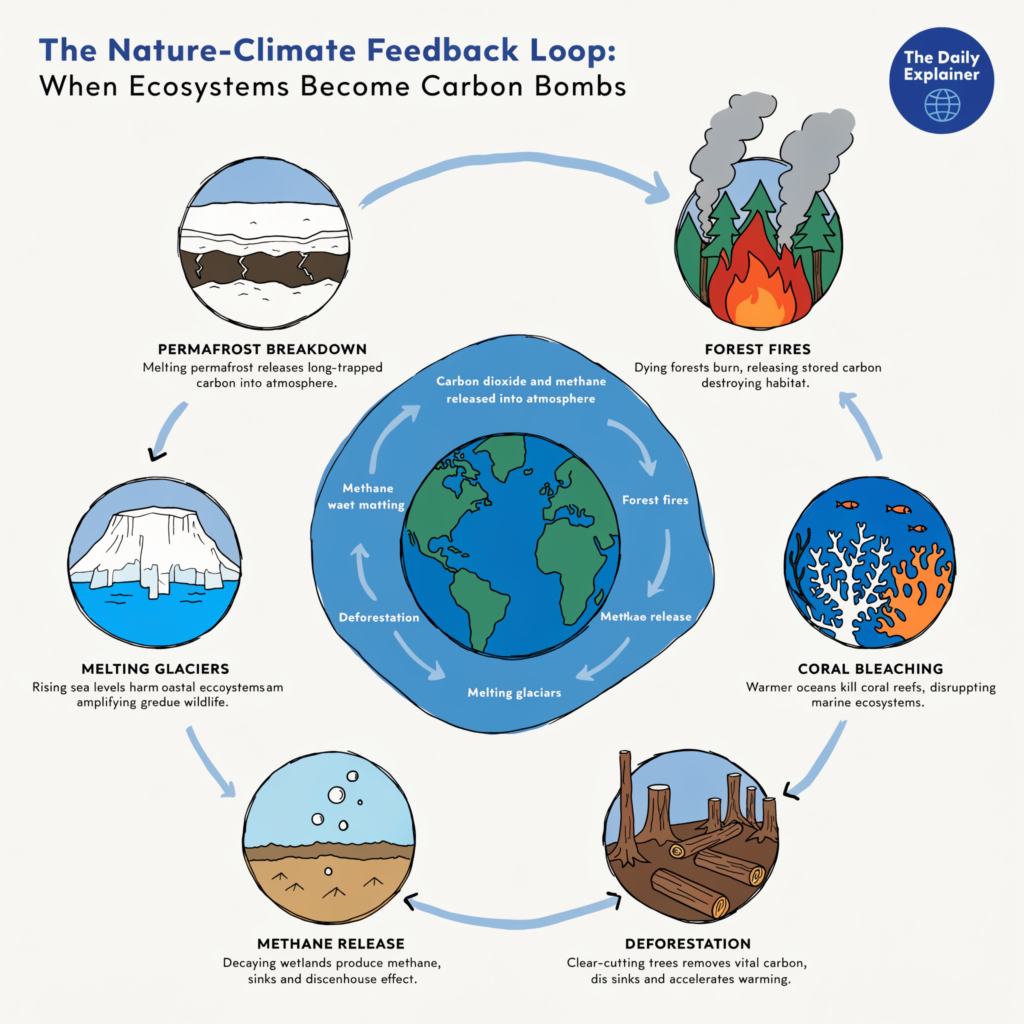
The nature-climate feedback loop isn’t a single event, but a chain reaction that plays out across the world’s major ecosystems. Here is a step-by-step breakdown of how it operates, using forests as the primary example.
Step 1: The Initial Warming Stress
Human-caused climate change raises global average temperatures. This isn’t just about it being a little warmer. It leads to more frequent and intense heatwaves, alters precipitation patterns (causing both severe droughts and floods), and reduces winter snowpack. These are the underlying stressors.
Step 2: The Ecosystem’s “Fever”
The stressed ecosystem begins to show symptoms.
- Drought Stress: Trees, lacking sufficient water, close their stomata (leaf pores) to conserve water, which also stops them from taking in CO2. They become weaker and more susceptible to disease and pests.
- Heat Stress: Extreme temperatures can directly damage tree tissues, slowing growth and increasing mortality.
- Pest Outbreaks: Warmer winters mean that pests like the mountain pine beetle no longer die back. Their populations explode, and they can overwhelm the weakened defenses of vast forests.
Step 3: The “Trigger Event”
A trigger event turns this stressed, vulnerable biomass into an active emission source. The most dramatic trigger is fire. A lightning strike or human carelessness ignites a forest already primed to burn by drought and heat. Because the fuel (dead and dying trees) is so abundant and dry, the fire becomes a megafire of unprecedented scale and intensity. These fires are so hot they can kill even fire-adapted trees and burn deep into carbon-rich soil.
Step 4: The Massive Carbon Pulse
This is the “carbon bomb” moment. The fire doesn’t just burn leaves and twigs. It combusts massive trunks, root systems, and deep peat layers, instantly releasing decades or even centuries of stored carbon back into the atmosphere as CO2. The 2023 Canadian wildfires, for example, released about 480 million tonnes of carbon—roughly the same as Japan’s annual CO2 emissions from fossil fuels .
Step 5: The Long-Term Degradation and Albedo Shift
The damage doesn’t end when the fire is out. A burned forest is no longer a carbon sink. It may take decades to regrow, and in a hotter, drier climate, it may never return to its original state, potentially shifting to a grassland or shrubland that stores far less carbon. In boreal forests, the loss of dark, fire-scorched trees (which absorb heat) or the replacement of forest with snow-covered shrubs (which reflect heat) can create complex local albedo effects that further complicate the warming .
Step 6: The Global Amplification
The massive pulse of CO2 from the fire enters the global atmosphere, adding to the greenhouse effect. This additional warming increases the global average temperature, which in turn worsens the drought and heat stress on other ecosystems around the world, making them more vulnerable to their own trigger events. The loop is complete: warming -> stressed ecosystem -> trigger event -> carbon release -> more warming.
Key Takeaways Box:
- Nature is shifting from a helper to a hindrance: Climate change is turning carbon sinks into sources.
- Megafires are the main trigger: They release centuries of stored carbon in a single season.
- It’s not just fire: Drought, pests, and storms also degrade ecosystems and cause carbon loss.
- This is a global accelerator: These emissions make the entire job of climate mitigation harder.
Why It’s Important
The nature-climate feedback loop is critical to understand because it fundamentally alters our understanding of the climate challenge. It’s not just about us stopping our own emissions; it’s about preventing the natural world from adding a massive new stream of emissions we can’t directly control.
- Blowing the Carbon Budget: Global climate targets, like the 1.5°C goal, are based on a finite “carbon budget”—the total amount of CO2 we can emit. These budgets historically accounted for human emissions. They did not fully account for the possibility that major ecosystems could become net emitters. If the Amazon or the boreal forests start releasing billions of tonnes of CO2 annually, it will consume our remaining budget much faster, making the 1.5°C target nearly impossible to reach.
- Ecosystem Collapse and Biodiversity Loss: The feedback loop is a one-way street towards ecosystem degradation. A forest that burns and cannot regrow is a forest that has lost its biodiversity. Species that depend on that specific habitat are displaced or go extinct. The 2026 Global Risks Report highlights “biodiversity loss and ecosystem collapse” as a top-tier global threat, inextricably linked to this feedback cycle .
- Threats to Human Health and Livelihoods: The smoke from megafires is a major public health crisis, causing respiratory illnesses thousands of miles from the flames. The loss of forests leads to soil erosion, water cycle disruption, and loss of livelihood for millions of people who depend on forests for food, medicine, and income.
- Accelerating Climate Change: This is the core of its importance. The feedback loop is an accelerant. It’s a self-perpetuating mechanism that can run independently of our fossil fuel use. If we trigger it at a large enough scale, it could lock us into a much hotter climate pathway, even if we drastically cut our own emissions.
Sustainability in the Future
Addressing the nature-climate feedback loop requires a twin-track approach: aggressive mitigation to reduce the stress on ecosystems, and proactive adaptation and resilience-building to protect the carbon sinks we have left.
Mitigation (Stopping the Stress): This remains the non-negotiable foundation. We must decarbonize the global economy as fast as possible. Every fraction of a degree of warming we prevent reduces the intensity of droughts, heatwaves, and pest outbreaks. Without this, our efforts to protect forests will be like trying to save an ice cube in a furnace.
Adaptation and Resilience (Protecting the Sinks):
- Proactive Forest Management: This means moving away from total fire suppression and towards managing forests to reduce fuel loads. Techniques include controlled burns (which mimic natural fire cycles and clear out undergrowth safely), thinning dense stands of trees, and creating fire breaks.
- Restoring Degraded Lands: Reforestation and afforestation must be done strategically, focusing on native, diverse species that are more resilient to future climate conditions, rather than monoculture plantations that are highly vulnerable.
- Protecting Peatlands: These carbon-dense ecosystems are critically important. Sustainability means halting drainage for agriculture or palm oil plantations, and rewetting drained peatlands to prevent them from decomposing and releasing CO2.
- International Cooperation: As we saw with the Amazon, ecosystem destruction in one country has global consequences. Future sustainability depends on robust international funding mechanisms, like the Green Climate Fund, to support developing nations in protecting their forests (REDD+ programs).
Common Misconceptions
The relationship between nature, carbon, and climate is often misunderstood. Here are some of the most common myths.
Misconception 1: “Planting trees can solve climate change.”
This is a dangerously oversimplified idea. While reforestation is a valuable tool, it is not a substitute for rapid emissions cuts. It takes decades for newly planted trees to absorb significant amounts of carbon. Meanwhile, we are releasing centuries’ worth of carbon by burning fossil fuels right now. Furthermore, if those new forests are then destroyed by fire in a few decades, the carbon is released again. We cannot “plant our way out” of this problem; we must stop digging the hole first.
Misconception 2: “Forest fires are always bad.”
Many forests are fire-adapted ecosystems. In fact, some tree species, like certain pines, require fire to open their cones and regenerate. The problem is the intensity and frequency of modern megafires. These are not the low-intensity, ground-clearing fires of the past. They are crown fires that kill everything, burn the soil, and are so frequent that ecosystems have no time to recover.
Misconception 3: “If we protect the Amazon, we’re safe.”
The Amazon is absolutely critical, but it’s not the only forest at risk. The boreal forests of Canada, Alaska, and Siberia store nearly twice as much carbon as tropical rainforests, most of it in their soils and peatlands . These northern regions are warming four times faster than the global average, making them ground zero for the feedback loop.
Misconception 4: “Dying trees just release carbon slowly as they rot, which is the same as burning.”
While decomposition does release CO2, it happens over many years, giving new vegetation time to grow and potentially reabsorb some of that carbon. A fire releases that same carbon in a matter of days or weeks, creating a massive, sudden pulse into the atmosphere that overwhelms the system and contributes to rapid warming.
Recent Developments (2025-2026)
The last year has provided stark evidence that the nature-climate feedback loop is accelerating.
- The 2025-2026 Fire Season: The global fire season was again extreme. Following the record-breaking Canadian fires of 2023, the 2025 season in parts of Siberia and the Amazon saw fire intensity and carbon emissions well above the historical average. Early data from 2026 suggests another challenging year, with drought conditions persisting in key regions.
- Amazon Drought and Fire Vulnerability: In late 2025 and early 2026, a severe drought, exacerbated by climate change and the lingering effects of El Niño, gripped much of the Amazon basin. Rivers reached record lows, isolating communities. More importantly, this drought primed the rainforest for fire. While deforestation rates have slowed in parts of the Brazilian Amazon under the current administration, the number of fires in drought-stricken areas increased, as fires set for agricultural clearing escaped into the tinder-dry forest.
- The Congo Basin Under Pressure: Scientists are increasingly turning their attention to the world’s second-largest tropical rainforest, the Congo Basin. While historically more resilient due to different rainfall patterns, new research published in early 2026 indicates that the Basin is showing signs of drying. Prolonged dry seasons are making parts of it more vulnerable to fire and degradation, threatening a critical carbon sink that has remained largely intact.
Real-Life Examples
These examples show the feedback loop in action, turning living ecosystems into massive emission sources.
1. The 2023 Canadian “Carbon Bomb”
The 2023 wildfire season in Canada was a landmark event. It wasn’t just destructive; it was a planetary-scale carbon event. The fires burned an area roughly the size of North Dakota and, as mentioned, released nearly 480 million tonnes of carbon . This single event effectively wiped out a significant portion of the carbon sink benefit provided by all of Canada’s forests over the previous decade. This is the clearest, most recent example of a “carbon bomb” detonating.
2. The Dying Boreal Forests of Alaska and Siberia
Across Alaska and Siberia, vast stretches of boreal forest are dying. The culprit is a combination of rising temperatures, drying soils, and explosive bark beetle outbreaks. In Alaska’s Kenai Peninsula, a spruce bark beetle infestation has killed trees across more than a million hectares—an area almost the size of Connecticut. These grey, standing dead forests are now immense fuel loads, primed for the next lightning strike, creating a multi-stage feedback loop of die-off, fuel accumulation, and fire.
3. Amazon “Flaming Rivers”
In the southern Amazon, the “arc of deforestation” has historically been the main fire risk. But in recent years, we’ve seen fires penetrating deep into the heart of the forest. In 2024, the city of Manaus, at the confluence of the Rio Negro and the Amazon, was shrouded in smoke for weeks from fires burning in rainforest that was once too moist to burn. This shows that climate-driven drought is overriding the natural fire resistance of the ecosystem, creating a new reality for the Amazon.
Success Stories
Despite the dire warnings, there are real-world examples of successful interventions that offer hope and a roadmap for the future.
- Costa Rica’s Reforestation Miracle: In the 1980s, Costa Rica had one of the highest deforestation rates in the world. Through a combination of policies—including payments for ecosystem services (PES), national park expansion, and ecotourism—it has more than doubled its forest cover. This shows that with political will and economic incentives, it is possible to reverse the tide and restore a major carbon sink.
- Indigenous-Led Fire Management in Australia: For millennia, Indigenous Australians used “cool burns”—small, controlled fires lit at specific times of the year—to manage the landscape, reduce fuel loads, and promote biodiversity. These practices are being revived and combined with modern technology. Programs like the West Arnhem Land Fire Abatement project have successfully reduced destructive late-season wildfires, cutting emissions and protecting the savanna ecosystem.
- Boreal Forest Conservation in Canada: The Canadian government, in partnership with Indigenous communities, has made significant strides in protecting vast swaths of boreal forest. The establishment of massive new Indigenous Protected and Conserved Areas (IPCAs) safeguards not only biodiversity and carbon stocks but also respects Indigenous rights and knowledge. These protected areas act as a buffer against industrial development and help maintain the ecological integrity of the forest.
Conclusion and Key Takeaways
The nature-climate feedback loop is the planet’s distress signal. It tells us that the old rules no longer apply. The comfortable assumption that nature is a permanent, stable ally in the climate fight is dangerously outdated. Our forests, peatlands, and other ecosystems are under siege, and their suffering adds fuel to the very fire that is destroying them.
This is not a reason for despair, but a call for a more sophisticated and urgent response. We must see ourselves not as separate from nature, but as part of a system where our actions have direct and immediate consequences on its health—and, by extension, our own. The future of a stable climate depends as much on keeping our existing ecosystems intact and resilient as it does on building solar panels and wind turbines.
Key Takeaways:
- Ecosystems are Shifting: Climate change is turning major carbon sinks like forests into net carbon sources, primarily through megafires and drought-induced die-off.
- The Feedback Loop Accelerates Warming: The carbon released from damaged ecosystems adds to atmospheric greenhouse gases, creating a self-reinforcing cycle that worsens climate change.
- Tipping Points are Near: The Amazon and boreal forests are approaching critical thresholds where they could irreversibly shift to a different, less-carbon-rich state.
- Protecting Existing Sinks is Paramount: Preventing deforestation and degradation is often more effective and immediate than planting new trees.
- Integrated Solutions are Key: We need to combine rapid emissions cuts with proactive forest management, Indigenous knowledge, and international cooperation to break the loop.
FAQs (Frequently Asked Questions)
- What exactly is the nature-climate feedback loop?
It’s a dangerous cycle where climate change (warming, drought) damages natural ecosystems, causing them to release stored carbon. This extra carbon then fuels more climate change, which further damages ecosystems. - How do forests usually help with climate change?
Healthy forests act as a major carbon sink. Through photosynthesis, trees absorb CO2 from the atmosphere and store the carbon in their trunks, branches, leaves, and roots, while releasing oxygen. - What is the difference between a carbon sink and a carbon source?
A carbon sink absorbs more carbon than it releases (like a growing forest). A carbon source releases more carbon than it absorbs (like a burning forest or a power plant). - How much carbon did the 2023 Canadian wildfires release?
The 2023 wildfires in Canada released approximately 480 million tonnes of carbon, which is roughly equivalent to the annual fossil fuel emissions of a major industrialized country like Japan . - Are all forest fires bad for the climate?
No. Low-intensity, natural fires are part of many forest ecosystems. The problem is the increase in high-intensity “megafires” that are fueled by climate change, kill mature trees, burn soil carbon, and release massive amounts of CO2 quickly. - What is a “megafire”?
A megafire is an exceptionally large and intense wildfire, typically over 40,000 hectares, that is difficult or impossible to control. They are often driven by extreme fire weather conditions (hot, dry, windy) and an abundance of dry fuel. - How does drought turn a forest into a carbon source?
Drought stresses trees, making them stop growing and absorbing CO2. If the drought is severe enough, trees can die. This dead wood then becomes fuel for fires, or slowly decomposes, both of which release carbon. - What role do pests like bark beetles play?
Warmer winters allow bark beetle populations to explode. They attack and kill vast areas of stressed trees. These standing dead forests become massive fuel loads, dramatically increasing the risk of catastrophic fire. - What are peatlands and why are they important?
Peatlands are wetland ecosystems that accumulate partially decayed plant matter (peat). They are incredibly carbon-dense, storing nearly a third of the world’s soil carbon despite covering only 3% of the land. When drained or burned, they release this carbon for decades . - Is the Amazon rainforest still a carbon sink?
Parts of the Amazon are no longer a carbon sink. In some areas, especially the southeastern Amazon, emissions from deforestation and fires now exceed the forest’s ability to absorb carbon, turning it into a net source. - What is the “arc of deforestation”?
This refers to the southern and eastern edge of the Brazilian Amazon, where forest is being cleared most aggressively for cattle ranching and soy farming. It’s a major hotspot for both deforestation and fire. - How does the nature-climate feedback loop affect the 1.5°C target?
It makes the target much harder to reach. Carbon budgets used for 1.5°C are based on human emissions. If forests start emitting billions of tonnes of CO2 on their own, we will blow through that budget much faster. - Can we reverse this feedback loop?
Yes, we can slow and potentially reverse it by combining two actions: 1) Rapidly cutting fossil fuel emissions to stop the underlying warming stress, and 2) Actively managing and protecting ecosystems to make them more resilient. - What is “proactive forest management”?
It includes practices like controlled or prescribed burns (setting low-intensity fires on purpose to reduce fuel buildup), thinning dense stands of trees, and creating fire breaks to prevent megafires. - Does planting trees help break the loop?
Reforestation helps, but it’s a long-term solution. It’s much more effective and urgent to protect the existing, mature forests we have, which already store vast amounts of carbon. New trees take decades to catch up. - What role do Indigenous communities play in preventing megafires?
A crucial one. Many Indigenous cultures have practiced controlled burning for millennia (“cultural burning”). This reduces fuel loads and maintains ecosystem health. Reviving and supporting these practices is a highly effective way to prevent catastrophic wildfires. - What is a “carbon budget”?
A carbon budget is the estimated total net amount of carbon dioxide that human activities can still emit while having a reasonable chance of limiting global warming to a given level, such as 1.5°C or 2°C. - How does smoke from megafires affect human health?
Wildfire smoke contains fine particulate matter (PM2.5) that can penetrate deep into the lungs and enter the bloodstream, causing respiratory and cardiovascular problems, and affecting millions of people far from the fires themselves. - What are REDD+ programs?
REDD+ stands for “Reducing Emissions from Deforestation and Forest Degradation.” It’s a UN-backed framework where developed countries provide financial incentives to developing countries to protect their forests. - Is the boreal forest more important than the Amazon for carbon?
They are both critically important but store carbon differently. The Amazon stores most carbon in its living biomass (trees). The boreal forest stores huge amounts in its soils and peatlands, making it a massive but vulnerable carbon vault. - What is the single most important thing to break the feedback loop?
Drastically and rapidly reducing global greenhouse gas emissions from fossil fuels. Without this, the warming stress on ecosystems will continue to intensify, overwhelming all local protection efforts.
About Author
This article was written by the editorial team at The Daily Explainer, building on our previous in-depth analysis of the Cryosphere Crisis. We synthesise reports from the World Resources Institute, Global Forest Watch, and peer-reviewed scientific literature to provide clear, actionable insights on the planet’s most pressing environmental challenges.
Free Resources
- Global Forest Watch: An interactive online platform providing data and tools for monitoring forests. You can see real-time fire alerts and tree cover loss.
- WRI’s Global Forest Review: Offers in-depth reports and analysis on the state of the world’s forests.
- Project Drawdown: A comprehensive resource listing and ranking the most effective climate solutions, including forest protection and restoration.
Discussion
How are changes in forests or wildfires affecting your region? Have you seen the impact of drought or pests on local trees? Share your observations and questions in the comments. What other aspects of the nature-climate connection would you like us to explain?
About The Author




6 thoughts on “The Nature-Climate Feedback Loop: When Ecosystems Become Carbon Bombs”