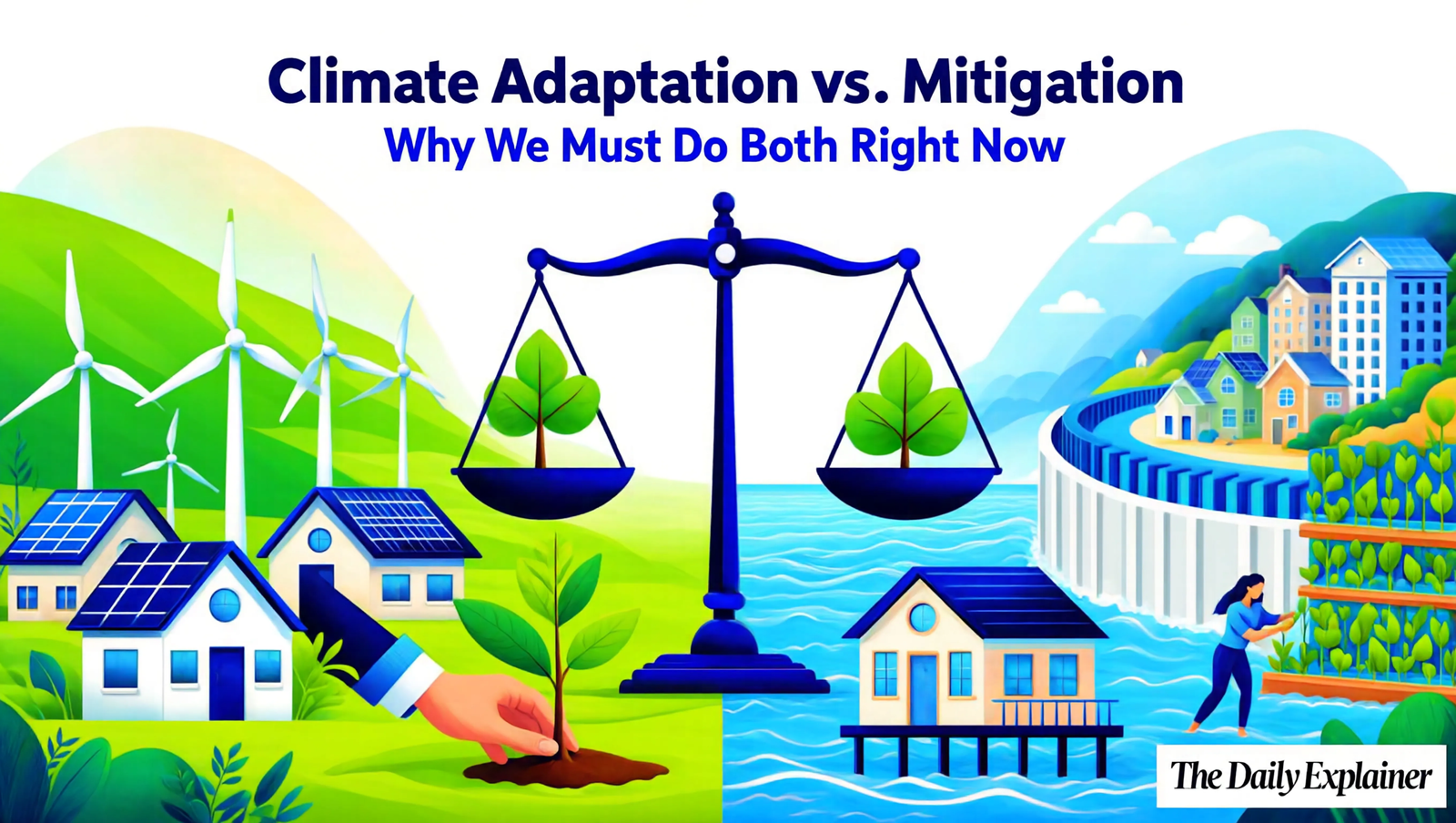
In 2026, climate action is a two-front war: we must aggressively cut emissions (mitigation) while simultaneously preparing for the impacts already locked in (adaptation).
- Introduction – Why This Matters
- Background / Context
- Key Concepts Defined
- How It Works (A Step-by-Step Breakdown of the Two-Pronged Strategy)
- Why It’s Important
- Sustainability in the Future
- Common Misconceptions
- Recent Developments (2025-2026)
- Real-Life Examples
- Success Stories
- Conclusion and Key Takeaways
- FAQs (20 Detailed Q&A)
- About Author
- Free Resources
- Discussion
Introduction – Why This Matters
In my experience working with small business owners and local government planners, I’ve noticed a deep confusion about what “fighting climate change” actually means. Many people think it’s purely about lowering emissions—driving electric cars, installing solar panels, and planting trees. While that’s a huge part of it, it’s only half the battle. What I’ve found is that the most effective climate leaders, from mayors to CEOs, are the ones who understand a critical distinction: the difference between mitigation and adaptation.
Think of it this way: If your house is on fire, mitigation is stopping the arsonist. Adaptation is installing sprinklers and buying fire insurance. You wouldn’t do just one. You’d do both, immediately and aggressively. The same logic applies to our planet. As we saw in our previous articles on the Cryosphere Crisis and the Nature-Climate Feedback Loop, some changes are now unavoidable. The ice is already melting, and some ecosystems are already releasing carbon. This means we have entered a new era where we must fight on two fronts simultaneously: stopping the problem from getting worse, while learning to live with the problem we’ve already created. This article will give you the framework to understand both.
Background / Context
For decades, the global conversation on climate change was dominated by mitigation. This makes sense. The core of the problem is the accumulation of greenhouse gases in the atmosphere from human activity. The United Nations Framework Convention on Climate Change (UNFCCC), signed in 1992, and its landmark offspring, the 2015 Paris Agreement, are fundamentally mitigation treaties. Their goal is to limit warming by getting countries to commit to reducing emissions.
The logic was, and still is, sound: if we can stabilize the atmosphere, we can prevent the worst impacts. For many years, adaptation was treated as a secondary issue, or even a taboo subject. Some activists worried that talking about adaptation was a form of surrender—an admission that we had failed at mitigation.
However, as climate science has advanced, it has become brutally clear that some degree of climate change is already “locked in.” Even if we stopped all emissions today (which we won’t), the planet would continue to warm for decades due to existing greenhouse gases and the slow response of the oceans. The impacts we are seeing—more intense heatwaves, rising sea levels, stronger storms—are not future possibilities; they are current realities.
The Intergovernmental Panel on Climate Change (IPCC) has been unequivocal: the world is not on track to meet the 1.5°C target. We are heading for a warmer world, and we must prepare for it. This has led to a fundamental shift in policy and investment. As the World Economic Forum’s Global Risks Report 2026 notes, we are now in an era where “Infrastructure Endangered” is a primary concern, and “Climate-adaptive Design” is no longer optional but essential for new construction and community planning.
Key Concepts Defined
To navigate this two-front war, we need a crystal-clear vocabulary. These terms are often used interchangeably in casual conversation, but their meanings are distinct and critical.
- Climate Mitigation: Any action taken to permanently reduce or prevent the emission of greenhouse gases into the atmosphere. The goal is to lessen the severity of future climate change. Think of it as addressing the cause of the fever.
- Examples: Switching from coal to solar power, improving energy efficiency in buildings, electrifying transportation, and protecting forests as carbon sinks.
- Climate Adaptation: Any action taken to adjust to the actual or expected future climate and its effects. The goal is to moderate harm or exploit beneficial opportunities. Think of it as managing the symptoms of the fever.
- Examples: Building sea walls to protect against sea-level rise, developing drought-resistant crops, creating early warning systems for heatwaves, and raising buildings in flood-prone areas.
- Resilience: The capacity of a system—whether it’s a city, an ecosystem, or a business—to anticipate, prepare for, and respond to hazardous events, trends, or disturbances. Adaptation is the action; resilience is the outcome.
- Maladaptation: An action taken with the intention of adapting to climate change that inadvertently increases vulnerability to climate change or makes the problem worse.
- Example: Building a high sea wall that protects one community but deflects storm surge onto a neighboring, more vulnerable community.
- Loss and Damage: A term used in international climate negotiations to refer to the impacts of climate change that have already occurred or are unavoidable, and which cannot be adapted to. This includes both economic losses (destroyed property) and non-economic losses (loss of culture, loss of life, loss of biodiversity).
- Nature-Based Solutions (NbS): Actions that work with nature to address societal challenges, including climate change. These solutions protect, sustainably manage, and restore ecosystems. They are powerful because they often provide both mitigation and adaptation benefits simultaneously.
- Example: Restoring a mangrove forest. It mitigates by absorbing CO2, and it adapts by providing a natural storm surge barrier for coastal communities.
How It Works (A Step-by-Step Breakdown of the Two-Pronged Strategy)
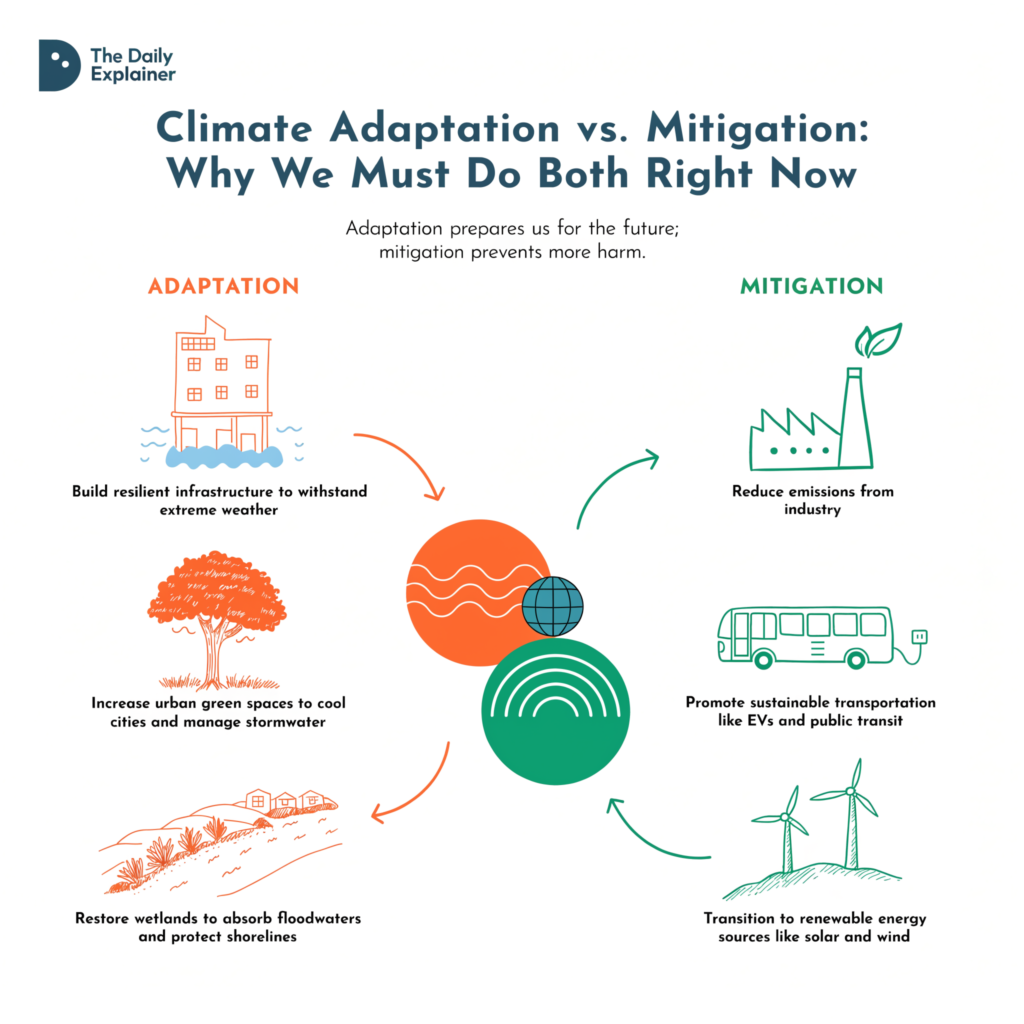
Understanding the difference is one thing; understanding how they work together in practice is another. Here is a step-by-step breakdown of a comprehensive climate action strategy.
Step 1: Assess the Baseline and the Trajectory
The first step for any government, company, or community is to understand its current situation. This involves two parallel assessments:
- Mitigation Assessment: A greenhouse gas inventory. How many tons of CO2 equivalent are we emitting? What are the biggest sources (transportation, electricity, industry, agriculture)?
- Adaptation Assessment: A climate risk and vulnerability assessment. What are the specific climate hazards we face (flooding, heat, drought, fire)? Who and what are most vulnerable (low-income neighborhoods, critical infrastructure, key supply chains)?
Step 2: Set Dual Goals
Based on the assessments, separate but parallel goals are set.
- Mitigation Goal (Example): Reduce community-wide emissions by 50% by 2035 and achieve net-zero by 2050, aligned with the Paris Agreement.
- Adaptation Goal (Example): Ensure all critical infrastructure (hospitals, power plants, water treatment) is resilient to a 1-in-100-year flood event by 2040, based on future climate projections.
Step 3: Identify and Prioritize Actions
This is where the real work begins. Actions are evaluated based on their cost, feasibility, and impact. The most powerful actions are those that serve both goals.
- Mitigation Action: A city decides to build a new solar farm to power all municipal buildings, reducing its reliance on fossil fuels. For a detailed guide on starting such green initiatives, resources like the Sherakat Network’s guide to starting an online business in 2026 can be surprisingly relevant, as they cover the fundamentals of project planning and execution in the current economic climate.
- Adaptation Action: The same city invests in permeable pavement and rain gardens to absorb stormwater, reducing flooding during heavy downpours.
- Integrated Action (Nature-Based Solution): The city protects and expands a nearby wetland. This action mitigates by preserving a carbon-rich ecosystem, and it adapts by acting as a natural sponge for floodwater.
Step 4: Implement, Monitor, and Adjust
Both strategies require funding, political will, and public support. Crucially, they are not “set and forget.” The climate is changing, and our actions must evolve.
- Mitigation Monitoring: Track emissions reductions annually. Are the solar panels performing as expected? Is public transit usage increasing?
- Adaptation Monitoring: Are the new flood defenses working? After a storm, conduct a post-event analysis. What worked? What failed?
- Adjustment: Use the monitoring data to adjust the plan. Perhaps the sea walls need to be higher than initially calculated, or a new technology has made electric vehicle charging more efficient.
Step 5: Address Unavoidable Loss and Damage
For impacts that are already happening and cannot be fully adapted to, a different framework is needed. This involves planning for financial and social support.
- Mechanisms: This includes things like climate risk insurance for farmers, disaster relief funds, and social safety nets for communities that may need to be relocated (managed retreat). The recent discussions at COP30, where some nations tried to obfuscate the severity of cryosphere loss, highlight how politically sensitive this area is . Acknowledging loss and damage is not a sign of failure; it is a sign of facing reality.
Key Takeaways Box:
- Mitigation addresses the cause: It’s about stopping the planet from heating further.
- Adaptation manages the symptoms: It’s about living with the climate changes we can no longer avoid.
- Both are essential, not optional: Focusing on one without the other is a recipe for disaster.
- Integrated solutions are the gold standard: Actions that both cut emissions and build resilience (like restoring nature) give us the best return on investment.
Why It’s Important
The distinction between mitigation and adaptation isn’t an academic exercise. It has profound implications for how we spend trillions of dollars, how we protect human lives, and how we plan for the future. As the World Economic Forum’s Global Risks Report 2026 makes clear, the failure to act on both fronts is creating a “polycrisis” where risks are interconnected and amplifying each other.
- Saving Money and Lives: Every dollar spent on adaptation saves significantly more in future disaster recovery costs. Building a resilient power grid before a heatwave prevents blackouts that can kill. Investing in drought-resistant seeds prevents famine. Failing to adapt is not just risky; it’s economically irresponsible.
- Protecting the Most Vulnerable: Climate change does not affect everyone equally. Low-income communities, the elderly, and developing nations are often the most vulnerable to climate impacts and have the least capacity to adapt. A strong adaptation strategy is a matter of equity and justice.
- Enabling Continued Mitigation: A society in chaos cannot focus on long-term emissions reductions. If a city is repeatedly devastated by floods, it won’t have the resources or political stability to invest in a new light rail system or building retrofits. Adaptation creates the stable foundation upon which we can build a low-carbon future.
- Guiding Investment: For businesses, understanding this distinction is critical for risk management. A company that fails to assess how climate change will impact its supply chains (adaptation) or fails to transition its business model away from fossil fuels (mitigation) is likely to become obsolete. Resources like the Sherakat Network’s SEO category might seem unrelated, but they highlight the importance of staying current and visible—a principle that applies directly to how businesses must adapt their entire strategy to a changing world.
Sustainability in the Future
Looking ahead, sustainability will be defined by our ability to seamlessly integrate mitigation and adaptation. The old model of sustainability—efficiency, recycling, and incremental improvement—is no longer enough. Future sustainability is about resilience and regeneration.
- Resilient Infrastructure: The 2026 Global Risks Report warns that our current infrastructure is “endangered” . Future sustainability means that every new road, bridge, and power line will be designed not for the climate of the past, but for the climate of 2050 and 2100. This means higher temperature tolerances, greater flood resilience, and the ability to withstand more intense storms.
- Regenerative Agriculture: This approach goes beyond “sustainable” (doing less harm) to actively improving the land. It builds healthy soils that store more carbon (mitigation) and hold more water, making farms more resilient to both drought and flood (adaptation).
- A Just Transition: The shift to a low-carbon economy (mitigation) must be managed in a way that supports workers and communities that depend on fossil fuels. This is an adaptation of our social and economic structures. Resources like the WorldClassBlogs page on their “Nonprofit Hub” often feature stories of organizations working on the front lines of this just transition, showing how communities are retooling for a new economy.
- Financing the Future: We need to fundamentally shift financial flows. This means ending subsidies for fossil fuels (a mitigation failure) and massively increasing investment in both green energy and climate-resilient infrastructure. The concept of “Loss and Damage” funding, agreed upon at COP27, is a crucial, albeit difficult, part of this future financial architecture.
Common Misconceptions
The mitigation/adaptation framework is often misunderstood. Here are the most common myths, debunked.
Misconception 1: “We should focus all our efforts on mitigation. If we stop climate change, we won’t need to adapt.”
This is dangerously wrong. Because of the lag in the climate system, we are already committed to significant warming. Even if we stopped all emissions tomorrow, the planet would continue to warm for decades. Adaptation is not a sign of giving up; it’s a recognition of physical reality. We have to do both.
Misconception 2: “Adaptation is just for poor countries. Rich countries can handle it with money.”
No country is immune. Hurricane Sandy caused $70 billion in damage to New York. The 2021 heatwave in the Pacific Northwest killed hundreds in the US and Canada. The 2025 wildfires in Canada disrupted air quality across the entire Eastern Seaboard. Climate impacts do not respect borders or bank accounts. As the WorldClassBlogs “Our Focus” page might highlight, this is a global challenge requiring global cooperation.
Misconception 3: “Building a sea wall is always a good adaptation strategy.”
Not necessarily. This can be a classic case of maladaptation. A sea wall might protect a wealthy waterfront neighborhood but redirect storm surge and erosion to a poorer community next door. It can also create a false sense of security, encouraging more development in a high-risk area. Good adaptation requires a systems-level view.
Misconception 4: “My individual actions don’t matter for adaptation.”
While systemic change is paramount, individual and community-level adaptation is vital. Knowing the nearest cooling center during a heatwave, having an emergency kit for floods, or even planting a rain garden in your yard are all small acts of adaptation that build community resilience. For more on how individuals and organizations can prepare, the Sherakat Network’s resources page offers a wide range of practical guides.
Recent Developments (2025-2026)
The last year has seen significant movement on both the mitigation and adaptation fronts.
- COP30 and the Adaptation Fight: At the COP30 climate summit in late 2025, a major battle was fought over the language surrounding adaptation. While some nations, as noted in our previous article, tried to downplay the severity of cryosphere loss, a coalition of vulnerable island nations and African states successfully pushed for the establishment of a more robust framework for tracking and funding adaptation efforts. The final “Mutirão decision” (named after a Brazilian term for collective effort) included stronger language on “National Adaptation Plans” (NAPs), though developing nations continue to demand more concrete financial commitments from wealthier, historically polluting countries .
- The Inflation Reduction Act’s Ripple Effects (Mitigation): In the US, the Inflation Reduction Act (IRA), passed in 2022, continues to reshape the global mitigation landscape. Two years on, its massive subsidies for clean energy have spurred a manufacturing boom, driving down the cost of solar panels, batteries, and electric vehicles worldwide. This is a prime example of how national policy can drive global mitigation efforts.
- “Sponge Cities” Go Mainstream (Adaptation): The concept of “sponge cities”—urban areas designed with permeable surfaces, green roofs, rain gardens, and parks to absorb floodwater—has moved from a niche idea to a mainstream urban planning principle. Following devastating floods in Germany and China in previous years, cities like Rotterdam, Copenhagen, and New York are now mandating sponge-like features in all new developments as a core climate adaptation strategy.
- The Business Case for Adaptation: Major corporations are increasingly treating climate adaptation as a material financial risk. In 2025, a coalition of Fortune 500 companies, including major insurers and agricultural giants, publicly called on the G20 to invest more in climate-resilient infrastructure, warning that supply chain disruptions from climate impacts were now a direct threat to their bottom lines. For more on how businesses are navigating these global shifts, you can explore the WorldClassBlogs blog, which often covers the intersection of business and world events.
Real-Life Examples
These examples show how the dual strategy of mitigation and adaptation is playing out on the ground.
1. The Netherlands: A Masterclass in Adaptation
The Netherlands has been adapting to water for centuries, but climate change has forced it to a new level. Their “Room for the River” program is a globally renowned adaptation success. Instead of just building higher dikes (a traditional, hard-engineered approach), they are giving rivers more space to flood safely. They are lowering floodplains, relocating dikes inland, and creating water-absorption zones. This is a sophisticated, large-scale adaptation that protects millions of people. Simultaneously, the country is a leader in offshore wind energy, aggressively pursuing mitigation by building a massive North Sea wind hub.
2. Medellín, Colombia: Green Corridors for Cooling (Adaptation)
Medellín, once known as the “city of eternal spring,” has seen temperatures rise. Instead of relying solely on energy-intensive air conditioning, the city launched a massive “green corridors” program. They planted trees and vegetation along roads and waterways, creating a network of connected, shaded routes. This nature-based solution has reduced the urban heat island effect by several degrees Celsius, cooling the city for millions of residents. It’s a powerful, cost-effective adaptation to rising heat.
3. Costa Rica’s Payment for Ecosystem Services (Mitigation)
As mentioned in our previous article, Costa Rica’s reforestation success is a landmark mitigation story. Through its national PES program, the government pays landowners to protect forests, which sequester carbon, protect watersheds, and provide biodiversity habitat. This program has helped double the country’s forest cover. It’s a direct action to enhance a natural carbon sink. You can find more examples of such innovative programs on the Sherakat Network’s blog.
4. Miami’s “Forever Bond” and Resilient Infrastructure (Adaptation)
Facing relentless sea-level rise and sunny-day flooding, Miami-Dade County in Florida is taking drastic adaptation measures. In 2024, voters approved a massive “Forever Bond” to fund climate resilience projects. This includes raising roads, installing massive pumps, and elevating sea walls. However, they are also grappling with the limits of adaptation, as some experts warn that parts of Miami may simply become unlivable within decades, highlighting the painful reality of “loss and damage.” The debate around infrastructure’s vulnerability is a key theme in the Global Risks Report 2026.
Success Stories
Despite the daunting challenge, there are clear victories that prove a dual approach can work.
- The Montreal Protocol (Mitigation Success): This is the gold standard. The global phase-out of ozone-depleting substances not only saved the ozone layer but also had a massive climate benefit, as many of those substances were also potent greenhouse gases. It proves that rapid, coordinated global action on an environmental threat is possible.
- Bangladesh’s Cyclone Preparedness Program (Adaptation Success): In 1970, a catastrophic cyclone killed hundreds of thousands of people in Bangladesh. Since then, the country has invested heavily in adaptation: building hundreds of multi-purpose cyclone shelters, developing an extensive early warning system with thousands of volunteers, and planting coastal mangroves as a natural buffer. As a result, when similarly powerful cyclones hit in recent years, the death toll has been in the hundreds, not the hundreds of thousands. This is a profound example of how planned adaptation saves lives on a massive scale.
- The Growth of Renewable Energy (Mitigation Success): The exponential drop in the cost of solar and wind power is an unsung success story. In many parts of the world, it is now cheaper to build new renewable energy than to run existing coal plants. This economic reality is driving a faster energy transition than anyone predicted a decade ago, proving that mitigation can also be economically beneficial. For those looking to understand the fundamentals of this new economy, resources like the Sherakat Network’s guide to starting an online business in 2026 can provide a foundational understanding of project planning in a green economy.
Conclusion and Key Takeaways
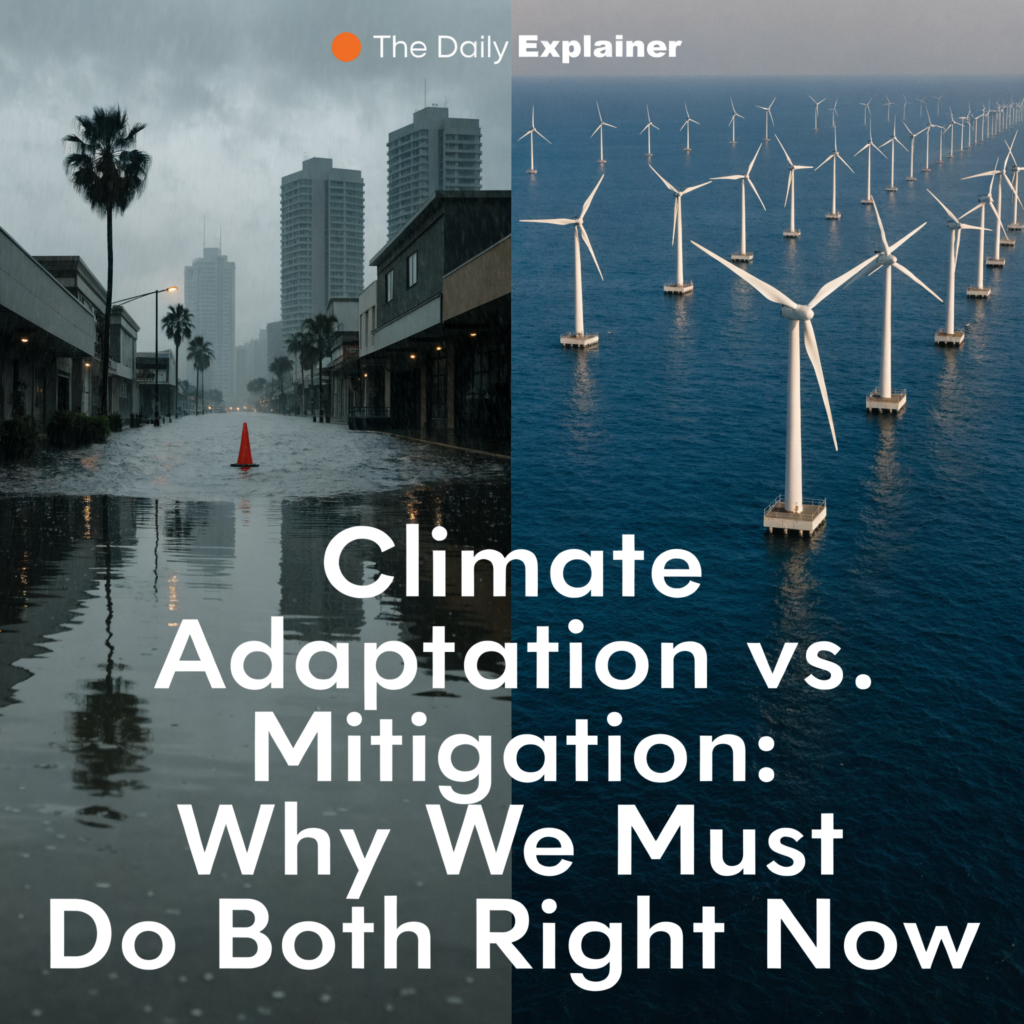
The choice between mitigating climate change and adapting to it is a false one. It’s like asking whether you’d rather put out a fire or call an ambulance for the people already burned. The only rational answer is to do both, immediately and with full force. Our previous articles explored how the Cryosphere Crisis and the Nature-Climate Feedback Loop are accelerating the crisis. This article provides the framework for the response.
We are in a new era. The debate is no longer about whether climate change is happening, but about how we will respond to its inevitability while fighting to prevent its worst extremes. This requires a clear head, a strategic mind, and the courage to invest in both stopping the problem and learning to live with its consequences.
Key Takeaways:
- Two Fronts, One War: Mitigation (stopping emissions) and adaptation (building resilience) are not competing priorities; they are two halves of a single, essential strategy.
- Delay is Deadly: The longer we wait on mitigation, the harder and more expensive adaptation becomes. Every ton of CO2 we emit today locks in more impacts for tomorrow.
- Think Ahead, Build Smart: All new infrastructure must be designed for the future climate, not the past one. “Climate-adaptive design” is now a baseline requirement .
- Nature is Our Best Ally: Nature-based solutions that protect and restore ecosystems offer some of the most effective ways to both absorb carbon and build resilience.
- Loss and Damage is Real: For some impacts, adaptation has limits. We must also prepare to address the unavoidable losses, with compassion and financial support for the most vulnerable.
FAQs (20 Detailed Q&A)
- What is the simplest way to explain the difference between mitigation and adaptation?
Mitigation is like taking medicine to lower a fever (addressing the cause). Adaptation is like putting on lighter clothes and drinking cool water to feel better while the fever is still there (managing the symptoms). - Which is more important, mitigation or adaptation?
Neither is more important. They are equally critical. You cannot have an effective climate strategy without both. Mitigation prevents future catastrophe; adaptation manages the current crisis. - Is it too late for mitigation?
Absolutely not. While some warming is locked in, every fraction of a degree we prevent matters. Avoiding 1.6°C instead of 1.7°C would save countless ecosystems and human lives. The most dangerous thing we can do is stop trying. - What is “loss and damage” in climate talks?
It refers to the unavoidable impacts of climate change that go beyond what people can adapt to. This includes both economic losses (destroyed homes, crops) and non-economic losses (lost culture, loss of life). It’s a major focus of climate justice discussions. - What is a “nature-based solution”?
An action that protects, manages, or restores natural ecosystems to address societal challenges. For example, restoring a mangrove forest to protect a coastline from storms (adaptation) while also absorbing CO2 (mitigation). - Can you give an example of maladaptation?
Building an air-conditioned city in a desert that relies on fossil fuels for power. It adapts to the heat in the short term, but its high energy use and emissions make the long-term climate problem worse. - How much money is being spent on adaptation globally?
Current adaptation finance flows are far below what is needed. The UNEP’s Adaptation Gap Report consistently finds that developing countries alone need tens of billions of dollars annually for adaptation, and current financial flows are a fraction of that. - What is the role of businesses in adaptation?
Businesses must assess how climate change will impact their supply chains, operations, and workforce. A coffee company, for example, needs to adapt by sourcing from more resilient regions or investing in farms that can withstand changing temperatures. - How can I personally adapt to climate change?
Know your local risks. If you’re in a flood zone, have a plan and insurance. If you’re in a fire zone, create defensible space around your home. If you’re in a city, know where the nearest cooling center is during a heatwave. Community-level preparedness is key. - What is the Paris Agreement’s goal for adaptation?
The Paris Agreement established a “global goal on adaptation” of enhancing adaptive capacity, strengthening resilience, and reducing vulnerability to climate change. It also requires countries to submit and update “National Adaptation Plans” (NAPs). - What is the difference between resilience and adaptation?
Adaptation is the process or action you take (e.g., building a sea wall). Resilience is the outcome—the ability to bounce back after a shock (e.g., the community recovers quickly after a storm). - Do we have enough water for all the proposed adaptation strategies?
Water scarcity is a major constraint. Some adaptation strategies, like massive tree-planting in arid regions, can actually strain water resources. Good adaptation planning must consider water as a critical and often limited resource. - How does mitigation relate to air pollution?
Directly. The vast majority of greenhouse gas emissions come from burning fossil fuels, which also produces deadly air pollution (particulate matter, ozone). Mitigation actions like switching to clean energy have the immediate co-benefit of saving lives by cleaning our air. - What are some examples of adaptation in agriculture?
Developing and planting drought-resistant or heat-tolerant crop varieties, shifting planting dates, implementing water-efficient irrigation (like drip irrigation), and using cover crops to improve soil health and water retention. - What is “managed retreat”?
It’s the controversial but sometimes necessary strategy of deliberately moving people and assets away from high-risk areas, such as coastlines that are eroding due to sea-level rise. It is often the last resort when other adaptation options fail. - How are cities adapting to extreme heat?
By planting trees to provide shade (reducing the urban heat island effect), painting roofs white or “cool colors” to reflect sunlight, creating public cooling centers, and installing shading structures at bus stops and public spaces. - Is building more nuclear power considered mitigation?
Yes. Nuclear power is a low-carbon energy source. Whether it is a desirable mitigation strategy depends on one’s view of its other risks (waste, safety, cost), but from a pure emissions perspective, it is a form of mitigation. - What role do international organizations like the UN play?
They set the global agenda (like the Paris Agreement), provide a forum for negotiation (COPs), assess the science (IPCC), and channel funding for mitigation and adaptation projects in developing countries (e.g., the Green Climate Fund). - How does protecting biodiversity help with both?
Healthy, biodiverse ecosystems are more resilient to shocks (adaptation). A diverse forest is less likely to be wiped out by a single pest. And these healthy ecosystems are also more effective at storing carbon (mitigation). - What is the single biggest barrier to effective adaptation?
Lack of funding and political will. Adaptation often requires significant upfront investment, and the benefits (disasters avoided) are invisible, making it a harder political sell than building something new and visible. - Where can I learn more about starting a green business or project?
For practical guides on launching sustainable initiatives, you can explore resources like the Sherakat Network’s comprehensive guide. For a broader perspective on global issues and nonprofit work, the WorldClassBlogs “About” page offers insights into their mission and focus areas. - How can I stay updated on these topics?
Following reputable news sources and analysis platforms is key. You can find in-depth explanations and breaking news on our Explained section and Breaking News page. For ongoing discussions and articles, our blog is regularly updated. We also have a dedicated section for Global Affairs & Politics that covers the international negotiations shaping climate policy.
About Author
This article was written by the editorial team at The Daily Explainer, building on our previous in-depth analysis of the Cryosphere Crisis and the Nature-Climate Feedback Loop. We specialize in breaking down complex global issues into a clear, actionable understanding for our readers. For any questions or feedback, please feel free to contact us.
Free Resources
- UNEP Adaptation Gap Report: An annual report from the UN Environment Programme that assesses the state of global adaptation efforts.
- IPCC Working Group II Report: The part of the IPCC’s assessment that focuses on impacts, adaptation, and vulnerability. It is the definitive scientific source on the topic.
- C40 Knowledge Hub: A resource from the C40 Cities climate leadership group, sharing best practices on urban climate action, including hundreds of case studies on both mitigation and adaptation.
Discussion
How is your community preparing for climate change? Are you seeing more investment in renewable energy (mitigation) or in flood defenses and heat action plans (adaptation)? What do you think is the biggest barrier to action where you live? Join the conversation in the comments below or reach out through our contact page. Your insights help us all learn.
About The Author



5 thoughts on “Climate Adaptation vs. Mitigation: Why We Must Do Both Right Now”