In 2026, a suite of breakthrough technologies—from sodium-ion batteries to enhanced rock weathering—are moving from labs to large-scale deployment, offering powerful tools to cut emissions and remove carbon from the atmosphere.
Introduction – Why This Matters
In my years covering the energy transition, I’ve witnessed a remarkable shift in the conversation. When I started, the question was always, “Can renewable energy ever be cost-competitive with fossil fuels?” That debate is over. Renewables have won on cost. What I’ve found is that the new, more exciting, and more complex question is: “What comes next?”
We have the tools to decarbonize the majority of our electricity grid today with solar, wind, and batteries. But as we explored in our series on the Cryosphere Crisis, the Nature-Climate Feedback Loop, and the urgency of the 1.5°C Target, the challenge is deeper and more urgent. We need to decarbonize not just electricity, but industry, heavy transport, and agriculture. And we need to not just stop emitting, but actively remove the billions of tons of carbon we’ve already pumped into the atmosphere.
This is where breakthrough climate technologies come in. These are not futuristic fantasies; they are technologies that are scaling up right now, in 2026. From sodium-ion batteries that break our dependence on lithium, to next-generation nuclear reactors that promise safer, cheaper atomic power, to a portfolio of carbon dioxide removal methods that range from planting trees to crushing rocks to giant machines that suck CO2 from the sky.
This article is your guide to the most important climate technologies of 2026. We’ll explore how they work, why they matter, and how they fit together into a comprehensive strategy to build a livable future.
Background / Context
The story of climate technology is one of exponential progress and surprising breakthroughs. As recently as 2010, solar power was expensive, batteries were bulky, and the idea of removing carbon from the air was a fringe scientific curiosity. Today, solar and wind are the cheapest sources of new electricity in most of the world, and battery costs have fallen by nearly 90% over the past decade.
This progress was not accidental. It was driven by decades of public investment in research and development, policy support (like feed-in tariffs and tax credits), and the relentless drive of private innovation. The MIT Technology Review notes that 2026 marks a breakout moment for several key technologies that have been in development for years.
The urgency has also intensified. The IPCC has made clear that to keep the 1.5°C target alive, we need not only rapid emissions reductions but also large-scale carbon dioxide removal (CDR) . The World Resources Institute estimates that we may need to remove 7 to 9 billion metric tons of CO2 per year by 2050. For context, that’s more than the current annual emissions of the United States.
This has spurred a wave of investment and innovation. The U.S. Department of Energy has poured billions into CDR demonstration projects. The European Union has just adopted the world’s first voluntary standard for permanent carbon removals. And private companies, from major tech firms to ambitious startups, are racing to scale up solutions.
As António Guterres, UN Secretary-General, stated at the 2026 IEA Ministerial Meeting: “We have entered the age of clean energy. Renewables are now the cheapest, fastest, and safest source of new electricity almost everywhere. Investors know it: last year, two trillion US dollars flowed into clean energy – nearly twice as much as into fossil fuels”. The transition is not a hope; it is a happening.
Key Concepts Defined
To navigate the world of climate tech, we need a clear understanding of the different categories of solutions and how they work together.
- Clean Energy Technologies: Solutions that generate energy without emitting greenhouse gases. This includes established technologies like solar PV, wind turbines, and hydropower, as well as emerging technologies like next-generation nuclear and green hydrogen.
- Energy Storage Technologies: Solutions that store energy for later use, critical for integrating variable renewable sources like solar and wind. Lithium-ion batteries are the current leader, but alternatives like sodium-ion are emerging.
- Carbon Dioxide Removal (CDR): Human activities that remove CO2 from the atmosphere and store it durably. This is different from carbon capture and storage (CCS), which captures emissions at the source (like a power plant) before they enter the air.
- Point-Source Carbon Capture and Storage (CCS): Capturing CO2 emissions from an industrial facility (like a cement plant or steel mill) and transporting it for permanent underground storage. This prevents new emissions, but does not remove existing atmospheric CO2.
- Direct Air Capture (DAC): A technological approach to CDR that uses large fans and chemical sorbents to scrub CO2 directly from the ambient air. The captured CO2 can then be stored underground or used in products.
- Bioenergy with Carbon Capture and Storage (BECCS): A CDR approach that involves growing biomass (like trees or crops), burning it for energy, capturing the resulting CO2 emissions, and storing them underground. The idea is that the biomass absorbed CO2 as it grew, so the overall process results in net removal.
- Enhanced Rock Weathering (ERW): A CDR approach that involves spreading finely crushed silicate rocks (like basalt) on cropland. The rocks react chemically with CO2 in the soil and air, forming stable bicarbonate minerals that lock away carbon for thousands of years. It also improves soil health.
- Ocean Alkalinity Enhancement (OAE): A marine-based CDR approach that involves adding alkaline minerals to the ocean to increase its ability to absorb and store CO2 from the atmosphere, while also reducing ocean acidification.
- Grid Flexibility: The ability of an electricity grid to reliably balance supply and demand, especially with high penetrations of variable renewable energy. Solutions include energy storage, demand response, and flexible generation.
How It Works (A Step-by-Step Breakdown of Key Technologies)
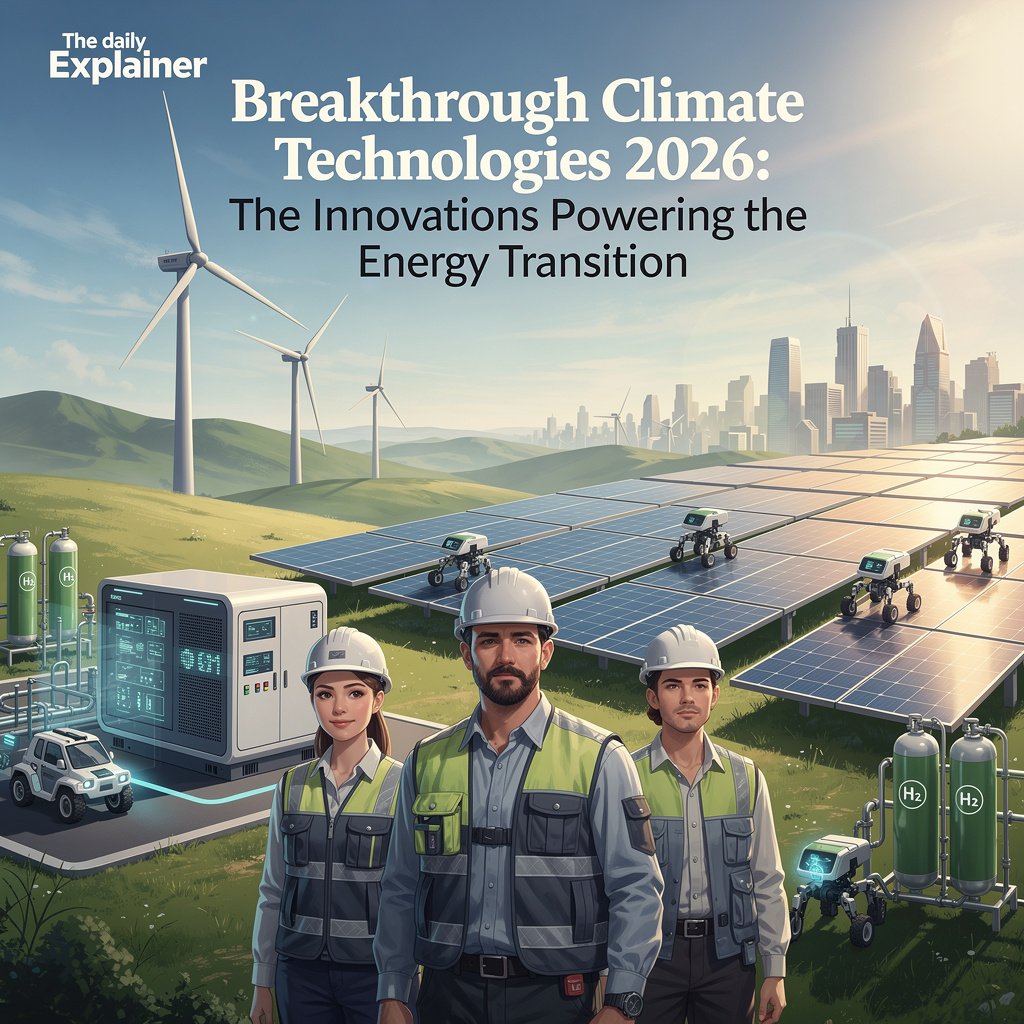
Let’s dive into the mechanics of the most important breakthrough technologies of 2026, following the expert analysis from the MIT Technology Review and other leading sources.
Technology 1: Sodium-Ion Batteries
Step 1: The Lithium Challenge
Lithium-ion batteries have powered the first wave of the electric vehicle revolution and grid storage. But lithium is relatively scarce, geographically concentrated, and its price has been volatile. This creates a long-term supply risk.
Step 2: The Sodium Alternative
Sodium is everywhere. It’s in seawater and salt mines. It’s chemically similar to lithium, and researchers have been working for decades to develop sodium-ion batteries that can do the same job.
Step 3: The Breakthrough
In 2025 and 2026, sodium-ion battery technology has reached a tipping point. Chinese battery giant CATL announced it had started manufacturing sodium-ion batteries at scale. These batteries use sodium ions to carry charge between electrodes, just like lithium-ion batteries use lithium ions.
Step 4: The Trade-Offs and Applications
Sodium-ion batteries can’t pack quite as much energy into a given weight as lithium-ion batteries. This means they may not be ideal for long-range electric cars, where weight matters. But for grid storage—where weight doesn’t matter—they are a game-changer. They are cheaper, safer (lower fire risk), and made from abundant materials. They can store solar power generated during the day for use at night, making renewable energy dispatchable around the clock.
Technology 2: Next-Generation Nuclear Power
Step 1: The Legacy Problem
Traditional nuclear power plants are massive, multi-billion-dollar projects that take a decade or more to build. Recent projects in the U.S. and Europe have gone wildly over budget and faced years of delays.
Step 2: The “Small Modular Reactor” (SMR) Concept
Next-generation nuclear aims to break this mold by building smaller reactors. These are designed to be factory-built and shipped to a site, which should lower costs and speed up construction.
Step 3: Advanced Designs and Coolants
Beyond just being smaller, many next-gen reactors use different technologies. Some use molten salt as a coolant instead of water, which operates at higher temperatures and lower pressures, potentially improving safety and efficiency. Others use TRISO fuel, which is encased in a ceramic shell that can withstand extreme temperatures without melting.
Step 4: The 2026 Status
Kairos Power became the first U.S. company to receive approval to begin construction on a next-generation reactor to produce electricity. China is also aggressively pursuing next-gen nuclear technology. These reactors could provide reliable, carbon-free power to complement variable renewables like solar and wind.
Technology 3: Direct Air Capture (DAC)
Step 1: The Gigaton Challenge
As the World Resources Institute explains, the IPCC models show that we need large-scale carbon removal. Planting trees helps, but there’s simply not enough land to plant enough trees to remove the 7-9 billion tons per year we may need. We need technological solutions.
Step 2: How DAC Works
Direct air capture uses large fans to pull air through a filter or chemical solution that binds with CO2. There are two main approaches:
- Liquid solvents: Air is bubbled through a chemical solution that absorbs CO2. The CO2 is then separated and released as a pure gas stream.
- Solid sorbents: Air passes over solid filter materials that chemically bind with CO2. When the filter is heated, it releases a pure stream of CO2.
Step 3: What Happens to the Captured CO2?
The captured CO2 can be compressed and injected deep underground for permanent geological storage. It can also be used to make products, like concrete, synthetic fuels, or even carbonated beverages (though this use is temporary, not permanent removal).
Step 4: The 2026 Status
DAC is still expensive, costing hundreds to over a thousand dollars per ton of CO2. But costs are falling as projects scale up. The world’s largest DAC plant, Mammoth in Iceland, is now operational, capable of capturing 36,000 tons of CO2 per year. The EU has just adopted the world’s first voluntary standard for permanent carbon removals, which will help build a market for DAC and other removal technologies.
Technology 4: Enhanced Rock Weathering (ERW)
Step 1: Nature’s Own Carbon Removal
Natural rock weathering is a geological process that has regulated Earth’s climate for millions of years. Rain, slightly acidic from CO2 in the air, falls on rocks and slowly dissolves them, locking the CO2 into bicarbonate minerals that wash to the ocean.
Step 2: Accelerating the Process
Enhanced rock weathering speeds up this natural process. It involves mining or collecting finely crushed silicate rocks (often a byproduct of mining) and spreading them on agricultural land.
Step 3: The Double Benefit
As the crushed rock dissolves in the soil, it does two things:
- Removes CO2: It chemically binds with CO2 from the air and soil, forming stable bicarbonate ions that eventually wash to the ocean and store carbon for thousands of years.
- Improves Soil Health: It releases essential nutrients (like calcium, magnesium, and iron) that plants need, reducing the need for synthetic fertilizers and mitigating soil acidification.
Step 4: The 2026 Status
ERW is attracting major investment from companies like Microsoft and Stripe as part of their voluntary carbon removal portfolios. A new study in Nature’s Communications Sustainability projects that ERW could remove 0.35 to 0.76 gigatons of CO2 per year by 2050, with significant potential in countries like India, Brazil, and China. It’s a scalable, affordable solution with powerful co-benefits for agriculture.
Key Takeaways Box:
- Sodium-ion batteries are here: They offer a cheaper, safer alternative to lithium-ion for grid storage, solving the intermittency problem of renewables .
- Next-gen nuclear is breaking ground: Smaller, advanced reactors are moving from blueprints to construction, offering reliable, carbon-free power .
- Direct air capture is scaling up: The world’s largest plant is operational, and new EU standards are creating a market for permanent carbon removal .
- Enhanced rock weathering is a win-win: It removes CO2 while improving soil health, with major potential in agriculture-heavy economies .
- We need a portfolio of solutions: No single technology can solve the climate crisis; we need all of them, deployed together, alongside rapid emissions cuts.
Why It’s Important
The importance of these breakthrough technologies cannot be overstated. They are not just incremental improvements; they are fundamental game-changers that open up new possibilities for climate action.
- Sodium-ion batteries solve the lithium supply crunch. By providing a cheaper, abundant alternative for grid storage, they accelerate the transition to a fully renewable grid. They help “flatten the duck curve,” as BloombergNEF describes it, by shifting solar power to evening hours and making renewables dispatchable.
- Next-generation nuclear provides firm, carbon-free power. In a deeply decarbonized grid, we need more than just solar and wind. We need reliable “firm” power sources that can run 24/7, regardless of weather. Next-gen nuclear, along with geothermal and hydropower, can fill this role.
- Direct air capture gives us a way to clean up the past. Even if we stop all emissions tomorrow (which we won’t), there is already too much CO2 in the atmosphere. DAC is one of the few technologies that can actually reverse some of the damage, drawing down legacy pollution. As the IPCC has made clear, large-scale CDR is essential for meeting the 1.5°C target .
- Enhanced rock weathering turns farms into carbon sinks. Agriculture is both a victim and a cause of climate change. ERW transforms millions of hectares of existing cropland into active carbon removal machines, while simultaneously making farms more resilient and productive.
- Together, they create a portfolio of solutions. There is no silver bullet. We need to decarbonize electricity (sodium-ion, nuclear), decarbonize industry (CCS, green hydrogen), and remove legacy carbon (DAC, ERW, BECCS, forests). These technologies, combined with the principles of the Circular Economy, give us a comprehensive toolkit.
Sustainability in the Future
Looking ahead, the future of climate technology is not just about inventing new things; it’s about scaling them up responsibly and integrating them into a just and equitable transition.
- Responsible Deployment: As the World Resources Institute emphasizes, carbon removal technologies must be deployed responsibly. This means ensuring they complement, rather than replace, emissions reductions. It means minimizing negative impacts on people and the environment (e.g., avoiding land-use conflicts for biomass). And it means ensuring benefits are shared equitably.
- Equitable Access: The Nature study on enhanced rock weathering highlights that while high-income countries lead in early deployment, countries like India and Brazil will overtake them by mid-century. Ensuring that lower-income countries have access to the technology, finance, and knowledge to participate in the CDR economy is a matter of climate justice.
- Governance and Standards: The EU’s new voluntary standard for permanent carbon removals is a critical step. It provides a clear, science-based definition of what counts as genuine, durable carbon removal, which is essential for building trust and attracting investment. Similar standards are needed for other technologies.
- Integration with Natural Solutions: Technological CDR is not a replacement for nature-based solutions like reforestation and soil carbon sequestration. As the IUCN’s new NbS Brief Series highlights, protecting and restoring ecosystems is essential for both mitigation and adaptation. The future lies in an integrated portfolio that deploys the right tool for the right job.
- A Just Transition for Workers: As we build new industries, we must also manage the decline of old ones. The transition away from fossil fuels must be fair and orderly, protecting workers and communities, as UN Secretary-General Guterres has urged.
Common Misconceptions
The world of climate tech is full of hype and confusion. Here are some of the most common myths.
Misconception 1: “We don’t have the technology to solve climate change.”
This is false. As this article shows, we have an increasingly powerful toolkit. Solar, wind, and batteries are already cost-competitive. Sodium-ion, next-gen nuclear, and green hydrogen are scaling up. DAC and ERW are moving from labs to the real world. The primary barriers are no longer technological; they are political, economic, and social.
Misconception 2: “Direct air capture is a magic bullet that will let us keep burning fossil fuels.”
This is a dangerous and misleading idea. DAC is expensive and energy-intensive. It is not a substitute for rapid emissions reductions. As the World Resources Institute makes clear, CDR is needed to deal with residual emissions and legacy pollution, not as an excuse to delay the transition.
Misconception 3: “Nuclear power is dead.”
Reports of nuclear’s death have been greatly exaggerated. While traditional large-scale projects have struggled, next-generation small modular reactors (SMRs) and advanced designs are attracting significant investment and regulatory approvals. They offer a firm, carbon-free power source that complements renewables.
Misconception 4: “Batteries are just for cars.”
Grid-scale batteries are exploding in deployment. They are essential for storing solar and wind power and providing stability to the grid. And with the arrival of cheap, abundant sodium-ion batteries, this role will only grow .
Misconception 5: “Carbon removal is unproven and won’t scale.”
While still in early stages, multiple CDR pathways are scaling up rapidly. The IPCC models show that large-scale CDR is necessary, and companies and governments are now investing billions to make it happen. The Nature study on enhanced rock weathering shows that with supportive policies and societal engagement, ERW could remove billions of tons of CO2 per year by mid-century.
Recent Developments (2025-2026)
The past 12 months have been packed with major developments in climate technology.
- Sodium-Ion Batteries Enter Mass Production (2025): As noted, CATL announced it had begun manufacturing sodium-ion batteries at scale, a pivotal moment for the technology.
- EU Adopts First-Ever Permanent Carbon Removal Standard (February 2026): The European Union passed a landmark voluntary standard for permanent carbon removals, covering direct air capture, bioenergy with CCS, and biochar. This creates a clear regulatory framework and is expected to spur investment.
- Kairos Power Approved for Next-Gen Reactor Construction (2025): The first U.S. company to receive approval to build a next-generation reactor for electricity production, marking a major step forward for advanced nuclear.
- Major Enhanced Rock Weathering Study Published (February 2026): A new study in Nature’s Communications Sustainability provided the most detailed global projections yet for ERW adoption, showing its potential to remove up to 1.1 gigatons of CO2 per year by 2100 .
- Guterres Calls for Global Platform on Fossil Fuel Transition (February 2026): At the IEA Ministerial Meeting, the UN Secretary-General urged governments to create a dedicated platform to manage a fair and orderly transition away from fossil fuels.
- BNEF Pioneers Finalists Announced (February 2026): BloombergNEF announced its 2026 Pioneers finalists, highlighting breakthrough innovations in data center sustainability, grid flexibility (“flattening the duck curve”), and decarbonizing shipping and heavy transport.
Real-Life Examples
These examples show the technologies in action.
1. The Mammoth DAC Plant, Iceland
Operated by Climeworks, the Mammoth plant is the world’s largest direct air capture facility. It uses fans and filters to capture CO2 from the air, which is then mixed with water and injected deep underground by Carbfix, where it turns into solid rock through a natural mineralization process. It’s a working example of technological carbon removal at scale.
2. The Projected ERW Boom in India and Brazil
The Nature study projects that by mid-century, countries like India and Brazil will become the global leaders in enhanced rock weathering. These are nations with vast agricultural lands, favorable warm and rainy climates that speed up the weathering reaction, and growing economies that could benefit from improved soil health and reduced fertilizer imports. This is a powerful example of how climate solutions can be both effective and equitable.
3. The UK’s Hinkley Point C vs. Kairos Power’s Hermes
The contrast between these two projects illustrates the evolution of nuclear. Hinkley Point C in the UK is a traditional, multi-billion-dollar, large-scale reactor project that has faced years of delays and cost overruns. Kairos Power’s Hermes reactor in Tennessee is a much smaller, simpler test reactor designed to demonstrate its molten salt technology. It represents the new, agile approach to nuclear.
Success Stories
Despite the daunting challenges, there are clear success stories that show the transition is not only possible but already underway.
- The Cost Plunge of Renewables: The exponential drop in the cost of solar and wind power over the past 15 years is perhaps the greatest technological success story in history. It has fundamentally altered the economics of energy and made a rapid transition feasible. As Guterres noted, “$2 trillion US dollars flowed into clean energy last year – nearly twice as much as into fossil fuels” .
- The EU’s Carbon Removal Standard: By creating the world’s first comprehensive regulatory framework for permanent carbon removals, the EU is providing the clarity and confidence that investors and project developers need. This is a policy success that will accelerate technological deployment.
- The Growth of the Voluntary Carbon Market: Companies like Microsoft, Stripe, and Shopify have committed hundreds of millions of dollars to purchasing high-quality carbon removal credits. This private-sector demand is providing crucial early revenue for startups developing DAC, ERW, and other novel technologies.
- International Scientific Collaboration: Research initiatives like the OceanNETs project, which studies ocean alkalinity enhancement, bring together scientists from multiple countries to rigorously assess the potential and risks of emerging CDR approaches. This collaborative, evidence-based approach is essential for responsible innovation.
Conclusion and Key Takeaways
The climate challenge is immense. The Cryosphere Crisis, the Nature-Climate Feedback Loop, and the narrow window of the 1.5°C Target can easily lead to despair. But the story of climate technology in 2026 is a story of hope, ingenuity, and accelerating progress.
We are not waiting for a miracle. The tools we need are emerging right now. Cheaper, safer sodium-ion batteries are solving the storage problem. Next-generation nuclear is breaking ground on safer, more flexible reactors. Direct air capture is scaling up, with new EU standards creating a market for permanent removal. And enhanced rock weathering offers a way to turn millions of farms into carbon sinks while improving soil health.
These technologies are not a reason to delay action. They are a reason to double down. The faster we deploy them, the more we invest in their scale-up, and the more we integrate them with natural solutions and a Circular Economy, the closer we get to a livable, prosperous future.
Key Takeaways:
- The transition is accelerating: Record investment in clean energy and breakthrough technologies show the momentum is unstoppable.
- Sodium-ion batteries are a game-changer for grid storage: They offer a cheaper, abundant alternative to lithium, enabling deeper renewable penetration.
- Next-generation nuclear is moving from concept to reality: Smaller, advanced reactors are being built and could provide reliable, carbon-free power.
- Carbon dioxide removal is scaling up: A portfolio of approaches—DAC, ERW, BECCS, forests—is essential for meeting climate goals, and new EU standards are creating the necessary market framework.
- Innovation must be responsible and equitable: We need governance, standards, and a just transition to ensure these technologies benefit everyone.
FAQs (Frequently Asked Questions)
- What is the most important climate technology breakthrough of 2026?
There isn’t one single breakthrough; it’s the convergence of multiple technologies scaling up simultaneously. However, the mass production of sodium-ion batteries and the EU’s new carbon removal standard are two of the most significant developments. - How do sodium-ion batteries differ from lithium-ion?
Both use similar principles, but sodium-ion uses abundant sodium instead of scarce lithium. They are cheaper, safer (lower fire risk), and better for grid storage, though they are less energy-dense, meaning heavier for the same power. - Are sodium-ion batteries available now?
Yes. Major manufacturers like China’s CATL began mass production in 2025, and they are starting to appear in grid storage projects and some electric vehicles. - What is next-generation nuclear power?
It refers to new reactor designs that are smaller, safer, and more flexible than traditional large-scale reactors. This includes Small Modular Reactors (SMRs) and advanced reactors using coolants like molten salt . - Is next-generation nuclear safe?
Many next-gen designs incorporate “passive safety” features, meaning they can shut down safely without human intervention or external power in an emergency. They also operate at lower pressures, reducing the risk of explosions. - What is the difference between carbon capture (CCS) and carbon removal (CDR)?
CCS captures CO2 at the source (like a power plant or factory) before it enters the atmosphere, preventing new emissions. CDR removes CO2 that is already in the atmosphere. Both are needed. - How does Direct Air Capture (DAC) work?
Large fans pull air through filters or chemical solutions that bind with CO2. The CO2 is then stripped off, compressed, and injected underground for permanent storage . - Is DAC affordable?
Not yet. Costs currently range from hundreds to over $1,000 per ton of CO2, but they are expected to fall as the technology scales up, similar to the cost curve for solar panels. - What is Enhanced Rock Weathering (ERW)?
It involves spreading finely crushed silicate rock (like basalt) on farmland. The rock reacts with CO2 in the soil and air, locking it away as stable bicarbonate minerals for thousands of years. It also improves soil health. - How much carbon could ERW remove?
A major 2026 study in Nature projects ERW could remove 0.35 to 1.1 gigatons of CO2 per year by 2100, with major potential in countries like India, Brazil, and China. - What is the EU’s new carbon removal standard?
Adopted in February 2026, it’s the world’s first voluntary standard for permanent carbon removals. It defines clear rules for quantifying, monitoring, and verifying removals from DAC, BECCS, and biochar, building trust and a market for these technologies. - What is “flattening the duck curve”?
The “duck curve” describes the mismatch between solar power generation (midday peak) and electricity demand (evening peak). Flattening it means using storage, demand response, and other tools to shift energy to when it’s needed. - What did UN Secretary-General Guterres say about fossil fuels in 2026?
He called for a dedicated global platform to manage a fair and orderly transition away from fossil fuels, stressing that delay will only breed instability and that the transition must protect workers and communities. - What is the role of nature-based solutions?
Technologies like reforestation, wetland restoration, and regenerative agriculture are essential for both mitigation (storing carbon) and adaptation (building resilience). The IUCN has released new guidance on scaling these solutions. - What is ocean alkalinity enhancement (OAE)?
It’s an emerging CDR approach that adds alkaline minerals to the ocean to increase its natural ability to absorb and store CO2, while also reducing ocean acidification. It’s still in early research stages. - What is the BNEF Pioneers competition?
An annual competition by BloombergNEF that identifies and celebrates standout innovations in the energy transition. The 2026 finalists are tackling data center sustainability, grid flexibility, and decarbonizing shipping. - Can these technologies really help meet the 1.5°C target?
Yes, but only if deployed alongside rapid, economy-wide emissions reductions. The IPCC models are clear: we need both deep cuts and large-scale carbon removal. - What is the biggest barrier to scaling these technologies?
The primary barriers are no longer technological. They are political (lack of supportive policies), financial (need for more investment), and social (need for public acceptance and a just transition) . - How can I, as an individual, support these technologies?
You can support policies that fund research and deployment, choose electricity providers that invest in clean energy, and, if you’re a business owner, explore purchasing high-quality carbon removal credits. For more on getting involved, you can contact us or explore our blog. - What is ISO 14092:2026, and how does it relate?
It’s a new international standard for local climate adaptation planning, released in February 2026. It helps communities and businesses structure their adaptation efforts, which is essential as we face the impacts of climate change that past emissions have already caused. - What are “hyperscale data centers,” and why do they matter for climate?
They are massive data centers built to power AI and cloud computing, and they consume enormous amounts of electricity. Making them sustainable is a major challenge that innovators are tackling with more efficient cooling and power systems. - What is “green hydrogen,” and is it mentioned?
Green hydrogen, made by splitting water using renewable electricity, is a key technology for decarbonizing heavy industry and shipping. While not the focus of this article, it’s a crucial part of the broader climate tech portfolio.
About Author
This article was written by the editorial team at The Daily Explainer, as the second in our series on climate solutions, following our exploration of the Circular Economy. This piece builds on our previous comprehensive series on climate challenges: the Cryosphere Crisis, the Nature-Climate Feedback Loop, the need for Climate Adaptation vs. Mitigation, the reality of Compound Climate Disasters, and the urgency of the 1.5°C Target. We synthesize insights from the MIT Technology Review, World Resources Institute, BloombergNEF, Nature, the EU, and the UN to provide a clear, accurate, and hopeful picture of the technologies shaping our future. For any questions or feedback, please feel free to contact us.
Free Resources
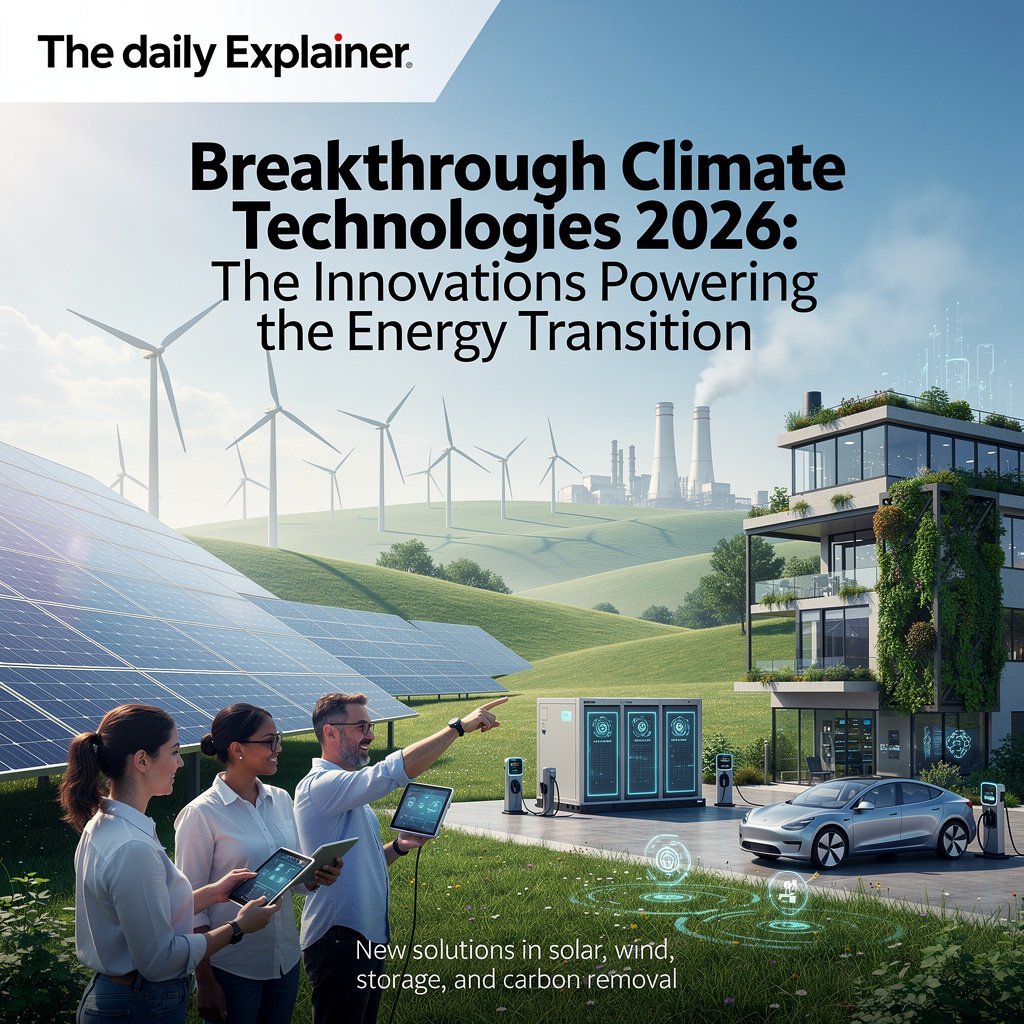
- Project Drawdown: A comprehensive resource listing and ranking the most effective climate solutions, including many of the technologies discussed here.
- World Resources Institute (WRI): Provides excellent data and analysis on carbon removal, clean energy, and climate policy.
- BloombergNEF: A leading source of data and analysis on the energy transition, including their annual “New Energy Outlook” and “Pioneers” awards.
- MIT Technology Review: Their annual “10 Breakthrough Technologies” list is a must-read for anyone following innovation.
Discussion
Which of these technologies excites you most? Do you have concerns about any of them? How do you see them fitting into the future of your community or industry? Share your thoughts and questions in the comments below. For more articles and insights, visit our blog and our Explained section. Your voice is part of the conversation we need to have.
About The Author




1 thought on “Breakthrough Climate Technologies 2026: The Innovations Powering the Energy Transition”