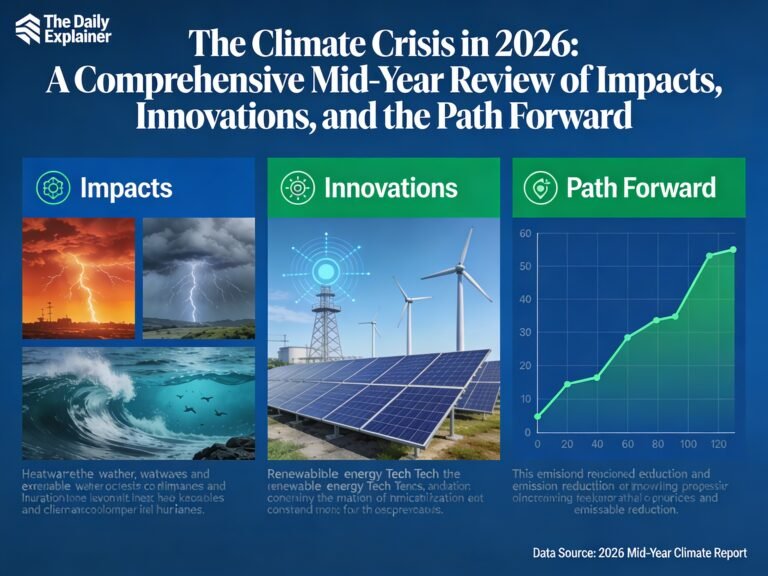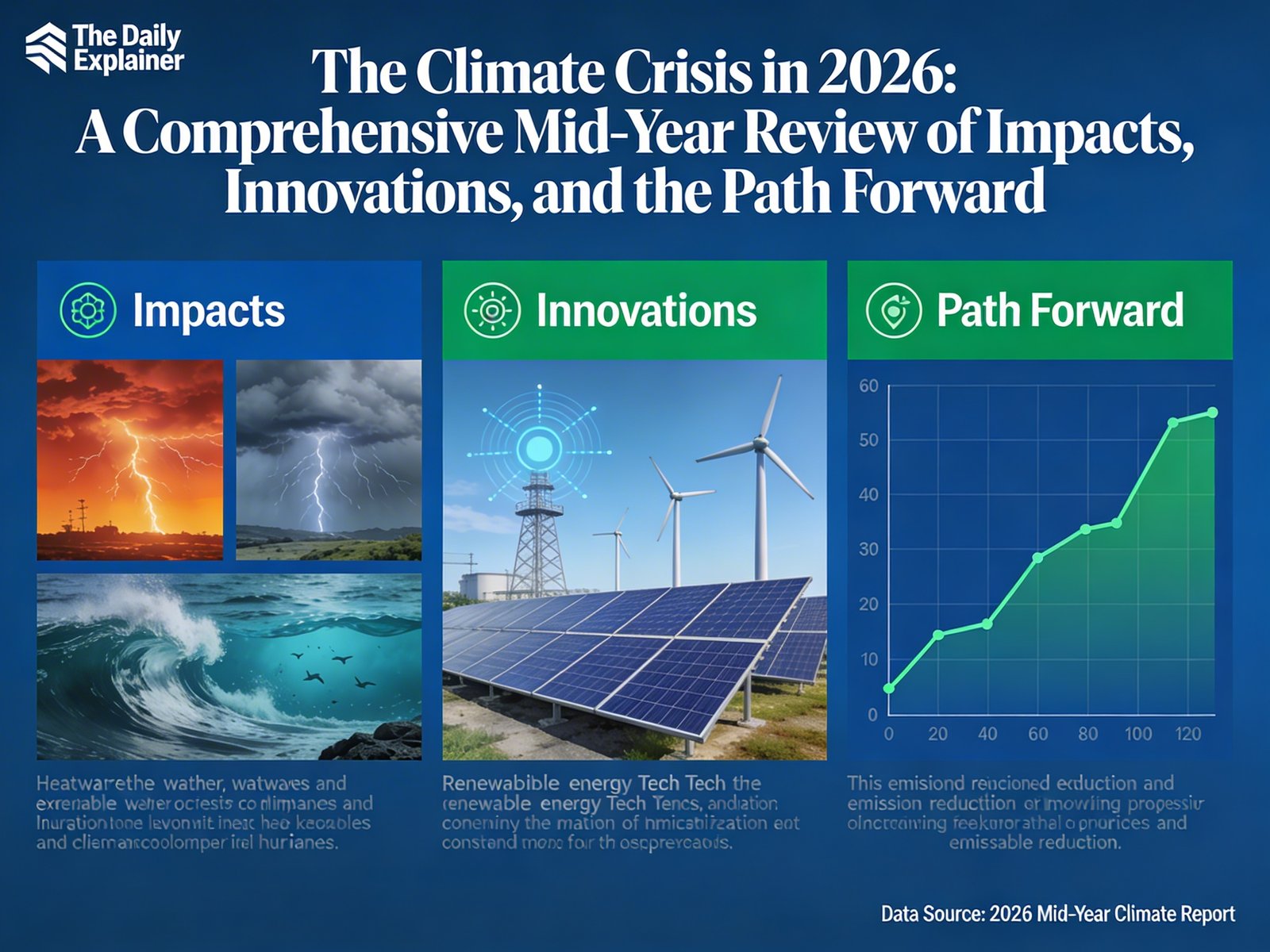
March 2026 presents a stark picture: record-breaking temperatures, devastating floods, and disappearing sea ice, alongside unprecedented policy momentum and technological breakthroughs that offer a pathway forward.
Introduction – Why This Matters
In my years of tracking climate science and policy, I’ve never seen a year quite like 2026. The signals are coming in from every direction—from the atmosphere, the oceans, the ice sheets, and the human communities on the front lines—and they tell a story of accelerating crisis alongside unprecedented response.
What I’ve found is that the first quarter of 2026 has delivered a series of wake-up calls that cannot be ignored. February was the fifth warmest on record globally, with temperatures soaring 1.49°C above pre-industrial levels. Western Europe was drenched by catastrophic flooding as atmospheric rivers—narrow bands of intensely moist air—slammed into Spain, Portugal, France, and Morocco, killing dozens and displacing thousands. Arctic sea ice extent was the third lowest for February, shrinking to 5% below average.
At the same time, the policy and technology landscape is shifting with remarkable speed. China’s 15th Five-Year Plan, finalized in March 2026, introduces binding carbon intensity targets and a green finance system that has already channeled 44.8 trillion yuan ($6.47 trillion) into climate-friendly investments. The UN General Assembly is poised to vote on a resolution that would transform the International Court of Justice’s landmark climate opinion into a practical roadmap for state accountability. Breakthrough technologies—sodium-ion batteries, next-generation nuclear reactors, and advanced carbon capture systems—are moving from laboratories to commercial deployment.
This article provides a comprehensive mid-year review of where we stand in March 2026. We will examine the latest climate data, the accelerating impacts on human communities, the policy responses taking shape across the globe, and the technological innovations that offer genuine hope. Because only by understanding the full picture—the crisis and the response, the setbacks and the breakthroughs—can we navigate the path forward.
Background / Context
To understand the significance of March 2026, we must place it in the context of the past year’s developments. The year 2024 was officially the hottest on record, with annual temperatures exceeding 1.5°C above pre-industrial levels for the first time. While this single-year breach does not mean the 1.5°C Target is permanently lost—the target refers to a multi-decade average—it was a profound psychological and symbolic shock.
COP30 in Belém, Brazil, marked a decisive shift from negotiation to implementation. The Global Mutirão Decision, the commitment to triple adaptation finance by 2035, and the mandate to develop fossil fuel transition roadmaps created a new architecture for action. The International Court of Justice’s landmark advisory opinion, issued in 2025, clarified states’ legal obligations to protect the climate system, including adopting 1.5°C-aligned NDCs, ending fossil fuel subsidies, and providing reparation for damage.
The technology landscape has also transformed. The cost of solar and wind power has continued its exponential decline. But 2025 and 2026 have seen the maturation of next-generation technologies. Sodium-ion batteries are now in mass production, offering a cheaper, safer alternative to lithium for grid storage. Next-generation nuclear reactors are moving from blueprints to construction. And the policy frameworks to support them—from China’s green finance architecture to the EU’s Carbon Border Adjustment Mechanism—are taking shape.
As the S&P Global Sustainability Trends to Watch in 2026 report notes, companies and investors are entering an “inflection point,” caught between immediate priorities like energy security and the scientific reality of climate change. This is the context for our mid-year assessment.
Key Concepts Defined
To understand the state of play in March 2026, we need a clear vocabulary that captures the latest developments.
- Atmospheric River: Narrow bands of very moist air that can transport huge amounts of water vapor. In January-February 2026, atmospheric rivers caused record rainfall and widespread flooding across Spain, Portugal, France, and Morocco.
- Carbon Intensity: The amount of carbon dioxide emitted per unit of economic output. China’s 15th Five-Year Plan sets a binding target to reduce carbon intensity by 17% by 2030 and approximately 3.8% in 2026 alone.
- Carbon Border Adjustment Mechanism (CBAM): The EU’s new policy, which took effect on January 1, 2026, imposes costs on imports based on their carbon intensity.
- ICJ Advisory Opinion: The International Court of Justice’s 2025 landmark ruling clarifying states’ legal obligations to protect the climate system, including adopting 1.5°C-aligned policies and ending fossil fuel subsidies.
- Just Energy Transition Partnerships (JETPs): International financing partnerships to support developing countries’ transitions away from coal.
- Green Finance Endorsed Project Catalogue (2025 Edition): China’s updated framework for defining eligible green investments, which standardizes definitions and improves comparability.
- MSCI Sustainable & Climate Indexes: Tracking funds that have surpassed $1 trillion in assets under management, demonstrating the mainstreaming of climate considerations in capital markets.
- Human Climate Niche: The narrow range of climatic conditions (averaging around 13°C) in which human societies have flourished for millennia. Research suggests 1-3 billion people could be pushed outside this niche by 2050.
How It Works (A Step-by-Step Breakdown of the 2026 Climate Landscape)
The climate landscape in March 2026 is not a single story but a convergence of multiple trends. Here is a step-by-step breakdown of how science, policy, technology, and finance are interacting.
Part 1: The Scientific Reality
Step 1: February 2026 Data
The Copernicus Climate Change Service released its monthly report on March 9, 2026. The findings are stark :
- Global temperatures last month were 13.26°C, which is 0.53°C above the 1991-2020 average and 1.49°C above pre-industrial levels.
- February was the fifth-warmest February on record globally, behind 2024, 2023, 2020, and 2016.
- Sea surface temperatures averaged 20.88°C over 60°S-60°N, the joint second-highest value on record for February (tied with 2025).
- Arctic sea ice extent was the third lowest for February, at 5% below average, with particularly low ice in the Labrador Sea, Baffin Bay, and the Sea of Okhotsk.
Step 2: Extreme Events
February 2026 was marked by dramatic contrasts across the globe :
- Western Europe experienced exceptional rainfall and widespread flooding, driven by atmospheric rivers. The floods killed dozens and displaced thousands across Spain, Portugal, France, and Morocco.
- Severe flooding also struck Australia, Mozambique, and Botswana.
- Temperature contrasts were stark: western, southern, and southeastern Europe experienced above-average temperatures, while Fennoscandia, the Baltic States, and northwest Russia had cold conditions.
- Outside Europe, warmer-than-average temperatures occurred across the United States, northeast Canada, West Asia, central Asia, and east Antarctica, while cold conditions prevailed in Alaska, northern Canada, Greenland, and northern Russia.
Step 3: Attribution Science
The World Weather Attribution network confirmed that human-driven climate change intensified the atmospheric rivers that caused the February flooding in Europe. This is part of a growing body of evidence that allows scientists to quantify the climate signal in extreme events.
Part 2: The Policy Response
Step 1: The ICJ Advisory Opinion and UN Resolution
In March 2026, the UN General Assembly is expected to vote on a resolution that would transform the International Court of Justice’s 2025 Advisory Opinion into a practical “roadmap for state accountability” . The draft resolution, circulated by Vanuatu, calls on states to :
- Adopt nationally determined contributions (NDCs) aligned with limiting warming to 1.5°C above pre-industrial levels.
- Take effective steps to cut emissions, including ending subsidies for fossil fuel exploration, production, and exploitation.
- Uphold obligations to refrain from returning displaced individuals to countries where climate impacts pose a risk to life.
- Consider creating safe, regular, and non-discriminatory pathways for persons displaced across borders by climate-related factors.
- For states that have violated their obligations, provide full and prompt reparation for damage.
Amnesty International warns that the resolution “is likely to trigger political pushback from higher income high emitting countries wary of their historical responsibility and financial liability” .
Step 2: China’s 15th Five-Year Plan
In March 2026, China finalized its 15th Five-Year Plan (2026-2030), marking a significant maturation of its climate strategy :
- Binding carbon intensity target: Reduce CO2 emissions per unit of GDP by 17% through 2030, listed among the plan’s 20 headline indicators. For 2026, the target is approximately 3.8% reduction.
- Energy efficiency: Reduce energy consumption per unit of GDP by around 10% over the five-year period.
- Green finance: Green loans reached 44.8 trillion yuan ($6.47 trillion) by the end of 2025, with the share of total lending surging from 6.7% to 16.2% during the 14th Five-Year Plan period. Green bonds outstanding reached approximately 2.4 trillion yuan.
- Carbon market expansion: Steel, cement, and aluminum smelting are now incorporated into the national emissions trading system alongside power generation, with annual trading volumes reaching 235 million tons in 2025.
Step 3: The EU’s CBAM Takes Effect
January 1, 2026, marked the implementation of the EU’s Carbon Border Adjustment Mechanism (CBAM). It imposes costs on imports based on carbon intensity, aiming to prevent “carbon leakage” and incentivize global emissions reductions. The policy affects imports in cement, iron and steel, aluminum, fertilizers, hydrogen, and electricity.
Step 4: Singapore’s Climate Budget
Singapore’s Budget 2026 reinforces the country’s carbon tax trajectory, legislated to reach S$45 per tonne in 2026-27 and S$50-80 by 2030. The budget emphasizes:
- Carbon costs are now firmly embedded in corporate capital allocation.
- A strategic bet on high-quality international carbon credits.
- Transition finance as a core element of industrial strategy.
- AI-driven tools for sustainability measurement and reporting.
Part 3: The Technology Breakthroughs
Step 1: Sodium-Ion Batteries Scale Up
After years of development, sodium-ion batteries are now in mass production. Chinese battery giant CATL announced it started manufacturing these batteries at scale in 2025. They offer:
- Cheaper production due to the abundance of sodium compared to lithium.
- Lower fire risk than lithium-ion batteries.
- Particular value for grid storage, where lower energy density is less critical than cost and safety.
Step 2: Next-Generation Nuclear Advances
Kairos Power became the first US company to receive approval to begin construction on a next-generation reactor to produce electricity. China is also advancing several next-gen reactors. Key innovations include :
- Smaller reactor designs can be financed more easily and built faster.
- Alternative fuels and coolants that improve efficiency and safety.
- Molten salt and TRISO fuel technologies operate at higher temperatures and lower pressures.
Step 3: Carbon Capture 2.0 Emerges
2026 is emerging as a breakthrough year for carbon dioxide removal. Key developments include:
- Singapore’s Equatic-1 plant, launching Q1 2026 in Tuas, is designed to capture 10 tonnes of CO2 per day (equivalent to removing 870 cars from roads) while producing 300 kg of clean hydrogen.
- AI-designed materials for direct air capture, with researchers screening over 1.6 million molecular structures to identify high-performance amines.
- Metal-organic frameworks (MOFs) achieve up to 99% capture rates with 17% less energy.
- MIT’s nanofiltration membranes deliver sixfold efficiency improvements for hard-to-abate sectors.
Step 4: Hyperscale Data Centers Reshape Energy Demand
The AI boom is driving a wave of massive data centers requiring a gigawatt or more of power—comparable to the output of an entire conventional nuclear power plant. S&P Global projects data center electricity consumption could top 2,200 TWh by 2030, comparable to India’s power usage, creating new pressure on grids and water resources.
Part 4: The Financial Transformation
Step 1: Sustainable Finance Reaches Critical Mass
Tracking funds for MSCI Sustainable & Climate Indexes have surpassed $1 trillion in assets under management. This milestone reflects a profound shift: sustainable investing has moved beyond “virtue-signalling” to become a core element of value investment.
As MSCI’s analysis shows, ESG ratings are not a valuation bubble but a filter for fundamental quality. Historically, companies with higher ESG ratings have consistently outperformed lower-rated peers, with the excess returns driven by profitability and fundamental performance rather than speculative multiples.
Step 2: The Baku to Belém (B2B) Roadmap
COP30 solidified the Baku to Belém Roadmap, which lays out a comprehensive strategy to meet the ambitious goal of delivering $1.3 trillion a year in international climate finance to emerging markets and developing countries by 2035. Half of this must come from private sources, requiring a 16-fold increase from 2022 levels.
Step 3: Transition Finance Takes Center Stage
The linguistic shift from “green” to “transition” is subtle but significant. Much of Asia’s economy is not pristine green but “brown-in-transition”—steel, cement, shipping, and aviation that need credible pathways to decarbonization. Financing these sectors demands instruments that reward measurable progress rather than binary labels.
The International Capital Market Association (ICMA), the Loan Market Association (LMA), and the Asia Pacific Loan Market Association (APLMA) have launched guidance on dedicated transition bonds and loans.
Step 4: Private Investment Expectations Surge
According to a recent Morgan Stanley survey, 86% of asset owners in North America, Europe, and the Asia Pacific expect to increase allocations to sustainable investments in the next two years. Climate tech businesses attracted $56 billion in the first nine months of 2025, more than they did in all of 2024.
Key Takeaways Box:
- The science is unambiguous: February 2026 was 1.49°C above pre-industrial levels, the fifth warmest February on record, with extreme flooding in Europe intensified by climate change .
- Legal accountability is strengthening: A UN resolution seeks to turn the ICJ’s landmark climate opinion into a practical roadmap for state accountability, including ending fossil fuel subsidies .
- Policy is maturing at scale: China’s 15th Five-Year Plan introduces binding carbon intensity targets and a $6.47 trillion green finance system .
- Technology is scaling rapidly: Sodium-ion batteries are in mass production, next-generation nuclear is breaking ground, and advanced carbon capture is moving toward commercial deployment .
- Finance is transforming: Tracking funds for sustainable indexes have surpassed $1 trillion, and 86% of asset owners plan to increase sustainable allocations .
Why It’s Important
The developments of early 2026 have profound implications for every aspect of climate action and human society.
- The Human Cost Is Already Here: The February 2026 floods in Western Europe and North Africa, which killed dozens and displaced thousands, are a reminder that climate impacts are not a future abstraction. The World Weather Attribution network’s confirmation that climate change intensified these events underscores the urgency of both mitigation and adaptation.
- Climate Migration Is Accelerating: A staggering 143 million people will likely be uprooted over the next 30 years by rising seas, drought, searing temperatures, and other climate catastrophes, according to an IPCC report. In Asia, governments are already scrambling to respond. Jakarta, the world’s most rapidly sinking major city, is planning to relocate its capital to Borneo, moving as many as 1.5 million civil servants.
- The Human Climate Niche Is Shifting: Research published in the Proceedings of the National Academy of Sciences finds that for thousands of years, humans have clustered within a surprisingly narrow range of climates, typically around 13°C average annual temperature. Depending on population growth and warming scenarios, 1 to 3 billion people could be pushed outside this niche by 2050. Without migration, one-third of the world’s population would experience average temperatures above 29°C—a level currently found on only 0.8% of land, mostly in the Sahara.
- Legal Accountability Is Becoming Real: The ICJ Advisory Opinion and the pending UN resolution create new tools for holding states accountable. As Amnesty International’s Candy Ofime notes, “The resolution attempts to turn the ICJ’s interpretation of key legal standards into a practical roadmap for state accountability.” This will almost certainly be used in domestic and international litigation.
- Investment Flows Are Reshaping the Economy: The $1 trillion milestone for sustainable funds reflects a fundamental shift. As MSCI’s analysis shows, sustainable investing is no longer about “virtue-signalling” but about identifying companies with stronger fundamentals and long-term resilience. The 86% of asset owners planning to increase sustainable allocations will drive capital toward climate solutions at an unprecedented scale.
- Technology Is Creating Pathways: The breakthrough technologies of 2026—sodium-ion batteries, next-generation nuclear, and advanced carbon capture—are not incremental improvements. They are fundamental game-changers that open new possibilities for decarbonization. Sodium-ion batteries solve the lithium supply constraint for grid storage. Next-generation nuclear offers firm, carbon-free power. Advanced carbon capture provides tools to address legacy emissions.
Sustainability in the Future
A sustainable future depends on accelerating the positive trends of 2026 while managing the risks and challenges.
- Integrating Climate into Core Economic Strategy: Singapore’s Budget 2026 demonstrates that decarbonization has ceased to be a matter of “virtue-signalling” and has become an industrial policy. Carbon costs are now firmly embedded in corporate capital allocation. This model—predictable carbon pricing, pragmatic transition finance, SME enablement, and global disclosure alignment—offers a template for other economies.
- Building Credible Transition Pathways: The shift from “green” to “transition” finance reflects a mature understanding that most of the economy is not pristine but in need of transformation. Financing credible pathways for steel, cement, shipping, and aviation demands instruments that reward measurable progress. The new guidance from ICMA, LMA, and APLMA on transition bonds and loans provides a framework.
- Strengthening Legal Accountability: The UN resolution on the ICJ Advisory Opinion, if adopted, will create a powerful tool for climate litigation and policy advocacy. States that fail to meet their obligations—including ending fossil fuel subsidies and adopting 1.5°C-aligned NDCs—will face increased legal pressure. This could drive more ambitious action.
- Managing Climate Migration as Adaptation: The projections of 143 million people displaced by 2050 are not a reason for despair but a call for planning. As Vittoria Zanuso of the Mayors Migration Council notes, migration doesn’t have to cause a crisis. Cities can prepare to welcome migrants as an opportunity for economic growth, building “climate havens” with adequate housing, water supply, and services.
- Scaling Technology with Responsible Deployment: The breakthrough technologies of 2026 must be deployed responsibly. Sodium-ion batteries must be manufactured with sustainable supply chains. Next-generation nuclear must address waste and safety concerns. Carbon capture must complement, not replace, emissions reductions. The governance frameworks for these technologies must keep pace with their development.
Common Misconceptions
The developments of early 2026 challenge several common misconceptions about climate change and the response.
Misconception 1: “Climate action is slowing down.”
The evidence suggests otherwise. While geopolitical tensions have created new challenges, the underlying momentum is accelerating. China’s 15th Five-Year Plan, the EU’s CBAM, the mass production of sodium-ion batteries, and the $1 trillion milestone for sustainable funds all point to a maturing, scaling response.
Misconception 2: “The 1.5°C target is already dead.”
February 2026’s 1.49°C anomaly is a stark warning, but the 1.5°C target refers to a multi-decade average, not a single month or year. The target is on life support, but it is not dead. The question is whether the policy momentum of 2026 can translate into the emissions reductions needed to keep it alive.
Misconception 3: “Climate migration is a future problem.”
It is happening now. Jakarta is already relocating its capital. Bangladesh already receives more than 2,000 migrants daily in Dhaka from coastal towns. The IPCC report’s projection of 143 million people displaced by 2050 is based on trends already underway.
Misconception 4: “Sustainable investing is just virtue-signalling.”
The $1 trillion milestone for sustainable funds and MSCI’s analysis showing that ESG ratings are correlated with fundamental profitability tell a different story. As the MSCI analyst notes, “ESG is not a valuation bubble, but a filter for fundamental quality.”
Misconception 5: “Technology will save us without policy.”
The breakthrough technologies of 2026 are the result of decades of policy support, public investment, and regulatory frameworks. They did not emerge in a vacuum. Technology and policy are complementary, not competing.
Recent Developments (January-March 2026)
The first quarter of 2026 has been packed with major developments across science, policy, technology, and finance.
- February 2026 Climate Data (March 9, 2026): The Copernicus Climate Change Service released its monthly report, showing February as the fifth warmest on record globally (1.49°C above pre-industrial), with extreme flooding in Western Europe and Arctic sea ice at third lowest extent.
- UN ICJ Resolution Negotiations (February-March 2026): Informal consultations on the draft resolution circulated by Vanuatu began in February, with a revised draft expected in early March and a vote scheduled for the end of the month.
- China’s 15th Five-Year Plan Finalized (March 2026): The plan includes binding carbon intensity targets (17% reduction by 2030), a mature green finance framework (44.8 trillion yuan in green loans), and expansion of the national carbon market.
- EU CBAM Takes Effect (January 1, 2026): The Carbon Border Adjustment Mechanism is now operational, imposing costs on imports based on carbon intensity.
- MSCI Sustainable Funds Surpass $1 Trillion (January 2026): Tracking funds for MSCI Sustainable & Climate Indexes reached a historic milestone, demonstrating the mainstreaming of climate considerations in capital markets.
- MIT Technology Review Breakthrough Technologies (January 15, 2026): The annual list highlighted sodium-ion batteries, next-generation nuclear, and hyperscale data centers as key technologies to watch.
- IPCC Climate Migration Report (March 2026): The report projected that 143 million people could be uprooted over the next 30 years by climate impacts, with Asia facing the largest displacement.
- Singapore Budget 2026 (March 2026): The budget reinforced carbon pricing at S$45-80 per tonne by 2030 and positioned transition finance as a core industrial strategy.
- Carbon Capture Breakthroughs (Ongoing): Singapore’s Equatic-1 plant launched, AI-designed materials advanced direct air capture, and next-generation MOFs achieved 99% capture rates.
Real-Life Examples
These examples bring the 2026 climate landscape to life.
1. The February Floods in Valencia, Spain
In early February 2026, the Spanish city of Valencia was hit by catastrophic flooding as an atmospheric river dumped record rainfall. Rivers burst their banks, streets became torrents, and homes were destroyed. Dozens died, and thousands were displaced. The World Weather Attribution network’s rapid analysis confirmed that human-driven climate change made the downpours significantly more intense. For the people of Valencia, this was not an abstract statistic; it was the destruction of their lives and livelihoods.
2. Saifullah’s Home in Jakarta, Indonesia
The walls of Saifullah’s home in northern Jakarta are lined like tree rings, marking how high the floodwaters have reached each year—some more than four feet from the damp dirt floor. When the water gets too high, the 73-year-old sends his family to stay with friends. He guards the house until the water can be drained using a makeshift pump. “It’s a normal thing here,” he says. “But this is our home. Where should we go?” Jakarta is the world’s most rapidly sinking major city, and the government is planning to move its capital to Borneo, relocating as many as 1.5 million civil servants.
3. CATL’s Sodium-Ion Battery Factory, China
In a factory in China, CATL is now manufacturing sodium-ion batteries at scale. These batteries, made from abundant sodium rather than scarce lithium, are cheaper and safer. They will be deployed in grid storage projects, storing solar power generated during the day for use at night. This is a tangible example of the technology revolution that is making the energy transition possible.
4. The Equatic-1 Plant, Singapore
In the Tuas region of Singapore, the Equatic-1 plant is launching in Q1 2026, designed to capture 10 tonnes of CO2 per day—equivalent to removing 870 cars from roads—while producing 300 kg of clean hydrogen. The plant uses electrolysis to convert dissolved CO2 into stable bicarbonates that remain stored for thousands of years. It scales up from pilots removing 100 kg per day and has attracted major investment from Temasek.
Success Stories
Despite the sobering science, there are genuine successes in the first quarter of 2026.
- The $1 Trillion Milestone for Sustainable Funds: The fact that tracking funds for MSCI Sustainable & Climate Indexes have surpassed $1 trillion in assets under management is a profound achievement. It demonstrates that climate considerations are now mainstream in capital markets, and that investors increasingly view sustainability as a source of fundamental value rather than a niche concern.
- China’s Green Finance Maturation: The scale and sophistication of China’s green finance system is a major success. Green loans reached 44.8 trillion yuan by the end of 2025, with the share of total lending surging to 16.2% . The adoption of standardized definitions and the push for carbon accounting are creating a credible, investable framework that can channel capital at the scale needed.
- The EU’s CBAM Implementation: Despite political controversy, the EU succeeded in implementing the world’s first carbon border adjustment mechanism on January 1, 2026. This is a major policy innovation that could reshape global trade and incentivize emissions reductions worldwide.
- The Breakthrough of Sodium-Ion Batteries: After years of development, sodium-ion batteries are finally in mass production. This is a classic example of patient research and development paying off, creating a cheaper, more abundant alternative to lithium that can accelerate the energy transition.
- The ICJ Advisory Opinion and UN Resolution: The fact that the UN General Assembly is poised to vote on a resolution operationalizing the ICJ’s climate opinion is a victory for climate justice, particularly for the small island nation of Vanuatu that spearheaded the effort. As Amnesty International notes, this creates a “practical roadmap for state accountability.”
Conclusion and Key Takeaways
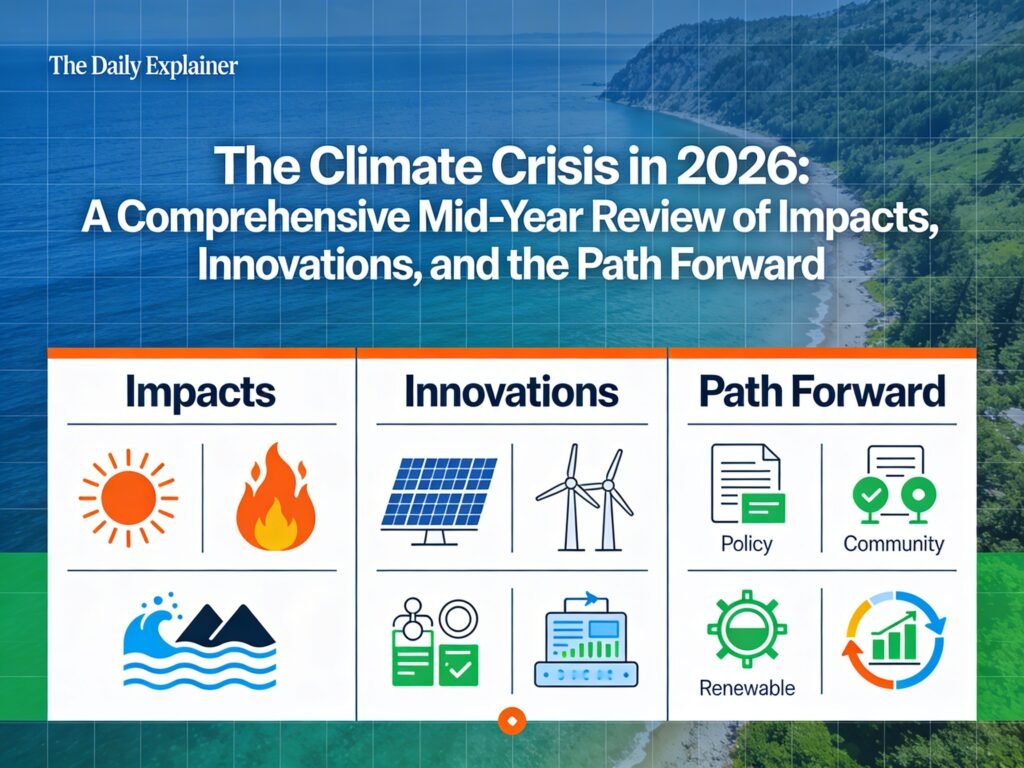
The first quarter of 2026 presents a picture of stark contrasts and competing truths. The science continues to sound alarms that cannot be ignored. February was 1.49°C above pre-industrial levels, the fifth warmest on record. Atmospheric rivers flooded Europe, killing dozens. Arctic sea ice is disappearing. One hundred forty-three million people may be displaced by climate impacts over the next three decades.
But the response is also accelerating with unprecedented scale and sophistication. China’s 15th Five-Year Plan introduces binding carbon intensity targets and a $6.47 trillion green finance system. A UN resolution seeks to give legal teeth to the ICJ’s landmark climate opinion. Sodium-ion batteries are in mass production, next-generation nuclear is breaking ground, and advanced carbon capture is moving toward commercial deployment. Sustainable funds have surpassed $1 trillion, and 86% of asset owners plan to increase sustainable allocations.
As we’ve seen throughout this series—from the melting cryosphere to the burning forests, from the urgent need for adaptation to the reality of compound disasters, from the hope of breakthrough technologies to the human toll of climate grief, from the mechanics of climate finance to the architecture of the post-COP30 era and the movement of climate migrants—the climate crisis is a test of our collective capacity to hold two truths at once: the severity of the threat and the possibility of the response.
The verdict of March 2026 is that the threat is real and accelerating. But so is the response.
Key Takeaways:
- The science is unequivocal: February 2026 was 1.49°C above pre-industrial, the fifth warmest February on record. Atmospheric rivers intensified by climate change flooded Europe, and Arctic sea ice is at record lows.
- Climate migration is already massive: 143 million people may be displaced by 2050. Jakarta is relocating its capital. Bangladesh receives 2,000 climate migrants daily.
- Legal accountability is strengthening: A UN resolution seeks to operationalize the ICJ’s landmark climate opinion, calling on states to end fossil fuel subsidies and adopt 1.5°C-aligned policies.
- Policy is maturing at scale: China’s 15th Five-Year Plan introduces binding carbon intensity targets and a $6.47 trillion green finance system. The EU’s CBAM is now in effect.
- Technology is scaling rapidly: Sodium-ion batteries are in mass production, next-generation nuclear is advancing, and carbon capture is moving toward commercial deployment.
- Finance is transforming: Sustainable funds have surpassed $1 trillion, and 86% of asset owners plan to increase sustainable allocations.
FAQs (Frequently Asked Questions)
- What was the global temperature in February 2026?
February 2026 averaged 13.26°C, which is 0.53°C above the 1991-2020 average and 1.49°C above pre-industrial levels (1850-1900). It was the fifth warmest February on record globally. - What extreme weather events happened in February 2026?
Western Europe experienced exceptional rainfall and widespread flooding driven by atmospheric rivers, affecting Spain, Portugal, France, and Morocco. Severe flooding also struck Australia, Mozambique, and Botswana. - Did climate change cause the February 2026 floods?
The World Weather Attribution network confirmed that human-driven climate change intensified the atmospheric rivers that caused the flooding. - What is the state of Arctic sea ice in early 2026?
Arctic sea ice extent in February 2026 was the third lowest on record for the month, at about 5% below average. Ice was particularly low in the Labrador Sea, Baffin Bay, and the Sea of Okhotsk. - What is the ICJ Advisory Opinion, and why does it matter?
In 2025, the International Court of Justice issued a landmark advisory opinion clarifying states’ legal obligations to protect the climate system. It affirmed that countries must adopt 1.5°C-aligned NDCs, cut emissions, end fossil fuel subsidies, and provide reparations for damage. A pending UN resolution seeks to turn this into a practical roadmap for accountability. - What is in the draft UN resolution on climate change?
The draft resolution, circulated by Vanuatu, calls on states to adopt 1.5°C-aligned NDCs, end fossil fuel subsidies, protect climate-displaced persons, and provide reparation for damage. A vote is expected in March 2026. - What are the key climate targets in China’s 15th Five-Year Plan?
The plan, finalized in March 2026, sets a binding target to reduce CO2 emissions per unit of GDP by 17% through 2030, with an approximate 3.8% reduction targeted for 2026. It also aims for around 10% reduction in energy consumption per unit of GDP. - What is the state of green finance in China?
By the end of 2025, green loans reached 44.8 trillion yuan ($6.47 trillion), with the share of total lending surging from 6.7% to 16.2% during the 14th Five-Year Plan period. Green bonds outstanding reached approximately 2.4 trillion yuan. - What is the EU’s Carbon Border Adjustment Mechanism (CBAM)?
It’s a new EU policy that took effect on January 1, 2026, imposing costs on imports based on carbon intensity. It affects cement, iron and steel, aluminum, fertilizers, hydrogen, and electricity, aiming to prevent “carbon leakage” . - How many people may be displaced by climate change?
A staggering 143 million people will likely be uprooted over the next 30 years by rising seas, drought, searing temperatures, and other climate catastrophes, according to an IPCC report. - What is happening in Jakarta due to climate change?
Jakarta is the world’s most rapidly sinking major city, with an estimated one-third expected to be submerged in the coming decades. The Indonesian government is planning to move its capital to Borneo, relocating as many as 1.5 million civil servants. - What is the “human climate niche”?
Research shows that for thousands of years, humans have clustered within a narrow range of climates, typically around 13°C average annual temperature. Depending on warming, 1-3 billion people could be pushed outside this niche by 2050. - What is the status of sodium-ion batteries in 2026?
Chinese battery giant CATL announced it started manufacturing sodium-ion batteries at scale in 2025. They offer a cheaper, safer, and more abundant alternative to lithium, particularly valuable for grid storage. - What is happening with next-generation nuclear power?
Kairos Power became the first US company to receive approval to begin construction on a next-generation reactor to produce electricity. China is also advancing several next-gen reactors using alternative fuels and coolants. - What are the latest advances in carbon capture?
Singapore’s Equatic-1 plant is launching in Q1 2026, capturing 10 tonnes of CO2 per day. AI-designed materials have screened over 1.6 million molecular structures for better capture. Metal-organic frameworks achieve up to 99% capture rates with 17% less energy. - What is the significance of sustainable funds reaching $1 trillion?
Tracking funds for MSCI Sustainable & Climate Indexes surpassing $1 trillion demonstrates that climate considerations are now mainstream in capital markets. MSCI analysis shows ESG ratings correlate with fundamental profitability, not just “virtue-signalling”. - What is the Baku to Belém (B2B) Roadmap?
Agreed at COP30, it lays out a strategy to deliver $1.3 trillion a year in international climate finance to emerging markets and developing countries by 2035, with half coming from private sources. - What is Singapore’s carbon tax trajectory?
Singapore’s Budget 2026 reinforces the carbon tax trajectory: S$45 per tonne in 2026-27 and S$50-80 by 2030. Carbon costs are now embedded in corporate capital allocation. - What percentage of asset owners plan to increase sustainable investments?
According to a Morgan Stanley survey, 86% of asset owners in North America, Europe, and the Asia Pacific expect to increase allocations to sustainable investments in the next two years. - How is AI affecting climate and energy?
The AI boom is driving hyperscale data centers requiring gigawatt-scale power, projected to consume 2,200 TWh by 2030. At the same time, AI is accelerating climate solutions by designing better materials for carbon capture and enabling automated sustainability reporting. - What is the status of climate tech investment?
Climate tech businesses attracted $56 billion in the first nine months of 2025, more than they did in all of 2024. Investment in Africa rose to upwards of $1 billion last year. - Where can I find reliable, up-to-date climate data for 2026?
The Copernicus Climate Change Service, World Meteorological Organization, IPCC, and NOAA are authoritative sources. For policy analysis, the World Resources Institute, IISD, and MSCI provide excellent coverage. For more explainers, visit our Explained section and our blog.
About Author
This article was written by the editorial team at The Daily Explainer, as the ninth in our comprehensive series on climate change. We have explored the Cryosphere Crisis, the Nature-Climate Feedback Loop, the need for Climate Adaptation vs. Mitigation, the reality of Compound Climate Disasters, the urgency of the 1.5°C Target, the hope offered by the Circular Economy and Breakthrough Climate Technologies, the human toll of Climate Grief, the mechanics of Climate Finance, the architecture of the Post-COP30 Implementation Era, and the movement of Climate Migrants. This piece synthesizes the latest data from March 2026 to provide a comprehensive mid-year review. We draw on reports from the Copernicus Climate Change Service, the World Weather Attribution network, the IPCC, the UN, MSCI, MIT Technology Review, and the World Resources Institute. For any questions or feedback, please feel free to contact us.
Free Resources
- Copernicus Climate Change Service: Monthly climate bulletins and data.
- World Weather Attribution: Rapid attribution studies on extreme weather events.
- IPCC Reports: The definitive source for climate science, including migration projections.
- MSCI Sustainable & Climate Indexes: Data on sustainable investment trends.
- MIT Technology Review’s 10 Breakthrough Technologies 2026: The full list and analysis.
- World Resources Institute Sustainable Finance Analysis: Opportunities for scaling climate finance.
Discussion
What do you make of the climate picture in March 2026? Are you encouraged by the policy and technology momentum, or alarmed by the continuing scientific warnings and human impacts? How do you hold both truths together? Share your thoughts and questions in the comments below. For more articles and insights, visit our blog and our Explained section. Your voice matters in this global conversation.
About The Author