By 2026, climate-driven migration has become a defining feature of the global landscape. Between 6.9 and 10.1 million people in Eastern Africa alone may be forced to relocate by 2030, part of a worldwide pattern of movement driven by drought, flood, and rising seas.
Introduction – Why This Matters
In my years of following climate policy, I’ve noticed a strange disconnect. We talk about climate impacts in degrees of warming, parts per million of CO2, and billions of dollars in damages. These numbers are essential, but they are also abstract. What I’ve found is that the most profound consequence of climate change is not a number at all—it is the movement of people.
When the rains fail for the fifth year in a row, farmers pack up what they can carry and walk. When the sea rises and swallows a village, families crowd into boats and flee. When a river floods and destroys everything in its path, survivors gather their children and head for higher ground, often never to return. This is not a future hypothetical. This is happening now, in 2026, on every continent.
By the start of this year, the total number of international migrants had reached an estimated 304 million, a figure that reflects a world in permanent flux. Within that vast number, a growing share is driven by environmental factors. The Climate Risk Index 2026 highlights that extreme weather events uprooted over 20 million people in the last year alone. For many of these “climate refugees,” there is no habitable land to return to.
This article is about that movement. We will explore the complex drivers of climate migration, the difference between rapid-onset displacement and slow-onset migration, the geopolitical tensions it creates, the legal gaps that leave millions unprotected, and the policies—from local adaptation to global governance—that can turn crisis into a managed transition. Because in a warming world, migration is not a problem to be solved; it is a reality to be managed.
Background / Context
The movement of people in response to environmental change is as old as humanity itself. Our ancestors migrated out of Africa as climates shifted. Ancient civilizations rose and fell with changes in rainfall patterns. What is new in 2026 is the scale, speed, and global interconnectedness of climate-driven migration.
The term “environmental refugee” first gained attention in the 1980s, when UNEP researcher Essam El-Hinnawi published a landmark report on the topic. But for decades, the issue remained on the margins of climate policy. The focus was on mitigation—preventing climate change—not on managing its inevitable human consequences.
That has changed. The IPCC has consistently highlighted human mobility as a key impact of climate change. The Groundswell report from the World Bank, first published in 2018 and updated regularly, has been instrumental in quantifying the scale of future migration. Its 2026 projections for Eastern Africa—6.9 to 10.1 million people may be forced to relocate by 2030—are a stark warning.
The drivers are multiplying. In the Horn of Africa, six years of consistent droughts have devastated pastoralist livelihoods, forcing communities into neighboring Ethiopia, South Sudan, and Uganda. In South Asia, cyclones and floods displace millions annually. In Small Island States, sea-level rise is making entire nations uninhabitable. And as the Lancet Countdown report makes clear, the health consequences of this displacement—from malnutrition to infectious disease to mental trauma—are mounting.
Yet the international legal framework has not kept pace. The 1951 Refugee Convention does not recognize climate as a ground for asylum. There is no international agreement defining the rights of “climate refugees.” This legal gap leaves millions in a precarious limbo, neither recognized nor protected.
As the Global Risks Report 2026 notes, environmental stress can exacerbate economic risks and act as a driver of social instability. Estimates suggest that approximately 40% of intrastate conflicts over recent decades have been linked to natural resource pressures . The movement of people, when poorly managed, can become both a cause and a consequence of conflict.
Key Concepts Defined
To understand climate migration, we need a precise vocabulary that distinguishes between different types of movement and their causes.
- Climate Migration (or Environmental Migration): The movement of people primarily due to sudden or gradual changes in the environment that adversely affect their lives or living conditions. This includes both internal movement (within a country) and cross-border movement.
- Climate Refugee: A term widely used in popular discourse but with no legal status under international law. It refers to people forced to flee their homes due to climate-related disasters or environmental degradation. The 1951 Refugee Convention does not recognize climate as a ground for asylum.
- Forced Displacement: Movement that occurs against the will of the people involved, typically due to sudden-onset disasters (floods, storms, wildfires) or conflict. In 2026, forced displacement has reached 117 million people globally.
- Slow-Onset Migration: Movement driven by gradual environmental changes, such as desertification, sea-level rise, or recurring droughts. Unlike sudden disasters, slow-onset events allow for some planning but can ultimately make large areas uninhabitable.
- Rapid-Onset Displacement: Movement triggered by sudden disasters, such as hurricanes, floods, wildfires, or landslides. These events often cause immediate, large-scale displacement, though many people may eventually return.
- Internal Climate Migration: Movement within a country’s borders. The majority of climate migration is internal, as people move from rural to urban areas or from coastal zones to higher ground. The Groundswell report focuses primarily on internal climate migration.
- Cross-Border Climate Migration: Movement across international borders. This is less common but growing, and it is politically sensitive because it falls into the legal gap where no international protection regime exists.
- Managed Retreat (or Planned Relocation): The deliberate, organized movement of people and assets away from high-risk areas. This is an increasingly important adaptation strategy for communities facing unavoidable climate impacts, such as sea-level rise.
- Trapped Populations: People who are unable to move despite facing significant environmental risks, due to poverty, lack of resources, conflict, or other factors. These populations are often the most vulnerable.
- Remittances: Money sent by migrants to their home communities. In 2025, India recorded a staggering $120 billion in remittance inflows, providing a vital economic cushion and demonstrating how migration can be a form of climate adaptation.
How It Works (A Step-by-Step Breakdown of Climate Migration Pathways)
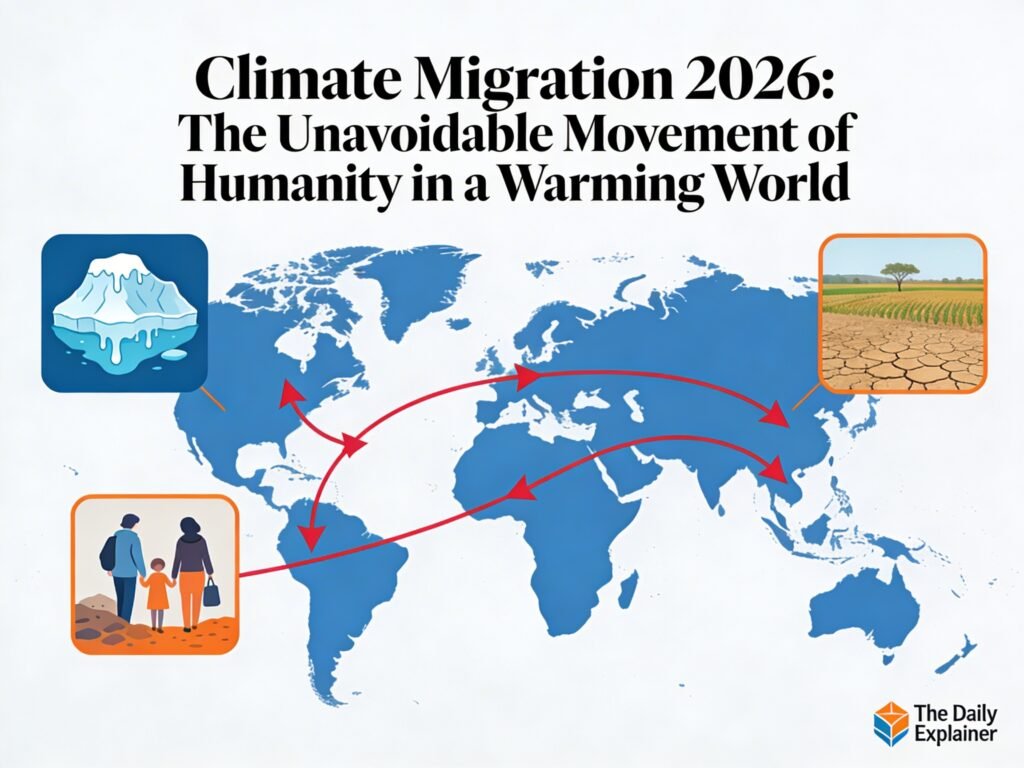
Climate migration is not a single phenomenon. It operates through multiple pathways, each with different drivers, timelines, and consequences. Here is a step-by-step breakdown.
Pathway 1: Rapid-Onset Displacement from Extreme Weather Events
Step 1: The Trigger Event
A hurricane, flood, wildfire, or storm strikes a populated area. The immediate danger forces people to flee, often with little warning and few possessions.
Step 2: Emergency Displacement
People move to emergency shelters, temporary camps, or the homes of relatives in safer areas. This is chaotic, traumatic, and often separates families.
Step 3: The Return Decision
Some people return once the immediate danger passes, especially if their homes and livelihoods are intact. Others cannot return because their homes are destroyed or their communities are no longer viable.
Step 4: Protracted Displacement
For those who cannot return, displacement becomes protracted. They may settle in informal camps on the edges of cities, or migrate further in search of work and safety. The 2024 Texas heatwave that followed Hurricane Beryl, discussed in our Compound Disasters article, is an example of how the aftermath of a disaster can create conditions that make return impossible.
Pathway 2: Slow-Onset Migration from Gradual Environmental Degradation
Step 1: The Initial Stress
Drought intensifies. Rainfall becomes erratic. Soils degrade. Sea levels inch higher, contaminating freshwater sources with salt. These changes are gradual, but they steadily undermine livelihoods.
Step 2: Coping Strategies
Households initially try to cope: selling livestock, using savings, sending one family member to work in a nearby town. These are short-term adaptations, but they erode resilience over time.
Step 3: The Tipping Point
When coping strategies are exhausted, the household faces a choice: stay and face destitution, or move. This is not a single moment of crisis but a slow realization that the old life is no longer possible.
Step 4: Migration as Adaptation
One or more family members migrate, often to cities or other regions, in search of work. They send remittances home, which can help the rest of the family survive and invest in adaptation. This is migration as a form of climate adaptation, not just a failure of it .
Step 5: Permanent Relocation
Over time, the entire household may relocate. The original community may shrink or be abandoned entirely. This is happening now in parts of the Sahel, the Horn of Africa, and coastal Bangladesh .
Pathway 3: Planned Relocation (Managed Retreat)
Step 1: Risk Assessment
Governments or communities identify areas that are becoming uninhabitable due to sea-level rise, flood risk, or other climate impacts. This is a deliberate, planned process.
Step 2: Community Engagement
Ideally, affected communities are consulted and involved in planning their own relocation. This is essential for preserving social and cultural ties and ensuring a just outcome.
Step 3: Relocation and Resettlement
People are moved to safer areas, with support for housing, livelihoods, and community infrastructure. This is complex, expensive, and often contested, but it is increasingly necessary.
Step 4: Long-Term Integration
Successful managed retreat requires long-term support for integration into new communities, as well as the restoration or rehabilitation of abandoned areas. Examples include communities in Alaska, the Pacific Islands, and parts of the US Gulf Coast that are planning for relocation.
Key Takeaways Box:
- Migration happens through multiple pathways: Rapid disasters cause sudden displacement; slow-onset changes drive gradual migration; planned relocation is a deliberate adaptation strategy.
- Most climate migration is internal: People move within their own countries, often from rural to urban areas. Cross-border movement is less common but politically sensitive.
- Migration can be adaptation: Remittances from migrants can help families survive and invest in resilience. Migration is not always a failure; it can be a strategy .
- Legal frameworks lag: There is no international agreement protecting “climate refugees,” leaving millions in a legal vacuum .
Why It’s Important
Climate migration is not a peripheral issue. It is a central, defining feature of the 21st century, with profound implications for every aspect of society.
- It’s a Humanitarian Crisis: Behind the numbers are real people—families fleeing floods, farmers watching their land turn to dust, children growing up in camps. The Lancet Countdown report documents the worsening health impacts: heat stress, infectious disease, malnutrition, and mental trauma . These are not abstract statistics; they are human lives.
- It’s a Geopolitical Flashpoint: Migration has been weaponized. Adversarial states have begun using “engineered migration flows” to pressure neighbors—a tactic seen on the borders of the EU and North Africa . This “hybrid warfare” uses human desperation as a tool to overwhelm a rival’s social infrastructure and trigger political polarization. The Global Risks Report 2026 ranks geoeconomic confrontation and misinformation as top short-term risks, and migration is central to both .
- It’s a Test of Governance: The ability to manage migration humanely and effectively is becoming the primary metric of government competence. In the US, 2026 legislative sessions are dominated by border enforcement, signaling a decisive break between immigration and its historical link to national growth . In Europe, centrist governments are forced to adopt “caps” to remain politically viable. The failure to manage migration fuels populism, erodes social cohesion, and undermines trust in institutions .
- It’s an Economic Force: Migration is also an economic engine. The Indian diaspora, the largest in the world, sent $120 billion in remittances in 2025—a figure that dwarfs traditional foreign aid . This is not just money; it is a lifeline for millions of families and a vital source of foreign exchange for developing economies. The “Great Re-routing” of students and workers—from traditional destinations like Canada and the UK to Germany, France, and Japan—is reshaping global talent flows .
- It’s Connected to Everything Else: Migration is not separate from the other themes in this series. It is driven by the Cryosphere Crisis (sea-level rise), the Nature-Climate Feedback Loop (land degradation), and Compound Disasters (sudden displacement). It is exacerbated by failures of Adaptation and Climate Finance. It is a human manifestation of the 1.5°C Target we are failing to meet. And it is a source of profound Climate Grief for those forced to leave their homes.
Sustainability in the Future
A sustainable future must include a sustainable approach to migration—one that recognizes its inevitability, manages it humanely, and harnesses its potential.
- Investing in Adaptation Where People Live: The best way to manage migration is to reduce the need for it. This means investing in adaptation in vulnerable regions: drought-resistant crops, coastal protection, water management, and diversified livelihoods. The commitment at COP30 to triple adaptation finance by 2035 is a critical step, but it must be delivered .
- Creating Legal Pathways for Climate Mobility: The absence of a legal framework for cross-border climate migrants is a ticking bomb. The international community must develop new protections, whether through an amendment to the Refugee Convention, a new protocol under the UNFCCC, or regional agreements. The Global Compact for Safe, Orderly and Regular Migration, adopted in 2018, provides a framework but is not legally binding.
- Planning for Managed Retreat: For communities facing unavoidable impacts, managed retreat must become a standard adaptation tool. This requires national policies, dedicated funding, and genuine community engagement. The ISO 14092:2026 standard for local adaptation planning provides a framework for this .
- Building Inclusive Cities: The majority of climate migrants move to cities. Urban areas must be prepared to absorb them, with affordable housing, basic services, and economic opportunities. This is not just a humanitarian obligation; it is an economic opportunity. Migrants bring skills, energy, and entrepreneurship. Cities that welcome them will thrive; cities that resist will stagnate.
- Strengthening International Cooperation: Migration is a global phenomenon that requires global solutions. This means cooperation on border management, on addressing the drivers of flight, on protecting the rights of migrants, and on sharing the responsibilities of hosting displaced populations. The “two-speed multilateralism” of the post-COP30 era could offer a model: a consensus track for foundational norms, and an implementation track for regional cooperation and burden-sharing .
Common Misconceptions
Climate migration is often misunderstood. Here are some of the most common myths.
Misconception 1: “Climate migration is mostly about people crossing borders illegally.”
False. The vast majority of climate migration is internal. People move from drought-stricken rural areas to nearby cities, or from flood-prone coasts to higher ground within their own country. Cross-border movement is a smaller but growing and politically sensitive fraction of the total .
Misconception 2: “Climate refugees have legal protection under international law.”
They do not. The 1951 Refugee Convention defines a refugee as someone fleeing persecution based on race, religion, nationality, membership in a particular social group, or political opinion. Climate is not a recognized ground. This legal gap leaves millions without protection .
Misconception 3: “Migration is always a sign of failed adaptation.”
This is a common and harmful misconception. Migration can itself be a form of adaptation. Remittances sent home by migrants can help families invest in resilience, diversify livelihoods, and survive crises. Circular migration, where people move temporarily for work and return, can be beneficial for both origin and destination communities .
Misconception 4: “We can stop climate migration with border walls.”
Walls do not stop climate change. They do not stop people from fleeing uninhabitable conditions. They merely divert flows, create humanitarian crises, and fuel smuggling networks. The only way to reduce climate migration is to address its root causes: reduce emissions, invest in adaptation, and create legal pathways for movement.
Misconception 5: “Climate migrants are a burden on destination countries.”
This framing is both inaccurate and harmful. Migrants contribute economically, culturally, and socially to their new communities. They fill labor shortages, start businesses, pay taxes, and enrich the cultural fabric. The challenge is not the presence of migrants, but the failure to integrate them effectively. As the Global Risks Report 2026 notes, the real risk is “infrastructural capacity”—the inability to build enough housing, schools, and services to accommodate new populations .
Recent Developments (2025-2026)
The past year has seen major developments in climate migration, from new data to policy initiatives.
- Global Migration Reaches 304 Million (2026): According to The Daily Guardian analysis, the total number of international migrants has reached an estimated 304 million, driven by the “Axis of Crisis”—war, climate change, and demographic demand . This represents a world in permanent flux.
- Eastern Africa Groundswell Projections (February 2026): A new report released by Groundswell projects that between 6.9 and 10.1 million people in the Eastern Africa region may be forced to relocate by 2030 due to climate-related factors . Countries affected include Kenya, Tanzania, Uganda, Rwanda, and Burundi, with Turkana County in Kenya already seeing communities move into Ethiopia, South Sudan, and Uganda.
- Loss and Damage Fund Operationalization (COP30 – 2025): As discussed in our Climate Finance article, the Loss and Damage Fund is now operational. A key test will be whether it can provide timely support to communities displaced by climate impacts, helping them recover and rebuild.
- ICJ Advisory Opinion and UN Resolution (Pending March 2026): The International Court of Justice’s landmark advisory opinion on climate obligations, and the pending UN resolution to operationalize it, could have implications for climate migrants. The resolution calls for creating protection frameworks for climate-displaced persons, though the details remain to be negotiated .
- S&P Global Report on Fragmented Climate Strategies (January 2026): The S&P Global report highlights the growing divergence between national climate strategies and the increasing recognition that adaptation—including managing migration—is unavoidable .
- Gavi Report on Health Threats (February 2026): The Gavi insight paper highlights the health consequences of displacement, including the spread of infectious diseases like cholera in conflict-affected and climate-vulnerable areas, and the strain on health systems from population movements .
Real-Life Examples
These examples put a human face on the statistics.
1. Turkana, Kenya: Where Drought Drives Cross-Border Movement
In Turkana County, northern Kenya, communities have been forced by years of drought to move into neighboring Ethiopia, South Sudan, and Uganda in search of water and pasture. Thomas Kiong’a, the county director for climate change, notes that these mobile populations have been ignored for a long time, “portrayed as rebels and terrorists as they moved across borders” . There are no laws protecting them or governing their movements. The MECMEA project (Managing the Impacts of Environmental Change and Conflict on Mobility in Eastern Africa), funded by the EU, is working to address this gap, training officials and fostering policy dialogue .
2. The Philippines’ Coastal Greenbelts: Adaptation Reducing Displacement
In the Philippines, one of the most disaster-prone countries in the world, local leaders are creating 100-meter-wide “coastal greenbelts”—strips of mangroves, beach forest, and wetland vegetation—as natural coastal buffers . More than 1,000 hectares of mangroves have been established or protected since 2022. This nature-based solution protects communities from typhoons and rising seas, reducing the need for displacement while also sequestering carbon . It’s a model for how adaptation can reduce migration pressures.
3. The Indian Diaspora: Migration as Economic Engine
India’s diaspora of over 18.5 million citizens is the largest in the world . In 2025, they sent home $120 billion in remittances, providing a vital economic cushion for millions of families and a significant source of foreign exchange. This is not just about money; it’s about resilience. Families use remittances to invest in drought-resistant seeds, improve their homes, and educate their children. India’s position has shifted from “brain drain” to “circular mobility,” encouraging professionals to gain international experience and return home . This is a powerful example of migration as a positive force.
4. The Great Re-routing of Students
With a 90% drop in Canadian study permits and surging rejection rates in the US, Indian students are rerouting to Germany, France, and Japan . This “Great Re-routing” is reshaping global talent flows and forcing Western institutions to reckon with the loss of their most lucrative demographic. It’s also creating new opportunities for countries that welcome international students, demonstrating how migration policy is a form of economic competition.
Success Stories
Despite the challenges, there are examples of successful approaches to managing climate migration.
- The MECMEA Project in Eastern Africa: This EU-funded project, implemented by a consortium including the Horn of Africa Regional Environmental Centre and Network (Hoarec) and PanAfricare, is a model for addressing climate-induced migration . It brings together governments, researchers, and communities to understand the links between environmental change, migration, and conflict, and to develop policy responses. The five-day capacity-building workshop in Mombasa in February 2026 is training officials from across the region to manage these complex dynamics .
- Bangladesh’s Cyclone Preparedness Programme: As discussed in our Climate Adaptation article, Bangladesh has dramatically reduced deaths from cyclones through early warning systems and cyclone shelters. This reduces the need for permanent displacement by enabling people to return home after the storm passes. It’s a model for managing rapid-onset displacement.
- Community-Led Mangrove Restoration in Indonesia and the Philippines: Women-led mangrove planting efforts in Indonesia and the coastal greenbelts in the Philippines demonstrate how local communities can take the lead in building resilience . These initiatives not only protect against storms and sea-level rise but also provide livelihoods through ecotourism and sustainable resource management, reducing the pressure to migrate.
- The Platform on Disaster Displacement: This intergovernmental initiative, launched under the auspices of the UNFCCC, brings together countries to cooperate on protecting people displaced by disasters and climate change. It has developed guidelines, shared best practices, and advocated for the rights of climate migrants at international forums.
Conclusion and Key Takeaways
The movement of people in response to climate change is not a hypothetical future. It is happening now, in 2026, on every continent. From the drought-stricken pastoralists of Turkana to the flood-displaced families of Bangladesh, from the students rerouting their educations to the workers sending remittances home, climate migration is a defining feature of our time.
This movement is not a problem to be solved; it is a reality to be managed. It carries immense challenges—humanitarian crises, geopolitical tensions, legal gaps, social strains—but also opportunities. Migrants bring skills, energy, and entrepreneurship. Remittances provide lifelines for vulnerable communities. Circular mobility can benefit both origin and destination countries.
As we’ve seen throughout this series—from the melting cryosphere to the burning forests, from the urgent need for adaptation to the reality of compound disasters, from the hope of breakthrough technologies to the human toll of climate grief, from the mechanics of climate finance to the architecture of the post-COP30 era—the climate crisis is fundamentally a human crisis. And migration is one of its most human dimensions.
The question is not whether people will move. They will. The question is whether we will manage that movement humanely, effectively, and justly. The answer depends on the choices we make today.
Key Takeaways:
- Climate migration is already massive and growing: International migrants have reached 304 million, with over 20 million displaced by extreme weather in the past year alone. Eastern Africa could see 6.9 to 10.1 million climate migrants by 2030.
- Migration happens through multiple pathways: Rapid-onset disasters cause sudden displacement; slow-onset changes drive gradual migration; planned relocation is a deliberate adaptation strategy.
- Legal frameworks are dangerously inadequate: There is no international protection for “climate refugees,” leaving millions in a legal vacuum and fueling political tensions.
- Migration can be a form of adaptation: Remittances (India received $120 billion in 2025) and circular mobility can build resilience and benefit both origin and destination communities.
- Managing migration requires integrated solutions: Investment in adaptation, legal pathways for mobility, planned retreat, inclusive cities, and international cooperation are all essential.
FAQs (Frequently Asked Questions)
- What is climate migration?
Climate migration is the movement of people primarily due to sudden or gradual changes in the environment that adversely affect their lives or living conditions. This includes both internal movement (within a country) and cross-border movement. - How many climate migrants are there in 2026?
Precise numbers are difficult, but the total number of international migrants has reached 304 million, driven by the “Axis of Crisis”—war, climate change, and demographic demand. Extreme weather events uprooted over 20 million people in the last year alone. The Groundswell report projects 6.9 to 10.1 million climate migrants in Eastern Africa alone by 2030. - What is the difference between a climate migrant and a climate refugee?
“Climate refugee” is a widely used term but has no legal status under international law. The 1951 Refugee Convention does not recognize climate as a ground for asylum. “Climate migrant” is a broader, more accurate term for people moving due to environmental factors. - Are climate refugees protected by international law?
No. This is one of the most critical gaps in international protection. People fleeing climate impacts are not covered by the Refugee Convention, leaving them in a legal limbo. - Is most climate migration internal or cross-border?
The vast majority of climate migration is internal. People move from drought-stricken rural areas to cities, or from flood-prone coasts to higher ground within their own country. Cross-border movement is a smaller but growing and politically sensitive fraction. - What is the Groundswell report?
A landmark report from the World Bank that quantifies projected internal climate migration. Its 2026 projections for Eastern Africa—6.9 to 10.1 million people by 2030—are a stark warning. - What is the difference between rapid-onset and slow-onset migration?
Rapid-onset migration is triggered by sudden disasters like hurricanes, floods, or wildfires. Slow-onset migration is driven by gradual changes like drought, desertification, or sea-level rise. They require different policy responses. - What are “trapped populations”?
People who are unable to move despite facing significant environmental risks, due to poverty, lack of resources, conflict, or other factors. They are often the most vulnerable. - How does migration relate to climate adaptation?
Migration can itself be a form of adaptation. Remittances sent home by migrants can help families invest in resilience, and circular mobility can build skills and diversify livelihoods. - What are remittances, and why do they matter?
Money is sent by migrants to their home communities. In 2025, India received $120 billion in remittances—a figure that dwarfs foreign aid and provides a vital economic cushion for millions. - What is “managed retreat” or “planned relocation”?
The deliberate, organized movement of people and assets away from high-risk areas. It is an increasingly necessary adaptation strategy for communities facing unavoidable climate impacts like sea-level rise. - How is migration being “weaponized”?
Adversarial states have begun using “engineered migration flows” to pressure neighbors, overwhelming their social infrastructure and triggering political polarization. This “hybrid warfare” is a growing concern. - What did the Global Risks Report 2026 say about migration?
The report highlights that environmental stress can exacerbate economic risks and act as a driver of social instability. Approximately 40% of intrastate conflicts over recent decades have been linked to natural resource pressures. - How does climate change affect health in the context of migration?
The Lancet Countdown report documents worsening health impacts: heat stress, infectious disease outbreaks in displacement camps, malnutrition, and mental trauma. Displacement disrupts healthcare access and increases vulnerability. - What is the MECMEA project?
The “Managing the Impacts of Environmental Change and Conflict on Mobility in Eastern Africa” project, funded by the EU. It works to address how climate change, environmental disasters, and conflict influence migration patterns across Eastern Africa, bringing together governments and researchers. - What is happening in Turkana, Kenya?
Communities in Turkana County are being forced by drought into neighboring Ethiopia, South Sudan, and Uganda. There are no laws protecting them, and they have often been portrayed negatively. The MECMEA project is working to change this. - What are “coastal greenbelts,” and how do they help?
In the Philippines, communities are creating 100-meter-wide strips of mangroves and coastal vegetation as natural buffers against storms and sea-level rise. This reduces the need for displacement while also sequestering carbon. - What is the “Great Re-routing” of students?
With visa restrictions tightening in traditional destinations like Canada and the UK, students from countries like India are rerouting to Germany, France, and Japan. This is reshaping global talent flows. - How can cities prepare for climate migration?
By investing in affordable housing, basic services, and economic opportunities. Migrants bring skills and energy; cities that welcome them will thrive. The challenge is not the presence of migrants but the failure to integrate them. - What is the Platform on Disaster Displacement?
An intergovernmental initiative that brings together countries to cooperate on protecting people displaced by disasters and climate change. It develops guidelines and advocates for the rights of climate migrants. - How does the Loss and Damage Fund relate to migration?
The fund, operationalized after COP30, is intended to help vulnerable countries cope with unavoidable climate impacts. A key test will be whether it can provide timely support to communities displaced by disasters, helping them recover and rebuild. - Where can I learn more about climate migration?
The Groundswell report (World Bank), the Platform on Disaster Displacement, the Internal Displacement Monitoring Centre (IDMC) , and the MECMEA project are excellent resources. For more explainers, visit our Explained section and our blog.
About Author
This article was written by the editorial team at The Daily Explainer, as the seventh in our comprehensive series on climate change. We have explored the Cryosphere Crisis, the Nature-Climate Feedback Loop, the need for Climate Adaptation vs. Mitigation, the reality of Compound Climate Disasters, the urgency of the 1.5°C Target, the hope offered by the Circular Economy and Breakthrough Climate Technologies, the human toll of Climate Grief, the mechanics of Climate Finance, and the architecture of the Post-COP30 Implementation Era. This piece addresses the most profound social consequence of climate destabilization: the movement of people. We draw on reports from Groundswell, the Lancet Countdown, the Global Risks Report, and on-the-ground reporting from Eastern Africa and beyond. For any questions or feedback, please feel free to contact us.
Free Resources
- Groundswell Report (World Bank): The definitive source for projections of internal climate migration.
- Internal Displacement Monitoring Centre (IDMC): Tracks displacement data globally, including disaster displacement.
- Platform on Disaster Displacement: Intergovernmental initiative working on protecting climate-displaced persons.
- MECMEA Project: Information on the EU-funded project addressing environmental change, migration, and conflict in Eastern Africa.
Discussion
Have you or your community experienced climate-related displacement? What do you think about the tension between border security and humanitarian obligations? How can we create legal pathways for climate migrants while also investing in adaptation to reduce the need for migration? Share your thoughts and questions in the comments below. For more articles and insights, visit our blog and our Explained section. Your voice matters in this global conversation.
About The Author




Great beat ! I wish to apprentice while you amend your web site, how could i subscribe for a blog website? The account helped me a acceptable deal. I had been tiny bit acquainted of this your broadcast provided bright clear idea