2026 is the year of implementation. After the historic agreements at COP30, the focus shifts from negotiation to delivery, with a packed calendar of events designed to turn promises into progress on the ground.
Introduction – Why This Matters
In my years of covering climate negotiations, I’ve witnessed a recurring cycle. A COP summit ends with a flurry of headlines, celebratory speeches, and a thick document of agreed text. Then, the world moves on, and the hard work of actually implementing those agreements begins in obscurity, far from the cameras. By the time the next COP rolls around, we’re often left wondering: what actually happened?
What I’ve found is that the period between COPs is where the real climate action—or inaction—occurs. And 2026 is shaping up to be the most consequential “in-between” year in history.
COP30 in Belém, Brazil, was a watershed moment. It marked the official transition of the global climate regime from a three-decade-long negotiation phase to a new era focused on implementation. The “COP of Truth,” as it was called, delivered a suite of ambitious agreements: the Global Mutirão Decision, roadmaps to transition away from fossil fuels, a call to triple adaptation finance by 2035, and a new architecture for accelerating action on the ground.
But agreements on paper are not the same as progress on the ground. Now, in the first half of 2026, the real test begins. This article is your guide to the post-COP30 landscape. We will explore the key outcomes of Belém, the packed calendar of events leading to COP31 in Antalya, Turkey, the emerging “two-speed multilateralism” that aims to accelerate action, and the profound challenges—and opportunities—that lie ahead.
Background / Context
To understand where we are, we must first understand the journey that brought us here. The Conference of the Parties (COP) process, under the UN Framework Convention on Climate Change (UNFCCC), has been the primary舞台 for global climate diplomacy since 1995.
The Paris Era (2015-2025): The 2015 Paris Agreement was the crowning achievement of this process. It established the universal goals—limiting warming to well below 2°C, pursuing 1.5°C—and created a flexible, bottom-up architecture based on nationally determined contributions (NDCs). The decade that followed was largely about “finishing the Paris rulebook”: negotiating the detailed rules for transparency, carbon markets (Article 6), and common timeframes. This phase culminated at COP26 in Glasgow (2021) and COP27 in Sharm el-Sheikh (2022), where the foundational rules were largely completed.
The Stocktake and the Shift (2023-2025): The first Global Stocktake (GST) at COP28 in Dubai (2023) was a moment of collective reckoning. It showed the world was far off track and, for the first time, explicitly called for “transitioning away from fossil fuels in energy systems.” This was a landmark, but it remained a call, not a binding plan.
COP30 Belém: The “COP of Truth”: Against this backdrop, COP30 in Belém, Brazil, was designed to be different. Hosted by President Lula, it aimed to move from negotiation to implementation. As André Corrêa do Lago, COP30 President, stated in his Twelfth Letter, the conference sought to foster an unprecedented debate on fossil fuel dependency and to lay the groundwork for a global structural transition.
The outcomes of Belém were substantial. Over 120 countries submitted new or updated NDCs. The conference adopted 56 decisions by consensus, including the landmark Global Mutirão Decision—named after an Indigenous concept of collective effort—which enshrined in international law a commitment to global mobilization. Critically, COP30 delivered a clear signal on adaptation finance, with an agreement to triple public adaptation finance by 2035 from 2025 levels. It also launched initiatives like the Global Implementation Accelerator and the Belém Mission for 1.5°C.
But as Lago acknowledged, COP30 also shed light on the limitations of climate multilateralism, particularly the difficulty of achieving formal consensus on the most contentious issues, like a concrete roadmap for phasing out fossil fuels. This has set the stage for the innovative, “two-speed” approach now being pursued in 2026.
Key Concepts Defined
To navigate the post-COP30 landscape, we need a clear understanding of the new terms and frameworks that are shaping this implementation era.
- COP30 (Belém): The 30th UN Climate Change Conference, held in November 2025 in Belém, Brazil. It is widely seen as the “COP of Implementation” or “COP of Truth,” marking the transition from negotiating rules to accelerating action.
- COP31 (Antalya): The 31st UN Climate Change Conference, scheduled for 9–20 November 2026 in Antalya, Turkey. It will be presided by Murat Kurum, Minister of Environment, Urbanization, and Climate Change of Turkey, with Australia’s Minister Chris Bowen presiding over negotiations. It will be the first major test of whether post-Belém commitments translate into measurable progress.
- Global Mutirão Decision: The core outcome document from COP30. “Mutirão” is a Brazilian Indigenous term for a collective, community-driven effort. The decision enshrines a new model of global mobilization, uniting governments, non-state actors, and citizens in accelerated implementation.
- Two-Speed Multilateralism: A concept articulated by COP30 President André Corrêa do Lago. It proposes that climate governance should operate at two complementary speeds: a consensus-based track (formal UNFCCC negotiations) that secures legitimacy and direction, and an implementation track where coalitions of capable actors (countries, cities, businesses) can move faster to mobilize resources and scale solutions, without reopening agreed texts.
- Belém Indicators for the Global Goal on Adaptation (GGA): A set of indicators adopted at COP30 to measure progress on adaptation, a critical step in making adaptation tangible and accountable.
- Plans to Accelerate Solutions (PAS): Concrete, multi-sectoral action plans launched under the COP30 Action Agenda. These are collaborative efforts among governments, businesses, and civil society to deliver measurable results on specific climate challenges, such as greening cities or building health resilience.
- NDC 3.0: The third generation of Nationally Determined Contributions, submitted by countries in the lead-up to and during COP30. These are supposed to be more ambitious and detailed, aligning with the 1.5°C goal and including implementation and investment plans.
- Belém Call for Action for Sustainable and Affordable Housing: An outcome of the first Ministerial Meeting of the Intergovernmental Council for Buildings and Climate (ICBC) at COP30, establishing concrete, time-bound commitments to advance climate resilience and affordability in the housing sector.
How It Works (A Step-by-Step Breakdown of the Implementation Era)
The post-COP30 world is not a single, monolithic process. It’s a complex, multi-layered system of parallel tracks, all designed to translate the Belém agreements into reality. Here is a step-by-step breakdown of how it works in 2026.
Step 1: The Foundation – The COP30 Outcomes
The starting point is the package of decisions and mandates from Belém. These provide the political and legal foundation for all that follows.
- The Mutirão Mandate: The Global Mutirão Decision creates a framework for collective action, calling on all actors to contribute.
- The Finance Signal: The agreement to triple adaptation finance by 2035 sets a clear target for public funders and sends a signal to private investors about future priorities.
- The NDCs: Over 120 new NDCs provide the country-level blueprints for action, though their quality and ambition vary.
- The Roadmaps: The COP30 Presidency takes on the responsibility to develop roadmaps for transitioning away from fossil fuels and halting deforestation, engaging experts, producers, and governments.
Step 2: The Legal and Normative Track – Reinforcing Obligations
Alongside the UNFCCC process, other international bodies are working to solidify the legal basis for climate action.
- The ICJ Advisory Opinion and UN Resolution: In March 2026, the UN General Assembly is expected to vote on a resolution to turn the International Court of Justice’s (ICJ) landmark 2025 Advisory Opinion into a practical roadmap for state accountability. This opinion clarified states’ legal obligations to protect the climate system, including adopting 1.5°C-aligned NDCs, ending fossil fuel subsidies, and providing reparation for damage. This could become a powerful tool for climate litigation and policy.
Step 3: The Implementation Track – The Plans to Accelerate Solutions (PAS)
This is where the “two-speed” concept comes to life. The 120 PAS, launched at COP30, is now in active implementation.
- Multi-Stakeholder Collaboration: Each PAS brings together governments, international initiatives, private sector actors, and civil society around a clear set of deliverables.
- National Anchoring: In Brazil, for example, an interministerial workshop in February 2026 brought together ministries to align their work with the 48 PAS they support, ensuring national policies are linked to international cooperation.
- Calendar of Delivery: The PAS has defined deliverables for 2026 and has integrated them into the calendar of strategic events throughout the year, such as Climate Weeks and thematic summits.
Step 4: The Preparatory Track – The Bonn Climate Conference (SB64)
In June 2026, negotiators will gather in Bonn, Germany, for the mid-year UNFCCC session (SB64). This is the crucial technical meeting where the details are hammered out.
- Refining the GGA: The focus will be on refining the Belém Indicators for the Global Goal on Adaptation, addressing concerns raised by countries about the final draft decision.
- Advancing the NCQG: Negotiators will continue the difficult work of defining the New Collective Quantified Goal (NCQG) on climate finance, aiming to replace the $100 billion pledge with a more ambitious target for the post-2025 period.
- Article 6 Implementation: With the rules finalized, the focus shifts to making international carbon markets operational.
Step 5: The Coherence Track – Synergies with Other Rio Conventions
Climate action does not happen in isolation. In 2026, major summits under the Convention on Biological Diversity (CBD) and the UN Convention to Combat Desertification (UNCCD) will be critical for ensuring policy coherence.
- CBD COP17 (Armenia, October 2026): Will focus on advancing the Kunming-Montreal Global Biodiversity Framework, with a strong emphasis on ecosystem-based adaptation (EbA) and the role of biodiversity in climate resilience.
- UNCCD COP17 (Mongolia, August 2026): Will advance agendas on land degradation neutrality, drought resilience, and sustainable land management, all central to adaptation outcomes in vulnerable regions.
These meetings offer crucial opportunities to align National Adaptation Plans (NAPs) with National Biodiversity Strategies and Action Plans (NBSAPs).
Step 6: The Culmination – COP31 in Antalya
All these tracks converge in November 2026 at COP31 in Turkey. This will be the first major political test of the post-Belém era.
- Stocktake of Progress: COP31 will assess whether the commitments made in Belém—on adaptation finance, on NDCs, on the PAS—are translating into measurable progress.
- Refining the Roadmaps: The roadmaps on fossil fuel transition and deforestation, developed under the COP30 Presidency’s responsibility, will be presented and debated.
- Setting the Next Ambition Cycle: The outcomes of COP31 will set the stage for the next round of NDCs and the second Global Stocktake.
Key Takeaways Box:
- 2026 is the year of implementation: After the historic agreements at COP30, the focus shifts to delivery, with a packed calendar of legal, technical, and multi-stakeholder processes .
- “Two-speed multilateralism” is the new model: A consensus track provides legitimacy, while an implementation track allows coalitions of the willing to move faster on solutions .
- The ICJ opinion adds legal teeth: A pending UN resolution seeks to turn the court’s advisory opinion into a practical tool for holding states accountable .
- Synergies matter: Climate action is increasingly linked with biodiversity (CBD) and land degradation (UNCCD) agendas, requiring coherent, integrated strategies .
- COP31 is the first big test: The summit in Antalya will reveal whether the post-Belém momentum can survive the complexities of geopolitics and implementation .
Why It’s Important
The post-COP30 implementation era is not a dry, procedural exercise. It is the make-or-break moment for the entire climate enterprise. Here’s why it matters.
- It’s About Trust and Credibility: For decades, developing countries have heard promises from wealthy nations. The $100 billion pledge was met, but late. The Loss and Damage Fund exists, but is vastly underfunded. The post-COP30 era is about rebuilding trust by demonstrating that commitments made in the spotlight of a COP will be honored in the years that follow. The UN resolution on the ICJ opinion is a critical test: will high-emitting countries accept their legal obligations, or will they push back?
- It Moves from “What” to “How”: The Paris Agreement told us what we need to do (limit warming). COP28 told us what we need to transition away from (fossil fuels). COP30, with its focus on roadmaps and implementation plans, is finally tackling the how. The roadmaps on fossil fuel transition, being developed under the COP30 Presidency’s responsibility, are not about climate morality; they are about planning and stability—providing predictable pathways for markets, investors, and societies to adjust without disruption.
- It Creates Accountability: The Belém Indicators for the Global Goal on Adaptation are a quiet revolution. For the first time, we are developing metrics to track whether adaptation is actually happening. This makes adaptation visible and accountable, shifting it from a vague aspiration to a measurable outcome. Similarly, the annual assessment of NDCs, proposed in the COP30 draft, would create much stronger pressure for countries to stay on track.
- It Unlocks Finance at Scale: The commitment to triple adaptation finance by 2035 is a powerful signal to the private sector and development banks. It tells them where to invest. The work on the NCQG and on reforming multilateral development banks is about creating the financial architecture capable of moving from billions to trillions.
- It Connects Global Goals to Local Action: The Plans to Accelerate Solutions (PAS) are designed to do exactly that. By bringing together ministries, businesses, and communities around concrete deliverables—like greening cities or building climate-resilient health systems—they translate global agreements into tangible improvements in people’s lives .
Sustainability in the Future
A truly sustainable future depends on the success of the post-COP30 implementation agenda. Here’s what that success looks like across key dimensions.
- Integrated Governance: The future of climate governance is integrated. As the COP30 President’s letter emphasizes, climate action can no longer be siloed. It must be embedded in financial and macroeconomic stability, security, migration, development, new industrial policy, trade, investment, and social protection. The work to align NAPs, NBSAPs (under the biodiversity convention), and land-use strategies is a concrete example of this integration.
- Predictable and Just Transitions: The roadmaps for transitioning away from fossil fuels are not about immediate, chaotic shutdowns. They are about “predictability, sequencing, credible signaling, and the timely reallocation of land, labor, and capital” . A sustainable future requires managing these transitions in a way that is just and orderly, protecting workers and communities, and avoiding the social fracture that poorly managed transitions can cause.
- Mainstreamed Adaptation: The goal is for adaptation to become a routine part of all decision-making, from infrastructure investment to agricultural policy to urban planning. The ISO 14092:2026 standard for local adaptation planning, mentioned in our previous article, provides a tool for this. The work at COP31 and beyond will be to ensure that the commitment to triple adaptation finance translates into actual projects on the ground.
- A Thriving, Multi-Stakeholder Ecosystem: The Action Agenda, with its 30 Activation Groups and 120 PAS, envisions a future where climate action is not just the domain of national governments. Cities, businesses, investors, Indigenous Peoples, and civil society are all essential partners, complementing government action and driving innovation. The ICBC, bringing together countries like India and France to decarbonize the buildings sector, is a perfect example of this new model.
- Strengthened Multilateralism: Paradoxically, the move to “two-speed” multilateralism is designed to strengthen, not weaken, the core UNFCCC process. By allowing coalitions of the willing to move faster on implementation, it reduces the pressure to achieve consensus on every detail, preserving the legitimacy of the consensus track for foundational decisions.
Common Misconceptions
The post-COP process is often misunderstood. Here are some of the most common myths.
Misconception 1: “COP is just a big talkfest where nothing gets done.”
While the COPs themselves are heavy on talk, they are the only forum where nearly 200 countries come together to make collective decisions. The agreements reached in Belém—on adaptation finance, on the Global Mutirão, on the roadmaps—are real and consequential. The real work of implementation happens in the years between COPs, but without the political mandate from the COP, that work would have no direction or legitimacy.
Misconception 2: “The fossil fuel phase-out is happening immediately.”
The COP30 draft text on this issue reflects deep divisions. There is no agreed-upon, immediate phase-out. Instead, the COP30 Presidency has taken on the responsibility to develop roadmaps to guide a gradual, just transition. This is about planning for the long term, not a sudden shutdown.
Misconception 3: “The ICJ opinion is just symbolic and won’t change anything.”
While advisory opinions are not binding in the same way as court judgments, they carry immense legal and moral weight. They clarify the law. The pending UN resolution aims to turn this clarification into a practical “roadmap for state accountability,” which will almost certainly be used in domestic and international climate litigation to pressure governments to strengthen their action.
Misconception 4: “All climate action depends on the UN process.”
This is increasingly false. The “two-speed” model explicitly recognizes that while the UN provides the foundational consensus, action is happening everywhere: in city halls, corporate boardrooms, investment firms, and community centers. The Action Agenda and the PAS are designed to harness and accelerate this multi-stakeholder action.
Misconception 5: “COP31 in Turkey will just be a repeat of previous COPs.”
COP31 will be different because it will be the first major test of the implementation era. The question will not be “what new goals can we set?” but “how are we doing on the goals we already set?” It will be a stocktake of progress on adaptation finance, on NDC implementation, and on the fossil fuel transition roadmaps. This makes it potentially more consequential and more difficult than a typical COP.
Recent Developments (2025-2026)
The first months of 2026 have been packed with activity, setting the stage for the year ahead.
- UN Resolution on ICJ Opinion (Expected March 2026): Informal consultations are underway on a draft resolution, circulated by Vanuatu, to operationalize the ICJ’s Advisory Opinion. The resolution calls on states to meet their legal obligations, including adopting 1.5°C-aligned NDCs, ending fossil fuel subsidies, and creating protection frameworks for climate-displaced persons. Amnesty International is urging all governments to sponsor and adopt the resolution in its current form, warning of political pushback from high-income, high-emitting countries.
- COP30 Presidency Strategic Session (January 2026): The COP30 Presidency, UNFCCC, and Climate Champions Team held a strategic session to launch the 2026 work of the Global Climate Action Agenda. The focus is on consolidating the progress of the 120 Plans to Accelerate Solutions (PAS) and ensuring a smooth transition to the incoming COP31 Presidency.
- Interministerial Workshop on PAS in Brazil (February 2026): Brazilian ministries met to align their work with the 48 Plans to Accelerate Solutions they support. This is a concrete example of anchoring global initiatives in national policy and ensuring coordinated implementation throughout 2026.
- India-France Commitment on Buildings Decarbonisation (February 2026): In a joint statement following President Macron’s visit to India, the two countries committed to engage in the Intergovernmental Council for Buildings and Climate (ICBC) to decarbonize and build resilience in the buildings sector. This bilateral commitment, referencing a multilateral framework, shows the growing recognition of buildings as a climate priority.
- Preparatory Meetings for COP31 (February 2026): COP30 President André Corrêa do Lago and CEO Ana Toni met with the COP31 Presidency in Istanbul to coordinate the transition and align on priorities, including the roadmaps on fossil fuels and deforestation.
- EU Launches Consultations on Post-2030 Climate Policy (February 2026): The European Commission opened public consultations on its post-2030 climate policy framework, including the role of national targets and the potential use of international credits. This is a major step in shaping the EU’s next NDC and its position in global negotiations.
Real-Life Examples
These examples show the post-COP30 machinery in action.
1. The ICJ Opinion and Vanuatu’s Leadership
Vanuatu, a small island nation highly vulnerable to climate change, spearheaded the campaign to seek an advisory opinion from the International Court of Justice. The opinion, delivered in 2025, was a landmark victory for climate justice. Now, in 2026, Vanuatu is leading the effort to turn that opinion into a UN resolution that can be used to hold governments accountable. This is a powerful example of how vulnerable nations are using international law to advance climate action.
2. Brazil’s Interministerial Coordination on the PAS
The workshop in Brasília, bringing together multiple ministries to coordinate their work on the Plans to Accelerate Solutions, is a concrete example of “whole-of-government” climate action. It shows how the high-level commitments made at COP30 are being translated into coordinated work programs across different sectors—energy, agriculture, urban development, and finance—within a single country.
3. The India-France Partnership on Buildings
India is projected to more than double its floor area by 2050. The choices it makes now about building materials and design will lock in emissions for decades. France has been a champion of buildings in global climate diplomacy. Their joint commitment to work through the ICBC is a practical example of international cooperation to tackle a hard-to-abate sector. It leverages a multilateral platform (ICBC) to drive action in a key bilateral relationship.
4. Türkiye’s Preparation for COP31
As the incoming COP31 President, Türkiye’s Minister Murat Kurum is already deeply engaged in consultations with the COP30 Presidency and other stakeholders. The success of COP31 will depend on this early preparation, ensuring that the summit in Antalya builds smoothly on the outcomes of Belém and maintains momentum on implementation.
Success Stories
Despite the geopolitical headwinds, there are clear successes in the post-COP30 landscape.
- The Rapid Submission of New NDCs: Over 120 countries submitted new or updated NDCs by the time of COP30. This is a significant achievement, demonstrating that the Paris Agreement’s five-year ambition cycle is working. While the quality of these plans varies, the sheer number shows that countries are taking the process seriously.
- The Institutionalization of the ICBC: The Intergovernmental Council for Buildings and Climate, established through the Déclaration de Chaillot in 2024 and institutionalized at COP29, held its first Ministerial Meeting at COP30 and adopted the Belém Call for Action. In just two years, it has grown into a functioning multilateral platform with growing membership and a clear work program, showing that new governance mechanisms can be built quickly.
- The Growth of the Action Agenda: The COP30 Action Agenda mobilized more than 480 initiatives involving 190 countries and tens of thousands of non-state actors. This demonstrates the immense energy and capacity outside of national governments. The 120 Plans to Accelerate Solutions provide a framework for channeling this energy into focused, measurable action.
- Brazil’s Domestic Leadership: Even before COP30, President Lula instructed the Brazilian government to prepare guidelines for a just and planned energy transition, aimed at gradually reducing fossil fuel dependence. This domestic leadership gives credibility to Brazil’s international role and provides a model for other countries.
Conclusion and Key Takeaways
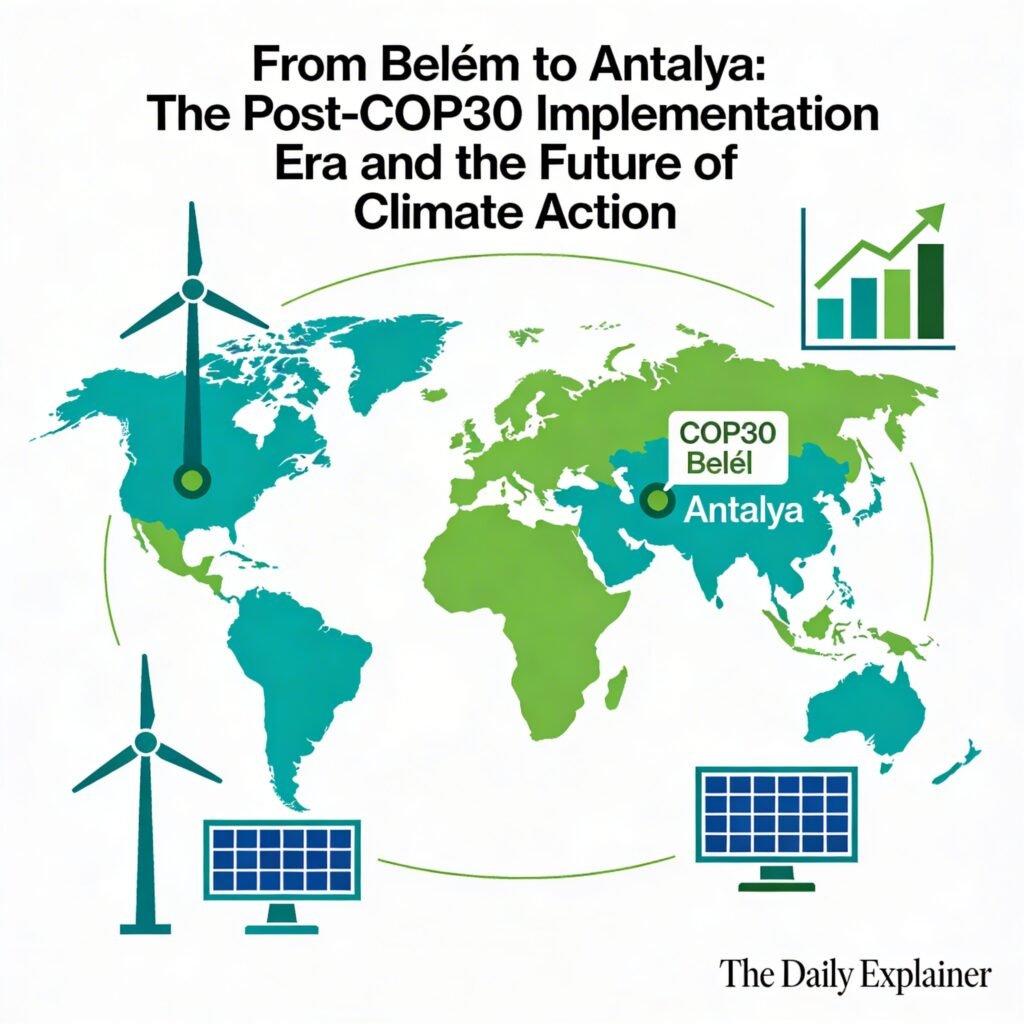
The world has entered a new phase of climate action. The era of pure negotiation is over. The era of implementation has begun. COP30 in Belém was the ceremonial handover, the moment when the global community collectively agreed to stop designing the blueprint and start building the house.
Now, in 2026, the work is underway. The road from Belém to Antalya is paved with a dense calendar of legal, technical, and multi-stakeholder processes. A UN resolution seeks to give legal teeth to the ICJ’s landmark opinion. Governments are embedding the Plans to Accelerate Solutions into national policy. Bilateral partnerships are forming to tackle critical sectors like buildings. And the incoming COP31 Presidency is preparing to take the baton.
The challenges are immense. Geopolitical tensions, the backlash against climate regulation, the deep divisions over fossil fuels, and the vast gap between financial needs and available resources all threaten to derail progress. But as the COP30 President reminded us, “climate urgency will not wait until political and socioeconomic conditions are ideal” .
The post-COP30 era is not about naive optimism. It is about clear-eyed, determined implementation. It is about recognizing that we must operate at two speeds—maintaining the legitimacy of the consensus track while enabling coalitions of the capable to move faster. It is about turning the “Mutirão spirit” of collective effort into a permanent feature of global governance.
The future of climate action will not be decided solely in conference rooms. It will be decided in the policies of national governments, the investment decisions of corporations, the actions of cities, and the mobilization of communities. The post-COP30 framework provides the direction, the tools, and the accountability mechanisms. The rest is up to us.
Key Takeaways:
- We are in a new era: COP30 marked the formal transition from negotiation to implementation. 2026 is the first full year of this new phase.
- “Two-speed multilateralism” is the operating model: Consensus-based decisions provide the foundation, while faster-moving coalitions drive implementation on the ground.
- Legal accountability is strengthening: The ICJ Advisory Opinion and the pending UN resolution are creating new tools for holding states to their obligations.
- Integration is essential: Climate action is now inextricably linked with finance, trade, biodiversity, and land use. Policy coherence across these domains is critical.
- COP31 will be the first big test: The summit in Antalya will reveal whether the post-Belém momentum can survive the complexities of geopolitics and deliver tangible progress.
FAQs (Frequently Asked Questions)
- What was the main outcome of COP30 in Belém?
COP30 is widely seen as the “COP of Implementation.” Its main outcome was to formally transition the global climate regime from a three-decade negotiation phase to a new era focused on accelerating action. Key decisions included the Global Mutirão Decision, a call to triple adaptation finance by 2035, and the launch of roadmaps for transitioning away from fossil fuels. - What is the Global Mutirão Decision?
“Mutirão” is a Brazilian Indigenous term for a collective, community-driven effort. The decision enshrines this spirit in international law, calling for a global mobilization uniting governments, non-state actors, and citizens to accelerate climate implementation. - What does “two-speed multilateralism” mean?
It’s a concept from COP30 President André Corrêa do Lago. It proposes that climate governance should operate at two complementary speeds: a consensus-based track (formal UN negotiations) that secures legitimacy, and an implementation track where coalitions of willing actors (countries, cities, businesses) can move faster to scale solutions, without reopening what has already been agreed. - When and where is COP31 taking place?
COP31 will be held in Antalya, Turkey, from 9 to 20 November 2026. It will be presided by Murat Kurum, Turkey’s Minister of Environment, Urbanization, and Climate Change, with Australia’s Minister Chris Bowen presiding over negotiations. - What is the ICJ Advisory Opinion, and why does it matter?
In 2025, the International Court of Justice issued a landmark advisory opinion clarifying states’ legal obligations to protect the climate system. It affirmed that countries must adopt 1.5°C-aligned NDCs, cut emissions, end fossil fuel subsidies, and provide reparations for damage. A pending UN resolution seeks to turn this opinion into a practical roadmap for accountability. - What is the Belém Indicators for the Global Goal on Adaptation (GGA)?
These are a set of indicators adopted at COP30 to measure progress on adaptation. For the first time, this makes adaptation tangible and accountable, shifting it from a vague aspiration to a measurable outcome. - What are the Plans to Accelerate Solutions (PAS)?
They are concrete, multi-sectoral action plans launched under the COP30 Action Agenda. There are 120 PAS, each bringing together governments, businesses, and civil society to deliver measurable results on specific challenges, like greening cities or building health resilience. - What is the ICBC, and why is the India-France commitment significant?
The Intergovernmental Council for Buildings and Climate (ICBC) is a multilateral platform for countries to cooperate on decarbonizing the buildings sector. The India-France commitment is significant because it shows two major countries using this platform to drive action in a critical sector, linking bilateral cooperation to a global framework. - What happened at the Bonn Climate Conference (SB64)?
SB64, the mid-year UNFCCC session in June 2026, is focused on the technical details of implementation. Negotiators are working to refine the Belém Indicators for adaptation, advance the New Collective Quantified Goal (NCQG) on climate finance, and operationalize Article 6 carbon markets. - How do the biodiversity (CBD) and desertification (UNCCD) COPs relate to climate action?
These are the “Rio Conventions,” and they are deeply interconnected. Land degradation drives climate change and biodiversity loss. Healthy ecosystems are essential for both adaptation and mitigation. The 2026 CBD and UNCCD COPs are crucial opportunities to align National Adaptation Plans (NAPs) with biodiversity and land-use strategies. - Did COP30 agree to phase out fossil fuels?
No single, agreed roadmap was adopted. The negotiations were deeply divided, with oil-producing countries opposing any such effort. Instead, the COP30 Presidency took on the responsibility to develop roadmaps to guide a gradual, just transition, engaging experts, producers, and governments. - What is the New Collective Quantified Goal (NCQG)?
It’s the new global climate finance goal currently being negotiated, which will replace the $100 billion pledge after 2025. Developing countries are pushing for a goal in the trillions, while developed countries are seeking to expand the contributor base. - What does it mean to “triple adaptation finance by 2035”?
At COP30, countries agreed to triple public adaptation finance by 2035 from 2025 levels. This is a powerful signal to funders and investors about where to prioritize resources, though the actual mobilization of funds remains a huge challenge. - What are NDC 3.0s?
They are the third generation of Nationally Determined Contributions. Over 120 countries submitted new or updated NDCs by the time of COP30. These are supposed to be more ambitious and detailed than previous versions, including implementation and investment plans aligned with the 1.5°C goal. - What is the “Global Implementation Accelerator”?
Launched at COP30, it’s a tool designed to align political decisions, science, and concrete action on the ground. It’s part of the new architecture to help move from agreement to delivery. - How can non-state actors (cities, businesses) participate in the post-COP30 process?
Through the Global Climate Action Agenda. The 30 Activation Groups and 120 Plans to Accelerate Solutions (PAS) provide platforms for cities, businesses, investors, and civil society to collaborate, report on their actions, and contribute to implementation. - What is the “Belém Mission for 1.5°C”?
Another initiative launched at COP30, the Mission is designed to keep the 1.5°C goal alive by accelerating implementation and bringing together actors committed to the highest level of ambition. - What are the main challenges for climate action in 2026?
Key challenges include geopolitical tensions, the political backlash against climate regulation in some countries, the deep divisions over fossil fuels, the vast gap between financial needs and available resources, and the sheer complexity of coordinating implementation across so many different tracks and actors. - How does the EU’s post-2030 policy framework fit into this?
The EU is a major player in climate policy. Its consultations on post-2030 targets and the potential use of international credits will shape its next NDC and its negotiating position at COP31 and beyond. This is a critical piece of the global puzzle. - What is the significance of the COP30 Presidency’s “Twelfth Letter”?
This letter from President André Corrêa do Lago, published in January 2026, lays out the vision for the post-COP30 implementation era. It introduces the concept of “two-speed multilateralism,” details the roadmaps on fossil fuels and deforestation, and reflects on the lessons learned from Belém. - Where can I follow the progress of the post-COP30 implementation?
The official UNFCCC website and the dedicated COP30 and COP31 presidency websites are the primary sources. Following the work of the Climate Champions and initiatives like the ICBC and the Action Agenda provides a more detailed picture. For more explainers, visit our Explained section and our blog.
About Author
This article was written by the editorial team at The Daily Explainer, as the sixth in our series on climate solutions and the capstone of our comprehensive coverage. We have explored the Cryosphere Crisis, the Nature-Climate Feedback Loop, the need for Climate Adaptation vs. Mitigation, the reality of Compound Climate Disasters, the urgency of the 1.5°C Target, the hope offered by the Circular Economy and Breakthrough Climate Technologies, the human toll of Climate Grief, and the mechanics of Climate Finance. This final piece synthesizes those threads to explain the overarching political and institutional framework for the implementation era. We draw on official documents from the COP30 Presidency, the UNFCCC, the ICJ, and analysis from leading policy institutions. For any questions or feedback, please feel free to contact us.
Free Resources
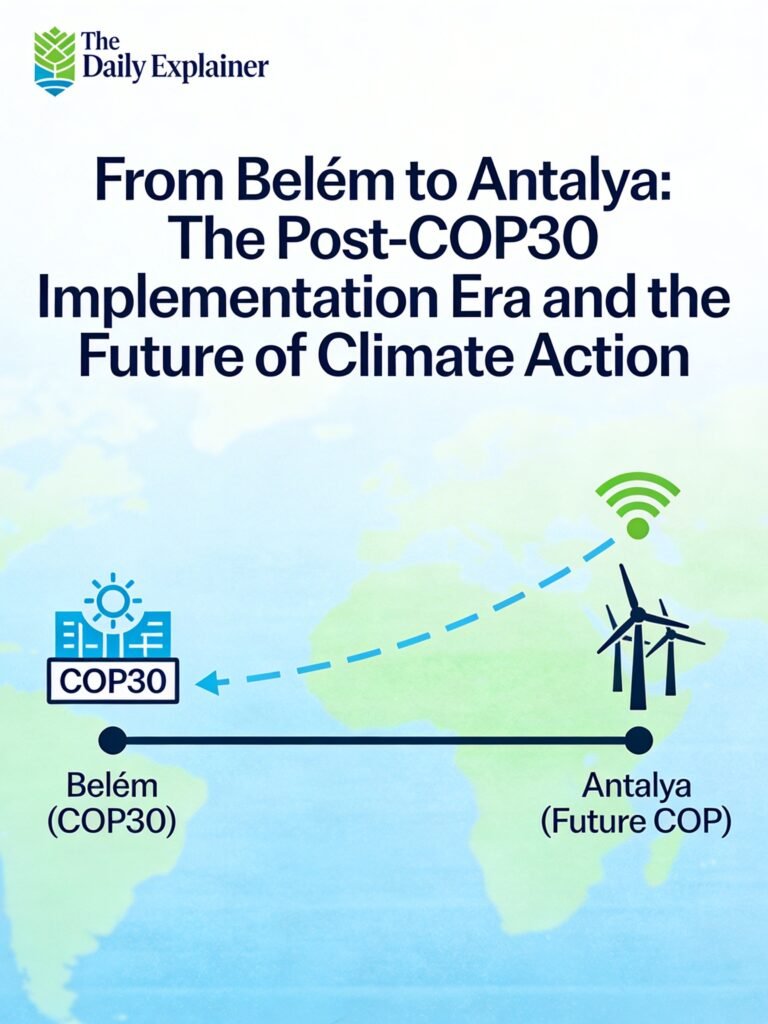
- UNFCCC COP30 Presidency Website: Official documents, letters from the President, and news on the follow-up to COP30.
- UNFCCC COP31 Website (to be launched): Information on the upcoming COP in Turkey.
- Climate Action Agenda Platform: The official hub for tracking the progress of the 120 Plans to Accelerate Solutions (PAS) and other non-state actor initiatives.
- Amnesty International ICJ Resource Page: Information on the ICJ Advisory Opinion and the campaign for a strong UN resolution.
Discussion
What do you think about the shift from negotiation to implementation? Are you hopeful that the “two-speed” approach can accelerate action, or do you fear it will undermine the UN process? How can we ensure that the roadmaps on fossil fuels lead to a just transition? Share your thoughts and questions in the comments below. For more articles and insights, visit our blog and our Explained section. Your voice is part of the global conversation we need.
About The Author




Its superb as your other articles : D, thanks for posting.