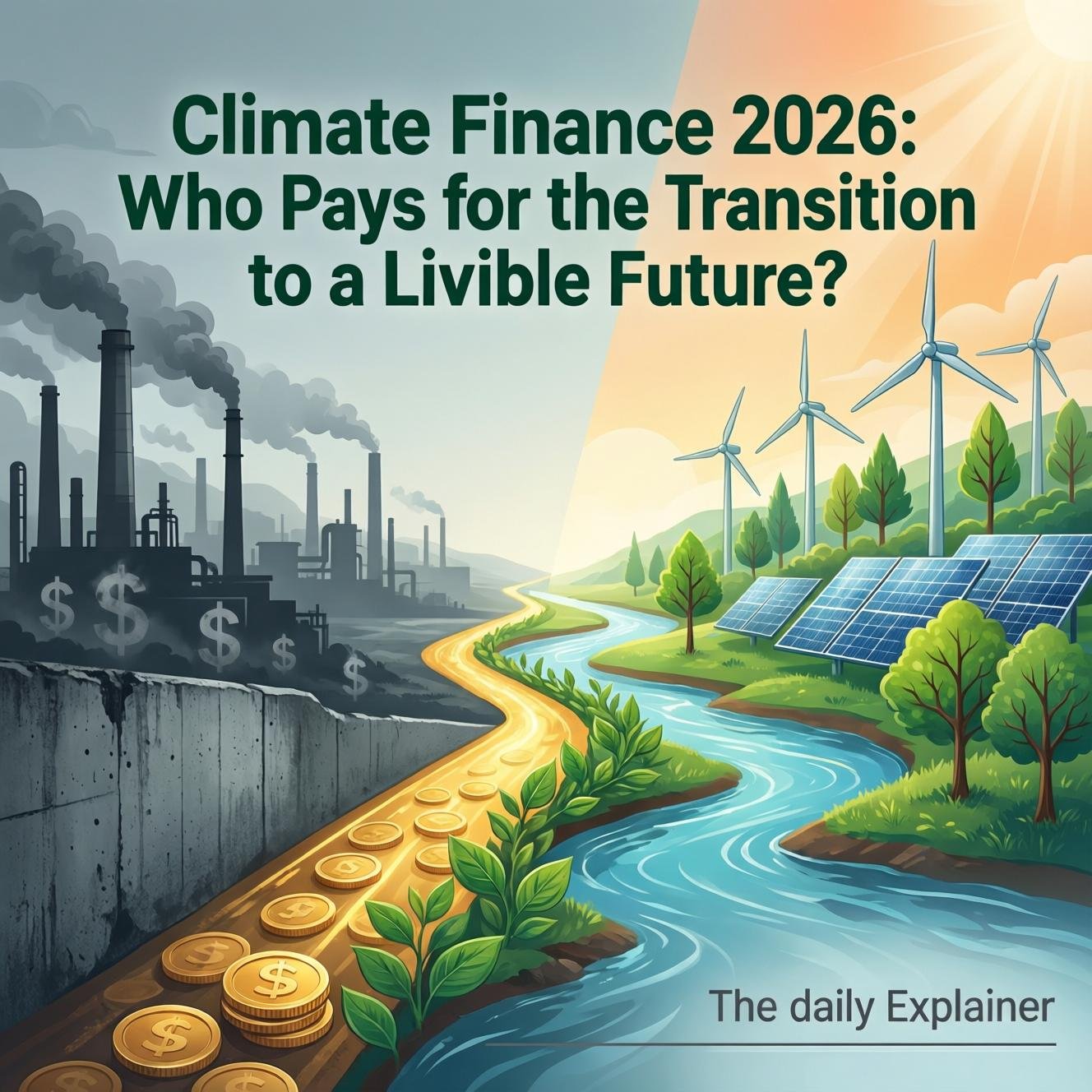
In 2026, climate finance is the central battleground of international climate policy. Trillions of dollars are needed to fund the transition, and the question of who pays—and who gets paid—is more urgent than ever.
Introduction – Why This Matters
In my years of following international climate finance 2026 negotiations, I’ve noticed a recurring pattern. The science is presented, the impacts are documented, and the solutions are laid out. Heads nod in agreement. Then the conversation shifts to a single, thorny, unresolved question: “Who is going to pay for all of this?”
It’s the question that has derailed summits, broken alliances, and exposed the deep fault lines of global justice. And in 2026, it is more urgent than ever.
The numbers are staggering. The International Energy Agency (IEA) estimates that we need to invest $4.5 trillion per year in clean energy by 2030 to stay on track for net-zero emissions by 2050. The United Nations Environment Programme (UNEP) calculates that developing countries alone will need $215 to $387 billion per year for adaptation by 2030. And then there is the newest, most emotionally charged category of all: loss and damage—the money needed to help countries cope with the climate impacts that can no longer be avoided.
What I’ve found is that most people, even those deeply concerned about climate change, have no idea how this financial system works. They hear about the “Green Climate Fund” and the “Loss and Damage Fund,” but these remain abstract concepts. This article is designed to change that.
We will break down the complex world of climate finance: where the money comes from, where it needs to go, the difference between public and private finance, the history of the $100 billion promise, and the new frontier of loss and damage. Because without understanding the money, we cannot understand the politics or the path forward.
Background / Context
The story of climate finance is inseparable from the story of climate justice. The core principle, enshrined in the 1992 United Nations Framework Convention on Climate Change (UNFCCC), is “common but differentiated responsibilities and respective capabilities.” This is a diplomatic way of saying that wealthy, industrialized nations have caused most of the problem (by burning fossil fuels for over a century), and they have the most capacity to pay for the solution.
This principle has guided climate finance ever since. At the 2009 Copenhagen climate summit (COP15), developed countries made a historic pledge: to mobilize $100 billion per year by 2020 to support climate action in developing countries. This was not charity; it was framed as a down payment on climate justice.
The $100 billion goal was met, belatedly, in 2022, according to the OECD. But the figure is widely seen as inadequate and politically fraught. Much of the money has been in the form of loans, not grants, adding to the debt burden of developing countries. And the split between funding for mitigation (reducing emissions) and adaptation (building resilience) has been heavily skewed toward mitigation, even though adaptation needs are urgent and growing.
At the same time, a new front has opened. As climate impacts have intensified—from the Pakistan floods of 2022 to the 2026 Chile wildfires—vulnerable nations have demanded a separate stream of finance for loss and damage. This is money for the impacts that go beyond what adaptation can handle: lives lost, cultures destroyed, nations made uninhabitable. At COP27 in 2022, after decades of resistance, developed countries finally agreed to establish a Loss and Damage Fund. At COP28, the fund was formally adopted. At COP30 in 2025, the hard work of operationalizing it began.
As Simon Stiell, UN Climate Change Executive Secretary, stated at COP30: “Climate finance is not charity. It is a down payment on a safer, more prosperous future for all humanity. And it is the only way to build the trust we need to keep raising our ambition.”
Key Concepts Defined
To navigate the world of climate finance, we need a clear understanding of the different types of money, where they come from, and what they’re for.
- Climate Finance: Local, national, or transnational financing—drawn from public, private, and alternative sources—that seeks to support mitigation and adaptation actions that will address climate change.
- Mitigation Finance: Funding for projects and programs that reduce greenhouse gas emissions or enhance carbon sinks. Examples: building solar farms, funding reforestation, and supporting energy efficiency.
- Adaptation Finance: Funding for actions that help communities and ecosystems adjust to the actual or expected effects of climate change. Examples: building sea walls, developing drought-resistant crops, installing early warning systems.
- Loss and Damage Finance: Funding to address the impacts of climate change that occur despite, or in the absence of, mitigation and adaptation efforts. This includes both economic losses (destroyed infrastructure, lost crops) and non-economic losses (loss of culture, loss of life, loss of biodiversity) .
- Green Climate Fund (GCF): The world’s largest dedicated climate fund, established under the UNFCCC to channel finance from developed to developing countries for mitigation and adaptation projects. It was a key part of the $100 billion pledge.
- The $100 Billion Pledge: The 2009 commitment by developed countries to mobilize $100 billion per year by 2020 (later delayed to 2022) for climate action in developing countries. The goal was met in 2022, but the figure is now seen as a floor, not a ceiling.
- Public Finance: Money from government sources, including national budgets, development finance institutions (like the World Bank), and multilateral funds (like the GCF). It is often used for projects that are not commercially viable or to de-risk investments to attract private capital.
- Private Finance: Money from corporations, banks, investors, and other private entities. This includes direct investment in renewable energy projects, green bonds, and venture capital for climate tech startups.
- Blended Finance: The strategic use of public finance to mobilize additional private investment. Public money might be used to guarantee a loan, provide a first-loss cushion, or fund technical assistance, making a project more attractive to private investors.
- Green Bonds: Debt instruments (like loans) issued by governments, corporations, or financial institutions specifically to raise money for climate and environmental projects. The market for green bonds has grown exponentially, reaching over $500 billion in annual issuance.
- Carbon Markets: Trading systems where carbon credits are bought and sold. Companies or countries can buy credits to offset their emissions, and projects that reduce or remove emissions (like reforestation) can sell credits. There are both compliance markets (mandated by law) and voluntary markets.
- Article 6 of the Paris Agreement: The section of the Paris Agreement that provides the rules for international carbon markets, allowing countries to trade emissions reductions to meet their national climate targets. After years of negotiations, the rules for Article 6 were finally agreed upon at COP26 and are now being implemented.
How It Works (A Step-by-Step Breakdown of Climate Finance Flows)
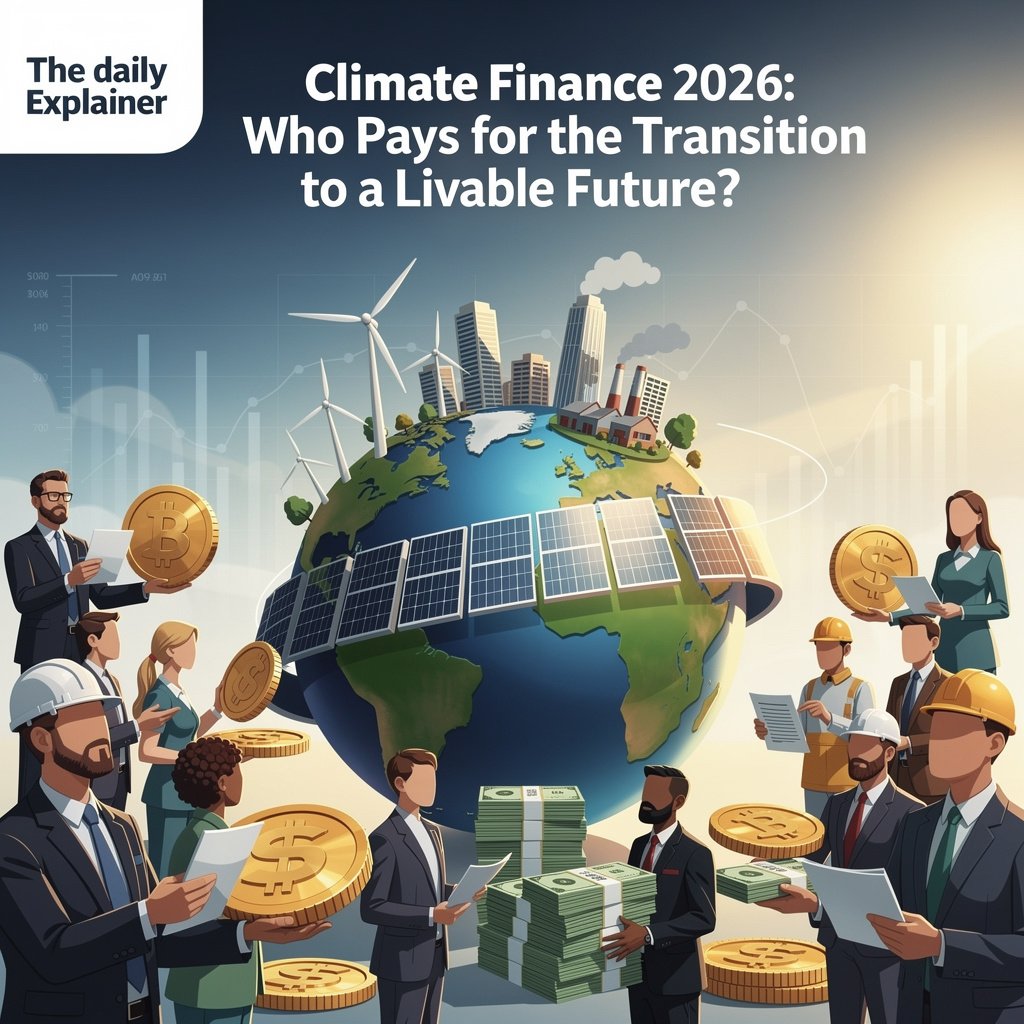
Climate finance is not a single pot of money. It’s a complex, multi-layered system. Here is a step-by-step breakdown of how money flows from sources to projects.
Step 1: The Sources – Where the Money Comes From
Money originates from two main sources: public and private.
- Public Sources: These include national governments (through their development aid budgets), multilateral development banks (like the World Bank and regional development banks), and dedicated climate funds (like the Green Climate Fund).
- Private Sources: These include institutional investors (pension funds, insurance companies), commercial banks, corporations, and individuals. Private capital is the largest potential source of climate finance, but it needs the right risk-return profile to flow.
Step 2: The Channels – How the Money Moves
Once raised, money flows through various channels to reach projects.
- Bilateral Channels: Direct from one government to another. For example, Germany’s development agency (GIZ) might fund a renewable energy project in India.
- Multilateral Channels: Through institutions like the World Bank or the Green Climate Fund. Developed countries contribute money to these funds, which then allocate it to projects in developing countries. This is intended to be more coordinated and less politically driven.
- National Channels: Some developing countries have set up national climate funds that can receive and disburse finance directly, building local ownership and capacity.
- Private Channels: Direct investment by corporations, or through financial intermediaries like green bonds or climate-focused investment funds.
Step 3: The Instruments – The Financial Tools
Money is not just given; it is deployed using a range of financial instruments.
- Grants: Money that does not need to be repaid. These are essential for adaptation projects that don’t generate revenue, and for the poorest, most vulnerable countries.
- Loans (Concessional and Non-Concessional): Money that must be repaid with interest. Concessional loans have below-market interest rates and longer repayment terms, making them more affordable.
- Guarantees: Public institutions can provide guarantees that reduce the risk for private investors, covering losses if a project fails. This is a key tool for blended finance.
- Equity: Direct investment in companies or projects in exchange for ownership shares.
- Results-Based Finance: Payments are made only after pre-agreed results are achieved and verified (e.g., a certain amount of emissions reduced or trees planted).
Step 4: The Uses – What the Money Pays For
At the project level, the money is used for specific activities.
- Mitigation Projects: Installing solar panels, building wind farms, improving public transit, and protecting forests.
- Adaptation Projects: Building flood defenses, developing drought-resistant seeds, and installing early warning systems for heatwaves and storms.
- Capacity Building: Training government officials, developing national climate plans, and strengthening institutions.
- Technology Transfer: Helping developing countries access and deploy clean technologies.
Step 5: The New Frontier – Loss and Damage
The Loss and Damage Fund operates on a different logic. It is not for prevention (mitigation) or preparation (adaptation). It is a response to impacts that have already happened.
- Eligibility: A major point of negotiation is who gets money from the fund. The consensus is that it should prioritize the most vulnerable countries.
- Sources: Countries have made initial pledges (hundreds of millions, not yet billions), but there is intense debate about expanding the contributor base. Some argue that major emerging economies (like China) and fossil fuel companies should also contribute.
- Disbursement: The fund will need to disburse money quickly after a disaster, but also for slow-onset events like sea-level rise and drought. Developing the rules for this is the work of 2026 and beyond.
Key Takeaways Box:
- The need is enormous: $4.5 trillion/year in clean energy investment and $215-387 billion/year for adaptation are needed by 2030 .
- The $100 billion pledge was a starting point: It was met in 2022, but is now seen as a floor, and the composition (loans vs. grants) is controversial .
- Private finance is essential but needs public de-risking: Most climate finance must come from the private sector, but public money is needed to make projects investable .
- Loss and damage is the new frontier: A fund exists, but operationalizing it and filling it with adequate resources is the central challenge of 2026 .
Why It’s Important
Climate finance is not a dry, technical subject. It is the fuel that powers the entire climate action engine. Without it, nothing else happens.
- It’s the Basis of Trust in International Cooperation: Developing countries have consistently said they will not raise their climate ambition unless they see the promised finance materialize. The $100 billion pledge was a test of good faith. Its (belated) fulfillment was crucial for maintaining trust. Now, the Loss and Damage Fund is the new test. If wealthy countries fail to fund it adequately, it will poison the well for all future negotiations.
- It Enables Mitigation Where It Matters Most: The majority of future emissions growth will come from developing countries. If they leapfrog fossil fuels and build clean energy systems, we have a chance at the 1.5°C Target. If they can’t afford to, they will build coal plants, and we will all lose. Climate finance is the investment in a global transition.
- It Makes Adaptation Possible for the Most Vulnerable: The countries that need adaptation the most are often the poorest and most indebted. They cannot afford to build sea walls or develop drought-resistant crops on their own. Adaptation finance is a matter of survival for millions of people.
- It Addresses Loss and Damage and Climate Justice: For communities that have lost everything to a climate-driven disaster, money is not a solution, but it is a lifeline. It enables them to rebuild, to recover, and to have some semblance of a future. Loss and damage finance is the ultimate expression of climate justice—acknowledging that those who did the least to cause the problem should not bear the full cost of its consequences.
- It Unlocks Private Innovation: Public finance, through mechanisms like blended finance and green bonds, can de-risk new technologies and attract the massive private capital needed to scale up solutions like those we explored in Breakthrough Climate Technologies.
Sustainability in the Future
A sustainable financial architecture for climate action will look very different from today’s patchwork system. Here’s what experts are calling for.
- Moving from Billions to Trillions: The $100 billion pledge was a political milestone, but it is dwarfed by the need. Future climate finance must operate on a scale of trillions, not billions. This means massively scaling up all sources: public budgets, multilateral development bank lending, and private investment.
- Reforming the Multilateral Development Banks (MDBs): The World Bank and its regional counterparts have been criticized for being too slow, too risk-averse, and too focused on loans rather than grants. There is a growing movement to reform them, to increase their lending capacity, and to align all their operations with the Paris Agreement goals.
- Expanding the Contributor Base: The original list of developed countries that pledged the $100 billion is from 1992. The world has changed. Some emerging economies, like China and the Gulf States, are now major economies and significant emitters. There is growing pressure for them to become contributors to climate finance, not just recipients.
- Making Private Finance Work for Adaptation: Private finance flows overwhelmingly to mitigation projects, which can generate revenue. Adaptation projects, like sea walls, are harder to monetize. New financial instruments and public-private partnerships are needed to channel more private capital to adaptation.
- Operationalizing the Loss and Damage Fund Justly: The fund must be designed to get money to those who need it most, quickly and with minimal bureaucracy. This means clear eligibility criteria, simplified access procedures, and a focus on both rapid-onset disasters and slow-onset events.
- Integrating Climate Risk into All Financial Decisions: Central banks and financial regulators are increasingly focused on climate-related financial risks. In the future, every investment decision—from a pension fund to a bank loan—will need to account for climate risk. This is the work of the Network for Greening the Financial System (NGFS) , a group of over 100 central banks.
Common Misconceptions
Climate finance is perhaps the most misunderstood aspect of climate policy. Here are the most common myths.
Misconception 1: “The $100 billion pledge was a failure because it wasn’t met by 2020.”
The pledge was met in 2022, two years late. While the delay was frustrating and damaged trust, the goal was ultimately achieved. The bigger issue is the quality of the finance—much of it was in loans, not grants, adding to developing country debt .
Misconception 2: “Climate finance is just a handout to poor countries.”
This framing is inaccurate and unhelpful. As Simon Stiell has said, it’s an investment in a global public good—a stable climate. It also creates markets for clean technologies from wealthy countries. And it’s a matter of justice: wealthy countries are responsible for the vast majority of historical emissions.
Misconception 3: “Private finance will solve the problem without government help.”
Private capital is essential, but it won’t flow to the places it’s most needed without public intervention. Many climate projects, especially in adaptation, are not commercially viable on their own. Public finance is needed to de-risk investments, providing guarantees and first-loss cushions that make projects attractive to private investors.
Misconception 4: “The Loss and Damage Fund is just a compensation scheme.”
This is a politically charged framing. The fund is not about legal liability or compensation, which wealthy countries have always rejected. It is about solidarity and support for vulnerable countries facing impacts they did not cause. The fund’s design carefully avoids creating a basis for future liability claims.
Misconception 5: “My country can’t afford to contribute.”
For wealthy countries, the amounts needed for international climate finance are a tiny fraction of national budgets and GDP. The failure to contribute is a failure of political will, not economic capacity. For developing countries, the argument is the opposite: they cannot afford not to receive finance, as the costs of inaction far outweigh the costs of adaptation.
Recent Developments (2025-2026)
The past year has been pivotal for climate finance, with major developments at COP30 and beyond.
- COP30 in Belém, Brazil (November 2025): The summit was a major test for climate finance. Key outcomes included:
- Operationalizing the Loss and Damage Fund: Significant progress was made on the rules for the fund, including agreement on the World Bank as interim host and initial pledges from several countries (totaling over $700 million). However, this is still far short of the need, which is estimated in the hundreds of billions.
- The New Collective Quantified Goal (NCQG): Negotiations began on a new goal for climate finance to replace the $100 billion pledge after 2025. This is a hugely contentious issue, with developing countries demanding a goal in the trillions, and developed countries pushing for a broader contributor base.
- Article 6 Carbon Market Rules Finalized: After years of negotiations, the rules for international carbon trading under the Paris Agreement were finalized, creating a framework for countries and companies to trade emissions reductions.
- The IMF and World Bank Spring Meetings (April 2026): Climate finance was a central theme. A coalition of developing countries, led by Barbados Prime Minister Mia Mottley, continued to push for sweeping reforms of the multilateral development banks, including a major increase in lending capacity and the inclusion of “climate resilience” clauses in debt contracts.
- Growth of the Voluntary Carbon Market: Despite controversies over quality, the voluntary carbon market continued to grow. New integrity initiatives, like the Integrity Council for the Voluntary Carbon Market (ICVCM) , are working to establish high-integrity standards to ensure credits represent real, additional, and permanent emissions reductions.
- Green Bond Issuance Surges: Global green bond issuance surpassed $600 billion in 2025, according to the Climate Bonds Initiative, demonstrating strong investor appetite for climate-friendly investments.
Real-Life Examples
These examples show climate finance in action.
1. The Green Climate Fund and Renewable Energy in Rwanda
The Green Climate Fund provided a $32 million grant to support off-grid solar power in Rwanda. This project is bringing electricity to hundreds of thousands of people for the first time, using clean energy instead of diesel or kerosene. It’s a classic example of mitigation finance (reducing emissions by leapfrogging fossil fuels) with huge social co-benefits (improving lives). You can find more examples of such projects on the Sherakat Network’s resources page.
2. Adaptation Finance in Bangladesh
Bangladesh is one of the most climate-vulnerable countries in the world. It has received significant adaptation finance from multiple sources, including the Green Climate Fund and bilateral donors, to build cyclone shelters, install early warning systems, and plant coastal mangroves. As we noted in our Climate Adaptation article, this investment has saved countless lives.
3. The Loss and Damage Fund in Vanuatu
Vanuatu, a Pacific island nation, was hit by two Category 5 cyclones in a single week in 2025. The cyclones destroyed homes, infrastructure, and crops, causing damage equivalent to over 60% of the country’s GDP. This is a textbook case for the Loss and Damage Fund. In 2026, Vanuatu is expected to be among the first countries to apply for funding, testing the new fund’s ability to respond quickly and effectively.
4. Blended Finance for a Solar Farm in South Africa
A private developer wants to build a large-scale solar farm in South Africa. The project is viable, but the risk is too high for commercial banks to lend at an affordable rate. A development finance institution steps in with a partial guarantee (public money), covering a portion of the potential losses. This de-risks the project, allowing the developer to secure a loan from a commercial bank. This is blended finance in action, using a small amount of public money to unlock much larger private investment.
Success Stories
Despite the challenges, there are clear successes in climate finance.
- The Green Climate Fund’s Project Portfolio: Since its inception, the GCF has approved over $15 billion for more than 200 projects in developing countries, leveraging an additional $60 billion in co-financing. It has funded everything from renewable energy in Africa to climate-resilient agriculture in Asia to forest protection in Latin America .
- The Exponential Growth of Green Bonds: The green bond market has grown from virtually zero in 2007 to over $600 billion in annual issuance. This demonstrates that the financial markets are capable of mobilizing massive capital for climate solutions, given the right policy signals and standards .
- Costa Rica’s Payment for Ecosystem Services (PES): As mentioned in our Nature-Climate Feedback Loop article, Costa Rica’s PES program is a success story in using domestic finance (a tax on fossil fuels) to pay landowners to protect forests, which sequester carbon and provide other ecosystem services. It’s a model for results-based finance.
- The Global Environment Facility (GEF)’s Work on Capacity Building: For over 30 years, the GEF has provided grants to help developing countries build the capacity to participate in global environmental agreements. This includes training negotiators, developing national climate plans, and establishing systems for measuring and reporting emissions. This behind-the-scenes work is essential for enabling countries to access and use climate finance effectively.
Conclusion and Key Takeaways
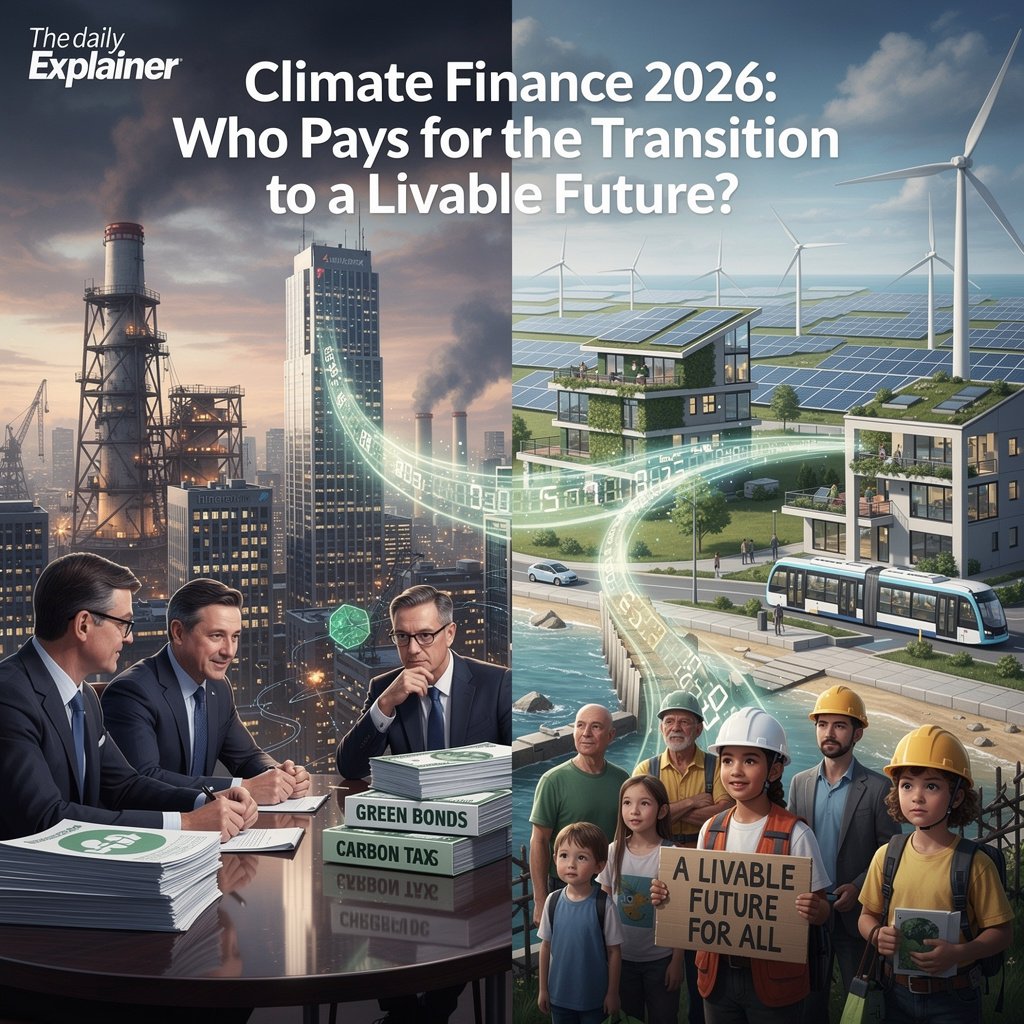
The question of “who pays?” is the most politically charged in all of climate policy. It goes to the heart of historical responsibility, current capability, and future justice. As we’ve seen throughout this series—from the melting cryosphere to the burning forests, from the urgent need for adaptation to the terrifying reality of compound disasters, from the hope of breakthrough technologies to the human toll of climate grief—the stakes could not be higher.
Climate finance is not an abstract accounting exercise. It is the tangible expression of global solidarity. It is the means by which we can ensure that the transition to a low-carbon, climate-resilient world is also a just and equitable one.
The $100 billion pledge was a down payment. The Loss and Damage Fund is a new and critical front. The New Collective Quantified Goal is a test of whether the world can move from billions to trillions. And the reform of the global financial architecture is a test of whether we can build a system fit for the 21st century.
The money exists. The challenge is the political will to mobilize it and the institutional capacity to deploy it effectively and fairly. As the UN Secretary-General has said, “We are in a race against time. And we are losing. But we can still win. To win, we need trust. And to build trust, we need finance.”
Key Takeaways:
- The need is in the trillions: We need $4.5 trillion/year in clean energy investment and hundreds of billions for adaptation by 2030.
- The $100 billion pledge was met, but it’s not enough: The goal was fulfilled in 2022, but the new goal (NCQG) must be far more ambitious.
- Loss and damage is now a reality: A fund exists, but operationalizing it and filling it with adequate resources is the critical task of 2026.
- Private finance is key, but needs public de-risking: Blended finance and green bonds are essential tools to unlock private capital.
- Climate finance is about trust and justice: It is the foundation of international cooperation and a prerequisite for a livable, equitable future for all.
FAQs (Frequently Asked Questions)
- What is climate finance?
It’s local, national, or transnational financing—from public, private, and alternative sources—that supports mitigation and adaptation actions to address climate change. - What is the $100 billion pledge?
A 2009 commitment by developed countries to mobilize $100 billion per year by 2020 (later delayed to 2022) for climate action in developing countries. The goal was met in 2022. - Was the $100 billion pledge successful?
It was met, but two years late, and much of the funding was in loans rather than grants. It is now seen as a political milestone, but the scale is completely inadequate for the need. - What is the Green Climate Fund (GCF)?
The world’s largest dedicated climate fund, established under the UNFCCC, channels finance from developed to developing countries for mitigation and adaptation projects. It has approved over $15 billion for more than 200 projects. - What is the Loss and Damage Fund?
A new fund, agreed at COP27 and operationalized at COP28 and COP30, to provide financial support to developing countries facing the unavoidable impacts of climate change (losses from disasters, sea-level rise, etc.) . - How much money is in the Loss and Damage Fund?
Initial pledges total over $700 million, but this is a tiny fraction of what’s needed. Estimates of annual loss and damage needs are in the hundreds of billions. - What is the difference between mitigation, adaptation, and loss and damage finance?
- Mitigation finance pays for actions to reduce emissions (e.g., solar farms).
- Adaptation finance pays for actions to prepare for climate impacts (e.g., sea walls).
- Loss and damage finance pays for responding to impacts that have already happened and cannot be avoided (e.g., rebuilding after a cyclone) .
- What is the New Collective Quantified Goal (NCQG)?
A new global climate finance goal, currently being negotiated, will replace the $100 billion pledge after 2025. Developing countries are pushing for a goal in the trillions. - What is blended finance?
The strategic use of public finance to mobilize additional private investment. Public money de-risks projects (e.g., through guarantees), making them attractive to private investors. - What are green bonds?
Debt instruments issued by governments, corporations, or financial institutions specifically to raise money for climate and environmental projects. The market has grown to over $600 billion annually. - What is Article 6 of the Paris Agreement?
The section that provides the rules for international carbon markets, allowing countries to trade emissions reductions. The rules were finally finalized at COP26 and are now being implemented. - Who contributes to climate finance?
Traditionally, it’s been developed countries (the “Annex II” countries under the UNFCCC). There is growing pressure for major emerging economies and private sources to contribute more. - Who receives climate finance?
Developing countries, with a focus on the most vulnerable (least developed countries and small island developing states). Eligibility and access rules vary by fund. - Is climate finance just loans, or are there grants?
It’s a mix. Grants are essential for adaptation and for the poorest countries. Loans, including concessional loans, are also used, but they can add to debt burdens. The composition is a major point of contention. - What is the role of the World Bank in climate finance?
The World Bank is a major channel for climate finance. It hosts several climate funds (including, temporarily, the Loss and Damage Fund) and is being pushed to reform its lending practices to better support climate action . - What is the Network for Greening the Financial System (NGFS)?
A group of over 100 central banks and financial supervisors is working to manage climate-related financial risks and mobilize capital for the green transition. - How does climate finance relate to the 1.5°C Target?
Directly. The emissions cuts needed to stay under 1.5°C require massive investment in clean energy in all countries, especially developing ones. Finance is the enabler of those cuts. - What are “carbon markets,” and do they work?
Carbon markets allow trading of emissions reductions. They can be an efficient way to drive investment, but they must have strong rules to ensure credits represent real, additional, and permanent reductions. The new Article 6 rules aim to provide that integrity. - What is the Integrity Council for the Voluntary Carbon Market (ICVCM)?
An independent governance body working to establish and enforce high-integrity standards for the voluntary carbon market, to ensure that carbon credits are credible and effective. - How can I, as an individual, support climate finance?
You can support policies that fund international climate action, choose financial institutions that invest in green bonds and avoid fossil fuels, and, if you’re an investor, explore climate-friendly investment options. For more on engaging with these issues, visit our blog. - Where can I learn more about specific climate finance projects?
The Green Climate Fund website has a project portfolio. The Climate Bonds Initiative tracks the green bond market. The OECD publishes data on climate finance flows. For deeper dives, our Explained section has related articles.
About Author
This article was written by the editorial team at The Daily Explainer, as the fourth in our series on climate solutions, following our exploration of the Circular Economy, Breakthrough Climate Technologies, and Climate Grief and Eco-Anxiety. This piece addresses the financial and political backbone of climate action, building on our previous comprehensive series on climate challenges: the Cryosphere Crisis, the Nature-Climate Feedback Loop, the need for Climate Adaptation vs. Mitigation, the reality of Compound Climate Disasters, and the urgency of the 1.5°C Target. We synthesize insights from the UNFCCC, the OECD, the Green Climate Fund, the World Bank, and leading climate finance experts. For any questions or feedback, please feel free to contact us.
Free Resources
- Green Climate Fund (GCF): The official website of the world’s largest dedicated climate fund, with information on its projects and portfolio.
- Climate Bonds Initiative: An international organization working to mobilize the bond market for climate solutions. They provide excellent data and analysis on green bonds.
- OECD Climate Finance Dashboard: Provides data and analysis on developed countries’ progress toward the $100 billion goal and other climate finance flows.
- UNFCCC Climate Finance Portal: The official UN gateway for information on climate finance under the Convention.
Discussion
What do you think about the state of climate finance? Is it fair for wealthy countries to pay? What about the role of China and other emerging economies? How can we ensure the Loss and Damage Fund works for the most vulnerable? Share your thoughts and questions in the comments below. For more articles and insights, visit our blog and our Explained section. Your voice matters in this conversation.
About The Author



I truly appreciate your piece of work, Great post.