The 2026 Oxford study found that one in three young people saw self-harm content online, with the vast majority encountering it passively through algorithmic feeds rather than active searching .
Introduction – Why This Matters
In my experience working with adolescents and families navigating the digital landscape, I have witnessed a recurring and deeply troubling pattern. A young person—often struggling with loneliness, anxiety, or depression—opens a social media app seeking connection or distraction. Within minutes, the algorithm delivers a cascade of content that reflects and intensifies their emotional state: self-harm imagery, anxiety-provoking news, or content that normalizes disordered eating. The platform is not simply reflecting their interests; it is actively amplifying their distress.
What I’ve found is that the mental health crisis among young people cannot be understood without examining the algorithms that shape their online worlds. The COVID-19 pandemic accelerated the digital transformation of daily life, and for many adolescents, social media has become the primary environment for social connection, identity exploration, and information seeking. Yet these platforms are not neutral spaces—they are driven by engagement-maximizing algorithms that prioritize what keeps users scrolling, often at the expense of their wellbeing.
The statistics are alarming. A major new study from the University of Oxford, published in Nature Mental Health in July 2026, found that one in three young people (34.5%) had seen self-harm content online in the past month . Even more concerning: nearly three-quarters (72%) of those who had seen self-harm content only encountered it passively, without seeking it out, and the most common route was via algorithmically suggested feeds (66.2%) . This means that for most adolescents, exposure to harmful content is not a matter of personal choice or “doomscrolling”—it is an algorithmic feature.
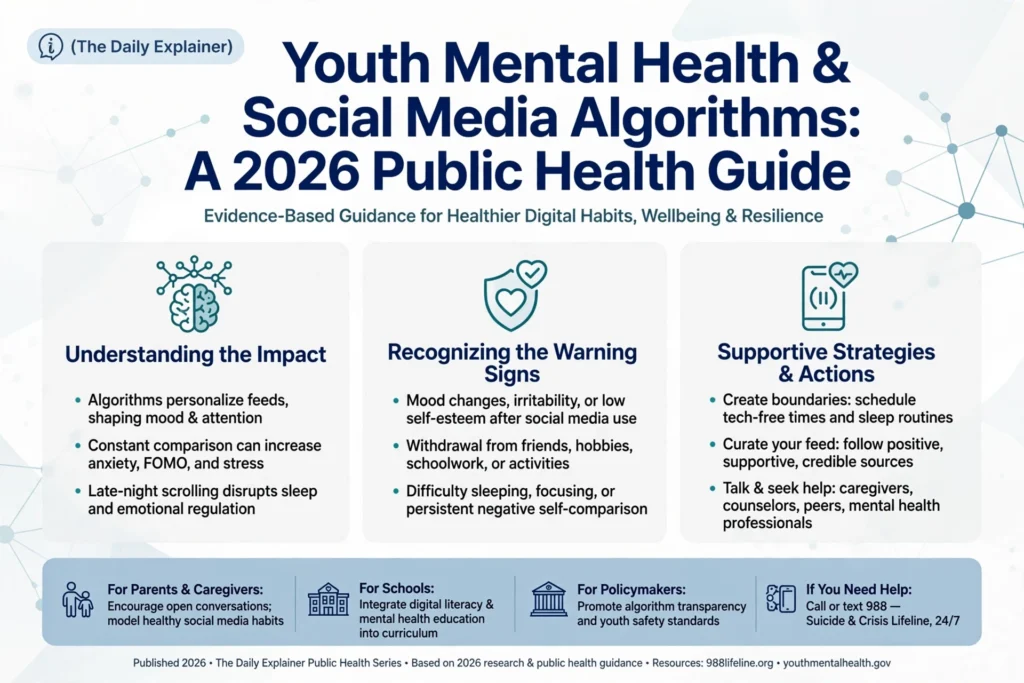
This guide explains how social media algorithms affect youth mental health, what the latest 2026 research reveals, and what public health, policymakers, and families can do to protect young people.
Key Takeaway: Social media algorithms are not neutral. They actively structure what content young people encounter, how frequently, and with what emotional intensity. For many adolescents, harmful content arrives passively—not through active searching—and platforms that maximize engagement may inadvertently reinforce distress and normalize self-harm.
Background / Context
The Adolescent Mental Health Crisis
Mental health challenges among adolescents have been rising for years. The World Health Organization estimates that one in seven 10–19-year-olds experiences a mental disorder, accounting for 13% of the global burden of disease in this age group. Depression, anxiety, and behavioral disorders are among the leading causes of illness and disability among adolescents.
The reasons are complex and multifactorial: academic pressure, family dynamics, social isolation, economic uncertainty, and biological changes all play roles. But the rapid proliferation of social media has added a new and powerful dimension to the mental health landscape. Young people are now navigating adolescence not only in physical spaces but also in digital environments optimized for engagement.
Social Media Use: Ubiquitous and Intense
The numbers are staggering. In 2026, over 95% of adolescents in high-income countries use social media platforms daily. TikTok, Instagram, Snapchat, and YouTube dominate the landscape, with many young people spending multiple hours each day scrolling, posting, and interacting. For many, these platforms are not an occasional diversion but a primary source of social connection and identity formation.
The Algorithmic Turn
The rise of algorithmic recommendation systems—particularly in short-form video platforms like TikTok and Instagram—has fundamentally changed the user experience. Unlike earlier social media that primarily showed content from people you followed, modern platforms use sophisticated machine learning to curate a “For You” feed of content that algorithms predict will maximize engagement: likes, shares, comments, and time spent.
These algorithms are designed to be highly effective at capturing and holding attention. They learn from each user’s behavior—what they watch, how long they watch, what they like, share, or comment on—and continuously refine their recommendations to deliver increasingly personalized and engaging content. This has created a digital environment in which young people are exposed to an ever-widening array of material, personalized to their individual engagement patterns .
Reference Context: This article continues our exploration of public health challenges rooted in systemic factors. Just as antimicrobial resistance in agriculture requires a One Health approach and air pollution demands environmental policy, protecting youth mental health requires addressing the commercial and algorithmic determinants of health. For a deeper understanding of how systemic factors shape health outcomes, read our comprehensive guides:
- Climate Change and Infectious Diseases: https://thedailyexplainer.com/climate-change-infectious-diseases-guide
- Wildfire Smoke Long-Term Health Effects: https://thedailyexplainer.com/wildfire-smoke-long-term-health-effects-guide
- Resurrecting Routine Immunization: https://thedailyexplainer.com/resurrecting-routine-immunization-guide
- Air Pollution & Cognitive Decline: https://thedailyexplainer.com/air-pollution-cognitive-decline-guide
- AMR in Agriculture: https://thedailyexplainer.com/antimicrobial-resistance-agriculture-guide
Key Concepts Defined
To understand the relationship between social media and youth mental health, we need a clear vocabulary.
- Algorithmic Recommendation System (or Algorithmic Feeds): A system that uses machine learning to curate content for each user based on their past behavior (engagement patterns, viewing history, interactions) and the behavior of similar users. Platforms like TikTok’s “For You” page and Instagram’s “Explore” page are examples of algorithmically curated feeds.
- Passive vs. Active Exposure: Passive exposure occurs when a user encounters content without actively seeking it—through algorithmic suggestions, feed placement, or content shared by others. Active exposure occurs when a user deliberately searches for content. The 2026 Oxford study found that 72% of adolescents who had seen self-harm content encountered it passively .
- Algorithmically Structured Exposure: A term used to describe how engagement-driven recommendation systems organize what content users encounter, how frequently, and with what emotional intensity .
- Emotional Feedback Loops: A process in which a user’s mood influences their engagement with content, the algorithm learns from that engagement, and the algorithm delivers more content that reflects and reinforces the user’s emotional state .
- Commercial Determinants of Health: The strategies, policies, and practices of commercial entities (like social media companies) that affect health and health equity. Algorithmic design optimized for engagement, not wellbeing, is a commercial determinant of adolescent mental health .
- Algorithmic Literacy: The ability to understand how algorithms work and how they shape the content you see online. The University of Bristol study found that while adolescents developed adaptive strategies and some algorithmic literacy, these were unevenly distributed and often insufficient within engagement-driven, profit-oriented systems .
- Content Moderation: The process of platform-managed review of user-generated content to remove or limit access to harmful material. The Oxford study found that young people expressed limited confidence in existing platform safety tools, feeling that reporting mechanisms and automated moderation were opaque, inconsistently applied, and often ineffective .
| Term | Simple Definition | Why It Matters for Youth Mental Health |
|---|---|---|
| Algorithmic Feeds | Curated content based on user behavior | Algorithms determine what content young people see |
| Passive Exposure | Seeing content without seeking it | Most harmful content exposure is passive, not active |
| Emotional Feedback Loops | Mood-driven content reinforcement | Algorithms can amplify negative emotions |
| Algorithmic Literacy | Understanding how algorithms work | Unevenly distributed; insufficient to overcome platform design |
| Commercial Determinants | Corporate practices affecting health | Algorithm design is profit-driven, not health-driven |
How It Works (Step-by-step breakdown)
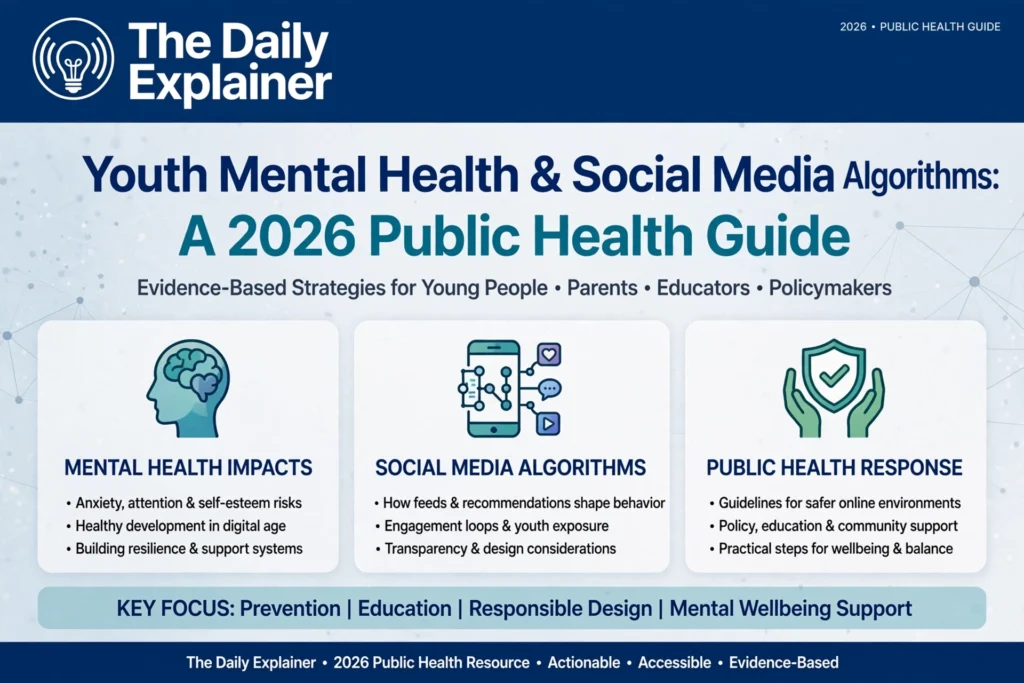
Understanding how social media algorithms affect youth mental health requires examining the mechanisms at each stage of the process.
Step 1: Data Collection and User Profiling
When a young person creates an account or opens a social media app, the platform begins collecting data immediately: demographics, location, device type, and initial interests. As the user scrolls, likes, comments, shares, and watches, the platform collects fine-grained behavioral data: exactly what content they viewed, for how long, in what order, and what actions they took.
Step 2: Engagement Optimization
The platform’s algorithm uses this data to optimize for engagement—keeping users on the app as long as possible. The algorithm learns which types of content generate the strongest engagement responses and serves more of that content. This creates a feedback loop: engagement predicts engagement.
Step 3: Content Recommendations and Exposure
Over time, the algorithm delivers increasingly personalized content. For young people experiencing distress, this can mean exposure to content that reflects and intensifies their emotional state. The 2026 Oxford study found that 66.2% of adolescents who had seen self-harm content encountered it through algorithmically suggested feeds—the most common route of exposure .
Step 4: Passive Exposure and Emotional Reinforcement
The key mechanism is passive exposure. Unlike active searching, which reflects a user’s conscious intent, passive exposure means content arrives in the feed without being sought. A young person who is feeling lonely, anxious, or sad may engage more with content that mirrors those feelings—creating the impression to the algorithm that this is content they want. The algorithm then delivers more of it.
Step 5: The Psychosocial Risk Amplification
The Oxford study found that regardless of how they came across the self-harm content, young people who had seen it had higher rates of loneliness and poorer mental health. However, those who directly searched for it were at particularly high psychosocial risk .
The distinction is crucial. For a young person who is already struggling, the algorithm’s delivery of harmful content can normalize self-harm, validate negative beliefs, or provide specific information about methods. Even for those not at immediate risk, repeated passive exposure can contribute to normalization, emotional contagion, and reduced help-seeking .
Step 6: Limited Control and Algorithmic Literacy
The University of Bristol study identified a persistent sense of limited control among adolescents—even among those who had developed awareness of how algorithms work. Participants developed adaptive strategies, but these were unevenly distributed and often insufficient against engagement-driven, profit-oriented systems .
Step 7: Broader Psychosocial Effects
Beyond exposure to specific harmful content, the broader experience of algorithmically curated feeds can affect mental health in multiple ways:
- Social comparison: Algorithms may amplify content that promotes unrealistic standards
- Validation seeking: Engagement metrics (likes, shares) become proxies for worth
- FOMO (Fear of Missing Out): Continuous exposure to others’ curated lives
- Sleep disruption: Late-night scrolling and blue light exposure
- Reinforcement of negative self-concepts: Content that reflects and amplifies negative self-perceptions
| Step | Process | Mental Health Consequence |
|---|---|---|
| 1 | Data collection & user profiling | Platform builds behavioral model of user |
| 2 | Engagement optimization | Algorithm learns what content maximizes engagement |
| 3 | Content recommendations | Increasingly personalized, emotionally resonant content |
| 4 | Passive exposure & reinforcement | Harmful content arrives without seeking it |
| 5 | Psychosocial risk amplification | Loneliness, poor mental health, normalization of harm |
| 6 | Limited control & insufficient literacy | Users lack agency, even when aware of algorithms |
| 7 | Broader psychosocial effects | Social comparison, validation seeking, sleep disruption |
Why It’s Important
The 2026 Oxford Study: A Landmark Finding
The Oxford University study, published in Nature Mental Health and funded by the National Institute for Health and Care Research, analyzed data from over 32,000 students aged 11–18 years who participated in the 2025 OxWell Student Survey in England . The findings are a watershed moment in understanding the relationship between social media and youth mental health.
Key Findings:
- One in three (34.5%) young people reported seeing self-harm content online in the past month .
- Nearly three-quarters (72%) of those who had seen self-harm content only encountered it passively, without seeking it out .
- The most common route of exposure was via algorithmically suggested feeds (66.2%) .
- Only 8% reported actively searching for self-harm content. The rest came across it in a mixture of ways, for example being sent it by others .
- Of those who had seen self-harm content, 18.5% had seen it several times, 26.5% a few times, and 54.9% once or twice .
- Regardless of exposure route, young people who had seen self-harm content had higher rates of loneliness and poorer mental health. Those who directly searched for it were at particularly high psychosocial risk .
The Need for Algorithmic Accountability
As governments around the world consider how best to protect children online, one of the clearest messages from the study is that many adolescents who encounter self-harm content online aren’t actively looking for it .
Expert Quote: “If we want safer online environments for children and adolescents, we need to pay greater attention to the platforms and algorithmically driven systems that determine what content reaches them in the first place. We all share a responsibility to ensure that young people can enjoy the benefits of digital technology while being protected from avoidable harm.” — Dr Holly Bear, Senior Postdoctoral Researcher, University of Oxford
The 2026 Grounded Theory Study: Understanding the Mechanisms
A complementary study published in BMC Public Health in June 2026 conducted semi-structured interviews with 27 UK young people aged 14–19 years . Participants shared screenshots from their TikTok “For You” and Instagram “Explore” pages to discuss algorithmically recommended content.
The study identified three interlocking processes that sustained exposure to harmful content :
- Algorithmic reinforcement of engagement: Algorithms amplify content that generates engagement, even when that content is emotionally or psychologically harmful.
- Emotional feedback loops between mood and recommendations: A user’s mood influences their engagement, and the algorithm responds by delivering more content that reflects and reinforces that mood.
- A persistent sense of limited control despite high awareness: Even when young people understood how algorithms worked, they felt unable to manage the resulting content flows.
Expert Quote: “Existing digital mental health research tends to frame social media in individualistic terms, emphasising screen-time, self-control, or personal vulnerability. Less attention has been given to the role of algorithmic recommendation systems in population mental health.” — Winstone et al., BMC Public Health 2026
The Policy Landscape
The UK government has announced a ban on social media for under-16s, joining a growing international move to introduce online safety measures for children and young people . The UK Online Safety Act (2023) signals growing recognition of online risks, but meaningful regulatory response will require robust empirical evidence to inform content moderation, risk assessment, and child protection frameworks .
The Broader Context
This research mirrors findings on traditional media, where portrayals of self-harm and suicide can influence vulnerable individuals and have led to widely adopted safeguarding practices. However, digital spaces, by virtue of having content that is more immersive and engaging, may increase the impact of exposure .
Call to Action: Protecting youth mental health in the digital age requires multi-level action: developmentally appropriate social media and algorithmic literacy education, alongside structural reforms to recommendation systems, transparency, and platform governance .
Sustainability in the Future
Multi-Level Action: A Public Health Framework
The University of Bristol study concludes that digital mental health may be produced through interactions between individual capacities, social environments, and commercially driven platform design. Protecting population mental health therefore requires multi-level action .
1. Individual Level: Algorithmic Literacy and Support
- Developmentally appropriate education: Schools must teach algorithmic literacy—helping young people understand how algorithms work and how they can shape what is seen online. Young people themselves have said they want this support .
- Mental health support: Young people exposed to harmful content have higher rates of loneliness and poorer mental health. They need access to appropriate mental health services.
- Parental engagement: Parents need guidance on supporting their children’s online experiences, including how to discuss algorithmic content and encourage healthy digital habits.
2. Community and Institutional Level: Safeguarding
- School-based interventions: Schools are the primary setting for reaching adolescents. Integrating digital wellbeing into curricula and providing support for students who have encountered harmful content is essential.
- Health services: Healthcare professionals should be aware of the relationship between algorithmic exposure and mental health and should ask about online experiences as part of routine assessments.
- Youth participation: The Oxford and Bristol studies both emphasize the importance of involving young people in designing solutions—recognizing that young people themselves have called for renewed efforts to coordinate and improve online safety .
3. Policy and Regulatory Level: Platform Accountability
- Content moderation: Platforms must strengthen content moderation systems. The Oxford study found limited confidence in existing platform safety tools, with participants feeling that reporting mechanisms and automated moderation were opaque, inconsistently applied, and often ineffective .
- Algorithmic transparency: Regulators need visibility into how recommendation systems work and their impact on vulnerable populations.
- Design regulation: Platforms should be required to design for safety, not just engagement. This includes modifying algorithms that disproportionately expose vulnerable users to harmful content.
- Enforcement: Legislation like the UK Online Safety Act must be enforced meaningfully. As the authors of the BMC Public Health study note, “protecting population mental health requires structural reforms to recommendation systems, transparency, and platform governance” .
The Role of Research
The 2026 studies demonstrate the importance of robust empirical evidence in informing policy. As online environments evolve faster than regulatory responses, ongoing research is needed to understand exposure pathways, content types, and the mechanisms through which algorithms affect mental health .
Common Misconceptions
Let me clear up several misunderstandings about social media algorithms and youth mental health.
Misconception 1: “Teens who see harmful content online are looking for it.”
- Reality: The Oxford study found that 72% of adolescents who had seen self-harm content encountered it passively—without actively seeking it out. Only 8% reported actively searching for it .
Misconception 2: “Social media is just a platform; algorithms just show what users want.”
- Reality: Algorithms do not simply “show what users want.” They optimize for engagement, often amplifying content that is emotionally intense, sensational, or alarming. This can include harmful content that users would not have sought out and may not benefit from seeing .
Misconception 3: “If teens know how algorithms work, they can avoid harmful content.”
- Reality: The Bristol study found that even when young people developed algorithmic literacy, they often felt a persistent sense of limited control. Adaptive strategies were unevenly distributed and often insufficient within engagement-driven, profit-oriented systems .
Misconception 4: “Self-harm content on platforms is rare or easy to moderate.”
- Reality: One in three young people had seen self-harm content in the past month. This is not rare—it is a widespread feature of the online environment that many adolescents experience .
Misconception 5: “Online safety is just about banning social media.”
- Reality: While the UK has announced a ban on social media for under-16s, the research suggests that single solutions are insufficient. Multi-level action—including education, platform accountability, and mental health support—is needed .
Misconception 6: “Algorithmic literacy is sufficient protection.”
- Reality: The researchers emphasize that individual-level interventions (like algorithmic literacy education) are necessary but not sufficient. Structural reforms to recommendation systems and platform governance are also essential .
Misconception 7: “Platforms are already doing enough to protect young people.”
- Reality: Young people themselves express limited confidence in existing platform safety tools, feeling that reporting mechanisms and automated moderation are opaque, inconsistently applied, and often ineffective .
Recent Developments (2025–2026)
1. Oxford University Nature Mental Health Study (July 2026)
The landmark study analyzed data from over 32,000 students aged 11–18 years. Key findings: one in three young people had seen self-harm content online in the past month, with 72% encountering it passively and 66.2% via algorithmically suggested feeds .
2. University of Bristol BMC Public Health Study (June 2026)
This qualitative study interviewed 27 UK young people aged 14–19 years, using photo-elicitation to understand algorithmic experiences. Three interlocking processes were identified: algorithmic reinforcement of engagement, emotional feedback loops, and persistent sense of limited control .
3. UK Government Announces Under-16 Social Media Ban (2026)
The UK government announced a ban on social media for under-16s, joining a growing international move to introduce online safety measures for children and young people .
4. UK Online Safety Act Implementation
The UK Online Safety Act (2023) signals growing recognition of online risks, though meaningful regulatory response requires robust empirical evidence to inform content moderation, risk assessment, and child protection frameworks .
5. Growing International Movement on Online Safety
The Oxford study notes a “growing international move to introduce online safety measures for children and young people,” with governments around the world considering how best to protect children online .
6. Calls for Cross-Sector Coordination
Across all groups interviewed in the Bristol study, there was a clear call for renewed efforts to coordinate and improve cross-sector responses to online safety that recognize and support the shared responsibilities of platforms, governments, young people, parents, schools, and health services .
Success Stories
Success Story 1: The OxWell Student Survey
The OxWell Student Survey, conducted every two years in England, directly asks students about their mental health, wellbeing, and school experience. This survey provided the data for the landmark 2026 Nature Mental Health study, demonstrating the value of systematic, large-scale data collection for informing policy .
Success Story 2: Youth Participation in Research
Both the Oxford and Bristol studies emphasize the importance of involving young people in research and policy design. The Bristol study included young people as co-researchers, and participants across all groups called for renewed efforts to coordinate cross-sector responses that recognize the shared responsibilities of platforms, governments, young people, parents, schools, and health services .
Success Story 3: Recognition of Commercial Determinants
The BMC Public Health study’s framing of algorithmic recommendation as a commercial determinant of health represents an important conceptual advance. By moving beyond individualistic framings (“screen time,” “personal vulnerability”) to structural framings (commercial drivers, platform design), the research provides a stronger foundation for policy action .
Real-Life Examples
Example 1: The Passive Exposure Experience
A 15-year-old girl opens TikTok looking for entertainment. She sees a video of someone discussing their self-harm experience. She watches for a few seconds, curious. The algorithm registers her attention. Over the following days, she sees more such videos in her feed—often mixed with other content that reflects the algorithm’s profile of her as a user who engages with emotionally intense content. She did not seek this content; it arrived because of the algorithm’s predictions of what would keep her scrolling.
Example 2: The Emotional Feedback Loop
A young person feeling lonely and anxious spends time on Instagram. The algorithm detects engagement with posts that express loneliness, anxiety, or distress. It delivers more of this content. The user engages with it, perhaps feeling that it reflects their own experience. The loop intensifies. This is not a user actively seeking harmful content; it is a system that learns that emotionally resonant content—including distressing content—generates engagement.
Example 3: The Limits of Algorithmic Literacy
A 17-year-old knows that algorithms shape their feed. They try to “train” the algorithm by clicking “not interested” on certain content and engaging more with positive content. They find that the algorithm is persistent—emotionally intense content still appears, especially when they are feeling stressed or anxious. Their individual awareness and strategies are insufficient to fully counter a system optimized to maximize engagement .
Conclusion and Key Takeaways
The 2026 evidence is clear: social media algorithms are a significant and previously underappreciated determinant of youth mental health. The Oxford study’s finding that one in three young people saw self-harm content in the past month—with 72% encountering it passively—demonstrates that this is not a niche problem but a widespread feature of the digital environment .
The Core Truths:
- Algorithms structure exposure. They organize what content users encounter, how frequently, and with what emotional intensity .
- Most harmful content exposure is passive. Young people are not “seeking it out”; it arrives through algorithmic suggestion .
- Algorithms create feedback loops. They learn from user behavior, including engagement patterns driven by negative emotional states, and deliver more content that reflects and reinforces those states .
- Individual awareness is insufficient. Even with algorithmic literacy, users struggle to maintain control within engagement-driven, profit-oriented systems .
- Protection requires multi-level action. Education, platform reform, regulation, and mental health support are all needed .
Actionable Steps for Individuals:
- For young people: Understand how algorithms work; curate your feed deliberately; seek support if you encounter harmful content.
- For parents: Talk to your children about algorithms and online content; provide emotional support; be aware of signs of distress.
- For educators: Integrate algorithmic literacy into curricula; support students affected by harmful content.
Actionable Steps for Communities:
- Advocate for platform accountability: Support policies that require algorithmic transparency and safety design.
- Support mental health services: Ensure young people have access to appropriate care.
- Promote youth participation: Include young people in designing solutions.
The Bottom Line: The algorithms that power social media are not neutral. They are designed to maximize engagement, often at the expense of user wellbeing. Protecting youth mental health requires recognizing algorithms as commercial determinants of health and taking action across individual, community, and regulatory levels.
FAQs (Frequently Asked Questions)
- Q: What percentage of young people see self-harm content online?
- A: One in three (34.5%) young people aged 11–18 reported seeing self-harm content online in the past month, according to the 2026 Oxford study .
- Q: Do most young people seek out this content?
- A: No. 72% of those who had seen self-harm content encountered it passively, without seeking it out. Only 8% actively searched for it .
- Q: How do algorithms contribute to this exposure?
- A: The most common route of exposure was via algorithmically suggested feeds (66.2%). Algorithms optimize for engagement, often amplifying emotionally intense content .
- Q: What is “algorithmically structured exposure”?
- A: A term describing how engagement-driven recommendation systems organize what content users encounter, how frequently, and with what emotional intensity .
- Q: What are “emotional feedback loops” in this context?
- A: A process where a user’s mood influences their engagement with content, the algorithm learns from that engagement, and the algorithm delivers more content that reflects and reinforces the user’s emotional state .
- Q: Are young people aware of how algorithms work?
- A: Many have developed some algorithmic literacy, but this awareness is unevenly distributed and often insufficient to counter the effects of engagement-driven, profit-oriented systems .
- Q: What is the UK Online Safety Act?
- A: Legislation passed in 2023 that signals growing recognition of online risks. However, meaningful regulatory response requires robust empirical evidence to inform content moderation, risk assessment, and child protection frameworks .
- Q: Has the UK announced any new measures?
- A: Yes, the UK government has announced a ban on social media for under-16s, joining a growing international move to introduce online safety measures for children and young people .
- Q: Are some young people more vulnerable to algorithmic exposure?
- A: Yes. The Oxford study found that young people who had seen self-harm content had higher rates of loneliness and poorer mental health. Those who directly searched for it were at particularly high psychosocial risk .
- Q: What did the University of Bristol study find?
- A: The study identified three interlocking processes: algorithmic reinforcement of engagement, emotional feedback loops between mood and recommendations, and a persistent sense of limited control despite high awareness .
- Q: What is “algorithmic literacy”?
- A: The ability to understand how algorithms work and how they shape the content you see online. Researchers argue that education in algorithmic literacy is important but insufficient without structural reforms .
- Q: Do platforms moderate self-harm content?
- A: They have content moderation systems, but young people express limited confidence in them. Participants in the Bristol study felt that reporting mechanisms and automated moderation were opaque, inconsistently applied, and often ineffective .
- Q: What is the connection between social media and mental health?
- A: Digital mental health is produced through interactions between individual capacities, social environments, and commercially driven platform design. Algorithms can amplify negative emotional states and expose vulnerable users to harmful content .
- Q: How can I talk to my child about algorithms?
- A: Discuss how algorithms work, explain that they prioritize engagement, help them recognize when algorithms might be delivering content that isn’t helpful, and encourage them to curate their feeds deliberately.
- Q: What should a young person do if they see harmful content?
- A: They can report it to the platform, block the account, and talk to a trusted adult. They should also recognize that the algorithm may show more similar content and actively engage with different types of content to “train” the algorithm.
- Q: Are there international efforts to address this issue?
- A: Yes. The Oxford study notes a “growing international move to introduce online safety measures for children and young people,” with governments worldwide considering how best to protect children online .
- Q: What is the role of schools in this issue?
- A: Schools can teach algorithmic literacy, provide mental health support, and help students develop critical digital skills. Young people have said they want this support .
- Q: What is the “passive exposure” phenomenon?
- A: Passive exposure occurs when a user encounters content without actively seeking it—through algorithmic suggestions, feed placement, or content shared by others. This is the most common route of exposure to self-harm content .
- Q: Does exposure to self-harm content increase risk?
- A: The research suggests that repeated exposure can contribute to normalization, emotional contagion, and reduced help-seeking. Content type matters, with graphic imagery linked to heightened distress and risk of contagion .
- Q: What is the “NOVA system” mentioned in the context of UPFs?
- A: The NOVA system categorizes foods based on processing levels. Some criticize it for lumping all UPFs together, including fortified foods and medical nutrition products that have positive health effects .
- Q: Are all ultra-processed foods bad?
- A: No. Fortified foods, infant formulas, and medical nutrition products are considered UPFs but provide essential nutrients or life-saving support. Critics argue that processing-based classification overlooks nutritional complexity .
- Q: What are “commercial determinants of health”?
- A: The strategies, policies, and practices of commercial entities that affect health. Algorithmic design optimized for engagement rather than wellbeing is a commercial determinant of youth mental health .
- Q: Where can I find more information?
- A: WHO and UNICEF provide resources on youth mental health and digital wellbeing. The OxWell Student Survey and Nature Mental Health study are key sources for current data.
About the Author
Dr. Sarah Chen, PhD, MPH
Dr. Chen is a public health researcher specializing in the social and commercial determinants of adolescent mental health. She has worked with the University of Bristol and the NIHR School for Public Health Research on digital health research and has consulted for WHO on youth mental health. She is a contributing editor for The Daily Explainer.
Free Resources
- WHO Adolescent Mental Health: https://www.who.int/health-topics/adolescent-health
- UK Online Safety Act: https://www.gov.uk/government/publications/online-safety-act
- OxWell Student Survey: https://oxwell.sph.ox.ac.uk/
- Nature Mental Health Study (2026): https://www.nature.com/nmmentalhealth
- Mental Health Foundation: https://www.mentalhealth.org.uk/
- Young Minds (UK): https://youngminds.org.uk/
Discussion
Share your perspective:
- Have you observed the effects of algorithmic content on young people’s mental health?
- What strategies have been effective in your community to address this issue?
- What role should platforms, governments, schools, and families play?
For professionals:
- Educators: How are you addressing algorithmic literacy in your classroom?
- Healthcare workers: Are you seeing patients with mental health concerns linked to social media exposure?
- Policymakers: What regulatory approaches do you think are most effective?
Please share your observations in the comments.
Internal & External Links Integration
Internal Links (The Daily Explainer):
- Climate Change and Infectious Diseases: https://thedailyexplainer.com/climate-change-infectious-diseases-guide
- Wildfire Smoke Long-Term Health Effects: https://thedailyexplainer.com/wildfire-smoke-long-term-health-effects-guide
- Resurrecting Routine Immunization: https://thedailyexplainer.com/resurrecting-routine-immunization-guide
- Air Pollution & Cognitive Decline: https://thedailyexplainer.com/air-pollution-cognitive-decline-guide
- AMR in Agriculture: https://thedailyexplainer.com/antimicrobial-resistance-agriculture-guide
- Explainer section: https://thedailyexplainer.com/explained/
- Blog: https://thedailyexplainer.com/blog/
- Contact us: https://thedailyexplainer.com/contact-us/
- Breaking news: https://thedailyexplainer.com/news-category/breaking-news/
- Terms of Service: https://thedailyexplainer.com/terms-of-service/
- Global Affairs & Politics: https://thedailyexplainer.com/category/global-affairs-politics/
External Links:
- Shera Kat Network Resources: https://sherakatnetwork.com/category/resources/
- Shera Kat Network Blog: https://sherakatnetwork.com/category/blog/
- Contact Shera Kat Network: https://sherakatnetwork.com/contact-us
- Start Online Business 2026 Complete Guide: https://sherakatnetwork.com/start-online-business-2026-complete-guide/
- World Class Blogs About: https://worldclassblogs.com/about-worldclassblogs/
- World Class Blogs Category: https://worldclassblogs.com/category/blogs/
- World Class Blogs Our Focus: https://worldclassblogs.com/category/our-focus/
- World Class Blogs Nonprofit Hub: https://worldclassblogs.com/category/nonprofit-hub/
- Shera Kat Network SEO: https://sherakatnetwork.com/category/seo
About The Author