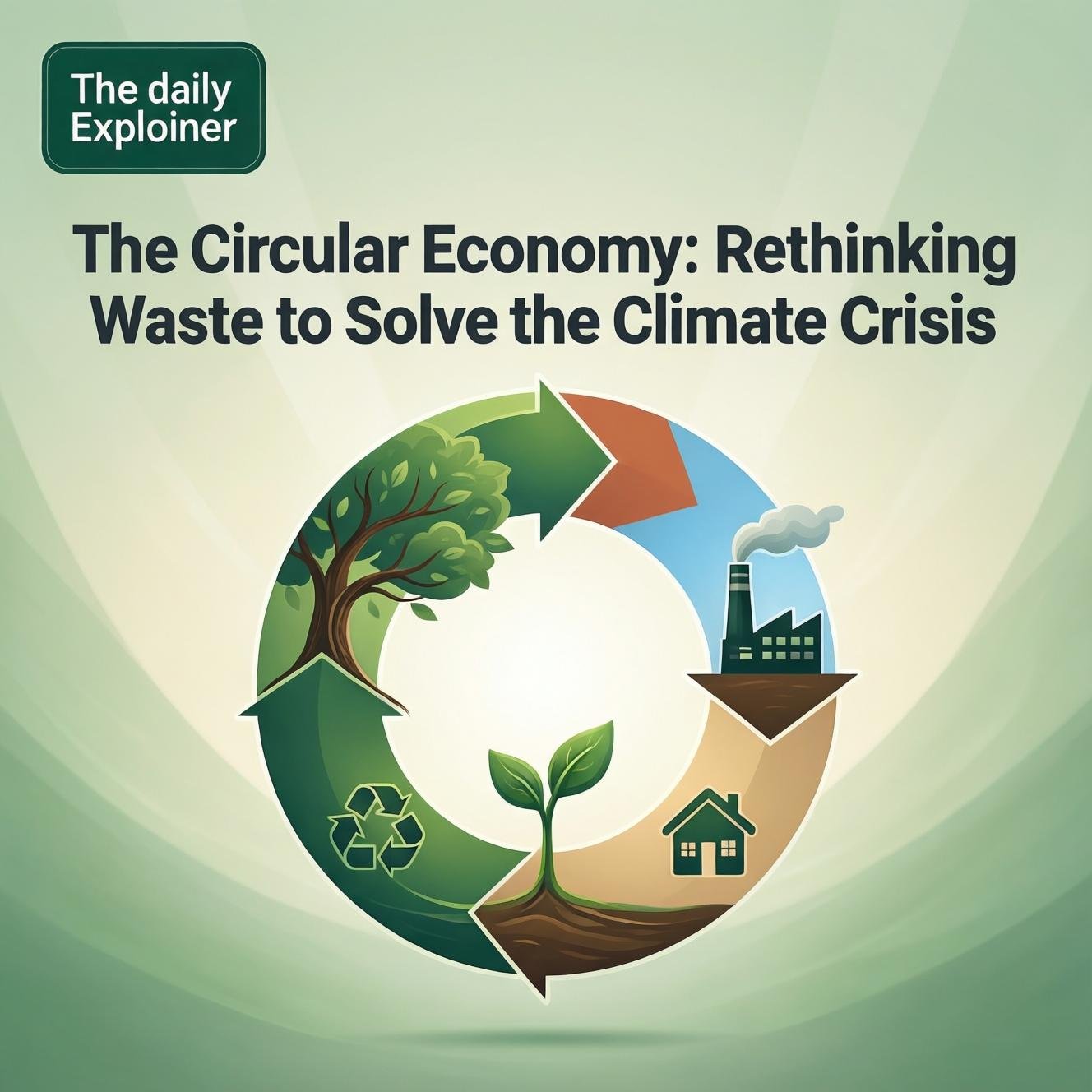
The circular economy offers a pathway to decouple economic growth from resource consumption, reducing emissions while building resilience and creating new economic opportunities.
Introduction – Why This Matters
In my experience visiting manufacturing plants and speaking with sustainability officers, I’ve noticed a fundamental flaw in how we think about climate solutions. We tend to focus on the obvious: replacing coal plants with solar farms, swapping gas cars for electric vehicles, and planting trees. These are all essential. But what I’ve found is that we are overlooking a massive piece of the puzzle: the stuff itself.
Everything we buy—from the phone in your pocket to the clothes on your back to the food on your plate—has a climate story. It required resources to extract, energy to manufacture, fuel to transport, and eventually, space in a landfill to decompose or be burned. This linear “take-make-waste” economy is not just inefficient; it is a primary driver of the climate crisis. In fact, according to the Circle Economy Foundation, the extraction and processing of materials (fossil fuels, biomass, metals, minerals) accounts for half of all global greenhouse gas emissions.
This is where the circular economy comes in. It is a profound rethinking of our relationship with materials. Instead of using something once and throwing it away, a circular economy aims to keep products and materials in use for as long as possible, extract the maximum value from them while in use, then recover and regenerate products and materials at the end of each service life. It’s a shift from a linear line to a continuous loop.
As we’ve explored the daunting challenges of the Cryosphere Crisis, the Nature-Climate Feedback Loop, the need for Adaptation and Mitigation, the reality of Compound Disasters, and the urgency of the 1.5°C Target, the circular economy offers a hopeful, practical, and economically viable pathway forward. It’s not about doing less; it’s about doing things smarter.
Background / Context
The concept of a circular economy is not new. For most of human history, waste was minimal because resources were scarce and expensive. People repaired, reused, and repurposed out of necessity. The rise of the linear economy is a relatively recent phenomenon, coinciding with the post-World War II boom, the rise of consumerism, and the era of cheap, abundant fossil fuels. Planned obsolescence—designing products to fail or become unfashionable quickly—became a business strategy.
The modern circular economy movement began to take shape in the 1970s and 1980s, influenced by thinkers like economist Kenneth Boulding, who spoke of transitioning from a “cowboy economy” (reckless and exploitative) to a “spaceship economy” (closed and regenerative). The term “circular economy” was popularized in the late 20th century by European academics and policymakers.
The real game-changer came in 2010 with the founding of the Ellen MacArthur Foundation. Named after the record-breaking sailor who saw the finite nature of resources during her solo voyages, the foundation became the leading global voice for the circular economy. It shifted the conversation from niche recycling to a systemic, economic opportunity.
Today, the circular economy is no longer a fringe idea. It is embedded in policy frameworks like the European Union’s Circular Economy Action Plan, a key pillar of the European Green Deal. Major corporations, from IKEA to Apple to Unilever, have made public commitments to circular principles. And as we face the climate crisis with increasing urgency, the circular economy is being recognized not just as an environmental strategy, but as a critical economic and security strategy. By reducing dependence on volatile global supply chains for raw materials, it builds resilience—a concept we explored in our article on Compound Disasters.
Key Concepts Defined
To understand the circular economy, we need a new vocabulary that describes a fundamentally different way of thinking about value and materials.
- Linear Economy: The traditional “take-make-waste” model. Resources are extracted, turned into products, used (often briefly), and then discarded. It assumes infinite resources and unlimited waste absorption capacity.
- Circular Economy: An economic system aimed at eliminating waste and the continual use of resources. It is based on three principles, driven by design: eliminate waste and pollution, circulate products and materials (at their highest value), and regenerate nature.
- The Three Principles of the Circular Economy:
- Eliminate Waste and Pollution: Designing products from the start so that they don’t become waste. This means designing for durability, repairability, and recyclability.
- Circulate Products and Materials: Keeping materials in use at their highest possible value. This includes strategies like reuse, repair, remanufacturing, and, as a last resort, recycling.
- Regenerate Nature: Shifting from extraction to restoration. This means using practices that actively improve natural systems, such as regenerative agriculture that builds soil health.
- Technical Cycle: In the circular economy, materials that cannot be safely returned to nature (like plastics and metals) are kept in a closed-loop technical cycle through reuse, repair, remanufacturing, and recycling.
- Biological Cycle: Materials that can safely biodegrade (like food, wood, and natural fibers) are designed to flow back into the natural world, where they can regenerate soil and support ecosystems through processes like composting.
- Design for Circularity: The practice of designing products with their entire lifecycle in mind. This includes using fewer materials, making them easy to disassemble, avoiding toxic substances, and using materials that can be readily recycled or composted.
- Product-as-a-Service (PaaS): A business model where customers pay for the service a product provides, rather than owning the product itself. For example, instead of buying a washing machine, you pay for “laundry services” provided by the manufacturer, who retains ownership and responsibility for maintenance and end-of-life recovery.
- Industrial Symbiosis: A collaborative approach where the waste or by-product of one industrial process becomes the raw material for another. One factory’s trash becomes another factory’s treasure.
How It Works (A Step-by-Step Breakdown of the Circular Loop)
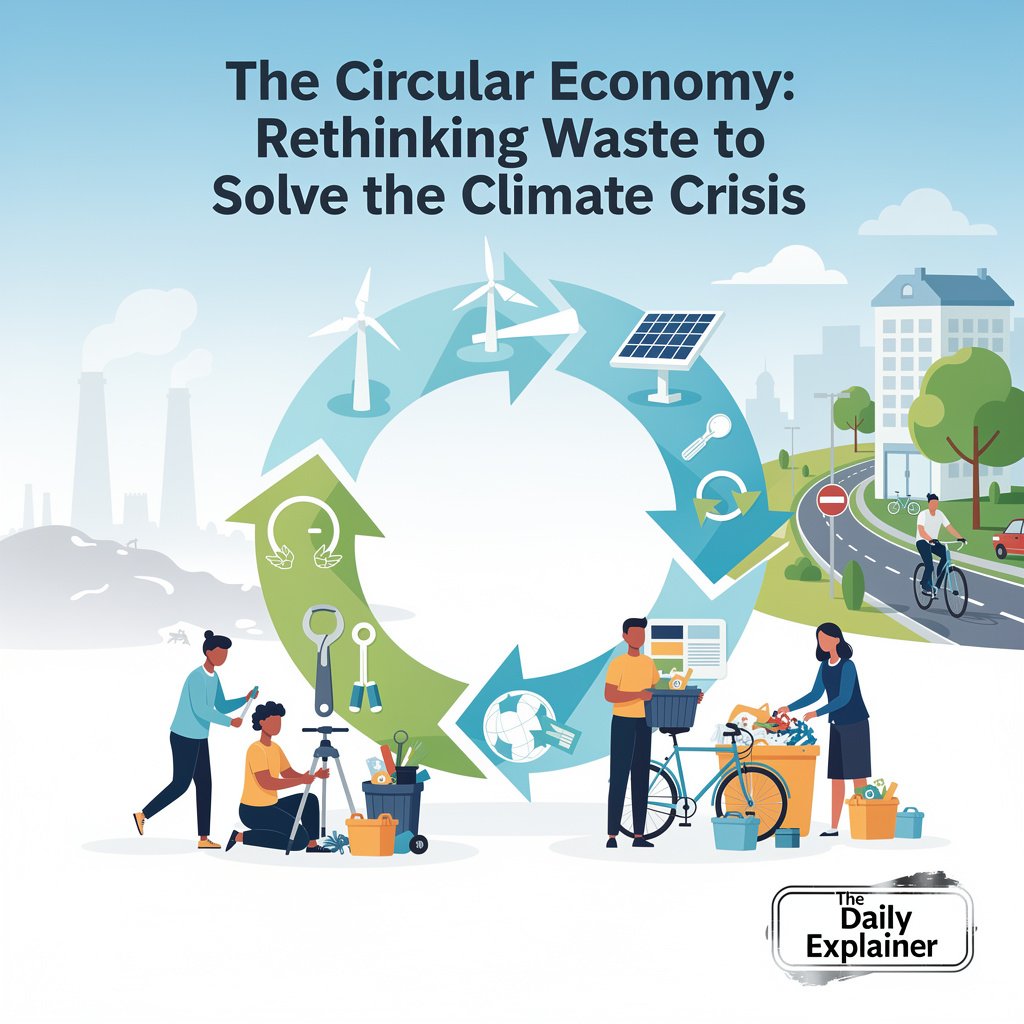
The circular economy is not a single action but a fundamental redesign of entire systems. Here is a step-by-step breakdown of how a product moves through a circular system, from conception to (re)birth.
Step 1: Circular Design (The Most Important Step)
Circularity is not something that can be added at the end of a product’s life. It must be designed in from the very beginning. This phase involves:
- Material Selection: Choosing materials that are non-toxic, durable, and can be easily recycled or safely composted. Avoiding composite materials that are impossible to separate.
- Design for Longevity: Creating products that are physically durable, but also emotionally durable—timeless in design so people want to keep them.
- Design for Repairability: Ensuring products can be easily taken apart with common tools, and that spare parts and repair manuals are readily available. This is a direct challenge to the planned obsolescence model.
- Design for Disassembly: Making it easy to separate different materials at the end of life so they can be properly recycled.
Step 2: New Business Models (Shifting from Volume to Value)
Circularity requires companies to make money in new ways. Instead of maximizing the number of units sold, they maximize the value extracted from each unit over a longer period. This includes:
- Product-as-a-Service (PaaS): As mentioned, this shifts ownership to the manufacturer, giving them a direct financial incentive to make products that last and are easy to repair.
- Sharing Platforms: Enabling multiple users to access a single product, like car-sharing services or tool libraries. This reduces the total number of products needed.
- Extended Warranties and Repair Services: Offering paid services to keep products functioning for longer.
Step 3: Reverse Logistics (Getting Stuff Back)
In a linear economy, products flow from manufacturer to consumer. In a circular economy, they need a way to flow back. This requires building “reverse logistics” systems for collection and return. This can involve:
- Take-Back Programs: Where manufacturers accept their old products for refurbishment or recycling (e.g., Apple’s trade-in program).
- Deposit Schemes: Where consumers pay a small deposit that is refunded when they return the item (e.g., bottle deposit schemes).
- Convenient Collection Infrastructure: Making it easy for consumers to return used items through drop-off points or mail-in programs.
Step 4: Value Retention (The Inner Circles)
The most valuable circular strategies are the ones that keep products and materials as close to their original form as possible. The Ellen MacArthur Foundation describes these as “inner circles.” The shorter the loop, the more value is retained.
- Reuse: Simply passing a product on to a new user (e.g., selling a used phone).
- Repair: Fixing a broken product to extend its life.
- Refurbish/Remanufacture: Restoring a product to “like-new” condition, often with upgrades.
- Recycle: Breaking down a product into its base materials to be made into something new. This is the least valuable circular strategy, as it requires significant energy and often results in downcycled materials of lower quality.
Step 5: Closing the Loop (The Final Stage)
For materials that cannot be reused, repaired, or remanufactured, recycling is the final step before they re-enter the economy as raw materials. High-quality recycling requires:
- Effective Sorting: Advanced technologies, like AI-powered sorting robots, to separate materials by type.
- Clean Material Streams: Avoiding contamination, which is why design for disassembly is so critical.
- Markets for Recycled Content: Manufacturers must be willing to buy and use recycled materials in new products, creating demand that drives the entire system.
Key Takeaways Box:
- Circularity starts with design: If a product isn’t designed for it, circularity is nearly impossible.
- New business models are key: Product-as-a-Service aligns company profits with durability and longevity.
- “Inner circles” are best: Reuse and repair retain far more value than recycling.
- It’s a system, not a single action: A circular economy requires coordinated action from designers, businesses, policymakers, and consumers.
Why It’s Important
The circular economy is not just a nice idea for environmentalists. It is a critical strategy for addressing some of the most pressing challenges of our time, including climate change, resource security, and economic resilience.
- Tackling the Other Half of Emissions: As the Circle Economy Foundation highlights, half of all global emissions come from the extraction and processing of resources . The energy sector gets most of the attention, but we cannot solve climate change without also addressing the materials we use and how we use them. Shifting to a circular economy can dramatically reduce these “embodied” emissions.
- Reducing Pressure on the Nature-Climate Feedback Loop: The relentless extraction of raw materials—mining, logging, intensive agriculture—is a primary driver of deforestation, habitat loss, and ecosystem degradation. By reducing demand for virgin materials, a circular economy relieves pressure on the natural world, helping to keep forests and other critical carbon sinks intact.
- Building Resilience Against Compound Disasters: Global supply chains are fragile. The pandemic, the war in Ukraine, and climate-driven disruptions have shown how quickly the flow of materials can be interrupted. A circular economy, with its emphasis on local loops, repair, and remanufacturing, reduces dependence on long, vulnerable supply chains, building economic resilience.
- Creating Economic Opportunity: The circular economy is a massive economic opportunity. The Ellen MacArthur Foundation has estimated that it could generate over $1 trillion a year in material cost savings by 2050. It also creates local jobs in repair, refurbishment, and recycling—jobs that cannot be outsourced.
- Meeting the 1.5°C Target: The International Energy Agency (IEA) has stated that energy efficiency and material efficiency (a key part of circularity) are essential for staying on a 1.5°C pathway. We cannot reach net-zero by 2050 without fundamentally changing how we use materials.
Sustainability in the Future
A truly sustainable future is a circular one. It’s a world where waste is a design flaw, not an inevitability. Here’s what that future looks like across key sectors.
- The Built Environment: Instead of demolishing buildings and sending debris to landfills, we will design for “material passports” and deconstruction. When a building reaches the end of its life, its components—steel beams, bricks, windows—will be carefully removed and reused in new construction. Cities will become “material banks.”
- Fashion and Textiles: The era of “fast fashion” will end. Clothes will be designed to be durable, repairable, and recyclable. Business models will shift toward rental, resale, and repair. Innovations in fiber-to-fiber recycling will allow old clothes to become new clothes, eliminating textile waste.
- Electronics: “Right to Repair” laws will be universal, ensuring consumers and independent shops can fix their devices. Manufacturers will design phones and laptops that are modular and upgradeable, so you can replace a cracked screen or a worn-out battery without throwing the whole device away. Critical minerals will be recovered from e-waste, reducing the need for new mining.
- Food and Agriculture: Regenerative agriculture will rebuild soil health, sequestering carbon and reducing the need for synthetic fertilizers. Food waste—which accounts for 8-10% of global emissions—will be dramatically reduced through better supply chain management and consumer behavior. Inevitable food scraps will be composted, returning nutrients to the soil (the biological cycle).
- Plastics: The focus will shift from recycling to reduction and redesign. We will eliminate unnecessary single-use plastics. The plastics that remain will be designed for true circularity—using fewer types of polymers, avoiding toxic additives, and ensuring they can be mechanically recycled into high-quality new products.
Common Misconceptions
The circular economy is often misunderstood or conflated with simple recycling. Here are the most common myths.
Misconception 1: “The circular economy is just recycling.”
Recycling is a part of the circular economy, but it is the least desirable part. The circular economy prioritizes strategies that come before recycling: reduce, reuse, repair, and remanufacture. These “inner loops” retain far more value and require far less energy. Recycling should be a last resort, not the primary goal.
Misconception 2: “It’s too expensive and bad for the economy.”
This is a short-term view. In the long term, a circular economy reduces costs by decoupling growth from volatile resource prices. It creates new business opportunities and local jobs. The cost of inaction—dealing with waste, pollution, and resource scarcity—is far higher. As the WorldClassBlogs “Our Focus” page might highlight, investing in circular solutions is investing in long-term economic stability.
Misconception 3: “It’s all about individual consumer choices.”
While consumer choices matter (choosing to repair, buy second-hand, or recycle), the circular economy is fundamentally a systems change. It requires companies to design better products and governments to create policies (like extended producer responsibility) that make circularity the default, not the exception. It’s not fair to put the burden solely on consumers.
Misconception 4: “It’s impossible to be truly circular.”
It’s true that 100% circularity is an ideal to strive for, not an immediate reality. There will always be some material losses and energy inputs. However, the goal is to get as close as possible. Even incremental progress—designing a phone that is 20% easier to repair—has a massive cumulative impact.
Misconception 5: “Bioplastics solve the plastic problem.”
Many “bioplastics” are not a silver bullet. Some are not easily compostable in home systems and require industrial composting facilities that are rare. Some can contaminate traditional plastic recycling streams. And if they are made from crops grown on deforested land, they can have a high carbon footprint. The best solution is to reduce plastic use overall, not simply swap one material for another.
Recent Developments (2025-2026)
The past year has seen significant momentum for the circular economy, driven by policy, business innovation, and consumer demand.
- The EU’s Right to Repair Directive (Adopted 2024, Implementation 2025-2026): This landmark legislation is now coming into force across the European Union. It requires manufacturers to make certain products (like washing machines, TVs, and phones) repairable for up to 10 years. It also mandates that spare parts be available at a reasonable price and that repair information be accessible to independent repair shops. This is a massive win for the “inner circle” of repair and a model for other regions.
- Global Plastics Treaty Negotiations (Ongoing): Negotiations for a legally binding UN treaty to end plastic pollution are continuing. A key point of contention is whether the treaty should focus on better waste management (recycling) or include upstream measures to reduce plastic production itself. The circular economy principle of “eliminate waste and pollution” strongly supports the latter.
- Corporate Circular Economy Commitments: Major companies are accelerating their circular economy efforts. In 2025, IKEA announced it had reached its goal of using only renewable or recycled materials in its products, a major milestone. Apple expanded its self-service repair program and highlighted its use of recycled cobalt and gold in new products. Unilever continues to push its “less plastic, better plastic, no plastic” strategy.
- The Rise of Reusable Packaging Systems: Companies like Loop are partnering with major brands to offer products in durable, refillable containers. Consumers buy the product, pay a small deposit for the container, and return the empty container to be cleaned and reused. This model is expanding from pilot programs to mainstream retail in parts of Europe and North America. For more on how businesses are adapting to these new models, the Sherakat Network’s blog often features case studies and guides.
Real-Life Examples
The circular economy is not a distant theory; it is happening now in innovative companies and communities around the world.
1. Fairphone: Designing for Longevity and Repair
Dutch company Fairphone has built its entire business model around circularity. Its modular smartphones are designed to be easily repaired by the user. You can open the phone with a standard screwdriver and replace a cracked screen, a worn-out battery, or a faulty camera module yourself. They also focus on ethical sourcing of materials and have a take-back program to recycle old phones. Fairphone proves that a circular alternative to the planned obsolescence model is commercially viable.
2. Patagonia’s Worn Wear Program
Outdoor clothing company Patagonia has long been a leader in circularity. Its “Worn Wear” program encourages customers to repair their gear instead of buying new. They sell used Patagonia clothing online, provide free repair guides, and even have a repair truck that travels to events. This extends the life of their products, builds brand loyalty, and directly challenges the fast-fashion model. Their famous slogan, “Don’t Buy This Jacket,” was an early and powerful call for conscious consumption.
3. Kalundborg Symbiosis: Industrial Symbiosis in Practice
In Kalundborg, Denmark, a network of companies has been practicing industrial symbiosis for over 50 years. It’s a public-private partnership where the waste of one company becomes a resource for another. A power plant sends its excess steam to a pharmaceutical company and a fish farm. The fish farm’s sludge becomes fertilizer for local farms. The power plant’s fly ash is used by a cement company. This collaborative loop reduces waste, saves water and energy, and cuts CO2 emissions by hundreds of thousands of tons annually. It’s a model for how industrial parks could operate everywhere.
Success Stories
These examples show that circular economy principles can deliver real environmental and economic results.
- The Netherlands’ Goal of a Fully Circular Economy by 2050: The Dutch government has set an ambitious target: a 50% reduction in primary raw material use by 2030 and a fully circular economy by 2050. This is backed by a comprehensive policy program that includes financial incentives, innovation funding, and regulatory changes. It’s a national-level commitment that provides a roadmap for other countries.
- France’s Anti-Waste Law: France passed a landmark anti-waste law in 2020 that is now being fully implemented. It bans the destruction of unsold non-food products (requiring them to be donated or recycled), mandates repairability scores for electronics, and requires manufacturers to manage the end-of-life of their products. It is one of the most comprehensive circular economy laws in the world.
- The Growth of the Global Second-Hand Market: The market for second-hand goods is booming. Platforms like Vinted, Depop, and ThredUp have made it easy to buy and sell used clothing. In 2025, the global second-hand apparel market was projected to reach over $350 billion, growing three times faster than the overall apparel market. This is a powerful, consumer-driven example of the “reuse” loop in action. For more on how to navigate the digital economy, including starting a business on such platforms, the Sherakat Network’s guide to starting an online business in 2026 is a valuable resource.
Conclusion and Key Takeaways
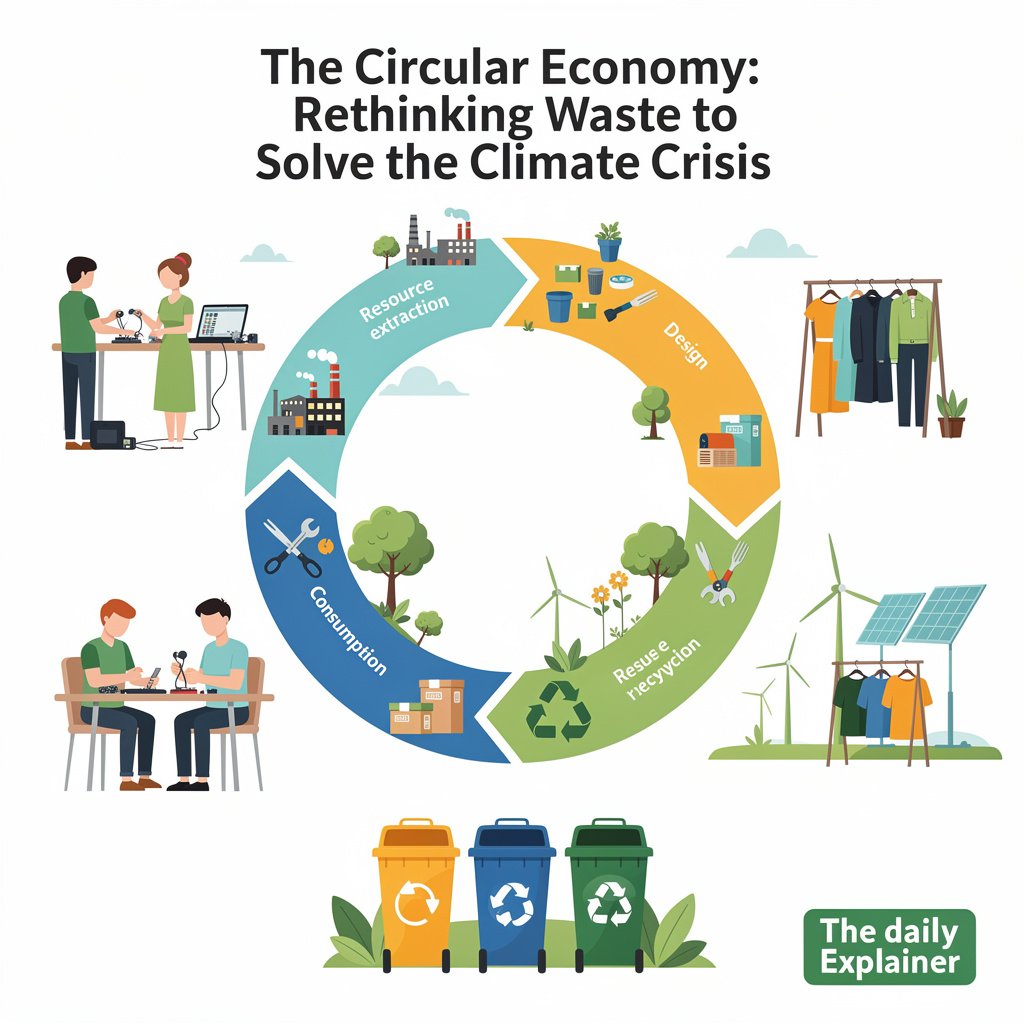
The climate crisis can feel overwhelming. The challenges we’ve explored in this series—the melting cryosphere, the burning forests, the need for urgent adaptation, the terrifying compound disasters, and the narrowing window of the 1.5°C target—can easily lead to despair.
The circular economy offers a powerful antidote to that despair. It is not a silver bullet, but it is a systemic solution that addresses the root cause of so many of our problems: our linear, wasteful relationship with materials. It shows us that we can build an economy that is not just less damaging, but actively regenerative. An economy where waste is a design flaw, where products are built to last, and where value is measured not by how much we consume, but by how well we use what we already have.
The transition will not be easy. It requires a fundamental shift in how businesses operate, how policymakers legislate, and how we, as consumers, think about our stuff. But the examples in this article show that it is possible, it is profitable, and it is happening. The circular economy is not just a nice idea; it is a practical, necessary, and hopeful path forward.
Key Takeaways:
- Half of all emissions come from stuff: The extraction and processing of materials is a massive, often overlooked, driver of climate change.
- Circularity is a hierarchy: Reduce, reuse, repair, and remanufacture are far more valuable than recycling. Design for these “inner loops” from the start.
- It’s good for business: Circular models like Product-as-a-Service and industrial symbiosis can save money, create new revenue streams, and build resilience against supply chain shocks.
- Policy is accelerating: The EU’s Right to Repair Directive and France’s Anti-Waste Law show that governments are starting to mandate circularity.
- It’s a hopeful, practical solution: The circular economy offers a tangible, systemic way to tackle the climate crisis while creating jobs and building a more resilient, equitable world.
FAQs (Frequently Asked Questions)
- What is the simplest definition of a circular economy?
It’s an economic system designed to eliminate waste and keep resources in use for as long as possible. Instead of the linear “take-make-waste” model, it’s a continuous loop. - How is a circular economy different from recycling?
Recycling is a part of it, but it’s the last resort. A circular economy prioritizes strategies that happen before recycling: reducing consumption, reusing products, repairing broken items, and remanufacturing used ones. These keep materials at their highest value. - What are the three core principles of the circular economy?
According to the Ellen MacArthur Foundation, they are: 1) Eliminate waste and pollution, 2) Circulate products and materials (at their highest value), and 3) Regenerate nature. - How does the circular economy help fight climate change?
It tackles the “other half” of emissions. About 45% of global greenhouse gas emissions come from the way we make and use products—extracting raw materials, manufacturing, and transport. A circular economy dramatically reduces these “embodied” emissions. - What is the “biological cycle” in a circular economy?
It’s the loop for materials that can safely biodegrade, like food, wood, and natural fibers. These materials are designed to return to nature through processes like composting, where they regenerate soil. - What is the “technical cycle”?
It’s the loop for materials that cannot safely biodegrade, like plastics, metals, and glass. These materials are kept in the economy through reuse, repair, remanufacturing, and finally recycling. - What is “Product-as-a-Service” (PaaS)?
A business model where you pay for the service a product provides, not for the product itself. For example, instead of buying a car, you subscribe to a mobility service. This gives the manufacturer a financial incentive to make the product durable and easy to repair. - What is “design for disassembly”?
Designing products so they can be easily taken apart at the end of their life. This allows different materials (like the plastic case and the metal circuit board) to be separated and properly recycled. - What is the “Right to Repair”?
A movement and set of laws that require manufacturers to make spare parts, repair manuals, and tools available to consumers and independent repair shops. The EU’s Right to Repair Directive is a major example . - Is the circular economy expensive for businesses?
It can require upfront investment, but it saves money in the long run by reducing material costs and creating new revenue streams from repair and refurbishment. It also reduces exposure to volatile commodity prices. - What is “industrial symbiosis”?
A collaboration where the waste or by-product of one company becomes a raw material for another. The Kalundborg Symbiosis in Denmark is a famous example. - How can I participate in the circular economy as an individual?
Buy less. Choose durable, repairable products. Repair things when they break. Buy second-hand. Rent or borrow items you don’t use often. Recycle correctly at the end of a product’s life. Support companies with circular practices. - What is the EU’s Circular Economy Action Plan?
It’s a comprehensive policy package that is a key part of the European Green Deal. It includes measures to make sustainable products the norm, empower consumers, and focus on sectors that use the most resources (electronics, batteries, packaging, plastics, textiles, construction, food). - What is happening with the UN Global Plastics Treaty?
Negotiations are ongoing for a legally binding treaty to end plastic pollution. A major debate is whether the treaty will focus only on better waste management or also include targets to reduce plastic production. - What is “planned obsolescence,” and how does circularity fight it?
Planned obsolescence is designing products to fail or become unfashionable after a certain period, forcing consumers to buy new ones. Circularity fights this by promoting design for longevity, repairability, and upgradability. - Can a circular economy create jobs?
Yes. It creates local jobs in repair, refurbishment, remanufacturing, and recycling—jobs that cannot be easily outsourced. A study by the ILO suggests the circular economy could create millions of jobs globally. - What is the role of technology in the circular economy?
Technology is crucial. AI-powered sorting robots improve recycling. Digital “material passports” can track the components in buildings. Online platforms enable sharing and resale. Blockchain can verify the ethical sourcing of materials. - What are “material passports”?
Digital documents that list all the materials and components used in a product or building, along with information on their quality and location. This makes it much easier to recover and reuse them at the end of life. - How does circularity relate to food waste?
A circular approach to food involves preventing waste in the first place (better planning, storage, supply chains), redistributing surplus food to people in need, and composting unavoidable food scraps to return nutrients to the soil (the biological cycle). - Is a fully circular economy possible?
100% circularity is an ideal to strive for, but may not be fully achievable due to inevitable material losses and energy needs. However, striving for it is essential, and significant progress—like the Netherlands’ goal of 50% reduction in primary raw materials by 2030—is both possible and necessary. - How does the circular economy help with the 1.5°C target?
The IEA and IPCC both recognize that material efficiency (a core part of circularity) is essential for staying on a 1.5°C pathway. It reduces the massive emissions from producing cement, steel, plastics, and other materials. - Where can I learn more about circular economy strategies for my business?
The Ellen MacArthur Foundation website is the best starting point, with extensive resources, case studies, and toolkits. For practical guides on launching sustainable initiatives, you can also explore resources like the Sherakat Network’s resources page.
About Author
This article was written by the editorial team at The Daily Explainer, as the first in a new series focused on climate solutions, following our comprehensive five-part series on climate challenges. We have explored the Cryosphere Crisis, the Nature-Climate Feedback Loop, the need for Climate Adaptation vs. Mitigation, the reality of Compound Climate Disasters, and the urgency of the 1.5°C Target. This piece pivots to solutions, synthesizing insights from the Ellen MacArthur Foundation, the Circle Economy Foundation, the EU, and leading circular businesses. For any questions or feedback, please feel free to contact us.
Free Resources
- Ellen MacArthur Foundation: The leading global voice on the circular economy. Their website offers extensive resources, reports, and case studies.
- Circle Economy Foundation: Publishes the annual “Circularity Gap Report,” which measures the global state of circularity and its potential to address climate change.
- EU Circular Economy Action Plan: The official EU policy page detailing its comprehensive circular economy strategy.
- iFixit: A global community of repair enthusiasts providing free repair guides for thousands of products. A practical resource for anyone wanting to fix their own stuff.
Discussion
What steps have you taken to embrace circularity in your own life? Have you repaired something recently, bought second-hand, or noticed companies making it easier to be circular? What barriers do you see? Share your experiences and questions in the comments below. For more articles and insights, visit our blog and our Explained section. Your voice helps build the movement.
About The Author



3 thoughts on “The Circular Economy: Rethinking Waste to Solve the Climate Crisis”