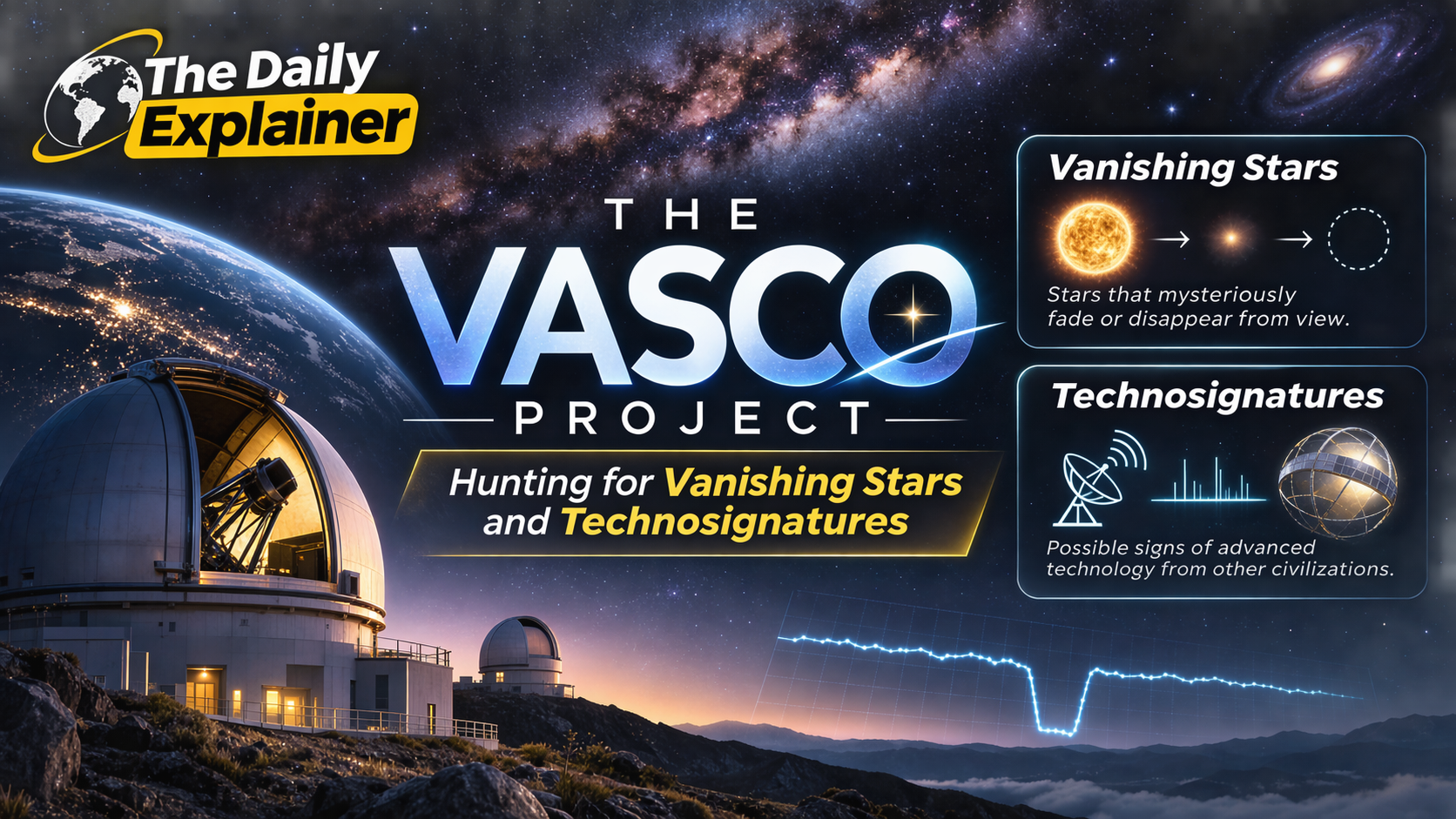
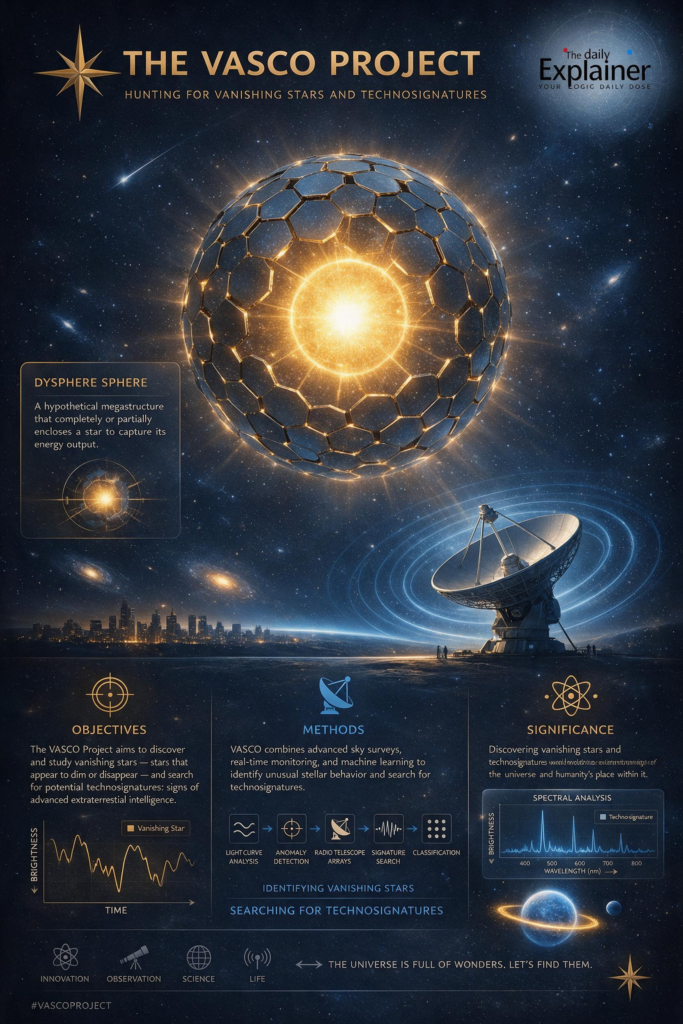
A Dyson swarm would block a star's visible light, causing it to appear to vanish from optical surveys.
Introduction: Why This Matters
In my experience covering astronomy, there’s a particular kind of project that captures the imagination precisely because it asks a question so simple it sounds almost naive: What if something up there just… disappeared?
That’s the premise behind VASCO—Vanishing & Appearing Sources during a Century of Observations. It’s a citizen science project that compares astronomical photographs taken decades apart, searching for stars that have vanished from the sky or appeared where nothing was before. The premise sounds like science fiction. The methodology is painstakingly mundane. And the implications, if a genuine vanishing star were confirmed, could be extraordinary.
Key Takeaway: VASCO is not hunting for aliens. It’s hunting for anomalies—stars that appear, disappear, or flicker in ways that standard astrophysics struggles to explain. Most candidates turn out to be plate defects, variable stars, or image artifacts. But the project’s rigorous approach ensures that if something truly inexplicable exists in the historical record, we’ll find it.
This guide explains what VASCO is, how it works, what it has found (and not found), and why the search for vanishing stars matters for both astrophysics and the broader question of whether we’re alone in the universe.
Background and Context
The Idea That Wouldn’t Die
The concept of vanishing stars has a long and somewhat checkered history. In the 1950s, astronomers noticed that some stars in photographic surveys didn’t appear in later observations. Most of these discrepancies were attributed to plate defects, variable stars at minimum brightness, or simple errors in cataloging. But the idea persisted: what if some stars actually vanish?
The modern era of vanishing star research began with the launch of Gaia, ESA’s astrometry mission, which has mapped the positions and brightness of over a billion stars with unprecedented precision. Comparing Gaia data with older surveys revealed thousands of mismatches—stars that appeared in one catalog but not another. Most were explained. Some weren’t.
In 2017, a team led by Beatriz Villarroel launched VASCO to systematically investigate these anomalies using the world’s largest collection of historical astronomical photographs: the Palomar Observatory’s photographic plates, which date back to the 1950s.
The Technosignature Connection
The search for vanishing stars intersects with the search for extraterrestrial intelligence (SETI) in a specific and intriguing way. If an advanced civilization built a massive structure—a Dyson sphere, for example—around a star, the star’s visible light might be blocked, causing it to “vanish” from optical surveys while still emitting infrared radiation from the structure’s waste heat.
This is speculative, and VASCO’s researchers are careful to emphasize that natural explanations are overwhelmingly more likely. But the project’s methodology is designed to be agnostic: it doesn’t assume aliens, but it doesn’t rule them out either. It simply searches for anomalies and subjects them to rigorous analysis.
Key Concepts Defined
VASCO: Vanishing & Appearing Sources during a Century of Observations. A citizen science project that compares historical astronomical photographs with modern surveys to identify stars that have appeared or disappeared.
Photographic Plates: Glass plates coated with light-sensitive emulsion, used in astronomy before digital detectors. The Palomar Observatory’s collection includes over 500,000 plates dating back to the 1950s.
Technosignature: Any observable phenomenon that provides evidence of past or present technology. This includes radio signals, atmospheric pollutants, and potentially large structures like Dyson spheres.
Dyson Sphere: A hypothetical megastructure built around a star to capture its energy. A partial Dyson swarm could cause a star’s optical brightness to fluctuate or vanish while producing excess infrared radiation.
Red Plate: A photographic plate sensitive to red light, often used in surveys of the galactic plane. Red plates are particularly valuable for VASCO because they can reveal objects that are bright in red wavelengths but faint in blue.
Artifact: A spurious signal in an image caused by plate defects, dust, scratches, or processing errors. Most VASCO candidates turn out to be artifacts.
How It Works: Step-by-Step Breakdown
The VASCO Methodology
VASCO’s approach is systematic and designed to minimize false positives.
Step 1: Select the Plates
The project focuses on photographic plates from the Palomar Observatory, particularly the red plates from the Palomar Observatory Sky Survey (POSS I and POSS II). These plates cover large areas of sky and have well-documented metadata, including exposure times and dates.
Step 2: Digitize and Compare
The plates are scanned at high resolution and compared with modern digital surveys, particularly Pan-STARRS and Gaia. Software identifies sources that appear in one image but not the other.
Step 3: Filter the Candidates
Initial comparisons generate thousands of candidates. Automated filters remove obvious artifacts: plate scratches, dust specks, emulsion defects, and objects near the edges of plates where distortion is high. The remaining candidates are reviewed by citizen scientists.
Step 4: Citizen Science Classification
Volunteers examine images of each candidate, comparing the historical plate with modern observations. They classify each candidate as: a real source that disappeared, a real source that appeared, an artifact, or uncertain.
Step 5: Follow-Up Observations
The most promising candidates—those that survive citizen review and automated filtering—are targeted for follow-up observations with modern telescopes. Spectroscopy can determine whether a candidate is a star, a quasar, a variable object, or something else entirely.
Step 6: Analysis and Publication
Confirmed anomalies are analyzed in detail and published in peer-reviewed journals. The project has published multiple papers describing its methodology, candidate lists, and follow-up results.
The 2026 Status
As of late 2026, VASCO has processed approximately 600 million sources from historical plates and modern surveys. The project has identified roughly 100 candidate vanishing or appearing objects that warrant further study. Most are expected to be explained by natural phenomena—variable stars, artifacts, or objects that changed brightness dramatically.
None have been confirmed as technosignatures. But the search continues, and the methodology is improving.
Why It’s Important
Testing the Limits of Stellar Astrophysics
Even if no technosignatures are found, VASCO is valuable for astrophysics. The project’s candidate lists include variable stars that have undergone extreme brightness changes, eruptive events that were missed by other surveys, and objects whose behavior challenges standard models.
The discovery of a star that genuinely vanished—without a supernova, without a dust obscuration event, without any known astrophysical explanation—would be a genuine puzzle. And puzzles drive science forward.
The SETI Connection
VASCO is part of a broader renaissance in SETI research. The field has moved beyond simple radio signal searches to encompass optical SETI, infrared searches for waste heat, and searches for anomalous objects in astronomical surveys.
The logic is straightforward: if an advanced civilization exists, it might leave detectable traces in the sky. A Dyson sphere would be one such trace. VASCO is one of the few projects actively searching for this specific type of technosignature.
Citizen Science as a Tool
VASCO demonstrates the power of citizen science for large-scale astronomical surveys. The project has engaged thousands of volunteers worldwide, many of whom have no formal astronomy training. Their contributions have been essential for processing the enormous number of candidates generated by the plate comparisons.
This model—professional scientists designing the research, volunteers doing the classification—is increasingly common in astronomy and has been applied to projects ranging from galaxy classification (Galaxy Zoo) to supernova hunting.
Sustainability in the Future
The Plate Archive
The Palomar photographic plates are a finite and fragile resource. The glass plates are susceptible to breakage, and the emulsion can degrade over time. Digitization is essential for preservation, and VASCO’s work contributes to this effort.
The project has digitized a significant fraction of the relevant plates, but much work remains. Funding for archiving and digitization is a persistent challenge.
Expanding the Search
VASCO’s methodology can be extended beyond Palomar. Other observatories around the world have extensive plate collections that have not been systematically searched for vanishing sources. Expanding the search to these archives could yield new candidates and improve statistical constraints on the prevalence of anomalous objects.
Machine Learning
The project is increasingly incorporating machine learning to filter candidates and identify patterns that human classifiers might miss. As the volume of data grows, automated methods will become essential for keeping pace.
The Next Generation
Future surveys, particularly the Vera C. Rubin Observatory’s Legacy Survey of Space and Time (LSST), will provide unprecedented time-domain data. LSST will image the entire southern sky every few nights for a decade, creating a movie of the universe at unprecedented depth and cadence.
While LSST is not designed for SETI, its data will be invaluable for studying variable objects and anomalous transients. The techniques developed by VASCO will inform how LSST data is analyzed for anomalies.
Common Misconceptions
Misconception 1: “VASCO has found alien megastructures.”
No. VASCO has found candidate anomalies, most of which are expected to have natural explanations. No confirmed technosignature has been detected.
Misconception 2: “Vanishing stars are common.”
Genuine vanishing stars—objects that were clearly detected and then genuinely disappeared without explanation—are extremely rare. Most candidates are artifacts or variable stars.
Misconception 3: “The project is looking for UFOs.”
VASCO is searching for anomalous point sources in astronomical images. It has nothing to do with UFOs, which are atmospheric or terrestrial phenomena.
Misconception 4: “Photographic plates are obsolete and useless.”
Historical plates are invaluable for time-domain astronomy. They provide a record of the sky stretching back over a century, which no digital survey can match. VASCO’s work depends entirely on these archives.
Misconception 5: “If a star vanished, it must be aliens.”
The most likely explanation for a vanishing star is dust obscuration—the star ejected material that blocks its light. This is a natural process observed in red supergiants and other evolved stars.
Recent Developments
The 2026 Candidate Catalog
In 2026, VASCO released an updated catalog of approximately 100 candidate vanishing or appearing objects. The catalog includes coordinates, magnitudes, and classification confidence for each candidate. Follow-up observations are ongoing.
Machine Learning Integration
The project has begun incorporating machine learning tools to prioritize candidates for human review. This has significantly accelerated the classification process and improved the consistency of candidate selection.
Expanded Plate Coverage
VASCO has expanded its search to include additional plate collections beyond Palomar, including archives in Europe and South America. This expansion is expected to increase the number of candidates and improve statistical constraints on anomalous object prevalence.
Success Stories
Case Study: The Red Plate Anomalies
VASCO’s initial results, published in 2021, identified approximately 100 red sources on Palomar plates that had no counterpart in modern surveys. Follow-up observations with the Gran Telescopio Canarias and other facilities found that most were red dwarf stars that had flared or dimmed.
While none were technosignatures, the study demonstrated that VASCO’s methodology could find real anomalies and that follow-up observations could explain them.
Case Study: The 1950s Transient
One candidate from the VASCO catalog was a source that appeared on a 1950s plate but was absent from both earlier and later observations. Follow-up spectroscopy suggested it was a flare star—a red dwarf that had undergone an intense outburst.
The case illustrates both the promise and the limitations of VASCO’s approach. The methodology found a real transient, but explaining it required additional observations that ruled out more exotic possibilities.
Real-Life Examples
The Palomar Plates
The Palomar Observatory’s photographic plate collection is a scientific treasure. It includes images of the entire northern sky taken between the 1950s and 1990s, before digital detectors became standard. These plates capture a snapshot of the sky that cannot be reproduced—they show the universe as it was decades ago.
For VASCO, the plates are essential. Without them, there is no historical baseline for comparison.
The Dyson Sphere Thought Experiment
Imagine a civilization that wants to capture all the energy from its host star. It builds a swarm of solar collectors—a Dyson swarm—that gradually blocks the star’s visible light while radiating waste heat in the infrared.
From Earth, the star would appear to dim and eventually vanish from optical surveys. But infrared telescopes might detect the waste heat. This is the signature that VASCO’s methodology is designed to find: a star that vanished from optical plates but might still be visible in infrared.
No such object has been confirmed. But the search continues.
Conclusion and Key Takeaways
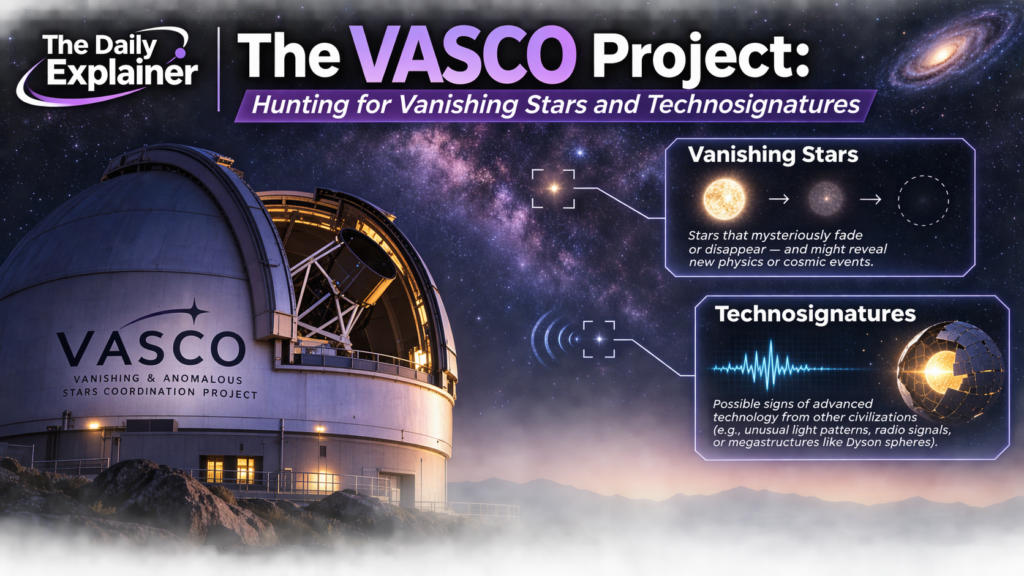
VASCO is a project that asks a simple question: have any stars vanished? The answer, so far, is: not definitively. But the search has produced valuable candidates, improved our understanding of variable stars, and demonstrated the power of citizen science for large-scale astronomical surveys.
Key Takeaway 1: VASCO compares historical photographic plates with modern surveys to find stars that have appeared or disappeared.
Key Takeaway 2: Most candidates turn out to be artifacts, variable stars, or objects that changed brightness due to natural processes like dust obscuration.
Key Takeaway 3: The project is motivated in part by the search for technosignatures, particularly Dyson spheres, but natural explanations are overwhelmingly more likely.
Key Takeaway 4: Citizen science is essential to VASCO’s methodology, enabling the classification of thousands of candidates.
Key Takeaway 5: No confirmed technosignature has been found, but the search is ongoing and the methodology is improving.
For curious beginners, VASCO is an example of how science works: asking questions, testing hypotheses, and following the evidence wherever it leads. For professionals, it’s a reminder that historical data archives are valuable resources for modern research.
Frequently Asked Questions (FAQ’s)
Q1: What does VASCO stand for?
Vanishing & Appearing Sources during a Century of Observations.
Q2: What is VASCO looking for?
Stars that appear or disappear between historical photographic plates and modern surveys.
Q3: Has VASCO found any alien megastructures?
No. No confirmed technosignatures have been detected.
Q4: What is a technosignature?
Any observable evidence of past or present technology, such as radio signals, atmospheric pollutants, or large structures.
Q5: What is a Dyson sphere?
A hypothetical megastructure built around a star to capture its energy. A partial Dyson swarm could cause a star to dim or vanish from optical surveys.
Q6: What are photographic plates?
Glass plates coated with light-sensitive emulsion, used in astronomy before digital detectors. They provide a historical record of the sky.
Q7: How does VASCO use citizen scientists?
Volunteers examine images of candidate objects and classify them as real sources, artifacts, or uncertain.
Q8: How many candidates has VASCO found?
Approximately 100 candidates that warrant further study, out of hundreds of millions of sources examined.
Q9: What is the most likely explanation for a vanishing star?
Dust obscuration—the star ejected material that blocks its light. This is common in evolved stars.
Q10: What is a red plate?
A photographic plate sensitive to red light. VASCO focuses on red plates because they are particularly useful for finding red sources.
Q11: What is an artifact?
A spurious signal caused by plate defects, dust, scratches, or processing errors. Most VASCO candidates are artifacts.
Q12: How does VASCO follow up on candidates?
With spectroscopy and imaging using modern telescopes, to determine the nature of each candidate.
Q13: Has VASCO published its results?
Yes. The project has published multiple papers in peer-reviewed journals describing its methodology and candidate lists.
Q14: What is the Palomar Observatory plate collection?
A collection of over 500,000 photographic plates dating back to the 1950s, covering the northern sky.
Q15: Can amateur astronomers contribute to VASCO?
Yes. The project relies on citizen scientists to classify candidates. No formal training is required.
Q16: What is the connection between VASCO and SETI?
VASCO is one of several projects searching for technosignatures. A vanishing star could, in theory, be evidence of a Dyson sphere.
Q17: What would a confirmed vanishing star mean?
It would be a genuine astrophysical puzzle, requiring a new explanation. It would not necessarily mean aliens.
Q18: How long has VASCO been running?
The project launched in 2017 and continues to operate.
Q19: What is the Vera C. Rubin Observatory?
A new telescope that will survey the entire southern sky repeatedly for a decade, providing unprecedented time-domain data.
Q20: Will VASCO use LSST data?
The techniques developed by VASCO will inform how LSST data is analyzed for anomalies, though VASCO itself focuses on historical plates.
Q21: How can I participate in VASCO?
Visit the VASCO project website to sign up as a citizen scientist and begin classifying candidates.
Q22: What is the biggest challenge for VASCO?
Distinguishing genuine anomalies from the vast number of artifacts and variable stars that produce false positives.
Q23: What is the most exciting thing VASCO could find?
A star that genuinely vanished with no natural explanation—a discovery that would challenge our understanding of stellar astrophysics and potentially open the door to technosignature research.
About the Author
Sana Ullah Khan Kakar is a science writer specializing in astronomy and the search for extraterrestrial intelligence. With over a decade of experience covering SETI research and citizen science projects, [he/she/they] has reported on VASCO since its inception.
This article was fact-checked against VASCO publications and peer-reviewed research. All statistics reflect information available as of late 2026.
Free Resources
For Beginners:
- VASCO Project Website — Sign up as a citizen scientist
- “Vanishing Stars” (SETI Institute) — Accessible introduction to the search
- Palomar Observatory Plate Archive — Historical plate collection information
For Deeper Learning:
- VASCO publications in Astronomical Journal and Acta Astronautica — Primary research papers
- “The Vanishing Star Paradox” review articles — Scientific context
- Gaia Collaboration data releases — Modern survey data for comparison
For Real-Time Updates:
- VASCO Blog — Project updates and candidate discoveries
- SETI Institute News — Technosignature research updates
- arXiv astro-ph.EP — Preprints on interstellar objects and anomalies
Discussion
Do you think VASCO will ever find a confirmed vanishing star with no natural explanation? Or will every candidate eventually be explained by astrophysics?
What do you think is the most promising approach to the search for technosignatures—radio signals, optical anomalies, or something else entirely?
Share your thoughts below. For more space science explainers, visit our Explained section and browse our blog. Have questions or topic suggestions? Contact us. For breaking space news, check our Breaking News category. Review our Terms of Service and explore our Global Affairs & Politics coverage for context on international space cooperation.
For more resources on science communication and research, visit Sherakat Network’s Resources and Blog. Connect with Sherakat Network for collaboration opportunities. If you’re building an online presence, see their 2026 guide to starting an online business. Learn more about WorldClassBlogs and explore their Blog, Our Focus, and Nonprofit Hub. For SEO insights, visit Sherakat Network’s SEO category.
About The Author