
The Architecture of Decentralized Finance: How smart contracts replace traditional financial intermediaries across lending, trading, and derivatives.
Introduction: The Dawn of Open, Permissionless Finance
Imagine a financial system where you can borrow money without a credit check, earn interest on your savings at rates far beyond what traditional banks offer, and trade assets 24/7 without needing anyone’s permission. This isn’t a distant fantasy—it’s the reality being built today by Decentralized Finance (DeFi), one of the most transformative applications of blockchain technology. DeFi represents nothing less than a complete re-architecting of the global financial system, removing intermediaries and replacing them with transparent, programmable code.
For the 1.7 billion people worldwide who remain unbanked, DeFi offers financial inclusion. For everyone else, it offers financial sovereignty—the ability to truly control your assets and participate in global markets without gatekeepers. Understanding DeFi is no longer optional for anyone serious about the future of money, investing, or economic freedom. This movement represents the most significant threat to traditional banking since its inception, and its growth has been nothing short of explosive. For more insights into economic transformations, explore our Economy and Market coverage.
Background/Context: From Bitcoin to a Full Financial Stack
The seeds of DeFi were planted with Bitcoin’s creation in 2009, which demonstrated that value could be transferred peer-to-peer without financial intermediaries. However, Bitcoin’s scripting language was limited. The true catalyst for DeFi was Ethereum’s launch in 2015, which introduced smart contracts—programmable money that could automate complex financial transactions.
The DeFi movement began gaining real momentum around 2017-2018 with the launch of foundational protocols like MakerDAO (which created the first decentralized stablecoin, DAI) and Compound (which pioneered decentralized lending). But it was the “DeFi Summer” of 2020 that catapulted the sector into mainstream consciousness. During this period, the introduction of yield farming and liquidity mining created massive incentives for users to provide liquidity to DeFi protocols, causing the Total Value Locked (TVL) in DeFi to explode from under $1 billion to over $15 billion in just a few months. Today, that figure regularly exceeds $50 billion, representing a parallel financial system being built in the open.
Key Concepts Defined: The Lexicon of Decentralized Banking
- DeFi (Decentralized Finance): An ecosystem of financial applications built on blockchain networks, primarily Ethereum, that operate without central financial intermediaries.
- Smart Contracts: Self-executing contracts with terms directly written into code that automatically execute when conditions are met—the building blocks of all DeFi protocols.
- Total Value Locked (TVL): The total amount of assets deposited in DeFi protocols, used as a key metric to measure the sector’s growth and health.
- Yield Farming: The practice of locking up cryptocurrencies in DeFi protocols to earn rewards, typically in the form of additional tokens.
- Liquidity Pools: User-funded pools of tokens that power decentralized exchanges and lending protocols, replacing traditional order books.
- Automated Market Maker (AMM): An algorithm that automatically sets token prices based on the ratio of assets in a liquidity pool, enabling decentralized trading.
How It Works (Step-by-Step): The Mechanics of a Decentralized Financial System
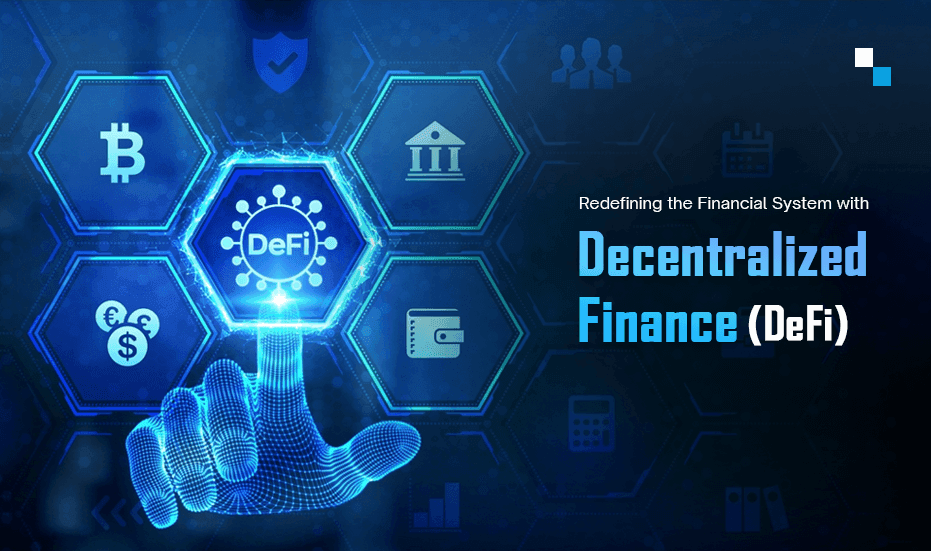
To understand DeFi’s revolutionary potential, let’s examine how it replicates and improves upon three core functions of traditional finance: lending, exchanging, and earning interest.
Part 1: Decentralized Lending and Borrowing
Traditional System: You apply for a loan at a bank, undergo credit checks, provide documentation, and wait for approval. The bank decides who qualifies and at what interest rate.
DeFi System (Using Aave or Compound as examples):
Step 1: Providing Collateral
Instead of a credit check, you provide crypto collateral. You deposit Ethereum (ETH) into a lending protocol. The protocol’s smart contract automatically calculates how much you can borrow against your collateral, typically 50-80% of its value.
Step 2: Borrowing Assets
You can now borrow stablecoins or other cryptocurrencies up to your borrowing limit. The smart contract automatically begins charging interest, which accrues in real-time.
Step 3: Interest Rate Mechanism
Interest rates are determined algorithmically based on supply and demand for each asset. When more people want to borrow a token, rates rise. When more people supply it, rates fall.
Step 4: Repayment or Liquidation
You can repay the loan plus interest at any time to reclaim your collateral. If your collateral’s value drops too close to your loan value, the protocol automatically liquidates it to protect lenders—all without human intervention.
Part 2: Decentralized Exchanges (DEXs)
Traditional System: You use a centralized exchange like Coinbase, which holds your assets, matches buyers and sellers, and charges fees.
DeFi System (Using Uniswap as an example):
Step 1: Liquidity Provision
Users called Liquidity Providers (LPs) deposit equal values of two tokens into a pool (e.g., ETH and USDC).
Step 2: Automated Pricing
The AMM algorithm sets prices based on the ratio of tokens in the pool. As people buy ETH with USDC, the pool has less ETH and more USDC, so the price of ETH rises automatically.
Step 3: Trading
Traders swap tokens directly with the pool, paying a small fee (e.g., 0.3%) that gets distributed to the LPs proportionally.
Step 4: LP Tokens
LPs receive LP tokens representing their share of the pool, which they can use to claim their portion of the pool plus accumulated fees.
Part 3: Earning Yield Through Advanced Strategies
Traditional System: You earn minimal interest in a savings account (often below inflation) or take on significant risk in search of higher returns.
DeFi System (Yield Farming):
Step 1: Capital Deployment
You identify a promising DeFi protocol and deposit your assets—this could be providing liquidity to a DEX or supplying assets to a lending protocol.
Step 2: Receiving Rewards
In addition to earning fees or interest, many protocols distribute their native governance tokens as rewards to incentivize usage—this is “liquidity mining.”
Step 3: Compound Returns
Sophisticated farmers might take their reward tokens and deposit them into other protocols to earn additional yield, creating complex “yield farming strategies” that can generate significantly higher returns than traditional finance.
Why It’s Important: The Transformative Potential of DeFi
- Financial Inclusion: DeFi is globally accessible to anyone with an internet connection and a smartphone, bypassing geographic restrictions and identity requirements that exclude billions from traditional banking.
- Transparency and Auditability: All transactions are visible on public blockchains, eliminating the opacity that led to the 2008 financial crisis. Anyone can audit protocol reserves and activities.
- Reduced Counterparty Risk: Your funds aren’t held by a company that could freeze them or go bankrupt. You interact directly with smart contracts that you can verify.
- Programmable Money: DeFi enables financial products that are impossible in traditional finance, such as flash loans (uncollateralized loans that must be repaid within one transaction block).
- Censorship Resistance: No central authority can block transactions or deny access based on politics, geography, or identity.
- Innovation Speed: The open-source, composable nature of DeFi protocols (“money legos”) allows for rapid innovation and iteration that traditional financial institutions cannot match.
Common Misconceptions and Real Risks
- “DeFi is just for gambling and speculation.” While speculation exists, DeFi provides real utility: cheaper remittances, access to credit for the unbanked, and better returns for savers. The underlying technology solves genuine financial inefficiencies.
- “DeFi is completely anonymous and unregulated.” While pseudonymous, all transactions are permanently recorded on public blockchains. Regulation is evolving rapidly, with many jurisdictions applying existing financial laws to DeFi activities.
- “The high yields are guaranteed and risk-free.” This is dangerously incorrect. DeFi yields reflect real risks: smart contract vulnerabilities, impermanent loss for liquidity providers, protocol failure, and market volatility. The principle of Sound Personal Finance—never investing more than you can afford to lose—applies doubly in DeFi.
- “DeFi is too complicated for ordinary people.” While the underlying technology is complex, user interfaces are improving rapidly. Many DeFi applications are now as user-friendly as traditional banking apps, and this trend will continue.
- “Traditional finance will quickly copy DeFi’s innovations.” While banks are adopting blockchain technology, they cannot replicate DeFi’s core value proposition: true decentralization and censorship resistance. The trust models are fundamentally different.
Recent Developments & Real-Life Examples
Recent Development: The Rise of Layer 2 Scaling and Real-World Assets (RWA)
Two major trends are shaping DeFi’s evolution in 2024. First, Layer 2 scaling solutions like Arbitrum, Optimism, and Base have dramatically reduced transaction fees and improved speeds, making DeFi accessible to mainstream users. Second, the integration of Real-World Assets (RWA) is bringing traditional finance on-chain. Protocols like MakerDAO now hold billions in U.S. Treasury bonds, creating a bridge between DeFi and TradFi that offers both stability and yield.
Real-Life Example: How Aave Revolutionized Lending
Aave (meaning “ghost” in Finnish) exemplifies DeFi’s power. What began as ETHLend in 2017 has evolved into a multi-billion dollar protocol that has processed over $300 billion in lending volume. Aave’s innovation includes:
- Flash Loans: The first uncollateralized loan product in history, enabling sophisticated arbitrage and refinancing strategies.
- Rate Switching: The ability to toggle between stable and variable interest rates.
- Credit Delegation: Allowing users to lend their credit lines to trusted counterparts.
During the 2021 bull market, Aave consistently facilitated over $1 billion in daily borrowing volume, demonstrating that decentralized protocols can achieve scale comparable to medium-sized traditional banks—but with a global reach and without physical branches.
Case Study: The Compound Protocol and the DeFi Summer Explosion
Background: Compound launched in 2018 as a decentralized money market protocol. Users could supply assets to earn interest and borrow against their collateral. While innovative, growth was steady but slow until June 2020.
The Catalyst: Compound introduced its COMP token and a revolutionary distribution mechanism: liquidity mining. Anyone who supplied or borrowed assets on Compound would earn COMP tokens daily, proportional to their activity.
The Result: The incentives created a flywheel effect:
- Users flooded into Compound to earn COMP tokens
- This increased TVL, making the protocol more robust
- The rising price of COMP attracted more users
- Compound’s TVL exploded from $100 million to over $1 billion in weeks
The Impact: The “Compound effect” sparked DeFi Summer, with dozens of protocols implementing similar token distribution models. While this led to some unsustainable yield farming, it demonstrated the power of aligned incentives and community-owned protocols. It also highlighted how quickly capital could flow into innovative financial models—a lesson traditional finance is still grappling with.
The Future of DeFi: Challenges and Opportunities
Despite its rapid growth, DeFi faces significant challenges on its path to mainstream adoption:
Scalability: While Layer 2 solutions help, achieving Visa-level transaction throughput while maintaining decentralization remains a work in progress.
Regulatory Uncertainty: How different jurisdictions will regulate DeFi is the sector’s biggest question mark. The tension between innovation and consumer protection will define DeFi’s development.
User Experience: Managing private keys, understanding gas fees, and navigating protocol risks remain barriers for non-technical users.
Security: While Ethereum itself has never been hacked, DeFi protocols have lost over $3 billion to exploits since 2020. Better auditing practices and insurance solutions are critical.
However, the opportunities are profound. As DeFi matures, we can expect:
- Institutional Adoption: Major financial institutions beginning to use DeFi protocols for settlement and liquidity
- Cross-Chain Interoperability: Seamless movement of assets between different blockchains
- Decentralized Identity: Solving the KYC/AML problem without sacrificing privacy
- On-Chain Credit Scores: Creating decentralized reputation systems for undercollateralized lending
Conclusion & Key Takeaways
DeFi represents the most significant reimagining of finance in centuries. By replacing trusted intermediaries with transparent, auditable code, it promises a financial system that is more open, accessible, efficient, and resilient. While the space is still maturing and carries significant risks, its core innovation—programmable money on a global scale—is undeniably powerful.
Key Takeaways:
- DeFi is Building Parallel Financial Infrastructure: It’s not just improving existing systems but creating entirely new ones from first principles.
- Understanding Risk is Non-Negotiable: The high yields come with real risks—from smart contract failures to market volatility. Education is your best protection.
- Start Small and Learn Gradually: Begin with established protocols like Aave and Uniswap with small amounts before exploring more complex strategies.
- Self-Custody is Empowering but Demanding: The responsibility for securing your assets shifts from institutions to individuals—a profound change that requires new habits and knowledge.
- The Technology is Moving Faster Than Regulation: This creates both opportunity and uncertainty that every participant must navigate carefully.
- Composability is a Superpower: The ability for DeFi protocols to seamlessly integrate creates innovation velocity that traditional finance cannot match.
DeFi is more than a technological innovation; it’s a philosophical one. It asks us to reconsider fundamental questions: What is money? What is trust? And who should control the global financial system? As this revolution continues to unfold, one thing is clear: the future of finance will be built on open protocols, not closed institutions. For those willing to navigate its complexities, DeFi offers not just financial returns, but a front-row seat to the rebuilding of global finance. For more insights into managing the psychological aspects of this rapidly evolving landscape, explore our guide on Mental Wellbeing.
Frequently Asked Questions (FAQs)
1. Is DeFi legal?
The legal status varies by country. Most jurisdictions are still developing regulatory frameworks. Generally, using DeFi protocols isn’t illegal for users, but the protocols themselves may face increasing regulatory scrutiny.
2. What is “impermanent loss” and how does it affect liquidity providers?
Impermanent loss occurs when the price of tokens in a liquidity pool changes compared to when you deposited them. The larger the change, the more significant the loss relative to simply holding the assets.
3. How do I start using DeFi safely?
Start with a small amount of capital, use a hardware wallet, stick to well-audited protocols with large TVL, and never invest in something you don’t understand.
4. What’s the difference between CeFi and DeFi?
CeFi (Centralized Finance) platforms like Coinbase are companies that manage your funds. DeFi protocols are open-source software where you interact directly with smart contracts and maintain custody.
5. Can DeFi survive a bear market?
DeFi has already proven its resilience through multiple market cycles. While TVL and activity decrease in bear markets, development continues, and the strongest protocols emerge leaner and more robust.
6. What are “oracles” and why are they important for DeFi?
Oracles are services that feed real-world data (like asset prices) to smart contracts. They’re crucial for DeFi protocols that need accurate, timely external information to function properly.
7. How are interest rates determined in DeFi?
Rates are typically determined algorithmically based on supply and demand for each asset. When more people want to borrow a token, rates rise to attract more suppliers.
8. What is a “stablecoin” and why is it important for DeFi?
Stablecoins are cryptocurrencies pegged to stable assets like the US dollar. They provide price stability within the volatile crypto ecosystem and serve as the primary medium of exchange in DeFi.
9. Can I lose all my money in DeFi?
Yes, through smart contract exploits, severe impermanent loss, protocol failure, or simply the value of your assets plummeting, it is possible to lose your entire investment.
10. What is the difference between supplying and staking?
Supplying typically refers to providing assets to a lending protocol to earn interest. Staking usually involves locking up tokens to help secure a blockchain network in exchange for rewards.
11. How do flash loans work?
Flash loans are uncollateralized loans that must be borrowed and repaid within a single blockchain transaction. If not repaid, the entire transaction reverts, eliminating default risk.
12. What are the tax implications of DeFi activities?
In most countries, DeFi transactions like yield farming, trading, and earning rewards are taxable events. It’s crucial to keep detailed records of all your transactions.
13. How can I assess the safety of a DeFi protocol?
Check its audit history, the size of its TVL, how long it’s been operating, the reputation of its team, and whether it has insurance coverage.
14. What is “composability” in DeFi?
The ability for different DeFi protocols to seamlessly interact and build upon each other, like “money legos,” creating complex financial products from simple components.
15. Where can I learn more about specific DeFi strategies?
Platforms like DeFi Pulse, DeFi Prime, and various educational YouTube channels offer tutorials. For broader economic context, explore our full Blog and consider how these innovations might integrate with traditional Business Models in the future.
About The Author