The Expansive Ethereum Ecosystem: From DeFi and NFTs to DAOs and the decentralized web.
Introduction: The World Computer is Here
While Bitcoin introduced the world to decentralized digital money, a young programmer named Vitalik Buterin envisioned something even more revolutionary: a blockchain that could do more than just process transactions. What if you could build entire applications that run exactly as programmed, without any possibility of downtime, censorship, fraud, or third-party interference? This vision became Ethereum—a global, decentralized computer that has become the foundation for an entirely new digital economy.
Ethereum isn’t just a cryptocurrency; it’s a platform for building the next generation of the internet, often called Web3. Understanding Ethereum is crucial for anyone who wants to grasp the future of finance, digital ownership, and online interaction. It’s where concepts like decentralized finance (DeFi), non-fungible tokens (NFTs), and decentralized autonomous organizations (DAOs) come to life. For more explorations of transformative technologies, visit our Technology & Innovation section.
Background/Context: From White Paper to World-Changing Platform
In 2013, a 19-year-old Vitalik Buterin published the Ethereum white paper, proposing a blockchain with a built-in Turing-complete programming language. The core insight was simple but profound: if Bitcoin could take the trusted middleman out of payments, why couldn’t a blockchain take the middleman out of all kinds of contracts and agreements?
The Ethereum network went live on July 30, 2015. Unlike Bitcoin, which had a relatively narrow focus, Ethereum was designed to be flexible and programmable from the start. This flexibility came with a cost—scaling challenges and high fees during periods of congestion—but it unlocked an explosion of innovation that continues to this day. The Ethereum community successfully executed “The Merge” in 2022, transitioning from energy-intensive Proof-of-Work to the more efficient Proof-of-Stake consensus mechanism, marking one of the most significant upgrades in crypto history.
Key Concepts Defined: The Lexicon of the World Computer
- Ethereum: A decentralized, open-source blockchain platform that features smart contract functionality.
- Ether (ETH): The native cryptocurrency of the Ethereum network. It’s used to pay for transaction fees and computational services on the network.
- Smart Contract: Self-executing contracts with the terms of the agreement directly written into code. They automatically execute when predetermined conditions are met.
- Gas Fees: The payment needed to perform any transaction or execute a smart contract on Ethereum. Gas prices fluctuate based on network demand.
- dApps (Decentralized Applications): Applications that run on a decentralized network like Ethereum rather than a single computer. They are typically open-source and not controlled by a single entity.
- Web3: The vision of a decentralized internet built on blockchain technology, with Ethereum as its primary foundation.
How It Works (Step-by-Step): The Engine of Decentralized Applications
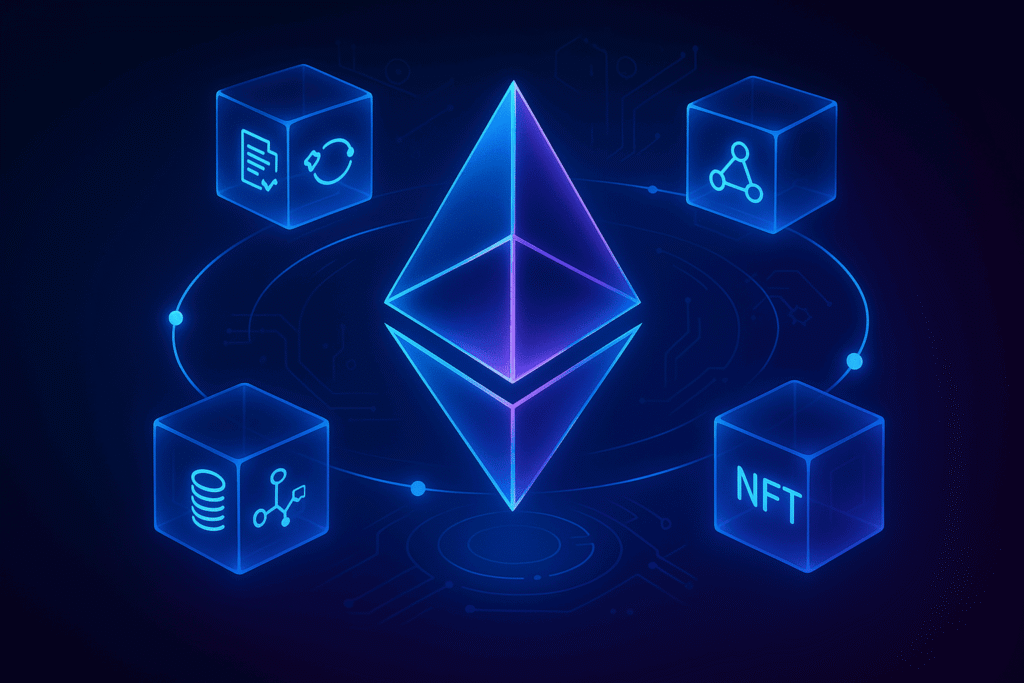
Let’s explore how Ethereum executes a smart contract, using a simple decentralized insurance example.
Step 1: Contract Creation
A developer writes a smart contract code—for example, one that automatically pays out flight delay insurance if a flight arrives more than 2 hours late. The code is compiled and deployed to the Ethereum blockchain, creating a contract address.
Step 2: User Interaction
A user wanting flight insurance sends ETH to the contract address, along with their flight details. This transaction is broadcast to the Ethereum network, just like a Bitcoin transaction.
Step 3: Validation and Execution
Ethereum validators (who have staked ETH to secure the network) pick up the transaction. They execute the smart contract code to verify the conditions. The contract might use an oracle—a service that feeds real-world data to the blockchain—to check the actual flight arrival time.
Step 4: Consensus and Settlement
If the oracle confirms the flight was delayed by more than 2 hours, the contract automatically executes: it transfers the insurance payout from the contract’s pool of funds to the user’s wallet. All validators reach consensus that this execution is valid, and the updated state of the blockchain is recorded.
Step 5: Immutable Record
The entire transaction—the payment, the contract execution, and the payout—is recorded permanently on the Ethereum blockchain. No insurance company employee needed to process a claim; no possibility of the claim being denied unfairly.
Why It’s Important: The Ethereum Value Proposition
- Programmable Money: Ethereum enables money that can be programmed to move automatically based on predefined conditions, unlocking entirely new financial instruments.
- Censorship Resistance: dApps running on Ethereum cannot be taken down by any single government or corporation, protecting free speech and innovation.
- Reduced Counterparty Risk: With smart contracts, you don’t need to trust the other party to fulfill their obligations—you only need to trust that the code will execute as written.
- Global Accessibility: Anyone with an internet connection can access Ethereum-based applications, providing financial services to the unbanked and underbanked.
- Composability (“Money Legos”): dApps on Ethereum can easily interact with and build upon each other, creating powerful network effects and rapid innovation.
Common Misconceptions
- “Ethereum is just another cryptocurrency like Bitcoin.” While both are cryptocurrencies, their purposes are fundamentally different. Bitcoin is primarily digital gold—a store of value. Ethereum is a decentralized computing platform—a world computer.
- “Smart contracts can handle complex, subjective agreements.” Smart contracts are only as smart as their code. They excel at executing objective, rules-based agreements but cannot handle subjective judgment or nuances not explicitly programmed.
- “Ethereum is finished and won’t change.” Ethereum is constantly evolving. The Merge to Proof-of-Stake was just one major upgrade in a long roadmap that includes scaling solutions to reduce fees and improve transaction speed.
- “All dApps are financial applications.” While DeFi dominates currently, Ethereum is also the foundation for social media platforms, gaming ecosystems, digital identity solutions, and supply chain management tools, much like how traditional businesses use E-commerce Platforms but in a decentralized manner.
Recent Developments & Real-Life Examples
Recent Development: The Rise of Layer 2 Scaling Solutions
To address Ethereum’s scalability challenges, Layer 2 networks like Arbitrum, Optimism, and Polygon have emerged. These networks process transactions off the main Ethereum chain but ultimately settle security on it. They offer dramatically lower fees and faster transactions while maintaining Ethereum’s security, making applications more accessible to everyday users. This represents a major step toward mainstream adoption.
Real-Life Example: Uniswap – The Decentralized Exchange
Uniswap is a perfect example of Ethereum’s power. It’s a fully decentralized exchange (DEX) that allows users to trade cryptocurrencies without any central intermediary. There’s no company behind Uniswap—it’s a collection of smart contracts and a front-end interface. Users provide liquidity to trading pools and earn fees, while traders can swap tokens permissionlessly. Uniswap routinely processes billions of dollars in volume, demonstrating that decentralized models can compete with traditional centralized exchanges.
Conclusion & Key Takeaways
Ethereum represents a fundamental shift in how we build and interact with digital systems. By combining money with programmability, it has created a fertile ground for economic and social experimentation at a global scale.
Key Takeaways:
- Ethereum is a Platform, Not Just a Currency: Its true value lies in the ecosystem of applications built on top of it.
- Smart Contracts Automate Trust: They enable complex agreements and transactions without relying on intermediaries.
- The Ecosystem is Still Maturing: High gas fees and user experience challenges remain, but rapid innovation in Layer 2 solutions is addressing these issues.
- Web3 is Being Built on Ethereum: The majority of dApps, DeFi protocols, and NFT projects choose Ethereum as their foundation due to its security and network effects.
- Understand the Risks: Smart contract bugs can lead to massive losses, and the regulatory environment remains uncertain. Always do your own research.
Ethereum is more than technology; it’s a movement toward a more open, transparent, and user-centric internet. As this ecosystem evolves, it promises to reshape everything from how we bank to how we organize communities online. For insights into managing the psychological aspects of navigating this rapidly changing landscape, consider our guide on Mental Wellbeing.
Frequently Asked Questions (FAQs)
1. What is the difference between Ethereum and Ether (ETH)?
Ethereum is the network/platform, while Ether (ETH) is the native cryptocurrency that powers the network.
2. How do I start using Ethereum dApps?
You’ll need a Web3 wallet like MetaMask, some ETH for gas fees, and then you can connect to any dApp through your browser.
3. What is “The Merge” and why was it important?
The Merge was Ethereum’s transition from Proof-of-Work to Proof-of-Stake consensus. It reduced Ethereum’s energy consumption by ~99.95% and set the stage for future scaling improvements.
4. Can Ethereum be used for purposes other than finance?
Absolutely! Ethereum is being used for gaming (NFTs, in-game assets), digital identity, supply chain tracking, voting systems, and decentralized social media.
5. What are the biggest challenges facing Ethereum?
Scalability (high fees during congestion), user experience complexity, and regulatory uncertainty are the primary challenges.
6. How is Ethereum different from other smart contract platforms?
Ethereum has the largest developer community, the most dApps, the highest total value locked (TVL), and the strongest network effects—though it faces competition from chains like Solana and Cardano.
7. What is staking on Ethereum?
Staking involves locking up ETH to help secure the network in its Proof-of-Stake system. In return, stakers earn rewards in the form of additional ETH.
8. Are smart contracts legally binding?
This is an evolving area of law. While smart contracts automate execution, their legal status varies by jurisdiction and may require connection to traditional legal frameworks.
9. What happens if there’s a bug in a smart contract?
Unless there are specific upgrade mechanisms built in, a deployed smart contract is immutable. Bugs can lead to permanent loss of funds, which is why extensive auditing is crucial before deployment.
10. How does Ethereum’s supply differ from Bitcoin’s?
Bitcoin has a fixed supply of 21 million coins. Ethereum transitioned to a potentially deflationary model with The Merge, where the supply can actually decrease during high network activity.
11. What are ERC-20 tokens?
A technical standard used for creating and issuing smart contract-based tokens on the Ethereum blockchain. Most DeFi tokens and stablecoins are ERC-20 tokens.
12. Is Ethereum more decentralized than Bitcoin?
This is debated. Bitcoin has greater decentralization in its mining distribution, while Ethereum has more decentralization in its development and node distribution. Both are highly decentralized compared to traditional systems.
13. Can Ethereum be used for private transactions?
By default, Ethereum transactions are public. However, privacy-focused solutions like zero-knowledge proofs and mixers are being developed to enable private transactions.
14. What is the Ethereum Foundation?
A non-profit organization dedicated to supporting Ethereum and related technologies, though it does not control the network.
15. Where can I learn to develop on Ethereum?
The Ethereum Foundation’s website, CryptoZombies (an interactive coding tutorial), and various developer documentation portals are great starting points. For broader economic context, explore our Blog.
About The Author