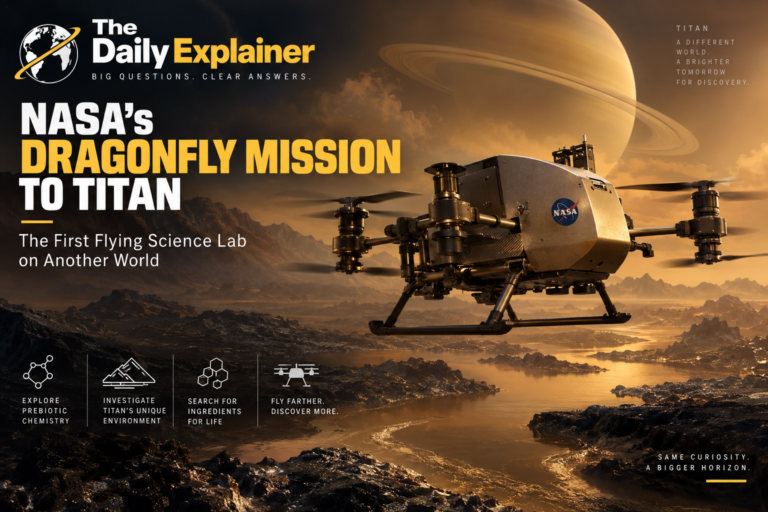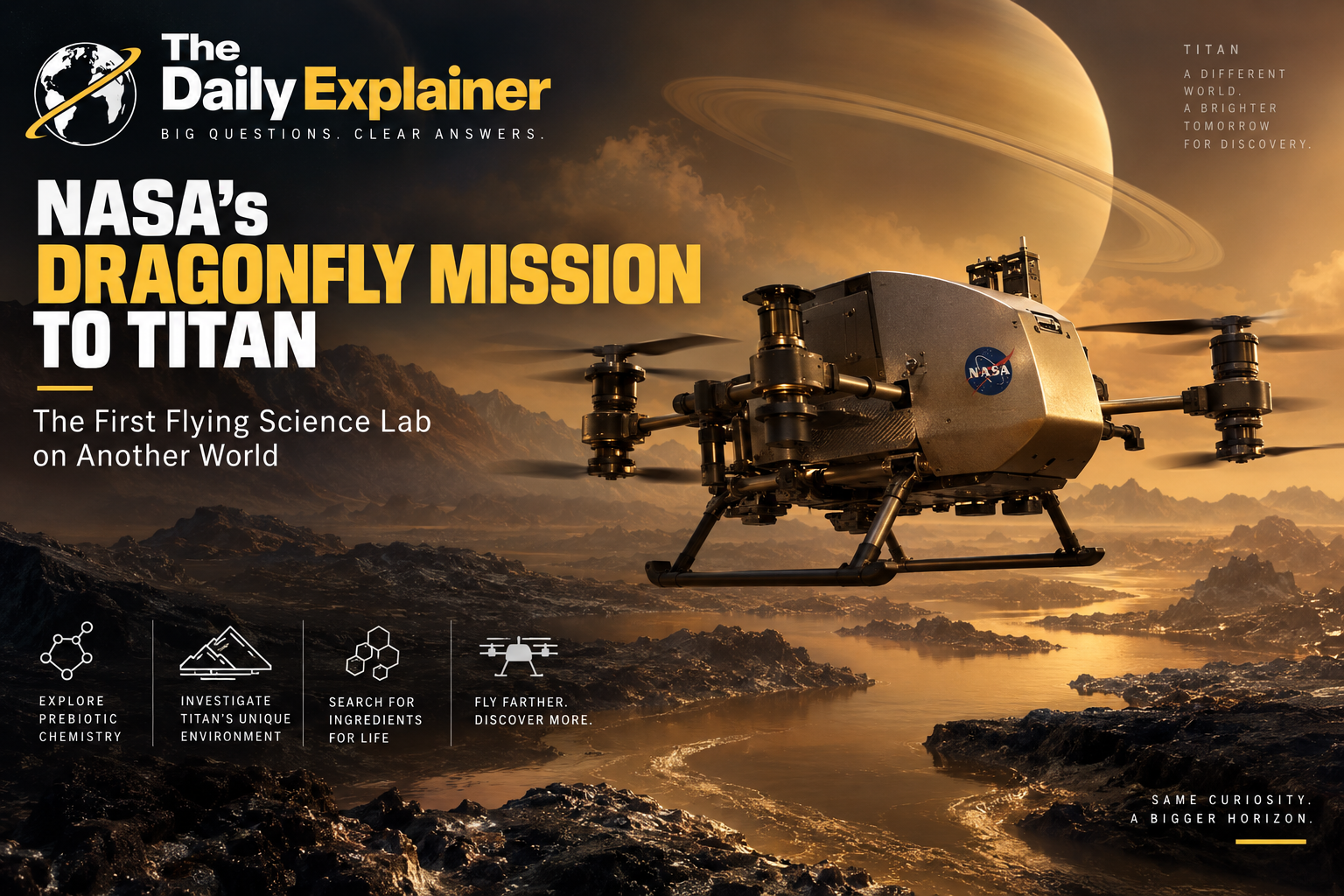
The October 2026 test used flight-like avionics and simulated sensor data to validate Dragonfly's autonomous landing capability.
Introduction: Why This Matters
In my experience covering planetary exploration, there are missions that follow the playbook and missions that tear it up entirely. NASA’s Dragonfly is the latter. Here is the detailed article about Dragonfly mission titan for reading and information.
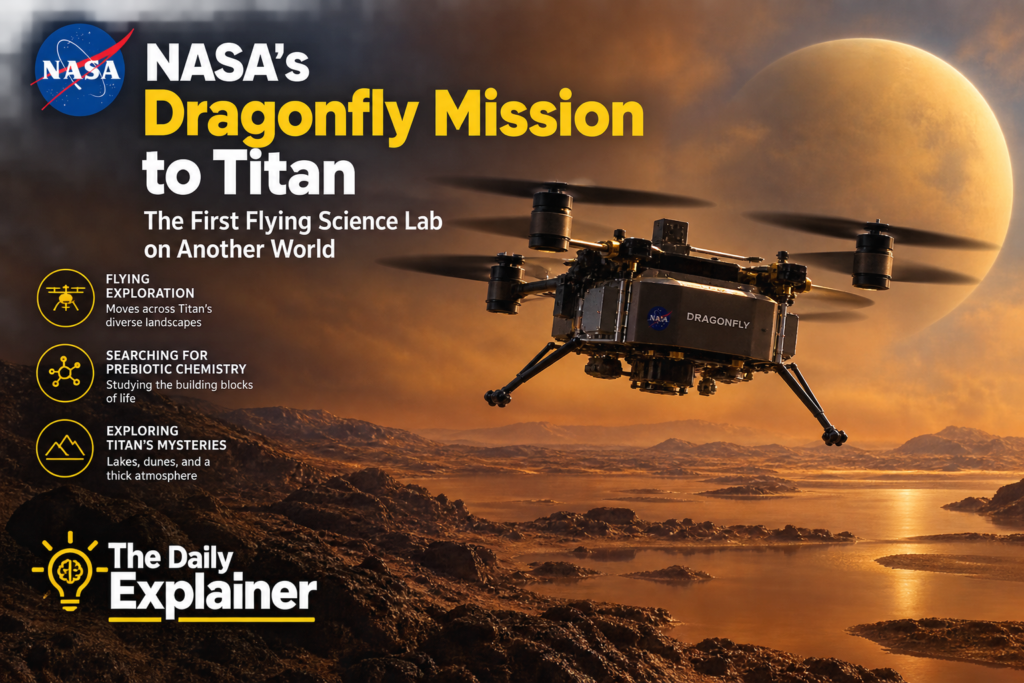
For decades, we’ve explored other worlds with rovers crawling across surfaces and orbiters circling from above. Dragonfly will do neither. It’s a car-sized, eight-rotor drone that will fly through the thick, orange haze of Saturn’s moon Titan, landing at one site, taking off, and flying kilometers to the next. It’s the first mission of its kind—a flying science laboratory on another world .
Key Takeaway: Dragonfly is scheduled to launch no earlier than 2028 and arrive at Titan in 2034. Over its 3.3-year primary mission, it will fly to dozens of locations, covering roughly 175 kilometers, to study the chemistry that could have preceded life on Earth .
Why Titan? Because it’s the only moon in the solar system with a substantial atmosphere, the only place besides Earth with stable liquids on its surface (methane and ethane lakes and rivers), and a natural laboratory for prebiotic chemistry—the chemical steps that lead to the building blocks of life . Dragonfly isn’t searching for life itself. It’s investigating whether the conditions for life existed, and what chemistry unfolded in those conditions.
This guide explains what Dragonfly is, how it works, what it will study, and why its recent milestones—including a complete simulated first flight—matter for the future of astrobiology.
Background and Context
Why Titan?
Titan is a world of paradoxes. It’s frigid—surface temperatures hover around minus 290 degrees Fahrenheit (minus 179 Celsius)—yet it has weather. Methane rain falls from clouds, carving channels and filling lakes. It has a thick nitrogen atmosphere, about 1.5 times the pressure at Earth’s surface, and organic molecules drift down from the upper atmosphere like a constant, gentle snow .
Those organic molecules are the key. Sunlight and energetic particles break apart methane and nitrogen in Titan’s upper atmosphere, and the fragments recombine into more complex organics. These molecules form a haze that gives Titan its orange color, and they settle onto the surface. Laboratory experiments have shown that similar chemistry can produce amino acids and nucleobases—the building blocks of proteins and DNA .
But there’s a twist. Titan’s surface is too cold for liquid water. Any chemistry that requires water—like the hydrolysis reactions that can turn simple organics into more complex ones—needs a different setting. Impact craters are the leading candidate. When an asteroid or comet strikes Titan, the energy of the impact can melt the icy crust, creating a pool of liquid water that might persist for thousands of years. In that transient oasis, organic molecules from the atmosphere could mix with water and undergo the kind of chemistry that leads to biologically relevant compounds .
Selk crater, about 80 kilometers wide, is Dragonfly’s primary target. It’s an impact crater where this kind of aqueous processing may have occurred, and it’s rich in organic material .
The Mission’s Origins and Challenges
Dragonfly was selected in 2019 as the fourth mission in NASA’s New Frontiers program, a line of medium-cost planetary science missions . The Johns Hopkins Applied Physics Laboratory (APL) leads the mission, with Elizabeth “Zibi” Turtle as principal investigator .
The mission has not been without difficulties. NASA’s Office of Inspector General reported in 2025 that Dragonfly faced schedule delays and nearly $1 billion in cost increases, pushing the launch from 2026 to 2028 and raising the life-cycle cost above $3 billion . The OIG attributed the issues to multiple replans driven by pandemic disruptions, supply chain problems, and funding challenges . Despite these setbacks, the mission has continued to mature, and recent tests have demonstrated that the hardware and software are coming together.
Key Concepts Defined
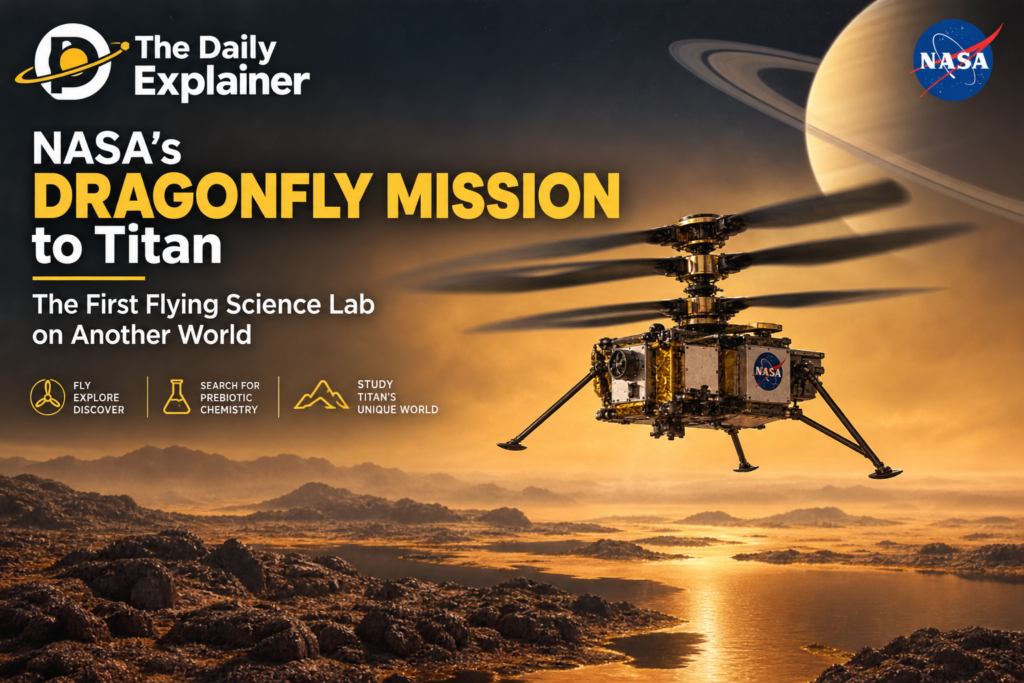
Rotorcraft: A flying vehicle with rotors that provide lift and propulsion. Dragonfly has four pairs of rotors (eight total), arranged like a large quadcopter .
Prebiotic Chemistry: The chemical processes that produce the molecular building blocks of life—amino acids, nucleobases, lipids—before life itself emerges. Dragonfly studies prebiotic chemistry, not life .
Tholins: Complex organic molecules formed by the irradiation of simple gases like methane and nitrogen. Tholins give Titan its orange haze and are a major source of surface organics .
Impact Melt Pool: A temporary body of liquid water created when an impact melts Titan’s icy crust. These pools may persist for thousands of years and provide the aqueous environment needed for prebiotic chemistry .
DraMS (Dragonfly Mass Spectrometer): The instrument that will analyze surface samples. It uses a linear ion trap and, with a French-built gas chromatograph (DraMS-GC), separates and identifies molecules in Titan’s soil .
MMRTG (Multi-Mission Radioisotope Thermoelectric Generator): Dragonfly’s power source. It converts heat from the decay of plutonium-238 into electricity. The same technology powered the Curiosity and Perseverance Mars rovers .
Tsol: A Titan day, equivalent to about 16 Earth days. Dragonfly is expected to make one flight per Tsol .
How It Works: Step-by-Step Breakdown
The Flight System
Dragonfly’s design is driven by Titan’s unique environment.
Step 1: Launch and Cruise
Dragonfly will launch on a SpaceX Falcon Heavy rocket, under a $256.6 million contract, no earlier than 2028 . The spacecraft will spend roughly six years in cruise, arriving at Titan in 2034.
Step 2: Entry, Descent, and Landing
Titan’s thick atmosphere is both an asset and a challenge. The entry vehicle will use a heat shield made of PICA-D, a variant of the material that protected the Curiosity and Perseverance rovers during Mars entry. Recent tests at Sandia National Laboratories’ Solar Tower facility subjected the heat shield to temperatures around 4,500 degrees Fahrenheit (2,500 Celsius) and confirmed it performed as expected, even with intentional defects .
After the heat shield slows the craft, a parachute will deploy. The “pose” mechanism—a structure connecting the backshell to the lander—will lower Dragonfly below the backshell, where it can start its rotors and separate for the final descent .
Step 3: First Flight
The first flight is the most challenging. It uses every flight sensor on the lander: navigation cameras, inertial measurement units, and lidar. The craft must scan the terrain, identify a safe landing site, and touch down autonomously .
In October 2026, the team completed a full simulated first flight on a computer testbed at APL, running flight-like avionics in real time with simulated sensor data. The test incorporated most of the systems and maneuvers Dragonfly will use at Titan .
Step 4: Surface Operations and Sampling
Once landed, Dragonfly will use its instruments to study the surface. The DraMS instrument, built with French contributions, will drill into the surface, heat the sample, and analyze the resulting gases. The gas chromatograph separates molecules so they can be identified individually .
Step 5: Flying to the Next Site
After a few Titan days of science, Dragonfly will take off and fly to a new location. The high-gain antenna, a 34.4-inch disc, will be stowed before flight to protect it from vibrations and raised again after landing . Over the mission, Dragonfly will visit 20 to 30 sites, covering about 175 kilometers .
Why It’s Important
A New Way to Explore
Dragonfly is not just a bigger Ingenuity. The Mars helicopter was a technology demonstration that flew short hops. Dragonfly is a primary science platform that will traverse tens of kilometers, landing at carefully selected sites and performing complex analyses. Its range and autonomy are orders of magnitude beyond anything previously attempted on another world .
This mobility is essential for Titan. The most interesting chemistry may be at specific locations—an impact crater, a dune field, a riverbed—that are kilometers apart. A stationary lander could study only one. A rover would be too slow. A rotorcraft can visit many sites in a single mission.
Testing the Chemistry of Life
Dragonfly’s science goal is to understand how far prebiotic chemistry can progress on a world without life. Titan offers a natural laboratory where organic molecules are abundant, water is occasionally available in impact melts, and the chemistry has been running for billions of years .
The results will inform our understanding of how life might have begun on Earth. If Dragonfly finds that amino acids or nucleobases have formed on Titan, it would demonstrate that the building blocks of life are common in the universe. If it finds that the chemistry stalls at simpler molecules, it would suggest that additional steps—perhaps ones unique to Earth—are required.
The Astrobiology Context
NASA is careful to emphasize that Dragonfly is not a life-detection mission. As Zibi Turtle put it, “Dragonfly is not a mission to detect life; it is a mission to investigate the chemistry that preceded biology on Earth” .
This framing is scientifically honest and strategically important. Claims of life detection require extraordinary evidence, and Dragonfly’s instruments are not designed to provide that evidence. What it can do is characterize the chemical inventory of Titan’s surface and assess whether the conditions for life’s origins existed there.
Sustainability in the Future
Mission Lifetime and Extension
Dragonfly’s primary mission is 3.3 years on Titan’s surface . The MMRTG power source has a long enough lifetime to support extended operations, and NASA has the option to extend the mission if the spacecraft remains healthy. Like many planetary missions, Dragonfly’s most interesting discoveries may come in an extended phase, when the team has learned enough about Titan to target the most promising sites.
Data and Collaboration
Dragonfly is an international collaboration. The French space agency CNES contributed the gas chromatograph for DraMS and the helium reservoirs that support it . The German space agency DLR, the Japanese space agency JAXA, and other partners are also involved . The mission’s data will be archived and made available to the global scientific community, ensuring that its discoveries can be analyzed for decades.
The Cost Challenge
The OIG’s findings on cost growth are a reminder that ambitious missions carry financial risks . Dragonfly’s budget overruns have delayed the next New Frontiers mission competition, a consequence that affects the broader planetary science community. Future missions will need to balance scientific ambition with realistic cost and schedule planning.
Common Misconceptions
Misconception 1: “Dragonfly is looking for life on Titan.”
No. Dragonfly is studying prebiotic chemistry—the chemical steps that could lead to life. It is not equipped to detect life itself, and NASA is explicit about this distinction .
Misconception 2: “Titan has water on its surface.”
Titan’s surface liquids are methane and ethane, not water. Liquid water exists only transiently, in impact melt pools or cryovolcanic flows, and possibly in a subsurface ocean .
Misconception 3: “Dragonfly is just a bigger Mars helicopter.”
Ingenuity was a technology demonstration that flew short hops. Dragonfly is a science platform with a suite of instruments, designed to traverse kilometers and perform detailed chemical analyses. The two are fundamentally different in purpose and capability .
Misconception 4: “Titan is too cold for chemistry.”
Titan is cold, but chemistry still happens. The atmosphere is a giant chemical reactor, producing complex organics continuously. The surface preserves these molecules, and impact melts provide the aqueous conditions for further reactions .
Misconception 5: “The mission has been cancelled because of cost overruns.”
No. Dragonfly has faced delays and cost increases, but NASA has continued to fund and develop the mission. Recent hardware deliveries and test milestones demonstrate that it is moving forward .
Recent Developments
Simulated First Flight (October 2026)
The most significant recent milestone was the completion of a full simulated first flight on flight-like avionics at APL. The test integrated navigation cameras, inertial measurement units, and lidar with simulated terrain data, running in real time. It validated that the flight software and hardware work together as expected .
“This is our most challenging flight,” said Zach Putnam, Dragonfly mobility subsystem lead engineer. “It uses every piece of flight sensor hardware on the lander” .
Fuselage Delivery and Integration (June-July 2026)
The nearly 13-foot-long fuselage was delivered for integration ahead of schedule in late June 2026, following structural testing. The team then began populating it with flight bulkheads, wiring harnesses, and other systems .
Heat Shield Testing (June 2026)
The PICA-D heat shield completed thermal-structural testing at Sandia National Laboratories, enduring temperatures around 4,500 degrees Fahrenheit. The material performed as expected, even when intentionally flawed to simulate manufacturing defects .
High-Gain Antenna Integration (May 2026)
The 34.4-inch high-gain antenna, adapted from technology developed for NASA’s DART mission, was integrated onto a motorized arm that raises it for communications and lowers it for flight. It is designed to operate in Titan’s frigid temperatures and potentially liquid methane rain .
Success Stories
Case Study: The Simulated First Flight
The October 2026 simulated flight was a milestone years in the making. The team built Dragonfly’s flight capabilities incrementally, starting with single-rotor simulations and progressing to short repositioning flights and partial scouting flights. The final test added lidar and ran the complete first-flight sequence in real time .
The test was not just a software exercise. It used flight-like avionics and simulated sensor inputs with realistic timing, including the millisecond-scale interactions between different processes. This kind of end-to-end validation is essential before the actual flight on Titan, where the spacecraft must operate autonomously without real-time help from Earth .
Case Study: The French Contribution to DraMS
The DraMS instrument’s gas chromatograph, built by CNES and French laboratories, is essential for identifying the complex mixture of molecules in Titan’s soil. The instrument heats samples, vaporizes the resulting compounds, and uses helium to carry them through a capillary column. Different molecules travel at different speeds and emerge at different times, allowing the team to identify them .
This international collaboration brings together expertise from APL, CNES, LATMOS, and other institutions. The French team’s experience with the SAM instrument on the Curiosity rover provided a foundation for DraMS’s development.
Real-Life Examples
The Huygens Legacy
In January 2005, the European Space Agency’s Huygens probe landed on Titan, transmitting data for about 90 minutes. It was the first landing on a world in the outer solar system, and it provided the first direct measurements of Titan’s atmosphere and surface .
Huygens confirmed that Titan’s atmosphere is thick and nitrogen-rich, and that the surface is solid, with evidence of liquid methane. Its data laid the groundwork for Dragonfly, which will pick up where Huygens left off—but with the ability to move from site to site.
The “Flying Monospace” Analogy
CNES project manager Gabriel Pont described Dragonfly as a “flying monospace” that weighs about as much as a small car—roughly 850 to 900 kilograms . Its dimensions, about 4.5 by 4.5 by 1.8 meters, are comparable to a large van.
The analogy is apt. Dragonfly is not a small, nimble drone. It’s a substantial spacecraft with a suite of scientific instruments, a nuclear power source, and the capability to operate autonomously in an alien environment. Its size and complexity reflect the ambition of the mission.
Conclusion and Key Takeaways
Dragonfly is one of the most innovative planetary missions ever conceived. It will fly through Titan’s atmosphere, land at multiple sites, and analyze the chemistry of a world that may hold clues to the origins of life.
Key Takeaway 1: Dragonfly is a rotorcraft lander that will fly to dozens of locations on Titan, covering roughly 175 kilometers over its 3.3-year mission.
Key Takeaway 2: Its primary target is Selk crater, an impact site where liquid water may have persisted long enough for prebiotic chemistry to occur.
Key Takeaway 3: Dragonfly studies prebiotic chemistry, not life. Its goal is to understand how far the chemistry of life can progress on a world without life.
Key Takeaway 4: The mission has faced cost and schedule challenges but is progressing. Recent milestones include a full simulated first flight and delivery of the flight fuselage.
Key Takeaway 5: Dragonfly is an international collaboration, with key contributions from France (DraMS-GC) and other partners.
For curious beginners, Dragonfly is a preview of a new era of planetary exploration—one where flying vehicles can access terrains that rovers cannot. For professionals, the mission’s technical achievements and scientific goals represent a significant step forward in astrobiology and planetary science.
Frequently Asked Questions (FAQ’s)
Q1: What is Dragonfly?
Dragonfly is a NASA rotorcraft lander mission to Saturn’s moon Titan. It will fly to multiple locations, study surface chemistry, and investigate prebiotic processes.
Q2: When will Dragonfly launch and arrive?
Launch is scheduled for no earlier than 2028, with arrival at Titan in 2034 .
Q3: Why is Dragonfly a rotorcraft instead of a rover?
Titan’s thick atmosphere and low gravity make flying easier than on Earth. A rotorcraft can cover much more ground than a rover, visiting dozens of sites in a single mission .
Q4: What is prebiotic chemistry?
The chemical processes that produce the building blocks of life—amino acids, nucleobases, lipids—before life itself emerges.
Q5: Is Dragonfly looking for life?
No. It is studying the chemistry that preceded biology. NASA is explicit that Dragonfly is not a life-detection mission .
Q6: Why Titan?
Titan has a thick atmosphere, organic molecules, and evidence of past liquid water in impact craters. It’s a natural laboratory for prebiotic chemistry .
Q7: What is Selk crater?
Selk crater is an 80-kilometer-wide impact crater on Titan. It’s Dragonfly’s primary target because impact melt may have provided the water needed for prebiotic chemistry .
Q8: How does Dragonfly fly?
It has eight rotors (four pairs) and uses lidar, navigation cameras, and inertial measurement units to fly autonomously. Titan’s low gravity and thick atmosphere make flight efficient .
Q9: What powers Dragonfly?
An MMRTG (Multi-Mission Radioisotope Thermoelectric Generator) that converts heat from plutonium-238 decay into electricity. The same technology powers the Curiosity and Perseverance rovers .
Q10: How far will Dragonfly travel?
About 175 kilometers over the primary mission, visiting 20 to 30 sites .
Q11: What instruments does Dragonfly carry?
DraMS (mass spectrometer with gas chromatograph), DraGNS (gamma-ray and neutron spectrometer), cameras, and meteorological sensors .
Q12: What is DraMS?
The Dragonfly Mass Spectrometer. It analyzes surface samples to identify their chemical composition. The gas chromatograph, built by CNES, separates molecules for identification .
Q13: Has Dragonfly flown yet?
Not on Titan. It completed a full simulated first flight on a testbed at APL in October 2026 .
Q14: What was the cost overrun?
The OIG reported nearly $1 billion in cost increases, pushing the life-cycle cost above $3 billion. The launch was delayed from 2026 to 2028 .
Q15: Is the mission still on track?
Yes. Hardware delivery, heat shield testing, and simulated flights have all progressed in 2026.
Q16: How long is a Titan day?
About 16 Earth days. Dragonfly is expected to make one flight per Titan day (Tsol) .
Q17: What is the high-gain antenna?
A 34.4-inch disc that focuses the radio beam for communication with Earth. It’s stowed during flight and raised during surface operations .
Q18: What is the heat shield made of?
PICA-D, a variant of the Phenolic Impregnated Carbon Ablator used on Mars rovers. It was tested at Sandia National Laboratories .
Q19: Who leads the mission?
The Johns Hopkins Applied Physics Laboratory (APL), with Elizabeth “Zibi” Turtle as principal investigator .
Q20: What is CNES’s role?
CNES provided the gas chromatograph (DraMS-GC) and helium reservoirs for the mass spectrometer, and French laboratories contributed to the instrument’s development .
Q21: Can Dragonfly be extended?
The MMRTG has a long lifetime, and NASA has the option to extend the mission if the spacecraft remains healthy.
Q22: What happens after Dragonfly?
Dragonfly’s results will inform future astrobiology missions and our understanding of prebiotic chemistry throughout the solar system.
Q23: How can I follow the mission?
NASA’s Dragonfly blog and APL’s mission page provide regular updates on integration, testing, and launch preparations.
About the Author
Sana Ullah Khan Kakar is a science writer specializing in planetary science and astrobiology. With over a decade of experience covering missions from Curiosity to Dragonfly, [he/she/they] has reported on the search for life’s origins across the solar system.
This article was fact-checked against NASA, APL, CNES, and peer-reviewed research. All statistics reflect information available as of late 2026.
Free Resources
For Beginners:
- NASA Dragonfly Mission Page (science.nasa.gov/mission/dragonfly) — Overview and updates
- APL Dragonfly Page (dragonfly.jhuapl.edu) — News and mission details
- “Why Titan?” (NASA) — Explainer on the moon’s habitability
For Deeper Learning:
- Dragonfly Prebiotic Chemistry Papers (Planetary Science Journal, 2026) — Thermodynamic modeling of amino acid synthesis
- NASA OIG Report on Dragonfly (2025) — Cost and schedule analysis
- CNES Dragonfly Pages — French instrument contributions
For Real-Time Updates:
- NASA Dragonfly Blog — Integration and testing updates
- APL News — Mission milestones
- arXiv astro-ph.EP — Preprints on Titan and prebiotic chemistry
Discussion
What do you think is the most exciting aspect of Dragonfly—the flying capability, the prebiotic chemistry, or the international collaboration?
Do you think Titan’s impact craters are the best place to look for the building blocks of life, or should future missions target the subsurface ocean?
Share your thoughts below. For more space science explainers, visit our Explained section and browse our blog. Have questions or topic suggestions? Contact us. For breaking space news, check our Breaking News category. Review our Terms of Service and explore our Global Affairs & Politics coverage for context on international space cooperation.
For more resources on science communication and research, visit Sherakat Network’s Resources and Blog. Connect with Sherakat Network for collaboration opportunities. If you’re building an online presence, see their 2026 guide to starting an online business. Learn more about WorldClassBlogs and explore their Blog, Our Focus, and Nonprofit Hub. For SEO insights, visit Sherakat Network’s SEO category.
About The Author