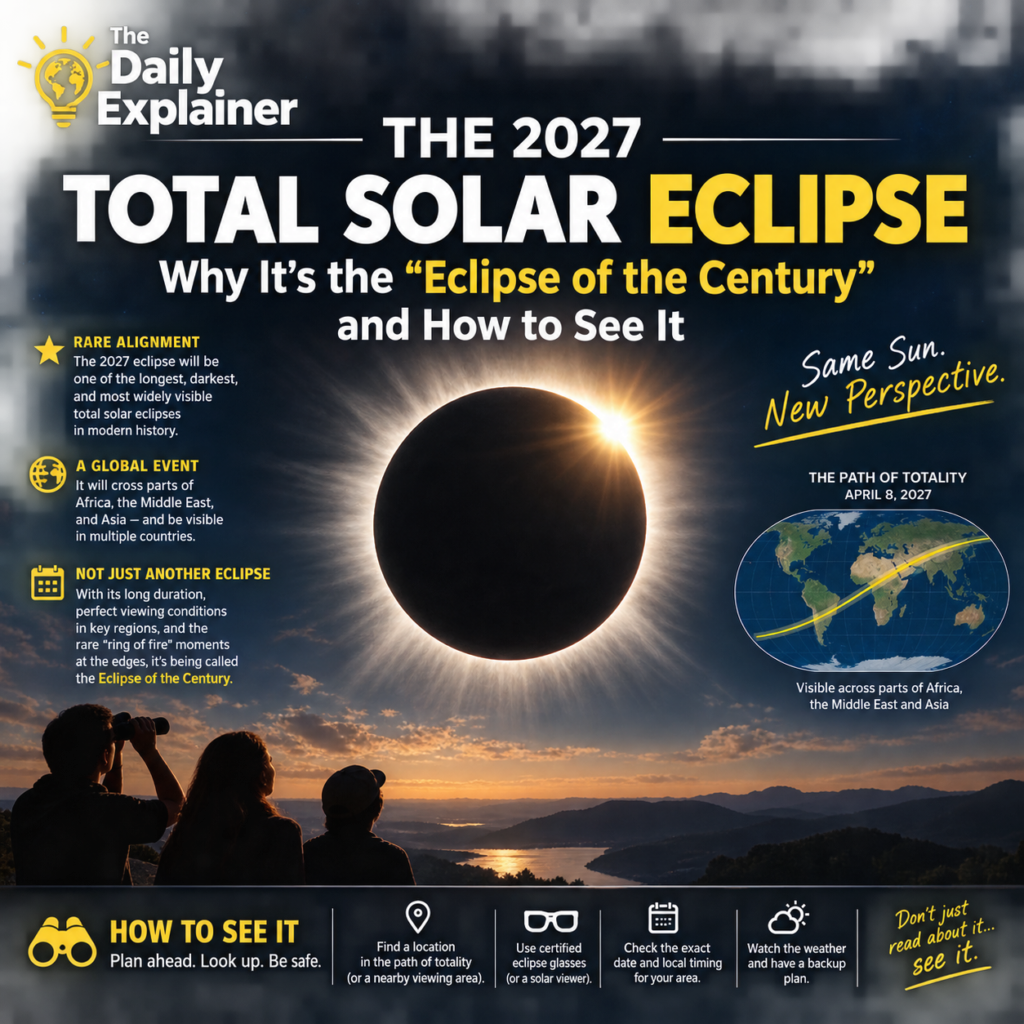
The path of totality crosses Spain, Morocco, Algeria, Tunisia, Libya, Egypt, Sudan, Saudi Arabia, Yemen, and Somalia.
Introduction: Why This Matters
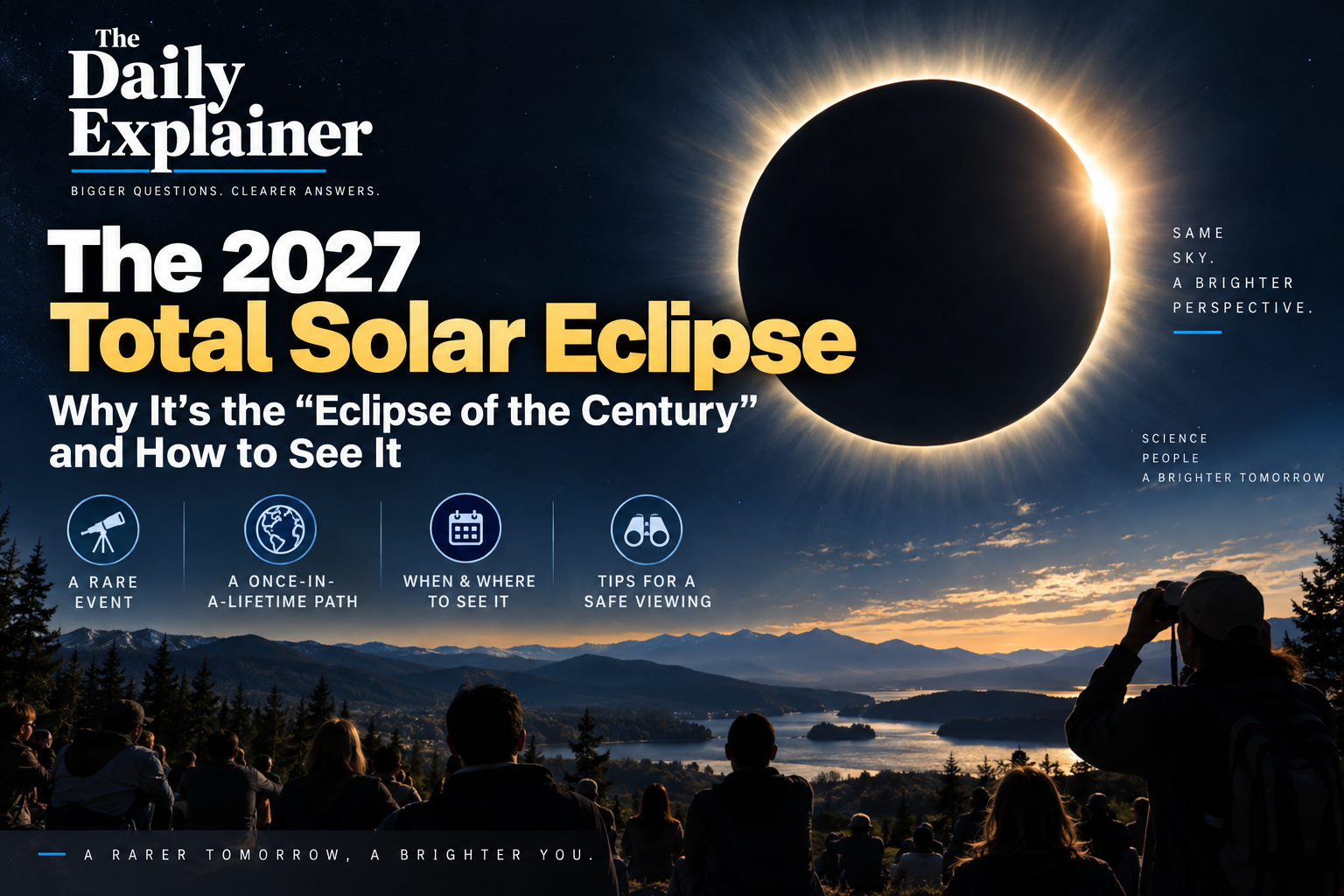
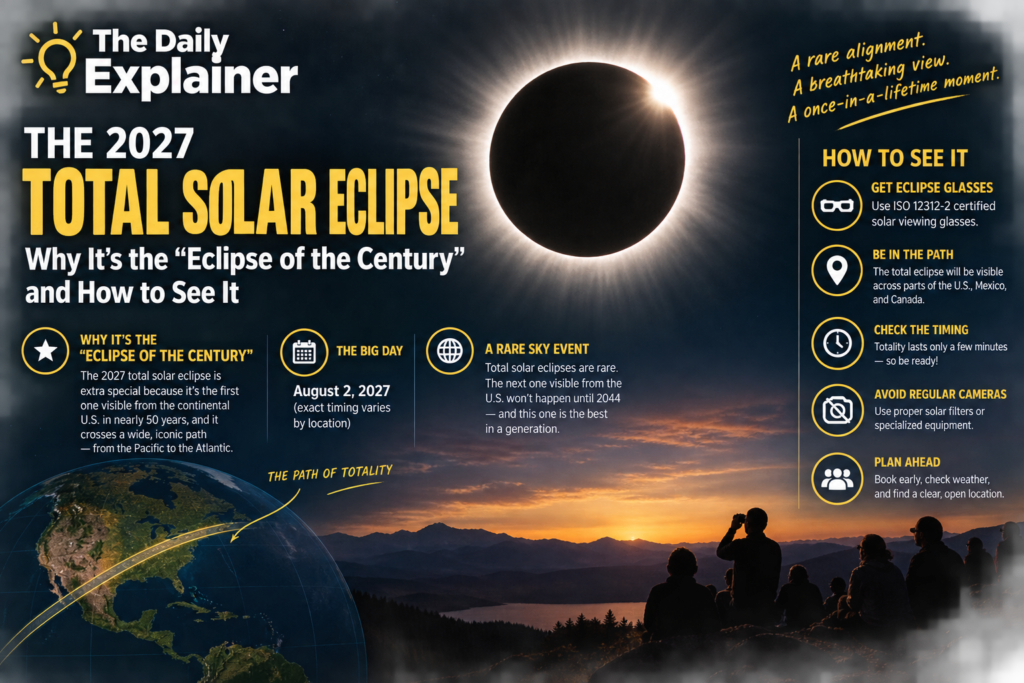
In my experience covering astronomy, there are events that remind you why you fell in love with the sky in the first place. The total solar eclipse of August 2, 2027, is one of them. Here is the article 2027 total solar eclipse.
Here’s the headline: totality will last up to 6 minutes and 23 seconds in some locations—the longest duration of any total solar eclipse until the year 2114 . Eclipse chasers are already calling it the “eclipse of the century,” and hotels along the path of totality in Egypt, Morocco, and Spain are reporting massive bookings nearly a year in advance .
Key Takeaway: The 2027 eclipse offers a rare combination of extreme duration, favorable weather prospects, and accessibility across populated regions of North Africa, the Middle East, and Southern Europe. For scientists, it’s an unparalleled opportunity to study the Sun’s corona. For everyone else, it’s a once-in-a-lifetime spectacle.
This guide explains what makes this eclipse special, where and when to see it, the science it enables, and how to prepare for an event that most people alive today have never experienced.
Background and Context
The Cosmic Coincidence
Total solar eclipses are possible because of an extraordinary coincidence. The Sun is about 400 times wider than the Moon, but it’s also about 400 times farther away. From Earth, both objects appear almost exactly the same size in the sky . When the Moon passes directly between Earth and the Sun, it can cover the Sun’s disk almost perfectly, revealing the faint outer atmosphere—the corona—that is normally hidden by the Sun’s glare.
This geometry isn’t permanent. The Moon is gradually moving away from Earth at about 3.8 centimeters per year. Hundreds of millions of years from now, total solar eclipses will no longer occur. We happen to live in the era when they’re still possible—and the 2027 event is one of the best in our lifetime.
Why Duration Varies
The length of totality depends on the geometry of the Sun, Moon, and Earth at the moment of alignment. When the Moon is at its closest point to Earth (perigee) and the Sun is at its farthest (aphelion), the Moon appears larger and the Sun appears smaller, allowing the Moon to cover it for longer .
The maximum possible duration of a total solar eclipse is about 7 minutes and 32 seconds . The 2027 event comes remarkably close to that theoretical limit.
Key Concepts Defined
Totality: The phase of a total solar eclipse when the Moon completely covers the Sun’s disk. Only during totality can you see the corona with the naked eye.
Path of Totality: The narrow track on Earth’s surface where the Moon’s shadow falls. Only observers within this path experience a total eclipse. Outside the path, only a partial eclipse is visible.
Corona: The Sun’s outermost atmospheric layer, visible during totality as a pearly white halo. It is more than 150 times hotter than the Sun’s surface, and why it’s so hot remains a major unsolved problem .
Coronagraph: An instrument that creates an artificial eclipse by blocking the Sun’s disk, allowing continuous study of the corona. However, natural eclipses block a tighter region against the Sun, revealing the innermost corona that coronagraphs cannot see .
Path Width: The width of the totality track, typically 100-300 kilometers. Observers must be inside this path to experience totality.
How It Works: Step-by-Step Breakdown
The Eclipse Timeline
Step 1: Partial Eclipse Begins
The Moon begins to cover the Sun’s disk. For about an hour, the Sun appears to have a “bite” taken out of it. This phase requires certified eclipse glasses to view safely.
Step 2: The Approach to Totality
As the Moon covers more of the Sun, the light becomes eerily dim. Shadows sharpen. The temperature drops. Birds may fall silent. A few minutes before totality, you might see “shadow bands”—faint rippling lines on light-colored surfaces.
Step 3: Baily’s Beads and the Diamond Ring
Just before totality, sunlight streams through valleys on the Moon’s edge, creating bright dots called Baily’s Beads. The last bead creates a brilliant “diamond ring” effect. This is the signal to remove eclipse glasses and prepare for totality.
Step 4: Totality
The Moon completely covers the Sun. The sky darkens to deep twilight. The corona blazes into view. Planets and bright stars become visible. The temperature can drop by several degrees. This is the moment eclipse chasers travel thousands of miles to experience.
Step 5: The End of Totality
The diamond ring reappears on the opposite side, and totality ends. Eclipse glasses go back on for the partial phases.
Step 6: Partial Eclipse Ends
The Moon gradually uncovers the Sun, and normal daylight returns.
Where to See It
The path of totality crosses several countries :
- Spain: Cádiz and other southern regions
- Morocco: Tangiers and northern areas
- Algeria, Tunisia, Libya: Northern sections
- Egypt: Luxor and other locations
- Sudan: Northern regions
- Saudi Arabia: Along the path
- Yemen, Somalia: Final segments
Major cities under or near the path include Luxor, Tangiers, and Cádiz . These areas have low likelihood of cloud cover, making them prime viewing locations.
Key Takeaway: The best viewing locations combine proximity to the centerline (longest totality) with favorable weather prospects. Egypt and the Red Sea region offer some of the clearest skies and longest durations.
Why It’s Important
Scientific Opportunity
The 2027 eclipse offers a rare chance to study the innermost corona. While coronagraphs can block the Sun’s disk artificially, natural eclipses block a tighter region, revealing the corona closer to the solar surface than any instrument can . This region is critical for understanding how the corona is heated and how the solar wind is accelerated.
Researchers will use the eclipse to study the corona’s fine structure, measure its temperature and density, and test theories about coronal heating. The long duration of totality—over six minutes in some locations—provides an extended window for observations.
Public Engagement
Eclipses are among the most powerful tools for public science engagement. The dramatic transformation of the sky, the sudden appearance of the corona, and the shared experience of totality create lasting memories and inspire curiosity about the universe.
For many people, a total solar eclipse is the only time they will directly observe a astronomical phenomenon that connects them to the cosmos in a visceral way.
Economic Impact
Eclipse tourism is a significant economic driver. Hotels, tour operators, and local businesses in the path of totality experience surges in demand. The 2027 event is expected to draw hundreds of thousands of visitors to North Africa and Southern Europe, generating millions in revenue.
Sustainability in the Future
Eclipse Tourism and Overtourism
The 2027 eclipse raises concerns about overtourism in sensitive locations. Luxor, Egypt, is a UNESCO World Heritage site with fragile archaeological treasures. The influx of visitors must be managed carefully to protect these sites.
Sustainable eclipse tourism involves:
- Spreading visitors across multiple locations along the path
- Promoting responsible viewing practices
- Investing in local infrastructure that benefits communities beyond the event
- Encouraging extended stays that support local economies
Scientific Legacy
The data collected during the 2027 eclipse will contribute to long-term solar physics research. Observations of the corona will be archived and made available to researchers worldwide, ensuring that the scientific value of the event extends far beyond the few minutes of totality.
Inspiring the Next Generation
Eclipses inspire young people to pursue careers in science and engineering. The 2027 event is an opportunity to engage students, teachers, and the public in astronomy education, creating a legacy of curiosity and discovery.
Common Misconceptions
Misconception 1: “It’s safe to look at the Sun during a total eclipse without protection.”
It is only safe to look directly at the Sun during the brief phase of totality, when the Moon completely covers the Sun’s disk. At all other times—including the partial phases before and after totality—you must use certified eclipse glasses. Looking at the Sun without protection can cause permanent eye damage.
Misconception 2: “You can see totality from anywhere.”
Totality is only visible within the narrow path of totality, typically 100-300 kilometers wide. Outside this path, observers see only a partial eclipse. To experience the full spectacle, you must travel to the path.
Misconception 3: “The eclipse will last for 6 minutes everywhere in the path.”
The maximum duration of 6 minutes and 23 seconds occurs only at the centerline of the path. Duration decreases as you move toward the edges of the path. Observers near the edge may experience only a minute or two of totality.
Misconception 4: “Eclipses are bad omens.”
This is an ancient superstition with no scientific basis. Eclipses are predictable astronomical events caused by the alignment of the Sun, Moon, and Earth. They are neither good nor bad luck—they’re just physics.
Misconception 5: “The corona is easy to study with telescopes.”
The corona is millions of times fainter than the Sun’s disk. Even with specialized coronagraphs, it’s difficult to observe the innermost regions. Natural eclipses provide a cleaner view of this region than any artificial instrument.
Recent Developments
Path Refinement and Weather Forecasting
As the eclipse approaches, astronomers are refining predictions of the path’s exact location and duration. Weather forecasting for eclipse day is also improving, helping viewers choose locations with the best chance of clear skies.
Hotel Bookings Surge
Hotels in Luxor, Tangiers, Cádiz, and other path locations are reporting record bookings nearly a year in advance . Some locations are already sold out. Prospective viewers are advised to book accommodations and travel as early as possible.
Scientific Campaigns
Several research teams are planning eclipse campaigns. These include:
- High-resolution imaging of the corona
- Spectroscopic measurements of coronal plasma
- Studies of the chromosphere and prominence activity
- Citizen science projects engaging the public in data collection
Success Stories
Case Study: The 2009 Eclipse
The 2009 total solar eclipse, visible from China and the Pacific, had a maximum duration of over 6 minutes. It was one of the longest of the 21st century and provided valuable scientific data on the corona. The 2027 event will be even longer .
Case Study: The 2017 American Eclipse
The 2017 total solar eclipse across the United States sparked massive public interest and scientific activity. Millions of people traveled to the path of totality, and citizen scientists collected data on temperature changes, animal behavior, and atmospheric effects. The 2027 event is expected to generate similar engagement on an international scale.
Real-Life Examples
The Luxor Experience
Luxor, Egypt, is one of the most anticipated viewing locations for the 2027 eclipse. The city is home to the Valley of the Kings and other ancient monuments, providing a dramatic backdrop for the celestial event. The eclipse will occur in the late morning, with the Sun nearly overhead, offering optimal viewing conditions .
The Cádiz Coast
Cádiz, Spain, offers a different experience: coastal viewing with the Mediterranean as a backdrop. The city’s beaches and historic architecture make it an attractive destination for eclipse tourists. Weather prospects are generally favorable, though coastal clouds are a possibility.
Conclusion and Key Takeaways
The August 2, 2027 total solar eclipse is a rare astronomical event that combines extreme duration, scientific value, and accessibility. For anyone who has never experienced totality, it is worth traveling to see.
Key Takeaway 1: The 2027 eclipse will have a maximum totality of 6 minutes and 23 seconds, the longest until 2114.
Key Takeaway 2: The path of totality crosses Spain, Morocco, Algeria, Tunisia, Libya, Egypt, Sudan, Saudi Arabia, Yemen, and Somalia.
Key Takeaway 3: Totality is only visible within the narrow path. Outside it, observers see only a partial eclipse.
Key Takeaway 4: The eclipse offers a unique opportunity to study the innermost corona, which is difficult to observe with any other method.
Key Takeaway 5: Book accommodations and travel early. Hotels along the path are already filling up.
For curious beginners, this is the astronomical event of a lifetime. For professionals, it’s a scientific opportunity that won’t come again for decades.
Frequently Asked Questions (FAQ’s)
Q1: When is the 2027 total solar eclipse?
Q2: How long will totality last?
Up to 6 minutes and 23 seconds at the centerline of the path .
Q3: Where can I see totality?
The path crosses Spain, Morocco, Algeria, Tunisia, Libya, Egypt, Sudan, Saudi Arabia, Yemen, and Somalia .
Q4: What are the best viewing locations?
Egypt (Luxor), Morocco (Tangiers), and Spain (Cádiz) are popular choices with good weather prospects .
Q5: Is it safe to look at the eclipse?
Only during totality. At all other times, use certified eclipse glasses.
Q6: What will I see during totality?
The Sun’s corona, planets, bright stars, and a darkened sky.
Q7: How long does the entire eclipse last?
From first contact to last contact, about 2-3 hours depending on location.
Q8: Do I need a telescope?
No. The eclipse is best viewed with the naked eye during totality. Binoculars or telescopes can enhance the view but require proper solar filters during partial phases.
Q9: What is the weather likely to be?
North Africa and the Middle East generally have clear skies. Spain may have some coastal clouds. Check forecasts closer to the date.
Q10: Can I photograph the eclipse?
Yes, but you need a solar filter for your camera during partial phases. During totality, you can photograph without a filter.
Q11: What is Baily’s Beads?
Bright dots of sunlight streaming through lunar valleys just before and after totality.
Q12: What is the diamond ring?
The brilliant flash of sunlight that appears just before and after totality.
Q13: Why is the corona so hot?
The corona is over 150 times hotter than the Sun’s surface. This remains one of the biggest unsolved problems in solar physics .
Q14: Will the eclipse affect Earth?
The temperature will drop slightly, and the sky will darken. No other effects.
Q15: Can I see the eclipse from a plane?
Yes, some airlines offer special eclipse flights. It requires careful planning.
Q16: What if it’s cloudy?
You’ll miss totality. Have a backup location or plan to be mobile.
Q17: How often do total solar eclipses occur?
About once every 18 months somewhere on Earth, but any given location experiences one every few centuries.
Q18: What is the difference between total and annular eclipses?
In a total eclipse, the Moon completely covers the Sun. In an annular eclipse, the Moon is too far to cover the Sun completely, leaving a “ring of fire.”
Q19: Do I need special glasses?
Yes, for all partial phases. Certified eclipse glasses are essential.
Q20: Where can I buy eclipse glasses?
Reputable astronomy suppliers and NASA-approved vendors. Avoid counterfeit products.
Q21: What should I bring?
Eclipse glasses, water, sunscreen, a chair, and patience.
Q22: Is the 2027 eclipse really the “eclipse of the century”?
It’s one of the longest of the 21st century, though the 2009 eclipse was slightly longer in some locations .
Q23: What happens after 2027?
The next long total solar eclipse visible from populated areas will occur in 2034 (Asia) and 2045 (North America).
About the Author
Sana Ullah Khan Kakar is a science writer specializing in astronomy and space science. With over a decade of experience covering eclipses and solar physics, he has observed total solar eclipses on four continents.
This article was fact-checked against NASA, New Scientist, and peer-reviewed research. All statistics reflect information available as of late 2026.
Free Resources
For Beginners:
- NASA Eclipse Website (eclipse.gsfc.nasa.gov) — Maps, times, and safety information
- American Astronomical Society Eclipse Resources — Viewing guides and safety tips
- TimeandDate.com Eclipse Page — Local times and animations
For Deeper Learning:
- “Totality: The Great American Eclipses” (book) — Comprehensive eclipse guide
- Solar Physics journal — Coronal research
- International Astronomical Union Eclipse Working Group — Scientific campaigns
For Real-Time Updates:
- EclipseWise.com — Detailed predictions and maps
- NASA Heliophysics — Solar research updates
- Local astronomy clubs — Viewing events and advice
Discussion
Have you ever seen a total solar eclipse? What was it like? Are you planning to travel for the 2027 event?
Share your thoughts below. For more space science explainers, visit our Explained section and browse our blog. Have questions or topic suggestions? Contact us. For breaking space news, check our Breaking News category. Review our Terms of Service and explore our Global Affairs & Politics coverage for context on international space cooperation.
For more resources on science communication and research, visit Sherakat Network’s Resources and Blog. Connect with Sherakat Network for collaboration opportunities. If you’re building an online presence, see their 2026 guide to starting an online business. Learn more about WorldClassBlogs and explore their Blog, Our Focus, and Nonprofit Hub. For SEO insights, visit Sherakat Network’s SEO category.
About The Author