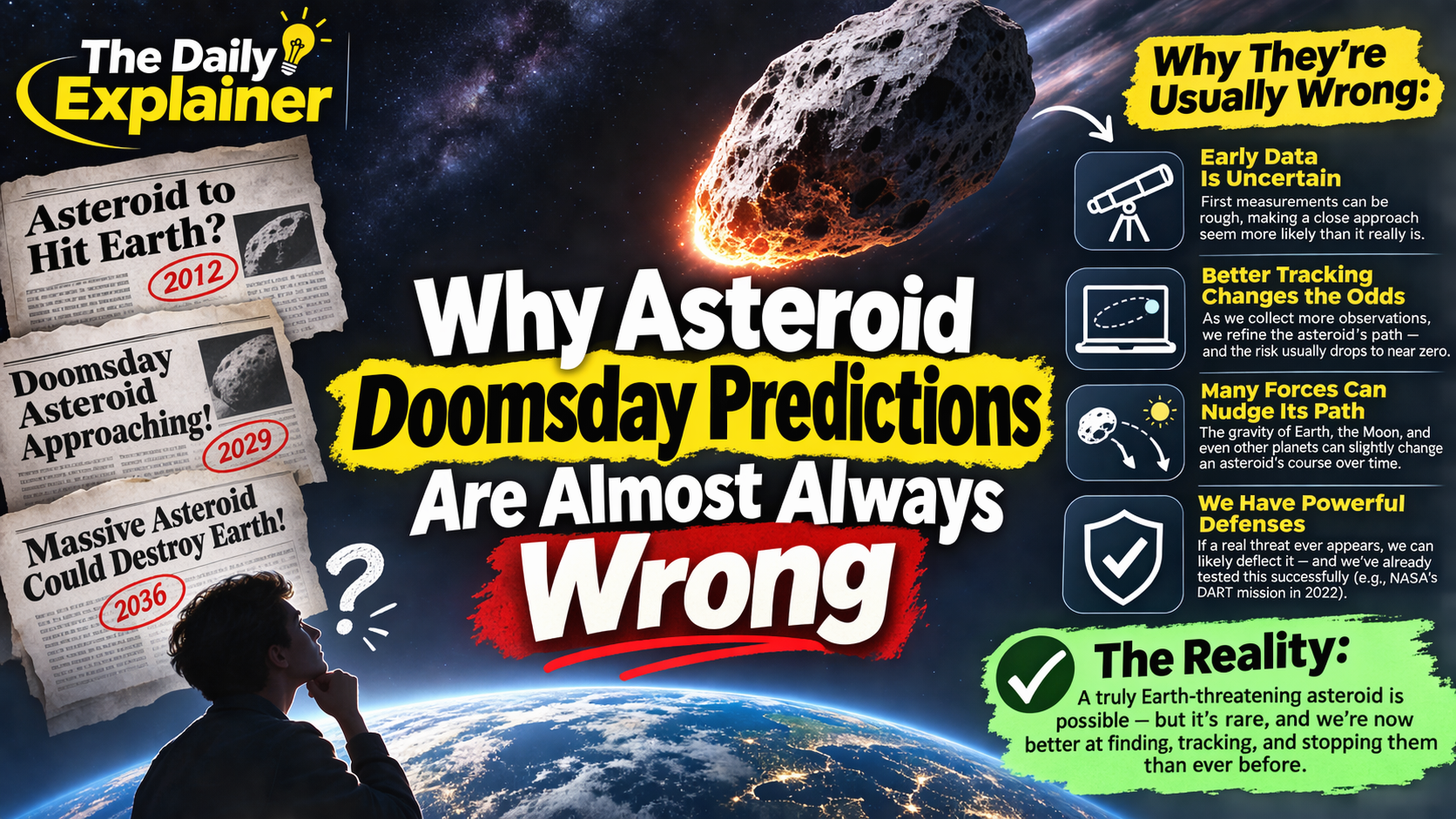
NEO Surveyor, launching in 2027, will find the dark and small asteroids that pose the greatest remaining risk.
Introduction: Why This Matters
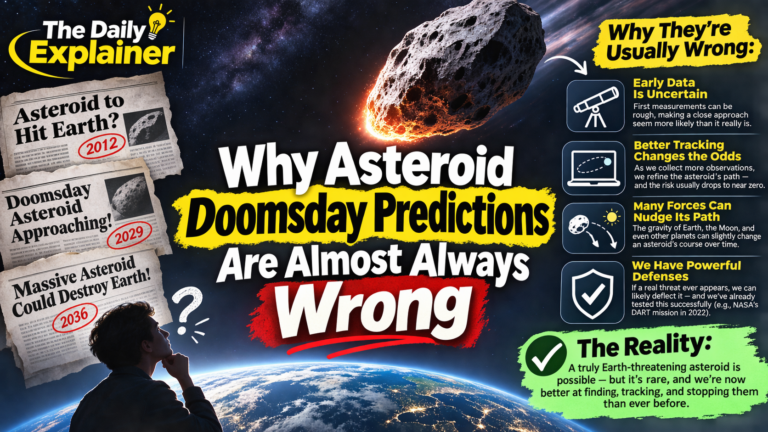
In my experience covering planetary science, there’s one cycle that repeats with depressing regularity. A grainy video appears on social media. It cites a real NASA document, flashes a terrifying percentage, and claims the world will end on a specific date. The comments fill with panic. The shares skyrocket. And then, a few days later, fact-checkers point out the obvious: the document was a training exercise, the percentage was hypothetical, and the “doomsday asteroid” doesn’t exist.
The most recent example hit TikTok in late 2026, racking up 4.2 million views before being deleted. The claim: NASA had confirmed a 96% chance that asteroid 2017 PDC would destroy life on Earth on July 21, 2027 . The source? A real NASA document—but one that described a fictional asteroid in a 2019 planetary defense exercise, not a real prediction .
Key Takeaway: Asteroid doomsday predictions fail for a simple reason: they confuse the tools of preparedness with prophecies of doom. NASA and international partners do track asteroids, do run impact scenarios, and do test deflection technologies. But the actual risk from known asteroids over the next century is vanishingly small—and the scientific process that protects us is far more interesting than the hoaxes that exploit it.
This guide explains why these predictions keep appearing, what the real science says, and how planetary defense actually works. Whether you’re a curious beginner who saw a scary video or a professional needing a refresher on the current state of asteroid tracking, this is your definitive explainer.
Background and Context
The Doomsday That Never Comes
The 2027 hoax is not new. Variations have circulated for years, resurfacing whenever the “deadline” approaches. The 2017 PDC scenario was created for the 2019 Planetary Defense Conference, where scientists and emergency managers practice responding to a fictional asteroid threat . In the exercise, the imaginary asteroid had a 96% chance of hitting Earth somewhere along a narrow band stretching from Hawaii through the continental United States to Africa .
The exercise was designed to test decision-making under uncertainty. Participants practiced everything from designing deflection missions to planning evacuations. In the simulation, the deflection attempt failed, and the final exercise day simulated an impact near New York with an energy of 5 to 20 megatons .
None of this was real. But social media videos stripped away that context, presenting the exercise document as if it were an actual NASA warning. The result was predictable: panic, confusion, and a fact-checking industry that has become depressingly familiar with the pattern.
The Real Threat Landscape
So what is the actual risk? NASA and its international partners have catalogued the vast majority of large near-Earth asteroids—those capable of causing global catastrophe. None of them pose a threat for at least the next 100 years .
The concern now is smaller objects. A 140-meter asteroid could devastate a region or a small country. A 60-meter object could destroy a city. These smaller asteroids are harder to find, which is why NASA is building the NEO Surveyor telescope, scheduled for launch in late 2027 .
The Torino Scale, which rates impact risk from 0 (no chance) to 10 (certain global catastrophe), currently shows zero for all known objects. The Palermo Scale, a more technical continuous measure, also indicates negligible risk for known threats like Apophis .
Key Takeaway: The real threat is not a known doomsday asteroid. It’s the possibility of an undiscovered smaller object catching us by surprise. That’s a solvable engineering problem—and we’re solving it.
Key Concepts Defined
Near-Earth Object (NEO): An asteroid or comet whose orbit brings it within about 45 million kilometers of Earth’s orbit. NEOs are classified as potentially hazardous if they are large enough and come close enough to pose a risk.
Torino Scale: A 0-to-10 scale for communicating asteroid impact risk to the public. Zero means no chance of impact; 10 means certain global catastrophe. All known asteroids currently rate 0 .
Palermo Scale: A continuous logarithmic scale used by scientists to compare an object’s impact risk to the background risk from random impacts. Negative values indicate below-average risk; positive values indicate elevated risk .
Kinetic Impactor: A spacecraft designed to collide with an asteroid at high speed, transferring momentum and changing the asteroid’s orbit. NASA’s DART mission demonstrated this technique in 2022.
Stellar Occultation: A technique where astronomers measure an asteroid’s position by observing it pass in front of a distant star. The brief dimming of starlight provides precise positional data .
NEO Surveyor: NASA’s next-generation infrared space telescope, designed specifically to find the hardest-to-detect asteroids—those that are dark, small, or hidden in the Sun’s glare .
Apophis: A 340-meter asteroid that will pass within 38,000 kilometers of Earth on April 13, 2029. This is the closest approach of an asteroid of this size in recorded history, but the impact probability is zero .
How It Works: Step-by-Step Breakdown
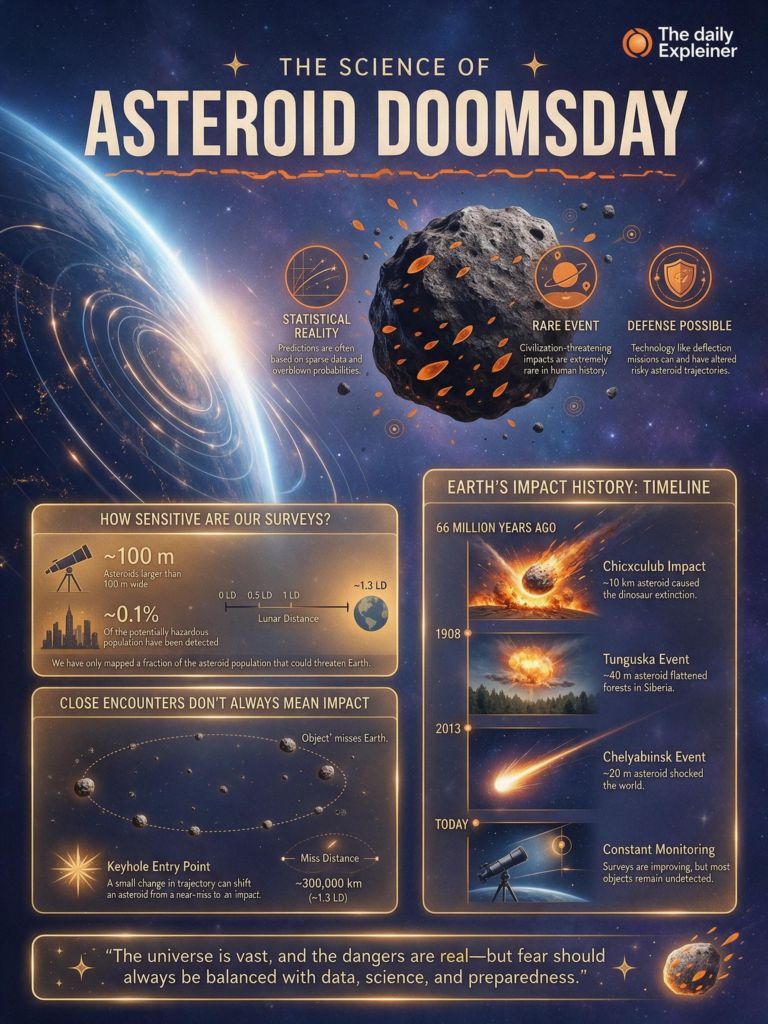
How Planetary Defense Actually Works
The real process of protecting Earth from asteroids is a careful, methodical chain of observation, analysis, and—if necessary—action.
Step 1: Discovery
Ground-based telescopes scan the sky nightly, photographing the same regions repeatedly. Software compares images to find moving objects—asteroids appear as streaks or dots that shift position against the background stars. The Catalina Sky Survey, Pan-STARRS, and ATLAS are among the most productive discovery surveys.
Step 2: Orbit Determination
Once an asteroid is discovered, follow-up observations from multiple telescopes refine its orbit. The more observations, the more precise the prediction of its future path. This is where stellar occultations become valuable—they provide extremely precise position measurements that dramatically improve orbit calculations .
Step 3: Risk Assessment
With a well-determined orbit, scientists calculate the probability of future impacts. The Torino and Palermo scales communicate this risk. For the vast majority of objects, further observations quickly reduce the probability to zero.
Step 4: Characterization
If an object warrants concern, telescopes study its size, composition, rotation, and internal structure. These properties determine how it would respond to a deflection attempt. A solid rock behaves differently from a loose “rubble pile.”
Step 5: Deflection (If Necessary)
If an impact threat is confirmed with enough lead time, a kinetic impactor mission can be launched. DART proved this works. The spacecraft struck Dimorphos in 2022, shortening its orbit around its parent asteroid by about 33 minutes—far more than the 73 seconds needed to declare success .
Step 6: Verification
After a deflection attempt, telescopes measure the asteroid’s new orbit to confirm the change. DART’s effects were so precisely measured that scientists detected a change not just in Dimorphos’s orbit around Didymos, but in the pair’s orbit around the Sun—a shift of just 0.15 seconds, but enough to matter over time .
The DART Breakthrough
The DART mission deserves special attention because it represents the transition from theory to practice. On September 26, 2022, a van-sized spacecraft struck Dimorphos, a 525-foot moonlet orbiting the larger asteroid Didymos. Neither asteroid posed any threat to Earth.
The impact was more effective than anyone predicted. The initial collision transferred momentum, but the real kick came from the debris blasted off Dimorphos’s surface. That ejecta acted like a rocket exhaust, pushing the asteroid backward with far greater force than the spacecraft alone .
New research published in 2026 revealed something even more remarkable. The recoil from Dimorphos’s orbital shift gave Didymos a gravitational “jostle,” changing both asteroids’ path around the Sun. The change was tiny—Didymos slowed by about 11.7 micrometers per second —but it marked the first time humanity measurably altered the orbit of a celestial body around the Sun .
Key Takeaway: DART demonstrated that kinetic impact deflection works. More importantly, it demonstrated that we can measure the results with extraordinary precision—a prerequisite for any real deflection mission.
Why It’s Important
The Difference Between Preparedness and Prophecy
The doomsday hoaxes exploit a real truth: NASA does take asteroid threats seriously. The agency runs exercises, funds surveys, and is building a dedicated asteroid-hunting telescope. But preparedness is not prophecy. The exercises exist precisely because the threat is not imminent—they’re rehearsal for a day that may never come.
When a real threat emerges, the process will be transparent and data-driven. The International Asteroid Warning Network (IAWN) coordinates global observations and issues notifications when an object warrants attention. The Space Mission Planning Advisory Group (SMPAG) coordinates deflection mission planning. These are real organizations doing real work, not shadowy agencies hiding the truth.
The Value of Finding Nothing
The NEO Surveyor mission, launching in 2027, will find hundreds of thousands of new asteroids. Most will be harmless. But the goal is to find the ones that aren’t—before they find us .
Every asteroid discovered and ruled out is a potential disaster prevented. The surveys have already found over 90% of the largest near-Earth asteroids. The remaining gap is in the 140-meter class—objects large enough to destroy a city but small enough to be hard to detect.
The Apophis Opportunity
The 2029 Apophis flyby is a case study in how real planetary defense works. Apophis was once considered a potential threat, but refined observations ruled out any impact for the foreseeable future. The Torino scale rating is 0, and the Palermo scale value is approximately -1.48—well below background risk .
Instead of panic, the flyby is an opportunity. NASA’s OSIRIS-APEX spacecraft will rendezvous with Apophis after the flyby to study how Earth’s gravity changed the asteroid. The European Space Agency’s RAMSES mission is also planned. And because the flyby occurs at a known time and location, it serves as a global exercise in rapid-response observation—without any actual threat .
Sustainability in the Future
The NEO Surveyor Mission
NASA’s NEO Surveyor is the most important planetary defense investment in a generation. Unlike ground-based telescopes, which struggle to find dark asteroids or those near the Sun, NEO Surveyor will observe in infrared—detecting the heat radiated by asteroids rather than the sunlight they reflect .
The telescope is scheduled for launch no earlier than September 2027. Its instrument enclosure completed environmental testing in early 2026, and the mission passed its critical design review . Once operational, it will dramatically accelerate the discovery of potentially hazardous objects, particularly the 140-meter class that poses the greatest remaining risk.
International Coordination
Planetary defense is inherently international. An asteroid doesn’t care about borders. The IAWN and SMPAG frameworks ensure that discoveries are shared, risks are communicated, and any necessary response is coordinated.
The 2029 Apophis flyby will serve as the first global joint exercise under the IAWN framework without an actual threat. Multiple missions—OSIRIS-APEX, RAMSES, and others—will observe the asteroid before, during, and after the flyby. The coordination required will build experience for a future response to a real threat .
The Long Game
Asteroid deflection requires years of lead time. DART launched in 2021 and impacted in 2022—but the asteroid it hit posed no threat. A real mission would need to launch years before the predicted impact, with enough time to design, build, and execute the deflection.
This is why discovery is so important. Finding an asteroid decades before a potential impact gives us options. Finding it months before gives us none.
Common Misconceptions
Misconception 1: “NASA predicted a 96% chance of impact in 2027.”
No. NASA ran a training exercise in 2019 using a fictional asteroid. The 96% figure was part of the scenario, not a real prediction .
Misconception 2: “Asteroid 2017 PDC is real.”
The “PDC” stands for Planetary Defense Conference. The asteroid was invented for the exercise. It does not exist.
Misconception 3: “NASA is hiding the truth about an incoming asteroid.”
NASA’s entire planetary defense strategy depends on transparency. The IAWN exists to share information globally. A real threat would be announced publicly, not hidden.
Misconception 4: “DART was a failure because it didn’t stop the asteroid.”
DART wasn’t designed to stop anything. It was a test of a technique. The mission succeeded beyond expectations, changing Dimorphos’s orbit by 33 minutes when only 73 seconds was required .
Misconception 5: “Apophis is going to hit Earth in 2029.”
No. The 2029 flyby will be close—about 38,000 kilometers, or one-tenth the Earth-Moon distance—but the impact probability is zero. Apophis will pass safely by .
Misconception 6: “We can’t do anything about an incoming asteroid.”
DART proved we can. Kinetic impact deflection works. With enough warning, we can change an asteroid’s orbit. The challenge is finding threats early enough.
Recent Developments
The 2026 DART Follow-Up Study
The March 2026 study in Science Advances revealed that DART not only changed Dimorphos’s orbit around Didymos but also altered the pair’s orbit around the Sun. The measurement, based on 22 stellar occultations observed by volunteer astronomers worldwide, detected a slowdown of about 0.15 seconds in Didymos’s orbital period .
“This study marks a notable step forward in our ability to prevent future asteroid impacts on Earth,” the research team wrote .
JWST Rules Out 2032 Lunar Impact
In May 2026, JWST observations of asteroid 2024 YR4 ruled out a potential lunar impact in December 2032. The observations extended the asteroid’s observational arc by eight months and reduced uncertainty in its 2032 encounter by a factor of more than 30. The predicted miss distance is 22,900 kilometers from the Moon’s center .
This was significant not because 2024 YR4 posed a threat to Earth—it didn’t—but because it demonstrated JWST’s capability for planetary defense follow-up. The observations reached a magnitude of V~30.5, beyond the reach of ground-based telescopes, and advanced the timeline for hazard assessment by two years .
NEO Surveyor Progress
NASA’s asteroid-hunting telescope continues to take shape. The instrument enclosure completed environmental testing at Johnson Space Center in early 2026 and returned to JPL. The mission remains on track for a launch no earlier than September 2027 .
Apophis Mission Preparations
OSIRIS-APEX, the follow-on to OSIRIS-REx, is en route to Apophis. The spacecraft completed an Earth gravity assist in September 2025 and will rendezvous with Apophis in mid-2029, shortly after the asteroid’s historic flyby .
Success Stories
Case Study: DART’s Overachievement
DART was designed to change Dimorphos’s orbit by 73 seconds—enough to prove the concept. The actual change was 33 minutes, a factor of 27 better than required .
Why was it so effective? The spacecraft’s kinetic energy was only part of the story. The impact blasted debris off Dimorphos, and that ejecta carried away momentum like a rocket exhaust. The “rocket effect” amplified the deflection significantly.
The follow-up study showed that the momentum transfer was even more complex than appreciated. The recoil from Dimorphos’s orbital shift changed the pair’s orbit around the Sun, demonstrating that binary asteroid systems can be deflected by hitting just one member .
Case Study: The 2024 YR4 Follow-Up
Asteroid 2024 YR4 was discovered in late 2024. Initial orbit calculations suggested a small but non-zero chance of a lunar impact in 2032. As observations accumulated, the probability fluctuated before settling at a level that warranted further study.
JWST’s observations in February 2026 provided the critical data. By extending the observational arc and achieving unprecedented precision, the team ruled out a lunar impact entirely. The miss distance is now known to be about 22,900 kilometers .
The case demonstrates the power of space-based follow-up. Ground-based telescopes can’t observe objects that are faint, distant, or in the Sun’s glare. JWST can. As next-generation surveys find more small asteroids, this capability will become essential.
Real-Life Examples
The 2027 Hoax Cycle
The 2027 doomsday hoax follows a predictable pattern. A real document—the 2019 exercise materials—is taken out of context. A specific date (July 21, 2027) is presented as a confirmed impact. A terrifying statistic (96%) is highlighted. The fact that the document describes a fictional scenario is buried or omitted.
The hoax resurfaces periodically because the “deadline” keeps getting closer. Each time, fact-checkers debunk it. Each time, the videos get millions of views. The cycle is frustrating but revealing: people are genuinely afraid of asteroid impacts, and that fear is easily exploited.
The Apophis Flyby: A Real Close Call
On April 13, 2029, Apophis will pass closer to Earth than any asteroid of its size in recorded history. It will be visible to the naked eye from parts of Europe and Africa. The event will be a scientific bonanza and a public spectacle.
But it will not be a disaster. The impact probability is zero. The Torino scale rating is 0 . The flyby is a reminder that “close” in astronomical terms is still very far away—38,000 kilometers is about three times the diameter of Earth.
Conclusion and Key Takeaways
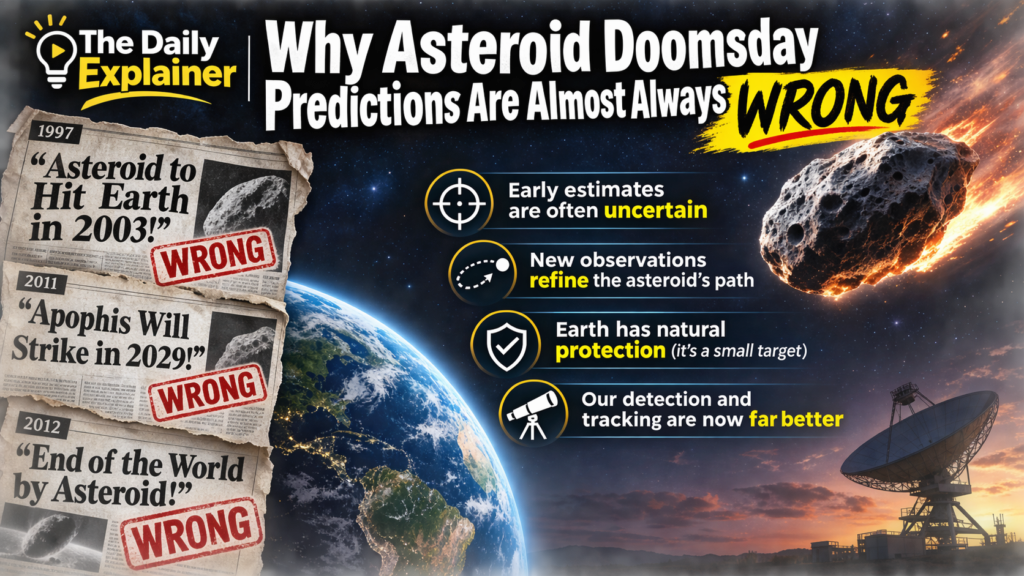
Asteroid doomsday predictions persist because they exploit a real fear and a real scientific effort. The fear is understandable—an asteroid impact is one of the few natural disasters that could end civilization. The scientific effort is genuine—NASA and its partners are actively working to find and track potentially hazardous objects.
But the predictions themselves are almost always wrong. They confuse exercises with emergencies, fictional scenarios with real threats, and preparedness with prophecy.
Key Takeaway 1: The 2027 “96% chance of impact” was from a 2019 NASA training exercise using a fictional asteroid. It was never a real prediction.
Key Takeaway 2: No known asteroid poses a significant impact risk for at least the next 100 years. The Torino scale rating for all known objects is 0.
Key Takeaway 3: DART proved that kinetic impact deflection works, changing an asteroid’s orbit by far more than required. This is the foundation of real planetary defense.
Key Takeaway 4: NASA’s NEO Surveyor, launching in 2027, will find the remaining undiscovered asteroids—particularly the 140-meter class that could destroy a city.
Key Takeaway 5: The 2029 Apophis flyby is a real close approach with zero impact risk. It will serve as a global exercise in planetary defense and a scientific opportunity.
For curious beginners, the lesson is to be skeptical of viral doomsday claims and to look for the context that’s often missing. For professionals, the takeaway is that planetary defense is maturing rapidly—from theory to practice, from ground-based surveys to space-based telescopes, from exercises to real capability.
Frequently Asked Questions (FAQ’s)
Q1: Is asteroid 2017 PDC real?
No. 2017 PDC was a fictional asteroid created for NASA’s 2019 Planetary Defense Conference exercise. The “PDC” stands for Planetary Defense Conference .
Q2: Did NASA predict a 96% chance of Earth’s destruction in 2027?
No. That figure came from a training scenario. It was not a real prediction. NASA has not issued any warning about a 2027 impact .
Q3: What was the 2019 planetary defense exercise?
It was a simulation where scientists and emergency managers practiced responding to a fictional asteroid threat. The exercise tested decision-making, communication, and deflection planning .
Q4: Is there any real asteroid threat in 2027?
No. No known asteroid poses a threat in 2027 or any other year in the next century.
Q5: What is the Torino scale?
A 0-to-10 scale for communicating asteroid impact risk. Zero means no chance; 10 means certain global catastrophe. All known asteroids currently rate 0 .
Q6: What is the Palermo scale?
A continuous logarithmic scale that compares an object’s impact risk to the background risk from random impacts. Negative values indicate below-average risk .
Q7: What did DART accomplish?
DART demonstrated that a kinetic impactor can change an asteroid’s orbit. It shortened Dimorphos’s orbit around Didymos by 33 minutes—far more than the 73 seconds required for success .
Q8: Did DART change an asteroid’s orbit around the Sun?
Yes. A 2026 study found that the DART impact changed the Didymos-Dimorphos pair’s orbit around the Sun by a tiny but measurable amount—about 0.15 seconds .
Q9: What is NEO Surveyor?
NASA’s next-generation infrared space telescope, designed to find potentially hazardous asteroids. It is scheduled to launch no earlier than September 2027 .
Q10: Why is NEO Surveyor important?
Ground-based telescopes struggle to find dark asteroids, small asteroids, and those near the Sun. NEO Surveyor’s infrared sensors will detect the heat radiated by asteroids, revealing objects that would otherwise remain hidden .
Q11: Is Apophis going to hit Earth?
No. The 2029 flyby will be close—about 38,000 kilometers—but the impact probability is zero .
Q12: When is the Apophis flyby?
April 13, 2029. Apophis will pass within about one-tenth of the Earth-Moon distance .
Q13: What is OSIRIS-APEX?
A NASA mission that will rendezvous with Apophis after the 2029 flyby to study how Earth’s gravity changed the asteroid .
Q14: What is a stellar occultation?
A technique where astronomers measure an asteroid’s position by observing it pass in front of a star. The brief dimming of starlight provides precise positional data .
Q15: How did JWST help planetary defense?
JWST observed asteroid 2024 YR4 in 2026, ruling out a potential lunar impact in 2032. The observations reached magnitude 30.5, beyond ground-based capabilities .
Q16: Can we deflect an asteroid?
Yes. DART proved that kinetic impact deflection works. With enough warning, we can change an asteroid’s orbit .
Q17: How much warning do we need?
Ideally, years to decades. Deflection requires designing, building, and launching a mission, plus time for the changed orbit to take effect. Finding threats early is essential.
Q18: What is the biggest remaining risk?
Smaller asteroids (around 140 meters) that haven’t been discovered yet. These could destroy a city or region but are hard to detect. NEO Surveyor is designed to find them.
Q19: Are there asteroids we haven’t found?
Yes. The surveys have found over 90% of the largest near-Earth asteroids, but many smaller ones remain undiscovered.
Q20: Why do doomsday hoaxes keep appearing?
They exploit fear and confusion. Real documents are taken out of context. Specific dates and scary statistics are highlighted. The cycle repeats because it generates engagement.
Q21: How can I verify asteroid claims?
Check NASA’s Planetary Defense Coordination Office, the ESA NEO Coordination Centre, or the International Asteroid Warning Network. Real threats will be announced through official channels.
Q22: What is the International Asteroid Warning Network?
A global network of organizations that coordinate asteroid observations and issue notifications about potential threats.
Q23: Should I worry about asteroid impacts?
Not on a day-to-day basis. The risk is real but extremely low. The scientific community is actively working to find and track threats. The best response is to stay informed and skeptical of viral claims.
About the Author
Sana Ullah Khan Kakar is a science writer specializing in planetary science and planetary defense. With over a decade of experience covering asteroid missions from DART to OSIRIS-APEX, he has reported on the intersection of science, risk communication, and public misinformation.
This article was fact-checked against NASA, ESA, and peer-reviewed research. All statistics reflect information available as of late 2026.
Free Resources
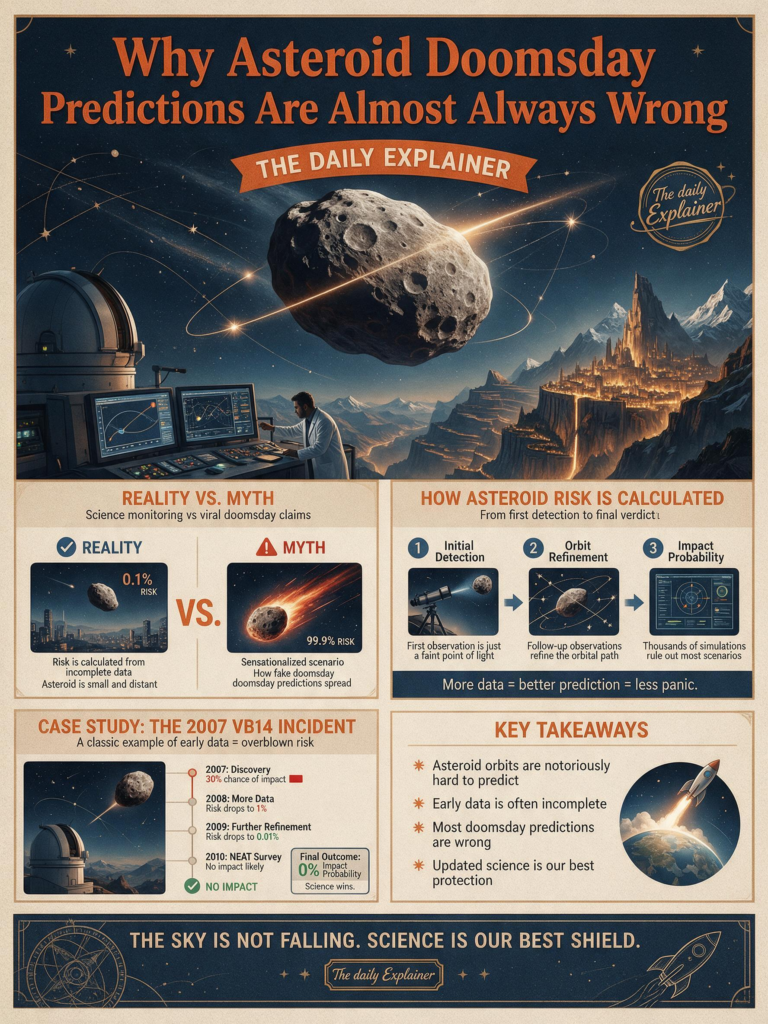
For Beginners:
- NASA Planetary Defense (nasa.gov/planetarydefense) — Official information on asteroid tracking and deflection
- ESA NEO Coordination Centre (neo.ssa.esa.int) — European asteroid risk assessments and FAQ
- “Don’t Look Up” vs. Reality (NASA) — Explainer on how planetary defense actually works
For Deeper Learning:
- DART Mission Results (Johns Hopkins APL) — Detailed mission science
- NEO Surveyor Mission Page (JPL) — Technical details and launch updates
- Torino and Palermo Scale Documentation (ESA) — How risk is communicated
For Real-Time Updates:
- NASA Asteroid Watch — Social media updates on close approaches
- IAWN Notifications — Official alerts (rare, but important)
- Minor Planet Center — Discovery and orbit data
Discussion
Why do you think asteroid doomsday hoaxes are so persistent? Is it the fear of cosmic catastrophe, the appeal of conspiracy theories, or something else?
Do you think NASA and other agencies are doing enough to communicate the real (low) risk and the real (impressive) preparedness efforts? Or does the scientific community need to do more to counter misinformation?
Share your thoughts below. For more space science explainers, visit our Explained section and browse our blog. Have questions or topic suggestions? Contact us. For breaking space news, check our Breaking News category. Review our Terms of Service and explore our Global Affairs & Politics coverage for context on international space cooperation.
For more resources on science communication and research, visit Sherakat Network’s Resources and Blog. Connect with Sherakat Network for collaboration opportunities. If you’re building an online presence, see their 2026 guide to starting an online business. Learn more about WorldClassBlogs and explore their Blog, Our Focus, and Nonprofit Hub. For SEO insights, visit Sherakat Network’s SEO category.
About The Author