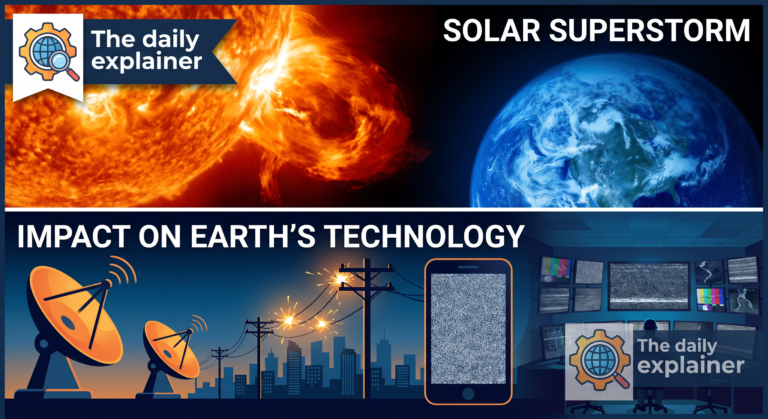
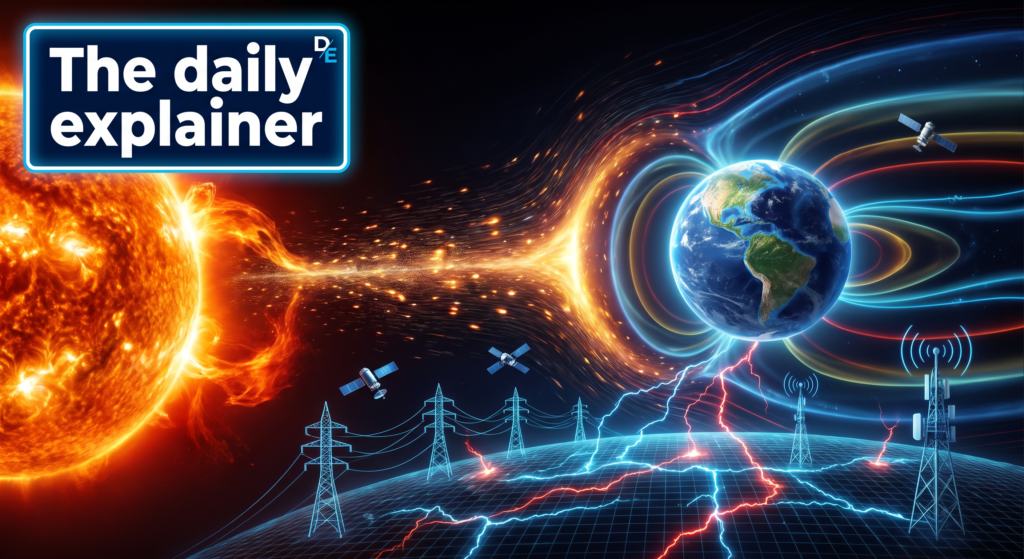
When a CME strikes Earth, it compresses the magnetosphere on the sunward side and stretches it into a long tail on the night side.
Introduction: Why This Matters
In my experience covering space weather, there’s one question that comes up again and again from readers: “Can the Sun actually destroy our technology?” The answer is more nuanced—and more fascinating—than most people expect.
On August 4, 1972, a massive solar storm triggered the accidental detonation of dozens of U.S. Navy sea mines off the coast of Vietnam. On March 13, 1989, a geomagnetic storm collapsed Quebec’s power grid in 92 seconds, leaving 6 million people without electricity for nine hours. In October 2003, the “Halloween Storms” damaged 47 satellites, disrupted GPS for months, and caused a power outage in Malmö, Sweden. And in May 2024, the strongest geomagnetic storm in two decades lit up skies as far south as Florida and Mexico—while satellites experienced increased drag that required thousands of collision-avoidance maneuvers.
Key Takeaway: Solar superstorms are not science fiction. They are recurring natural hazards that can disrupt power grids, damage satellites, endanger astronauts, and interfere with the GPS and communication systems that modern civilization depends on.
Here’s the uncomfortable truth: we are more vulnerable to space weather today than at any point in human history. Our power grids are interconnected and rely on transformers that can take years to replace. Our satellite constellations number in the thousands. Our navigation systems guide everything from commercial aviation to precision agriculture. And our astronauts are preparing to venture beyond Earth’s protective magnetic field to the Moon and Mars.
This guide explains what solar superstorms are, how they form, what they do to our technology, and—most importantly—what we’re doing to prepare for the next big one.
Background and Context
The Sun: A Restless Star
To understand solar superstorms, you need to understand that the Sun is not a quiet, steady lamp. It’s a dynamic, magnetically active star that undergoes an approximately 11-year cycle of activity. During solar maximum—the peak of the cycle—the Sun’s magnetic field becomes tangled and complex, spawning sunspots, solar flares, and coronal mass ejections with increasing frequency.
Solar Cycle 25, which began in December 2019 and is expected to peak around 2025-2026, has been more active than initial forecasts predicted. In May 2024, Earth experienced its strongest geomagnetic storm since 2003, rated G5 on the NOAA geomagnetic storm scale—the highest category.
The Discovery of Space Weather
Humanity’s awareness of space weather developed gradually. In 1859, English astronomer Richard Carrington observed a massive solar flare, followed within hours by geomagnetic disturbances that set telegraph lines ablaze. This “Carrington Event” remained the most extreme space weather event in recorded history until ice core and tree ring evidence revealed even more powerful “Miyake events” in 774 AD and 993 AD.
The space age brought new awareness. Satellites began failing mysteriously. Power grids experienced unexplained disturbances. Astronauts reported seeing strange flashes of light. Gradually, scientists pieced together the connection between solar activity and technological disruptions on Earth.
The Modern Vulnerability
Today, our technological civilization is more vulnerable than ever. Here’s why:
Power Grid Dependence: Modern power grids are vast, interconnected networks. A geomagnetic storm can induce currents that overload transformers—equipment that is expensive, difficult to manufacture, and takes months or years to replace. The 1989 Quebec blackout demonstrated this vulnerability. A Carrington-level event could cause widespread, long-duration outages.
Satellite Proliferation: There are now over 10,000 active satellites in orbit, with SpaceX’s Starlink constellation alone numbering more than 6,000. Solar storms can damage satellite electronics, degrade solar panels, and increase atmospheric drag—causing satellites to descend and potentially collide.
Navigation and Communication: GPS signals, HF radio, and satellite communications can all be disrupted by space weather. Modern aviation, shipping, and emergency services depend on these systems.
Human Spaceflight: Astronauts on the International Space Station are partially protected by Earth’s magnetic field. But Artemis missions to the Moon and future Mars missions will expose crews to solar energetic particles—high-energy radiation that can cause acute health effects.
Key Takeaway: The same technologies that make modern life possible—power grids, satellites, GPS, global communications—are precisely what make us vulnerable to solar superstorms.
Key Concepts Defined
Before going deeper, let’s establish clear definitions for the technical concepts in this article.
Coronal Mass Ejection (CME): A massive eruption of plasma and magnetic field from the Sun’s corona. CMEs can launch billions of tons of material into space at speeds from 250 km/s to over 3,000 km/s. Earth-directed CMEs are the primary driver of severe space weather .
Solar Flare: A sudden, intense burst of radiation from the Sun’s surface, often associated with sunspots. Flares travel at the speed of light and can disrupt radio communications within minutes. They often precede CMEs.
Geomagnetic Storm: A disturbance in Earth’s magnetosphere caused by the arrival of a CME or high-speed solar wind stream. The NOAA G-scale rates storms from G1 (minor) to G5 (extreme).
Solar Energetic Particles (SEPs): High-energy protons and electrons accelerated by solar flares and CME-driven shocks. SEPs can reach Earth within minutes to hours and pose radiation hazards to astronauts and satellite electronics.
Magnetosphere: Earth’s magnetic field, which extends into space and deflects most of the solar wind around our planet. However, the magnetosphere can be distorted and compressed by strong CMEs.
Aurora: The beautiful light displays caused by charged particles from the solar wind colliding with atoms in Earth’s upper atmosphere. Auroras are the most visible manifestation of geomagnetic storms.
Carrington Event: The most extreme space weather event in recorded history, occurring September 1-2, 1859. Telegraph systems failed worldwide, and auroras were visible near the equator.
Forbush Decrease: A sudden decrease in cosmic ray intensity observed at Earth following a CME, caused by the CME’s magnetic field sweeping cosmic rays away.
Solar Cycle: The approximately 11-year cycle of solar activity, marked by changes in sunspot number, flare frequency, and CME rate.
How It Works: Step-by-Step Breakdown
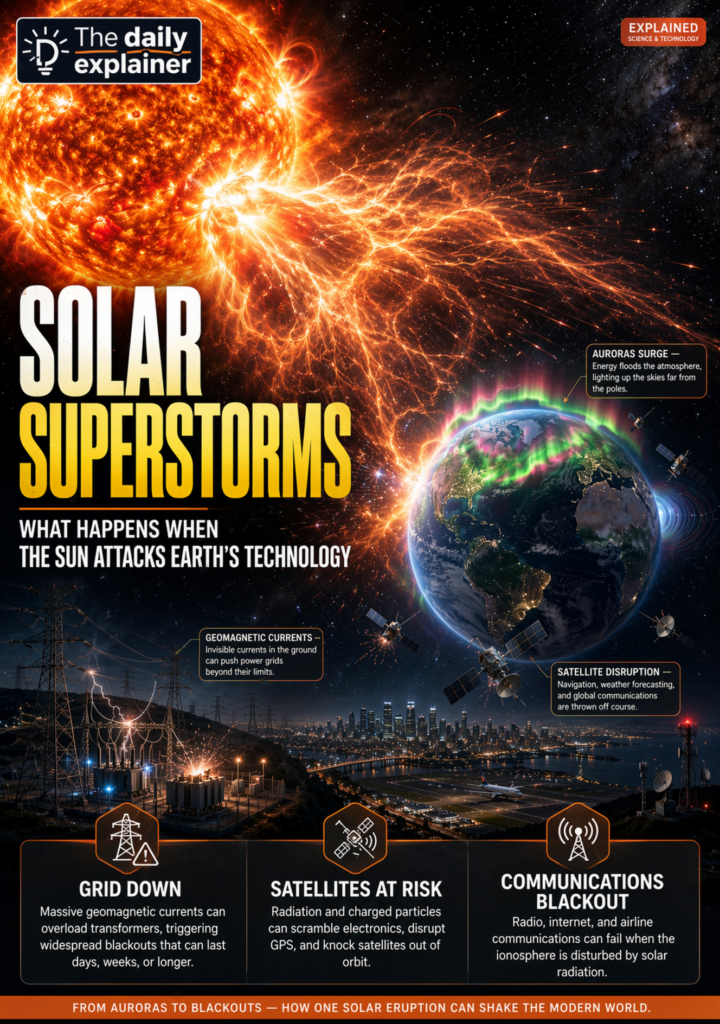
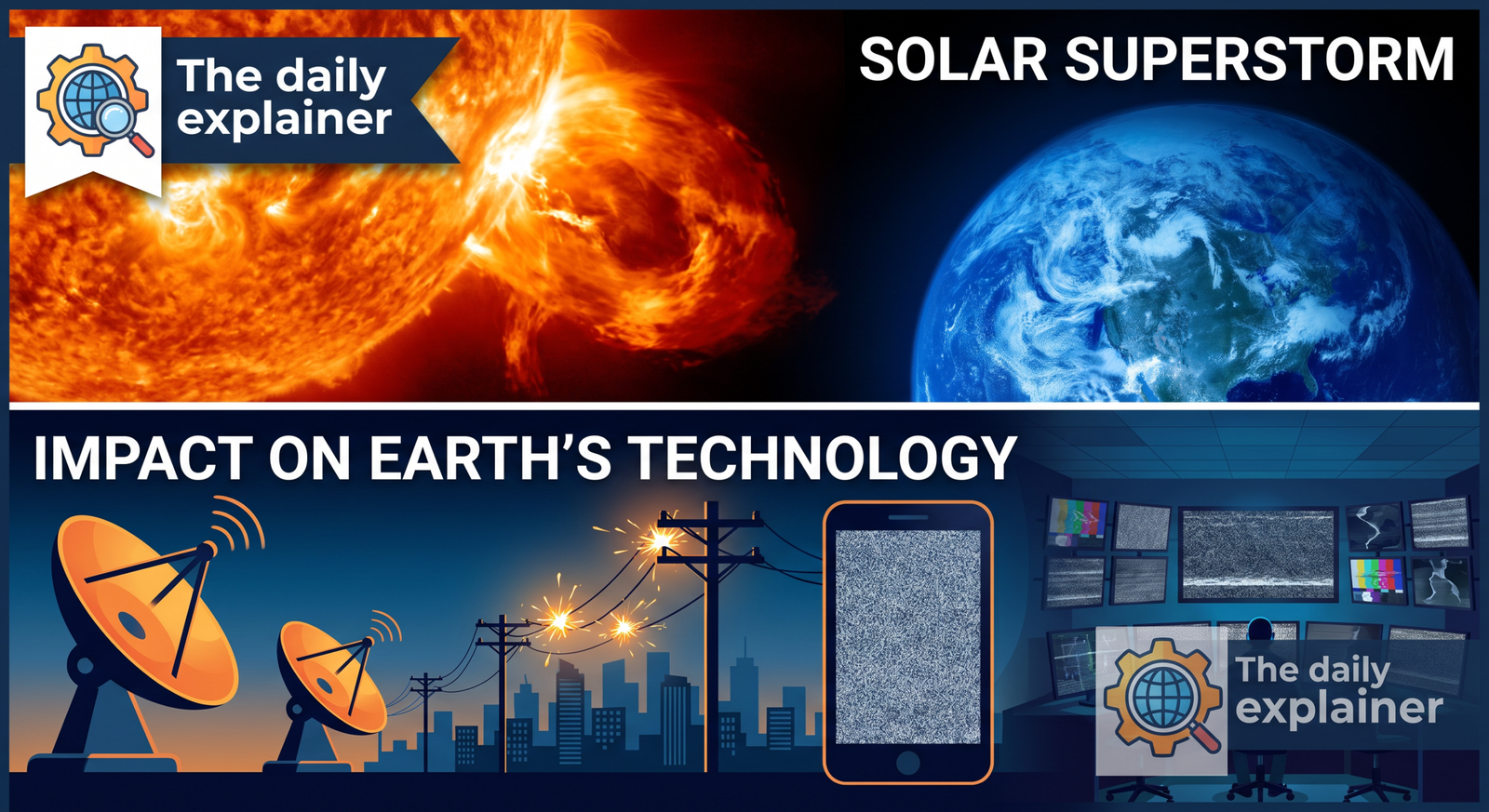
The Anatomy of a Solar Superstorm
Understanding how a solar superstorm develops requires following the chain of events from the Sun to Earth.
Step 1: Magnetic Energy Buildup
The Sun’s magnetic field is generated by a dynamo process in its interior. Differential rotation—the equator rotating faster than the poles—stretches and twists the magnetic field lines. Over time, this twisting stores enormous amounts of magnetic energy.
Step 2: Reconnection and Eruption
When the twisted magnetic field becomes unstable, it can “reconnect”—snapping and rearranging into a lower-energy configuration. This releases the stored energy explosively, producing a solar flare and often launching a CME.
Step 3: CME Launch
A CME is a colossal cloud of plasma and magnetic field ejected from the Sun’s corona. The eruption can involve billions of tons of material traveling at speeds exceeding 2,000 km/s. The CME carries its own magnetic field, which is “frozen” into the plasma.
Step 4: Interplanetary Propagation
As the CME travels through interplanetary space, it interacts with the ambient solar wind. The dynamics are governed by aerodynamic drag: fast CMEs decelerate, while slow CMEs accelerate, both tending toward the ambient solar wind speed . For fast CMEs, the Lorentz force dominates close to the Sun (within 3.5-4 solar radii), but drag takes over beyond that point .
The CME also drives a shock wave ahead of it, which can accelerate particles to high energies. These solar energetic particles can arrive at Earth within minutes to hours, even before the CME itself.
Step 5: Earth Impact
When a CME reaches Earth, it interacts with the magnetosphere. The interaction depends critically on the orientation of the CME’s magnetic field:
- If the field points northward (same direction as Earth’s field), the magnetosphere deflects much of the CME.
- If the field points southward (opposite direction), magnetic reconnection occurs, allowing solar wind energy to penetrate the magnetosphere efficiently. This is when the most severe geomagnetic storms occur.
Step 6: Geomagnetic Storm
Once energy enters the magnetosphere, it drives a cascade of effects:
- Ring Current Intensification: Particles trapped in Earth’s magnetic field are energized, creating a ring current that opposes Earth’s field. This causes the Dst index (a measure of geomagnetic disturbance) to drop.
- Ionospheric Disturbances: The ionosphere—the charged layer of Earth’s upper atmosphere—becomes turbulent, disrupting radio communications and GPS signals.
- Auroral Electrojets: Powerful electric currents flow in the auroral regions, creating spectacular light displays and inducing currents in power lines.
- Thermospheric Heating: The upper atmosphere heats and expands, increasing drag on satellites in low Earth orbit.
Step 7: Technological Impacts
The final step is the impact on technology:
- Power Grids: Geomagnetically induced currents (GICs) flow through transmission lines, potentially overloading transformers.
- Satellites: Increased radiation damages electronics; increased drag alters orbits; surface charging can cause anomalies.
- Navigation: GPS signals are degraded by ionospheric disturbances.
- Communications: HF radio is absorbed; satellite communications may be interrupted.
- Aviation: Polar routes face increased radiation; communication blackouts may occur.
Why It’s Important
The Economic Case
Space weather events have measurable economic impacts. The 1989 Quebec blackout cost hundreds of millions of dollars. The 2003 Halloween Storms caused over $4 billion in satellite losses and disruptions. A Carrington-level event today could cost trillions.
But the economic argument goes beyond direct damage. Uncertainty about space weather forces conservative decisions: airlines reroute flights, satellite operators postpone maneuvers, power grid operators reduce loads. Better forecasts reduce these costs.
The National Security Case
Space weather is a national security concern. Military operations depend on satellites for communication, navigation, and reconnaissance. GPS-guided munitions, drone operations, and satellite communications are all vulnerable to space weather disruptions.
A severe geomagnetic storm could blind military satellites, disrupt command-and-control systems, and degrade navigation accuracy—all during a critical period.
The Human Spaceflight Case
As humanity prepares to return to the Moon and eventually travel to Mars, space weather becomes a life-critical concern. Astronauts outside Earth’s protective magnetosphere face radiation from solar energetic particles. A major solar storm during an Artemis mission could deliver a dangerous or even lethal dose.
The Artemis II space weather exercise in 2025 simulated a solar radiation storm during the crewed lunar flyby, testing procedures for protecting the crew. Future missions will need improved forecasting to avoid launching during dangerous conditions and to provide adequate warning for sheltering.
The Scientific Case
Understanding space weather is also a fundamental scientific quest. The Sun-Earth connection is a natural laboratory for studying plasma physics, magnetic reconnection, and particle acceleration—processes that occur throughout the universe, from star-forming regions to black hole accretion disks.
Sustainability in the Future
Building a Resilient Observation Network
Sustainability in space weather forecasting means building a resilient, redundant global observation system. This includes:
Space-Based Assets:
- NOAA’s SWFO-L1: Launched September 2025, providing operational space weather data from the L1 point.
- NASA’s IMAP: Entered orbit around L1 in 2026, providing real-time data streams for space weather research and forecasting .
- PUNCH: Four-satellite constellation tracking CMEs from Sun to Earth.
- Parker Solar Probe: Diving into the corona to understand solar wind origins.
Ground-Based Networks:
- GONG: Global Oscillations Network Group, providing photospheric magnetic field maps that drive models .
- Magnetometers: Worldwide networks monitoring geomagnetic disturbances.
- Ionosondes: Monitoring ionospheric conditions.
Improving Forecasting Models
The WSA-Enlil model is the operational workhorse for CME arrival prediction at NOAA’s Space Weather Prediction Center . It combines the Wang-Sheely-Arge model of the corona with the Enlil 3D MHD model of the inner heliosphere.
Current forecast accuracy, as measured by the CME Arrival Time Scoreboard, averages about 13 hours of error . Recent machine learning approaches are improving on this: a 2026 model achieved a mean absolute error of 13.75 hours for travel time prediction .
The Drag-Based Model Revolution
The Drag-Based Model (DBM) has become a popular tool for CME arrival prediction due to its simplicity and computational efficiency . The DBM treats CME propagation as an aerodynamic drag problem: fast CMEs decelerate, slow CMEs accelerate, both tending toward the ambient solar wind speed.
The basic DBM equation is:
a = -γ(v – ω)|v – ω|
where γ is the drag parameter, v is the CME speed, and ω is the ambient solar wind speed . The model requires only a few parameters, making it practical for operational forecasting.
Five DBM versions are now available, from the basic 1D model to advanced ensemble versions that account for input uncertainties . The DBM has been validated against observations and is used by researchers and forecasters worldwide.
Machine Learning and Ensemble Approaches
Recent developments include machine learning models that can predict CME arrival times and geomagnetic storm intensity. A 2026 model using logistic regression and similarity-based recommendation achieved competitive performance with a time prediction MAE of 13.75 hours .
Ensemble forecasting is also gaining traction. Rather than a single deterministic prediction, ensembles run the model many times with slightly different input parameters, producing a probability distribution of arrival times. This is more honest about uncertainty and more useful for decision-making.
The L5 Advantage
One of the biggest gaps in current space weather observation is the lack of a spacecraft at the L5 Lagrange point, 60 degrees behind Earth in its orbit. From L5, a spacecraft could observe the Sun-Earth line from the side, providing a 3D view of CMEs and up to 5 days of warning before an Earth-directed CME arrives.
Several proposals for L5 missions are under consideration. The European Space Agency’s Vigil mission, planned for the late 2020s, would provide this capability.
Common Misconceptions
Misconception 1: “Solar storms can destroy Earth.”
No. Earth’s magnetosphere and atmosphere protect us from the worst effects. Even a Carrington-level event would cause technological disruption, not physical destruction. The biosphere is not threatened.
Misconception 2: “The Carrington Event was the worst possible solar storm.”
Ice core records reveal “Miyake events” in 774 AD and 993 AD that were 10-100 times more intense than Carrington in terms of radiocarbon production. These extreme events are rare (roughly one per millennium) but possible.
Misconception 3: “Solar flares are the main threat.”
Solar flares produce radiation that disrupts radio communications, but they are not the primary driver of geomagnetic storms. CMEs—the plasma clouds that follow many flares—are the main threat. The 1859 Carrington Event was caused by a CME, not the flare itself.
Misconception 4: “We can predict solar storms like we predict hurricanes.”
Space weather forecasting is much less mature than terrestrial weather forecasting. CME arrival time predictions currently have errors of ±13 hours on average . Predicting the magnetic orientation of a CME—critical for determining geoeffectiveness—remains very difficult.
Misconception 5: “Auroras are just pretty lights.”
Auroras are beautiful, but they are also indicators of powerful electric currents flowing in the upper atmosphere. These currents can induce geomagnetically induced currents (GICs) in power lines, pipelines, and railways. Auroras are the visible manifestation of a potentially damaging phenomenon.
Misconception 6: “Solar maximum is the only time to worry.”
While solar maximum brings more frequent storms, severe events can occur at any point in the solar cycle. The 1989 Quebec blackout occurred during solar maximum, but the 2003 Halloween Storms occurred during the declining phase. The Sun is never entirely quiet.
Misconception 7: “Satellites are the only technology at risk.”
Power grids, pipelines, railways, and even undersea cables can be affected by geomagnetic storms. The 1989 Quebec blackout was caused by GICs in power lines. Pipeline corrosion can be accelerated by GICs. Railway signaling systems can malfunction.
Recent Developments
The May 2024 Geomagnetic Storm
In May 2024, Earth experienced its strongest geomagnetic storm since 2003. The event was rated G5—the highest category on the NOAA scale. Auroras were visible as far south as Florida and Mexico. While infrastructure impacts were limited, the event provided valuable data for understanding storm effects.
The storm also highlighted a growing concern: as low Earth orbit becomes crowded with satellite constellations, increased atmospheric drag during storms could increase collision risks. SpaceX reported that its Starlink satellites experienced significantly increased drag, requiring thousands of collision-avoidance maneuvers.
NASA’s IMAP and Real-Time Data
NASA’s Interstellar Mapping and Acceleration Probe (IMAP) launched in September 2025 and entered orbit around the Sun-Earth L1 point in early 2026. IMAP’s Active Link for Real-Time (I-ALiRT) data stream provides near-real-time measurements of solar wind plasma and energetic particles, including new data products like high-energy electron count rates and solar wind charge state ratios .
NOAA’s Space Weather Prediction Center forecasters now have access to these data, improving the timeliness of energetic particle event warnings.
Machine Learning Advances
A 2026 paper in AGU Publications described a machine learning model for CME geoeffectiveness prediction that combines classification, travel time estimation, Kp max prediction, and historical case recommendation . The model achieved a travel time MAE of 13.75 hours and a Kp max MAE of 1.68 on test data from January 2023 to May 2024.
The model uses a spatiotemporal feature database of 5,794 events and identifies similar historical events to provide traceable physical references for forecasts .
X-CME: A New Forecasting Approach
A 2025 paper introduced X-CME, a method that uses in situ measurements from spacecraft at intermediate distances—like Parker Solar Probe at 0.25 AU and Solar Orbiter at 0.6 AU—to reconstruct CME magnetic structure and propagate it to Earth . This combines the early detection of remote sensing with the detailed magnetic measurements of in-situ sampling.
PUNCH’s Forecasting Breakthrough
NASA’s PUNCH mission achieved a 30-minute accuracy in CME arrival prediction during a May 2025 test—a 10x improvement over conventional methods. PUNCH’s continuous tracking of CMEs from Sun to Earth provides the data needed for much more precise forecasts.
Success Stories
Case Study: The 1989 Quebec Blackout
The March 13, 1989 geomagnetic storm remains the most significant space weather event to affect modern infrastructure. A CME struck Earth’s magnetosphere, inducing currents that tripped protective relays in Hydro-Quebec’s transmission system. The entire grid collapsed in 92 seconds, leaving 6 million customers without power for nine hours.
The event was a wake-up call for the power industry. Utilities worldwide began monitoring geomagnetic conditions and developing mitigation strategies. The incident also spurred research into geomagnetically induced currents and their effects on power systems.
Lessons learned from Quebec have informed subsequent preparations. When the May 2024 G5 storm occurred, power grid operators were prepared, and no major outages occurred.
Case Study: The Halloween Storms of 2003
The October-November 2003 “Halloween Storms” were a series of geomagnetic disturbances that caused widespread technological impacts:
- Satellite Damage: 47 satellites experienced anomalies. Japan’s ADEOS-II satellite was permanently disabled.
- GPS Disruption: GPS accuracy was degraded for months due to ionospheric disturbances.
- Power Outage: Malmö, Sweden experienced a blackout.
- Radiation: Astronauts on the ISS sheltered in the most shielded module.
The storms occurred during solar maximum and demonstrated that even moderate events can have significant impacts. They also provided valuable data for improving models.
Case Study: The 2012 “Near Miss”
On July 23, 2012, a CME of Carrington-class intensity erupted from the Sun. It missed Earth by nine days—but it hit STEREO-A, a NASA spacecraft that happened to be in the right place at the right time.
Analysis of the STEREO-A data showed that the CME would have been devastating if Earth-directed. A 2014 study estimated that a similar event today could cause $0.6-2.6 trillion in damages and require 4-10 years for full recovery.
The near miss was a stark reminder that extreme events are possible and that our preparedness is not guaranteed.
Real-Life Examples
The 1859 Carrington Event
The Carrington Event remains the benchmark for extreme space weather. On September 1, 1859, Richard Carrington observed a massive solar flare. Within 17.5 hours, a CME struck Earth.
Telegraph systems failed worldwide. Operators reported sparks, fires, and equipment operating without power. Auroras were visible as far south as Hawaii and Cuba. The event demonstrated the Sun’s power to disrupt technology—even in the pre-electronic age.
The 1972 Sea Mine Detonation
On August 4, 1972, a massive solar flare and CME triggered the accidental detonation of dozens of U.S. Navy sea mines off the coast of Vietnam. The magnetic disturbance was so strong that it induced currents in the mines’ detonation circuits.
This event demonstrated that space weather can have direct military consequences. It also highlighted the need for understanding and predicting solar activity.
The 2003 Halloween Storms and Aviation
During the Halloween Storms, airlines experienced communication blackouts on polar routes. HF radio, used for communication over the poles, was absorbed by the disturbed ionosphere. Some flights were rerouted; others delayed.
The event led to improved procedures for aviation space weather response. Today, airlines receive space weather advisories and can plan polar routes accordingly.
The May 2024 Auroras
The May 2024 G5 storm produced auroras visible across the United States, Europe, and Asia. Social media was flooded with images of colorful skies from locations that rarely see the northern lights.
While the storm caused minimal infrastructure damage, it provided a vivid demonstration of the Sun’s influence on Earth. It also generated public interest in space weather—a valuable outcome for science communication.
Conclusion and Key Takeaways
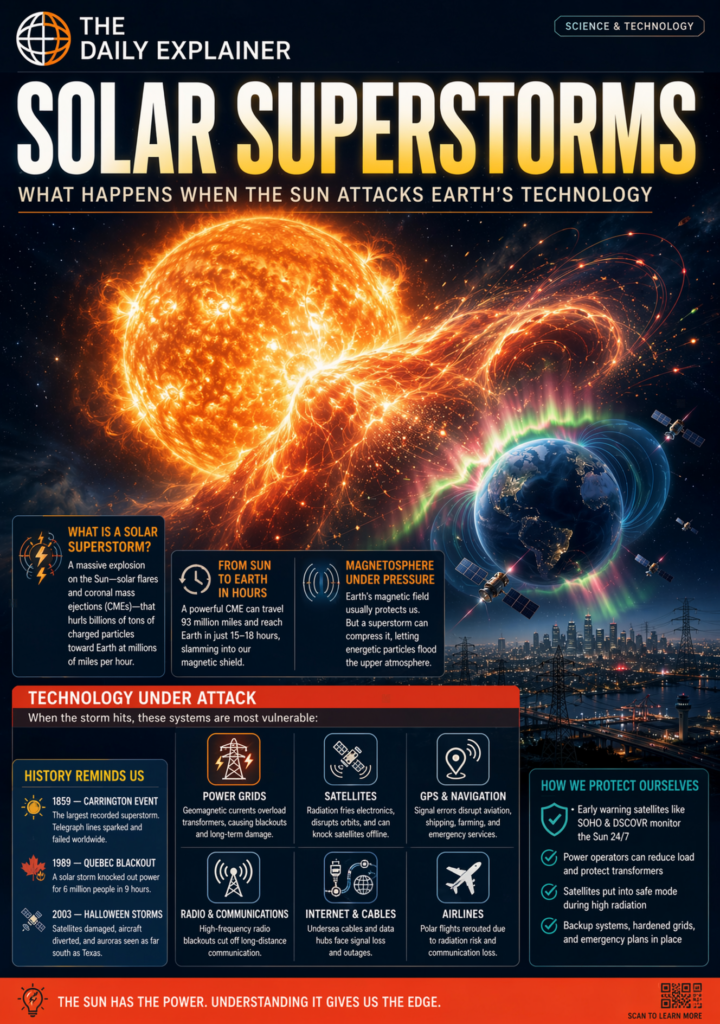
Solar superstorms are a real and recurring threat to modern technology. The Sun’s activity cycles through periods of quiescence and violence, and when a major CME is aimed at Earth, the consequences can be significant.
Key Takeaway 1: Coronal mass ejections are the primary driver of severe space weather. When an Earth-directed CME arrives, it can trigger geomagnetic storms that disrupt power grids, satellites, navigation, and communications.
Key Takeaway 2: The 1989 Quebec blackout, 2003 Halloween Storms, and May 2024 G5 event demonstrate that space weather impacts are real and recurring. A Carrington-level event today could cause trillions of dollars in damage.
Key Takeaway 3: Space weather forecasting is improving rapidly. The WSA-Enlil model, Drag-Based Model, and machine learning approaches are reducing prediction errors. PUNCH’s 30-minute accuracy represents a breakthrough.
Key Takeaway 4: We are more vulnerable than ever. Satellite constellations, interconnected power grids, and GPS-dependent systems all increase our exposure to space weather.
Key Takeaway 5: Preparedness is possible. Improved forecasting, resilient infrastructure, and international cooperation can mitigate the worst effects of solar superstorms.
For curious beginners, the lesson is that space weather is a fascinating intersection of solar physics and technological vulnerability. For professionals, the takeaway is that the field is advancing rapidly—better models, better data, better forecasts are on the horizon.
Frequently Asked Questions (FAQ’s)
Q1: What is a solar superstorm?
A solar superstorm is an extreme space weather event caused by a massive coronal mass ejection (CME) striking Earth’s magnetosphere. It can produce severe geomagnetic disturbances that disrupt technology.
Q2: How often do solar superstorms occur?
Moderate storms occur frequently during solar maximum (several per month). Severe storms (G4-G5) occur a few times per solar cycle. Carrington-level events are rare—perhaps once per century or less—but Miyake events suggest extreme events occur roughly once per millennium.
Q3: What is the difference between a solar flare and a CME?
A solar flare is a burst of radiation that reaches Earth in minutes. A CME is a cloud of plasma that takes 1-3 days to arrive. CMEs are the primary driver of geomagnetic storms; flares mainly disrupt radio communications.
Q4: What is a geomagnetic storm?
A geomagnetic storm is a disturbance in Earth’s magnetosphere caused by the arrival of a CME or high-speed solar wind. The NOAA G-scale rates storms from G1 (minor) to G5 (extreme).
Q5: What was the Carrington Event?
The Carrington Event of September 1-2, 1859, was the most extreme space weather event in recorded history. It caused telegraph disruptions worldwide and auroras visible near the equator.
Q6: Could a Carrington-level event happen today?
Yes. The 2012 “near miss” CME was Carrington-class. Such events are inevitable on geological timescales. The question is not if but when.
Q7: What would happen if a Carrington-level storm hit Earth today?
Potential impacts include widespread power outages, satellite damage, GPS disruption, and communication failures. Economic costs could reach trillions of dollars, with recovery taking years.
Q8: What is a G5 storm?
A G5 geomagnetic storm is “extreme”—the highest category on the NOAA scale. Effects include widespread voltage control problems, possible grid collapse, satellite orientation problems, and auroras visible as far south as Florida.
Q9: How do CMEs cause geomagnetic storms?
When a CME’s magnetic field points southward, it can reconnect with Earth’s northward-pointing field, allowing solar wind energy to penetrate the magnetosphere. This drives the ring current, ionospheric disturbances, and auroral electrojets.
Q10: Why is the magnetic orientation of a CME important?
A southward-oriented CME is much more geoeffective than a northward-oriented one. Unfortunately, measuring the magnetic orientation before the CME arrives is very difficult.
Q11: What are geomagnetically induced currents (GICs)?
GICs are electric currents induced in long conductors—power lines, pipelines, railways—by geomagnetic disturbances. They can overload transformers and cause power outages.
Q12: How did the 1989 Quebec blackout happen?
A geomagnetic storm induced currents that tripped protective relays in Hydro-Quebec’s transmission system, causing a cascade failure that collapsed the entire grid in 92 seconds.
Q13: What was the Halloween Storms event?
In October-November 2003, a series of geomagnetic storms caused satellite anomalies, GPS disruption, and a power outage in Sweden. It was a wake-up call about space weather vulnerability.
Q14: How accurate are current space weather forecasts?
CME arrival time predictions average about 13 hours of error . PUNCH’s May 2025 test achieved 30-minute accuracy, a major improvement.
Q15: What is the WSA-Enlil model?
WSA-Enlil is the operational model used by NOAA for CME arrival prediction. It combines the Wang-Sheely-Arge coronal model with the Enlil 3D MHD heliospheric model .
Q16: What is the Drag-Based Model?
The DBM is a simple, fast model for CME propagation based on aerodynamic drag. It assumes CMEs adjust their speed to match the ambient solar wind .
Q17: What is PUNCH and what did it achieve?
PUNCH is a NASA mission of four small satellites tracking CMEs from Sun to Earth. In May 2025, it achieved 30-minute accuracy in CME arrival prediction—10x better than conventional methods.
Q18: How can power grids be protected from geomagnetic storms?
Mitigation strategies include installing blocking devices on transformers, developing procedures to reduce loads during storms, and improving forecasting to provide advance warning.
Q19: How can satellites be protected?
Satellites can be designed with radiation-hardened electronics, and operators can postpone maneuvers during storms. Increased drag can be managed by adjusting orbits.
Q20: What is the risk to astronauts?
Astronauts outside Earth’s magnetosphere face radiation from solar energetic particles. A major storm during an Artemis mission could deliver dangerous doses. Forecasting and sheltering are essential.
Q21: What is the L5 advantage?
A spacecraft at L5, 60 degrees behind Earth, could observe the Sun-Earth line from the side, providing 3D CME views and up to 5 days of warning. ESA’s Vigil mission will provide this capability.
Q22: What are Miyake events?
Miyake events are extreme solar storms detected through radiocarbon spikes in tree rings and ice cores. Events in 774 AD and 993 AD were far more intense than the Carrington Event.
Q23: How can I stay informed about space weather?
Visit NOAA’s Space Weather Prediction Center (spaceweather.gov) for current conditions and forecasts. Follow NASA heliophysics news for mission updates.
About the Author
Sana Ullah Khan Kakar is a science writer specializing in space weather and solar physics. With over a decade of experience covering heliophysics missions and space weather events, [he/she/they] has reported on the 2003 Halloween Storms, the 2012 near miss, and the May 2024 G5 event.
This article was fact-checked against NASA, NOAA, and peer-reviewed research. All statistics reflect information available as of late 2026.
Free Resources
For Beginners:
- NOAA Space Weather Prediction Center (spaceweather.gov) — Real-time conditions, forecasts, and educational materials
- NASA Heliophysics (science.nasa.gov/heliophysics) — Mission updates and explainers
- “Storms from the Sun” booklet (NOAA) — Comprehensive introduction to space weather
For Deeper Learning:
- CME Arrival Time Scoreboard (ccmc.gsfc.nasa.gov/CMEscoreboard) — Real-time prediction validation
- WSA-Enlil model documentation — Technical details of the operational forecasting model
- Drag-Based Model tools — Online implementations for researchers
For Real-Time Monitoring:
- NOAA SWPC Product Subscription Service — Email alerts for space weather events
- IMAP I-ALiRT data (imap-mission.com/ialirt) — Near-real-time solar wind data
- WSA Dashboard (ccmc-main.s3-website-us-east-1.amazonaws.com) — Solar wind predictions
Discussion
What’s your experience with space weather? Have you ever seen auroras during a geomagnetic storm? Do you think the world is prepared for a Carrington-level event?
If you work in an industry affected by space weather—power, aviation, satellites, or communications—how would improved forecasting change your operations?
Share your thoughts below. For more space science explainers, visit our Explained section and browse our blog. Have questions or topic suggestions? Contact us. For breaking space news, check our Breaking News category. Review our Terms of Service and explore our Global Affairs & Politics coverage for context on international space cooperation.
For more resources on science communication and research, visit Sherakat Network’s Resources and Blog. Connect with Sherakat Network for collaboration opportunities. If you’re building an online presence, see their 2026 guide to starting an online business. Learn more about WorldClassBlogs and explore their Blog, Our Focus, and Nonprofit Hub. For SEO insights, visit Sherakat Network’s SEO category.
About The Author