Raptor 3 integrates sensors and controllers inside the engine, saving weight and simplifying the vehicle.
Introduction: Why This Matters
In my experience watching rocket development over the past decade, there are moments that genuinely shift what’s possible. The first Falcon 9 landing in 2015 was one. The first Starship belly-flop in 2021 was another. But the debut of Starship V3 on May 22, 2026, might be the most consequential yet.
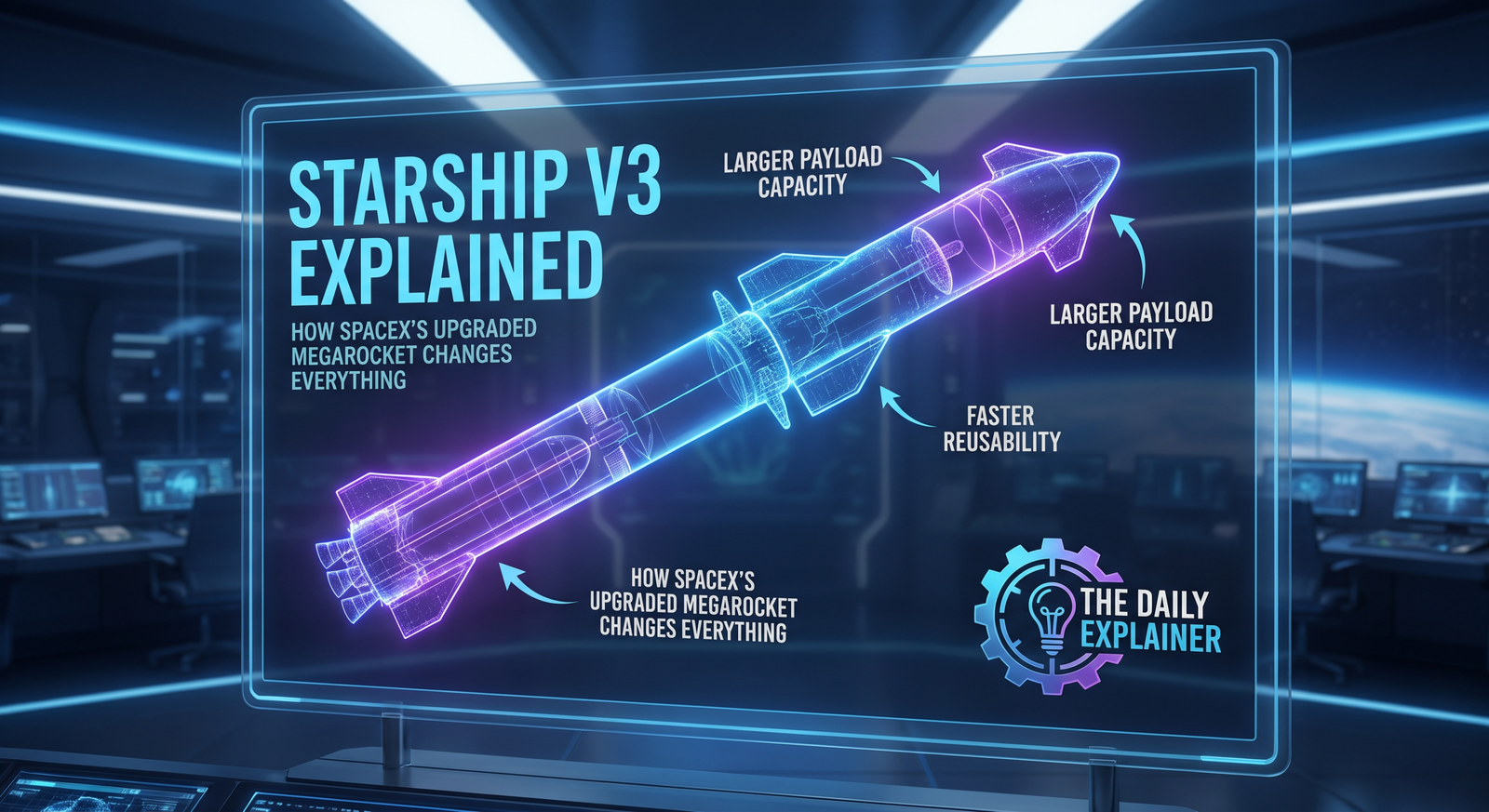
Why? Because this isn’t just a bigger rocket. It’s a fundamentally different capability. Starship V3 can carry over 100 tons to low Earth orbit—nearly three times what the previous version could manage . It’s designed for rapid reusability at a scale that no one has attempted. And critically for NASA, it’s the vehicle that will land astronauts on the Moon on the Artemis IV mission in 2028 .
Key Takeaway: Starship V3 represents a generational leap in launch capability. Its successful debut flight—despite engine anomalies—demonstrated that SpaceX is on track to deliver the heavy-lift capacity needed for lunar missions, Mars ambitions, and mega-constellation deployment.
This guide breaks down what Starship V3 actually is, how it differs from previous versions, what happened on its first flight, and why it matters for the future of spaceflight. Whether you’re a curious beginner or a professional needing a technical refresher, this is your comprehensive explainer.
Background and Context
The Starship Program: A Brief History
Starship’s development has been a decade-long saga of rapid iteration, spectacular failures, and incremental progress. SpaceX founder Elon Musk first announced the concept in 2016 as the “Interplanetary Transport System,” a vehicle designed to make humanity a multi-planet species.
The program evolved through multiple designations—BFR (Big Falcon Rocket), then Starship—and through three major hardware generations:
Starship V1 (2023-2024): The early prototypes. These flights tested basic capabilities: getting to space, surviving reentry, and attempting controlled splashdowns. Several ended in explosions, but each flight gathered critical data.
Starship V2 (2024-2025): Refined versions with improved engines and heat shields. V2 completed its final test flight in mid-October 2025, demonstrating progressively better performance .
Starship V3 (2026-present): The current generation, representing what Musk described as a “capability leap” rather than an incremental update . According to SpaceX, “nearly all components are different from V2” .
The Stakes: NASA, Artemis, and Beyond
The Starship program isn’t just about SpaceX’s Mars ambitions. NASA has contracted SpaceX to develop a Human Landing System (HLS) variant of Starship that will carry astronauts from lunar orbit to the Moon’s surface on the Artemis IV mission, scheduled for 2028 .
This makes Starship’s development directly relevant to the future of human space exploration. If Starship V3 fails to deliver, NASA’s lunar plans face significant delays.
The stakes extend to SpaceX’s business plans as well. The company was preparing for a record-breaking IPO that could value it at up to $1.75 trillion . The success of Starship V3 was seen as a critical signal to investors about the company’s technical readiness .
Key Concepts Defined
Before going deeper, let’s establish clear definitions for the technical concepts in this article.
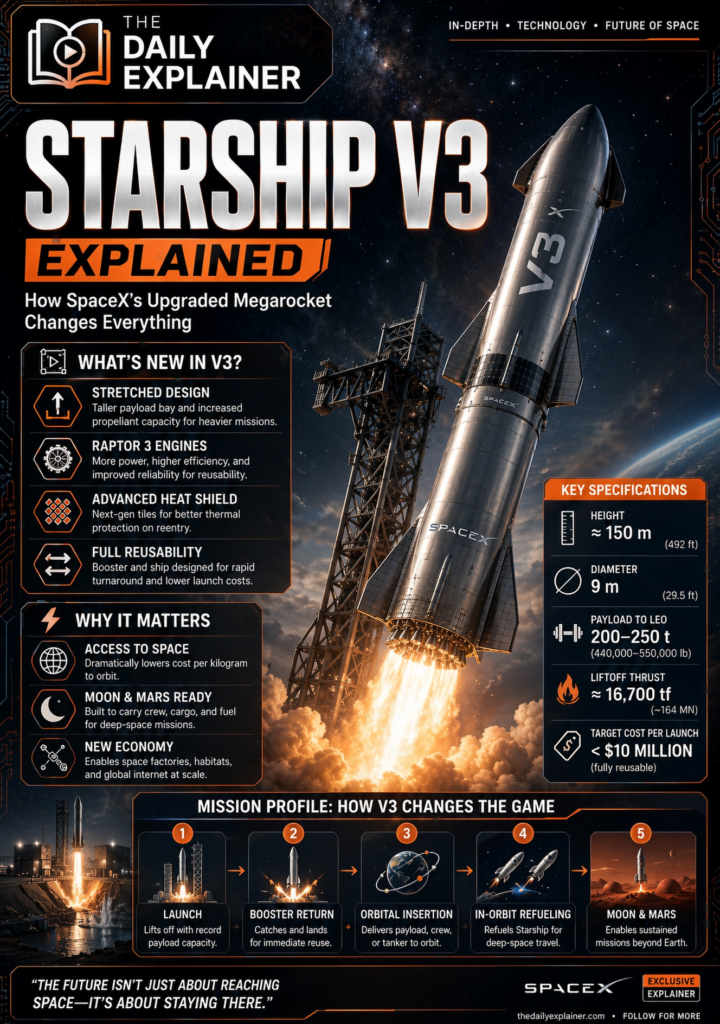
Starship: SpaceX’s fully reusable super-heavy-lift launch system. It consists of two stages: the Super Heavy booster and the Starship upper stage (sometimes called “Ship”). When fully stacked, it stands about 124 meters tall .
Super Heavy: The first-stage booster. V3 is equipped with 33 Raptor 3 engines .
Raptor 3: SpaceX’s third-generation methalox (methane-liquid oxygen) engine. It generates about 250 tons of thrust at sea level and 275 tons in vacuum, an increase over the previous generation .
Hot-Staging: A separation technique where the upper stage ignites its engines while the booster’s engines are still firing. This eliminates the need for a separate separation system and improves performance .
Grid Fins: Movable aerodynamic surfaces on the booster that control its orientation during descent. V3 uses three larger fins instead of four smaller ones .
Thermal Protection System (TPS): The heat shield covering Starship’s upper stage, consisting of thousands of ceramic tiles designed to withstand reentry temperatures .
Pez Dispenser: SpaceX’s nickname for the satellite deployment mechanism. Satellites are stacked inside and pushed out through a slot, like Pez candy .
Boostback Burn: A maneuver where the booster fires its engines after separation to reverse its trajectory and return to the launch site for recovery .
Suborbital Trajectory: A flight path that reaches space but doesn’t achieve orbital velocity. Starship V3’s test flights use suborbital trajectories with splashdowns in designated ocean zones .
How It Works: Step-by-Step Breakdown
The Launch Sequence
Understanding Starship V3’s first flight requires understanding the sequence of events.
Step 1: Liftoff
At 5:30 p.m. CT on May 22, 2026, Starship V3 lifted off from Pad 2 at Starbase, Texas. All 33 Raptor 3 engines ignited, producing approximately 18 million pounds of thrust—nearly 10% more than the previous generation .
This was the first flight from the new Pad 2, a launch facility designed for faster turnaround and higher flight rates. The pad features upgraded flame deflection and water deluge systems that aim to eliminate the need for post-launch refurbishment .
Step 2: Ascent
The rocket ascended over the Gulf of America. About one minute into flight, one Raptor engine on the outer ring of the booster shut down. Despite this, the booster continued its ascent successfully .
Step 3: Hot-Staging Separation
At approximately 2 minutes 24 seconds, Starship’s upper stage ignited its six Raptor engines while the booster was still firing—a hot-staging maneuver. The stages separated cleanly .
Step 4: Booster Return Attempt
After separation, Super Heavy performed a flip maneuver to orient itself for the boostback burn—the engine firing needed to reverse its trajectory and return to the launch site. However, the booster “was unable to light all planned engines” and performed only a partial boostback burn that ended early .
The booster ultimately experienced what SpaceX called a “hard splashdown” in the Gulf of Mexico. It was not recovered .
Step 5: Upper Stage Ascent
Meanwhile, Starship’s upper stage continued toward space. During its ascent burn, one of its six Raptor vacuum engines failed. SpaceX stated that Starship “demonstrated its engine-out capability and achieved its planned trajectory” despite the loss .
Step 6: Payload Deployment
During the coast phase, Starship successfully deployed 22 payloads: 20 Starlink simulators and two specially modified Starlink satellites equipped with cameras .
The modified satellites were designed to image Starship’s heat shield from space, providing the first real-time assessment of thermal protection performance during flight .
Step 7: Reentry
Starship re-entered Earth’s atmosphere, gathering critical data on heat shield performance and structural integrity. In the final minutes of flight, SpaceX intentionally stressed the vehicle’s rear flaps and performed a dynamic banking maneuver to simulate future return trajectories to Starbase .
Step 8: Splashdown
Starship guided itself to a pre-planned splashdown zone in the Indian Ocean. It executed a landing flip maneuver, fired its engines, and splashed down on two Raptor engines .
After splashdown, the vehicle tipped on its side and exploded—an expected outcome since SpaceX had no recovery plans for this test article .
The Key Upgrades in V3
Understanding why V3 is different requires examining its major changes.
Raptor 3 Engines
The most significant upgrade is the Raptor 3 engine. Compared to Raptor 2, it’s lighter (1,525 kg vs. 1,630 kg), more powerful (250 tons sea-level thrust vs. 230), and simpler .
The sensors and controllers are now integrated inside the engine, covered by the engine’s own thermal protection. This eliminates the need for separate engine shrouds, saving about 1 ton per engine—33 tons total on the booster .
Structural Changes
The booster’s grid fins were reduced from four to three, but each is 50% larger and significantly stronger. Their position was lowered to reduce thermal exposure during hot-staging .
The hot-staging system is now integrated into the booster itself, replacing the single-use protective interstage. This reduces parts lost per flight and simplifies refurbishment .
Payload Capacity
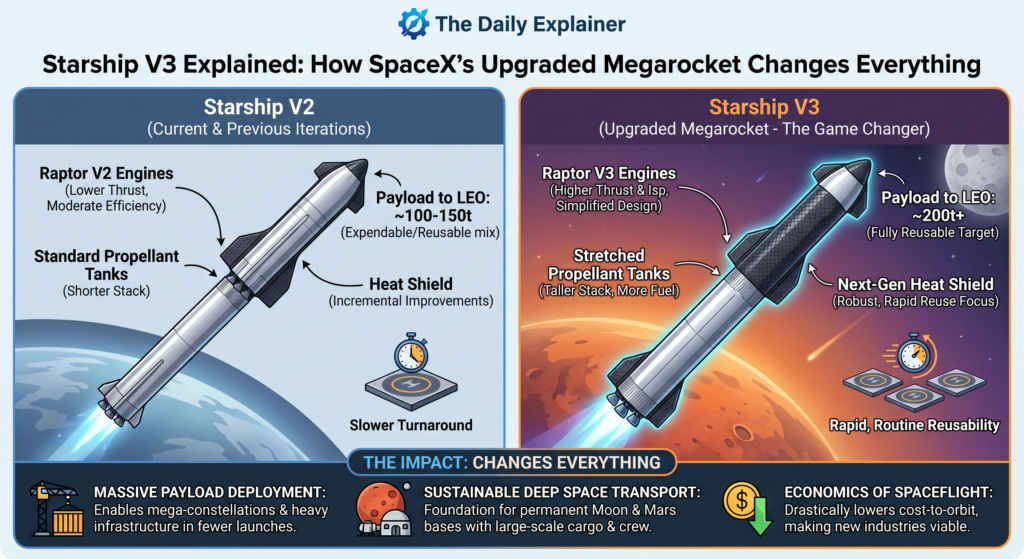
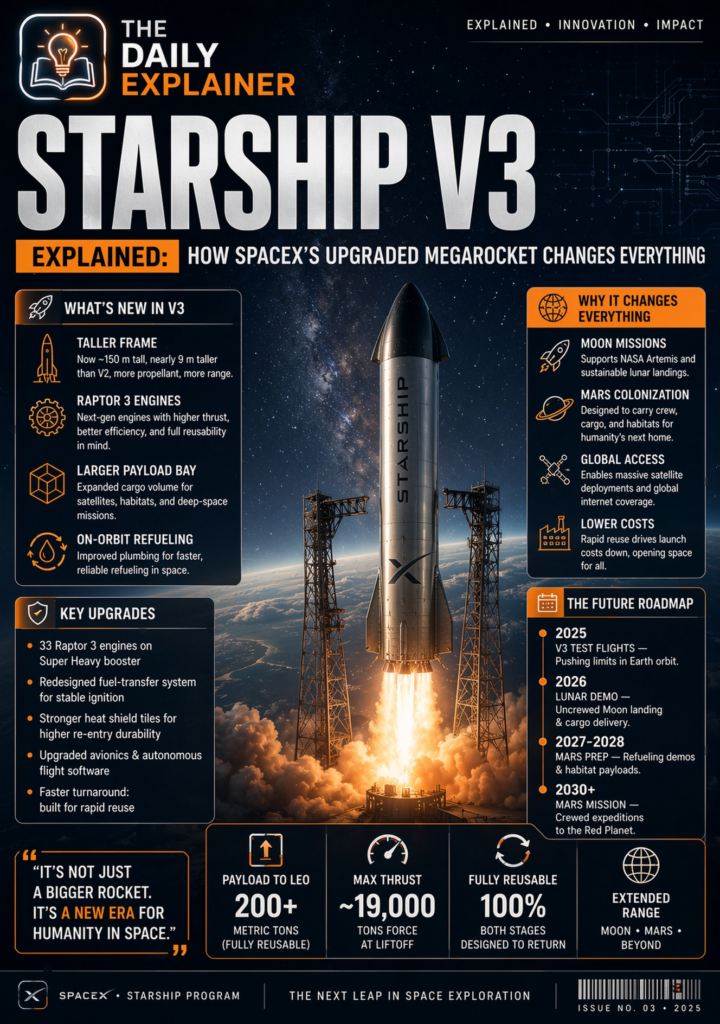
V3 can carry over 100 tons to low Earth orbit, compared to V2’s 35 tons—nearly triple the capacity . Some sources indicate it may ultimately be capable of 150-250 tons .
Avionics
V3 uses a distributed avionics system with about 60 independent units. A single module failure doesn’t affect the whole vehicle .
Docking and Refueling
V3 includes a ship-to-ship docking interface and propellant management system, laying the groundwork for orbital refueling—a critical capability for lunar and Mars missions .
Why It’s Important
Enabling NASA’s Lunar Return
The most immediate significance of Starship V3 is its role in NASA’s Artemis program. SpaceX’s HLS contract requires a Starship variant capable of landing astronauts on the Moon .
But reaching the Moon requires more than just a big rocket. Starship HLS must refuel in Earth orbit before departing for the Moon. This requires multiple Starship launches to deliver propellant to a depot, then transfer it to the lunar lander .
The orbital refueling capability is the critical path for Artemis. Starship V3’s larger payload capacity and docking system are essential steps toward demonstrating this capability.
Key Takeaway: Starship V3 is not just a bigger rocket—it’s the vehicle that will carry astronauts to the lunar surface on Artemis IV, if SpaceX can successfully demonstrate orbital refueling.
Revolutionizing Launch Economics
Starship V3’s payload capacity changes the economics of space access. With 100+ tons per launch, the cost per kilogram to orbit drops dramatically.
SpaceX customer documents suggest a Starship launch could cost around $90 million, compared to $60-75 million for a Falcon 9 with 22.8 tons capacity . Even at similar per-launch costs, Starship’s much larger capacity means far lower cost per kilogram.
This matters for:
- Starlink deployment: Larger batches per launch
- Space stations: Modules can be launched in fewer flights
- Deep space missions: More mass means more capability
- Commercial payloads: Lower costs open new markets
A Step Toward Full Reusability
SpaceX’s ultimate goal is rapid, complete reusability—launching, landing, refueling, and relaunching with minimal refurbishment. This is fundamentally different from any existing rocket, including Falcon 9, which requires significant refurbishment between flights.
V3’s design choices reflect this goal:
- Integrated hot-staging reduces parts lost
- Larger grid fins enable higher-angle descent
- Distributed avionics improve reliability
- Simplified engine design reduces maintenance
Musk has acknowledged that the thermal protection system remains the biggest challenge. “No one has ever built a reusable orbital-class thermal protection system,” he said in a 2025 podcast . V3’s flight included experiments to test tile durability and inspection methods.
Sustainability in the Future
Toward High-Frequency Launch
SpaceX is designing Starship V3 for a flight rate measured in hundreds per year, not dozens. The new Pad 2 at Starbase is a key enabler, featuring systems designed to eliminate post-launch refurbishment .
The FAA has approved raising Starbase’s annual launch limit to 25 flights, with further expansion possible as the program matures . SpaceX is also exploring additional launch sites, including potential facilities in Florida .
High-frequency launch is essential for:
- Starlink: Deploying and maintaining thousands of satellites
- Tanker flights: Delivering propellant to orbital depots for lunar missions
- Commercial demand: Meeting growing demand for launch services
Orbital Refueling: The Key Enabler
Orbital propellant transfer—moving fuel between spacecraft in space—is the technology that unlocks Starship’s full potential. Without it, Starship can’t reach the Moon or Mars with meaningful payload.
SpaceX plans to demonstrate this capability through a series of increasingly complex tests:
- Docking: Two Starships rendezvous and dock in orbit
- Propellant transfer: Fuel moves from one vehicle to another
- Long-term storage: Propellant remains usable in orbit for extended periods
- Operational refueling: Multiple tankers fill a depot for lunar missions
V3’s docking interface and propellant management systems are foundational for these steps .
Environmental Considerations
Starship uses methane and liquid oxygen as propellants—a cleaner combination than traditional kerosene-based fuels. Methane can be produced synthetically, potentially enabling carbon-neutral operations if the energy source is renewable.
The vehicle’s reusability also reduces waste compared to expendable rockets. Every component that returns and flies again is one less that must be manufactured.
However, the high launch rate envisioned by SpaceX raises questions about atmospheric impacts. The company will need to manage emissions from hundreds of annual launches, particularly as the program scales.
Common Misconceptions
Misconception 1: “Starship V3 reached orbit.”
It did not. Flight 12 used a suborbital trajectory—Starship reached space but not orbital velocity. The upper stage followed a path that brought it back to Earth for splashdown in the Indian Ocean. This is intentional for test flights; future operational missions will reach orbit .
Misconception 2: “The flight was a complete success.”
It was not perfect. Both stages experienced engine failures. The booster failed to complete its boostback burn and splashed down hard. One upper-stage engine failed. An in-space engine relight was aborted due to trajectory deviation .
However, the mission achieved most of its primary objectives: successful launch, stage separation, payload deployment, reentry, and controlled splashdown. The anomalies provided valuable data for future improvements.
Misconception 3: “Starship V3 will go to the Moon next.”
No. Before any lunar mission, SpaceX must demonstrate orbital refueling—a complex choreography requiring multiple launches, docking, and propellant transfer. The Artemis IV lunar landing is scheduled for 2028, but that timeline depends on successful refueling demonstrations .
Misconception 4: “The booster crash was a failure.”
The booster’s hard splashdown was not the planned outcome, but it wasn’t unexpected either. SpaceX had stated before the flight that it would not attempt booster recovery on this mission . The anomalies in the boostback burn provide data that will help engineers improve reliability for future recovery attempts.
Misconception 5: “Starship V3 replaces Falcon 9.”
Starship and Falcon 9 serve different markets. Falcon 9 is a workhorse for medium-lift missions with a proven track record and low cost. Starship is designed for heavy-lift and super-heavy-lift missions. Both will operate concurrently for the foreseeable future .
Misconception 6: “The heat shield worked perfectly.”
While the heat shield performed well enough for Starship to survive reentry and execute a controlled splashdown, SpaceX is still testing and iterating. The flight included deliberate experiments—removing tiles, painting reference marks—to understand failure modes and develop inspection methods .
Recent Developments
FAA Grounding (May 2026)
Following the hard splashdown of the Super Heavy booster, the FAA declared the launch a “mishap” and required SpaceX to conduct an investigation before the next flight .
The FAA stated that return to flight depends on determining “that any system, process, or procedure related to the mishap does not affect public safety” . SpaceX-led investigations with FAA oversight typically resolve quickly—a previous Falcon 9 grounding in February 2026 lasted only four days .
SpaceX IPO Preparations
Starship V3’s debut came just days after SpaceX revealed plans for a record-breaking IPO, potentially valuing the company at $1.75 trillion . The flight was closely watched by investors as a signal of technical readiness .
SpaceX has spent over $15 billion developing Starship, with approximately $3 billion spent in 2025 alone and another $1 billion in early 2026 .
Artemis Timeline
NASA’s Artemis IV mission, which will use Starship HLS for the first crewed lunar landing since Apollo 17, remains scheduled for 2028 . This timeline depends on SpaceX successfully demonstrating orbital refueling and other critical capabilities.
Success Stories
Case Study: Pad 2 Operations
The debut flight of Starship V3 was also the first launch from SpaceX’s new Pad 2 at Starbase. The pad represents a significant engineering achievement, incorporating lessons from dozens of previous launches.
Key features include:
- Upgraded flame deflector: A two-way deflector cone and top-layer system designed to eliminate base refurbishment
- Enhanced propellant systems: Larger storage capacity and more pumps for faster loading
- Improved chopstick arms: Shorter and faster-moving for potential booster catches
- Electromechanical actuators: Replacing hydraulic systems for better precision
The successful launch from Pad 2 demonstrates that SpaceX can build and operate new launch infrastructure rapidly—a critical capability for scaling to high flight rates.
Case Study: In-Flight Heat Shield Inspection
One of the most innovative aspects of Flight 12 was the use of two modified Starlink satellites to inspect Starship’s heat shield during flight .
The satellites, deployed from the “Pez Dispenser” along with 20 simulators, were equipped with cameras and sensors. They maneuvered to image Starship’s thermal protection system, transmitting data back to ground operators in real time .
This was the first attempt to assess heat shield integrity during flight rather than after landing. If successful, the technique could enable rapid inspection and turnaround between flights—essential for SpaceX’s reusability goals .
Real-Life Examples
The Pez Dispenser in Action
Starship’s satellite deployment system is unlike anything else in spaceflight. Rather than large payload bay doors, satellites are stacked vertically inside the vehicle and pushed out through a narrow rectangular slot—hence the “Pez Dispenser” nickname .
On Flight 12, this system successfully deployed 22 payloads: 20 Starlink simulators and 2 modified satellites .
The design offers significant advantages. By maintaining a small opening instead of large doors, Starship preserves structural strength provided by internal pressure. This allows a lighter vehicle and greater payload capacity .
Raptor Engine-Out Capability
Both stages experienced engine failures during Flight 12. The booster lost one of 33 Raptor engines during ascent. The upper stage lost one of six vacuum engines .
Despite these failures, both stages continued to function. The booster completed its ascent and hot-staging. The upper stage achieved its planned trajectory .
This demonstrated “engine-out capability”—the ability to tolerate engine failures without mission loss. For a vehicle with 33 engines, this redundancy is critical. It means a single engine problem doesn’t doom the mission .
Conclusion and Key Takeaways
Starship V3’s debut flight was not perfect. Both stages experienced engine anomalies. The booster’s return was uncontrolled. An in-space engine relight was aborted. But the mission achieved its primary objectives and generated invaluable data.
Key Takeaway 1: Starship V3 represents a generational leap in capability, with over 100 tons of payload capacity to low Earth orbit—nearly triple the previous version.
Key Takeaway 2: The May 22, 2026 debut flight successfully demonstrated launch, stage separation, payload deployment, reentry, and controlled splashdown, despite multiple engine anomalies.
Key Takeaway 3: Starship V3 is critical for NASA’s Artemis program. It will serve as the Human Landing System for the Artemis IV lunar landing, scheduled for 2028.
Key Takeaway 4: Orbital refueling is the key enabling technology for lunar and Mars missions. Starship V3’s docking interface and propellant systems lay the groundwork for this capability.
Key Takeaway 5: SpaceX is iterating rapidly. The FAA grounding is expected to be brief, and the company’s flight test philosophy—fly, learn, improve—continues to drive progress.
For curious beginners, Starship V3 is a window into the future of spaceflight—a future where massive payloads, rapid reuse, and lunar missions become routine. For professionals, it’s a case study in managing complexity, tolerating failures, and iterating toward a transformative capability.
Frequently Asked Questions (FAQ’s)
Q1: What is Starship V3?
Starship V3 is the third-generation version of SpaceX’s super-heavy-lift launch system. It’s the largest and most powerful rocket ever built, standing about 124 meters tall and capable of carrying over 100 tons to low Earth orbit .
Q2: How is V3 different from V2?
V3 features Raptor 3 engines, a redesigned hot-staging system, three larger grid fins (instead of four), distributed avionics, a docking interface, and significantly greater payload capacity .
Q3: When did Starship V3 first fly?
The first flight of Starship V3 occurred on May 22, 2026, from Starbase, Texas. It was the 12th overall Starship test flight .
Q4: What happened on the first flight?
The launch and ascent were successful. Hot-staging worked. Payload deployment succeeded. Reentry and splashdown were controlled. However, one booster engine failed during ascent, the booster’s boostback burn was incomplete, and one upper-stage engine failed .
Q5: Did the booster land successfully?
No. The Super Heavy booster failed to complete its boostback burn and experienced a “hard splashdown” in the Gulf of Mexico. It was not recovered .
Q6: Did Starship reach orbit?
No. Flight 12 used a suborbital trajectory. Starship reached space but not orbital velocity, then reentered and splashed down in the Indian Ocean .
Q7: What is the Pez Dispenser?
It’s SpaceX’s satellite deployment mechanism. Satellites are stacked inside Starship and pushed out through a narrow slot, like Pez candy from a dispenser .
Q8: What payloads did Starship deploy?
It deployed 20 Starlink simulators and two modified Starlink satellites equipped with cameras to inspect the heat shield .
Q9: What are Raptor 3 engines?
Raptor 3 is SpaceX’s third-generation methalox engine. It produces about 250 tons of sea-level thrust and 275 tons in vacuum, while being lighter and simpler than the previous version .
Q10: How many engines does Starship V3 have?
The Super Heavy booster has 33 Raptor 3 engines. The Starship upper stage has 6 Raptor engines (3 sea-level, 3 vacuum-optimized) .
Q11: What is hot-staging?
Hot-staging is a separation technique where the upper stage ignites its engines while the booster is still firing. It eliminates the need for a separate separation system .
Q12: Why does Starship need orbital refueling?
Starship can’t reach the Moon or Mars with meaningful payload without refueling in orbit. Orbital propellant transfer allows multiple tanker flights to fill a depot, which then fuels the lunar or Mars vehicle .
Q13: When will Starship land on the Moon?
NASA’s Artemis IV mission, scheduled for 2028, will use Starship HLS to land astronauts on the Moon. This depends on successful demonstration of orbital refueling .
Q14: Why was the FAA involved?
The FAA regulates commercial launch activities. After the booster’s hard splashdown, the FAA declared a mishap and required SpaceX to investigate before returning to flight .
Q15: How long will the grounding last?
It’s unclear, but SpaceX tends to resolve investigations quickly. A previous Falcon 9 grounding in February 2026 lasted only four days .
Q16: What is the “hard splashdown”?
A “hard splashdown” means the booster hit the water with more force than planned, likely due to the incomplete boostback burn and uncontrolled descent. It was not a controlled landing .
Q17: Did the heat shield work?
Yes, the heat shield performed well enough for Starship to survive reentry and execute a controlled splashdown. However, SpaceX is still testing and iterating on thermal protection .
Q18: What are the “Dodger Dogs”?
“Dodger Dogs” was the nickname SpaceX gave to the two modified Starlink satellites that inspected the heat shield during Flight 12 .
Q19: How much does a Starship launch cost?
Customer documents suggest approximately $90 million per launch. This is comparable to Falcon 9 but with much greater payload capacity .
Q20: What is the IPO?
SpaceX is preparing for an initial public offering that could value the company at up to $1.75 trillion. Starship’s success is seen as critical for investor confidence .
Q21: What’s next for Starship?
SpaceX will investigate the Flight 12 anomalies, make corrections, and fly again. Future flights will test orbital refueling, booster recovery, and eventually lunar missions .
Q22: Can Starship carry people?
Not yet. Starship HLS is being designed for crewed lunar missions, but no crewed flights have occurred. SpaceX must demonstrate safety and reliability before astronauts fly .
Q23: How does Starship compare to NASA’s SLS?
Starship V3 has about 2.3 times the thrust of SLS and significantly greater payload capacity. Unlike SLS, Starship is designed for full reusability. SLS is expendable .
About the Author
Sana Ullah Kakar is a space technology writer with over a decade of experience covering launch vehicles, human spaceflight, and commercial space. [He/She/They] has reported on Starship’s development since the earliest prototypes and has attended multiple launch events at Starbase. [Author] holds a degree in [field] from [institution] and has contributed to [publications]. When not writing, [author] enjoys [hobby related to space].
This article was fact-checked against SpaceX, NASA, and FAA sources. All statistics reflect information available as of late 2026.
Free Resources
For Beginners:
- SpaceX Starship page (spacex.com/vehicles/starship) — Official vehicle overview
- NASA Artemis blog — Lunar mission updates
- Everyday Astronaut Starship videos — Accessible explainers of technical concepts
For Deeper Learning:
- SpaceX Flight 12 mission page — Detailed timeline and objectives
- NSS Starship Flight 12 analysis — Independent technical review
- Raptor engine technical discussions — SpaceX updates and enthusiast analyses
For Real-Time Updates:
- SpaceX Twitter/X — Launch announcements and updates
- FAA Commercial Space Transportation — Regulatory updates
- NASASpaceflight.com — Independent coverage and forums
Discussion
What do you think was the most significant achievement of Starship V3’s first flight? Was it the payload capacity, the in-flight heat shield inspection, or simply getting the vehicle to space and back?
Do you think SpaceX can demonstrate orbital refueling in time for Artemis IV in 2028? What are the biggest technical hurdles?
Share your thoughts below. For more space science explainers, visit our Explained section and browse our blog. Have questions or topic suggestions? Contact us. For breaking space news, check our Breaking News category. Review our Terms of Service and explore our Global Affairs & Politics coverage for context on international space competition.
For more resources on science communication and research, visit Sherakat Network’s Resources and Blog. Connect with Sherakat Network for collaboration opportunities. If you’re building an online presence, see their 2026 guide to starting an online business. Learn more about WorldClassBlogs and explore their Blog, Our Focus, and Nonprofit Hub. For SEO insights, visit Sherakat Network’s SEO category.
About The Author