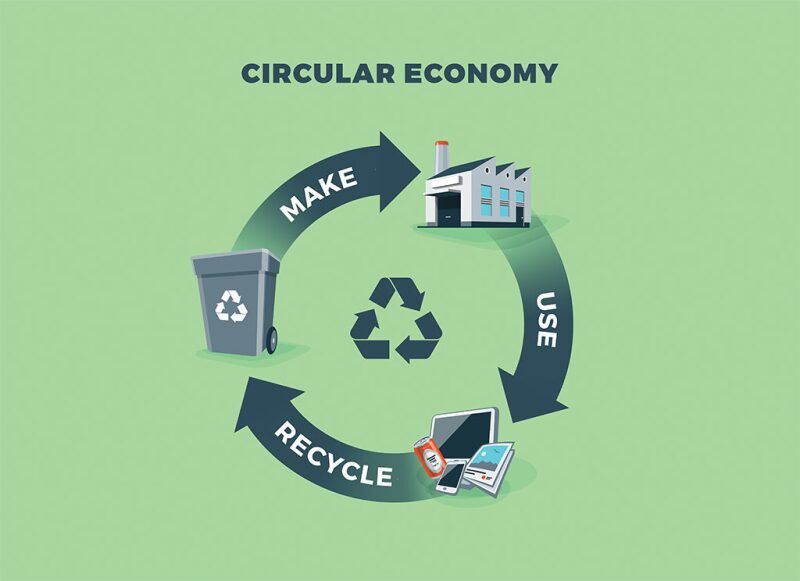
The Circular Economy System Diagram: Contrasting the take-make-waste linear model with the restorative and regenerative circular loop.
Introduction: Why the Circular Economy is the Future of Business and Our Planet
We live in a world of finite resources on a planet straining under the weight of our consumption. For centuries, the dominant economic model has been linear: we take raw materials from the earth, make products from them, and then throw those products away as waste after use. This “take-make-waste” system is not just environmentally destructive; it is economically shortsighted and increasingly risky.
But what if waste and pollution were design flaws that could be eliminated? What if we could decouple economic growth from the consumption of finite resources? This is the powerful promise of the Circular Economy—a transformative framework that is redesigning the future of business and industry.
The Circular Economy is not just a fancy term for recycling. It is a systemic shift aimed at redefining growth, focusing on positive society-wide benefits. It entails gradually decoupling economic activity from the consumption of finite resources and designing waste out of the system. For business leaders, investors, and consumers, understanding this shift is no longer a niche “green” concern; it is a critical strategic imperative for resilience, profitability, and long-term survival. This guide will demystify the circular economy, providing a clear blueprint for how it works and why it represents the single greatest economic opportunity of our time. For more foundational economic concepts, explore our Explained section.
Background & Context: The Problem with Our Linear System
The linear economy, which powered the Industrial Revolution and post-war boom, is hitting its limits. Its consequences are becoming impossible to ignore:
- Resource Depletion: The World Bank estimates that global waste will grow by 70% by 2050 if we continue on our current path. We are extracting raw materials at an unsustainable rate.
- Environmental Degradation: Resource extraction and processing account for about half of global greenhouse gas emissions. Landfills and plastic pollution are choking our ecosystems.
- Economic Vulnerability: Businesses are exposed to volatile commodity prices and supply chain disruptions, as seen during recent global crises. A linear system is inherently fragile.
The circular economy emerges as the logical, necessary response. It is inspired by living systems, where there is no concept of waste—everything is a resource for something else. This model is gaining unprecedented traction, with institutions like the European Union adopting ambitious Circular Economy Action Plans and global corporations re-engineering their operations to tap into a potential $4.5 trillion economic opportunity by 2030. For insights into optimizing traditional systems, you can read our guide on Global Supply Chain Management.
Key Concepts Defined: The Principles of a Circular System
To move beyond the linear model, the circular economy is built on three core principles, driven by design:
- Eliminate Waste and Pollution: This is a fundamental design challenge. Instead of managing waste after it’s created, the circular economy asks us to redesign products, services, and systems from the beginning to ensure waste and pollution are not created in the first place.
- Circulate Products and Materials at Their Highest Value: This principle distinguishes true circularity from simple recycling. It means keeping materials in use, either as a product, component, or raw material, for as long as possible. This occurs through two main cycles:
- The Biological Cycle: Regenerating natural systems by returning biodegradable materials to the earth.
- The Technical Cycle: Recovering and restoring products, components, and materials through strategies like reuse, repair, remanufacturing, and recycling.
- Regenerate Natural Systems: A circular economy avoids the use of non-renewable resources and preserves and enhances renewable ones, for instance, by returning valuable nutrients to the soil to support regeneration.
Underpinning these principles are key concepts like “Cradle to Cradle” design (as opposed to “Cradle to Grave”), Product-as-a-Service models, and Industrial Symbiosis, where one industry’s waste becomes another’s raw material.
How It Works: A Step-by-Step Business Implementation Framework
Adopting a circular model is a journey, not a flip-of-a-switch. Here is a strategic, step-by-step framework for a business:
Step 1: Conduct a Linear Model Audit
You cannot change what you don’t measure. Begin by mapping your entire value chain.
- Action: Identify your key resource inputs, energy sources, production processes, and end-of-life product pathways.
- Output: A clear picture of your waste hotspots, carbon footprint, and most resource-intensive activities.
Step 2: Reimagine Product Design (Circular Design)
This is where the magic happens. Design products with their entire lifecycle in mind.
- Action: Implement “Design for X” principles: Design for Durability, Repair, Disassembly, and Remanufacturing. Choose non-toxic, modular, and easily separable materials.
- Output: Products that are built to last, are easy to fix, and whose components can be easily recovered and reused.
Step 3: Develop New Business Models
Move beyond selling physical products to selling the service or performance they provide.
- Action: Explore models like:
- Product-as-a-Service (PaaS): Customers lease or pay for a service (e.g., lighting, laundry) instead of buying the physical product (e.g., light bulbs, washing machines). This gives the manufacturer an incentive to create long-lasting, efficient products. Philips’ “Lighting as a Service” is a classic example.
- Sharing Platforms: Facilitate the sharing of underutilized assets (e.g., tools, vehicles, space).
- Resource Recovery & Recycling: Create systems to take back products and harvest materials for new production cycles.
- Output: New, recurring revenue streams and a deeper, long-term customer relationship.
Step 4: Build Circular Supply Chains
Your suppliers and partners are critical. You cannot be circular alone.
- Action: Source renewable, recycled, or recyclable materials. Partner with suppliers who adhere to circular principles. Establish reverse logistics networks to get products back from customers.
- Output: A resilient, transparent, and resource-efficient supply chain.
Step 5: Leverage Digital Technology
Technology is the great enabler of the circular economy.
- Action: Use IoT sensors to track product location and condition, enabling maintenance and predicting failure. Use AI and data analytics to optimize reverse logistics and material matching platforms. Use blockchain for material traceability.
- Output: An intelligent, data-driven system that maximizes the value circulation of products and materials. For more on the role of technology, explore related content on World Class Blogs – Technology & Innovation.
Step 6: Engage and Educate Stakeholders
A circular transition requires a cultural shift.
- Action: Communicate the new model’s value to customers, employees, and investors. Train customers on how to return products. Incentivize circular behaviors.
- Output: A coalition of support that drives the adoption and success of your circular initiatives.
Why It’s Important: The Multifaceted Business Case
The circular economy is not just an environmental feel-good story; it delivers a powerful, tangible business case:
- Cost Reduction: By using recycled materials and designing out waste, businesses can significantly reduce raw material and waste disposal costs. It also mitigates risks associated with resource price volatility.
- New Revenue Streams: Circular models like PaaS, refurbishment, and resale open up entirely new profit centers. The second-hand market is booming.
- Enhanced Brand Value and Customer Loyalty: Consumers, especially younger generations, are increasingly favoring sustainable brands. A genuine commitment to circularity builds deep trust and loyalty.
- Increased Resilience: Less dependence on virgin, often geographically concentrated raw materials makes supply chains more resilient to geopolitical shocks and disruptions.
- Fosters Innovation: The constraints of circular design force companies to think creatively, leading to breakthrough products and processes.
- Regulatory Compliance: Governments worldwide are implementing stricter regulations on waste, plastics, and producer responsibility. Being circular future-proofs your business against these policies.
Common Misconceptions and Pitfalls to Avoid
As with any paradigm shift, misconceptions can hinder progress.
- Misconception: Circular Economy is just a fancy word for recycling.
Reality: Recycling is a last resort in a circular economy. The primary focus is on designing out waste, followed by maintaining, reusing, refurbishing, and remanufacturing—all of which preserve more energy and value than recycling. - Misconception: It’s only for manufacturing companies.
Reality: While manufacturing is central, the circular economy applies to all sectors, including fashion, food, technology, and even finance, which can develop new investment models to fund the transition. - Misconception: It’s too expensive and complex to implement.
Reality: While there are upfront costs, the long-term savings and new revenue opportunities often provide a strong ROI. Starting with a single product line or process is a low-risk way to begin. - Misconception: Consumers won’t pay for sustainable products.
Reality: Evidence shows a growing “green premium.” More importantly, models like Product-as-a-Service can offer customers lower upfront costs and better performance, changing the value proposition entirely. - Misconception: It’s just an environmental trend.
Reality: It is a core economic and business strategy. The World Economic Forum and major consultancies have repeatedly highlighted its multi-trillion-dollar potential. It is a fundamental shift in how value is created.
Recent Developments and Success Stories
The circular economy is moving from theory to practice at an accelerating pace.
Recent Developments:
- The Right to Repair Movement: Gaining legal traction in the EU and parts of the US, forcing manufacturers to make products repairable.
- Digital Product Passports: Proposed in the EU, these will provide detailed information on a product’s composition and reparability, empowering consumers and enabling recycling.
- Advanced Recycling Technologies: Chemical recycling is emerging to handle complex plastics that are difficult to recycle mechanically.
Success Stories:
- Interface: The carpet tile manufacturer pioneered a “Mission Zero” pledge to have no negative environmental impact by 2020. They now operate a take-back program where old tiles are recycled into new ones, a classic example of a technical cycle.
- MUD Jeans: A Dutch company that offers a “Lease A Jeans” model. Customers pay a monthly fee, and after a year, they can return the jeans to be recycled into a new pair, keep them, or swap them.
- Philips: As mentioned, their “Pay-per-Lux” model sells light as a service, maintaining ownership of all fixtures and fittings and guaranteeing performance and energy efficiency.
For more inspiring stories of business model innovation, check out the Business & Entrepreneurship section on World Class Blogs.
Conclusion & Key Takeaways
The linear “take-make-waste” economy has reached its expiration date. The transition to a circular economy is not a matter of if, but how fast. It represents the most profound restructuring of global industry since the first Industrial Revolution, offering a path to a future that is not only more sustainable but also more prosperous, resilient, and innovative.
For businesses, the call to action is clear: the future is circular.
Key Takeaways:
- It’s a System, Not a Feature: Circularity requires rethinking your entire business model, from design and sourcing to customer engagement and end-of-life.
- Start with Design: The greatest leverage point is at the product design stage. Design out waste and design for cycles.
- Business Model Innovation is Key: Explore service-based, sharing, and resale models to create new value.
- Collaboration is Non-Negotiable: Build circular ecosystems with your suppliers, customers, and even competitors to create closed-loop systems.
- The Upside is Enormous: The benefits—cost savings, revenue growth, risk mitigation, and brand strength—are too significant to ignore.
The journey is complex but essential. Just as we prioritize Mental Health and Wellbeing for a sustainable society, we must prioritize the health of our economic and planetary systems. For more insights that connect economic and personal finance strategies, this guide on Personal Finance is a valuable resource. To continue this conversation, feel free to explore our other articles in our Blog or get in touch via our Contact Us page.
Frequently Asked Questions (FAQs)
1. What is the simple definition of a circular economy?
A circular economy is an industrial system that is restorative and regenerative by design. It aims to keep products, components, and materials at their highest utility and value at all times, distinguishing between technical and biological cycles.
2. How is it different from recycling?
Recycling is a subset of the circular economy, often a last step. Circularity prioritizes strategies that prevent waste in the first place, like reuse and repair, which are more efficient and value-preserving than recycling.
3. What are the biggest challenges for companies adopting a circular model?
Key challenges include high upfront investment, redesigning complex products, establishing reverse logistics networks, changing internal company culture, and a lack of standardized regulations.
4. Can small and medium-sized enterprises (SMEs) adopt circular principles?
Absolutely. SMEs are often more agile and can innovate faster. They can start by focusing on one product, using recycled materials, offering repair services, or collaborating with other local businesses to create symbiotic waste-to-resource exchanges.
5. What role do consumers play in the circular economy?
Consumers are vital. Their choices to repair, buy second-hand, lease products, and properly dispose of items drive demand for circular business models and enable the reverse logistics that make the system work.
6. Is the circular economy only about the environment?
No. While it has massive environmental benefits, it is primarily an economic model. It creates new industries and jobs in repair, remanufacturing, and reverse logistics, and it builds more resilient and profitable businesses.
7. What is “Product-as-a-Service” (PaaS)?
PaaS is a business model where a company sells the outcome or service a product provides, rather than the physical product itself. For example, selling “cooling hours” instead of air conditioning units, which incentivizes the manufacturer to create durable, efficient units.
8. How does the circular economy relate to climate change?
It is a critical climate solution. By reducing the need for resource extraction, manufacturing, and waste disposal—all energy-intensive processes—the circular economy can significantly cut global greenhouse gas emissions.
9. Are there any global policies supporting the circular economy?
Yes. The European Union’s Circular Economy Action Plan is one of the most comprehensive. Countries like Japan and China also have national circular economy strategies. Many governments are introducing Extended Producer Responsibility (EPR) laws.
10. What is a real-world example of industrial symbiosis?
In Kalundborg, Denmark, a network of companies (a power plant, a pharmaceutical plant, a plasterboard factory, etc.) exchange steam, gas, heat, and other materials. One company’s waste by-product becomes another’s resource, reducing costs and environmental impact for all.
11. How can I, as an individual, support the circular economy?
You can support it by repairing items instead of replacing them, buying second-hand, choosing products designed to last, supporting brands with take-back programs, and properly sorting your waste for recycling.
12. Does the circular economy mean we have to stop consuming?
No. It means changing how we consume. It shifts consumption from owning short-lived, disposable goods to accessing long-lasting, service-based models and high-quality, durable products, which can lead to a higher standard of living with less material throughput. For those interested in starting a business aligned with these principles, this E-commerce Business Setup Guide offers a great starting point.
About The Author