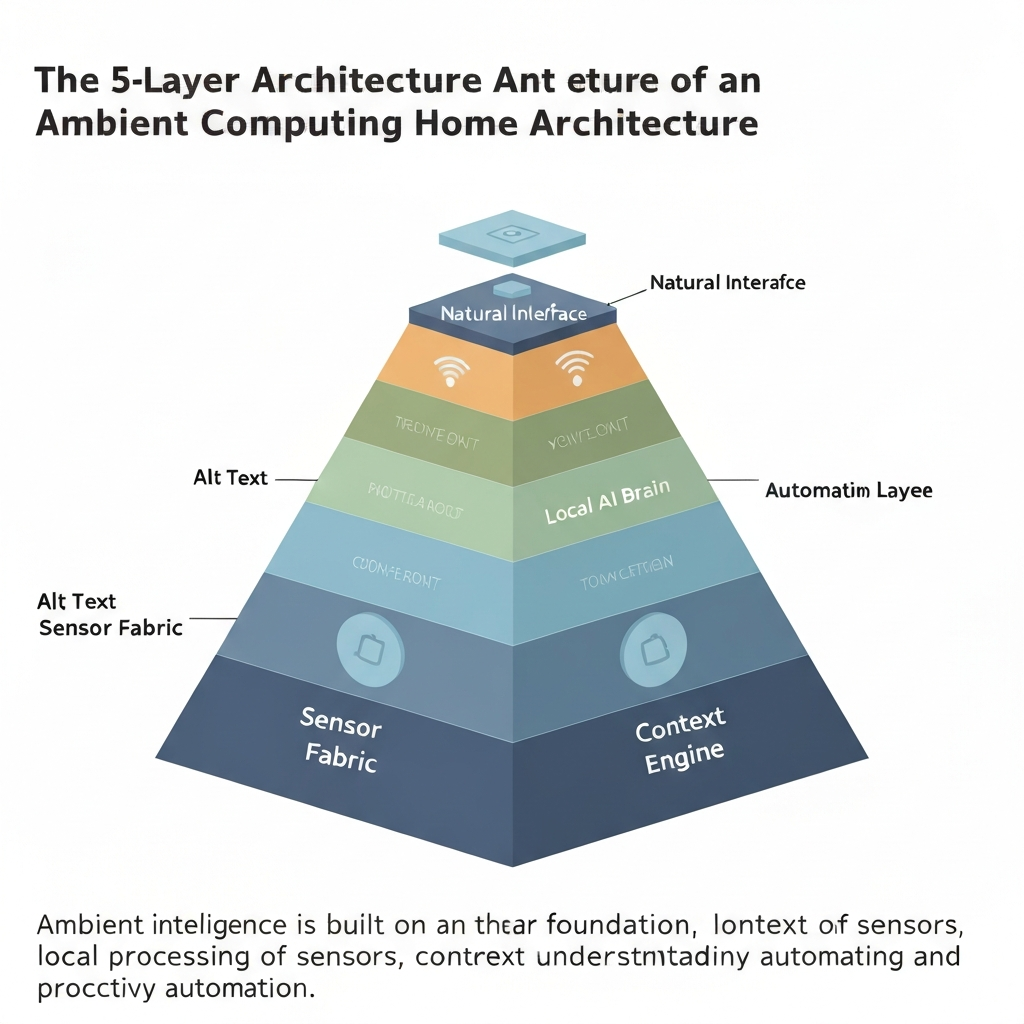
Ambient intelligence is built on a foundation of sensors, local processing, context understanding, and proactive automation.
Introduction – Why This Matters
I was sitting in a friend’s new apartment, and something felt different. It wasn’t the furniture. The lights were just… right. The temperature was perfect. When we started a movie, the shades closed automatically, and the lamp in the corner dimmed to a soft glow. My friend hadn’t touched a switch or spoken a command. “It just knows,” he said, almost sheepishly. That moment—a home that anticipates rather than reacts—captures the quiet revolution of ambient computing. For curious beginners, this might sound like a fancier smart home. For professionals, it’s the culmination of decades of IoT, AI, and human-computer interaction research. What I’ve found, after testing dozens of devices and platforms, is this: We are moving from a world of gadgets we command to an environment that understands us. In 2025, with AI processing moving to the edge (on-device) and sensors becoming cheaper and more ubiquitous, the ambient home is shifting from a luxury concept to a mainstream technological shift. This article will peel back the layers of your future living space, showing how invisible intelligence will reshape comfort, efficiency, and even our relationship with technology itself.
Background / Context: From Clap-On Lights to Context-Aware Spaces
The journey to the ambient home has had three distinct phases:
- The Remote Control Era (1980s-2000s): Everything had its own clicker. The “smart” feature was wireless control. It was about convenience, but it added complexity—a pile of remotes.
- The Connected App Era (2010-2020): The rise of Wi-Fi and smartphones gave us the “smart home.” We replaced remotes with apps. We could turn on the heater from the office or check a camera from vacation. This was revolutionary but created a new problem: app overload. You were now the central processor, manually orchestrating your devices. As one UX researcher I spoke to put it: “We traded a pile of remotes for a folder of apps. The cognitive load was still on the human.”
- The Voice Assistant Hub Era (2015-Present): Amazon Alexa and Google Assistant introduced a central, conversational interface. This was a leap forward in natural interaction. But it was still fundamentally reactive. You had to issue a command: “Hey Google, turn on the kitchen light.” The home was listening, but not understanding context.
Ambient computing represents Phase 4. It’s defined by three core principles:
- Invisibility: The technology recedes into the background. You don’t “use” it; you benefit from it.
- Context-Awareness: The system understands situations (it’s 7 AM, you’re in the bedroom, your alarm just went off, it’s a Tuesday) rather than just responding to explicit commands.
- Proactivity: It anticipates needs and acts autonomously within a band of trust, asking for confirmation only when necessary.
The catalyst for this shift is the fusion of three technologies: ubiquitous low-cost sensors, powerful on-device AI chips, and sophisticated predictive algorithms.
Key Concepts Defined
- Ambient Computing: A paradigm where computing is seamlessly integrated into the environment, becoming invisible and context-aware, requiring minimal conscious interaction from users.
- Context-Awareness: A system’s ability to gather and reason about information related to the user’s situation (location, time, activity, biometrics, preferences) to provide relevant services.
- Predictive Automation: Using historical data and real-time context to anticipate user needs and automatically trigger device actions (e.g., pre-heating the oven when you’re driving home from the grocery store).
- Spatial Computing: The digitization of physical space, allowing devices to understand their own location and the location of other objects and people in a 3D environment. Key for devices like the Apple Vision Pro or smart home robots.
- On-Device AI (Edge AI): Running artificial intelligence algorithms locally on a device (like a smart speaker or thermostat) rather than sending data to the cloud. This enables faster response, greater privacy, and works without an internet connection.
- Sensor Fusion: The process of combining data from multiple sensors (motion, temperature, sound, vision, proximity) to form a more accurate and complete understanding of the environment than any single sensor could provide.
- Mesh Network (e.g., Thread, Matter): A robust wireless networking protocol where devices relay signals for each other, creating a self-healing web of connectivity that covers the entire home more reliably than a traditional Wi-Fi router.
How It Works: The Invisible Orchestra of an Ambient Home
Let’s walk through a day in a near-future ambient home, deconstructing the technology at each step.
The Architectural Layers:
Layer 1: The Sensor Fabric – The Home’s Nervous System
This is the foundational layer of data collection. It’s not one sensor, but dozens, woven into the environment.
- Common Sensors: Motion (PIR), Temperature/Humidity, Contact (doors/windows), Ambient Light, Sound (for glass break, smoke alarm patterns), Air Quality (VOCs, CO2), Water Leak, and Presence (mmWave radar that detects subtle breathing and movement without cameras).
- Key Innovation: Low-power, ubiquitous sensing. Batteries last years. Sensors are built into light switches, outlets, and appliances. You don’t install them; they come with everything.
Layer 2: The Local AI Brain – The On-Device Intelligence
Raw sensor data is meaningless without interpretation. This happens on local “hubs.”
- The Hub Ecosystem: Instead of one central brain, think of a distributed nervous system. Your smart speaker handles voice and audio context. Your thermostat manages climate and occupancy patterns. Your router (with a dedicated AI chip) oversees network traffic and security.
- On-Device Processing Example: A mmWave presence sensor in the living room detects micro-movements of someone breathing on the couch. Its local AI model determines “person is present and resting.” It doesn’t send a video stream to the cloud; it sends a simple, private status update:
"LivingRoom: Occupied, State: Relaxing."
Layer 3: The Context Engine – The Story Builder
This software layer (which can be local or cloud-assisted) fuses data from all hubs.
- Data Fusion: It combines:
[Time: 7:30 PM] + [Location: Living Room Occupied] + [Media: TV State On] + [Previous Pattern: On weekdays at 7:30 PM, user watches news]. - Inference: It creates a context label:
"Evening Relaxation Mode." - This is the magic. The system now understands situation, not just sensor states.
Layer 4: The Automation Layer – The Proactive Butler
Armed with context, it executes personalized “policies.”
- Policy:
IF context = "Evening Relaxation Mode" AND outdoor light level < threshold THEN set lamp to 40% AND ensure hallway path lights are at 20%. - It acts. No command needed.
Layer 5: The Natural Interface Layer – For When You Need to Intervene
When you do need to give a command or make a change, the interface is adapted to your context.
- Voice: Still works, but the microphone array uses beamforming to know which room you’re in, so “turn on the light” affects your room, not the whole house.
- Spatial Displays: A glance at a smart display shows controls relevant to your current activity (recipe on the kitchen display when you’re near the stove, weather and calendar on the hallway panel as you walk by).
- Implicit Input: Picking up your gaming controller could trigger the TV to switch to the correct input and the lights to dim to gaming mode.
A Day in the Life: Step-by-Step
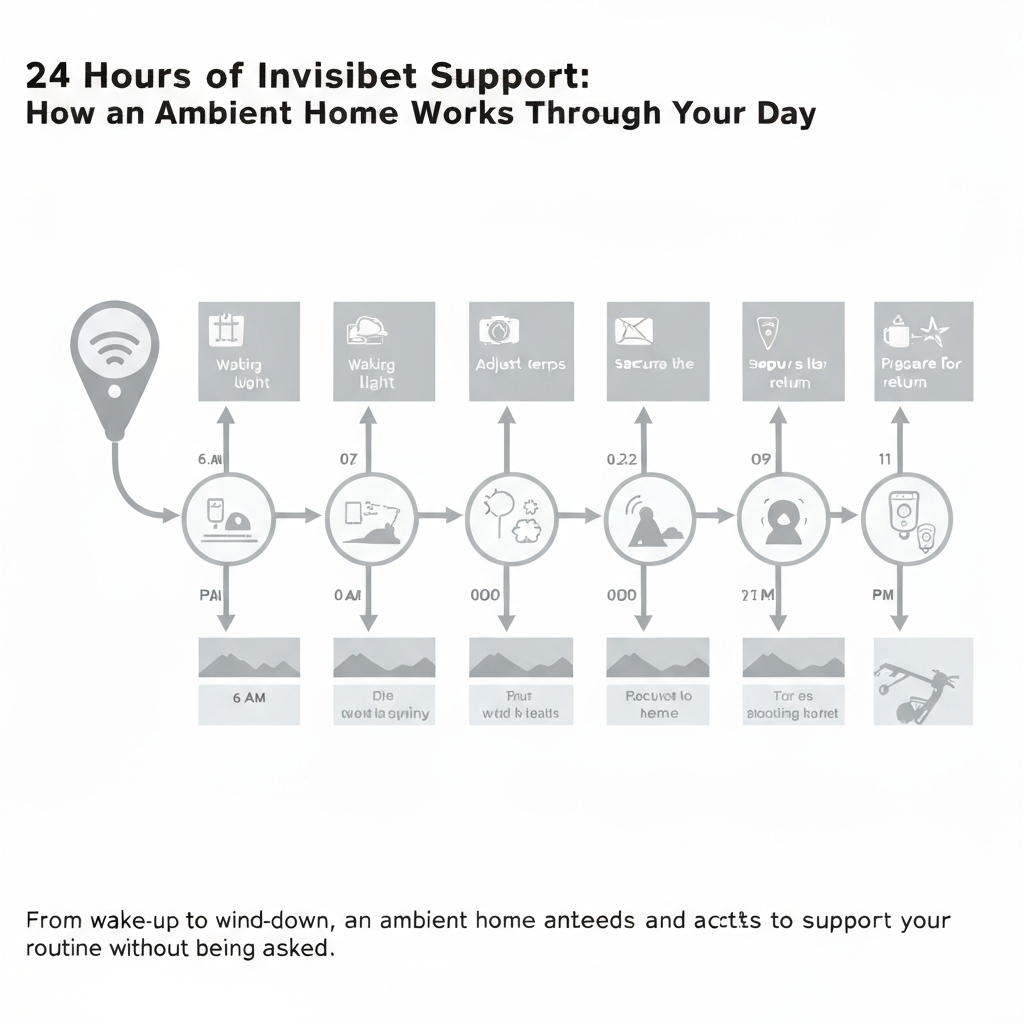
- 6:55 AM – Gentle Awakening: The sleep sensor under your mattress detects you entering a light sleep phase. Instead of a jarring alarm, it signals the smart blinds to begin opening slowly, letting in natural light, and the thermostat to raise the temperature from the night-time setting.
- 7:05 AM – Contextual Morning Routine: As you walk into the bathroom, the motion sensor updates your location. The mirror display shows your calendar, the day’s weather, and a news headline. The water heater, which had been in eco-mode, prioritizes hot water for your shower.
- 7:30 AM – Predictive Kitchen: You enter the kitchen. The presence sensor fuses with the sound of the coffee grinder (from a sound classification AI on the speaker). The context becomes “Making morning coffee.” The under-cabinet lights brighten to task-lighting levels automatically.
- 8:45 AM – Secure Departure: The contact sensor on the front door opens, then closes. The system detects no further presence via mmWave sensors after 2 minutes. It arms the security system, lowers the thermostat, and turns off all non-essential lights and outlets. It sends a simple notification:
"Home is secure." - 5:30 PM – Anticipatory Return: Your phone’s location (with your permission) indicates you’re 15 minutes from home. The context engine knows it’s a winter weekday. It triggers:
"Pre-warm living area to 21°C"and turns on the driveway light.
Why It’s Important: Beyond Convenience to Wellbeing and Efficiency
The ambient home matters for reasons far deeper than turning on lights with your voice.
- Cognitive Offloading: It reduces decision fatigue. You don’t waste mental energy on trivial adjustments. Your environment simply supports your goals. This frees up attention for work, creativity, and family. In my experience testing these systems, the most profound benefit isn’t the time saved, but the mental quiet it creates.
- Energy Efficiency at Scale: Predictive automation can drastically reduce waste. A study by the American Council for an Energy-Efficient Economy (ACEEE) in 2024 estimated that context-aware HVAC and lighting systems could reduce a typical home’s energy use by 18-22%. This isn’t just about saving money; it’s a meaningful contribution to sustainability at the grid level.
- Enhanced Safety and Security: True ambient security isn’t just cameras and alarms. It’s a water sensor that shuts off the main valve the instant a leak is detected, preventing catastrophic damage. It’s a CO2 sensor that automatically vents the house and alerts you. It’s proactive protection.
- Accessibility and Aging in Place: For the elderly or those with disabilities, an ambient home can be life-changing. Subtle sensors can detect falls, changes in routine that signal illness, or automatically adjust the environment for mobility aids, allowing for greater independence and safety. This mission-driven application aligns with the goals of many organizations in the nonprofit hub focused on social good.
- The Reclamation of Privacy (Potentially): This is counter-intuitive but crucial. A well-designed ambient system using on-device AI and differential privacy can be more private than today’s cloud-dependent models. Your data about when you shower or sleep never leaves your home. The intelligence is local. The future battle is between proprietary, cloud-sucked data models and open, local, private ones.
Sustainability in the Future: The Self-Optimizing, Adaptive Habitat
Looking toward 2030, the ambient home evolves into a true partner in living.
- The Self-Calibrating Home: Systems will continuously A/B test micro-adjustments. “Did adjusting the temperature by 0.5°C at night lead to better sleep scores (from your wearable)? If yes, adopt that policy.” The home learns not just your habits, but your biological responses.
- Integration with the Smart Grid: Your home will become an active participant in energy markets. It will know the real-time cost and carbon intensity of electricity. Your EV will charge, and your water heater will heat, during periods of abundant renewable energy, reducing cost and strain on the grid.
- Generative AI for Personalization: Instead of pre-set “scenes,” you’ll describe your desired atmosphere. “Make the living room feel like a cozy alpine cabin on a winter night.” The AI will adjust lighting hue, temperature, and even scent diffusion and soundscape to match.
- Predictive Maintenance: Vibration and current sensors in appliances will detect anomalies—a washing motor bearing wearing out, a fridge compressor struggling—and schedule service before it fails, saving money and hassle.
- Embodied AI Companions: Devices like the upcoming Figure 01 robot or advanced home robots will add a mobile, dexterous layer to the ambient home, capable of tasks that require physical manipulation—tidying up, fetching items, assisting with chores—all guided by the same context-aware system.
Common Misconceptions
- Misconception: “It’s just a fancy smart home that spies on you more.” Reality: The direction of innovation is toward local processing. Companies like Apple, Google (with its Home initiative), and the open-source Home Assistant community are pushing for “local first” execution, where routine automations and sensor data never touch the internet. Privacy is a design choice, not an inherent flaw.
- Misconception: “It will be too expensive for normal people.” Reality: The cost is plummeting. The enabling sensors and chips are commodity items. The Matter standard ensures interoperability, preventing vendor lock-in. You’ll build an ambient layer gradually, just as people built smart homes—starting with a few bulbs and plugs. The key is that devices work together seamlessly from day one.
- Misconception: “I’ll lose control of my own home.” Reality: You define the band of autonomy. Settings will have clear hierarchies: “Always ask,” “Notify me,” or “Just do it” for different actions. The goal is to handle the trivial (adjusting a light) so you can focus on the meaningful. Control is enhanced, not diminished.
- Misconception: “It’s a solution looking for a problem.” Reality: The problems are inefficiency, waste, cognitive load, and inaccessible environments for many. The ambient home directly addresses these. The value becomes visceral the first time you experience a space that genuinely adapts to you without being asked.
Recent Developments (2024-2025)
- The Matter 1.3 Standard Release: Launched in late 2024, this update added support for microwave oven controls, air quality sensors, and energy reporting. Most importantly, it solidified scenes that can be triggered automatically by other devices, a foundational block for predictive automation across brands.
- Google’s “Home” Reboot: In 2025, Google began rolling out its revamped smart home ecosystem, emphasizing local fulfillment. Routines and automations using Google devices now run entirely on your local network, with near-instant response and no cloud dependency for basic functions.
- Apple’s Home Upgrade with iOS 19: Leveraging the powerful silicon in Apple TVs and HomePods as “home hubs,” Apple introduced “Contextual Actions” in 2025. Using anonymized, on-device data from your iPhone (like leaving your car or starting a workout), your home can prepare itself without any explicit geofence setup.
- mmWave Presence Sensor Breakthrough: Companies like Aqara and Tuya released affordable, puck-sized mmWave presence sensors in 2025. Unlike PIR motion sensors, these can detect stillness (like someone reading on a couch) with high reliability, solving the “motion timeout” problem that has plagued smart lighting for years.
- Generative AI in Smart Displays: The Amazon Echo Hub 2 and Google Nest Hub Max (2025) now integrate small, on-device language models. You can ask complex, contextual questions: “Why is the living room so humid?” and it will analyze data from multiple local sensors and suggest actions, all without a web search.
Success Story: The Passive House Meets Active Intelligence
A compelling case study comes not from a tech giant, but from the building science community. In Germany, several “Passive House Plus” certified homes have been built with integrated ambient computing systems from the ground up.
- The Integration: Hundreds of sensors for temperature, humidity, CO2, and pressure are embedded in the walls and ceilings during construction. A local computer runs an open-source home operating system (like Home Assistant).
- The Outcome: The system doesn’t just control lights. It manages the Mechanical Ventilation with Heat Recovery (MVHR) system in real-time, opening and closing dampers in different rooms based on occupancy and air quality. It controls external shades to optimize solar heat gain in winter and prevent it in summer.
- The Result: These homes achieve an 80-90% reduction in heating and cooling energy compared to standard homes, while maintaining perfect air quality and comfort automatically. The residents report a profound sense of “the house breathing for them.” This proves that when ambient computing is designed as an integral part of the architecture, not an add-on, it can achieve radical sustainability and comfort goals.
Real-Life Examples
- For a Family Home:
- Morning Chaos Management: The system detects multiple people moving quickly in the hallway and kitchen between 7-8 AM. It infers “morning rush.” It automatically ensures the kitchen radio is on at a low volume, the bathroom exhaust fans run to prevent mirror fog, and the smart lock is disarmed for the school run.
- Sleep Optimization: A wearable sleep tracker (with user permission) shares sleep quality data with the home system. Over time, the system learns that a gradual temperature drop of 1°C over the hour before bedtime correlates with faster sleep onset. It begins to implement this automatically.
- For a Home Office Worker:
- Focus Mode: Your calendar shows a “Deep Work” block from 10 AM-12 PM. At 9:55, the system closes your office blinds halfway to reduce glare, sets your smart light to a cool, focus-enhancing hue, and sends a “Do Not Disturb” command to your smart doorbell and nearby Alexa devices.
- Post-Work Transition: At 5:30 PM, it detects you’ve stopped typing and are no longer in video calls. It slowly raises the blinds, shifts the light to a warm white, and starts playing low-volume ambient music to signal the end of the workday.
- For an Empty Nest/Aging Resident:
- Wellbeing Monitoring: Using only anonymous mmWave and utility sensors (no cameras), the system establishes a baseline pattern of activity—typical times for meals, bathroom visits, TV watching. If a significant deviation occurs (no kitchen motion by 10 AM, unusual restroom frequency), it can send a discreet, non-alarming check-in alert to a trusted family member’s phone.
Conclusion and Key Takeaways
The ambient computing home represents a fundamental reimagining of our relationship with technology. It’s not about more screens or louder speakers; it’s about technology that earns its place by making itself usefully invisible. The goal is an environment that feels less like a collection of gadgets and more like a responsive extension of ourselves—a place that cares for its inhabitants and resources with quiet intelligence.
The path forward requires careful navigation of privacy, interoperability, and user trust. But the potential rewards—in personal wellbeing, energy conservation, safety, and accessible living—are immense. We are building the nervous system for the next generation of living spaces.
Key Takeaways Box:
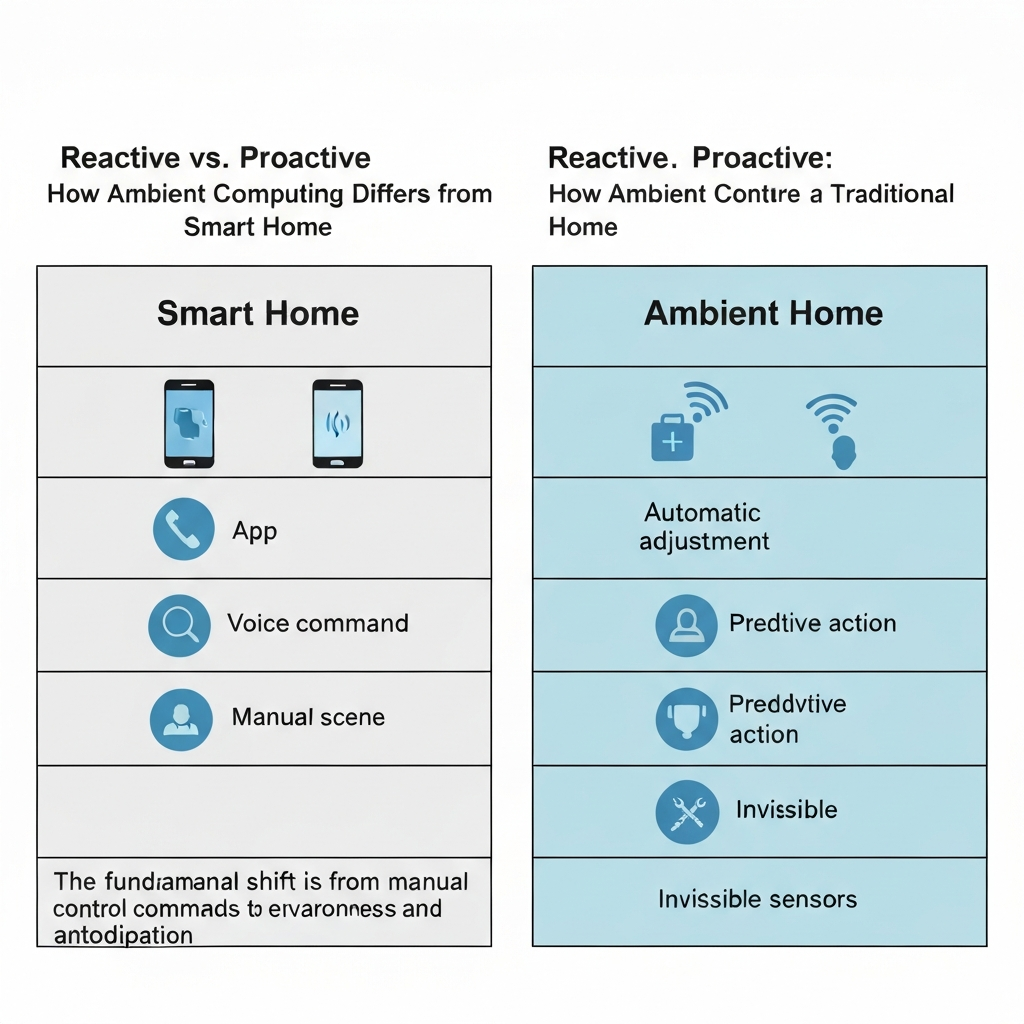
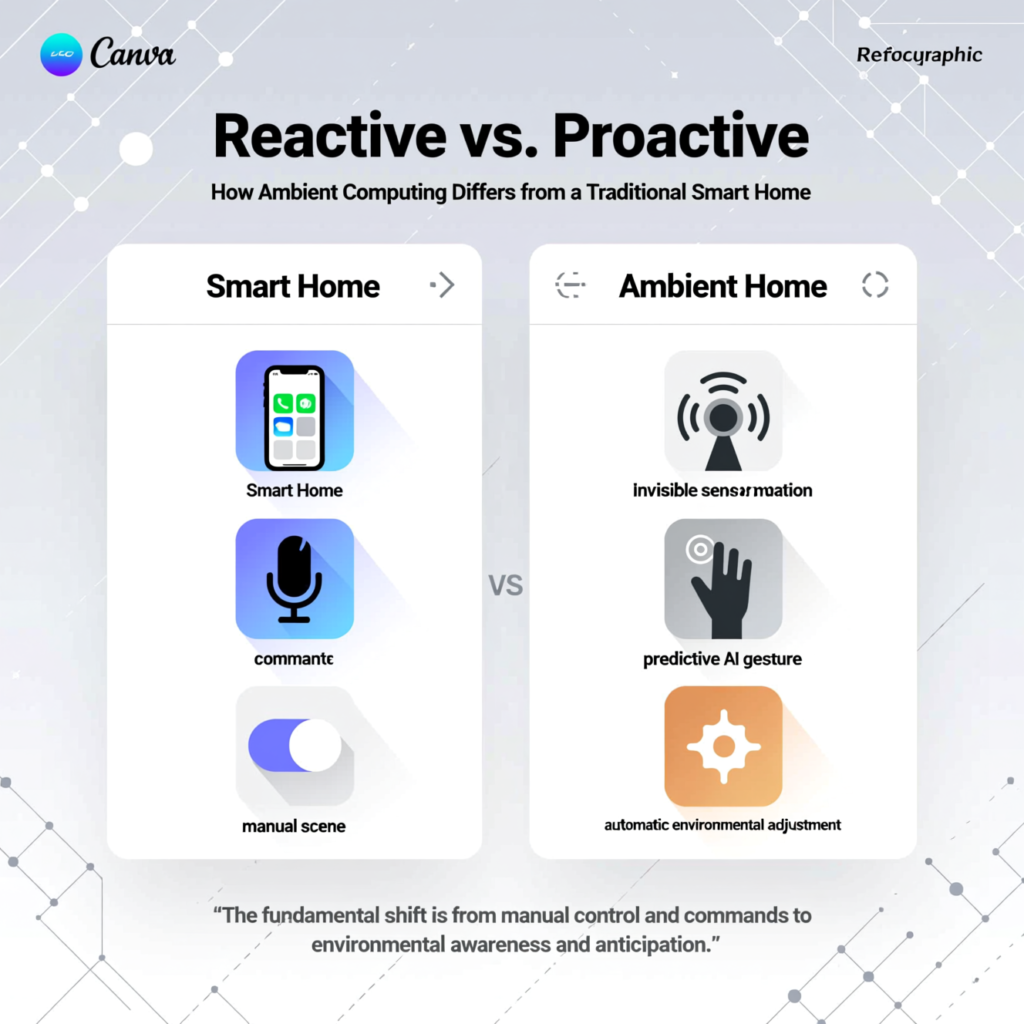
- From Reactive to Proactive: The core shift is from commanding devices (“do this”) to the system anticipating needs based on context.
- Intelligence is Moving Local: For speed, reliability, and privacy, the AI processing that powers ambient experiences is increasingly happening on devices in your home, not in a distant cloud.
- Sensors Are the New Foundation: Cheap, ubiquitous, and diverse sensors provide the raw data that makes context-awareness possible. They are the unsung heroes.
- Interoperability is Non-Negotiable: Standards like Matter are critical. An ambient home must work with devices from any brand to avoid walled gardens.
- The Value is in the System, Not the Device: The magic isn’t in any single gadget, but in the seamless, intelligent orchestration of all of them.
For more insights into how technology is reshaping our daily lives and the world at large, explore the latest analysis in our blog.
Frequently Asked Questions (FAQs)
1. Is an ambient home the same as a smart home?
It’s the evolution. A smart home is a collection of internet-connected devices you control. An ambient home is an intelligent system where those devices work together autonomously based on an understanding of context and your habits. All ambient homes are smart, but not all smart homes are ambient.
2. How much does it cost to set up an ambient computing system?
You can start small for a few hundred dollars. A Matter-compatible smart speaker as a hub ($100), a few mmWave presence sensors ($40 each), and some smart bulbs or plugs ($15-30 each) can create a meaningful, context-aware setup for a key room like the living room or bedroom. It scales from there.
3. Won’t this drain my Wi-Fi network?
Not if designed well. Ambient systems rely heavily on low-power, low-bandwidth protocols like Thread, Zigbee, and Bluetooth Mesh for sensor communication. These create their own mesh network separate from your main Wi-Fi, which is used only for higher-bandwidth devices (like cameras or streaming) and internet access.
4. What happens when the internet goes down?
A properly built ambient system with local execution hubs (like a HomePod, Apple TV, or dedicated hub running Home Assistant) will continue to function. Your automations, sensor triggers, and local voice commands will work. You’ll only lose remote access and cloud-dependent features (like asking general knowledge questions).
5. Is it secure? Could someone hack my home?
Security is a layered effort. Matter includes mandatory encryption. Local processing reduces the attack surface by keeping data off the internet. Best practices include: using strong, unique passwords, enabling two-factor authentication on hub accounts, keeping device firmware updated, and segregating IoT devices on a separate network VLAN if your router supports it.
6. How does the system know the difference between me, my spouse, and my child?
Through a combination of methods: Voice ID on assistants, phone presence (whose smartphone is in the room), or wearable identifiers (like who is wearing a specific smartwatch). For truly personalized actions (like setting your preferred chair temperature), the system uses these identifiers to apply the right profile.
7. Can I build an ambient home with products from different brands?
Yes, and you should. This is the entire point of the Matter standard. Matter-certified devices from Apple, Google, Amazon, Samsung, and hundreds of smaller companies can all be controlled by and interact with each other through any Matter-compatible platform (Apple Home, Google Home, etc.). Avoid vendor lock-in.
8. What’s the biggest technical challenge right now?
Reliable presence detection. Differentiating between a person sitting still, a pet, and a blowing curtain is hard. mmWave radar is the current best solution, but it’s still becoming mainstream. False triggers or missed occupancy break the illusion of intelligence.
9. How do I prevent the system from making annoying mistakes?
User feedback loops are key. A good system will have a simple way to “undo” or correct an unwanted action (e.g., a notification saying “We dimmed the lights for movie time. Undo?”). Over time, it learns from these corrections. You should also be able to adjust the “aggressiveness” of automations.
10. Will my 5-year-old non-smart appliances work?
Yes, indirectly. Smart plugs can give on/off control to dumb appliances (like lamps, fans, coffee makers). Contact sensors can detect when a door (like a laundry machine) is opened or closed. You won’t get fine-grained control, but you can integrate them into automations (e.g., turn on the laundry room light when the washer door opens).
11. What about renters? Can they have an ambient home?
Absolutely. The beauty of modern systems is they are largely wireless and non-destructive. Use smart bulbs instead of switches. Use plug-in sensors and hubs. The only potential issue is changing the Wi-Fi password, but Matter’s multi-admin feature often allows you to keep your personal hub network separate from the landlord’s internet.
12. Is all this data being used to train AI?
It depends on the company and your settings. Read the privacy policies. Apple is famously focused on on-device processing and anonymized, differential privacy for improvement. Others may aggregate more data. Look for settings labeled “Help improve [product] by sharing analytics” and choose based on your comfort level.
13. Can I use an open-source system to ensure privacy?
Yes. Home Assistant is a powerful, open-source home automation platform that runs locally on a Raspberry Pi or old computer. You can connect thousands of devices to it, and it gives you complete control over your data and automations. It has a steeper learning curve but is the ultimate in privacy and flexibility.
14. How does ambient computing help with energy bills?
Through predictive efficiency. It learns when you’re home and active vs. away or asleep, and adjusts HVAC precisely. It can turn off “vampire loads” (electronics on standby) in rooms it knows are empty. It can run energy-intensive appliances (dishwasher, EV charging) during off-peak hours if you have time-of-use pricing.
15. What is “spatial computing’s” role in this?
Devices like the Apple Vision Pro or Meta Quest 3 are the ultimate ambient interface. Wearing them, you could see virtual controls overlaid on your real thermostat or have context-sensitive information appear as you look at objects. They also map your space in 3D, providing rich data for the ambient system.
16. Could my insurance company use this data?
Potentially, with your explicit consent. Some insurers offer discounts for having certain security or leak detection systems. In the future, they might offer “behavior-based” discounts for proven energy efficiency or safety patterns, but this raises significant privacy questions. Always understand what you’re opting into.
17. How do I get started without being overwhelmed?
Start with a single pain point. Is it coming home to a dark house? Get a smart bulb and a motion sensor for the entryway. Is it forgetting to turn off the basement lights? Get a smart plug and an occupancy sensor. Build one reliable, useful automation. Then expand to the next room or problem. This iterative approach is similar to building any complex system, like the strategic planning discussed in Sherakat Network’s resources.
18. What’s the environmental impact of all these electronics?
There’s an upfront manufacturing impact. The trade-off is long-term operational efficiency. A well-designed ambient system should save far more energy over its lifetime than it took to produce. Look for devices with good repairability scores and companies with recycling programs.
19. Will we become too dependent on this technology?
It’s a valid concern. Systems should have manual overrides (physical light switches still work) and fail-gracefully. The goal is augmentation, not replacement of basic skills. It should feel like a helpful butler, not a life-support system.
20. Can I create automations based on weather or sunrise/sunset?
Yes, easily. Most platforms allow you to use “sunrise” and “sunset” as triggers (which change daily based on your location). You can also integrate weather data: “If the forecast predicts rain after 3 PM and the laundry room window is open, send me an alert at 2:30 PM.”
21. How does this intersect with broader “smart city” initiatives?
In the future, your home could interact with city infrastructure (with strict privacy controls). Think: the grid signaling your home about renewable energy availability, or traffic data influencing your morning routine timing. Your home becomes a node in a larger, efficient network, a concept tied to evolving global affairs and policy on data and infrastructure.
22. What happens when I sell my house?
You’ll need a “factory reset” process. For most systems, this involves removing all personal data and accounts from the hubs and devices, leaving them in a neutral state for the next owner. Some systems allow you to transfer “home templates” or scenes if the new owner uses the same platform.
23. Where can I learn about specific products and compatibility?
- Matter.Com: The official site for the standard and a product database.
- Home Assistant Community Forums: Unbiased user experiences and integration guides for thousands of devices.
- YouTube Channels: Like Smart Home Solver or Paul Hibbert for hands-on reviews and setup tutorials.
About the Author
Sana Ullah Kakar is a smart home consultant and technology ethicist. They have spent the last eight years helping everyone from tech novices to architects design and implement home automation systems that are both powerful and respectful of privacy. Their work sits at the intersection of practical installation and philosophical consideration asking not just “can we do this?” but “should we, and how can we do it right?” At The Daily Explainer, they are passionate about demystifying complex consumer technology, empowering people to make informed choices about the tools that inhabit their most personal spaces. They believe that technology should serve human flourishing, not the other way around. When not testing the latest sensor or writing, they can be found hiking in places with no cellular signal, enjoying the original “ambient” computing of the natural world. You can share your home tech questions or stories via our contact page.
Free Resources
- Matter Standard Website: The definitive guide to the interoperability standard, with a product database.
- Home Assistant Open-Source Platform: Download and documentation for the ultimate local-control hub.
- The Wirecutter’s Smart Home Guides: Excellent, unbiased buyer’s guides and setup tutorials for beginners.
- Privacy Guides’ Smart Home Section: Recommendations for privacy-respecting devices and network setup.
- Energy Star’s Connected Home Page: Information on energy-efficient smart devices and savings calculators.
- Related Innovation Context: To see how this trend fits into wider technological and social shifts, explore perspectives from our partners at World Class Blogs.
Discussion
What’s your biggest hesitation about adopting more ambient, proactive technology in your home? Is it privacy, cost, complexity, or a fear of losing control? Conversely, what’s one repetitive daily task you wish your home would just handle for you automatically? Share your thoughts, fears, and wishlist for the future home below.
About The Author