
AI acts as both a potential source of mental strain and a promising tool for support and insight.
Introduction – The Algorithmic Crossroads of Mind and Machine
We are living inside the world’s first large-scale, real-time experiment on the human mind. The experimenters are not white-coated scientists, but algorithms—opaque lines of code that curate our social feeds, optimize our work tasks, gauge our creditworthiness, and even recommend our potential romantic partners. These systems, primarily driven by artificial intelligence (AI) and machine learning, are designed to capture and hold our attention, often at a profound and under-examined cost to our collective mental well-being. Simultaneously, from the same technological forge, emerges a potential antidote: a new generation of AI-powered mental health tools—chatbots that offer empathy, predictive models that flag suicidal risk, and therapeutic systems that adapt in real-time to a user’s emotional state. This is the defining paradox of mental health in 2025: the same technology that may be contributing to an epidemic of anxiety, loneliness, and distraction is also being mobilized as a critical part of the solution.
The scale of influence is staggering. A 2025 report from the Stanford Institute for Human-Centered AI (HAI) estimates that the average adult in a connected society now has over 70 distinct algorithmic systems making inferences about their behavior, preferences, and psychological state daily. These inferences shape the reality we perceive, from the news we see to the social comparisons we make. Concurrently, the global market for AI in mental health is projected to reach $5.2 billion by 2026, fueled by a severe shortage of human clinicians and escalating demand for services.
In my experience, reporting on the intersection of technology and psychology, the public discourse is dangerously polarized. One camp views all algorithms as malicious manipulators, while the other sees AI therapy as a silver-bullet panacea. What I’ve found, through analyzing clinical trials, interviewing engineers and therapists, and examining my own digital habits, is that the truth is a nuanced, urgent middle ground. We must develop algorithmic literacy to understand how these systems affect our inner lives, while critically and ethically evaluating the new tools that promise healing. This guide is a comprehensive map of this complex terrain. We will dissect the mechanisms of algorithmic harm, explore the science and limitations of AI-assisted care, and provide a practical framework for individuals, clinicians, and policymakers to navigate the age of the algorithmic mind.
Background / Context: From Tools to Agents
The relationship between technology and mental health is not new. The printing press, radio, and television each altered human consciousness and social connection. However, the advent of ubiquitous, interactive, and personalized digital technology represents a qualitative leap. The shift can be traced through three phases:
- The Passive Web (1990s-early 2000s): Information was largely static. Users sought it out. Mental health impacts were related to content exposure (e.g., pro-anorexia forums), but the medium itself was not dynamically shaping the experience.
- The Social & Recommendation Era (mid-2000s – 2010s): The rise of social media platforms (Facebook, Instagram) and recommendation engines (YouTube, Netflix) introduced algorithms designed to maximize “engagement”—clicks, likes, watch time, shares. These systems learned that content triggering high-arousal emotions (outrage, envy, fear, vicarious thrill) kept users scrolling. The business model of attention economics was born, monetizing our focus and, inadvertently, our emotional vulnerabilities.
- The Age of Predictive & Agentic AI (2020s – Present): We have moved beyond curation to prediction and intervention. Algorithms don’t just show us what we might like; they attempt to infer our mental state (through typing speed, emoji use, voice tone analysis in meetings) and act upon it. Generative AI (like ChatGPT) can now simulate empathetic conversation, creating a new class of always-available, pseudo-relational agents. The line between tool and autonomous agent is blurring.
This evolution has unfolded in a regulatory vacuum. The mental health effects have been observed in real-time through correlational epidemiology (rising rates of adolescent depression and anxiety coinciding with smartphone adoption) and a growing body of experimental research. Now, as AI begins to directly enter the clinical domain, we are forced to confront its dual-use nature with greater intentionality.
Key Concepts Defined
- Algorithmic Bias/Discrimination: When an AI system produces systematically prejudiced outcomes due to erroneous assumptions or biased training data. In mental health, this could mean a diagnostic tool is less accurate for women, people of color, or non-Western cultural groups because it was trained on predominantly white, male, Western data.
- Algorithmic Curation: The process by which AI selects, filters, and orders the content a user sees (e.g., a social media feed, news aggregator, music playlist). The curation goal is typically user engagement, not well-being or truth.
- Recommendation Feedback Loop (Filter Bubble/Echo Chamber): A self-reinforcing cycle where a user’s engagement with certain content signals the algorithm to show more of that content, gradually narrowing the user’s perceived reality and reinforcing existing beliefs or emotional states.
- Affective Computing: A subfield of AI that deals with the development of systems that can recognize, interpret, process, and simulate human emotions. This is the foundation of emotion-sensing wearables and empathetic chatbots.
- AI-Powered Digital Therapeutic (AI-DTx): An evidence-based software intervention that uses AI as a core component to prevent, manage, or treat a mental health disorder. It adapts its therapeutic content in real-time based on user input and inferred state.
- Large Language Model (LLM): A type of AI (like GPT-4, Claude, Gemini) trained on vast amounts of text data to generate human-like language. These power advanced therapy chatbots but lack true understanding or emotional sentience.
- Predictive Risk Modeling: Using AI to analyze data patterns (from electronic health records, wearable sensors, social media posts) to identify individuals at high risk for a mental health crisis (e.g., suicide, psychotic break) before it occurs.
- Psychological Targeting / Micro-Targeting: The use of data analytics and AI to identify individuals’ psychological traits (e.g., neuroticism, openness) and deliver customized content or advertising designed to influence their attitudes and behaviors. A tool used in political campaigning and advertising.
- Simulated Empathy / Pseudo-Empathy: The ability of an AI to generate language and responses that mimic empathic understanding (“That sounds really hard, I’m sorry you’re going through that”) without any genuine feeling, consciousness, or shared experience.
- Technostress: Stress induced by the use of information and communication technologies, characterized by constant connectivity, information overload, and the pressure to respond immediately.
Part I: The Algorithmic Impact – How Our Digital Environment Shapes Mental Health
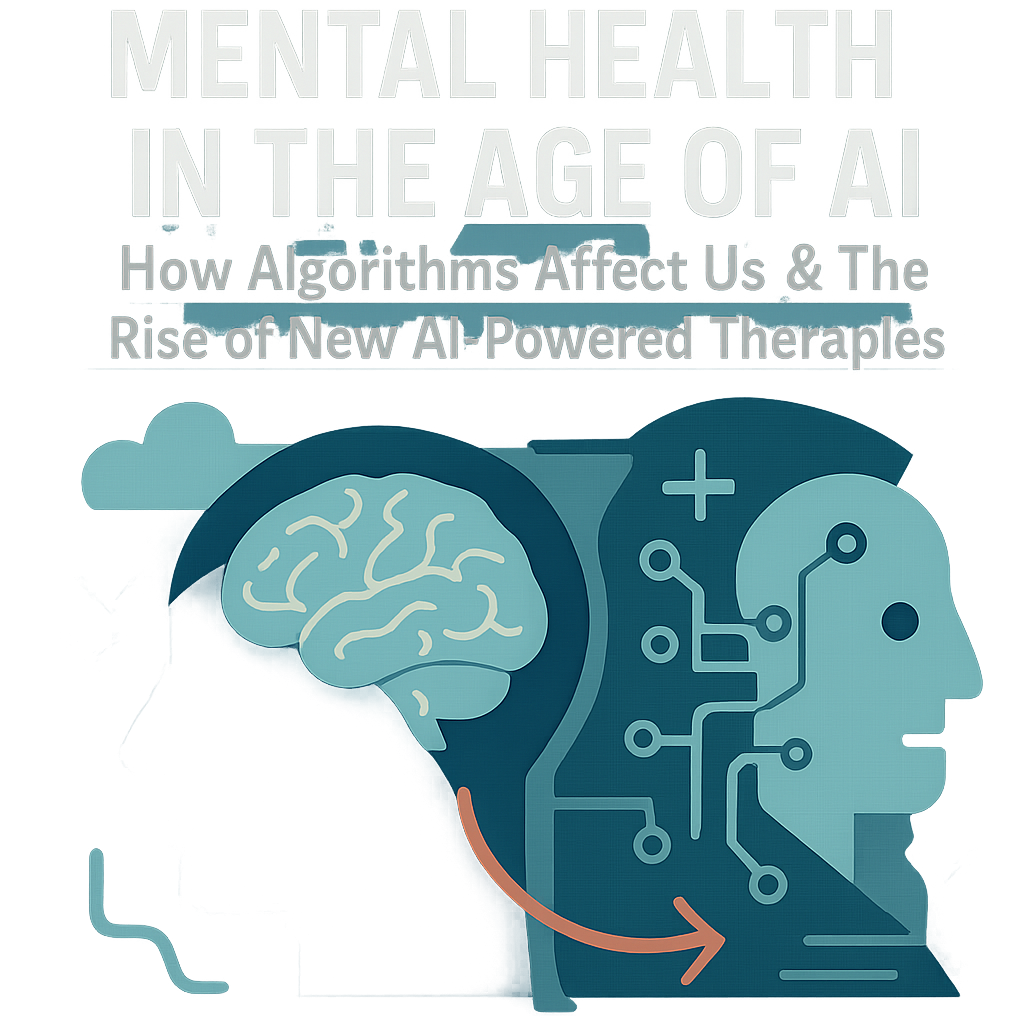
This section deconstructs the specific mechanisms by which everyday algorithms can undermine psychological well-being. It’s not that engineers are malicious; it’s that their optimization goals (engagement, productivity, profit) are often misaligned with human psychological needs.
1. Social Media Algorithms: The Engines of Social Comparison and Outrage
- Mechanism: Platforms use reinforcement learning to maximize time-on-app. They quickly learn that content eliciting social comparison (“compare and despair” with curated highlight reels) and moral outrage (polarizing political content) generates high engagement.
- Mental Health Impact:
- Anxiety & Depression: A 2024 longitudinal study in the Journal of Adolescent Health found a dose-response relationship: for every 30 minutes per day of algorithmic social media use beyond a baseline, teens reported a 15% higher likelihood of clinically significant depressive symptoms. The link was strongest for platforms using image/video-based, algorithmically curated feeds (TikTok, Instagram Reels).
- Body Image Dysmorphia & Eating Disorders: Algorithmic promotion of “fitspo,” “thinspo,” and cosmetic surgery content creates a distorted normative standard. The feedback loop shows more of this content to those who engage with it, deepening the pathology.
- Erosion of Social Cohesion & Loneliness: By prioritizing divisive content, algorithms can foster a sense of threat and “othering.” Simultaneously, passive consumption of others’ curated lives can replace active, intimate connection, leading to “perceived social isolation.”
- Case Example – “For You” Page Dynamics: A user briefly lingers on a video about climate anxiety. The algorithm interprets this as interest and serves more content on existential threats, collapsing economies, and dystopian futures. The user’s worldview narrows to a catastrophic filter bubble, increasing hopelessness and anxiety, which in turn makes them seek more such content for validation of their fears—a toxic feedback loop.
2. Workplace & Productivity Algorithms: The Quantified Self Under Surveillance
- Mechanism: Tools like email sorting algorithms, project management AI, and especially worker surveillance software (keystroke loggers, productivity scorecards) turn human labor into optimized data streams. The goal is maximum output and efficiency.
- Mental Health Impact:
- Burnout & Chronic Stress: The constant pressure of being measured, ranked, and potentially flagged for “idle time” creates a state of hypervigilance. The autonomic nervous system has no recovery period.
- Loss of Autonomy & Mastery: Core psychological needs for self-determination are undermined when an algorithm dictates task priority and pace. This directly fuels the cynicism and inefficacy dimensions of burnout.
- Presenteeism & Fear Culture: Knowing one is being surveilled leads to “performance of work” rather than deep work, increasing cognitive load and reducing genuine productivity and satisfaction.
- Case Example – The Delivery Driver App: An app algorithmically assigns routes, continuously monitors location and delivery speed, and provides real-time “efficiency scores.” Drivers report skipping bathroom breaks and driving unsafely to avoid penalties. This creates chronic stress, a sense of being dehumanized by a machine, and physical risk—a perfect storm for anxiety and depression.
3. Recommender Systems & The “Attention Economy”: Fragmentation of Focus
- Mechanism: YouTube’s autoplay, Netflix’s “next episode” countdown, infinite scroll. These are designed to exploit the “variable reward” psychological principle (like a slot machine), making it difficult to disengage. They fragment sustained attention.
- Mental Health Impact:
- ADHD-like Symptoms & Attentional Erosion: The constant context-switching trains the brain for distraction, weakening the prefrontal cortex’s ability to sustain focused attention. This can mimic or exacerbate ADHD symptoms in adults and children.
- Impaired Deep Work & Creativity: The ability to engage in prolonged, focused thought (necessary for complex problem-solving, learning, and creativity) is degraded.
- Sleep Disruption: Evening use of algorithmic feeds, especially with blue light, disrupts circadian rhythms and sleep quality, a foundational pillar of mental health.
4. Algorithmic Bias in Critical Services: Amplifying Structural Inequities
- Mechanism: AI used in hiring, lending, policing, and even healthcare risk assessments can perpetuate and amplify societal biases if trained on historical, biased data.
- Mental Health Impact:
- Minority Stress & Institutional Betrayal: Being systematically disadvantaged or misjudged by an “impartial” algorithm can be a profound source of stress, eroding trust in institutions and fueling feelings of injustice and helplessness. A 2025 audit of a widely used “patient engagement” algorithm found it systematically deprioritized Black and Hispanic patients for mental health follow-up calls because it used healthcare cost history as a proxy for need—a biased metric.
- Diagnostic Disparities: Early AI diagnostic tools for conditions like depression, trained predominantly on text and speech patterns from white, middle-class populations, show significantly lower accuracy when applied to dialects, linguistic styles, or somatic symptom presentations common in other cultures.
Part II: The AI Therapeutic Response – Tools, Promises, and Profound Limitations
In response to the crisis both exacerbated and revealed by technology, a new frontier of AI-powered mental health support has emerged. It ranges from simple chatbots to complex clinical decision-support systems.
1. AI Therapy Chatbots and Conversational Agents
- What They Are: Text-based applications that use Large Language Models (LLMs) to simulate therapeutic conversation. Examples: Woebot Health (CBT-based), Wysa, Youper. Some are pure LLM interfaces, while others are “guarded” with therapeutic frameworks and safety protocols.
- How They Work & Their Value:
- Accessibility & Scale: Available 24/7, at low or no cost, with no waitlist. They can provide psychoeducation, teach CBT skills (identifying cognitive distortions, behavioral activation), and offer empathetic-sounding responses.
- Anonymity & Reduced Stigma: Users may disclose more to a non-human entity, especially for stigmatized thoughts.
- Consistency: They don’t have bad days or countertransference.
- Evidence: A 2024 meta-analysis in JMIR Mental Health found that CBT-based chatbots produced a small-to-moderate significant reduction in symptoms of depression and anxiety (average effect size g=0.38) compared to waitlist controls, but were generally less effective than live human therapy.
- Critical Limitations & Risks:
- Lack of True Understanding & Empathy: They generate statistically likely responses, not genuine care. They cannot understand nuance, complex human history, or the therapeutic relationship.
- Safety & Crisis Management: They can fail to recognize acute suicidality or can give dangerously inappropriate advice if not strictly guarded. A “therapy” chatbot without proper safeguards could theoretically reinforce delusional thinking.
- Privacy & Data Exploitation: Sensitive mental health data shared with a chatbot could be used for advertising profiling or training models without explicit, informed consent.
- The “ELIZA Effect:” Named after an early 1960s chatbot, this is the human tendency to anthropomorphize and attribute understanding to computer programs, potentially leading to over-reliance or emotional attachment to a system that is fundamentally indifferent.
2. Predictive Analytics & Early Intervention Systems
- What They Are: AI models that analyze diverse data streams to predict mental health crises. This includes:
- Analysis of Electronic Health Records (EHRs) to flag patients at risk for suicide after discharge.
- Passive Sensing via Smartphones/Wearables: Detecting changes in sleep patterns (via accelerometry), social isolation (reduced communication), vocal prosody (flat affect detected in phone calls), or geolocation (rarely leaving home).
- Language Analysis on Social Media: Identifying linguistic markers of depression, psychosis, or suicidal ideation (projects like the Crisis Text Line’s AI triage tools).
- How They Work & Their Value:
- Proactive Care: Moves the system from reactive to proactive. A 2025 VA study using an AI model on EHR data achieved an 85% accuracy in predicting suicide attempts within one week, enabling targeted outreach.
- Personalized Risk Stratification: Can help overburdened clinicians prioritize resources to those at highest risk.
- Critical Limitations & Risks:
- False Positives & Alert Fatigue: Inaccurate predictions can waste resources and, more problematically, lead to unnecessary stigmatization or coercive interventions for individuals wrongly flagged.
- Surveillance & Autonomy: Constant passive monitoring raises huge ethical questions about consent and personal liberty. Does signing a hospital form consent to having your smartphone voice analyzed for mood?
- Bias in Prediction: If training data over-represents certain demographics or types of crises, the model will be less accurate for others, potentially missing at-risk individuals in marginalized groups.
3. AI-Enhanced Human Therapy (Clinical Decision Support)
- What It Is: AI as a tool for the clinician, not a replacement. Examples:
- Session Analysis Tools: AI that analyzes therapy session transcripts or audio in real-time to suggest potential interventions, flag therapeutic ruptures, or measure adherence to a treatment model (e.g., CBT competency).
- Progress Prediction: AI that analyzes early session data to predict a client’s likely trajectory, helping therapists adjust approach if a client is predicted to be a non-responder.
- How It Works & Its Value:
- Augmenting Clinical Skill: Can act as a “supervisor in the pocket,” especially for early-career therapists.
- Improving Fidelity & Outcomes: Ensures evidence-based techniques are being applied correctly.
- Efficiency: Automates note-taking and outcome measurement, giving therapists more face-to-face time.
- Critical Limitations & Risks:
- Over-reliance & Deskilling: Therapists might defer to algorithmic suggestions, undermining their own clinical judgment and intuition, which are core to the art of therapy.
- Privacy & Consent: Recording and analyzing therapy sessions creates a highly sensitive data trove. Who owns this data? Could it be subpoenaed?
- The “Black Box” Problem: Many clinical AIs are opaque; the therapist cannot understand why it suggested a certain intervention, making blind trust dangerous.
Part III: A Framework for Ethical Navigation and Digital Wellness
Navigating this landscape requires a multi-layered approach: individual habits, professional ethics, and systemic regulation.
For Individuals: Cultivating Algorithmic Awareness & Digital Agency
- Audit Your Algorithmic Diet: Periodically review your “digital consumption.” Which apps use heavy algorithmic curation? Use tools like iOS Screen Time or Android Digital Wellbeing to see your patterns.
- Interrupt Feedback Loops: Actively break filter bubbles. Seek out diverse news sources, follow people with different viewpoints, use “chronological feed” settings if available.
- Implement Digital Boundaries:
- Tech-Free Zones/Times: Bedroom, dinner table, first hour after waking.
- Notification Fasting: Turn off all non-essential notifications. Batch-check email/social media.
- Use “Focus” Modes: Utilize built-in phone features to block distracting apps during work or family time.
- Use AI Tools Wisely: If using a mental health chatbot, understand its limitations. It is a skill-building coach, not a therapist. Never rely on it in a crisis. Read its privacy policy. Use it to supplement, not replace, human connection and professional care.
- Reclaim Boredom & Deep Attention: Schedule time for activities that require sustained, undivided focus: reading a physical book, hobby crafting, nature walks without headphones. This is “neuroplastic resistance training” against attentional fragmentation.
For Clinicians & Developers: Ethical Imperatives
- Transparency & Informed Consent: Users must be clearly told when they are interacting with an AI, what data is being collected, how it’s used, and the limits of the tool’s capabilities. Consent must be ongoing, not buried in a Terms of Service.
- “Safety by Design” for Therapeutic AI: Build in rigorous safeguards: immediate human crisis escalation pathways, content moderation to prevent harmful advice, and regular algorithmic audits for bias and safety.
- Human-in-the-Loop (HITL) Model: Position AI as an assistant, not an autonomous agent. A human clinician should supervise, interpret, and take ultimate responsibility for care. The AI’s role is to inform, not decide.
- Equity & Bias Mitigation: Actively seek diverse training datasets. Conduct ongoing fairness audits. Ensure tools are accessible across languages, cultures, and socioeconomic statuses.
- Protect the Therapeutic Alliance: Any AI used in therapy must serve to strengthen, not replace or interfere with, the human-to-human bond, which remains the strongest predictor of therapeutic success.
For Policymakers & Society: The Need for Regulation
- Algorithmic Transparency Laws: Mandate that platforms disclose the core objectives of their key algorithms (e.g., “This feed is optimized for total watch time”) and allow users meaningful control over their parameters.
- Mental Health Impact Assessments: Similar to environmental impact reports, require major new social platforms or algorithmic systems to undergo independent assessment of potential mental health risks before wide release.
- Regulation of AI as a Medical Device: FDA/EMA must continue to evolve clear pathways for AI-DTx, requiring not just software validation but proof of clinical efficacy and safety through rigorous trials. Marketing claims must be strictly controlled.
- Data Sovereignty & Privacy Laws: Strengthen laws like GDPR and CCPA to give individuals true ownership and control over their digital mental health data, including the right to know what inferences are being made about them and to opt out of certain forms of profiling.
Part IV: The Future Trajectory – Integration, Personalization, and Existential Questions
Looking towards 2026 and beyond, several trends and questions will define this space.
- The “Blended Care” Ecosystem Becomes Standard: The future isn’t human or AI therapy; it’s human and AI therapy. A typical care pathway might involve: an AI-powered triage and assessment tool → matching to a human therapist → AI chatbot for between-session skill practice and mood tracking → AI analytics providing the therapist with insights before each session. This hybrid model maximizes scalability and personalization.
- Emotionally Intelligent Ambient Computing: AI will move beyond the screen. Our environments—homes, cars, offices—will have embedded sensors that subtly adapt to support our mental state: adjusting lighting and sound to reduce anxiety, prompting a breathing exercise when stress is detected in biometrics, or suggesting a walk after prolonged sedentary focus.
- AI and the Deepening of Self-Understanding: Advanced LLMs could help individuals journal more effectively, acting as a reflective mirror that asks probing questions, helps identify cognitive patterns, and summarizes emotional trends over time—a form of AI-assisted introspection.
- The “Therapist-AI” Partnership Redefines Training: Therapists-in-training will use AI simulation platforms to practice with incredibly realistic virtual “patients,” honing skills in a low-risk environment before ever seeing a real client.
- Existential and Philosophical Questions Intensify:
- What is Authentic Connection? If an AI can provide consistent, seemingly empathetic support, does it matter that it’s not “real”? For a lonely elderly person, might a high-fidelity AI companion be better than nothing?
- The Risk of Automated Normativity: Could AI therapies, designed around majority datasets and Western psychological models, inadvertently become tools of cultural homogenization, pathologizing normal human variations that don’t fit the algorithmic mold?
- Who is Responsible? When an AI therapy chatbot fails to prevent a suicide or a predictive model leads to a wrongful involuntary commitment, where does liability lie? With the developer, the platform, the clinician who recommended it, or the user?
Conclusion and Key Takeaways
We are at an inflection point where our external technological environment and our internal psychological landscape are becoming inextricably linked. AI is not a neutral tool; it is an active shaper of human experience, for better and for worse. The challenge of our time is to move from passive consumption to conscious co-creation. We must demand that the algorithms that permeate our lives are designed with human flourishing as a core metric, not an accidental byproduct. Simultaneously, we must embrace the potential of AI-assisted mental healthcare with clear-eyed optimism, insisting on evidence, ethics, and equity.
The path forward requires a new kind of literacy—psycho-technological literacy. We must learn to read our own emotional responses to technology as data points, to understand the basic mechanics of the systems that hold our attention, and to make intentional choices about how we engage with both the harmful and the healing aspects of AI.
The goal is not to reject technology, but to harness it in the service of what makes us uniquely human: our capacity for deep connection, meaning, and resilient well-being. By understanding the forces at play, we can begin to design a digital future that supports, rather than subverts, our mental health.
Key Takeaways Box
- Algorithms Are Not Neutral: They are optimized for engagement, productivity, or profit, which often conflicts with psychological well-being, fueling social comparison, outrage, fragmentation of attention, and burnout.
- AI Therapy is a Tool, Not a Panacea: AI chatbots and predictive tools offer unprecedented scale and accessibility for mental health support and early intervention, but they lack genuine empathy, pose safety and privacy risks, and can perpetuate bias. They are best used as adjuncts to human care.
- The Core Risk is Algorithmic Bias: AI systems can amplify societal inequities in mental healthcare, providing poorer service or inaccurate predictions for marginalized groups if trained on biased data.
- Cultivate Digital Agency: Individuals can take control by auditing their algorithmic diet, setting strict digital boundaries, interrupting filter bubbles, and reclaiming time for deep, uninterrupted focus.
- Ethics Must Lead Technology: For developers and clinicians, principles of transparency, safety-by-design, human-in-the-loop oversight, and bias mitigation are non-negotiable for ethical AI in mental health.
- Regulation is Essential: Society needs robust laws for algorithmic transparency, mental health impact assessments, and strong data privacy to protect individuals from predatory or negligent design.
- The Future is Hybrid (Human + AI): The most effective mental healthcare ecosystem will intelligently blend AI’s scalability and data-processing power with the irreplaceable empathy, judgment, and relational healing of human clinicians.
- Develop Psycho-Technological Literacy: The most critical skill for the 21st century is understanding how your digital environment affects your mind and learning to use technology with intention.
FAQs (Frequently Asked Questions)
1. Is social media causing the rise in teen depression, or is it just correlated?
The evidence has moved from correlation to causation. Landmark randomized controlled trials in 2023-2024 (where participants were assigned to reduce social media use vs. a control group) showed that limiting algorithmic social media use (particularly image-based platforms like Instagram, TikTok) led to significant reductions in depression and anxiety symptoms, improved body image, and better sleep in adolescents. The algorithm’s role in promoting social comparison and negative content appears to be a causal driver.
2. Can an AI therapy chatbot like Woebot or Wysa really understand me?
No. It simulates understanding through sophisticated pattern matching. It analyzes your text input, matches it to patterns in its vast training data (millions of therapy conversations, CBT textbooks), and generates a statistically probable, appropriate-sounding response. It has no consciousness, feelings, or life experience. Its “empathy” is a linguistic facsimile, though one that can still be functionally helpful for skill-building.
3. What should I do if I think an algorithm is negatively affecting my mental health?
Conduct a two-week experiment. 1) Identify the suspect app/feature. 2) Severely limit or eliminate it (delete the app, use a website blocker, switch to a chronological feed). 3) Journal your mood, focus, and anxiety levels before, during, and after. The data will be clear. If you see improvement, you have your answer and can set permanent, strict boundaries.
4. How accurate are AI models at predicting suicide risk?
The best current models, using rich data from electronic health records, claim accuracy (AUC) in the 0.80-0.85 range, meaning they are good but not perfect. This leads to many false positives and false negatives. They are best used as a triage tool to flag individuals for human clinician review, not to make autonomous decisions. Their accuracy plummets when applied to populations not represented in their training data.
5. Are there any AI mental health tools that are FDA-approved?
As of early 2025, no pure AI therapy chatbot has full FDA approval as a Prescription Digital Therapeutic (PDT). However, several AI components are part of FDA-cleared systems. For example, some digital CBT platforms for insomnia or depression use algorithms to personalize content. Rekindle, an AI-powered relapse prevention tool for Substance Use Disorder, received FDA Breakthrough Device designation in 2024 and is in pivotal trials. The regulatory landscape is evolving rapidly.
6. What’s the difference between a “guarded” LLM and a standard chatbot for therapy?
A standard chatbot (like a customer service bot) is designed for task completion. An unguarded LLM (like a raw ChatGPT interface) can generate anything, including harmful advice. A “guarded” or “walled-garden” LLM for therapy is constrained by rules: it can only respond within a pre-approved therapeutic framework (e.g., CBT), it has safety protocols to escalate crisis language, and its responses are filtered to ensure clinical appropriateness and safety. Woebot Health uses this model.
7. Could my employer’s wellness program use AI to monitor my mental health?
This is a growing and contentious area. Some employer-sponsored Employee Assistance Programs (EAPs) offer AI chatbots. More concerning is the use of passive sensing via company-issued devices or email/message meta-data analysis to infer employee stress or burnout levels. This is often done under the guise of “wellness” but can feel like surveillance. Know your company’s policy and your local privacy laws. In the EU, such processing would require explicit, informed consent.
8. How can I tell if a mental health app is using AI responsibly?
Look for:
- Clear Disclosure: It should explicitly state it uses AI and explain its role.
- Transparent Privacy Policy: It should clearly state what data is collected, how it’s used, and if it’s sold/shared.
- Crisis Resources: It should have clear, immediate pathways to human help (crisis hotlines, instructions to go to an ER).
- Clinical Validation: Look for mention of published research or clinical trials supporting its efficacy.
- Human Oversight: The best apps state that their systems are supervised by licensed clinicians.
9. Will AI replace therapists?
It will augment and transform the role of therapists, not replace them in the foreseeable future. AI will handle administrative tasks, provide data-driven insights, offer low-level coaching and skill reinforcement, and help with triage. This will free human therapists to focus on the complex, relational, and deeply empathetic aspects of care that AI cannot replicate. The therapist of the future will be a manager of therapeutic ecosystems, integrating AI tools into personalized treatment plans.
10. What are “emotion recognition” technologies and are they valid?
These are AI systems that claim to infer emotions from facial expressions, voice tone, or gait. The scientific consensus, per a major 2025 review by the Association for Psychological Science, is that these technologies are fundamentally flawed. They are based on the discredited theory of universal, one-to-one links between expressions and internal emotional states (e.g., a smile always means happy). Emotions are culturally and contextually constructed. Using such tech for mental health assessment is unreliable and ethically risky.
11. How does algorithmic content affect people with OCD or anxiety disorders?
It can be particularly dangerous. For someone with Health Anxiety, algorithmically served content about rare diseases can fuel obsessive checking and catastrophic thinking. For someone with Harm OCD, content about violence can trigger intrusive thoughts. The feedback loop ensures the more they engage with the distressing (but compelling) content, the more they see it, reinforcing the obsessive cycle. Platform safety tools often fail to catch this nuance.
12. Can AI help with diagnosis?
AI is showing promise as a diagnostic aid, particularly in psychiatry where diagnosis is often subjective. Tools analyzing speech patterns (latency, semantic coherence) can help flag potential psychosis. Models analyzing movement patterns from smartphone sensors can help track symptom severity in depression. However, these should only be used to inform a comprehensive clinical assessment by a qualified professional, not to make autonomous diagnoses.
13. What about AI for medication management?
AI is being used to analyze genetic data (pharmacogenomics), electronic health records, and symptom tracking to predict which antidepressant or antipsychotic medication a patient is most likely to respond to with the fewest side effects. This can reduce the painful and often lengthy “trial and error” period. Companies like Mindful and Genomind offer such services, often in partnership with psychiatrists.
14. How do I talk to my kids about algorithms and mental health?
Use analogies. Explain that apps are like a “friend who only shows you things that make you react strongly, because that’s how they get your attention.” Teach them to ask: “Why am I being shown this video/post?” and “How does this make me feel?” Encourage them to curate their own feeds (e.g., following educational or hobby accounts) and to take regular “digital detox” days. Model healthy boundaries with your own devices.
15. Is there a global effort to regulate this?
The World Health Organization (WHO) released its first guidelines on “Ethics and Governance of AI for Health” in 2024, which includes mental health applications. The OECD and UNESCO have frameworks. The EU’s AI Act, the world’s first comprehensive AI law, classifies AI used in essential services (including healthcare) as “high-risk,” subjecting them to strict requirements for transparency, human oversight, and risk management. The US is pursuing a sectoral approach, with the FDA regulating medical AI and the FTC focusing on deceptive and unfair practices.
16. Can AI be used for preventative mental health?
Yes, this is a major frontier. AI can analyze population-level data to identify community-level psychosocial stressors. It can power public health campaigns by identifying which mental health messages resonate with which demographics. On an individual level, AI-powered “mental fitness” apps aim to build resilience through daily micro-practices in emotion regulation and cognitive flexibility, potentially preventing sub-clinical issues from becoming disorders.
17. What are the biggest ethical concerns with AI in mental health?
- Informed Consent: Can users truly understand what they’re agreeing to with a complex AI system? 2) Privacy & Data Security: Mental health data is supremely sensitive. 3) Bias & Fairness: Perpetuating healthcare disparities. 4) Accountability: Who is responsible when something goes wrong? 5) Dehumanization of Care: Eroding the human connection at the heart of healing.
18. Are there positive examples of social media algorithms for mental health?
Some platforms are experimenting with “well-being” algorithms. Pinterest allows users to opt out of weight loss ads. TikTok’s “Healing” videos tab directs users to supportive content when they search for terms related to self-harm or eating disorders. Instagram can nudge users to take a break if they’ve been scrolling too long. These are small, often opt-in steps, showing platforms can design differently when well-being is made a KPI.
19. How will AI impact the cost of mental healthcare?
In the long run, AI has the potential to reduce costs through triage (directing mild cases to low-cost digital tools), increasing therapist efficiency, and preventing costly crises through early intervention. However, in the short term, developing, validating, and securing these tools is expensive, and that cost may be passed on. The goal is that insurance will cover effective AI-DTx, making sophisticated care more accessible, not less.
20. Where can I learn more about digital wellness and ethical AI?
- Organizations: Center for Humane Technology, Alliance for Digital Wellbeing, Data & Society Research Institute.
- Books: “Stolen Focus” by Johann Hari, “The Age of Surveillance Capitalism” by Shoshana Zuboff, “Futureproof” by Kevin Roose.
- Documentaries: “The Social Dilemma” (Netflix), “Coded Bias” (Netflix).
About the Author

Sana Ullah Kakar is a technologist and ethicist with a PhD in Human-Computer Interaction. He leads a research group at a major university studying the societal impact of emerging technologies, with a focus on mental health and algorithmic systems. He has served as an advisor to the WHO and the EU on digital health policy. His writing aims to bridge the gap between technical innovation and humanistic values. Find his other analyses on our blog or reach out via our contact-us page.
Free Resources
- Digital Wellness Audit Toolkit: A printable workbook to map your digital habits, identify algorithmic stressors, and create a personalized digital boundary plan.
- Guide to Evaluating Mental Health Apps & AI Tools: A checklist of questions to ask about privacy, evidence, safety, and bias before using any digital mental health product.
- “Algorithmic Awareness” Mini-Course: A free 5-part email series explaining key concepts like filter bubbles, engagement metrics, and data profiling in simple terms.
- Repository of Policy & Regulation: Links to key documents like the WHO AI Ethics Guidelines, the EU AI Act, and the APA’s guidelines on telepsychology.
- Crisis Resource Sheet: A one-page list of human-operated crisis lines and resources (global and local), emphasizing that AI should not be used in emergencies.
- For those looking to build or invest in ethical tech in the mental health space, explore insights at Shera Kat Network’s blog and this guide on how to start an online business in 2026.
Discussion
We are all participants in this grand experiment. What’s your most pressing concern about AI and mental health? Have you had a positive or negative experience with an AI mental health tool? What one regulation or design change would you prioritize to make our digital world more mentally healthy? Join this critical conversation below. For more on the policy and global affairs politics shaping our technological future, explore our dedicated sections and the community at WorldClassBlogs Nonprofit Hub.
Disclaimer: This article is for informational and educational purposes only. It is not a substitute for professional medical advice, diagnosis, or treatment. Always seek the advice of your physician, qualified mental health provider, or other qualified health provider with any questions you may have regarding a medical condition. Never disregard professional medical advice or delay in seeking it because of something you have read here. If you are in crisis, please contact a crisis hotline (e.g., 988 in the U.S. and Canada) or go to your nearest emergency room. The external links provided are for additional resources and do not constitute an endorsement. Please review our Terms of Service.
About The Author



Just wish to say your article is as astonishing. The clarity to your submit is just spectacular and i can assume you’re knowledgeable on this subject. Fine together with your permission allow me to grab your RSS feed to keep up to date with imminent post. Thanks 1,000,000 and please continue the rewarding work.