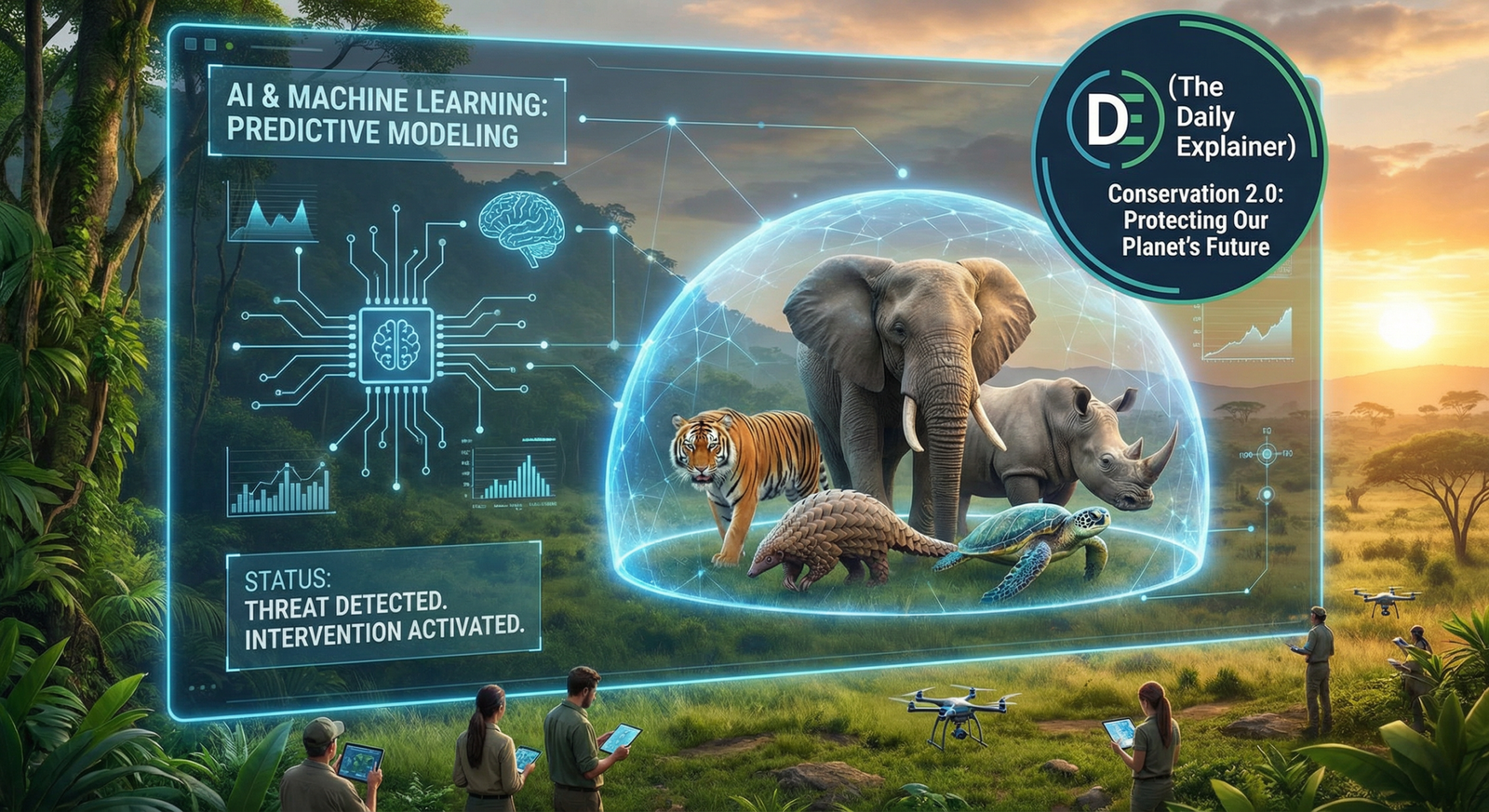
The AI-powered conservation loop: from data collection in the field to intelligent alerts that guide protection efforts.
Introduction – Why This Matters
Picture a vast, dense rainforest. A ranger patrols, hoping to catch the sound of an elusive, endangered parrot or the trail of a rare pangolin. For decades, conservation has been a game of immense scales and painfully limited data—like finding a needle in a continent-sized haystack with a flashlight. Today, that flashlight is being replaced by a constellation of satellites and intelligent algorithms.
We are in the midst of a silent revolution in conservation biology. Artificial Intelligence (AI) and Machine Learning (ML) are not just buzzwords from the tech world; they are becoming the most powerful tools in our arsenal to understand, protect, and restore the natural world. This matters because the scale and speed of biodiversity loss are unprecedented. The 2025 Living Planet Report indicates a 69% average decline in wildlife populations since 1970, and traditional methods alone cannot keep pace with the threats of habitat loss, climate change, and poaching.
AI offers a paradigm shift: from reactive to predictive, from localized to global, and from data-scarce to data-rich. This article is your comprehensive guide to understanding how this technological leap is reshaping the fight to preserve life on Earth, making it accessible for curious beginners and providing a crucial update for professionals.
Background / Context
Conservation has always been data-driven, but historically, the data was hard-won. It involved months of field surveys, manual camera trap image sorting, and painstaking acoustic analysis. The challenges were (and are) monumental:
- Scale: Ecosystems are vast and complex.
- Resources: Funding and personnel are perpetually limited.
- Speed: By the time a population decline is manually detected, it may be too late for intervention.
The emergence of “Big Data” in conservation—from satellite imagery, bioacoustic recorders, camera traps, and citizen science platforms—created both an opportunity and a problem. We were suddenly drowning in data. A single camera trap project can generate millions of images. Manually processing this is impossible.
This is where AI and ML enter. In essence, AI is the broader concept of machines performing tasks that typically require human intelligence. Machine Learning, a subset of AI, involves algorithms that improve automatically through experience and by the use of data. They can be trained to recognize patterns—like identifying a tiger in an image or an illegal logging truck in a satellite photo—at speeds and volumes no human team could ever match.
Key Concepts Defined
- Artificial Intelligence (AI): The simulation of human intelligence processes by machines, especially computer systems. In conservation, it’s the umbrella term for systems that can learn, reason, and act on environmental data.
- Machine Learning (ML): A method of data analysis that automates analytical model building. It is based on the idea that systems can learn from data, identify patterns, and make decisions with minimal human intervention. Think of it as teaching a computer to recognize a whale shark’s spot pattern by showing it thousands of pictures.
- Computer Vision: A field of AI that enables computers to derive meaningful information from digital images, videos, and other visual inputs. This is the technology behind automated species identification in camera trap and drone footage.
- Bioacoustics Monitoring: The use of sound recorders to monitor wildlife and ecosystem health. AI can analyze thousands of hours of audio to identify species by their calls, detecting presence/absence and even behavioral changes.
- Predictive Analytics: The use of data, statistical algorithms, and ML techniques to identify the likelihood of future outcomes based on historical data. In conservation, this can predict poaching events, species migration shifts due to climate change, or disease outbreaks.
- Remote Sensing: The science of obtaining information about objects or areas from a distance, typically from aircraft or satellites. AI algorithms scour this data for changes in forest cover, water quality, or urban encroachment.
How It Works (Step-by-Step Breakdown)
Let’s trace the journey of AI in a specific application: Preventing Poaching in a National Park.
Step 1: Data Acquisition
Multiple data streams are established:
- Historical Data: Past poaching incident reports, ranger patrol logs, and animal movement data.
- Real-Time Data: Signals from ground sensors, camera traps with cellular uplinks, and acoustic monitors.
- Environmental Data: Satellite imagery (for vegetation and terrain), weather data, and even social media scraping for tips on illegal wildlife trade.
Step 2: Data Fusion & Processing
All this disparate data is fed into a central platform. AI algorithms begin to “clean” and organize it, creating a unified digital picture of the park.
Step 3: Model Training & Pattern Recognition
This is the core ML phase. Using historical data, scientists train an algorithm. They “show” it patterns that led to poaching events in the past—combinations like specific moon phases, proximity to roads, recent rainfall (which affects ranger mobility), and increased human cell phone signals in remote areas. The algorithm learns to weigh these factors and identify high-risk patterns.
In my experience, talking to teams at SMART (Spatial Monitoring and Reporting Tool), the leap from simple data logging to predictive AI was a game-changer. “We moved from asking ‘Where did poaching happen?’ to ‘Where is it most likely to happen tomorrow?’ This changed ranger patrols from a routine to a targeted, intelligence-led operation,” one project manager shared.
Step 4: Prediction & Alert Generation
The trained model now analyzes real-time data. When it detects a combination of factors that match a high-risk pattern, it doesn’t just log it. It generates an alert.
Step 5: Human-in-the-Loop Action
The alert is sent to ranger station dashboards and mobile devices. It might say: “High Probability of Poaching Activity in Grid Sector D7. Factors: Unidentified vehicular noise detected via acoustic sensor, absence of elephant herd GPS signals from usual watering hole, and social media post referencing ivory in nearby town.” Rangers are dispatched to the precise location.
Step 6: Feedback Loop
The outcome of the ranger intervention (poacher apprehended, false alarm, etc.) is fed back into the AI system. This allows the algorithm to learn and become more accurate over time, continuously refining its predictions.
Why It’s Important
The importance of AI in conservation cannot be overstated:
- Efficiency at Scale: AI processes millions of data points in minutes, freeing up human experts for strategy and action. A task like identifying species in 10 million camera trap images would take a human years; AI can do it in weeks.
- Predictive Power: Moving from documentation to prediction is arguably AI’s greatest contribution. It enables proactive protection, stopping crimes before they happen and planning for climate impacts before they cause irreversible damage.
- Democratizing Conservation: Cloud-based AI tools are becoming more accessible. Smaller NGOs and community groups can now use smartphone apps with built-in AI to identify species or report habitat destruction, leveling the playing field.
- Unlocking Hidden Insights: AI can find correlations humans might miss. For example, an algorithm might discover that a specific pattern of ocean temperature, salinity, and chlorophyll levels from satellite data is a near-perfect predictor of right whale migration routes.
Sustainability in the Future
The future of AI in conservation is one of deeper integration and accessibility:
- Federated Learning: AI models that can learn from data across different organizations (e.g., parks in Kenya and Indonesia) without the raw data ever leaving its source, preserving privacy and security while improving global models.
- Generative AI for Scenario Planning: Using tools like advanced simulations to model the 50-year impact of different conservation strategies (e.g., corridor A vs. corridor B) under various climate scenarios, allowing for better long-term planning.
- Edge Computing: Running lightweight AI models directly on camera traps or drones in the field. This allows for immediate alerts—like triggering a warning sound when an AI-powered camera detects a poacher—even in areas with no internet connectivity.
- Automated Restoration: AI-driven drones that not only map degraded land but also autonomously plant native tree seeds at optimal locations, monitored by computer vision for growth.
However, sustainability also means addressing AI’s own footprint (energy use of data centers) and ensuring these tools are developed and deployed ethically, with the involvement of local and indigenous communities who are the original stewards of the land.
Common Misconceptions
- “AI will replace conservation biologists.” False. AI is a tool that augments human expertise. It handles the massive, repetitive data tasks, allowing biologists to focus on complex problem-solving, community engagement, and policy work. The future conservationist needs to be tech-savvy, not replaced by tech.
- “AI solutions are too expensive for most projects.” Increasingly false. While advanced systems require investment, many open-source and low-cost AI tools are emerging. Google’s Wildlife Insights platform offers free AI-powered camera trap analysis. Apps like iNaturalist use AI for species ID, empowering citizen scientists globally.
- “AI is infallible and always objective.” Dangerously false. AI models are only as good as the data they’re trained on. If training data is biased (e.g., mostly images of male lions, or data only from easily accessible areas), the AI’s outputs will be biased. Continuous human oversight and diverse data collection are critical.
- “It’s all about fancy algorithms; ground work doesn’t matter.” False. The most sophisticated AI is useless without boots on the ground. Rangers, community monitors, and field biologists are the ones who collect the foundational data, validate AI findings, and take the ultimate physical action to protect ecosystems.
Recent Developments (2025-2026)
The field is moving rapidly. Here are key recent developments:
- The “Earth’s Digital Twin” Initiative: Led by a consortium of EU agencies and tech partners, this ambitious 2025 project aims to create a highly detailed, AI-powered simulation of the entire planet to model and predict environmental changes. Conservation applications are a core pillar.
- AI-Powered DNA Analysis: New ML models are drastically reducing the cost and time needed to analyze environmental DNA (eDNA) samples. A 2026 study in Nature Ecology & Evolution showed an AI system that could identify over 2,000 species from a single water sample with 95% accuracy, revolutionizing biodiversity surveys.
- Real-Time Deforestation Alerts Go Mainstream: Global Forest Watch’s RADD (Radar for Detecting Deforestation) Alert system, powered by satellite radar and AI, now provides weekly—almost real-time—alerts for the tropics, even through cloud cover, enabling faster enforcement.
- Chatbots for Conservation Policy: Organizations are training large language models (LLMs) on global environmental treaties, local laws, and scientific literature. These AI assistants help policymakers draft legislation, ensure compliance, and model the legal/financial impacts of conservation decisions.
Success Stories
Project: Protection Assistant for Wildlife Security (PAWS)
Location: Multiple countries across Africa and Asia.
How AI Helped: PAWS is an ML framework that uses data on past poaching activities, terrain information, and animal tracking data to generate optimal, randomized patrol routes for rangers. By making patrols unpredictable and focusing on high-risk areas, it maximizes the deterrent effect.
Result: In field tests in Uganda and Malaysia, parks using PAWS saw a significant increase in poacher intercepts and a decrease in snare counts compared to areas using traditional patrol methods. It’s a prime example of “game theory” enhanced by AI, saving animal lives.
Real-Life Examples
- Whale Safe: An AI-powered tool that uses satellite data, underwater microphones, and predictive models to track whale movements in near real-time off the California coast. It provides shipping companies with “whale presence ratings” and suggested routes to avoid lethal ship strikes, a major threat to whales like the blue and humpback.
- Wildbook: An open-source software framework that uses computer vision to identify individual animals by their unique markings (whale shark spots, zebra stripes, manta ray belly patterns). It crowdsources images from researchers and tourists, using AI to scan them and build life histories of individual animals, tracking their migrations, reproduction, and survival over decades.
- Rainforest Connection (RFCx): Uses old cell phones powered by solar energy as “guardian” devices in rainforests. Their microphones stream audio to the cloud, where AI models scan for sounds of illegal logging (chainsaws, trucks) and key species. Alerts are sent to local partners in minutes. In 2025, RFCx AI helped partners in Brazil and Indonesia prevent an estimated 15,000 hectares of deforestation.
Conclusion and Key Takeaways
The integration of AI into conservation is no longer a futuristic concept; it is a present-day necessity. It represents our best hope of matching the pace and scale of the biodiversity crisis with an equivalent scale in our response. The transition is from intuition-driven to data-driven, from reactive to predictive, and from isolated efforts to a globally connected intelligence network for nature.
Key Takeaways:
- AI is a Force Multiplier: It doesn’t replace people but empowers them to do more with limited resources.
- Data is the New Lifeline: The collection of high-quality, diverse field data remains the irreplaceable fuel for all AI systems.
- Prediction is the Ultimate Goal: The shift from monitoring to forecasting threats is where AI delivers its greatest conservation value.
- Ethics and Access are Critical: We must ensure these tools are developed transparently, mitigate bias, and are made accessible to frontline communities worldwide.
- The Time is Now: The technology is proven and available. The challenge is scaling investment, training, and integration into the daily workflow of every conservation organization.
The story of 21st-century conservation will be written in lines of code as much as in lines of field notes. By embracing Conservation 2.0, we are giving nature a powerful new voice in the digital age.
FAQs (Frequently Asked Questions)
1. Isn’t AI just a complicated tech fad that will fade away in conversation?
No. The fundamental challenge conservation faces—too much data, too few resources—is exactly what AI is designed to solve. Its applications are already delivering measurable, peer-reviewed results in anti-poaching, population monitoring, and habitat protection. It’s a foundational shift, not a fad.
2. How much does it cost to implement AI in a conservation project?
It’s a spectrum. Using free, cloud-based platforms like Wildlife Insights for camera trap analysis can cost almost nothing but time. Deploying a custom, real-time anti-poaching prediction system with sensors and dedicated software developers can cost hundreds of thousands of dollars. The key is to start small with a defined problem and use existing tools.
3. I’m a biologist, not a programmer. Do I need to learn to code?
While beneficial, it’s not strictly necessary. The field is moving towards user-friendly, “no-code” or “low-code” interfaces. Your expertise in ecology is vital for asking the right questions, designing the study, collecting good data, and interpreting the AI’s outputs. Collaborating with a data scientist is often the most effective path.
4. Can AI help with climate change adaptation for wildlife?
Absolutely. Predictive models are crucial here. AI can analyze climate projections and species habitat requirements to map future “climate refugia” (areas that will remain suitable) and identify needed wildlife corridors. It can also help model the impact of assisted migration or other intervention strategies.
5. What’s the biggest ethical concern with using AI in conservation?
Data sovereignty and community consent. Deploying sensors and collecting data, especially on indigenous lands or with local communities, must be done with their full, prior, and informed consent. They should own their data and benefit from the insights. AI must not become a tool for the surveillance of people, only for the protection of nature.
6. How accurate is AI in species identification from camera traps?
For common species in clear images, the best models now exceed 99% accuracy, rivaling or surpassing human experts. Challenges remain for rare species with few training images, blurry images, or partial body shots. The standard practice is to have human experts verify a subset, especially for critical detections.
7. Does using AI require constant internet in the field?
Not necessarily. “Edge AI” is a growing field where lightweight models run directly on devices (cameras, drones). They can process data and make decisions (e.g., “save this image,” “send an alert”) locally, syncing with the cloud only when a connection is available.
8. Can AI be used to combat the illegal wildlife trade online?
Yes, this is a major application. AI algorithms scan social media platforms, e-commerce sites, and encrypted messaging apps (where legal) for images and code words related to illegal wildlife products. Groups like the International Fund for Animal Welfare (IFAW) use such tools to flag listings for enforcement agencies, leading to thousands of takedowns monthly.
9. How does AI handle animal welfare? Can it cause stress?
Responsible AI conservation focuses on non-invasive monitoring—using cameras, acoustics, and satellites that observe from a distance. The goal is to reduce stress by replacing the need for physical capture or constant human presence. Ethics reviews are essential for any project.
10. What’s an example of AI in marine conservation?
The organization The Ocean Cleanup uses AI-powered computer vision on cameras mounted on their cleanup systems to identify, count, and categorize plastic debris in real-time, optimizing their operations. Other projects use AI to analyze drone footage to count marine mammal populations or identify coral bleaching from underwater images.
11. Are there open-source AI tools I can try today?
Yes! Key platforms include:
- Wildlife Insights: For camera trap photo management and AI identification.
- TensorFlow & PyTorch: Open-source ML libraries (more technical).
- Merlin Bird ID: A user-friendly app from the Cornell Lab of Ornithology that uses AI to identify birds by sound and photo.
- iNaturalist: Its AI suggestion engine helps identify any plant or animal from a photo.
12. How does AI contribute to “rewilding” projects?
AI helps select optimal release sites by analyzing habitat quality, connectivity, and threat levels. It can also monitor released animals via GPS/sensor tags, using ML to alert if an animal’s movement patterns indicate distress, illness, or wandering into a dangerous area.
13. Can AI help with plant conservation and botany?
Definitely. Apps like Pl@ntNet and Seek by iNaturalist use image recognition to identify plant species. On a research level, AI analyzes satellite and drone imagery to map invasive plant species, monitor forest health, and even predict flower blooms to understand pollinator resources.
14. What is the role of governments in this AI conservation shift?
Governments are critical. They can fund research, develop national “bio-digital” strategies, establish ethical guidelines, and use AI to monitor compliance with environmental laws (e.g., illegal fishing vessels, pollution discharge). In 2025, the UN Environment Programme (UNEP) launched its first global guidance on AI for environmental governance.
15. How is AI used in fisheries management?
AI analyzes data from vessel monitoring systems, satellite imagery, and ocean sensors to identify illegal, unreported, and unregulated (IUU) fishing. It can detect “dark” vessels that have turned off transponders and predict fishing hotspots to ensure sustainable quotas aren’t exceeded.
16. What’s the environmental cost of running these powerful AI computers?
This is a valid concern. Training large AI models consumes significant energy. The solution lies in using efficient algorithms, running computations on green energy-powered cloud servers, and developing specialized, low-power chips for conservation AI. The net benefit for the planet should always outweigh the computational carbon cost.
17. Can local communities with low literacy use these tools?
Yes, with thoughtful design. Interfaces using icons, voice commands, and simple alerts on basic phones are being developed. The focus is on providing actionable information: “Alert: Elephant herd near north village field” or “Sound of chainsaw detected in sacred grove.”
18. How does AI deal with new or unknown species?
This is a frontier. AI can flag “anomalies”—images or sounds it can’t classify with high confidence. These are then sent to human experts for review, potentially leading to the discovery of new species or behaviors. The AI system learns from this, gradually expanding its knowledge.
19. Is there a risk of cyberattacks on conservation AI systems?
Yes, like any critical infrastructure. Poaching syndicates could potentially try to jam sensor signals or hack alert systems. Robust cybersecurity measures, including encryption and offline backups, are essential components of any deployed system.
20. Where can I learn more or get training?
- Online Courses: Coursera’s “AI for Conservation” series, Microsoft’s “AI for Earth” learning resources.
- Workshops: Organizations like WILDLABS host online and in-person tech training.
- Conferences: The International Congress for Conservation Biology (ICCB) now has dedicated AI and tech tracks.
- Read More: Follow the blogs of leading projects like https://sherakatnetwork.com/category/blog/ for insights on tech and social impact, or explore resources at https://worldclassblogs.com/category/nonprofit-hub/.
About Author
Sana Ullah Kakar is a conservation technologist and science communicator with over a decade of experience bridging the gap between ecological fieldwork and cutting-edge digital tools. Having worked on projects from the Amazon to Southeast Asia, they have witnessed firsthand the transformative power of data and AI in empowering protectors of the natural world. They now focus on writing and consulting to make these technologies accessible and actionable for a global audience. Their work has been featured in various environmental publications, and they are a regular contributor to https://thedailyexplainer.com/blog/, where they break down complex scientific topics.
Free Resources
- WILDLABS Tech Toolkit: A curated directory of free and open-source conservation technology tools, including AI software. (Find it via a search engine.
- Google’s AI for Social Good – Conservation Case Studies: Read detailed reports on real-world projects.
- The CITES Wildlife Tradeviewer: While not strictly AI, it’s a powerful data visualization tool for understanding the legal wildlife trade, a key context for AI enforcement work.
- IUCN Red List API: For developers, this allows integration of the world’s most comprehensive species threat data into applications.
- **For more guides on explaining complex topics, visit **https://thedailyexplainer.com/explained/****.
Discussion
The fusion of AI and conservation is ripe for discussion. What ethical lines should we never cross? Should we ever use autonomous drones to deter poachers with non-lethal means? How do we ensure the benefits of this “Conservation 2.0” are equitably shared, especially with indigenous communities whose knowledge is invaluable but often overlooked by high-tech solutions?
I believe the most successful projects will be co-designed from the start with the people who live alongside the wildlife. Technology should be in service of local stewardship, not a replacement for it. What are your thoughts? Can technology truly solve a crisis that is, at its heart, driven by human behavior and values?
**Share your perspective. For more discussions on global issues shaping our future, explore https://thedailyexplainer.com/category/global-affairs-politics/. Have a news tip or story idea related to conservation tech? Reach out via https://thedailyexplainer.com/contact-us/. For the latest updates, check https://thedailyexplainer.com/news-category/breaking-news/
About The Author