The global spread of Right to Disconnect legislation as of 2026. Green indicates countries with national laws.
It’s 8:32 PM on a Tuesday. You’ve just finished dinner and are settling in to watch a show. Your phone buzzes. A Slack notification from your boss. A “quick question” email from a client. The ping of a new task in Asana. The workday ended at 5 PM, but the work hasn’t. The feeling in your stomach isn’t just annoyance—it’s a deep, quiet erosion of your peace. Your living room has become an annex of your office, and your personal time is no longer your own.
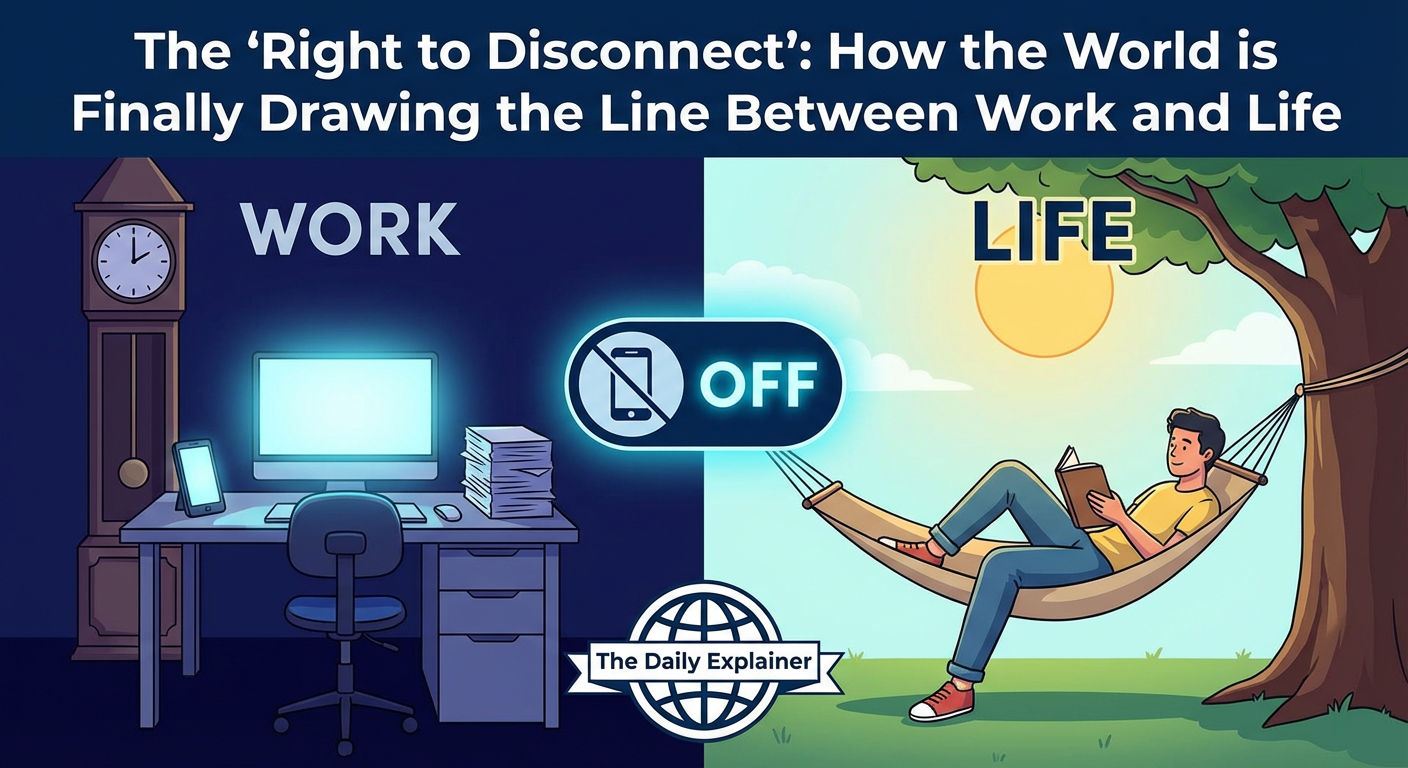
This scenario is the daily reality for millions. But around the globe, a powerful new idea is fighting back: the “Right to Disconnect.” This is not just a trendy phrase; it is becoming actual law, a formal workplace policy, and a radical cultural shift that says: Your time off is sacred, and your employer does not have an all-access pass to your life.
For decades, the rise of smartphones and “always-on” communication tools blurred the lines between professional and personal life. The expectation to be perpetually available crept in silently, fueled by hustle culture and the fear of appearing uncommitted. But the consequences—burnout, anxiety, destroyed relationships, and plummeting creativity—have sparked a global backlash.
In my experience, consulting with companies on workplace culture, I’ve seen both extremes. I worked with a startup where the founder would regularly text employees at midnight with “brilliant ideas,” creating a culture of exhausted panic. Conversely, I helped a mid-sized tech firm implement a “Right to Disconnect” policy. In my first check-in three months later, an employee told me, with tears in her eyes, “I just read my kid a full bedtime story for the first time in a year without looking at my phone. I got my evenings back.” This isn’t just about policy; it’s about giving people back their humanity.
The data is now undeniable. A landmark 2025 study by the World Health Organization officially classified “Chronic Workplace Telepressure” as a significant contributor to global anxiety disorders. Meanwhile, countries and companies pioneering disconnect laws are reporting surprising results: increased productivity, higher employee retention, and a resurgence of innovative thinking. This is the story of how we are collectively relearning how to shut down, log off, and reclaim our lives outside of work.
The Great Blur: How Work Crept Into Every Corner of Life
To understand the revolution, we must first understand the problem it’s solving. The “always-on” culture wasn’t born overnight. It was a slow-motion merger between several powerful forces:
- The Technology Trap: The smartphone is the ultimate double-edged sword. It gave us flexibility and freedom but also installed a pocket-sized office that never closes. Email, once a formal business tool, became an instantaneous, informal demand channel. Messaging apps like Slack and Teams created virtual offices where the “watercooler” chatter and urgent requests exist in the same endless scroll.
- The Rise of Remote and Hybrid Work: The massive shift to remote work, accelerated by global events, shattered the physical boundary of “the office.” Your home became your workplace. When your desk is ten feet from your bed, the mental separation between “work mode” and “home mode” collapses. Logging off requires immense psychological discipline when your laptop is right there, glowing.
- Hustle Culture Mythology: For years, popular culture celebrated the grind—the founder who sleeps four hours, the employee who sends emails at 2 AM. Being “busy” became a badge of honor. This created an unspoken pressure: if you’re not always working, you’re not ambitious enough. It confused presence for productivity and hours for output.
The result was a state of constant, low-grade alertness known as “anticipatory stress.” Your brain never fully powers down because it’s perpetually waiting for the next ping. This isn’t sustainable. The human mind needs true downtime—time for what psychologists call “default mode network” activity—to consolidate memories, generate creative ideas, and simply recharge.
Defining the “Right to Disconnect”: More Than Just Ignoring Your Phone
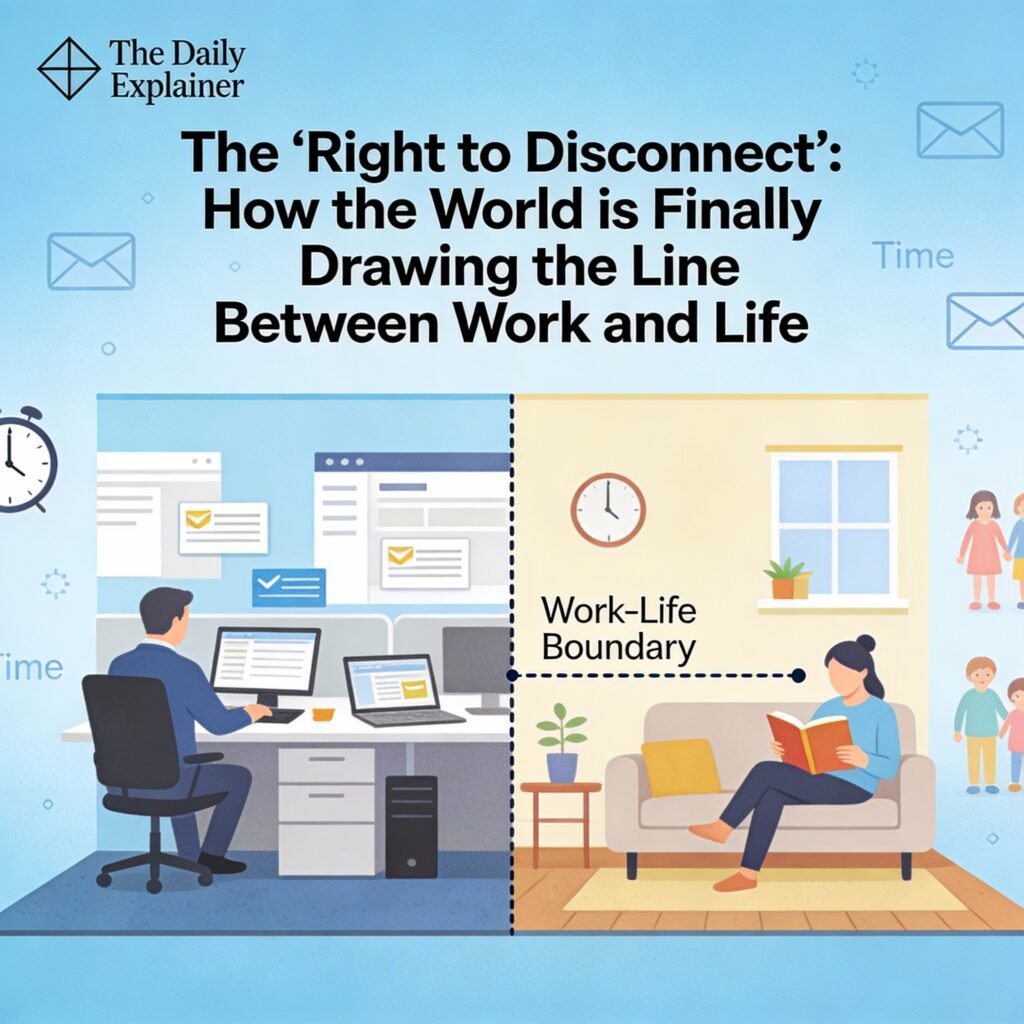
So, what exactly is this right? It’s more nuanced than a simple “no emails after 6 PM” rule. At its core, the Right to Disconnect is a worker’s legal or contractual entitlement to be free from work-related digital communications outside of their standard working hours without fear of reprisal.
Let’s break down the key components:
- It’s About Boundaries, Not Silence: It doesn’t mean colleagues can never contact you. It means that unless it is a genuine, predefined emergency, there is no expectation for you to read, acknowledge, or respond to that communication until your next work period begins.
- Freedom from Reprisal: This is the legal backbone. An employee who exercises this right cannot be penalized, passed over for promotion, or seen as less dedicated. This protects the right from being just an empty statement.
- Obligation on the Employer: The responsibility isn’t just on the employee to “be stronger.” The law or policy obligates the company to create a culture that respects these boundaries. This includes training managers, setting clear communication protocols, and leading by example.
- Defined “Disconnection Periods”: These are typically after standard work hours, on weekends, and during public holidays and approved vacation time.
Importantly, this right is closely linked to but distinct from two other concepts:
- Work-Life Balance: This is the broader, desired outcome—a healthy equilibrium.
- Digital Wellbeing: This refers to the personal practices and tools used to manage technology use. The Right to Disconnect is the structural, organizational framework that makes digital wellbeing possible.
How It Actually Works: A Step-by-Step Guide to Implementation
For a “Right to Disconnect” to be effective, it must move from a poster on the wall to a practiced reality. Here is how forward-thinking organizations are making it work.
Step 1: The Foundation – Policy Creation
A clear, written policy is essential. This isn’t a vague value statement. It explicitly defines:
- Standard Working Hours: When is the “on” time for your organization?
- Communication Channels: Which tools (email, Slack, WhatsApp groups) are covered by the policy?
- The Definition of an Emergency: What constitutes a true crisis that warrants an after-hours contact? (e.g., “The website is down and losing $10,000 per hour,” not “I had a thought about the Q3 report.”) A required protocol for emergency contact is established.
- Manager Responsibilities: Guidelines for managers on planning and respecting boundaries.
- Employee Rights & Process: How employees can raise concerns if the policy is violated.
Step 2: Cultural Preparation & Training
Rolling out a policy without preparing the culture is a recipe for failure. This involves:
- Leadership Modeling: The CEO and senior leaders must visibly adhere to the policy. If the boss is emailing at 10 PM, the policy is dead.
- Manager Training: Managers are often the biggest pressure point. They must be trained on realistic workload planning, asynchronous communication, and how to handle their own anxiety about not getting an immediate response.
- Company-Wide Launch: Communicate the “why” passionately. Frame it not as a restriction, but as an investment in employee health, sustainability, and long-term performance.
Step 3: Technical Enablers & Tools
Policy is supported by technology:
- Scheduled Send: Encouraging the use of “schedule send” features for emails written outside of hours.
- Channel Pausing: Using features like Slack’s “Do Not Disturb” scheduling or muting non-urgent channels.
- Separate Work Profiles: Encouraging the use of separate work profiles on smartphones (a built-in feature on Android and iOS) to allow for a true digital separation.
- Out-of-Hours Autoreplies: A simple auto-reply stating, “I have completed my workday and will respond during my next working hours,” normalizes the behavior.
Step 4: The Practice of Asynchronous Work
This is the most critical behavioral shift. The “Right to Disconnect” only works if work is not designed for instant reaction. Teams must learn asynchronous communication principles:
- Default to Documentation: Share updates in a shared document (like a Wiki or Notion) instead of a meeting that requires everyone’s simultaneous presence.
- Clear, Actionable Messages: Communications should be thorough enough that the recipient has all context needed to act when they next log on, eliminating back-and-forth clarifications.
- Respect for Focus Time: Protecting large, uninterrupted blocks of time during the day for deep work reduces the panic that pushes work into the evening.
Step 5: Ongoing Monitoring & Reinforcement
This is not a “set and forget” initiative. It requires:
- Regular Pulse Surveys: Checking in on employee well-being and perceived pressure.
- Open Feedback Channels: Creating a safe way for employees to report pressure without fear.
- Celebrating Success: Recognizing teams and leaders who are exemplars of healthy boundary-setting.
Key Takeaway: The Implementation Flywheel
A successful Right to Disconnect creates a virtuous cycle: Clear Policy → Leader Modeling → Tools & Training → Async Practices → Better Rest → Increased Creativity & Productivity → Stronger Cultural Commitment. It’s a system, not just a rule.
The Compelling Case: Why This is a Win for Everyone
The push for disconnect rights is often framed as employees versus employers. This is a false dichotomy. When implemented well, it creates a classic win-win scenario.
For Employees (The Obvious Wins):
- Mental Health Restoration: Reduced anxiety, lower risk of clinical burnout, and improved sleep.
- Reclaimed Personal Life: Time for family, hobbies, community, and simply being a human, not just a worker.
- Increased Autonomy & Trust: Being measured by output, not online presence, fosters professional respect and empowerment.
- Renewed Creativity: True downtime is where the subconscious makes unexpected connections, leading to more innovative problem-solving at work.
For Employers (The Strategic Wins):
- Higher Productivity: Contrary to old fears, rested, focused employees get more meaningful work done in fewer hours. France, an early adopter, saw no drop in economic productivity after its law passed.
- Talent Attraction & Retention: In a 2026 LinkedIn Global Talent Trends report, “Respect for Time Boundaries” shot into the top three factors candidates consider when choosing an employer. This is a powerful recruiting tool.
- Reduced Burnout & Healthcare Costs: Lower stress means fewer sick days, lower turnover costs, and reduced claims on company health plans.
- Stronger, More Resilient Culture: A culture that values sustainability over heroics builds deeper loyalty and collective resilience for the long haul.
For Society (The Big-Picture Wins):
- Stronger Communities: When people have time and energy for family, friends, and local causes, civil society thrives.
- Rethinking Success: It challenges the toxic narrative that self-worth is tied to busyness.
- Digital Citizenship: It fosters a healthier relationship with technology for all of us.
The Future of Disconnection: Sustainability and Evolution
This is not a passing fad. The “Right to Disconnect” is evolving into a core component of sustainable work in the 21st century. Here’s what the future holds:
- Global Legislative Domino Effect: Following the lead of France (2017), Spain (2021), Portugal (2021), and Ireland (2021), more countries are drafting laws. Canada passed its Right to Disconnect Act in 2025, and several U.S. states (like New York and California) have active bills in their 2026 legislative sessions. The European Union is considering a bloc-wide directive. The trend is unequivocal.
- Integration with “Right to Flex”: The future is about autonomy within boundaries. The next evolution pairs the “right to disconnect” with the “right to flexible work.” The deal becomes: “You have immense control over when and where you work, and in return, we all respect protected, uninterrupted off-time.” It’s a trade of flexibility for presence.
- Technology as a Solution, Not Just a Problem: Expect a wave of “wellbeing by design” tech. Think of tools that:
- Auto-detect stress levels from typing patterns and suggest breaks.
- Enforce disconnect policies at a system level (e.g., enterprise software that locks employees out of certain functions outside of hours).
- Use AI to prioritize and batch notifications to minimize interruptions.
- A Redefinition of “Professionalism”: The old ideal of the always-available, instant responder is fading. The new professional is the communicator who is clear, thorough, and respectful of others’ time, not the one who replies fastest. This is a profound cultural shift that will take a generation to fully cement.
Busting the Myths: Common Misconceptions About Disconnecting
Misconception 1: “It will kill productivity and responsiveness to clients.”
Reality: This is the most common fear, and it’s consistently proven wrong. Studies of companies with strong disconnect cultures show that productivity metrics either hold steady or improve. Clients learn the boundaries, and emergencies are handled through clear protocols. The chaos of perpetual urgency is replaced with reliable, planned execution.
Misconception 2: “It’s only for salaried office workers. What about hospitals/restaurants/essential services?”
Reality: The principle applies to all work, but the implementation differs. For shift-based or on-call work, the “disconnection period” is clearly defined as the time between scheduled shifts. The right protects that time just as fiercely. It also mandates fair compensation and predictable scheduling for those in irregular roles.
Misconception 3: “Employees will abuse it and become lazy.”
Reality: This is a fundamental trust issue. A vast majority of employees want to do good work. Policies built on distrust create the very behaviors they fear. A disconnect policy built on respect and clear goals empowers responsible adults to manage their time and energy to deliver their best work.
Misconception 4: “If I don’t respond, someone else will get the promotion.”
Reality: This is why the “freedom from reprisal” clause in law is critical. It protects employees from this exact fear. The role of leadership is to evaluate performance based on results and impact, not on after-hours green status dots.
The Global Landscape: Recent Developments (2024-2026)
The movement is accelerating with concrete actions:
- Canada’s National Law (2025): The Canadian Right to Disconnect Act requires all federally regulated employers to develop a disconnect policy in consultation with employees. It’s a flexible framework that recognizes different workplace needs but mandates the conversation and formal agreement.
- U.S. State-Level Momentum: New York’s proposed bill is one of the most comprehensive, requiring private employers with 10+ employees to have a policy and establishing a private right of action for violations. California’s bill focuses on “digital fasting” periods.
- Corporate Policy Race: Even without laws, companies are acting. In early 2026, Microsoft Germany made headlines by instituting a “company-wide digital shutdown” from 6 PM Friday to 6 AM Monday, where all internal communications platforms are turned off. Their internal data showed a 23% decrease in reported stress and a 15% increase in project completion rates the following month.
- Union Advocacy: Labor unions worldwide have made the “Right to Disconnect” a central bargaining point. Successful negotiations at major automakers and telecom companies in Europe have set powerful precedents for collective agreements.
Success Stories in Action
Case Study 1: The European Tech Giant (A “Before and After”)
- Before: A fast-growing SaaS company had a culture of “heroic effort.” Weekend deployments were common, and Slack was a 24/7 firehose. Burnout turnover was over 25%. A top engineer left a resignation note that simply said, “I need to remember what my kids’ voices sound like without headphones on.”
- The Intervention: A new CEO, hired in 2024, made well-being the first priority. They implemented a strict Right to Disconnect policy, hired a “Head of Work Sustainability,” and retrained all managers. They introduced “Focus Fridays” (no meetings) and used technology to mute all non-urgent notifications from 7 PM to 7 AM.
- After (18 Months Later): Voluntary turnover dropped to 8%. Employee satisfaction scores on “work-life balance” jumped from 3.2/10 to 8.7/10. Most tellingly, product release cycles became more predictable and reliable because work was planned, not reactive. The CEO stated, “Our most valuable metric is now uninterrupted employee off-time. It predicts everything else.”
Case Study 2: The Small Marketing Agency
A 25-person agency felt constant client pressure for instant revisions. The founder, herself burnt out, implemented a simple rule: “No communication after 6 PM or on weekends. For true emergencies, call my cell. You get three emergency calls a year per client. Use them wisely.”
- Result: Clients initially pushed back but adapted. The agency found clients prepared better briefs during the day. The team’s creative output improved dramatically because they had time to recharge. The founder reported her own relationship with her family transformed. As she told WorldClassBlogs in an interview for their Our Focus series, “We didn’t lose a single client. We just gained our lives back.”
Real-Life Examples and Personal Scenarios
- The “Out of Office” That Means It: Jane, a project manager in Dublin, sets an auto-reply after 5:30 PM that says, “I have disconnected for the day to spend time with my family. I will respond to your email during my next working hours. If this is urgent, please resend with ‘URGENT’ in the subject line and text my manager at [number]. Thank you for respecting this boundary.” This simple tool trains her colleagues and clients.
- The Team Agreement: A design team in Toronto has a pinned agreement in their Slack: “We are an async-first team. We respond within 24 hours, not 24 minutes. No expectation of response outside 9-5 local time. For collaborative brainstorming, we use Figma comments, not live calls.”
- The Manager’s Pledge: David, a senior director, ends every team meeting by stating his working hours and his disconnect time. He says, “If I send an email late, it’s because it works for my flow. I have scheduled it for your morning. I do not expect a response until you are working.” This explicit statement removes ambiguity and fear.
Conclusion and Key Takeaways: Reclaiming Your Time, Redefining Success
The “Right to Disconnect” movement is about more than just turning off notifications. It is a fundamental recalibration of the contract between work and life. It asserts that time off is not a loophole or a privilege, but a non-negotiable requirement for human health, creativity, and sustainable performance.
The core truth is this: A culture that respects boundaries is not a fragile culture. It is a resilient, trusting, and high-performing one. It acknowledges that employees are whole human beings with lives that fuel their work, not just resources to be depleted.
Your Key Takeaways:
- This is Inevitable: Whether through law or market force, the future of work includes protected disconnect time. It is becoming a standard, not a perk.
- It’s a System, Not a Switch: Success requires policy, technology, training, and most of all, a shift in leadership behavior and organizational values.
- The Benefits are Mutual: Employees gain well-being, employers gain productivity and loyalty. It is the end of the false trade-off between performance and humanity.
- You Can Start Now: You don’t need a law to begin. You can set personal boundaries, have team conversations, use “schedule send,” and model the behavior you want to see.
- The Goal is Integration, Not Segregation: The ultimate aim is not a rigid wall between work and life, but a conscious, controlled integration where you are in charge of the blend, not your inbox.
The global conversation has shifted. The question is no longer “Can we afford to give people time off?” but “Can we afford not to?” The path forward is clear: to build a world where work serves life, not the other way around.
For more insightful explanations on the forces shaping our daily lives, explore our archive at The Daily Explainer’s Explained section.
Frequently Asked Questions (FAQ)
Q1: Is the “Right to Disconnect” a law where I live?
A: It depends. As of 2026, it is national law in France, Spain, Portugal, Ireland, Belgium, and Canada (federally regulated sectors). Several other countries (Italy, Germany, India) have it in certain sectors or via court rulings. In the United States, there is no federal law, but states like New York and California are considering bills. Many companies worldwide have adopted voluntary policies. Check your local labor authority or your company handbook.
Q2: My boss says our industry is too fast-paced for this. Is that true?
A: All industries have rhythms, but “fast-paced” often masks poor planning and a culture of crisis. High-stakes fields like finance, tech, and media have successfully implemented these policies by defining clear emergency protocols and shifting to better asynchronous coordination. The pace of response may change, but the quality and sustainability of output improve.
Q3: What if I’m a freelancer or run my own business?
A: This is arguably more important for you. Without the structure of an employer, you must be your own protector. Establish clear “office hours” on your website and in client contracts. Use booking links that only show your availability. Your professionalism is defined by the quality of your work and your clear processes, not your 24/7 availability. Resources like SheraKat Network’s guide to starting an online business often emphasize boundary-setting as a key to sustainability.
Q4: Doesn’t this just mean work will pile up and be more stressful the next day?
A: This points to a workload issue, not a disconnect issue. A proper disconnect policy must be paired with realistic workload management. If there is consistently more work than can be done in standard hours, that is a resourcing problem that a manager needs to solve. Disconnection protects the time to recharge so you can handle the work you do have effectively.
Q5: How do I talk to my manager about this without sounding like I’m slacking off?
A: Frame it positively and proactively. Tie it to performance and sustainability. You could say: “I’m thinking about how to ensure I’m bringing my most focused, creative energy to my key projects. To do that, I need to protect some uninterrupted off-time to recharge. Can we discuss what a ‘disconnect’ agreement might look like for our team, so we can all perform at our best sustainably?” Use data on burnout and productivity to support your case.
Q6: What about global teams across different time zones?
A: This makes asynchronous communication essential, not optional. The policy must be based on local working hours. The expectation is that you respond within one business day, not instantly. Tools like Slack allow you to set your working hours, so notifications are held until you’re online. It requires more thoughtful communication (leaving thorough briefs) but leads to better outcomes.
Q7: Can I be forced to install work apps on my personal phone?
A: In many jurisdictions with disconnect laws, the “right” includes the right to refuse to install work communication tools on a personal device. If the company requires you to be reachable, they may need to provide a separate work phone, which you can physically turn off.
Q8: What’s the difference between this and just having a strong “work-life balance” personal ethic?
A: Personal ethics are vulnerable to power dynamics. If the culture rewards always-on behavior, your personal boundary will be seen as a lack of commitment. The “Right to Disconnect” creates a collective, protected standard that removes the individual stigma and competitive disadvantage of setting boundaries. It levels the playing field.
Q9: How do we handle true on-call roles, like IT support?
A: For legitimate on-call rotations, the rules are different but still clear. Employees must be formally scheduled for on-call duty, compensated significantly for that standby time (often a premium pay rate), and have a defined response time. Crucially, when they are not on the on-call schedule, the standard Right to Disconnect applies fully. The key is predictability and compensation.
Q10: Won’t this just lead to people working “under the table” secretly to get ahead?
A: This is a cultural trust issue. If the performance review system truly rewards results and impact (not hours logged), this behavior is disincentivized. Leadership must actively recognize and reward sustainable high performance, not martyrdom. Secret work often stems from fear, not ambition.
Q11: What are the first three things I can do tomorrow to start implementing this?
A: 1) Personal: Turn on “Do Not Disturb” scheduling for all work apps on your phone from 7 PM to 7 AM. 2) Team: In your next team meeting, propose a simple agreement like “No new Slack threads after 6 PM.” 3) Communication: Start using “Schedule Send” for every email you write outside standard hours.
Q12: How does this work with flexible schedules? If I work 12 PM-8 PM, do I have to disconnect at 5 PM?
A: No. The right is tied to your defined working hours. If your agreed schedule is 12-8 PM, your disconnect period begins at 8:01 PM. The policy protects your non-work hours, whenever they are.
Q13: Are there any good tools to help enforce this for myself?
A: Yes! Use features like: Focus Modes (iOS/Android), Slack’s “Pause Notifications” scheduling, Outlook’s “Quiet Time,” and apps like Freedom or Cold Turkey Blocker to limit access to work sites after hours.
Q14: What if a client or external partner violates my boundary?
A: This is where organizational backing is crucial. Your manager or company should support you. A standard response can be, “Thank you for your message. Per our company’s working hours policy, I’ve received this and will address it during my next working period, beginning [Time/Date].” Consistency trains external parties.
Q15: Could this hurt career advancement in companies that don’t officially have a policy?
A: There is a risk in toxic cultures. This is why legislative protection is so important—it removes that risk. In the absence of a law, you must assess your company’s true values. More and more, data shows that companies valuing sustainable performance are outperforming burnout factories in the long run.
Q16: What about checking email quickly just to reduce anxiety about what’s waiting?
A: This is the trap! The “quick check” rarely reduces anxiety; it just activates your work stress receptors and ruins your recovery time. The goal is to break the compulsion. Try a full 24-hour digital detox from work to reset your nervous system. You’ll see the world doesn’t end.
Q17: How do I disconnect when my work is also my passion?
A: This is a tricky but important distinction. Even passion needs rest. Schedule “passion project” time separately from “obligation work” time. Use different physical spaces or devices if possible. The principle is to maintain conscious choice over your engagement, rather than letting it bleed into all waking hours uncontrollably.
Q18: What are the penalties for companies that break disconnect laws?
A: It varies by country. In France, fines can be substantial. In others, like Ireland, the penalty is primarily that an employee can bring a case to a labor court, which can award compensation and force the company to create a policy. The reputational damage is often a bigger deterrent.
Q19: Is this part of a larger movement?
A: Absolutely. It’s a cornerstone of the broader “Future of Work” conversation, which includes the 4-day workweek, universal basic income experiments, and the shift to human-centered leadership. It’s all about redesigning work for human well-being. You can follow these larger trends in our Global Affairs & Politics category, as economic policy and labor law are deeply intertwined.
Q20: Where can I learn more about advocating for this in my workplace?
A: Look for white papers from organizational psychology groups, reports from the International Labour Organization (ILO), and case studies from companies that have done it well. Reach out to your HR department with resources in hand. Connecting with a professional network, like those discussed on the SheraKat Network blog, can also provide support and strategies.
About the Author
The author is a workplace culture strategist and former organizational psychologist who has advised Fortune 500 companies and fast-growing startups on building sustainable, high-performance cultures. Having witnessed the human and financial cost of burnout firsthand, they have become a leading voice in the “Human-First Work” movement. They believe that the future of competitive advantage lies not in extracting more hours, but in fostering more engaged and creative minds. Their writing aims to translate complex socio-economic trends into actionable insights for both employees and leaders. For more of their analysis, visit The Daily Explainer’s blog or connect via The Daily Explainer’s contact page.
Free Resources & Further Reading
- The “Digital Detox” Starter Kit: A free PDF guide with a 7-day plan to reclaim your attention. (Available via SheraKat Network Resources)
- Template Library: Downloadable “Right to Disconnect” policy templates for companies of different sizes, and sample email scripts for setting boundaries with clients.
- The “Time Off” Calculator: An interactive tool that shows the real financial cost of employee burnout versus the ROI of well-being initiatives.
- Global Tracker Map: An up-to-date interactive map showing which countries and states have passed disconnect legislation. (A great resource from non-profit advocacy groups, similar to those featured in the WorldClassBlogs Nonprofit Hub).
- Book Recommendations: “A World Without Email” by Cal Newport, “Rest: Why You Get More Done When You Work Less” by Alex Soojung-Kim Pang, and “The Burnout Epidemic” by Jennifer Moss.
Join the Discussion
Has your company implemented a disconnect policy? What has been your biggest challenge in “switching off”? Do you think laws are necessary, or can culture change alone solve this?
Share your stories, tips, and frustrations in the comments below. Let’s learn from each other and build a community advocating for saner workplaces. For the latest news on legislative changes, keep an eye on our Breaking News category.
(Note: By participating, you agree to our Terms of Service, promoting respectful and constructive dialogue.)
About The Author