Why good advice often fails: it assumes a rational actor. Behavioral hacks work with your human psychology, not against it.
Introduction – Why This Matters
You know you should save more. You understand compound interest. You’ve read the articles about smart investing. Yet, you still find yourself making impulsive purchases, delaying opening that retirement account, or feeling paralyzed when faced with too many financial choices. The problem isn’t a lack of knowledge; it’s that knowledge alone is powerless against the psychology of money. Recent studies consistently show that our financial behaviors are driven less by spreadsheet logic and more by deep-seated cognitive biases, emotional triggers, and mental shortcuts developed over a lifetime.
This article is your guide to the invisible forces shaping your financial life. For the curious beginner, this is the missing key to understanding why you do what you do with money. For the professional, it’s a masterclass in the behavioral frameworks that can predict and improve financial outcomes far more reliably than market forecasts. What I’ve found, through both research and coaching, is that addressing the “why” behind financial decisions is more transformative than any budgeting template. By understanding the behavioral psychology of money, you can stop fighting against your own brain and start designing systems that make good financial behavior the easiest, most automatic choice. Let’s move from willpower to wiring.
Background / Context: The Rise of Behavioral Finance
For decades, traditional economic theory operated on the “rational actor” model—the idea that humans make financial decisions by logically weighing costs and benefits to maximize utility. This model is elegant, but it’s wrong. In the late 20th century, psychologists like Daniel Kahneman and Amos Tversky (Nobel Prize, 2002) began to systematically document the ways human judgment deviates from rationality. Their work birthed behavioral economics, a field that merges psychology with economics to explain why we make the financial choices we do.
This matters because our financial environment is a minefield of psychological triggers. Marketing is designed to exploit our impulses. Investment platforms use confetti animations to gamify trading. The sheer complexity of financial products leads us to choose the default option or procrastinate entirely. Furthermore, money is rarely just about money; it’s intertwined with our identity, sense of security, family history, and emotional states like fear, shame, or optimism. Recognizing that financial decisions are psychological events first and mathematical events second is the first step toward true mastery. Understanding these underlying forces is as crucial for personal finance as it is for navigating complex global supply chains in business—both require managing complex systems and human behavior.
Key Concepts Defined
- Cognitive Bias: A systematic pattern of deviation from norm or rationality in judgment. Essentially, mental shortcuts (“heuristics”) that often lead to errors.
- Loss Aversion: The psychological principle that losses loom larger than gains. The pain of losing $100 is far more intense than the pleasure of gaining $100. This explains why we sell winning investments too early (to lock in gains) and hold onto losers too long (to avoid realizing a loss).
- Present Bias (or Hyperbolic Discounting): The tendency to overvalue immediate rewards at the expense of long-term goals. This is why we choose to spend money now rather than save for retirement decades away.
- Mental Accounting: Treating money differently depending on its source or intended use, even though a dollar is a dollar. E.g., treating a tax refund as “free money” to splurge, while being frugal with your salary.
- Anchoring: Relying too heavily on the first piece of information offered (the “anchor”) when making decisions. Seeing a shirt “marked down” from $100 to $60 feels like a better deal than seeing it priced at $60 from the start, even if $60 is its true value.
- The Planning Fallacy: The tendency to underestimate the time, costs, and risks of future actions while overestimating the benefits. Common in budgeting and project planning.
- Choice Paralysis/Overload: When too many options lead to stress, poor decisions, or decision avoidance (like failing to choose a 401(k) fund).
- Emotional Accounting (or the “Pain of Paying”): The psychological discomfort experienced when spending money. This pain is reduced by using credit cards (deferred pain) or digital wallets (abstracted pain), leading to overspending.
How It Works: Identifying and Hacking Your Financial Psychology (Step-by-Step)
This is a process of self-observation, framework application, and system design.
Step 1: Self-Audit – Map Your Money Triggers & Narratives
- The Money Story Journal: For two weeks, keep a log of every financial decision, no matter how small. Next to each, note: a) The emotion you felt (stress, excitement, fear, guilt). b) The context (tired after work, scrolling social media, with friends). c) The internal narrative (“I deserve this,” “This is a good deal,” “I’ll figure it out later”).
- Identify Your “Money Scripts”: These are unconscious beliefs about money formed in childhood (e.g., “Money is the root of all evil,” “Rich people are greedy,” “We’ll never have enough”). They act as an invisible operating system. Uncover them by asking: What did my family believe about money? What was never discussed? What did I learn from observing my parents?
- Pinpoint Your Bias Profile: Review your journal. Do you see patterns of loss aversion (holding bad investments)? Present bias (late-night online shopping)? Mental accounting (treating bonuses differently)? This is your personal bias fingerprint.
Step 2: System Design – Build “Choice Architecture” That Works For You
Instead of relying on willpower, redesign your environment to make good choices automatic and bad choices difficult.
- Automate the Important Stuff: This is the single most powerful hack. Set up automatic transfers to savings, investments, and debt payments on payday. This bypasses present bias—the money is gone before you can spend it.
- Implement Friction for Temptation: Make impulsive spending harder. Delete shopping apps, unsubscribe from marketing emails, don’t save credit card info on websites, or institute a mandatory 24-hour waiting period for any non-essential purchase over a certain amount.
- Use Commitment Devices: Bind your future self to good behavior. Schedule an annual meeting with a fee-only financial advisor. Use apps that penalize you for not meeting savings goals (e.g., by donating to a charity you dislike). Tell a trusted friend your financial goal for accountability.
Step 3: Reframe Your Perspective – Combat Cognitive Biases
- Fight Loss Aversion with Reframing: When considering an investment loss, ask: “If I didn’t own this asset, would I buy it at today’s price?” This separates the emotional baggage of the past loss from the rational decision for the future.
- Overcome Present Bias with Vivid Future-Self Visualization: Make your future self real. Use an aging app to see yourself at 65. Write a letter from your future self thanking you for the sacrifices you’re making today. Name your retirement account something meaningful (“Beach House Fund,” “Freedom Account”).
- Shatter Mental Accounting with the “One-Pot” Philosophy: Consciously remind yourself that all money is fungible. A tax refund isn’t a bonus; it’s a return of your own overpayment. A work bonus is part of your income. Direct all windfalls immediately to your goals (e.g., 50% to debt, 50% to savings) before the mental accounting trap can spring.
Step 4: Manage Information & Simplify Choices
- Combat Choice Paralysis with the “Three-Option Rule”: When faced with overwhelming choices (e.g., 50 mutual funds), force yourself to pre-select only three to compare in depth. Use a simple filter: “Low-cost index funds from a reputable provider.”
- Defuse Anchoring by Seeking Independent Benchmarks: Before buying a “discounted” item, research its true market price elsewhere. Before accepting a salary offer, know the independent range for your role and location.
- Counter the Planning Fallacy with the “Multiply-by-1.5” Rule: For any budget or timeline you create, take your initial estimate and multiply the cost by 1.5 and the time by 1.5. This builds in a realistic buffer for the unforeseen.
Step 5: Cultivate Emotional Awareness & Resilience
- Create an “Emotional Spending” Budget Category: Instead of trying to eliminate emotional spending (impossible), acknowledge and plan for it. Allocate a small, guilt-free amount each month for “comfort spending.” When the urge strikes, use this category. Once it’s gone, it’s gone.
- Implement a “Financial Sabbath”: One day a week or one weekend a month, declare a complete moratorium on making any financial decisions, checking investment balances, or even thinking about money problems. This breaks the cycle of anxiety and allows for clearer thinking.
- Practice “Temptation Bundling”: Only allow yourself a guilty pleasure (favorite podcast, streaming show, fancy coffee) while doing a financial “chore” you avoid, like reviewing your budget or reconciling accounts. This links a positive reward to a necessary behavior.
Key Takeaway Box: The Behavioral Mindset
You are not a perfectly rational computer. You are a human with a beautifully complex, sometimes flawed, brain shaped by evolution and experience. The goal is not to eliminate emotion or bias, but to become aware of your own psychological patterns and build financial structures that are “human-proof.”
Why It’s Important: The Hidden Cost of Ignoring Psychology
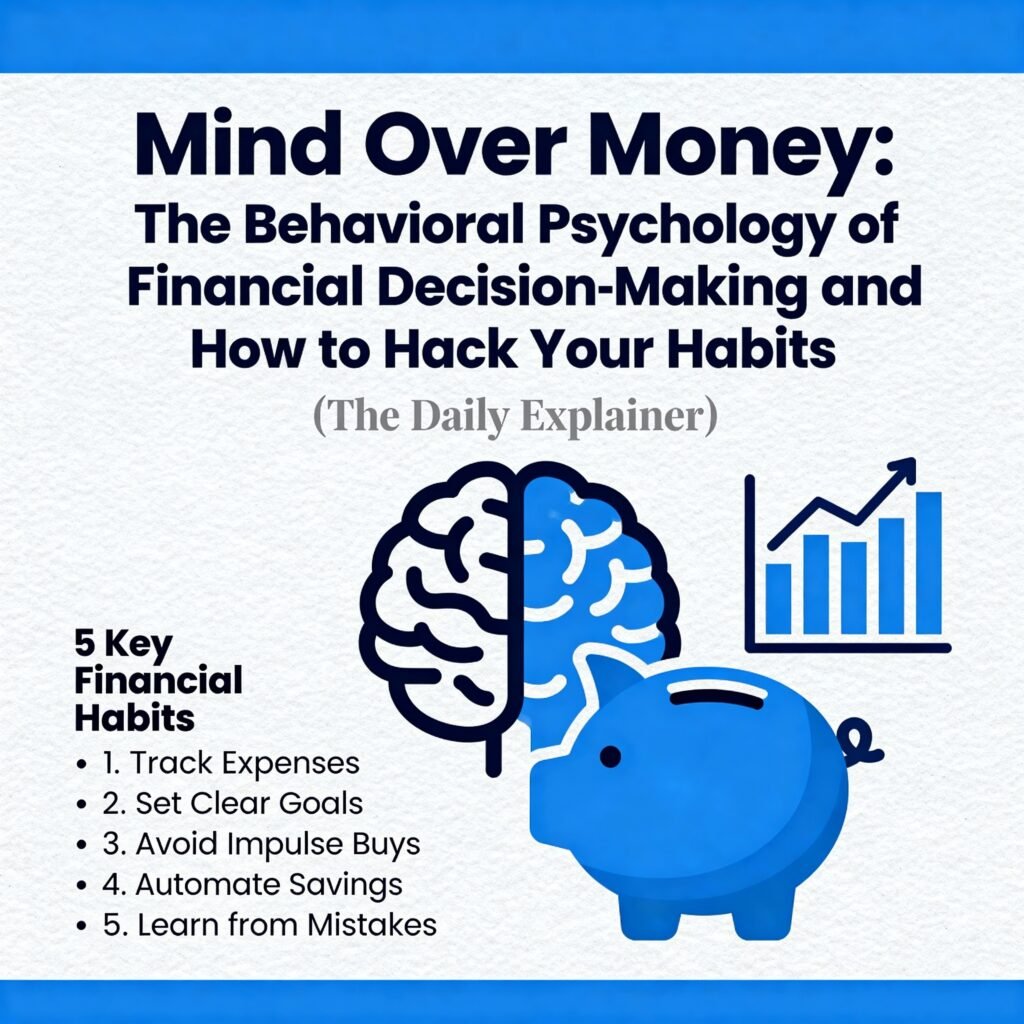
Ignoring the psychological dimension of money has profound costs that pure financial literacy cannot solve.
- The “Gap” Problem: This explains the frustrating gap between knowing what to do and actually doing it. Behavioral science bridges this gap by addressing the motivational and cognitive barriers to action.
- Significant Financial Leakage: Impulse spending driven by emotional states, poor investment decisions fueled by fear or greed, and procrastination on vital tasks (like rebalancing or will-writing) can cost hundreds of thousands of dollars over a lifetime.
- Chronic Stress and Anxiety: Feeling out of control with money is a major source of psychological distress. Understanding that your struggles have a logical, psychological basis—and are not a personal moral failing—reduces shame and empowers change.
- Improved Relationship with Money: By untangling money from your self-worth and emotional triggers, you can approach it as a practical tool for life design, leading to greater overall well-being and satisfaction.
Sustainability in the Future
The future of personal finance will be increasingly behavioral-first, with technology as the delivery mechanism.
- AI-Powered Behavioral Coaches: Apps will evolve from trackers to therapists. Using your transaction data and self-reported moods, they will identify your unique triggers (“You spend 40% more on Fridays when it rains”) and deliver micro-interventions in real-time (“Noticing stress? Let’s review your budget goal before you click ‘buy’.”).
- Hyper-Personalized “Nudge” Engines: Financial platforms will use vast datasets to determine which type of nudge works for you. Are you motivated by social comparison, loss framing (“Don’t miss out on your match!”), or goal visualization? The interface will adapt accordingly.
- Gamification for Good: Advanced gamification will make building positive financial habits as engaging as a good video game, using streaks, levels, and meaningful rewards that align with long-term wealth building, not short-term spending.
- Integration with Biometric Data: With consent, future apps could use wearable data (heart rate, sleep quality) to predict periods of high financial decision risk (e.g., high stress, low willpower) and temporarily increase friction on spending channels or surface calming financial affirmations.
- Focus on Financial Therapy as Mainstream: The field of financial therapy—addressing the emotional and relational aspects of money—will become a standard component of financial planning, as essential as investment advice.
Common Misconceptions
- Misconception 1: “Smart people don’t make these mistakes.”
- Reality: Cognitive biases are universal. In fact, research shows that higher cognitive ability can sometimes lead to more overconfidence, making one more susceptible to certain biases like the planning fallacy. Intelligence is no shield against human psychology.
- Misconception 2: “It’s all about willpower and discipline.”
- Reality: Willpower is a finite resource that depletes with use (a concept called “ego depletion”). Relying on it for daily financial discipline is a recipe for failure. The behavioral approach is to conserve willpower by designing systems that don’t require it.
- Misconception 3: “Emotion has no place in financial decisions.”
- Reality: Emotion is always present. The goal isn’t to be a robot; it’s to recognize which emotions are driving you (fear, greed, euphoria) and decide whether they are serving your long-term interests. Harnessing positive emotions (like hope for the future) can be a powerful motivator.
- Misconception 4: “Once I understand a bias, I’m immune to it.”
- Reality: Knowledge alone does not confer immunity. This is known as the “bias blind spot”—the cognitive bias of recognizing biases in others while failing to see them in oneself. Systematic environmental design (hacks) is still required.
- Misconception 5: “This is just an excuse for bad behavior.”
- Reality: Behavioral psychology is not an excuse; it’s an explanation and an empowerment tool. It removes moral judgment (“I’m bad with money”) and replaces it with a diagnostic framework (“My present bias is activated; I need to automate my savings”).
Recent Developments (2025/2026)
- Generative AI as a Behavioral Simulator: Individuals can use AI chatbots to role-play difficult financial conversations (asking for a raise, discussing money with a partner) or to simulate the long-term outcomes of different financial decisions, making the abstract future more tangible and reducing present bias.
- The “Dopamine Detox” Movement Influencing Finance: As people become more aware of how apps are designed to hijack attention, there’s a growing counter-movement toward “dull” financial tools: plain-text interfaces, delayed balance updates, and apps that purposely reduce engagement to encourage long-term thinking.
- Regulatory Focus on “Dark Patterns” in FinTech: Policymakers are increasingly scrutinizing and regulating design elements in banking and investment apps that exploit cognitive biases to encourage excessive trading, overdraft fees, or high-cost borrowing.
- Personalized Neurofinance: While still emerging, research is exploring how individual differences in brain structure and function correlate with financial risk tolerance and decision-making, pointing toward a future of truly personalized financial guidance.
- Integration with Mental Health Platforms: Financial wellness tools are being offered within employee assistance programs (EAPs) and mental health apps, acknowledging the direct link between financial stress and conditions like anxiety and depression.
Success Stories & Real-Life Examples
The “Impulse Spender’s” Friction Solution:
Jenna knew she spent too much on online fashion. Understanding her trigger (boredom scrolling) and bias (present bias + anchoring on “sale” prices), she didn’t just try to “be better.”
- Hack Applied: She deleted all shopping apps, unsubscribed from every retail email, and installed a browser extension that blocked her favorite sites during evening hours (her peak vulnerability). She also instituted a 48-hour cart rule.
- Result: The simple friction cut her discretionary clothing spend by over 70% in six months. The urges faded when the triggers were removed. She redirected the saved money via automation to a travel fund, aligning her spending with a deeper value (experiences over things).
The “Investment Paralysis” Case:
Marcus wanted to invest but was overwhelmed by fund choices and terrified of loss (choice paralysis + loss aversion). He opened a brokerage account but left it in cash for two years.
- Hack Applied: He used the “three-option rule” to limit his choices. He decided his criteria: one total US stock fund, one total international fund, one total bond fund—all from Vanguard. He then implemented “dollar-cost averaging” (automating monthly purchases) to overcome the fear of buying at a market peak.
- Result: He started investing within a week. The automation removed the daily decision and emotional weight. A year later, he barely checked the account, having successfully externalized the discipline.
My Own “Mental Accounting” Breakthrough:
Early on, I viewed my freelance income as “fun money” and my salary as “serious money.” I’d blow through freelance checks on gadgets while being frugal with my salary. Recognizing this as mental accounting, I instituted a new rule: all money hits one checking account. Allocate 50% to taxes, 20% to retirement, 10% to business expenses, and the remainder is just my income, budgeted normally. This simple policy erased the artificial distinction and probably saved me tens of thousands in frivolous spending over the years.
Conclusion and Key Takeaways
Mastering your financial psychology is the highest form of financial self-care. It’s the work that makes all other financial work possible and sustainable.
Final Takeaways:
- Awareness Precedes Control: You cannot change what you do not see. Start by journaling your money emotions and narratives without judgment to map your psychological landscape.
- Design Over Willpower: Stop relying on fleeting willpower. Invest your energy in building automatic systems (automation) and creating friction for bad habits. Make the right choice the easy choice.
- Reframe Your Biases: Learn the common cognitive biases and practice specific reframing techniques for each. When you feel loss aversion, ask the “would I buy it today?” question.
- Emotions Are Data, Not Directives: Your feelings about money are signals, not commands. Learn to pause and ask, “What is this emotion telling me, and is acting on it aligned with my long-term goals?”
- Start Small and Iterate: Pick one behavioral hack to implement this month—perhaps automating a savings transfer or deleting one shopping app. Success with one creates momentum for more.
Your brain is not the enemy; it’s a powerful tool that needs a user manual. This is that manual. By applying these principles, you move from being a passive participant in your financial life to its architect. For more on building systems and a mindset geared for success, resources like those from World Class Blogs on mission-driven focus can provide complementary insights.
FAQs (Frequently Asked Questions)
1. I’ve tried budgeting apps and they don’t work for me. Is something wrong with me?
No. This is a classic case of a tool mismatch. If an app makes you feel guilty, overwhelmed, or requires too much manual entry, it’s clashing with your psychology. The solution is to find a tool that aligns with your behavioral style. Try a “hands-off” aggregator that auto-categorizes, a cash-envelope digital system, or even a simple one-line budget (“Spend less than I earn and automate the rest”).
2. How can I talk to my partner about money without it turning into a fight?
Use behavioral framing. Schedule a neutral, low-stress time (not after a bill arrives). Use “I feel” statements focused on shared goals (“I feel anxious about our retirement; I’d love for us to feel secure together”). Frame it as a “we vs. the problem” puzzle, not a “you vs. me” argument. Consider using a third-party tool or mediator (like a financial therapist) to facilitate.
3. What’s the best way to deal with financial shame from past mistakes?
Practice self-compassion and cognitive distancing. Talk to yourself as you would a friend: “That was a mistake many people make. What did I learn?” Then, separate the past from the present. The person who made that mistake is not the same person you are today with this new awareness. Focus on the next right action.
4. I’m a very analytical person. How does this apply to me?
Analytical thinkers are often prone to overconfidence and analysis paralysis. You may research investments to death but never pull the trigger, or create incredibly complex budgets you can’t maintain. Your hack is simplification and pre-commitment. Set simple rules (“I will only invest in low-cost index funds”) and automate the execution to bypass your own tendency to over-analyze.
5. How does social media affect my financial behavior?
Profoundly. It fuels social comparison (“keeping up with the Joneses”), present bias (instant gratification hauls), and anchoring (seeing inflated lifestyles as normal). The hack: curate your feed. Unfollow accounts that trigger envy or spendiness. Follow accounts about financial independence, frugality, or investing. Remember, social media is a highlight reel, not a balance sheet.
6. What is “financial trauma” and how does it impact decisions?
Financial trauma is a psychological response to a deeply distressing financial event (e.g., bankruptcy, foreclosure, poverty in childhood). It can lead to hyper-vigilance (extreme risk aversion) or avoidance (complete refusal to engage with money). Healing often requires professional financial therapy to separate past trauma from present-day reality.
7. I get a rush from finding a “good deal.” Is that bad?
It’s a double-edged sword. The thrill of the hunt activates the brain’s reward system. This can lead to spending more to save more—buying things you don’t need because they’re on sale. The hack: Ask the pre-commitment question: “Would I buy this at full price?” If not, it’s not a deal; it’s just spending.
8. How can I help my children develop good money psychology?
Focus on experiential learning and mindset. Give them allowances with responsibilities. Let them make small, consequential spending mistakes early. Talk openly about family values around money. Model delayed gratification. Avoid labeling things as “we can’t afford it”; instead, say “we’re choosing to save our money for a family vacation.”
9. What is “decision fatigue” and how does it hurt my finances?
Every choice you make depletes a finite reservoir of mental energy. By the end of a day of choices, your willpower is low. This leads to defaulting to easy, often poor, financial choices (ordering takeout instead of cooking, making an impulsive purchase). The hack: Make important financial decisions in the morning. Automate everything else.
10. I’m afraid of running out of money in retirement (loss aversion). How can I overcome this?
Reframe it from loss to security planning. Use tools to calculate your “probability of success” with different withdrawal rates. Consider purchasing an annuity for a portion of your portfolio to create a guaranteed “paycheck” for life, directly addressing the fear of a total loss. Visualize the security you are building.
11. Is there a personality type that’s “better” with money?
Not inherently. Each personality has strengths and pitfalls. A conscientious planner might excel at budgeting but be too risk-averse. A spontaneous person might struggle with budgets but be great at generating income. The key is self-awareness—understanding your type and designing systems that complement it, not fight it.
12. What’s a simple first hack I can implement tomorrow?
Set up one automated transfer. From your checking to a savings account, even for $25. This single action bypasses present bias, loss aversion, and willpower. It’s a tangible step that proves the power of system design.
13. How do “sunk costs” play into bad financial decisions?
The sunk cost fallacy is our tendency to continue an endeavor once we’ve invested money, time, or effort into it, even if continuing is irrational. Example: Holding a losing stock because you’ve “put so much in already,” or finishing a expensive meal you’re not enjoying. The hack: Ignore sunk costs. Make decisions based only on future costs and benefits.
14. Can gratitude improve my financial behavior?
Yes. A regular gratitude practice shifts focus from scarcity (“I don’t have enough”) to abundance (“Look what I have”). This reduces the impulse for compensatory spending to fill an emotional void and can increase patience and saving behavior.
15. What should I do when I feel overwhelmed and want to just ignore my finances?
This is avoidance, often driven by anxiety. Use the “five-minute rule.” Commit to engaging with your finances for just five minutes. Open one bill, log into one account, update one number. Often, starting is the hardest part, and five minutes is manageable. The momentum can carry you forward.
16. How does framing affect my perception of financial offers?
Dramatically. “90% fat-free” sounds better than “10% fat.” A fee framed as a “small $5 monthly charge” feels less painful than a “$60 annual fee,” even though the latter is the same. Be aware: always calculate the total cost and annualize recurring fees to see the true impact.
17. I’m paid on commission. How does this affect my psychology?
Variable income creates a rollercoaster of mental accounting and present bias. Feast-or-famine thinking is common. The hack: “Smooth” your income. Direct all payments into a separate account. Pay yourself a consistent, conservative “salary” via automatic transfer to your main checking every month. The rest stays to cover dry spells.
18. What is “money dysmorphia”?
A newer term describing a distorted view of one’s finances, akin to body dysmorphia. Someone with high net worth may feel perpetually poor, while someone in debt may feel financially reckless even when they’re acting responsibly. It stems from internal narratives, not reality. Combat it with objective data—your actual net worth statement and budget.
19. How can I use rewards without them backfiring?
Tie rewards to habit formation, not outcomes. Instead of “If I save $1,000, I’ll buy a new TV,” try “Every month I hit my savings transfer, I’ll put $20 in a ‘fun fund.'” This rewards the process (the behavior you want) not just the outcome, and avoids large, budget-busting splurges.
20. Where can I learn more about behavioral finance?
Start with the classics: “Thinking, Fast and Slow” by Daniel Kahneman, “Nudge” by Richard Thaler and Cass Sunstein, and “The Psychology of Money” by Morgan Housel. Follow researchers at universities and think tanks focused on behavioral science. For a broader perspective on human systems and behavior, explore the insights in our Explained section.
About the Author
Sana Ullah Kakar is a cognitive psychologist and behavioral finance researcher. His work focuses on the intersection of poverty, cognitive load, and decision-making. He consults with financial institutions to design more humane products and writes to empower individuals to understand and outsmart the psychological traps in their financial lives.
Free Resources
- The “Money Trigger” Identification Worksheet: A guided journaling template to help you map emotions, contexts, and narratives around your spending and saving.
- Cognitive Bias Cheat Sheet: A one-page visual guide to the 10 most common financial biases, with a simple “hack” for each.
- “Friction vs. Automation” Audit Template: A checklist to review your financial environment and identify where to add friction (for bad habits) and increase automation (for good habits).
- Financial Self-Compassion Meditation Script: A short, audio-guided exercise to address feelings of shame or anxiety around money.
(Note: These resources are available to our readers. Please visit our Explained section or contact us to request access.)
Discussion
We want to hear from you!
- What’s the one cognitive bias you recognize most in your own financial life?
- Have you successfully “hacked” a bad money habit using a behavioral principle? What did you do?
- What money script from your childhood do you still wrestle with today?
- What financial situation causes you the most decision paralysis or anxiety?
Share your stories and insights below. This is a judgment-free zone for exploring the human side of money. For more discussions on wellbeing, which is deeply connected to financial psychology, you can reference our guide on psychological wellbeing.
About The Author