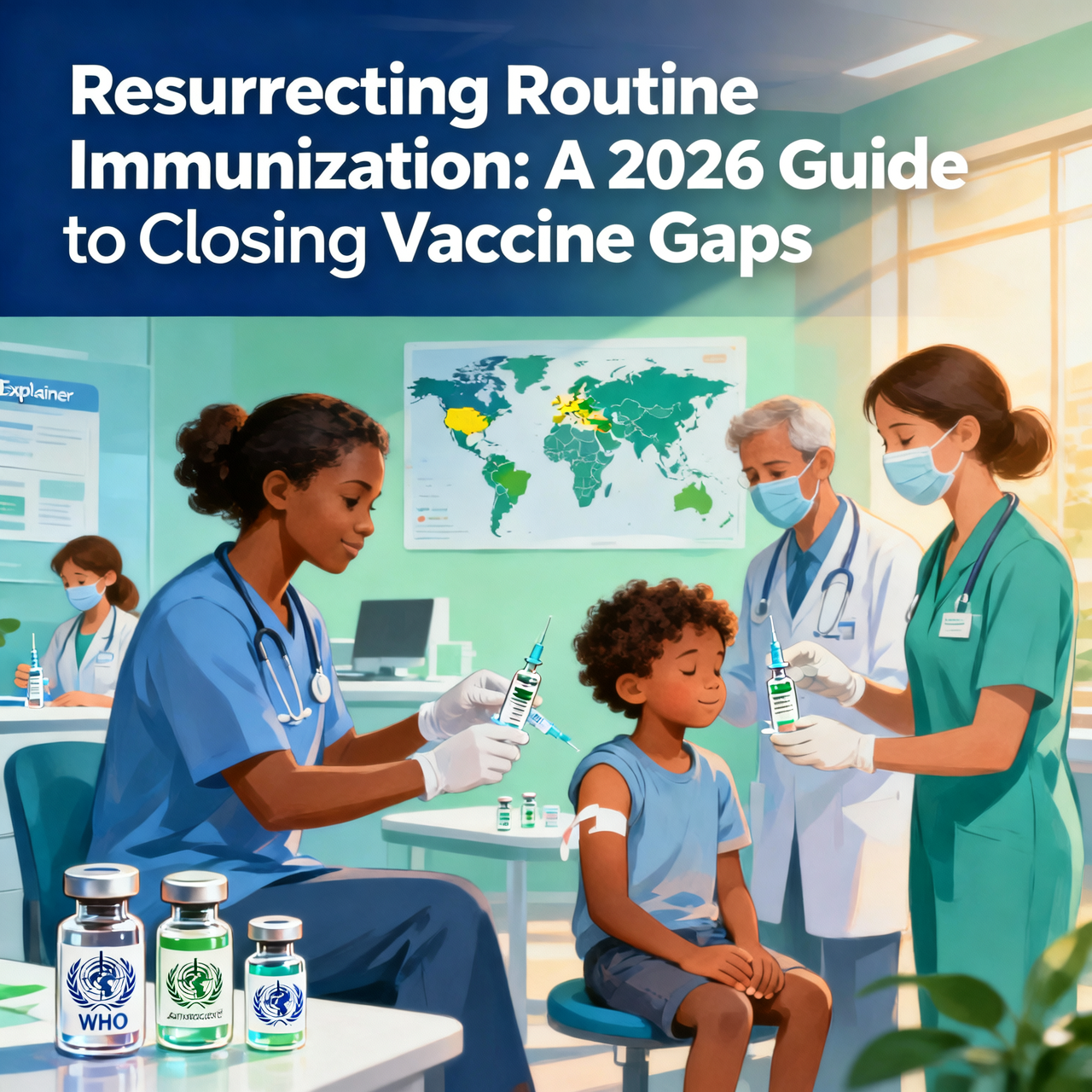
Global DTP3 coverage remains one point below the 2019 baseline, with no significant improvement since 2022
Introduction – Why This Matters
In my experience working with immunization programs in South Asia and sub-Saharan Africa, I have seen what happens when vaccination rates slip. A 5% drop in measles coverage doesn’t sound like much until the outbreak starts. Then, hospital wards fill with children gasping for air, parents weep in corridors, and health workers scramble to contain a disease that was entirely preventable.
What I’ve found is that the public has largely forgotten how devastating vaccine-preventable diseases can be. In wealthy countries, diseases like measles, polio, and diphtheria seem like relics of the past. In conflict zones and impoverished regions, they never left. But the COVID-19 pandemic created a new, dangerous phenomenon: a global immunity gap that now threatens everyone.
The numbers are stark. In 2025, according to the annual WHO-UNICEF Estimates of National Immunization Coverage (WUENIC), an estimated 13.5 million “zero-dose” children — infants who did not receive a single vaccine in their first year of life — remained unprotected. While this represents nearly 750,000 fewer children than the previous year, global coverage still hovers one percentage point below 2019 levels, stuck in the same narrow range since 2009.
This isn’t just a statistic. These are children who will grow up without protection against measles, polio, diphtheria, and pertussis. These are communities where one outbreak can ignite a humanitarian crisis. This guide explains how we got here, what is being done, and what still needs to happen to resurrect routine immunization.
Key Takeaway: Routine immunization is the most cost-effective public health intervention in history. But global coverage remains below the 2019 baseline, with 13.5 million children still missing all vaccines in 2025. Closing this gap requires strengthening health systems, rebuilding trust, and sustaining political commitment .
Background / Context
The Foundation of Modern Public Health
Routine immunization — the scheduled delivery of vaccines to infants and young children through health systems — is the bedrock of modern public health. WHO estimates that vaccines prevent 3.5 to 5 million deaths annually. Over the past 25 years, sustained investments from governments and partners, commitments from communities, strengthened programs, and broad public trust have reduced the annual number of zero-dose children by 40%.
The Pandemic’s Devastating Blow
The COVID-19 pandemic, which officially ended as a Public Health Emergency of International Concern in May 2023, disrupted essential health services worldwide. Health facilities became overwhelmed, supply chains broke down, lockdowns prevented families from reaching clinics, and fear of COVID-19 kept caregivers away.
The consequences were severe. Global immunization coverage experienced its most significant drop in 30 years during 2020 and 2021. The number of zero-dose children rose from 13.3 million in 2019 to an alarming 18.2 million in 2021 — a nearly 40% increase.
By 2023, coverage had stalled at 84% for three doses of the diphtheria-tetanus-pertussis (DTP) vaccine, a key marker of global immunization performance. While 2025 data shows some recovery — 90% of infants globally received at least one DTP dose — coverage remains stubbornly below the 2019 baseline and far short of the 95% thresholds needed to prevent outbreaks.
The Consequences: Outbreaks on the Rise
The immunity gap left by disrupted immunization is not theoretical. In 2025, 57 countries reported large or disruptive measles outbreaks. Measles, one of the most contagious viruses known to humanity, requires 95% coverage with two doses to prevent outbreaks. In 2025, global first-dose measles coverage stood at only 84%, with second-dose coverage at 77%.
The connection between immunization gaps and outbreaks is clear. In Bangladesh, a 2026 measles outbreak followed an abrupt decline in measles-rubella vaccination coverage from above 95% to approximately 57% within a single programme cycle. The collapse, researchers argue, reflected institutional disruption linked to health sector restructuring rather than demand-side failure or vaccine hesitancy.
Reference Context: This article continues our exploration of public health challenges driven by systemic disruptions. Just as climate change expands infectious disease vectors and wildfire smoke creates chronic health burdens, pandemic-related immunization gaps are creating predictable, preventable health crises. For a deeper understanding of how environmental factors are reshaping disease patterns, read our comprehensive guides:
- Climate Change and Infectious Diseases: https://thedailyexplainer.com/climate-change-infectious-diseases-guide
- Wildfire Smoke Long-Term Health Effects: https://thedailyexplainer.com/wildfire-smoke-long-term-health-effects-guide
Key Concepts Defined
To understand the current immunization landscape, we need a clear vocabulary.
- Routine Immunization (RI): The regular, scheduled delivery of vaccines to infants and children through health systems — normally at clinics, community centers, outreach services, or health worker visits. This is distinct from mass campaigns, which are supplementary efforts.
- Zero-Dose Children: Infants who have not received a single dose of any vaccine in their first year of life. As of 2025, there are an estimated 13.5 million zero-dose children globally. These children are the most vulnerable and often live in the hardest-to-reach communities.
- Under-Vaccinated Children: Children who have started the vaccination schedule but have not completed it. Globally, 7.3 million infants are estimated to have received their first DTP dose but dropped out before receiving their first measles dose. This “drop-out” is a major contributor to immunity gaps.
- The Big Catch-Up (BCU): A global initiative launched in 2023 by WHO, UNICEF, and Gavi, the Vaccine Alliance, with the aim of reaching children who missed vaccines during the pandemic, restoring coverage to previous levels, and strengthening immunization systems. From 2023 through 2025, the initiative delivered over 100 million vaccine doses to an estimated 18.3 million children in 36 countries.
- Immunization Agenda 2030 (IA2030): A global strategy adopted by all WHO member states in 2020, pledging to halve the number of children not receiving vaccinations by 2030.
- Vaccine Hesitancy: The delay in acceptance or refusal of vaccines despite availability of vaccination services. It is a complex phenomenon influenced by confidence (trust in vaccine and provider), complacency (perception of disease risk), and convenience (access and affordability).
- Zero-Dose Children in FCV Settings: “FCV” stands for Fragile, Conflict-Affected, and Vulnerable countries. More than half of all zero-dose children live in these settings, even though they account for only about a third of the world’s child population.
| Term | Simple Definition | Why It Matters Now |
|---|---|---|
| Zero-Dose Children | Children with no vaccines at all | 13.5 million globally in 2025; most vulnerable |
| Under-Vaccinated Children | Started but didn’t finish vaccine schedule | 7.3 million dropped out before measles dose |
| Big Catch-Up | Global initiative to vaccinate missed children | Reached 18.3 million children in 36 countries |
| Immunization Agenda 2030 | Global pledge to halve unvaccinated children | Progress is off-track |
| Vaccine Hesitancy | Delay or refusal despite availability | Fuelled by COVID-19 misinformation |
| FCV Settings | Fragile, conflict-affected, vulnerable countries | 50%+ of zero-dose children live here |
How It Works (Step-by-step breakdown)
Understanding how immunization coverage is measured, disrupted, and restored is essential for grasping the current crisis.
Step 1: Measuring Coverage
Immunization coverage is tracked through the WHO-UNICEF Estimates of National Immunization Coverage (WUENIC), the world’s largest and most comprehensive dataset on immunization trends. Countries report data on vaccinations for 13 diseases given through regular health systems. The DTP3 (three doses of diphtheria-tetanus-pertussis vaccine) is the key marker — it indicates whether a child has accessed the health system multiple times in their first year.
Step 2: The Pandemic’s Disruption
When COVID-19 struck, routine immunization services were hit from multiple angles:
- Supply chains broke down: Vaccine shipments were delayed or cancelled.
- Health workers were redeployed: Staff who normally delivered childhood vaccines were assigned to COVID-19 response.
- Caregivers stayed away: Fear of COVID-19, lockdowns, and movement restrictions kept families from clinics.
- Health systems were overwhelmed: Facilities focused on COVID-19, and routine services were deprioritized.
Step 3: Creating the “Zero-Dose” Cohort
When these barriers persist over a child’s entire first year, they become zero-dose. These children are not just unvaccinated — they are often completely disconnected from health systems. They live in remote areas, marginalized communities, or conflict zones where routine services are inaccessible.
Step 4: The “Catch-Up” Challenge
Reaching zero-dose children is harder than reaching children through routine services. They are, by definition, the hardest-to-reach. They may be older than the typical vaccination age (requiring policy adjustments), living in insecure areas, or part of communities that have lost trust in health systems.
Step 5: The Outbreak Spiral
Immunity gaps create disease outbreaks. Outbreaks demand emergency responses, which divert resources from routine services, creating further gaps. This is the outbreak spiral — a vicious cycle that traps vulnerable communities.
Step 6: Recovery Through Integration
Recovering from this spiral requires integrating catch-up vaccination into routine systems. This means strengthening data systems to identify missed children, deploying periodic intensification of routine immunization (PIRI) activities, and ensuring that health systems can reach every child, every time.
| Step | Process | Consequence |
|---|---|---|
| 1 | Measurement via WUENIC | Identifies coverage gaps and trends |
| 2 | Pandemic disruption | Services shut down, caregivers stay away |
| 3 | Zero-dose cohort created | 13.5 million unprotected infants in 2025 |
| 4 | Catch-up challenges | Reaching the unreached is difficult and costly |
| 5 | Outbreak spiral | Outbreaks divert resources from routine services |
| 6 | Recovery through integration | Strengthening systems to reach every child |
Why It’s Important
The Human Cost
The consequences of immunization gaps are measured in lives lost and suffering endured. A 2024 Lancet study estimated that between 2020 and 2030, vaccine coverage disruption could cause 49,119 additional deaths from measles, HPV, yellow fever, hepatitis B, rubella, and meningitis A . Measles alone accounted for 90-68% of these excess deaths.
These estimates are conservative. As of 2025, 57 countries reported large or disruptive measles outbreaks — a clear sign that the global immunity gap is real and growing.
The 2026 Data
The 2026 WUENIC release provided mixed news :
- Positive: Zero-dose children fell by nearly 750,000 in the past year. 100 countries have maintained at least 90% DTP3 coverage since 2019. The Americas and South-East Asia have fully recovered and improved their performance.
- Concerning: Global coverage remains one point below 2019 levels. Of the countries below 90% coverage in 2019, 65 are stagnating or falling behind, including 13 FCV countries. The Western Pacific region experienced a decline, leaving it the region furthest below its 2019 baseline.
The Inequity Crisis
Behind these averages lies a deeply inequitable reality. More than half of all zero-dose children live in FCV settings, even though these account for only about a third of the global child population. In these settings, immunization programmes are strained by political upheaval, insecurity, and chronic underfunding.
Within countries, zero-dose children are disproportionately from:
- Remote rural communities (distance to health facilities)
- Urban slums (poor quality services)
- Marginalized ethnic or religious groups (systematic exclusion)
- Households with low maternal education and income
The Drop-Out Problem
Even where children start the vaccination schedule, many do not complete it. Globally, 7.3 million infants received their first DTP dose but dropped out before receiving their first measles dose. This indicates that health systems are failing to keep families engaged — a problem of quality and continuity, not just access.
The Financial Threat
The foundations that enabled past progress are now under significant strain. The full impact of cuts to international health financing announced over the past two years is not yet reflected in these estimates. Weakening investments in data systems needed to find and reach children will lead to outbreaks and deaths that could have been prevented.
Expert Quote: “Every child, whether born into wealth or poverty, peace or conflict, deserves the life-giving protection that vaccines provide. Immunization is one of the most cost-effective, most equitable, and most reliable interventions for protecting children’s health and well-being.” — Dr Tedros Adhanom Ghebreyesus, WHO Director-General
Call to Action: Routine immunization is not a luxury. It is the lowest-cost, highest-impact public health intervention available. Governments, donors, and communities must prioritize vaccine coverage and reach every child.
Sustainability in the Future
The Big Catch-Up: A Historic Effort
Launched in 2023, the Big Catch-Up (BCU) is the largest-ever international effort to vaccinate missed children and strengthen routine immunization. Backed by UNICEF, Gavi, and WHO, the initiative delivered over 100 million vaccine doses to an estimated 18.3 million children in 36 countries by April 2026. Around 12.3 million of these were zero-dose children.
The BCU demonstrated what is possible when partners align: reaching the unreached, integrating catch-up into routine services, and strengthening health systems.
Beyond the Catch-Up: Institutionalizing Success
While the BCU was time-bound, its lessons are being institutionalized. In Pakistan’s Khyber Pakhtunkhwa province, for example, routine immunization coverage increased from 55% in 2022 to 71% in 2026, with immunization centre functionality reaching 92% and vaccination services accessible to 86% of the population. The provincial government’s “Immunization Roadmap” targets 85% full immunization coverage by March 2027.
Key Strategies for Sustainability:
- Strengthening Data Systems: Digital architecture like India’s U-WIN and e-VIN systems enables tracking of supplies and usage for the world’s largest routine immunization programme. Without data, we cannot find or reach missed children.
- Community Engagement: Trust is built before crises, not during them. Sustained investment in frontline health workers, community leaders, and local scientists is essential.
- Integration with Primary Care: Linking immunization with other health services (maternal health, nutrition, and child health) improves coverage and efficiency.
- Domestic Financing: Countries must invest in their own immunization programs. As international financing fluctuates, domestic budgets must cover gaps.
- New Vaccine Introductions: Pakistan, for example, is rolling out an HPV vaccination programme in November 2026, targeting 3.2 million girls in Khyber Pakhtunkhwa.
Sustainability Insight: The most sustainable vaccination program is one that is fully integrated into primary health care and funded by domestic budgets, not reliant on volatile international aid.
Common Misconceptions
Let me clear up several misunderstandings I frequently encounter.
Misconception 1: “Vaccination coverage has recovered to pre-pandemic levels.”
- Reality: Global coverage remains one point below 2019 levels, with stagnation in 65 countries and decline in the Western Pacific region. The Americas and South-East Asia have recovered, but many regions are still behind.
Misconception 2: “Measles is no longer a serious threat.”
- Reality: In 2025, 57 countries reported large or disruptive measles outbreaks. Measles is one of the most contagious viruses known; even a 5% coverage gap can trigger an outbreak.
Misconception 3: “Vaccine hesitancy is the main driver of low coverage.”
- Reality: In many settings, the main barriers are not hesitancy but access: distance to clinics, conflict, poverty, and weak health systems. In Bangladesh’s 2026 measles outbreak, the collapse was driven by institutional disruption, not demand-side failure.
Misconception 4: “If a child missed their vaccines during the pandemic, it’s too late to catch up.”
- Reality: Catch-up vaccination is possible and effective. National immunization programs can vaccinate children who missed doses due to age, following clearly defined catch-up policies.
Misconception 5: “Richer countries don’t need to worry about this.”
- Reality: In middle- and high-income countries, coverage is slipping amid shifting political commitment, structural challenges, or rising hesitancy. South Africa’s DTP1 coverage has fallen 20 percentage points since 2019, and Bosnia and Herzegovina saw a 23-point drop in measles coverage in one year.
Misconception 6: “The Big Catch-Up reached everyone who needed it.”
- Reality: While the BCU reached 18.3 million children, an estimated 13.5 million infants still became zero-dose in 2025 alone. The work is far from over.
Misconception 7: “Vaccines are too expensive for low-income countries.”
- Reality: Through Gavi, the Vaccine Alliance, countries can access vaccines at dramatically reduced prices. But financing alone is not enough — health systems must be able to deliver them.
Recent Developments (2025–2026)
1. WUENIC 2026 Data Release (July 2026)
The WHO-UNICEF immunization coverage estimates for 2025 showed 90% DTP1 coverage, 85% DTP3 coverage, and an estimated 13.5 million zero-dose children. While these figures are slightly improved from 2024, they remain below 2019 levels. 57 countries reported measles outbreaks.
2. The Big Catch-Up Milestone (April 2026)
UNICEF and partners announced that the BCU had delivered over 100 million vaccine doses to 18.3 million children in 36 countries from 2023 to 2025. Around 12.3 million of these children were zero-dose, and about 15 million had never received a measles vaccine.
3. Pakistan’s Immunization Progress (July 2026)
Khyber Pakhtunkhwa reported a substantial increase in routine immunization coverage from 55% in 2022 to 71% in 2026. The province is preparing for an HPV vaccine launch in November 2026, targeting 3.2 million girls.
4. HPV Vaccine Rollout in Pakistan
Pakistan launched its HPV vaccination programme in September 2025, targeting approximately 13 million girls aged 9–14 in the first phase. The second phase (November 2026) will expand to Khyber Pakhtunkhwa, with a third phase planned for Balochistan in 2027.
5. Governance Failure and Immunization Collapse (July 2026)
A study on Bangladesh’s 2026 measles outbreak concluded that the collapse was driven by institutional disruption following health sector restructuring in 2025, not demand-side failure. This highlights that immunization is an institutional function — its continuity depends on governance arrangements.
6. Measles Vaccine Confidence Crisis
In India, measles coverage remains below 95% for the first dose and below 90% for the second dose in 2024. Misinformation continues to circulate through social media, with community gatekeepers and faith leaders sometimes influenced by these channels.
7. Scientific Transparency as a Foundation for Trust
Experts highlighted that regulatory transparency and clear communication are foundational to building trust. As Professor Gagandeep Kang noted, “The more open and transparent we are about what we do not know and what we are waiting for evidence on, the greater the difference it will make in building trust”.
Success Stories
Success Story 1: Ethiopia’s Big Catch-Up Impact
During the Big Catch-Up, Ethiopia reached more than 2.5 million previously zero-dose children with DTP1. The country also delivered nearly 5 million doses of inactivated polio vaccine and more than 4 million doses of measles vaccine to un- and under-vaccinated children.
Success Story 2: Pakistan’s Khyber Pakhtunkhwa
Routine immunization coverage in Pakistan’s Khyber Pakhtunkhwa province rose from 55% in 2022 to 71% in 2026 . The provincial government has a clear “Immunization Roadmap” targeting 85% full coverage by March 2027. Immunization centre functionality has reached 92%, and services are now accessible to 86% of the population.
Success Story 3: Sudan’s Rapid Recovery
Even amid ongoing conflict, Sudan recorded the largest single-country gain globally in 2025, increasing DTP1 coverage by 35 percentage points and lifting MCV1 coverage by 22 points. This demonstrates what is possible when access to services improves, even in challenging circumstances.
Success Story 4: Liberia’s Post-Ebola Recovery
Liberia’s routine immunization coverage plummeted to 58% for first-dose measles-containing vaccine (MCV1) in 2014, the first year of its Ebola epidemic. By 2017, the year after the epidemic was declared over, MCV1 coverage had surged to 87%. The percentage of districts reporting over 80% coverage increased from 7% in 2014 to 80% in 2018. This success was driven by a strong health system recovery plan and integration of outbreak response resources.
Success Story 5: India’s Digital Immunization Architecture
India built digital systems — e-VIN and U-WIN — to track supplies and usage for the world’s largest routine immunization programme. This infrastructure was crucial for identifying zero-dose children, managing supply chains, and strengthening implementation.
Real-Life Examples
Example 1: Afghanistan’s Trust-Building Approach
In Afghanistan’s Southeast region, nearly 30,000 children remained unvaccinated due to refusals in the December 2025 polio campaign. Refusals were predominantly “hard and chronic” (70%), driven by religious misperceptions and misinformation. The response involved a trust-centred “cluster approach” targeting 50 high-refusal clusters, engaging religious leaders and community influencers through mosque sermons, shura/jirga sessions, and household follow-up.
Example 2: Bangladesh’s 2026 Measles Collapse
Bangladesh’s measles outbreak in 2026 followed an abrupt decline in measles-rubella vaccination coverage from above 95% to approximately 57% within a single programme cycle. This collapse was driven by institutional disruption linked to health sector restructuring in 2025, not demand-side failure. Administrative reorganization weakened accountability, disrupted logistics, and led to the cancellation of planned catch-up activities. The case is a stark warning: routine immunization depends on governance continuity.
Example 3: Haiti’s Stagnation vs. Liberia’s Recovery
Haiti’s national MCV1 coverage stagnated between 64–69% during its years-long cholera epidemic (2010–2019), while Liberia’s coverage surged from 58% to 87% after its Ebola epidemic. The difference? Liberia integrated outbreak response resources into routine immunization, strengthened community health systems, and maintained political commitment.
Example 4: HPV Vaccine Rollout Challenges
Pakistan’s HPV vaccine rollout illustrates both progress and the challenges ahead. Phase 1 targeted 13 million girls; Phase 2 (November 2026) targets 3.2 million girls in Khyber Pakhtunkhwa. Health workers are being trained in evidence-based communication and community engagement strategies to address vaccine hesitancy and counter misinformation. Success depends not just on vaccinating girls but on building lasting trust with communities.
Conclusion and Key Takeaways
Routine immunization is the cornerstone of modern public health. It saves millions of lives annually and is one of the most cost-effective interventions ever devised. But the COVID-19 pandemic created a massive immunity gap that we are still struggling to close.
The 2026 data provides a mixed picture: progress is being made, but it is fragile and inequitable. The 13.5 million zero-dose children in 2025 represent real children at real risk — not numbers on a spreadsheet.
The Core Truths:
- Global coverage is recovering but not recovered. One point below 2019 levels is a gap that will cause outbreaks.
- Outbreaks are already happening. 57 countries reported measles outbreaks in 2025.
- Inequity is the defining feature. Zero-dose children are concentrated in FCV settings and marginalized communities.
- Governance matters. Immunization is an institutional function; institutional collapse leads to coverage collapse.
- Trust must be built before crises. Misinformation erodes confidence; community engagement builds it.
Actionable Steps for Decision-Makers:
- Invest in data systems. You cannot reach children you cannot identify.
- Strengthen routine services. Catch-up campaigns cannot substitute for functioning health systems.
- Engage communities. Build trust through frontline health workers and local leaders.
- Sustain political commitment. Vaccination requires long-term investment, not crisis response.
- Protect financing. Cuts to immunization budgets will lead to outbreaks.
The Bottom Line: Resurrecting routine immunization is achievable. The Big Catch-Up demonstrated that we can reach millions of missed children. But we cannot stop at catch-up. We must build resilient, equitable, and well-funded immunization systems that reach every child, every time.
FAQs (Frequently Asked Questions)
- Q: What is a “zero-dose” child?
- A: A zero-dose child is an infant who has not received a single dose of any vaccine in their first year of life. In 2025, there were an estimated 13.5 million zero-dose children globally.
- Q: Are immunization rates recovering from the COVID-19 pandemic?
- A: Yes, but slowly. In 2025, 90% of infants received at least one DTP dose, but global coverage remains one point below 2019 levels.
- Q: Why are measles outbreaks increasing?
- A: Measles requires 95% coverage with two doses to prevent outbreaks. In 2025, only 84% received the first dose and 77% the second, leaving large immunity gaps.
- Q: What is the Big Catch-Up campaign?
- A: Launched in 2023 by WHO, UNICEF, and Gavi, the Big Catch-Up delivered over 100 million vaccine doses to 18.3 million children in 36 countries from 2023 to 2025.
- Q: How many children missed vaccines during the pandemic?
- A: The number of zero-dose children rose from 13.3 million in 2019 to 18.2 million in 2021. Coverage remains below pre-pandemic levels.
- Q: What are the main barriers to immunization?
- A: Access (distance, conflict, weak health systems), quality (poor services, drop-outs), and confidence (hesitancy, misinformation).
- Q: What is the Immunization Agenda 2030?
- A: A global strategy adopted by all WHO member states in 2020, pledging to halve the number of children not receiving vaccinations by 2030.
- Q: What is the difference between zero-dose and under-vaccinated?
- A: Zero-dose children have no vaccines at all. Under-vaccinated children have started the schedule but not completed it. In 2025, 7.3 million were under-vaccinated.
- Q: How do we identify zero-dose children?
- A: Through health system data, household surveys, and outreach. However, 2025 saw only 18 national immunization surveys submitted, down from 50 in 2024.
- Q: Why did Bangladesh have a measles outbreak in 2026?
- A: Coverage dropped from above 95% to 57% following health sector restructuring that weakened accountability and disrupted logistics. It was institutional failure, not hesitancy.
- Q: How can we catch up children who missed doses?
- A: Through catch-up vaccination strategies integrated into routine services, periodic intensification, and outreach. WHO provides guidance on implementing catch-up schedules.
- Q: What is Pakistan doing to improve immunization?
- A: Khyber Pakhtunkhwa increased coverage from 55% in 2022 to 71% in 2026. The province is launching an HPV vaccination program for 3.2 million girls in November 2026.
- Q: What is the role of Gavi in immunization?
- A: Gavi, the Vaccine Alliance, helps low-income countries access vaccines at reduced prices. Most zero-dose children live in Gavi-supported countries.
- Q: Is vaccine hesitancy increasing?
- A: Yes, fuelled by COVID-19 misinformation. But in many settings, access barriers are a bigger driver of low coverage.
- Q: How important is community engagement?
- A: Essential. In Afghanistan, engagement of religious leaders and community influencers was key to reducing vaccine refusals. In India, community trust is built through sustained investment in frontline workers.
- Q: What is the “drop-out” problem?
- A: Children who start the vaccination schedule but do not complete it. Globally, 7.3 million infants dropped out before their first measles dose in 2025.
- Q: Does conflict affect immunization?
- A: Yes. More than half of zero-dose children live in FCV settings. In Syria, coverage dropped 6 points on DTP1 and 12 points on measles in a single year.
- Q: What is Liberia’s recovery example?
- A: MCV1 coverage in Liberia surged from 58% in 2014 to 87% in 2017 after the Ebola epidemic by integrating outbreak response resources into routine immunization.
- Q: What is the role of digital systems in immunization?
- A: Digital systems like India’s e-VIN and U-WIN track supplies and usage, helping identify gaps and strengthen implementation.
- Q: What are the financial threats to immunization?
- A: Cuts to international health financing are not yet reflected in coverage estimates but threaten progress.
- Q: How do we build trust in vaccines?
- A: Through transparency, community engagement, and sustained investment in frontline health workers. Trust is built before crises, not during them.
- Q: What is the HPV vaccination situation in Pakistan?
- A: Pakistan launched HPV vaccination in September 2025, targeting 13 million girls. Phase 2 targets Khyber Pakhtunkhwa in November 2026, with Phase 3 in Balochistan in 2027.
- Q: Where can I find real-time immunization data?
- A: The WHO-UNICEF WUENIC dataset provides annual coverage estimates. Country-level data is often available through national health ministries.
About the Author
Dr. Amara Singh, MD, MPH
Dr. Singh is a public health physician with 15 years of experience in immunization programs across South Asia and East Africa. She previously served as a technical advisor to Gavi, the Vaccine Alliance, and has worked with WHO and UNICEF on routine immunization strengthening in post-conflict settings. She is a contributing editor for The Daily Explainer.
Free Resources
- WHO-UNICEF WUENIC Data: https://www.who.int/teams/immunization-vaccines-and-biologicals/immunization-analysis-and-insights/global-monitoring/immunization-coverage/who-unicef-estimates-of-national-immunization-coverage
- WHO Catch-up Vaccination Guidance: https://www.who.int/teams/immunization-vaccines-and-biologicals/essential-programme-on-immunization/implementation/catch-up-vaccination
- Gavi, the Vaccine Alliance: https://www.gavi.org/
- UNICEF Immunization: https://www.unicef.org/immunization
- Immunization Agenda 2030: https://www.who.int/teams/immunization-vaccines-and-biologicals/strategies/ia2030
- Big Catch-Up Campaign Details: https://www.unicefusa.org/stories/historic-catch-campaign-reaches-18m-children-lifesaving-immunization
Discussion
Share your perspective:
- Have you seen immunization coverage gaps in your community or work?
- What strategies have been most effective in reaching zero-dose children?
- How can we rebuild trust where it has been eroded by misinformation?
For professionals:
- Healthcare workers: Are you seeing vaccine-preventable disease outbreaks?
- Policymakers: What are your priorities for immunization system strengthening?
- Educators: How can we improve public understanding of vaccine safety and effectiveness?
Please share your observations in the comments. Your experiences help researchers understand the real-world challenges of immunization recovery.
Internal & External Links
Internal Links (The Daily Explainer):
- Climate Change and Infectious Diseases: https://thedailyexplainer.com/climate-change-infectious-diseases-guide
- Wildfire Smoke Long-Term Health Effects: https://thedailyexplainer.com/wildfire-smoke-long-term-health-effects-guide
- Explainer section: https://thedailyexplainer.com/explained/
- Blog: https://thedailyexplainer.com/blog/
- Contact us: https://thedailyexplainer.com/contact-us/
- Breaking news: https://thedailyexplainer.com/news-category/breaking-news/
- Terms of Service: https://thedailyexplainer.com/terms-of-service/
- Global Affairs & Politics: https://thedailyexplainer.com/category/global-affairs-politics/
External Links:
- Shera Kat Network Resources: https://sherakatnetwork.com/category/resources/
- Shera Kat Network Blog: https://sherakatnetwork.com/category/blog/
- Contact Shera Kat Network: https://sherakatnetwork.com/contact-us
- Start Online Business 2026 Complete Guide: https://sherakatnetwork.com/start-online-business-2026-complete-guide/
- World Class Blogs About: https://worldclassblogs.com/about-worldclassblogs/
- World Class Blogs Category: https://worldclassblogs.com/category/blogs/
- World Class Blogs Our Focus: https://worldclassblogs.com/category/our-focus/
- World Class Blogs Nonprofit Hub: https://worldclassblogs.com/category/nonprofit-hub/
- Shera Kat Network SEO: https://sherakatnetwork.com/category/seo
About The Author


2 thoughts on “Resurrecting Routine Immunization: A 2026 Guide to Closing Vaccine Gaps”