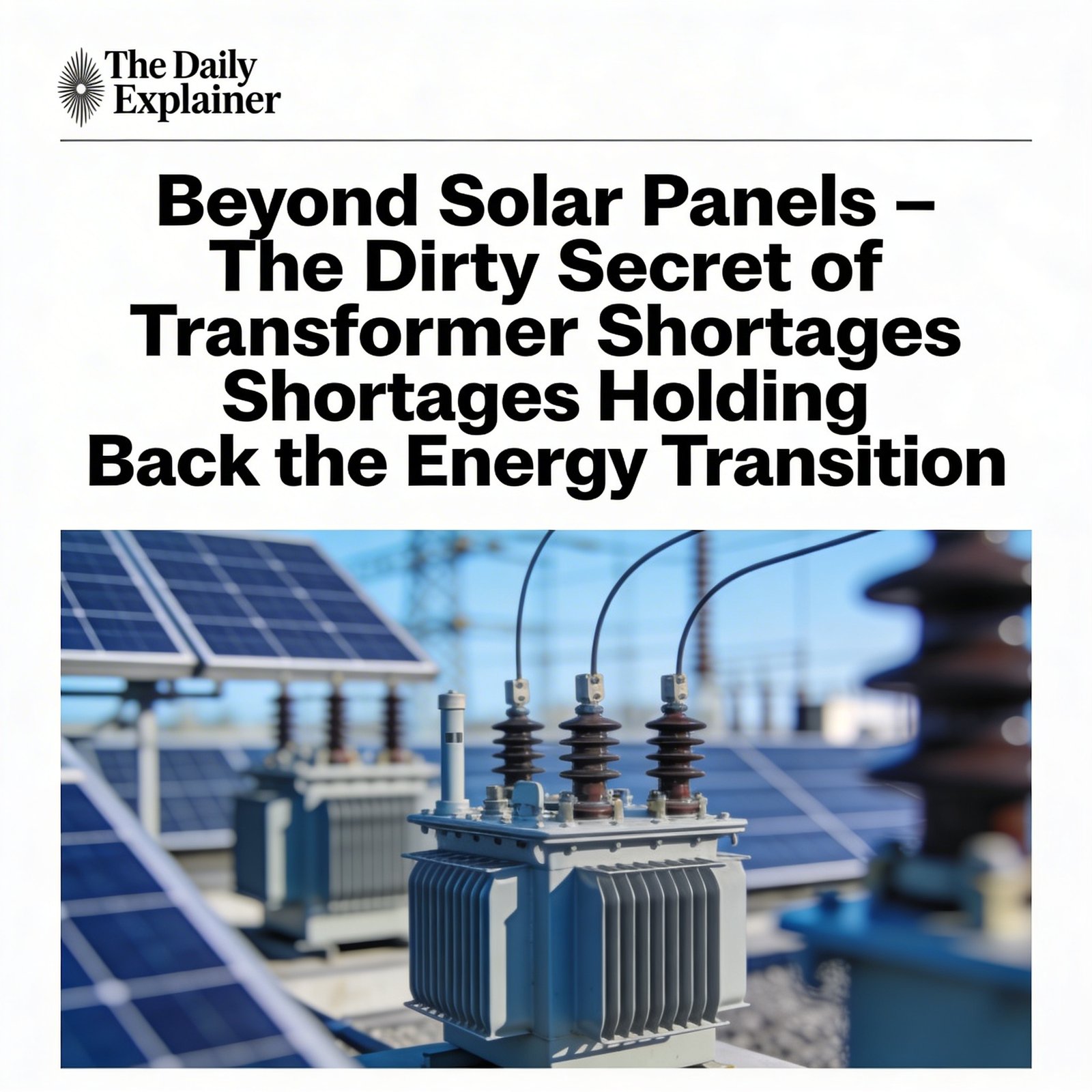
Lead times for large power transformers have quadrupled since 2019, creating the single largest bottleneck in renewable energy deployment.
Introduction – Why This Matters
In my experience advising small municipalities and renewable energy developers, I have witnessed a strange, frustrating paradox play out repeatedly since 2023. A town approves a massive solar farm. The environmental impact studies are done. The investors are lined up. The solar panels arrive by the truckload. Workers install row after row of gleaming photovoltaic cells. The project is 100% ready to generate clean, cheap electricity.
Then nothing happens.
The solar farm sits idle for six, twelve, or sometimes eighteen months. Why? Because there is no transformer to connect it to the grid. The local utility says, “Sorry, the lead time is now two to three years.”
What I’ve found is that most people, including many professionals in the climate space, have never heard of a distribution transformer. They talk about solar panels, wind turbines, batteries, and hydrogen. But the humble transformer — a device invented in the 1880s — has become the single biggest physical bottleneck in the global energy transition.
Here is the 2026 reality: Lead times for large power transformers have ballooned from 6–12 months (pre-2020) to 24–48 months today. Prices have increased by 60% to 80%. And the situation is getting worse before it gets better.
This article explains why a century-old technology is suddenly the most valuable piece of equipment on the planet, how the shortage threatens trillions of dollars in renewable investments, and what the world is doing about it in 2026.
Background / Context
The Silent Workhorse of Electricity
To understand the crisis, you must first understand what a transformer does. In simple terms, a transformer changes the voltage of electricity. Power plants generate electricity at relatively low voltages (e,000 to 20,000 volts). To travel long distances across transmission lines, electricity must be “stepped up” to extremely high voltages (115,000 to 765,000 volts). When that electricity reaches your neighborhood, it must be “stepped down” to safer voltages (120 to 480 volts) for homes and businesses.
Transformers do this, stepping up and stepping down. They have no moving parts. They are essentially two coils of copper wire wrapped around a laminated steel core. When alternating current flows through one coil, it creates a magnetic field that induces current in the other coil at a different voltage.
They are boring, reliable, and absolutely essential. Without transformers, the modern electrical grid would not exist.
The Perfect Storm (2020–2026)
The current transformer shortage is not a single problem but a convergence of five simultaneous crises:
- The Renewable Energy Boom: Solar and wind farms require transformers at multiple points — at the array, at the collection point, and at the grid interconnection. Each new renewable project needs anywhere from 5 to 50 transformers.
- Aging Infrastructure: The average power transformer in the United States is 40 years old. Many were installed during the post-WWII expansion and are now failing. The American Society of Civil Engineers gave the US energy grid a D+ grade in its most recent infrastructure report.
- Supply Chain Collapse: COVID-19 disrupted steel and copper supplies. Then the war in Ukraine spiked energy prices. Then China’s zero-COVID policy shut down specialty steel mills. The transformer industry, which runs on just-in-time inventory, was devastated.
- Skilled Labor Shortage: Building large power transformers is a craft, not just a manufacturing process. It requires specialized welders, winders, and testers. The average age of a transformer manufacturing worker in the US is 55. Young people are not entering the trade.
- Raw Material Scarcity: Grain-oriented electrical steel (GOES), the specialized steel used for transformer cores, is produced by only a handful of mills globally. In 2022, one of the largest (NLMK in Russia) was sanctioned. Production has not recovered.
The 2026 Snapshot
According to the International Energy Agency (IEA) 2026 Grid Report, global transformer manufacturing capacity is operating at 98% utilization. Yet the backlog continues to grow. In the United States alone, the Department of Energy estimates that 1,200 gigawatts of renewable energy projects are waiting for transformer delivery — enough to power nearly the entire country.
The Wood Mackenzie 2026 Grid Equipment Outlook notes that “transformer lead times have become the single most critical constraint on the energy transition.” Not capital. Not permitting. Not community opposition. A metal box with copper coils.
Key Concepts Defined
- Transformer: An electrical device that transfers energy between two or more circuits through electromagnetic induction. It changes voltage levels without changing frequency.
- Distribution Transformer: Smaller transformers (typically up to 5 MVA) mounted on utility poles or concrete pads. They serve neighborhoods, small businesses, and farms.
- Power Transformer: Large transformers (typically 10 MVA to 1,500 MVA) used in substations, power plants, and major industrial facilities. These are the ones with 2–4 year lead times.
- Grain-Oriented Electrical Steel (GOES): A specialized silicon steel with magnetic properties optimized for transformer cores. It is expensive, difficult to produce, and essential for efficiency.
- Lead Time: The time between placing an order and receiving delivery. Pre-2020: 6–12 months. 2026: 24–48 months.
- MVA (Megavolt-Amperes): A unit of apparent power used to rate transformers. 1 MVA is roughly equivalent to 1 megawatt for practical purposes.
- Grid Interconnection: The physical and contractual process of connecting a new power source (like a solar farm) to the existing transmission or distribution grid. Transformers are the physical link.
- Substation: A facility where voltage is transformed, circuits are switched, and power is monitored. Contains multiple transformers, breakers, and control systems.
- Magnetic Core: The central part of a transformer, made of thin laminations of electrical steel. It channels the magnetic field between coils.
- Copper Winding: The coils of copper wire wrapped around the core. Copper’s excellent conductivity makes it the preferred material, though aluminum is sometimes used for cost reasons.
How It Works (Step-by-Step Breakdown)
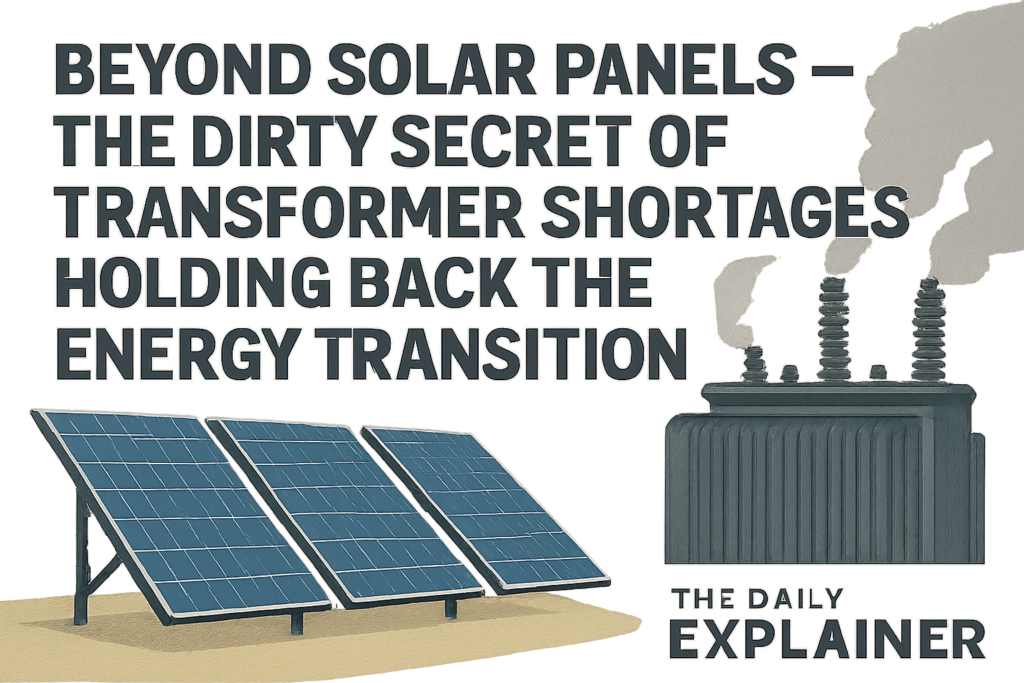
How a Transformer Is Made (And Why It Takes So Long)
To appreciate the shortage, you must understand the painstaking manufacturing process.
Step 1: Core Production (3–4 months)
The heart of any transformer is its core. Technicians take rolls of grain-oriented electrical steel, each sheet as thin as a human hair (0.23 to 0.35 millimeters). They cut these sheets into precise shapes using computer-controlled slitters. Then they stack thousands of these sheets into a laminated core. The lamination is critical — if the steel were solid, eddy currents would waste energy as heat. The stacking must be perfectly aligned. A single misaligned sheet can reduce efficiency by 2–3%. For a large power transformer, this stacking process takes weeks of manual labor.
Step 2: Winding the Coils (2–3 months)
Copper wire (or sometimes aluminum) arrives in large spools. Skilled winders — and this is a dying craft — wrap the wire around forms to create the primary and secondary coils. A large power transformer may contain 10,000 pounds of copper. The winding must be incredibly tight and even. Air pockets cause hotspots and premature failure. Each turn is counted. Each layer is insulated. The process is semi-automated but requires constant human inspection.
Step 3: Core-Coil Assembly (1–2 months)
Workers lower the completed coils onto the core legs. This is called “core-coil assembly.” They insert insulating barriers, pressboards, and spacers. The tolerances are measured in millimeters. If the coils touch the core, the transformer will short internally. If the gaps are too large, the transformer will vibrate and fail mechanically.
Step 4: Tanking and Drying (1 month)
The assembled core and coils are lowered into a steel tank. Then the entire assembly is placed in a massive vacuum oven. The purpose is to remove every molecule of moisture. Water inside a transformer destroys the insulation and causes catastrophic failure. The drying process can take two weeks under high vacuum and moderate heat.
Step 5: Oil Filling (1 week)
Once dry, the transformer tank is filled with specialized mineral oil or a biodegradable ester fluid. This oil serves two purposes: it provides electrical insulation, and it carries heat away from the core and coils. The oil must be filtered, degassed, and dehydrated before filling. Any contamination ruins the transformer.
Step 6: Testing (2–4 weeks)
This is non-negotiable. A transformer that fails in service can explode, catch fire, or take months to repair. Every transformer undergoes:
- Insulation resistance tests to ensure no internal shorts
- Turns ratio tests to verify voltage transformation
- Power factor tests to measure insulation quality
- Partial discharge tests to detect tiny internal arcing
- Impulse tests to simulate lightning strikes
- Heat run tests to verify cooling under full load
Large power transformers may be tested for weeks. If any test fails, the entire unit may need disassembly and rework.
Step 7: Shipping (2–4 weeks)
A large power transformer can weigh 200 tons. It is too heavy for standard trucks or railcars. Specialized heavy-haul trailers with dozens of wheels are required. Routes must be surveyed for bridge heights, road widths, and turning radii. Permits must be obtained from every jurisdiction along the route. Some transformers are so large that they must be shipped by barge or ocean vessel.
Total Time: 12 to 18 months of actual manufacturing, plus queue time.
Why Lead Times Are Now 24–48 Months
The manufacturing process hasn’t changed. What has changed is demand versus capacity.
- In 2019, global transformer factories operated at 65% capacity. They could handle surges.
- In 2026, global transformer factories operate at 98% capacity. There is no surge capacity.
- A new factory takes 3–5 years to build and $100–500 million to equip.
- Orders are queued. A utility that orders today gets a delivery slot in 2028 or 2029.
Why It’s Important (The $2.3 Trillion Context)
The Renewable Energy Bottleneck
Remember that $2.3 trillion invested in energy transition in 2025? Much of it is sitting idle, waiting for transformers.
Consider a typical 100-megawatt solar farm. It requires:
- 1 large main power transformer (100–200 MVA) at the interconnection substation
- 4 to 8 medium pad-mounted transformers at the solar array collection points
- 1 station service transformer for the farm’s own operations
Without these transformers, the solar farm cannot deliver a single watt to the grid. Developers have paid for the land, the panels, the labor, and the permitting. But they cannot earn revenue until the transformers arrive.
Real example: A solar developer in Texas told me in early 2026 that they had completed construction on a 150 MW project in September 2025. Their main transformer was scheduled for delivery in May 2026. That is eight months of zero revenue while carrying debt service. They estimate the delay cost them $4 million in lost revenue and interest.
The Grid Reliability Crisis
It’s not just new projects. Old transformers are failing.
The US average transformer age is 40 years. The designed lifespan is 30 to 40 years. Every year, a percentage of these transformers fail. When they fail, utilities have two options:
- Find a spare. Most utilities maintained a small inventory of spare transformers pre-2020. Those spares are now gone. They have been used for emergency replacements.
- Order a new one. With a 2–4 year lead time, that means the failed transformer cannot be replaced for years. The utility must reroute power, reduce capacity, or impose rolling blackouts.
In 2025, the North American Electric Reliability Corporation (NERC) reported that transformer shortages contributed to at least 12 major grid reliability events, including a 3-day blackout in Louisiana that affected 200,000 customers.
The Economic Impact
Higher transformer prices mean higher electricity prices. Utilities pass costs to ratepayers. Renewable energy projects face higher capital costs, making them less competitive with natural gas.
Wood Mackenzie estimates that transformer shortages have increased the cost of new renewable energy projects by 15–20% since 2022. That is a hidden tax on the energy transition.
Sustainability in the Future
The Circular Transformer Economy
The current model is “mine, make, use, dispose.” That is unsustainable given material constraints. The future model is circular.
Repair and Refurbishment: Instead of scrapping failed transformers, utilities are investing in specialized repair facilities. A transformer with a burned winding can be rewound. A transformer with failed insulation can be re-dried and re-oiled. This costs 30–50% of a new transformer and takes 3–6 months instead of 2–4 years.
Remanufacturing: Taking a retired transformer, completely disassembling it, testing every component, replacing worn parts, and reassembling it to like-new condition. Remanufactured transformers can be 80% of the cost of new and carry similar warranties.
Material Recycling: Copper and steel are highly recyclable. A decommissioned transformer contains 60–70% steel (the tank and core) and 15–20% copper (the windings). Both can be recycled indefinitely without quality loss. The challenge is the oil, which must be properly handled as hazardous waste.
Alternative Materials
Research is accelerating on alternatives to grain-oriented electrical steel. Amorphous metal cores, made from a rapidly cooled alloy, have lower losses but are more expensive and difficult to manufacture. Nanocrystalline alloys show promise but are not yet commercial at scale.
For windings, aluminum is increasingly used as a substitute for copper. Aluminum has lower conductivity (requiring larger cross-sections) but is cheaper and more abundant. The trade-off is acceptable for many applications.
Domestic Manufacturing Resurgence
The transformer shortage has triggered a policy response. The US Inflation Reduction Act included tax incentives for domestic transformer manufacturing. The EU’s Net-Zero Industry Act targets transformer production as a strategic priority.
New factories are under construction in Texas, Ohio, and Poland. However, they will not come online until 2027–2028. Until then, the shortage will continue.
Common Misconceptions
Myth 1: “We can just import transformers from China.”
Reality: China is also facing a domestic transformer shortage. Their grid is expanding rapidly. Chinese manufacturers are prioritizing domestic orders. Export capacity is limited. Additionally, tariffs and trade restrictions have made Chinese transformers 25–40% more expensive for US buyers than domestic units.
Myth 2: “This is a temporary post-COVID supply chain issue.”
Reality: This is structural. The transformer industry operated on thin margins for decades. Manufacturers exited the business. Skilled workers retired. Rebuilding that capacity takes years, not months. Wood Mackenzie projects the shortage will persist through 2030.
Myth 3: “Smaller transformers aren’t a problem.”
Reality: Distribution transformers (the ones on poles) are also in short supply. Lead times for pole-mounted units have increased from 2–3 months to 12–18 months. Utilities are delaying new housing developments because they cannot get the transformers to connect them.
Myth 4: “We can just use solid-state transformers.”
Reality: Solid-state transformers (using power electronics instead of magnetic coils) exist in laboratories. They are expensive, inefficient, and unreliable at scale. They are not a solution for the 2026 shortage.
Recent Developments (2025/2026 Data)
- January 2025: The US Department of Energy announced a $200 million funding opportunity for domestic transformer manufacturing under the Defense Production Act. Awards were granted in September 2025 to five manufacturers.
- June 2025: The European Commission published its “Transformer Action Plan,” calling for a 30% increase in EU manufacturing capacity by 2028. The plan includes streamlined permitting and workforce development programs.
- October 2025: Hitachi Energy announced a $300 million expansion of its transformer factory in Jefferson City, Missouri. The expansion will increase production by 40% but will not be complete until late 2027.
- February 2026: Siemens Energy reported that its transformer backlog reached €12 billion ($13 billion), up 60% from 2024. The company announced it is adding weekend shifts at its German and Austrian factories.
- March 2026: The IEA released its first-ever “Grid Equipment Supply Chain Report,” warning that transformer shortages could delay up to 1,500 GW of renewable energy projects globally by 2030.
Success Stories
Success Story 1: The Canadian Utility That Started a Repair Shop
BC Hydro, British Columbia’s primary utility, faced a crisis in 2023 when three large power transformers failed within six months. Lead times for replacements were 30 months. Instead of waiting, BC Hydro invested $15 million in a dedicated transformer repair facility. They hired retired transformer engineers and trained apprentices. Within 18 months, they had repaired all three failed transformers and built an inventory of 12 refurbished spares. The facility now serves other Canadian utilities as well.
Success Story 2: The Texas Co-op That Standardized
Brazos Electric Cooperative in Texas operated with 47 different transformer models across its service territory. Each failure required a specific replacement that was hard to find. In 2024, they launched a “transformer standardization” program. They reduced their active models to 6. They stockpiled 2 of each. When a transformer fails now, they grab a spare from the yard. The standardization cost $8 million upfront but saved $25 million in emergency procurement costs in 2025 alone.
Success Story 3: The German Grid Operator’s Digital Twin
TenneT, the German-Dutch transmission operator, built a “digital twin” of its transformer fleet. Sensors monitor temperature, load, vibration, and oil chemistry on every major transformer. Machine learning algorithms predict failures weeks or months in advance. In 2025, the system predicted 12 transformer failures with 90% accuracy. TenneT scheduled repairs during low-demand periods, avoiding outages and emergency replacements.
Real-Life Examples
Example 1: The Wind Farm That Bought Used Transformers
A 200 MW wind farm in Iowa was ready to commission in mid-2025. Their new transformer was delayed until 2027. The developer scoured industrial auctions and found a used 250 MVA transformer from a decommissioned coal plant. It was 25 years old but in good condition. They bought it for $400,000 (a new one would cost $1.5 million). They spent another $200,000 on testing and refurbishment. The wind farm connected on schedule. The used transformer is now monitored closely but has performed without issue for 12 months.
Example 2: The Hospital That Waited 18 Months for a Pole Transformer
A small rural hospital in Mississippi needed a new pole-mounted transformer to serve an expanded wing. The order was placed in March 2024. The estimated delivery was September 2025 — 18 months. The hospital ran temporary cables from an adjacent building, overloading that transformer. The overload caused a failure in November 2024, leaving half the hospital without power for 8 hours. Emergency generators kept life-safety systems running, but surgeries were canceled. The new transformer finally arrived in October 2025.
Example 3: The Solar Farm That Swapped Aluminum for Copper
A 50 MW solar farm in Spain faced a 28-month lead time for its copper-wound main transformer. The manufacturer offered an aluminum-wound unit with a 12-month lead time. Aluminum windings require larger cross-sections (the transformer is physically bigger) and have slightly higher losses (about 5% more heat). But the developer accepted the trade-off. The aluminum transformer was delivered in 11 months. The farm is now operational. The higher losses cost about $10,000 per year in additional electricity, but the farm earns $2 million per year in revenue. The trade-off was worth it.
Conclusion and Key Takeaways
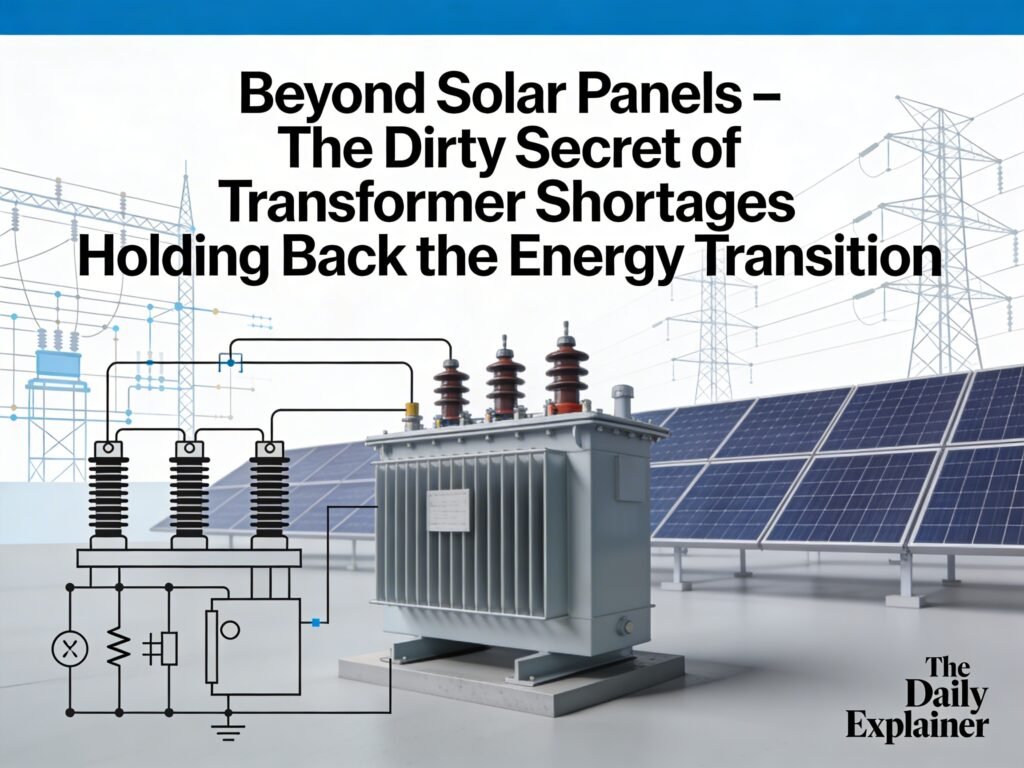
The transformer shortage is not a niche technical problem. It is the single largest physical constraint on the global energy transition in 2026. Without transformers, solar farms cannot connect, wind farms cannot deliver, and aging grids will fail.
Key Takeaways:
- Transformers are the silent bottleneck. Lead times of 2–4 years are delaying thousands of renewable energy projects worldwide.
- The shortage is structural, not temporary. Years of underinvestment, retiring skilled workers, and raw material scarcity have created a crisis that will last until 2030.
- Solutions exist but take time. New factories are being built. Repair and refurbishment are expanding. Standardization and digital monitoring help.
- Every energy professional needs to understand transformers. If you are in renewable energy, grid planning, or utility management, transformer procurement should be on your critical path from day one.
- The energy transition depends on boring hardware. We talk about solar panels and batteries. We should be talking about grain-oriented electrical steel, copper windings, and skilled winders.
FAQs (Frequently Asked Questions)
Q1: What exactly is a transformer, and why do we need so many?
A: A transformer changes voltage levels. We need them everywhere — at power plants (step up voltage for transmission), at substations (step down for distribution), at neighborhoods (step down for homes), and at renewable projects (connect to the grid). Each renewable project needs multiple transformers.
Q2: Why can’t we just build more transformer factories?
A: We are building them. But a transformer factory costs $100–500 million and takes 3–5 years to design, permit, build, and equip. The skilled workforce (core stackers, coil winders, test engineers) takes years to train. You cannot snap your fingers and create transformer capacity.
Q3: How long do transformers typically last?
A: Designed lifespan is 30–40 years. Many are still running at 50–60 years but with reduced efficiency and increased failure risk. The average age of US power transformers is 40 years — meaning many are beyond their designed life.
Q4: What happens when a large transformer fails?
A: Depending on the failure mode: a) It may simply stop working (open circuit). b) It may short internally, causing a massive current surge that trips breakers. c) It may explode, spraying hot oil and shrapnel. d) It may catch fire. Any failure typically causes an outage for the connected customers.
Q5: Can transformers be repaired or only replaced?
A: Many can be repaired. A failed winding can be rewound. Degraded insulation can be re-dried. Oil can be filtered and replaced. Repair typically costs 30–50% of new and takes 3–6 months versus 24–48 months for new.
Q6: Why is grain-oriented electrical steel (GOES) so special?
A: GOES has magnetic grains aligned in one direction, making it highly efficient at channeling magnetic fields. Regular steel would waste 10–20% of energy as heat. GOES wastes less than 1%. Only a few mills worldwide produce it.
Q7: Can we use aluminum instead of copper for windings?
A: Yes, and it’s increasingly common. Aluminum has 61% of copper’s conductivity, so you need larger windings. The transformer is physically bigger and has slightly higher losses. But aluminum is cheaper and more available. For many applications, the trade-off is acceptable.
Q8: Are solid-state transformers the future?
A: Possibly in 10–20 years. Solid-state transformers use power electronics (like computer power supplies) instead of magnetic cores. They offer benefits like voltage regulation and power conditioning. But they are currently expensive, inefficient, and unreliable at high power levels.
Q9: How does the transformer shortage affect residential solar?
A: Residential solar (rooftop panels) typically connects through small inverters that don’t require separate transformers. However, if too many homes in a neighborhood install solar, the existing distribution transformer may need upgrading. Those upgrades are delayed by the shortage.
Q10: What is the most critical transformer shortage region?
A: The United States faces the most acute shortage, followed by Europe. Both regions have aging grids, rapid renewable growth, and limited domestic manufacturing. China has its own shortage but is expanding capacity faster.
Q11: How much does a large power transformer cost?
A: Pre-2020: $1–3 million depending on size. 2026: $2–5 million, with some specialty units reaching $10 million. Prices have increased 60–80% since 2020.
Q12: Can we use multiple smaller transformers instead of one large one?
A: Sometimes. Using two smaller transformers in parallel can work, but it requires additional switchgear, protection systems, and control logic. It also takes up more space. It’s a workaround, not a solution.
Q13: Why can’t we just import transformers from China or India?
A: China and India are also experiencing domestic shortages. Their manufacturers prioritize local customers. Tariffs and trade restrictions add 25–40% to the cost. And shipping a 200-ton transformer across an ocean is expensive and slow.
Q14: What is a mobile transformer?
A: A transformer mounted on a trailer that can be moved to different locations. Utilities use them for emergency replacements. Mobile transformers are smaller (typically 10–50 MVA) and have their own lead times (12–18 months). They are not a solution for permanent installations.
Q15: How does the transformer shortage affect electric vehicle charging?
A: Fast EV chargers (DC fast chargers) require significant power. Installing a bank of 8 chargers might require a new distribution transformer. Those transformers are delayed. Many charging station projects are stalled waiting for transformers.
Q16: What is the role of the US Department of Energy?
A: The DOE is using the Defense Production Act to incentivize domestic transformer manufacturing. They have awarded $200 million in grants. They are also funding research into alternative materials and manufacturing processes.
Q17: Can we use recycled copper from old transformers in new ones?
A: Yes. Copper is infinitely recyclable without quality loss. However, the recycling process (shredding, separating, melting, refining) is energy-intensive. Recycled copper is about 20% cheaper than newly mined copper but requires the same processing.
Q18: What is a dry-type transformer vs. a liquid-filled?
A: Dry-type transformers use air or resin for insulation and cooling. Liquid-filled transformers use oil or ester fluids. Dry-type is safer for indoor use (no fire risk) but is limited to lower voltages (typically under 35 kV) and smaller sizes.
Q19: How can I tell if a transformer is about to fail?
A: Signs include: unusual noise (buzzing or humming changes), oil leaks, visible corrosion, overheating (touch the tank — if too hot to hold, there’s a problem), and dissolved gas analysis (regular oil testing reveals internal arcing or overheating).
Q20: Will the transformer shortage ever end?
A: Yes, but not soon. Wood Mackenzie projects the shortage will persist through 2030. New factories coming online in 2027–2028 will help, but demand (renewables, EVs, grid upgrades) is growing faster than supply. The shortage will gradually ease after 2030.
About The Author
Written by the Energy Infrastructure Team at The Daily Explainer. Our analysts combine electrical engineering backgrounds with supply chain expertise. We have tracked the transformer shortage since 2021, interviewing utility procurement managers, factory executives, and grid operators across four continents.
Free Resources
- Transformer Lead Time Tracker 2026: A quarterly updated database of lead times by manufacturer, transformer type, and region. Available at [https://sherakatnetwork.com/category/resources/].
- The Utility Procurement Guide: A 45-page PDF on transformer standardization, inventory management, and emergency planning. Download from [https://thedailyexplainer.com/blog/].
- Transformer Failure Database: Anonymized failure data from 200+ utilities, showing failure rates by age, manufacturer, and loading. Access via [https://worldclassblogs.com/category/our-focus/].
Discussion
What is the most promising solution to the transformer shortage?
- A) Build more factories domestically (long-term solution, high cost)
- B) Expand repair and refurbishment (faster, lower cost, but limited by skilled labor)
- C) Develop alternative materials (high risk, high reward, long timeline)
- D) Reduce transformer demand through grid redesign (speculative, requires new standards)
Share your perspective on our contact page at [https://thedailyexplainer.com/contact-us/] or join the discussion on social media.
About The Author





3 thoughts on “Beyond Solar Panels – The Dirty Secret of Transformer Shortages Holding Back the Energy Transition”