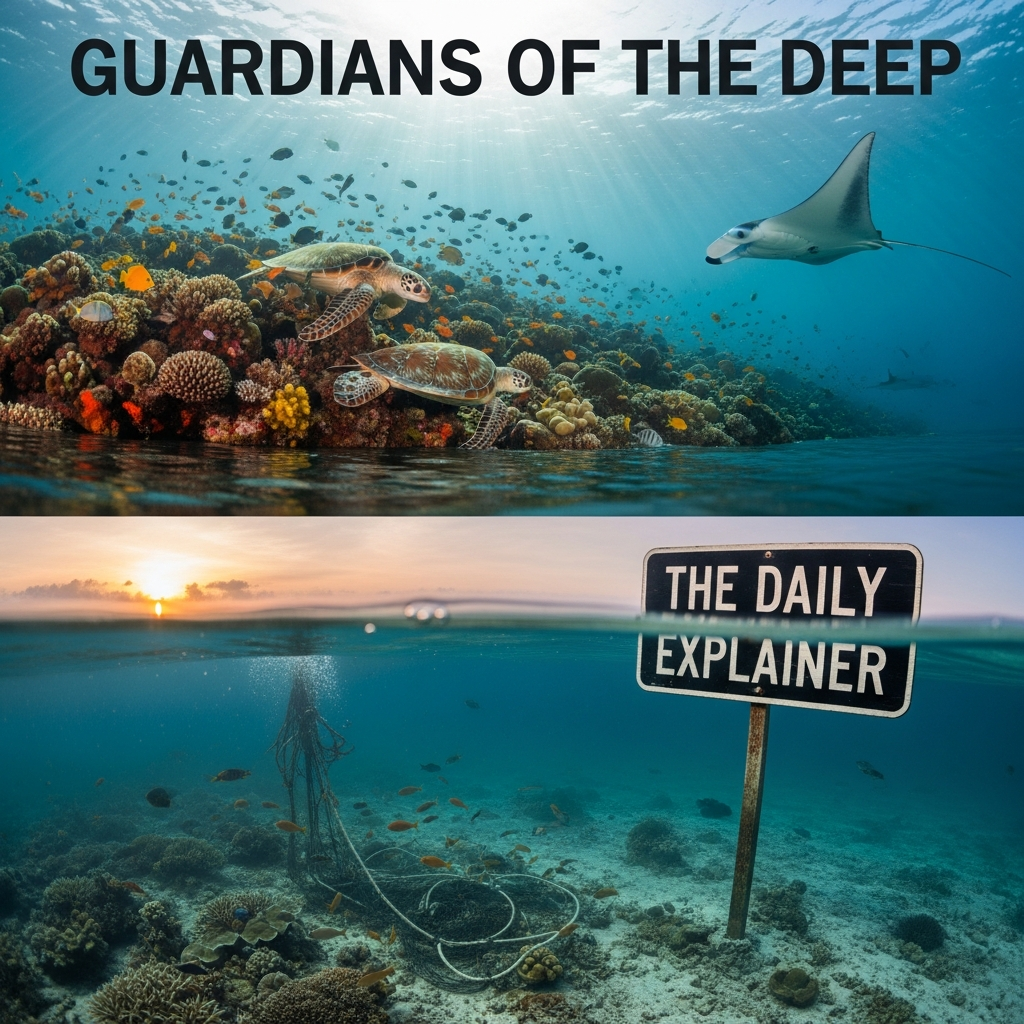
The science of marine protected areas: well-enforced, fully protected reserves trigger cascading ecological and social benefits.
Introduction – Why This Matters
In my experience, explaining marine protected areas to a curious audience usually begins with a confession: most people imagine something that doesn’t actually exist. They picture a fence line floating on the open ocean, or perhaps a ranger station bobbing on waves. The reality is less visible but far more profound.
What I’ve found is that MPAs are not just lines on a nautical chart. They are the closest thing we have to a time machine for the ocean. When we get them right—when we design them well, enforce them rigorously, and leave them alone long enough—they show us what the sea looked like before industrial fishing, before bottom trawling, before plastic pollution. They are our living baselines.
This matters now more than at any moment in human history. On 17 January 2026, the High Seas Agreement (BBNJ Agreement) formally entered into force, transforming how we can protect the nearly two-thirds of the ocean that lies beyond national jurisdiction. Weeks earlier, a landmark meta-analysis published in npj Ocean Sustainability synthesised data from 138 marine reserves across 32 countries, confirming what many suspected but few could prove: well-managed MPAs work, and their benefits ripple through entire ecosystems.
Yet the struggle continues. Only 8% of the ocean is currently protected, and just 2.9% is fully or highly protected from extractive activities. As the world races toward the 30×30 target—protecting 30% of land and sea by 2030—we face an urgent question: Are we building enough protected areas, and are we building them well enough to actually work?
This guide is for beginners who want to understand what MPAs actually do, and for professionals needing a 2026 refresher on the latest science, policy breakthroughs, and persistent challenges. Let’s descend beneath the surface.
Background / Context
Marine protected areas are not a new idea. Coastal communities in the Pacific Islands practised reef tenure systems—temporarily closing fishing grounds to allow stocks to recover—for centuries before the term “MPA” existed. What is new is the scale of ambition and the urgency of need.
The modern MPA movement gained momentum in the 1990s and 2000s, driven by accumulating evidence of fisheries collapse and habitat destruction. But progress was slow, fragmented, and often symbolic. Many countries designated “paper parks”—MPAs that existed in law but lacked management, enforcement, or even basic staffing. By 2020, it was clear that simply counting square kilometres of protected area was insufficient. Quality mattered as much as quantity.
What I’ve found is that the turning point arrived in December 2022, when 196 countries signed the Kunming-Montreal Global Biodiversity Framework. Target 3—the famous 30×30 commitment—transformed the political landscape. For the first time, nations agreed to legally binding targets not just for area coverage, but for effective management and ecological representation .
Then came January 2026. After nearly two decades of negotiation, the BBNJ Agreement (Biodiversity Beyond National Jurisdiction) entered into force. This “High Seas Treaty” creates the first legal mechanism to establish MPAs in international waters—the 64% of the ocean that belongs to no single nation . It is, without hyperbole, historic.
We are now living through a paradigm shift. Conservation is moving from coastal, territorial protection toward a truly global ocean governance framework. But law alone does not save fish. Implementation does.
Key Concepts Defined
Marine Protected Area (MPA): A clearly defined geographical space in the ocean that is recognised, dedicated, and managed through legal or other effective means to achieve the long-term conservation of nature with associated ecosystem services and cultural values. This is the IUCN definition, and the qualifiers—”clearly defined,” “long-term,” “effective means”—are where most of the complexity resides.
No-Take Reserve / Fully Protected MPA: An MPA where all extractive activities (fishing, mining, drilling) are prohibited. These are the gold standard. A 2026 meta-analysis confirms that fish biomass inside fully protected MPAs can be 4–6 times higher than in unprotected waters .
Partial Protection / Multiple-Use MPA: Allows some extractive activities while restricting others. May permit recreational fishing but ban commercial trawling, for example. Effectiveness varies dramatically; many partially protected areas show little ecological benefit compared to fully protected reserves .
30×30 Target: The commitment under the Kunming-Montreal Global Biodiversity Framework to protect at least 30% of the world’s land and ocean by 2030. Not just any protection—the target explicitly calls for “effective conservation and management” .
BBNJ Agreement / High Seas Treaty: The United Nations Agreement on the Conservation and Sustainable Use of Marine Biodiversity Beyond National Jurisdiction. Entered into force January 2026. Enables the creation of MPAs in international waters, mandates environmental impact assessments for high-seas activities, and establishes benefit-sharing mechanisms for marine genetic resources .
Spillover Effect: The net movement of adult fish and larvae from inside a protected area to surrounding fishing grounds. This is not a compromise of conservation goals—it is a feature, not a bug. Well-designed MPAs function as fish banks, generating surplus biomass that supports adjacent fisheries.
Trophic Cascade: A chain reaction of ecological effects triggered by changes at the top of the food web. When MPAs allow predator populations to recover, they can reduce populations of herbivores (like certain urchins), which in turn allows macroalgae and coral to thrive. The 2026 Nature study documents these cascading effects across both temperate and tropical systems .
Connectivity: The degree to which different marine populations are linked through the exchange of larvae, juveniles, or adults. An MPA that protects a nursery area may support fisheries hundreds of kilometres away if ocean currents transport larvae to distant reefs. Effective MPA networks are designed with connectivity in mind.
How It Works (Step-by-Step Breakdown)
Understanding how MPAs deliver conservation outcomes requires moving beyond simple “fish inside = good” logic. Here is the mechanistic pathway from designation to recovery.
Step 1: Biomass Accumulation
When fishing pressure is removed or reduced, the immediate effect is that fish live longer and grow larger. This is not merely intuitive—it is mathematically inevitable. Larger females produce exponentially more eggs. A single large grouper can produce more larvae than dozens of smaller individuals. Biomass accumulates rapidly in the first 5–10 years post-protection.
Step 2: Reproductive Output and Larval Export
Larger, older fish spawn more frequently and produce more viable eggs. Ocean currents transport these larvae beyond reserve boundaries. This is the spillover mechanism. Research from well-managed MPAs in the Philippines and Kenya demonstrates that larval export can seed fisheries up to 50 km downstream.
Step 3: Trophic Rewiring
This is where the ecosystem-level effects emerge. The 2026 meta-analysis reveals a consistent pattern: in tropical reserves, herbivorous fish show the strongest positive response to protection, followed by carnivores. Why? Because recovery cascades. As predator populations rebound, they exert top-down control on prey. In temperate systems, this often means sea urchin populations decline, allowing kelp forests to regenerate. In tropical systems, increased herbivory reduces macroalgae cover, creating space for coral recruitment and growth.
Step 4: Habitat Recovery and Structural Complexity
With reduced algal competition and the cessation of destructive fishing practices (bottom trawling, blast fishing, anchor damage), benthic habitats begin to recover. Coral cover increases. Seagrass meadows stabilise. Sponges and gorgonians re-establish. This physical structure provides refuge for juvenile fish, creating a positive feedback loop: more structure supports more fish, which support more structure .
Step 5: Socio-Economic Feedback
Healthy ecosystems attract tourists. Divers, snorkelers, and recreational fishers generate revenue that can fund ongoing management. In some contexts—the Great Barrier Reef, the Galápagos, Cabo Pulmo—tourism revenue from MPAs exceeds pre-protection fishing revenue. This creates political durability. An MPA that generates local jobs is far less likely to be downgraded or degazetted.
Step 6: Climate Buffering (The Emerging Frontier)
The 2026 research emphasises a critical additional mechanism: MPAs cannot stop climate change, but they can buy time. Healthy, biodiverse ecosystems with intact trophic structure are more resilient to marine heatwaves, ocean acidification, and disease outbreaks. Coral reefs inside well-managed MPAs bleach later and recover faster than degraded reefs outside. Kelp forests with intact predator guilds better withstand warming events .
Why It’s Important
First: The Biodiversity Arithmetic
We are losing species before we discover them. The deep ocean, the mesophotic reefs, the benthic plains—these are Earth’s last frontiers. MPAs are not just fish reservoirs; they are biodiversity vaults. The 2026 meta-analysis examined 138 reserves and found significant positive effects across ten functional groups, from predatory fish to calcified algae. When we protect habitat, we protect not only the charismatic megafauna but the cryptic invertebrates, the endolithic organisms, the microbial communities that constitute the actual engine of marine ecosystem function.
Second: Food Security is Ocean Security
Approximately 3 billion people rely on seafood as their primary protein source. This is not negotiable. The choice is not between conservation and food production—it is between managing fisheries sustainably and watching them collapse. MPAs function as insurance policies. The spillover effect is not theoretical; it is documented across dozens of well-studied systems. A properly sited, properly enforced MPA can increase adjacent fishery catches by 20–40% within a decade .
Third: Climate cannot be solved without the ocean
The ocean has absorbed 90% of excess heat and 25% of anthropogenic CO₂ since the industrial revolution. It is our greatest ally against climate breakdown, and it is exhausted. MPAs protect carbon-dense ecosystems: mangroves, seagrasses, salt marshes, and—recently documented—the deep-sea sediments that store organic carbon for millennia. Disturbing these habitats releases carbon. Protecting them is a climate mitigation strategy.
Fourth: The Equity Imperative
This is the dimension most frequently omitted from technical discussions. Indigenous Peoples and local coastal communities have managed marine resources sustainably for generations, often without legal recognition of their rights. The BBNJ Agreement explicitly references “fair and equitable sharing of benefits” and recognises traditional knowledge. Well-governed MPAs, co-managed with coastal communities, can simultaneously conserve biodiversity and strengthen Indigenous sovereignty.
Common Misconceptions
Misconception 1: “MPAs are just fishing bans that punish fishermen.”
This is perhaps the most pervasive and politically damaging misconception. Reality: Effective MPAs are not anti-fishing; they are pro-future-fishing. The spillover effect is now empirically established. A 2026 synthesis of marine reserve performance found that well-enforced, no-take reserves consistently increase adjacent fishery catches within 5–10 years of establishment . The problem is not the tool; it is the transition period. Short-term losses for long-term gains require social safety nets, compensation mechanisms, and inclusive governance—none of which have been adequately funded historically.
Misconception 2: “Size is all that matters. Bigger MPAs are always better.”
Reality: Size matters, but design matters more. A massive MPA that is poorly enforced, allows destructive activities in sensitive zones, or is placed in ecologically depauperate waters will underperform relative to a smaller, well-enforced, strategically sited reserve. The 30×30 target explicitly emphasises “effective conservation”—not just area statistics. Several very large MPAs in the Pacific are essentially “passive conservation” areas with minimal management infrastructure. They count toward 30×30 but deliver limited biodiversity benefit.
Misconception 3: “Climate change makes MPAs obsolete because species will just move.”
Reality: This is dangerously fatalistic. Species are indeed shifting poleward and to deeper waters in response to warming. But this increases, not decreases, the importance of MPAs. Well-managed, connected networks of protected areas provide stepping stones for species migration and protect climate refugia—areas where conditions remain suitable even as surrounding waters warm. The 2026 Nature study explicitly addresses this: “Understanding ecological processes and distinguishing between climate change and biotic drivers of change is crucial to enhance the adaptation and mitigation capacity of MPAs” .
Misconception 4: “Partial protection is almost as good as full protection.”
Reality: It is not. The evidence is now unambiguous. Partially protected areas—those that prohibit bottom trawling but allow longlining, or ban commercial fishing but permit recreational angling—show significantly weaker ecological responses than fully protected reserves . They are not worthless; they are simply less effective. The policy implication is that 30×30 must prioritise fully protected areas within the broader MPA estate. A target of 30% partial protection is not equivalent to 30% fully protected.
Misconception 5: “The High Seas Treaty instantly protects the high seas.”
Reality: The BBNJ Agreement, which entered into force in January 2026, is a framework, not a designation. It creates the legal mechanism to establish MPAs in international waters, but those MPAs must still be proposed, assessed, negotiated, and adopted through the Conference of the Parties process. This is a historic achievement—it transforms what was previously impossible into something merely difficult. But actual protection remains years away.
Recent Developments (2025–2026)
1. BBNJ Agreement Enters Into Force (January 2026)
This is the single most significant development in international ocean governance since UNCLOS. The High Seas Treaty crossed the threshold of 60 ratifications required for entry into force. IUCN Director General Dr Grethel Aguilar stated: “The international community has taken a decisive step toward protecting the ocean as a common heritage of humankind. This Agreement transforms decades of science, advocacy and diplomacy into concrete tools for action” .
The practical implications are threefold:
- MPAs can now be established in international waters, closing a governance gap that left 64% of the ocean essentially lawless.
- Environmental impact assessments are now mandatory for high-seas activities (deep-sea mining, certain fishing operations, geoengineering experiments).
- Marine genetic resources—the biochemical compounds derived from deep-sea organisms—are subject to benefit-sharing provisions.
2. Global MPA Effectiveness Meta-Analysis (January 2026)
The npj Ocean Sustainability study provides the most comprehensive quantitative assessment of marine reserve performance to date. Analysing 138 tropical and temperate reef reserves across 32 countries, researchers documented:
- Herbivorous fish show the strongest positive response in tropical reserves.
- Carnivorous fish recovery is significant in both tropical and temperate systems.
- Coral cover is significantly higher inside tropical reserves.
- Macroalgae cover declines inside tropical reserves, consistent with herbivore-mediated recovery pathways.
- Temperate systems show more context-dependent outcomes, with herbivorous invertebrate declines not consistently affecting macroalgae .
3. MPA Quality Framework Gains Traction
Island Conservation’s January 2026 synthesis argues that “quality is more important than quantity” for achieving 30×30 . The framework assesses MPAs across four dimensions:
- Level of protection (strict vs. partial)
- Management and enforcement capacity
- Ecological outcomes (species recovery, habitat health)
- Social benefits (fisheries support, community engagement)
This represents a significant shift from the earlier emphasis on area coverage alone.
4. UNESCO eDNA Expeditions Phase II Launches
The second phase of the eDNA Expeditions project (2026–2028) will establish a global sampling network across 25 marine sites. During Phase I, citizen scientists collected samples revealing over 4,000 marine species, from bacteria to whales. Phase II shifts from a single campaign to long-term monitoring, with rapid data feedback loops to support local management decisions .
5. Island-Land-Sea Connectivity Research
Emerging research demonstrates that terrestrial restoration on islands directly benefits adjacent MPAs. Seabird restoration increases nutrient input to coastal waters, boosting coral reef health and herbivorous fish biomass. This reinforces the necessity of integrated land-sea conservation planning.
Success Stories
Cabo Pulmo National Park, Mexico
Often called the “miracle of Cabo Pulmo,” this 71 km² no-take reserve in the Gulf of California was established in 1995 by a local community determined to reverse decades of overfishing. What I’ve found is that the Cabo Pulmo story is frequently romanticised, and the romanticisation obscures the real lesson: it took nearly 15 years of consistent enforcement, community commitment, and intergenerational persistence before the ecosystem crossed a recovery threshold.
Today, fish biomass has increased by over 400% since protection began. Apex predators—bull sharks, tiger sharks, groupers—are now abundant. The local community shifted from fishing to ecotourism; dive shops, pangas for whale shark encounters, and small hotels now support the economy. Cabo Pulmo demonstrates that recovery is possible even after severe degradation, and that communities can be the primary agents of that recovery .
Palau National Marine Sanctuary
In 2020, Palau closed 80% of its exclusive economic zone to commercial fishing, creating one of the largest fully protected marine reserves on Earth. The remaining 20% is reserved for domestic, subsistence, and traditional fishing. This was not imposed by international conservation organisations—it was a sovereign act of a small island nation asserting its right to manage its own waters.
Early monitoring indicates rebounding shark populations and increased tuna biomass within sanctuary boundaries. The governance model—traditional knowledge integrated with modern fisheries science—is being studied as a template for other Pacific Island nations.
Mediterranean No-Take Reserves
The Medes Islands (Spain) and Cerbère-Banyuls (France) are among the oldest no-take reserves in the Mediterranean, established in the 1980s and 1990s. Long-term datasets reveal sustained biomass increases for commercial species, recovery of long-lived bryozoan forests, and spillover effects supporting adjacent artisanal fisheries. These reserves function as scientific baselines, demonstrating what a healthy Mediterranean rocky reef looks like—a reference point increasingly valuable as climate change accelerates.
Real-Life Examples
Golfo Dulce, Costa Rica – Scalloped Hammerhead Conservation
The IUCN Save Our Species (SOS) programme, in partnership with Misión Tiburón, has supported community-based conservation of Critically Endangered scalloped hammerhead sharks in Costa Rica’s Golfo Dulce. Local researchers used tagging and nursery-habitat monitoring to demonstrate the area’s importance for juvenile sharks. This evidence supported the expansion of marine protection in the region. Critically, hammerhead sharks regularly move between national waters and the High Seas; the BBNJ Agreement now creates a pathway for coordinated protection across their full migratory range .
Robinson Crusoe Island, Chile
Part of the Juan Fernández archipelago, Robinson Crusoe Island is surrounded by a multiple-use MPA co-managed with the local community. Island Conservation’s work here demonstrates the land-sea connectivity principle: removing invasive mammals from the island restores native vegetation, reduces sediment runoff, and increases nutrient input to coastal waters. The MPA protects the marine side of this coupled system. Seabird restoration efforts are now being linked directly to coral reef health monitoring.
Tolworth Court Farm Fields, London – Urban Wetland Restoration
While this is technically a terrestrial rewilding project, it illustrates the public engagement dimension essential for marine conservation success. The Wild Tolworth project—a partnership between Kingston Council, Citizen Zoo, and The Community Brain—restored wetlands to a 42-hectare London site and released cattle for grazing management. The project’s stated goals include “reconnecting people with the living world” and “creating something local communities can feel proud of every time they pass by”.
My observation: Marine conservation suffers from an invisibility problem. People cannot see what is happening beneath the waves. Urban restoration projects like Tolworth demonstrate how to build constituency for conservation—through visibility, access, and local pride. The MPA movement must translate these lessons to the coastal context.
Sustainability in the Future
1. From Quantity to Quality
The next decade will see a fundamental recalibration of how we measure MPA success. The 30×30 target created a race to designate area. The post-2030 framework will likely emphasise effective protection metrics: biomass recovery, trophic integrity, connectivity maintenance, and climate resilience. Countries that accumulated large, weakly managed MPAs will face pressure to upgrade protection levels or risk being counted as non-compliant with international commitments.
2. High Seas Implementation
With the BBNJ Agreement now in force, the work of actually establishing high-seas MPAs begins. This requires:
- Scientific proposals identifying biodiversity hotspots, vulnerable marine ecosystems, and migratory corridors
- Diplomatic negotiation through the Conference of the Parties
- Development of monitoring and enforcement mechanisms for areas far from any nation’s coast
- Financing mechanisms to support developing states in participation
This will be slow, technical, and politically fraught. It is also essential.
3. Integration with Climate Policy
The ocean is increasingly recognised as a climate solution. MPAs that protect carbon-dense habitats (mangroves, seagrasses, salt marshes, deep-sea sediments) should be eligible for carbon finance. Several pilot projects are exploring blue carbon credits linked to MPA establishment and restoration. However, significant methodological challenges remain regarding additionality, permanence, and leakage.
4. Technology-Enabled Enforcement
In my experience, the single weakest link in MPA effectiveness is enforcement. A reserve that exists only on paper delivers no conservation benefit. Emerging technologies—satellite vessel monitoring, AI-powered anomaly detection, automated identification system (AIS) analytics, and eDNA surveillance—offer pathways to cost-effective, scalable MPA enforcement. UNESCO’s eDNA Expeditions programme demonstrates how low-cost sampling protocols combined with centralised laboratory processing can generate high-resolution biodiversity data .
5. Rights-Based Governance
The future of MPAs is not more centralised state control; it is devolved, participatory governance. Indigenous Peoples and local communities manage or hold tenure over approximately 40% of the world’s remaining ecologically intact landscapes, and analogous patterns exist in coastal and marine systems. The BBNJ Agreement’s recognition of traditional knowledge sets an important precedent. The most durable MPAs will be those where local communities have legal authority, management capacity, and a direct stake in conservation outcomes.
Conclusion and Key Takeaways
The ocean is not a limitless resource. It is not a waste disposal system. It is not a frontier to be conquered. It is our life-support system, and it is in trouble.
What I’ve found is that the debate about marine protected areas has shifted decisively. Twenty years ago, the question was whether MPAs “worked.” Today, the question is whether we have the political will to implement them at the scale and quality the science demands.
The 2026 evidence is unequivocal: well-designed, well-enforced, fully protected marine reserves deliver profound conservation benefits. They rebuild fish biomass, restore trophic structure, enhance habitat complexity, and generate economic returns through tourism and fisheries spillover. They are not a silver bullet—they cannot stop ocean warming or acidification—but they are the most powerful tool we have to build resilience into marine ecosystems.
Key Takeaways:
- Quality over quantity: A small, well-enforced no-take reserve outperforms a vast, poorly managed paper park. The 30×30 target must be measured in effectiveness, not just area.
- Fully protected is fundamentally different: Partial protection delivers weaker ecological outcomes. Fully protected no-take areas should be the priority within broader MPA networks.
- The High Seas era has begun: The BBNJ Agreement’s entry into force (January 2026) creates the legal mechanism to protect biodiversity in international waters. Implementation is now the critical challenge.
- Connectivity is everything: MPAs cannot be isolated. They must function as networks, linked by larval dispersal and species migration, integrated with terrestrial restoration, and connected to climate refugia.
- Communities are not obstacles—they are agents: The most successful MPAs are co-managed with Indigenous Peoples and local coastal communities who have legal tenure, management authority, and direct stake in conservation outcomes.
- Climate changes everything, but does not invalidate MPAs: MPAs are not climate-proof, but they are climate-buffering. Intact, biodiverse ecosystems resist and recover from disturbances more effectively than degraded ones.
The ocean covers 71% of our planet. It regulates our climate, produces half the oxygen we breathe, and supports the livelihoods of billions of people. For most of human history, we assumed it was too vast to fail. We now know otherwise.
But we also know what to do. The science is settled. The tools exist. The legal frameworks are, finally, coming into place. What remains is the harder work: building the political will, the financing mechanisms, and the social consensus to implement protection at the scale the moment demands.
The best time to protect the ocean was 50 years ago. The second-best time is now.
FAQs (Frequently Asked Questions)
1. What exactly is a Marine Protected Area (MPA)?
An MPA is a defined geographical space in the ocean that is managed for long-term biodiversity conservation. This can range from fully protected no-take reserves (no fishing, mining, or extraction) to multiple-use areas that allow certain activities while restricting others. The IUCN definition emphasises “effective” management, not just designation .
2. How much of the ocean is currently protected?
Approximately 8% of the global ocean is within designated MPAs. However, only 2.9% is fully or highly protected from extractive activities. The 30×30 target aims to increase this to 30% by 2030 .
3. What is the 30×30 target, and is it legally binding?
Target 3 of the Kunming-Montreal Global Biodiversity Framework (2022) commits signatory nations to protect at least 30% of land and sea by 2030. While the framework itself is not a treaty, countries that ratified it are expected to translate commitments into national legislation and policy. Progress is tracked through reporting mechanisms .
4. What is the High Seas Treaty (BBNJ Agreement)?
The Agreement on the Conservation and Sustainable Use of Marine Biodiversity Beyond National Jurisdiction is a legally binding UN treaty that entered into force in January 2026. It creates the legal framework to establish MPAs in international waters, mandates environmental impact assessments for high-seas activities, and establishes benefit-sharing for marine genetic resources .
5. Does the High Seas Treaty automatically protect the high seas?
No. The treaty creates the mechanism to establish protected areas, but each MPA must still be proposed, assessed, and adopted through the Conference of the Parties process. This is a historic achievement—it transforms what was previously legally impossible into a functional process—but actual designation will take years .
6. How effective are MPAs, really?
The 2026 meta-analysis published in npj Ocean Sustainability examined 138 marine reserves across 32 countries and found significant positive effects for ten functional groups. Fish biomass inside fully protected reserves can be 4–6 times higher than in unprotected waters. Coral cover is significantly higher inside tropical reserves. However, effectiveness depends entirely on design, enforcement, and age .
7. What is the difference between “fully protected” and “partially protected” MPAs?
Fully protected (no-take) reserves prohibit all extractive and destructive activities. Partially protected areas allow some activities while restricting others. The evidence is now clear: fully protected reserves deliver significantly stronger ecological outcomes. Partial protection is better than nothing but should not be considered equivalent .
8. Do MPAs harm fishing communities?
This is context-dependent. Short-term displacement can impose costs on fishers who lose access to traditional grounds. However, well-designed MPAs with adequate enforcement generate spillover effects that increase adjacent fishery catches within 5–10 years. The policy challenge is managing the transition period through compensation, alternative livelihood support, and co-management arrangements .
9. What is the spillover effect?
Spillover is the net movement of adult fish and larvae from inside a protected area to surrounding fishing grounds. Larger, older fish inside reserves produce disproportionately more larvae; ocean currents transport these larvae beyond boundaries. Adult fish also gradually move into adjacent areas as density increases inside the reserve. This is the mechanism by which MPAs support fisheries .
10. How long does it take for an MPA to show results?
Biomass accumulation begins immediately but becomes detectable within 3–5 years for fast-growing species. Trophic recovery (predator recovery, cascading effects on prey, habitat restoration) takes 10–15 years or longer. The Mediterranean’s oldest no-take reserves, established in the 1980s and 1990s, continue to show ecological changes decades after protection began .
11. Can MPAs stop climate change?
No. MPAs cannot reduce atmospheric CO₂ concentrations or stop ocean warming. However, healthy, biodiverse ecosystems are more resilient to climate impacts. Coral reefs inside well-managed MPAs bleach later and recover faster than degraded reefs outside. MPAs are climate adaptation tools, not mitigation solutions .
12. What are “paper parks”?
Paper parks are MPAs that exist in law or on maps but lack adequate management, enforcement, staffing, or funding. They deliver minimal conservation benefit while counting toward international area targets. The shift toward quality-based assessment is a direct response to the proliferation of paper parks .
13. How are MPAs enforced?
Enforcement ranges from community-based monitoring (local fishers reporting violations) to high-tech surveillance (satellite vessel tracking, radar, drones, and AI-powered anomaly detection). Most MPAs in developing countries are severely under-resourced for enforcement, which is the single greatest barrier to effectiveness .
14. What is eDNA, and how is it used in MPAs?
Environmental DNA (eDNA) is genetic material shed by organisms into water. Collecting and sequencing eDNA samples can reveal hundreds or thousands of species present in an area without ever seeing them. UNESCO’s eDNA Expeditions programme, now in Phase II (2026–2028), is building a global sampling network to support MPA monitoring and management .
15. What is the relationship between island restoration and MPAs?
Emerging research demonstrates that terrestrial restoration directly benefits adjacent marine protected areas. Removing invasive mammals from islands restores seabird populations; seabird guano fertilises coastal waters, increasing nutrient availability and boosting coral reef health. This land-sea connectivity is increasingly recognised as essential for effective MPA design .
16. How do MPAs benefit species that migrate long distances?
This is a major challenge. Many threatened marine species—sharks, tunas, seabirds, marine mammals—migrate thousands of kilometres across national boundaries and into the high seas. The BBNJ Agreement now enables coordinated protection across their full range. MPAs can protect critical habitat nodes (breeding sites, nursery areas, foraging hotspots) within broader migratory corridors .
17. What is a “trophic cascade” in the context of MPAs?
When MPAs allow predator populations to recover, they can reduce populations of herbivores (urchins, certain fish), which in turn allows macroalgae and coral to thrive. The 2026 meta-analysis documented these cascading effects in both tropical and temperate systems. This is evidence that MPAs restore not just species but ecosystem function .
18. Are there MPAs in the Arctic or Antarctic?
The Ross Sea Region Marine Protected Area in the Southern Ocean is one of the largest MPAs in the world, designated under the Commission for the Conservation of Antarctic Marine Living Resources (CCAMLR). Arctic high-seas MPAs are not yet established but are under discussion. The BBNJ Agreement provides a mechanism for future designation .
19. How are Indigenous rights addressed in MPA governance?
Poorly designed MPAs have historically displaced Indigenous communities and ignored traditional tenure systems. Best practice now emphasises co-management, Free Prior and Informed Consent (FPIC), and legal recognition of Indigenous and community conserved areas (ICCAs). The BBNJ Agreement explicitly references traditional knowledge .
20. What is “blue carbon,” and how does it relate to MPAs?
Blue carbon refers to carbon stored in coastal and marine ecosystems—mangroves, seagrasses, salt marshes, and potentially deep-sea sediments. MPAs that protect these habitats prevent carbon release and can support sequestration. Emerging carbon finance mechanisms may provide new funding streams for MPA management .
21. Can MPAs protect deep-sea ecosystems?
Yes, and this is a growing priority. Deep-sea habitats (seamounts, hydrothermal vents, cold-water coral reefs, abyssal plains) are increasingly threatened by bottom trawling, deep-sea mining, and bioprospecting. The BBNJ Agreement’s environmental impact assessment provisions are particularly relevant for these ecosystems .
22. How do scientists measure MPA effectiveness?
Researchers use multiple indicators: fish biomass and abundance, species richness, habitat cover (coral, macroalgae, seagrass), predator-prey ratios, and larval export metrics. The 2026 meta-analysis used log-response ratios comparing protected sites to control sites, accounting for different monitoring designs (ACI, BA, BACI) to reduce bias .
23. What can I do to support MPAs?
Individual actions matter less than systemic change, but several pathways exist:
- Advocate for strong MPA policies with your elected representatives
- Donate to organisations supporting community-based MPA management
- Choose sustainable seafood (certified, traceable, and from well-managed fisheries)
- Reduce carbon footprint—climate change is the existential threat to ocean ecosystems
- Visit and appreciate well-managed MPAs as an ecotourist; tourism revenue supports management
- Stay informed about the BBNJ implementation process and 30×30 progress
About Author
Sana Ullah Kakar is a marine conservation scientist and policy advisor with fifteen years of experience spanning academic research, non-governmental advocacy, and government advisory roles. They have worked on MPA design and evaluation projects in Southeast Asia, the Western Indian Ocean, and the Pacific, and served as a technical advisor during the BBNJ negotiation process. Their current work focuses on translating complex ocean governance frameworks into accessible guidance for practitioners and policymakers. They are a regular contributor to https://thedailyexplainer.com/blog/ and have previously written on climate adaptation, fisheries management, and the intersection of technology and conservation.
Free Resources
- Protected Planet (www.protectedplanet.net): The official repository of global MPA data, maintained by UNEP-WCMC and IUCN. Interactive maps, country profiles, and downloadable datasets.
- MPAtlas (www.mpatlas.org): Marine Conservation Institute’s platform providing detailed, quality-assessed information on MPA coverage and protection levels. Particularly useful for distinguishing fully protected from partially protected areas.
- eDNA Expeditions Toolkit (ednaexpeditions.org): UNESCO’s open-access protocols, training materials, and case studies for implementing community-based eDNA monitoring.
- IUCN MPA Guidelines: The definitive technical guidance on MPA design, management, and evaluation. Updated regularly.
- WILDLABS Marine Conservation Tech Hub: Community forum and resource library for technology-enabled MPA enforcement and monitoring.
- **For more explainers on conservation policy, visit **https://thedailyexplainer.com/explained/****.
Discussion
The entry into force of the High Seas Treaty in January 2026 is genuinely historic. It closes a governance gap that has existed since the law of the sea was codified. But I am uneasy.
In my experience, international environmental law is littered with treaties that achieved the necessary compromise by deferring the difficult questions. The BBNJ Agreement creates MPAs—but who will patrol them? It mandates environmental impact assessments—but who will verify compliance? It establishes benefit-sharing for marine genetic resources—but will the benefits actually reach the developing countries that hosted the bioprospecting?
These are not arguments against the Treaty. They are arguments for what comes next. Implementation is unglamorous, expensive, and politically difficult. It requires sustained investment in ocean governance capacity, particularly in Small Island Developing States and least developed countries. It requires transparency mechanisms that actually function. It requires holding governments accountable for promises made in New York and Montreal.
The ocean is not a lawyer. It does not know that it is now protected by a historic legal instrument. It knows only whether fishing vessels stop catching fish, whether mining companies stop scraping the seafloor, whether plastic pollution stops flowing from rivers.
We have the framework. Now we need the follow-through.
What are your thoughts? Have you visited an MPA and witnessed the difference between protected and unprotected waters? Do you work in coastal communities where MPAs have succeeded—or failed? The comment section is open.
**For more discussions on global environmental governance, explore https://thedailyexplainer.com/category/global-affairs-politics/. To share a success story or concern from your region, contact us at https://thedailyexplainer.com/contact-us/. For real-time updates on the BBNJ implementation process, follow **https://thedailyexplainer.com/news-category/breaking-news/.
About The Author



A really good blog and me back again.
wish you all the best