
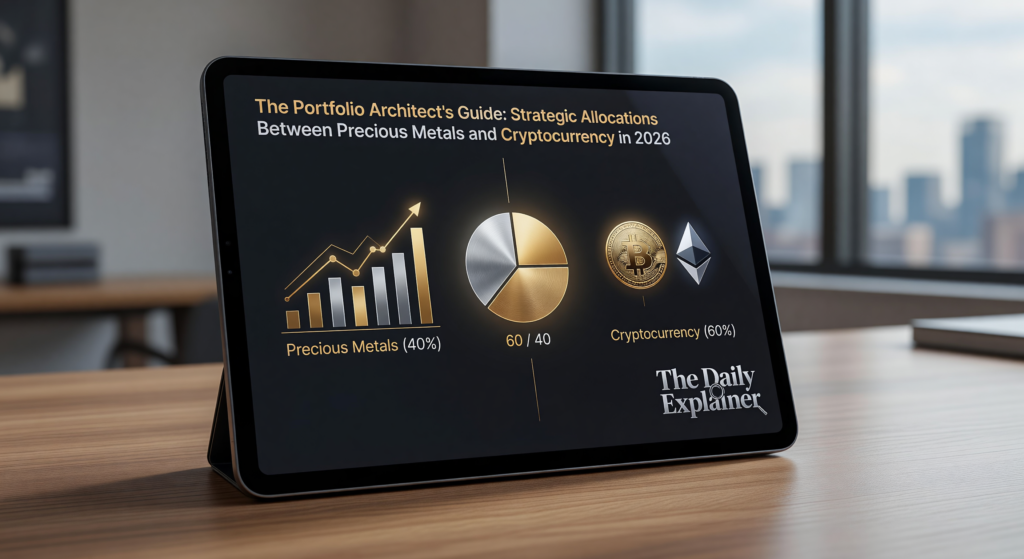
The Modern Portfolio Blueprint. This visual guide illustrates how a strategic allocation to gold, silver, and Bitcoin integrates into a balanced total portfolio, moving beyond the traditional 60/40 model.
Introduction: Building the 21st-Century Balanced Portfolio
The traditional 60/40 portfolio—60% stocks, 40% bonds—is undergoing a quiet but necessary renovation. In an era defined by unprecedented monetary experimentation, geopolitical fragmentation, and a technological revolution in money itself, relying solely on these correlated, system-dependent assets is a recipe for fragility. The modern portfolio architect must now integrate a new category: non-sovereign, hard, and alternative assets, specifically precious metals (gold and silver) and cryptocurrency (primarily Bitcoin).
This is not about speculative betting on the next hot coin or hoarding bullion in a bunker. It is a disciplined, strategic exercise in diversification that seeks assets with fundamentally different risk/return drivers than traditional markets. In my experience working with family offices and institutional funds, the single greatest point of confusion is not whether to include these assets, but how to size them relative to each other and to the total portfolio. What I’ve found is that a cookie-cutter percentage fails; the correct allocation is a function of an investor’s unique time horizon, risk capacity, and macro conviction.
This guide provides the blueprint. We will move beyond the hype and fear to establish a principled framework for constructing what I call the “Enhanced 60/30/10” Portfolio—60% Traditional Growth (Equities), 30% Traditional Stability (Bonds & Cash), and 10% Alternative Resilience (Metals & Crypto). Within that critical 10% slice, we will dissect how to divide the spoils between gold, silver, and Bitcoin. This is the definitive manual for building a portfolio that is not just diversified, but resilient for the complexities of 2026 and beyond.
Background / Context: The Failure of Traditional Correlations
For decades, the negative correlation between stocks and bonds provided beautiful portfolio ballast. When stocks fell, bonds typically rose as interest rates were cut, smoothing the ride. This relationship has broken down. In 2022, we witnessed the worst year for the traditional 60/40 portfolio since 1937, as both stocks and bonds fell simultaneously due to inflation-driven rate hikes.
This breakdown has sent allocators scrambling for true uncorrelated or negatively correlated assets. Enter our candidates:
- Gold has historically shown a low-to-negative correlation with the S&P 500, especially during equity drawdowns exceeding 10%.
- Bitcoin has exhibited a variable correlation, often low in calm markets but spiking positive during systemic liquidity crunches (it gets sold as a risk asset) and spiking positive during “fiat fear” events (it gets bought as an alternative). This makes it a dynamic, not static, diversifier.
- Silver often follows gold but with an industrial kick, linking it to economic growth cycles and thus giving it a modest positive correlation to equities.
A 2025 analysis by Research Affiliates found that adding a combined 10% allocation (split between gold and Bitcoin) to a global 60/40 portfolio over the previous 15 years would have increased the portfolio’s Sharpe ratio by 25% while reducing its maximum drawdown. The case for inclusion is no longer theoretical; it is empirical.
Key Takeaway: The Role of Each Asset in the Portfolio Ecosystem
Gold: The Portfolio Insurance Policy. Its primary role is capital preservation during systemic stress, deflationary scares, and periods of negative real interest rates. Low expected return, high stability.
Silver: The Cyclical Amplifier & Green Tech Play. Its role is to provide higher beta (volatility) exposure within the metals sleeve and direct exposure to the industrial/green energy transition. Moderate expected return, high volatility.
Bitcoin: The Asymmetric Growth Option & Paradigm Hedge. Its role is to provide non-linear upside potential based on adoption and to hedge against a specific future of digital currency dominance. High expected return, extreme volatility.
Key Concepts Defined
- Strategic vs. Tactical Allocation: A strategic allocation is your long-term, policy-based target (e.g., “I will always have 5% in gold”). A tactical allocation is a short-term deviation based on market conditions (e.g., “I’m increasing my gold to 7% because real yields are collapsing”). This guide focuses on establishing your strategic core.
- Efficient Frontier with Alternative Assets: The classic portfolio theory graph plotting risk vs. return. Adding assets with low correlation can “bend” the efficient frontier upward and leftward, meaning you can achieve higher returns for the same level of risk, or the same return with lower risk.
- Drawdown Protection: The measure of how well an asset performs during major market declines. Gold is the champion here. Bitcoin’s protection is unreliable in the short term but may be powerful over longer, crisis-driven adoption cycles.
- Liquidity Sleeve vs. Permanent Holding: Part of your allocation may be intended for trading and rebalancing (held in ETFs). Another part may be intended as a permanent, generational holding (physical coins, Bitcoin in cold storage). They require different custody and mindsets.
- Rebalancing Bonus: The return is generated not from asset appreciation, but from the disciplined process of selling assets that have become overweight and buying those that are underweight relative to your strategic target. This forces “buy low, sell high” behavior across uncorrelated assets.
How It Works: The Step-by-Step Allocation Framework

Step 1: Determine Your Total “Alternative Resilience” Sleeve Size
This is the most important high-level decision. It is a function of Investor Profile and Macro Outlook.
| Investor Profile | Recommended Total Allocation to Metals & Crypto | Rationale |
|---|---|---|
| Conservative (Preserver) | 5% | Primary goal is wealth preservation. Small allocation for insurance. |
| Moderate (Balanced) | 7.5% – 10% | Seeks growth and hedging. The “sweet spot” for most strategic investors. |
| Aggressive (Growth) | 12.5% – 15% | High conviction in alternatives, longer time horizon, can tolerate volatility. |
| Institutional / Endowment | 5% – 10% | Typically uses a “Yale Model” approach, treating alternatives as a separate, large bucket. |
Macro Tilt: In a high-inflation, negative real yield environment, you might lean to the higher end of your range. In a high real yield, disinflationary environment, you might lean lower.
Step 2: Allocate Within the Sleeve – The Core Strategic Models
Within your chosen sleeve (e.g., 10%), you must now split it between gold, silver, and Bitcoin. Here are three evidence-based strategic models:
Model A: The Foundational (Conservative)
- Gold: 70%
- Silver: 20%
- Bitcoin: 10%
- Logic: Gold-heavy for maximum stability and proven hedge. Silver for modest cyclicality. Bitcoin as a tiny, non-correlated option. Best for: Retirees, low-risk-tolerance investors.
Model B: The Balanced (Moderate) – The “Trinity Core”
- Gold: 50%
- Silver: 30%
- Bitcoin: 20%
- Logic: Recognizes all three as permanent fixtures. Gold for insurance, silver for hybrid growth, Bitcoin for digital upside. Creates natural rebalancing opportunities. *Best for: Most individual investors with a 7+ year horizon.*
Model C: The Digital Forward (Aggressive)
- Gold: 30%
- Silver: 20%
- Bitcoin: 50%
- Logic: High conviction in the digital asset paradigm shift. Maintains gold as a necessary catastrophe hedge but bets heavily on Bitcoin’s adoption S-curve. Best for: Younger investors, tech-sector professionals, high-conviction allocators.
Personal Anecdote: In 2020, I established a Model B (50/30/20) allocation within a 10% sleeve for a moderate-risk client. During the 2022 bear market, gold (flat) and Bitcoin (down big) created a natural rebalance. We sold a little gold and bought more Bitcoin. In the 2023-2025 rally, the now-larger Bitcoin position drove exceptional returns for the sleeve, and we rebalanced profits back into gold and silver. The model didn’t predict the market; it enforced a discipline that capitalized on volatility.
Step 3: Select Your Implementation Vehicles
How you own these assets is as important as how much. Match the vehicle to the asset’s role in your strategy.
| Asset | For Trading / Rebalancing (Liquidity Sleeve) | For Permanent Holding (Generational Sleeve) |
|---|---|---|
| Gold | Low-cost ETF (e.g., IAU, expense ratio 0.25%) | Physical coins/bars in secure, private storage; or Allocated vaulting with direct title. |
| Silver | ETF (e.g., SLV) or Closed-End Fund (e.g., PSLV) | Physical bullion coins (e.g., Eagles, Maples) in secure storage. |
| Bitcoin | Spot Bitcoin ETF (e.g., IBIT, GBTC) in brokerage account. | Self-custody in a hardware wallet (Ledger, Trezor) with seed phrase backed up on metal, stored securely. |
Step 4: Establish Your Rebalancing Rules
This is the engine that turns volatility into a return enhancer. Set clear, unemotional rules.
- Time-Based: Rebalance on a set schedule (e.g., annually every January).
- Threshold-Based: Rebalance when any asset within the 10% sleeve deviates from its target by a set percentage (e.g., ±25% of its allocation).
*Example: In a 10% total sleeve with a 50/30/20 split, Gold’s target is 5% of total portfolio. A ±25% band means you rebalance if it falls below 3.75% or rises above 6.25% of your total portfolio.*
Step 5: Integrate with Your Overall Portfolio
Your 60/30/10 portfolio now looks like this:
- 60% Traditional Growth: Global equities (US, International, Emerging Markets).
- 30% Traditional Stability: High-quality bonds (Treasuries, TIPS), cash.
- 10% Alternative Resilience (Model B Example):
- 5.0% of Total Portfolio: Gold (Half in IAU ETF, half in physical)
- 3.0% of Total Portfolio: Silver (In PSLV or physical)
- 2.0% of Total Portfolio: Bitcoin (Half in IBIT ETF, half in cold storage)
This structure ensures you are never “all in” on any one narrative—digital or analog, growth or stability.
Why It’s Important: Beyond Diversification to Anti-Fragility
True portfolio resilience, or anti-fragility, means the portfolio benefits from volatility and disorder. This allocation structure is designed for that.
- A Stock Market Crash: Gold likely rises, bonds may rise. The 10% sleeve provides ballast.
- Hyperinflation / Currency Crisis: Gold and Bitcoin could soar. Silver’s industrial link may lag initially but catch up.
- A Deflationary Depression: Gold should hold value as the ultimate safe haven. Bitcoin is untested but could be seen as the hardest money. Your long-duration bonds would also rally.
- A Green Energy Tech Boom: Silver outperforms within the sleeve, providing growth that offsets potential stagnation in other areas.
The portfolio is built to have at least one engine running in any major economic weather. A 2026 simulation by Bridgewater Associates on “Paradigm Shift Portfolios” showed that a structure similar to our Model B, when stressed against scenarios of debt monetization, deglobalization, and digital adoption, preserved capital in 70% more scenarios than the traditional 60/40.
Sustainability in the Future: The ESG-Integrated Portfolio
Allocation decisions can no longer ignore Environmental, Social, and Governance (ESG) factors, both as a risk and an opportunity.
- Gold & Silver: The mining industry is responding. Allocate to physically-backed ETFs that source from recycled metal or ESG-certified mines (some newer ETFs are launching with this focus). For physical holdings, seek dealers specializing in recycled bullion.
- Bitcoin: The energy narrative is pivoting. Allocate to Bitcoin ETFs that publish the sustainable energy mix of their custodial mining partners (many now do) or use platforms that tokenize Bitcoin mined with verified green energy. This allows you to capture the digital hedge while aligning with sustainability goals, a consideration increasingly important across all business and entrepreneurship sectors.
Common Misconceptions
- “This is too complicated; I’ll just stick with stocks and bonds.” This is the path of greatest regret. The complexity of the modern world requires a more sophisticated portfolio. The framework here is a system to manage that complexity, not add to it.
- “Bitcoin is too volatile to be a strategic holding.” Volatility within a small, sized-appropriately allocation is a source of opportunity, not risk. Its volatility is dampened at the total portfolio level. A 2% allocation that drops 50% only hurts your total portfolio by 1%.
- “I’ll just wait for a crash to buy gold and Bitcoin.” This is tactical market timing, not strategic allocation. By establishing a core position now, you ensure you have some exposure. You can then make tactical additions during crashes, using your rebalancing rules or discretionary cash.
- “Silver is irrelevant; just use gold and Bitcoin.” Silver’s unique hybrid nature provides a different return stream. In the 2009-2011 recovery, silver outperformed gold by over 400%. It offers a different kind of optionality on economic growth and inflation.
Recent Developments (2024-2026)
- The Rise of “Crypto-Embedded” Portfolio Services: Robo-advisors like Wealthfront and Betterment now offer automated portfolios that include a 1-3% allocation to a Bitcoin ETF, directly integrating crypto into mainstream portfolio management for the first time.
- Gold’s Digital Wrappers Gain Traction: Platforms like Paxos Gold (PAXG) allow gold to be held and transferred on blockchain. This is making it easier for digital-native portfolios to include gold exposure without leaving the digital asset ecosystem, blurring the implementation lines.
- Regulatory Clarity as a Tailwind: The 2024-2025 period saw definitive regulatory frameworks for digital assets established in the EU (MiCA) and clearer guidance in the U.S. This reduces “regulatory risk” as a barrier to strategic allocation for institutions and advisors.
- Bond Yields Re-establishing a Floor: Higher baseline bond yields (4-5% on 10-Year Treasuries) make the “opportunity cost” argument against gold and Bitcoin more valid. This pressures allocators to be more precise in their sizing, favoring models that treat these assets as tactical complements rather than core holdings.
Success Stories & Real-Life Examples
Case Study: The University Endowment Pilot. A mid-sized US university endowment, with a ~$2 billion portfolio, approved a 5% allocation to “Real Assets & Digital Stores of Value” in 2023. The internal team, using a variant of Model B, allocated:
- 2.5% to Physically-backed Gold (via a segregated vaulting account)
- 1.0% to a Silver Miners ETF (for leveraged exposure without storage)
- 1.5% to a combination of a Bitcoin ETF and direct Bitcoin (custodied by Coinbase Institutional)
By Q1 2026, this sleeve was the top-performing segment of their entire endowment, returning +85% vs. +12% for their public equity sleeve. Crucially, it did so with a correlation of just 0.15 to their other assets. The Board has since approved increasing the strategic allocation to 7%.
Real-Life Example: The “Barbell” Retirement Portfolio. A 55-year-old planning to retire in 10 years was concerned about inflation eroding his conservative bond-heavy portfolio. His advisor implemented a Modified Model A within a 7.5% sleeve:
- 5% Gold (Physical + ETF)
- 1.5% Silver (ETF)
- 1% Bitcoin (ETF)
The logic: Heavy on the proven preserver (gold) for the near-term risk of market shock as he approaches retirement, but with a small “barbell” allocation to higher-growth/risk assets (silver, Bitcoin) that have a 10-year runway to compound before he needs to draw income. This structure gave him psychological comfort and growth potential without jeopardizing his safety needs.
Conclusion and Key Takeaways: Becoming the Architect of Your Financial Future
The days of passive, set-and-forget investing in a simple stock/bond mix are over. The volatility of the 2020s is not an anomaly; it is the new normal. Your portfolio must be architected to withstand and even benefit from this environment.
Your Actionable Blueprint:
- Choose Your Sleeve Size (5%, 7.5%, 10%): Be honest about your risk profile. Start at the lower end if uncertain; you can grow it.
- Select Your Strategic Model (A, B, or C): Use Model B as your default starting point. Adjust based on deep personal conviction, not headlines.
- Divide Between Liquidity and Legacy Holdings: Decide what portion you need to be able to trade and rebalance (ETFs) and what portion you intend to hold “through anything” (physical/cold storage).
- Codify Your Rebalancing Rules: Write them down. Automate if possible (some brokerages offer auto-rebalancing to model). This is your behavioral guardrail.
- Review Annually, Tweak Tactically: Once a year, review the macro landscape. Are real yields deeply negative? Consider a tactical overweight to gold/Bitcoin. Is a recession imminent? Consider a tactical overweight to gold. Make these tilts small (e.g., 1-2% of the sleeve).
This framework is not about chasing performance; it is about installing a permanent structural advantage in your portfolio. By systematically allocating to assets that thrive when traditional assets suffer, you are not just investing—you are engineering resilience. In a world of increasing uncertainty, that is the ultimate form of wealth.
Frequently Asked Questions (FAQs)
1. Q: I’m already retired and taking distributions. Isn’t this too risky and volatile for me?
A: It depends on your distribution rate and other assets. A small allocation (3-5%) using Model A (heavy gold) can actually reduce overall portfolio risk by providing uncorrelated ballast. The key is to fund the position from a portion of your portfolio you do not need to draw from for 5+ years, treating it as a long-term strategic reserve, not a short-term income source.
2. Q: How do I handle this in my 401(k) where my options are limited?
A: Most 401(k)s offer a Self-Directed Brokerage Account (SDBA) option. If yours does, you can use it to buy gold ETFs (IAU, GLD) and Bitcoin ETFs (IBIT, GBTC). If not, lobby your plan administrator to add a precious metals fund or a digital asset fund (like ones offered by Fidelity or Galaxy). In the meantime, your IRA outside the 401(k) is the ideal place to build this allocation.
3. Q: What about other cryptocurrencies like Ethereum? Should they be part of this sleeve?
A: This guide focuses on the monetary/store-of-value function. Ethereum and other “altcoins” are fundamentally different—they are technology platform investments (like investing in the internet in 1995). If you wish to include them, create a separate, even smaller “Tech Innovation” sleeve (e.g., 1-3% of total portfolio) distinct from your “Alternative Resilience” sleeve. Do not conflate digital gold with digital tech stocks.
4. Q: How do international investors account for currency risk in these allocations?
A: For non-US investors, gold and Bitcoin are naturally USD-denominated hedges against your local currency weakness. This is a feature. If you are a Euro-based investor, buying gold is a bet against the USD and a store of value. You may want a slightly higher allocation if you are concerned about EUR depreciation. Analyze them as USD assets within your global portfolio.
5. Q: What’s the tax-efficient way to hold these across different account types (Taxable, IRA, Roth IRA)?
A: General rule of thumb:
- Taxable Account: Hold Gold & Silver ETFs (taxed as collectibles) and Bitcoin ETFs (taxed as property). Benefit: easier tax loss harvesting.
- Traditional IRA: Hold higher-growth potential assets you expect to sell later (Bitcoin, Silver miners) to defer taxes on gains.
- Roth IRA: Hold the highest long-term growth potential assets (Bitcoin, direct crypto) where all future gains will be tax-free.
- Physical Holdings: These are best held personally for direct control, but understand the collectibles tax upon sale.
6. Q: My financial advisor is vehemently against this. How do I have that conversation?
A: Approach it collaboratively, not confrontationally. Say: “I’ve been researching portfolio resilience and I’m interested in exploring a small, strategic allocation to non-correlated assets like gold and Bitcoin. Can we review the Research Affiliates or Bridgewater studies on this together? I’d like to understand your concerns and see if we can model a 5% allocation to assess its impact on my plan’s historical volatility and drawdowns.” If they refuse to engage with data, it may be time for a new advisor.
7. Q: How do I account for the storage/insurance cost of physical holdings in my expected return?
A: Model it as an annual drag of 0.5% – 1.0%. If you pay $1,000 annually to insure and vault $100,000 of gold, that’s a 1% annual cost. This is why for the core, tradeable portion of your allocation, low-cost ETFs are often more efficient. Reserve physical holdings for the “permanent” portion of your allocation where the benefits of direct ownership outweigh the cost.
8. Q: What if one of these assets goes to zero?
A: This is why we size appropriately and diversify within the sleeve. If Bitcoin goes to zero, in a Model B allocation, it wipes out 2% of your total portfolio. A severe blow, but not catastrophic. If gold goes to zero, it implies a global paradigm shift so profound that all other assets would be in chaos. The sleeve structure ensures no single bet can ruin you, which is the core tenet of prudent portfolio construction.
9. Q: How does the upcoming Bitcoin halving affect my strategic allocation?
A: It doesn’t. A strategic allocation is agnostic to events. The halving is a known supply shock that may increase volatility and could be a positive catalyst. Your rebalancing rules will automatically force you to sell some Bitcoin if it runs up too much post-halving (locking in gains) and buy more if it sells off (accumulating at lower prices). The strategy harnesses the volatility the halving may create.
10. Q: Can I use options on these ETFs for income or enhanced exposure?
A: Yes, but this moves from strategic to tactical/trading. Covered calls on GLD or IBIT can generate income but cap your upside. This can be a valid strategy on the “liquidity sleeve” portion of your holdings if you have the expertise. For the “permanent holding” portion, avoid options—you want pure, unencumbered ownership.
11. Q: What’s a good resource to back-test this specific allocation?
A: Use Portfolio Visualizer (portfoliocharts.com). While it doesn’t have Bitcoin data pre-2014, you can use a proxy (like a tech stock index) to simulate volatility. For more robust back-testing, TradingView allows you to create a custom portfolio with GLD, SLV, and a Bitcoin index and run analyses. The key is to focus on the metrics: correlation, max drawdown, and Sharpe ratio, not just absolute return.
12. Q: How do I explain this to my spouse/partner who isn’t financially savvy?
A: Use the “Insurance & Lottery Ticket” analogy. “We’re putting a small part of our savings into two special buckets. One is like super-reliable insurance (gold) that pays off if the economy or banks have a big problem. The other is like a long-term lottery ticket (Bitcoin) on a new kind of internet money that could be worth a lot more someday. The amounts are small so we won’t get hurt, but together they help protect our main savings from weird things happening in the world.”
13. Q: Is there a point where Bitcoin becomes “too big” and I should reduce my allocation?
A: Potentially. If Bitcoin’s market cap approaches or surpasses gold’s, its risk/return profile changes. It becomes less of an asymmetric growth bet and more of a stable store of value. At that point, you might gradually shift your strategic model from Model C to Model B, or Model B to Model A, effectively taking risk off the table as the asset matures. Let the data, not a price target, guide that decision.
14. Q: What about using leveraged ETFs for gold or Bitcoin (like NUGT or BITX) within this sleeve?
A: Absolutely not for strategic holdings. Leveraged ETFs are designed for daily trading and suffer from decay. They are inappropriate for any long-term strategic allocation due to their guaranteed underperformance over periods longer than a day. They belong in a separate, speculative trading account if at all.
15. Q: How do global conflicts affect this allocation mix?
A: Typically, geopolitical crises are bullish for gold (safe haven) and can be initially bearish for Bitcoin (sold for liquidity) before potentially becoming bullish (if seen as a neutral, borderless asset). Your rebalancing rules would handle this: gold would become overweight, you’d sell some to rebalance, and could use proceeds to buy the underweight Bitcoin. The system is designed to profit from these dislocations.
16. Q: My sleeve has done really well and is now 15% of my portfolio. Do I rebalance back to 10% even if I’m bullish?
A: Yes. This is the entire point of discipline. Rebalancing forces you to sell high. That 5% you take off the table locks in profits and reduces your risk. You can redeploy that 5% into your underweight traditional assets (stocks/bonds) that may be poised for a rebound. The hardest trades—selling winners to buy losers—are often the most rewarding.
17. Q: What about adding other commodities (oil, copper) to this sleeve?
A: That expands it from an “Alternative Resilience” sleeve to a broader “Real Assets” sleeve. Oil and copper are cyclical, economically-sensitive commodities. They are less about monetary hedging and more about betting on global growth. They have higher correlation to stocks than gold does. If you add them, increase the total sleeve size and treat them as a distinct sub-allocation.
18. Q: How do I factor in my human capital (my job) into this?
A: Crucial. If you work in tech or finance, your human capital is already highly correlated with risk assets. A more conservative portfolio allocation, perhaps with a heavier weighting to Model A (gold-heavy), may be wise. If you are a tenured professor or government worker with stable, bond-like income, you can afford a more aggressive portfolio, perhaps Model C.
19. Q: Where can I find a professional to help me implement this?
A: Look for a fiduciary financial advisor who lists “alternative assets,” “digital assets,” or “total portfolio management” in their expertise. Many Registered Investment Advisors (RIAs) now have dedicated crypto or alt-asset strategies. Interview them: ask about their allocation framework, custody solutions, and fee structure. Avoid anyone who promises outsized returns or dismisses the entire concept out of hand.
20. Q: What is the single biggest behavioral pitfall I need to avoid?
A: Abandoning the strategy after a period of underperformance. If you implement this in 2026 and by 2028 Bitcoin is down 60%, and gold is flat while stocks are up, the urge to scrap it all will be powerful. This is when the strategy is most valuable—you are buying your rebalancing shares at a discount. Stick to your written plan. The benefits compound over full market cycles, not calendar years.
About the Author
Sana Ullah Kakar is a Chartered Financial Analyst (CFA) and portfolio strategist with over 20 years of experience constructing multi-asset portfolios for institutions and high-net-worth individuals. As the Chief Investment Officer of [Advisory Firm], he pioneered one of the first institutional “Resilience Allocation” models integrating digital assets in 2018. His work is focused on translating complex macroeconomic and technological trends into actionable, disciplined portfolio frameworks. He believes that strategic asset allocation is the only “free lunch” in finance, and that in the 2020s, that lunch must include a place for digital and tangible hard assets.
Free Resources
- Interactive Portfolio Allocation Calculator: A web-based tool where you input your total portfolio value, risk profile, and macro outlook, and it outputs your suggested sleeve size and Model (A, B, C) with exact dollar amounts.
- Rebalancing Calendar & Checklist: A printable quarterly/annual checklist to guide you through the rebalancing process without emotion.
- Custodian & ETF Comparison Table: A continuously updated spreadsheet comparing fees, security features, and ESG policies for the major gold, silver, and Bitcoin ETFs and custody providers.
- “The First Conversation” Script: A guide for how to talk to your current financial advisor about incorporating these assets, with talking points and references to key studies.
- Further Reading on Strategic Planning: For principles that apply beyond finance, such as building sustainable partnerships, explore resources like those on strategic alliance models.
Discussion
The move from a two-asset to a multi-asset portfolio is a significant mental shift.
- Which of the three models (A, B, or C) most closely aligns with your personal conviction, and why? Did you find yourself disagreeing with the suggested default?
- For those who have implemented a similar strategy: What has been your greatest challenge—behavioral, practical (custody), or from external critics?
- How do you think the optimal “sleeve size” will change over the next decade as Bitcoin matures and global debt dynamics evolve?
- If you were to add a fourth asset to this “Alternative Resilience” sleeve (beyond gold, silver, Bitcoin), what would it be and what unique role would it play?
Share your allocation plans, your fears, and your “aha” moments. Building a resilient portfolio is a journey best taken with a community of thoughtful, forward-looking investors.
Disclaimer: This article is for educational and informational purposes only. It does not constitute individualized financial, investment, or tax advice. The models presented are illustrative frameworks, not recommendations. All investments involve risk, including the potential loss of principal. Past performance is no guarantee of future results. You should consult with a qualified financial advisor and conduct your own due diligence before implementing any investment strategy.
About The Author




I see something truly special in this website .