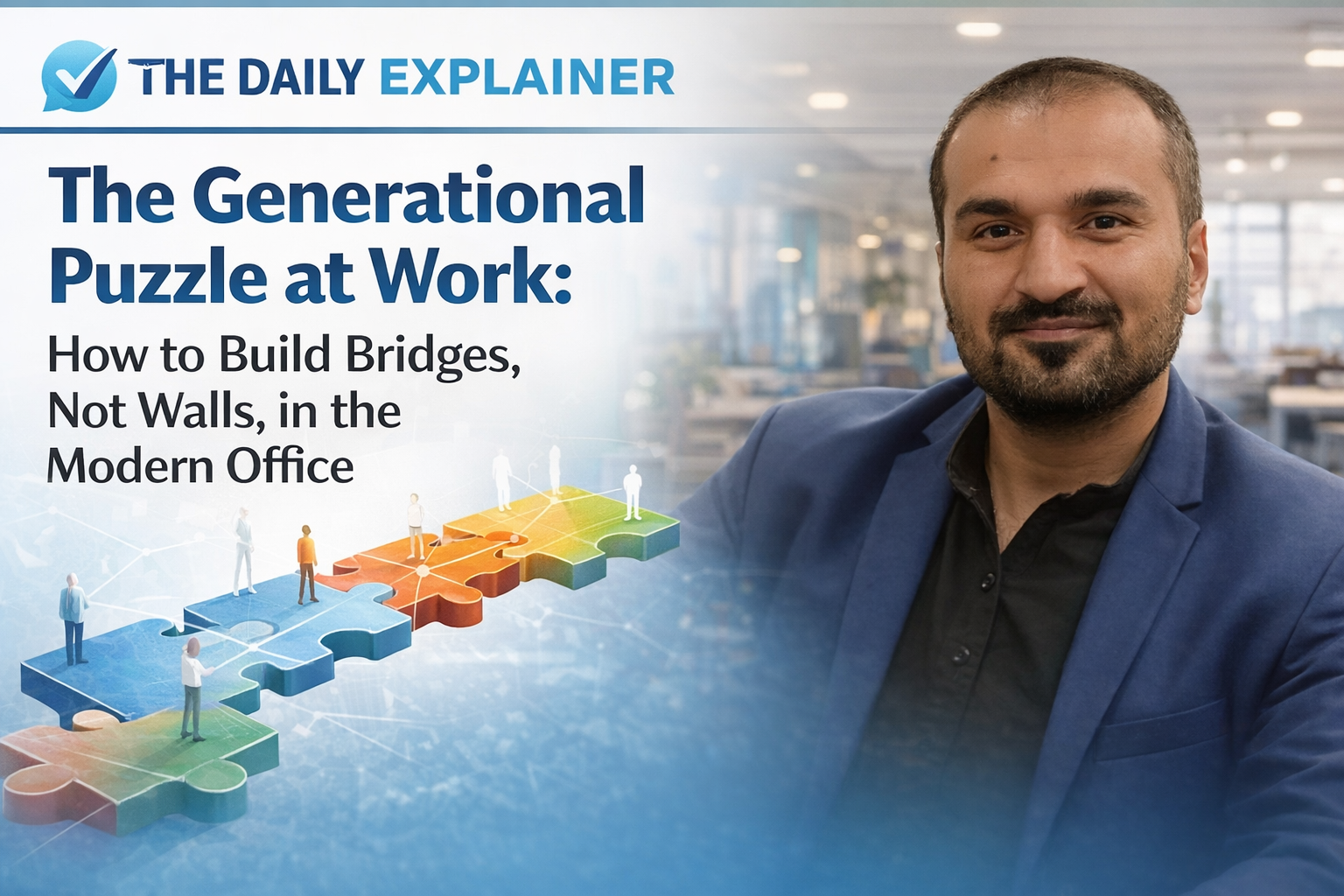
A snapshot of how history shaped the work operating systems of each generation in today's workforce.
It’s Monday morning. In one corner of the virtual meeting, a Baby Boomer (born 1964 or earlier) sends a formal, detailed email follow-up to a conversation that just ended. A Millennial (born 1981-1996) posts the key takeaways in a colorful, collaborative Google Doc and drops the link in the team Slack channel. Meanwhile, a Gen Z employee (born 1997-2012) has already created a 60-second recap video on a TikTok-style platform and DMed it to the group chat. The Boomer is frustrated by the lack of documentation, the Millennial is annoyed by the “email clutter,” and Gen Z wonders why no one is engaging with their much more efficient video.
This isn’t a comedy sketch. It’s the daily reality of the most generationally diverse workforce in human history. For the first time, we have five distinct generations working side-by-side: Traditionalists (1928-1945), Baby Boomers, Gen X (1965-1980), Millennials, and Gen Z. This diversity is a tremendous asset, a melting pot of experience, innovation, and perspective. Yet, too often, it feels like a source of friction, misunderstanding, and quiet judgment.
The workplace has become a generational puzzle. Each piece—shaped by vastly different world events, technologies, and social norms—is essential to completing the picture, but they don’t always seem to fit. The key to success isn’t forcing one piece to change its shape, but learning how to connect them effectively.
In my experience leading multi-generational teams, the biggest breakthroughs haven’t come from generational stereotypes, but from understanding core motivations. I once mediated a clash between a Boomer manager who valued formal, scheduled check-ins and a Gen Z report who thrived on real-time, casual feedback via chat. The manager saw the casual pings as disruptive; the employee saw the scheduled meetings as artificial and slow. The solution wasn’t for one to capitulate. We created a “feedback menu”: quick, informal chat for minor updates and a brief, weekly structured sync for bigger-picture alignment. Both got what they needed, and productivity soared. The generational “clash” was just a misalignment of communication vehicles.
Ignoring these dynamics is a strategic risk. A 2026 study by the Society for Human Resource Management (SHRM) found that teams with high “generational fluency” reported 30% higher innovation output and 45% lower turnover. Conversely, teams plagued by generational tension wasted nearly 20% of their time on miscommunication and rework. This isn’t about “managing” Millennials or “catering to” Boomers. It’s about building a trans-generational culture where difference is leveraged as the ultimate competitive advantage.
The Roots of the Divide: How History Shaped Our Work Ethic
To build bridges, we must first understand the landscapes each generation came from. Their formative years created deeply ingrained “work operating systems.”
- Traditionalists & Baby Boomers: The Builders (Influenced by Post-War Stability, Hierarchy)
- Formative Events: World Wars, the Great Depression, post-war economic boom, the rise of large, stable corporations.
- Work OS Installed: Loyalty & Linear Ladders. Work is a place you go. Authority is respected. Paying your dues, seniority, and a clear chain of command are paramount. Communication is formal (memos, meetings), and job security is a primary motivator. The career path is a vertical climb within one or two companies.
- Gen X: The Independents (Influenced by Latchkeys, Layoffs, and Early Tech)
- Formative Events: The rise of divorce, the “latchkey kid” phenomenon, the early PC (Apple IIe, Commodore 64), corporate downsizing in the 80s/90s.
- Work OS Installed: Autonomy & Skepticism. Having seen their parents’ loyalty rewarded with layoffs, Gen X trusts systems less and self-reliance more. They are the original work-life balancers, valuing efficiency and output over face time. They are digitally adaptable (email pioneers) but not native. They communicate directly, often with a dry, pragmatic wit.
- Millennials: The Optimistic Collaborators (Influenced by Connectivity, 9/11, and the Great Recession)
- Formative Events: The dawn of the internet/social media, 9/11, the 2008 financial crisis, rising student debt.
- Work OS Installed: Purpose & Feedback. They entered a shaky job market burdened by debt, seeking meaning and stability. They crave collaborative, flat structures, constant feedback (having grown up with instant likes and comments), and work that aligns with personal values. They are digital natives who blend personal and professional online identities. They see a career as a “portfolio” of experiences, not a ladder.
- Gen Z: The Pragmatic Realists (Influenced by Smartphones, Climate Anxiety, and Pandemic Disruption)
- Formative Events: Lifelong access to smartphones/social media, the climate crisis, school shootings, the COVID-19 pandemic, and remote schooling.
- Work OS Installed: Authenticity & Entrepreneurship. They are the true digital integrators, with brains wired for rapid-fire, visual communication (TikTok, Instagram Stories). Having witnessed economic and social instability, they are fiscally cautious and pragmatic. They demand radical authenticity from employers, prioritize mental health, and see traditional career paths as obsolete. Many are building personal brands and side hustles alongside—or instead of—a traditional job. For a deeper look at this entrepreneurial mindset, resources like the SheraKat Network’s guide to starting an online business resonate strongly with them.
The clash isn’t about right or wrong. It’s about different systems trying to run the same program. A Boomer’s “prove your dedication through overtime” conflicts with a Gen Xer’s “prove your effectiveness by getting done early.” A Millennial’s request for weekly praise can feel high-maintenance to a Gen X manager who believes “no news is good news.” Gen Z’s preference for video messages can feel unprofessional to a Traditionalist who values written formality.
Key Concepts: Moving Beyond Stereotypes to Understanding
To navigate this, we need a new vocabulary that focuses on values, not birth years.
- Generational Cohort: A group of people born within a particular timeframe who share formative cultural and historical experiences. This is the factual basis.
- Life Stage vs. Generation: A 25-year-old Gen Z and a 25-year-old Millennial in 1995 are at the same life stage (early career) but had different generational experiences (growing up with vs. without social media). It’s crucial to separate youthful behavior from generational traits.
- Digital Nativeness: The degree to which a person grew up immersed in a digital environment. This is a spectrum, not a binary. It profoundly affects communication preferences, learning styles, and concepts of privacy and collaboration.
- Motivational Currency: What truly drives and engages each group. For Boomers, it may be respect and legacy. For Gen X, autonomy and trust. For Millennials, purpose and development. For Gen Z, authenticity and well-being. Effective management exchanges in the right currency.
- Trans-Generational Culture: A workplace culture intentionally designed to be inclusive of all generational perspectives, leveraging the strengths of each while mitigating friction points. It’s the ultimate goal.
The Bridge-Building Blueprint: A Step-by-Step Guide to Harmonious Teams

Creating generational harmony is an active process, not a passive hope. Here’s how to build your bridge, plank by plank.
Step 1: Cultivate Generational Curiosity, Not Assumptions
Ban stereotypes. Replace “Ugh, Boomers are so resistant to change” with “I’m curious about what risks they perceive in this new tool.” Swap “Gen Z has no attention span” for “I wonder what format would make this information most accessible to them.” Launch this with formal training or simple team workshops that explore each generation’s formative influences without judgment. Our Explained section often breaks down such complex social dynamics into understandable frameworks.
Step 2: Create a “Communication Menu”
A one-size-fits-all communication policy will fail. Instead, co-create a team “menu” of options.
- For Formal/Asynchronous: Detailed email, formal report. (Appeals to Boomer/Gen X preference for documentation).
- For Collaborative/Project-Based: Shared cloud documents (Google Docs, Notion), project management boards (Asana, Trello). (Appeals to Millennial/Gen Z love for real-time collaboration).
- For Quick/Synchronous: Instant message (Slack/Teams), quick video call. (Appeals to Gen X/Gen Z desire for speed).
- For Engaging/Visual: Short Loom video update, infographic, internal social post. (Appeals strongly to Gen Z).
The rule: the sender considers the receiver’s preferred channel for the message type, and the team agrees on response time expectations for each channel.
Step 3: Implement Reverse and Reciprocal Mentoring
This is the most powerful tool in the kit.
- Reverse Mentoring: Pair a junior Gen Z or Millennial employee with a senior leader. The junior teaches the senior about new technologies, social media trends, and the emerging consumer mindset. This gives young employees a powerful voice and keeps leadership connected.
- Reciprocal Mentoring: Pair employees from different generations as true peers. A Gen Xer can mentor a Millennial on organizational navigation and pragmatic decision-making, while the Millennial mentors on digital collaboration tools and emerging wellness practices. Both give and receive wisdom.
Step 4: Redefine “Professionalism” and “Productivity”
The old markers are obsolete. Update your organizational definitions:
- From “Face Time” to “Results.” Measure output and impact, not hours logged at a desk. This satisfies Gen X’s desire for autonomy and Gen Z’s demand for flexibility.
- From “Formal Attire/Speech” to “Respectful Contribution.” Focus on the quality of ideas, not the style of delivery (within respectful bounds). A well-argued point in a casual team chat is more professional than a poorly reasoned one in a formal memo.
- From “Quiet Endurance” to “Sustainable Performance.” Champion taking breaks, using vacation time, and setting boundaries. This is crucial for Millennial/Gen Z mental health and prevents burnout across all generations.
Step 5: Design Inclusive Benefits and Recognition
Your benefits package tells each generation what you value.
- For Boomers/Gen X: Strong retirement planning support, premium health coverage, recognition of tenure and experience.
- For Millennials: Student loan repayment assistance, clear career development paths, paid volunteer time, wellness stipends.
- For Gen Z: Financial literacy tools, mental health days and therapy coverage, flexibility to work on passion projects, clear sustainability/ESG commitments.
Recognition should also be multi-format: formal awards ceremonies and public shout-outs in digital channels.
Key Takeaway Box: The Generational Exchange
Boomers/Gen X Offer: Institutional knowledge, risk management, nuanced client relationships, strategic patience.
Millennials/Gen Z Offer: Digital fluency, innovation mindset, focus on purpose & ethics, agility.
The Synergy: The stability and wisdom of experience combined with the agility and new perspective of youth creates an unstoppable, future-proof organization.
The Business Imperative: Why Getting This Right is Non-Negotiable
This isn’t touchy-feely stuff. It’s a hard-nosed business strategy.
- Innovation Engine: Homogeneous groups think alike. Diverse groups, including generational diversity, challenge assumptions and spark breakthrough ideas. A Boomer’s understanding of industry cycles combined with a Gen Z’s grasp of emerging platforms can identify opportunities invisible to either alone.
- Talent Retention & Attraction: You can’t afford to alienate any generation. A company known as a “Boomer club” will never attract top Gen Z talent. A startup that glorifies only “young hustle” loses the stabilizing force of experienced leaders. Becoming known as a trans-generational workplace makes you a talent magnet for all.
- Customer Mirror: Your workforce should reflect your multi-generational customer base. Who better to understand the needs of Boomer investors, Millennial parents, and Gen Z consumers than employees from those generations?
- Risk Mitigation: Experienced workers provide continuity and historical context, preventing the organization from repeating past mistakes. They are the organizational memory.
The Future of the Generational Mix: Sustainability and Evolution
The puzzle isn’t getting simpler. Generation Alpha (born 2013-2025) is already on the horizon, shaped by AI assistants, virtual reality, and even greater climate awareness. The principles of generational fluency will only become more critical.
The sustainable model is a “Circle of Wisdom,” not a pyramid of seniority. Leadership will involve curating contributions from all ages. Learning will be truly lifelong and multi-directional. Technology adoption will be driven by a coalition of the digitally native and the strategically experienced, ensuring tools serve people, not the other way around.
Companies that master this will not have a “generational problem.” They will have a generational advantage. They will be resilient, adaptive, and deeply human places to work. For insights on how these workplace trends intersect with broader global shifts, exploring analyses in our Global Affairs & Politics category can be enlightening.
Debunking the Most Common Generational Myths
Myth 1: “Gen Z is lazy and doesn’t want to work.”
Reality: They don’t want to work in meaningless, exploitative ways. They are fiercely hardworking on projects they believe in. They reject “hustle culture” in favor of “impact culture.” They want to see the tangible result of their labor.
Myth 2: “Boomers are technologically incompetent and resistant to change.”
Reality: They adopted personal computers, email, and complex enterprise software—technological leaps far more dramatic than moving from one app to another. Their resistance is often to poorly implemented change that doesn’t respect past learning or demonstrate clear value. They are capable but selective.
Myth 3: “Millennials need constant praise and hand-holding.”
Reality: Having grown up with structured activities and frequent feedback, they are accustomed to clear benchmarks and calibration. They don’t want empty praise; they want clarity on how to succeed and grow. It’s a desire for effective management, not coddling.
Myth 4: “Gen X is disengaged and cynical.”
Reality: They are pragmatically independent. They saw corporate loyalty fail, so their engagement is earned through autonomy, competence in leadership, and fair exchange. Their “cynicism” is often a valuable reality check on unrealistic plans.
The Latest Frontier: 2025-2026 Developments
- The “Intergenerational ERG”: Leading companies are moving beyond generic Employee Resource Groups (ERGs) to create specific “Intergenerational Connection” groups. These are safe spaces for cross-age dialogue, often tackling specific friction points like meeting norms or feedback styles.
- AI as a Translator: Early-stage AI tools are being piloted to “translate” communication styles. Imagine an AI that can rephrase a Gen Z’s quick, emoji-filled chat update into a more formal bullet-point summary for a Boomer stakeholder, and vice-versa.
- The Rise of the “Perennial” Mindset: A new cultural concept is gaining traction: the “perennial” (ageless) professional. This mindset, discussed by thought leaders on platforms like WorldClassBlogs, focuses on continuous learning and contribution regardless of chronological age, actively fighting ageism in all directions.
Success Stories: Where the Magic Happens
Case Study: The Financial Services Firm’s Digital Transformation
A staid, 100-year-old financial firm needed a massive digital overhaul. Leadership (heavily Boomer/Gen X) assembled a project team of their most senior IT architects. Progress was slow and fraught with fear of risk.
- The Pivot: A new VP dissolved the siloed team and formed a “Digital Guild” with equal parts senior architects, mid-career Millennial project managers, and Gen Z UX designers and data analysts fresh from university.
- The Process: The seniors provided the crucial understanding of regulatory constraints and system architecture. The Millennials facilitated agile workflows and stakeholder communication. The Gen Z team conducted user research via social listening and built prototype interfaces in weeks, not months.
- The Result: The project delivered 6 months ahead of schedule with a 40% higher user adoption rate. The senior architects reported feeling “re-energized,” while the Gen Z employees gained invaluable institutional knowledge. The firm now uses this “Guild” model for all major initiatives.
Case Study: The Retail Brand’s Marketing Revival
A classic apparel brand was losing relevance with younger consumers. Their marketing department, mostly Millennials, was creating beautiful Instagram content that wasn’t converting.
- The Insight: The Head of Marketing (a Gen Xer) mandated that every campaign concept be reviewed by a panel including two Boomer-era store managers and three Gen Z interns from the design team.
- The Collision & Fusion: The Boomers immediately flagged that the campaigns didn’t highlight product durability or value—key drivers for their core customer base. The Gen Z interns pointed out the content felt inauthentic and suggested collaborating with nano-influencers instead of celebrities.
- The Result: The next campaign featured a dual message: high-quality craftsmanship (speaking to Boomers/Gen X) promoted through authentic, creator-led “wear tests” on TikTok (speaking to Gen Z/Millennials). Sales increased across all three demographic segments.
Real-Life Scenarios and Everyday Solutions
- The Feedback Dilemma:
- Scenario: A Gen X manager gives a Gen Z employee a quarterly review with a few critical points. The employee is devastated, feeling blindsided.
- Bridge-Building Solution: Implement a “feedback charter.” The manager agrees to give smaller, real-time bits of feedback (via chat or quick call) closer to the event. The employee agrees to view the formal review as a summary, not a surprise. This blends the Gen Z need for frequent calibration with the company’s formal process.
- The Meeting Mismatch:
- Scenario: Boomers and Gen Xers see meetings as essential for decision-making and alignment. Millennials and Gen Z see many meetings as wasteful and prefer async updates.
- Bridge-Building Solution: Adopt a “Default to Async” rule. Every meeting must have a clear agenda and goal sent in advance. If the goal can be achieved via a shared document with comments, the meeting is canceled. This respects everyone’s time and leverages efficient tools.
- The Knowledge Transfer Challenge:
- Scenario: A retiring Boomer expert has decades of tacit knowledge in their head. The younger team relies on documented processes.
- Bridge-Building Solution: Instead of a rushed week of shadowing, institute a “Legacy Project.” The retiring expert is paired with two younger employees to create a multimedia knowledge base: written guides, Loom video walkthroughs, and a series of “storytelling” interviews about major past projects and lessons learned. This captures wisdom in engaging, modern formats.
Conclusion and Key Takeaways: From Collision to Collaboration
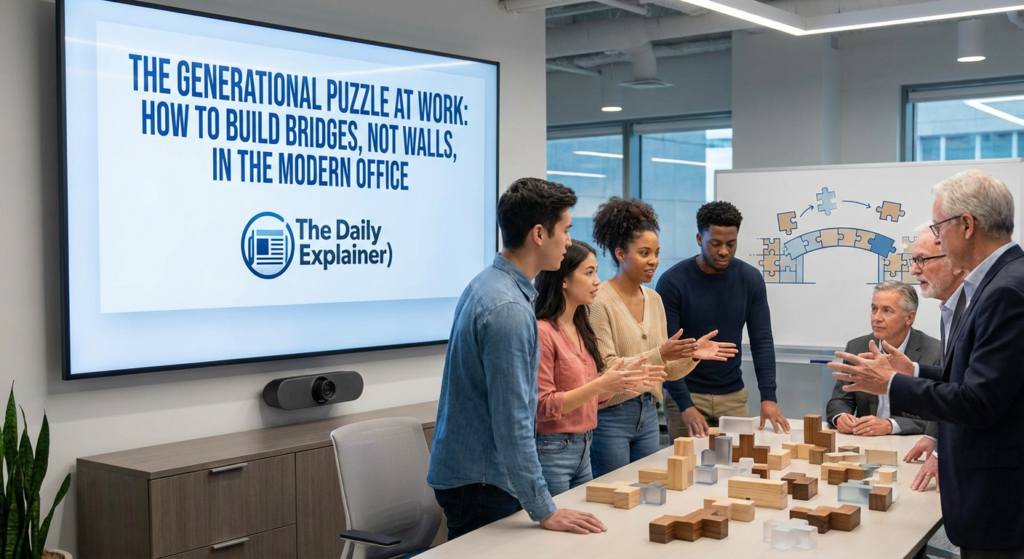
The generational puzzle at work is not a problem to be solved, but a reality to be mastered. The friction points are not signs of dysfunction but opportunities for growth—if we approach them with curiosity, respect, and a willingness to adapt.
The goal is not a bland, homogeneous workplace where everyone acts the same. It is a vibrant, trans-generational ecosystem where the strategic patience of a Boomer, the pragmatic independence of a Gen Xer, the collaborative idealism of a Millennial, and the digital pragmatism of Gen Z combine to create something far stronger than the sum of its parts.
Your Action Plan for Building Bridges:
- Diagnose Your Currency: Identify the primary “motivational currency” of your colleagues and yourself. Are they driven by respect, autonomy, purpose, or authenticity? Learn to “speak” their currency.
- Champion a “Menu of Options”: In communication, recognition, and benefits, advocate for choice. One rigid way excludes someone.
- Seek a Reverse Mentor: If you’re over 40, find a mentor under 30. If you’re under 30, seek a mentor 20+ years your senior. Make it explicit. The learning will flow both ways.
- Separate Style from Substance: Judge contributions by their merit, not by the generationally-influenced style in which they are delivered.
- Be the Bridge: When you hear a generational stereotype, gently challenge it. Model curiosity. “I wonder why they see it that way?” is a more powerful question than “Why are they so difficult?”
The most successful organizations of the next decade will be those that can harness the full spectrum of human experience in their workforce. They will understand that a 25-year-old and a 65-year-old are not just at different life stages; they are valuable repositories of different kinds of intelligence, both essential for navigating an uncertain future.
Start building your bridge today. The view from the middle, where all generations meet, is where the future is being built.
For more perspectives on building effective teams and communities, explore the diverse commentary available on the WorldClassBlogs platform.
Frequently Asked Questions (FAQ)
Q1: Isn’t this just stereotyping based on age?
A: It’s a crucial distinction. Stereotypes are rigid assumptions (“All Boomers are bad at tech”). Generational theory is about understanding probabilistic influences. It says, “Because someone grew up during X event, they may be more likely to value Y.” It’s a starting point for curiosity, not a conclusion. The individual always comes first.
Q2: How do I handle a much older employee who dismisses my ideas because of my age?
A: This is about establishing credibility. First, ensure your ideas are well-researched and connect to business goals. Second, use inclusive language: “Building on the strong foundation the team has created, one potential adaptation for the current market could be…” Third, enlist allies. Find a respected peer or mentor from the older generation to help champion the idea. It’s often about influence, not just the idea itself.
Q3: What’s the single biggest mistake managers make with multi-gen teams?
A: Using only one leadership style. The “command and control” style that might resonate with some Traditionalists/Boomers will alienate Gen X (who values autonomy) and Gen Z (who values collaboration). The key is situational leadership—adjusting your approach based on the individual’s needs and the task, not just their age, but understanding generational tendencies can inform that adjustment.
Q4: How does remote/hybrid work affect generational dynamics?
A: It amplifies them. The lack of casual, in-person interaction can magnify misunderstandings from digital communication styles. A Gen Z’s brief, casual Teams message can be read as rude by a Boomer expecting more formality. Proactive “communication charter” creation (see Step 2) is even more critical in remote settings. For ongoing coverage of how work itself is evolving, check our Breaking News category for relevant updates.
Q5: As a Gen Z, how can I get my older colleagues to take my short-form video updates seriously?
A: Frame the value in their terms. Don’t just send a video. Say, “I’ve created a 90-second video summary of the project status to save us all time reading a long report. It covers the key metrics, blockers, and next steps we identified.” You’re addressing a universal value (efficiency) using your preferred medium. The first few times, you could also provide a one-bullet-point text summary.
Q6: Are there industries where this is less of an issue?
A: Industries with rapid innovation cycles (tech, biotech, digital marketing) often have flatter age hierarchies out of necessity, which can reduce overt friction. However, the underlying differences in communication, motivation, and work style still exist and must be managed. More traditional, hierarchical industries (law, manufacturing, academia) may experience the clashes more visibly.
Q7: What if my company’s leadership is entirely from one generation?
A: This is a common risk. Advocate for “shadow boards” or advisory panels that include younger employees to provide input on strategy. Share articles and data (like the SHRM study cited) on the business benefits of generational diversity. Most importantly, model inclusive behavior in your own sphere of influence. Change often starts from the middle.
Q8: How do I navigate different preferences for social interaction (happy hours vs. virtual game nights)?
A: Offer a mix and normalize non-participation. Have a quarterly in-person dinner and a monthly virtual trivia night. Make it clear that participation is optional and not a measure of commitment. This allows people to engage in ways they find comfortable.
Q9: Is Gen Z really going to change everything about work?
A: They are certainly acting as a powerful catalyst, accelerating trends Millennials started (flexibility, purpose). However, lasting change requires coalition-building. The most enduring transformations will happen when Gen Z’s demands for well-being and authenticity align with Gen X’s desire for efficiency and Millennials’ push for purpose, and when Boomers’ wisdom helps implement these changes sustainably.
Q10: Where can I find good, non-stereotypical resources on this topic?
A: Look for research from academic institutions (.edu domains), the Center for Generational Kinetics, and reports from major consulting firms (McKinsey, Deloitte). Avoid listicles that traffic in broad stereotypes. For a more narrative take on human dynamics in organizations, the SheraKat Network blog often features relevant case studies and reflections.
Q11: How do performance reviews need to change?
A: They must become more fluid and multi-source. Incorporate peer feedback (valued by Millennials/Gen Z), self-assessments, and 360-degree input. Focus on evaluating results and competencies, not just seniority or hours worked. Allow for goals related to learning, mentorship, and well-being, not just pure output.
Q12: What about the “forgotten” generation, Gen X, stuck in the middle?
A: Gen X often plays the crucial role of translator and mediator. They remember life before the internet but adopted it readily. They can often explain Boomer perspectives to Millennials/Gen Z and vice-versa. Recognize and leverage this unique strength. They often value being given autonomy to solve these cultural problems.
Q13: How does this intersect with other DEI (Diversity, Equity, and Inclusion) efforts?
A: Generational diversity is a core part of DEI. Ageism can target both young and old. An inclusive culture must combat bias based on age just as it does based on race, gender, or ability. Efforts should be integrated, ensuring, for example, that mentorship programs are cross-generational as well as cross-cultural.
Q14: What’s a good icebreaker activity to start a conversation about this on my team?
A: Try “A World Without…” In small groups, ask: “A world without the internet?” (Boomers/Gen X lived it). “A world without smartphones?” (Millennials/Gen Z have barely known it). “A world without remote work?” (Gen Z started their career in it). Share stories. It’s a non-confrontational way to highlight different formative experiences.
Q15: Are there tools to help with generational communication?
A: Beyond the “menu” approach, tools like Grammarly can help tailor tone. Project management tools (like Asana) with visual and list views cater to different preferences. The most important “tool” is a shared team agreement on how to use your existing tools, created with input from all generations.
Q16: How do I deal with a colleague who constantly makes “OK, Boomer” or “lazy Millennial” jokes?
A: Address it gently but directly, focusing on impact. “I know you mean it as a joke, but those kinds of comments can make people feel stereotyped and shut down. We get the best from each other when we focus on our individual strengths.” Redirect to the positive.
Q17: What will happen when Generation Alpha enters the workforce?
A: They are true “AI-natives.” Their expectations for personalized, instant, and visually immersive digital experiences will be even higher. They will likely further dissolve the line between “work” and “learning/creating.” Organizations building trans-generational fluency now will be best prepared to integrate their unique talents.
Q18: Is it ever okay to not accommodate a generational preference?
A: Yes, when it conflicts with core business needs, legal requirements, or fundamental respect. For example, a preference for completely informal communication cannot override the need for documented, compliant records in a regulated industry. The key is to explain the “why” behind the non-negotiable and seek compromise elsewhere (e.g., “We must document this in the system, but we can discuss it first in a quick call if you prefer”).
Q19: Can a small business or startup afford to focus on this?
A: They can’t afford not to. Startups often have stark generational mixes (Boomer/Gen X founders, Millennial/Gen Z early employees). Ignoring these dynamics can lead to catastrophic culture clashes that sink a young company. The principles (curiosity, flexible communication, reciprocal mentoring) cost nothing to implement and pay huge dividends in cohesion.
Q20: What’s the most important mindset shift for leaders?
A: Move from seeing yourself as the source of knowledge to the curator of wisdom. Your job is not to have all the answers, but to create an environment where the best answer can emerge from the collective intelligence of all generations on your team. This requires humility, curiosity, and intentional design. If you need to formulate a broader leadership or communication strategy, using our Contact Us page to connect with our editorial team can be a first step to finding more resources.
About the Author
The author is an organizational anthropologist and leadership development expert with over two decades of experience working inside corporations, nonprofits, and government agencies. They specialize in diagnosing and healing cultural friction points, with generational dynamics being a frequent area of focus. They have led hundreds of workshops designed not to label generations, but to foster authentic dialogue and practical collaboration strategies. They believe that the complexity of the modern workplace is its greatest source of potential if we learn to connect differently. Their writing aims to provide actionable frameworks for building better teams. For more, visit our Blog for their latest articles.
Free Resources
- The Generational Motivator Checklist: A one-page PDF to help you quickly identify the primary motivational currency of your team members and tailor your approach.
- “Communication Menu” Template: A customizable template for teams to co-create their official agreement on communication channels and response times.
- Reverse Mentoring Program Blueprint: A step-by-step guide to launching a successful reverse mentoring initiative in your organization, including facilitator guides and conversation starters.
- Video Library: Short Loom videos (created by the author) explaining key concepts like “Asynchronous vs. Synchronous Work” and “Giving Feedback Across Generations.”
- Further Reading List: Curated links to the most reputable, non-sensationalist research on generations at work from .edu and .gov sources, as well as thought pieces from platforms focused on human-centered work, like those found in the WorldClassBlogs Our Focus section.
Join the Discussion
What’s the most positive cross-generational collaboration you’ve experienced? What’s your biggest frustration? Do you think the focus on generations is helpful or divisive?
Share your stories and strategies below. Let’s learn from each other’s experiences and build a repository of practical wisdom for navigating the modern, multi-generational workplace. For discussions on how these interpersonal dynamics play out in larger societal contexts, our Global Affairs & Politics category often features complementary analysis.
(As with all discussions on our site, we encourage respectful and constructive dialogue in line with our Terms of Service.)
About The Author


For the reason that the admin of this site is working,
no question very rapidly it will be famous, due to its feature contents.