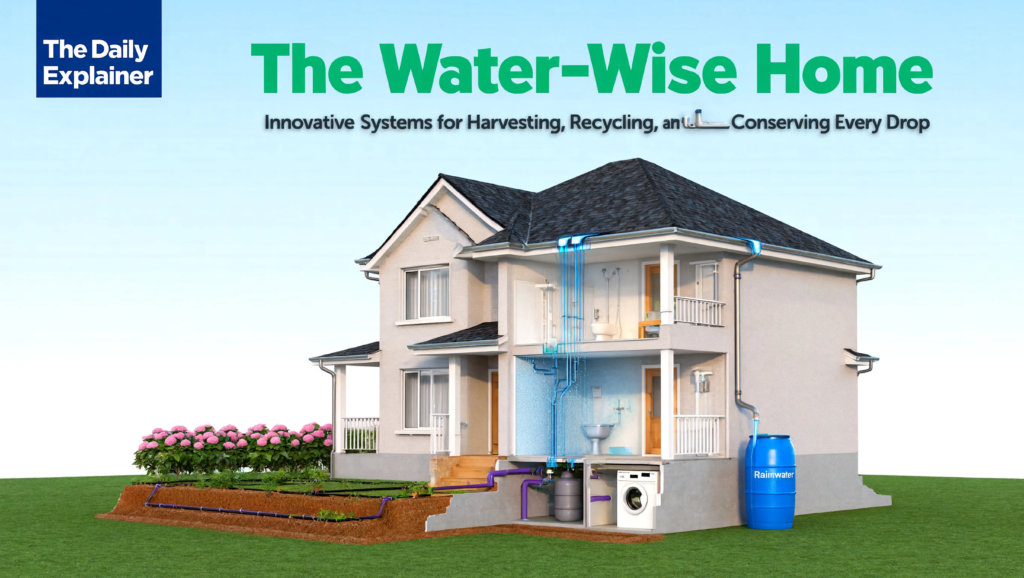
The Circular Home Water Cycle. This integrated system shows how a water-wise home captures, reuses, and conserves water through multiple connected loops, reducing reliance on municipal supply.
Why Our Most Precious Resource Demands a New Mindset
What I’ve found is that water, unlike energy, feels limitless until it isn’t. My wake-up call came not from a drought headline, but from a silent, steady drip. A faulty toilet flapper was wasting over 200 gallons a day—enough to fill a bathtub three times over. That invisible leak, costing me money and squandering a critical resource, made the abstract concept of “water conservation” painfully concrete. I realized my home was a sieve, and I had no idea where the holes were.
This matters because while 71% of the Earth is covered in water, less than 1% is freshwater available for human use. According to the 2025 UN World Water Development Report, global freshwater demand is projected to exceed sustainable supply by 40% by 2030. For the curious beginner, water conservation is the most immediate form of environmental stewardship, with visible impacts on your utility bill. For the sustainability professional, integrated water management represents the next frontier in resilient home design, especially as municipalities face aging infrastructure and climate-induced scarcity. Being water-wise isn’t about deprivation; it’s about intelligence—creating systems that capture, reuse, and respect every molecule that enters your property. This holistic approach to resource management is part of a larger conversation about sustainable systems, a topic we regularly break down in our Explained series for clearer understanding.
The Context: From Linear Consumption to a Circular Hydrological Loop
Most homes operate on a linear, one-way water model: municipal supply → fixture use → sewer/wastewater treatment. This model is inherently wasteful. It treats pristine, potable water—which has been expensively pumped, chemically treated, and pressurized—as suitable for flushing toilets and watering lawns. Meanwhile, gentle rainwater, a free resource, is treated as a nuisance, funneled off roofs and driveways into storm drains, often carrying pollutants into local waterways.
The water-wise home disrupts this linear flow. It creates multiple, integrated loops:
- The Rainwater Harvesting Loop: Capturing precipitation for non-potable uses.
- The Greywater Recycling Loop: Gently treating and reusing water from showers, sinks, and laundry for irrigation or toilet flushing.
- The Blackwater Treatment Loop (advanced): On-site treatment of toilet waste for reuse.
- The Conservation & Efficiency Loop: Minimizing demand through ultra-efficient fixtures and behaviors.
This circular approach turns your home into a mini-watershed, enhancing local groundwater recharge, reducing strain on municipal systems, and providing a crucial buffer during droughts or supply interruptions. Understanding these systemic shifts is crucial, and they’re often influenced by larger policy decisions explored in discussions on global affairs and politics.
Key Concepts Defined: The Vocabulary of Water Stewardship
- Water-Wise/Water-Smart: An approach that combines conservation, efficiency, and alternative sources to minimize freshwater extraction.
- Rainwater Harvesting (RWH): The collection and storage of rain from rooftops or other surfaces for later use.
- Greywater: Gently used water from bathroom sinks, showers, bathtubs, and washing machines (excluding kitchen sinks and toilets, which are considered “blackwater”).
- Greywater System: A system that filters and redirects greywater for subsurface irrigation or, in more complex systems, for toilet flushing.
- Blackwater: Wastewater from toilets and kitchen sinks containing organic matter and potential pathogens, requiring significant treatment.
- First Flush Diverter: A device on a rainwater harvesting system that discards the initial, dirtiest runoff from a roof after a dry period.
- Xeriscaping: Landscaping that reduces or eliminates the need for irrigation by using drought-tolerant native plants, efficient design, and mulch.
- Pressure-Reducing Valve (PRV): A device that lowers excessively high municipal water pressure, reducing strain on pipes and fixtures and cutting consumption by up to 30%.
- Demand Hot Water Recirculation System: A pump system that provides instant hot water, eliminating the wasteful practice of running the tap until it gets hot.
- Fixture Unit (FU): A measure of the flow rate and frequency of use of a plumbing fixture, used in system design.
How It Works: Building Your Integrated Home Water System, Phase by Phase

Implementing a water-wise home is a progressive journey from low-cost fixes to integrated systems.
Phase 1: The Audit & the No-Cost Fix (The Foundation)
- Step 1: The Leak Detective. Read your water meter before bed and again first thing in the morning (with no water use in between). Any movement indicates a leak. The EPA’s WaterSense leak calculator can help quantify losses. Check toilets with dye tablets.
- Step 2: Behavioral Shifts. This is free and powerful: Turn off the tap while brushing teeth or scrubbing dishes. Shorten showers by 2 minutes (saves ~5 gallons per shower). Only run full loads in dishwashers and washing machines.
Phase 2: The Efficiency Overhaul (The Quick ROI)
- Step 3: Fixture Retrofit. Replace all showerheads, faucets, and toilets with WaterSense-labeled models. A pre-1992 toilet uses 3.5-7 gallons per flush (gpf); a WaterSense model uses 1.28 gpf or less. Install aerators on all faucets (they cost ~$2 and cut flow by 30%).
- Step 4: Appliance Upgrade. When your washing machine fails, replace it with an ENERGY STAR-certified front-loading model, which uses about 40% less water than top-loaders. For more guidance on making smart, sustainable purchases that affect multiple resource areas, the insights shared on the SheraKat Network blog can be very helpful.
Phase 3: The Outdoor Transformation (Largest Potential Savings)
- Step 5: Landscape for Your Biome. Implement Xeriscaping principles. Group plants with similar water needs (hydrozoning). Use a 3-inch layer of organic mulch to retain soil moisture. My transformation from a thirsty Kentucky bluegrass lawn to a native pollinator garden with permeable pathways cut my outdoor water use by over 80%.
- Step 6: Irrigation Intelligence. Replace sprinklers with drip irrigation for targeted watering. Install a smart irrigation controller that adjusts watering based on local weather data (like Rachio or Orbit B-hyve).
Phase 4: The Harvesting & Recycling Systems (The Advanced Loop)
- Step 7: Rainwater Harvesting. Start simple with a rain barrel (55-gallon) connected to a single downspout for garden use. For whole-house systems, underground cisterns (1,000+ gallons) with pumps and filtration can supply water for toilets and laundry. A basic rule: 1 inch of rain on 1,000 sq ft of roof yields about 600 gallons.
- Step 8: Greywater Recycling. The simplest legal system is a laundry-to-landscape (L2L) system, which uses the washing machine’s pump to direct water directly to mulch basins around trees and shrubs. More complex branched drain or pumped systems require professional design and permits, but can service toilets.
Why This Layered Approach is Non-Negotiable for Resilience
The benefits are tangible and multi-faceted:
- Financial Protection: Water and sewer rates are rising faster than inflation. Reducing indoor use by 30% can save the average household hundreds annually. In many regions, rainwater is completely free.
- Drought Resilience: A 1,500-gallon cistern can provide weeks of irrigation for a xeriscaped garden during a ban, protecting your landscaping investment.
- Infrastructure Support: Reducing demand eases pressure on overtaxed municipal treatment plants and water mains, especially during peak summer periods.
- Environmental Stewardship: Harvesting rainwater reduces stormwater runoff, which is the #1 source of pollution for many urban waterways. Using less water conserves energy (water treatment and pumping are energy-intensive) and preserves aquatic ecosystems.
- Increased Property Value: A well-designed water-wise landscape and documented efficient systems are increasingly attractive to buyers, especially in water-stressed regions.
The Future of Home Water: Smart, Integrated, and Autonomous
The future home water system will be a self-regulating, networked organ.
- AI-Optimized Water Networks: Whole-home water monitors (like Flo by Moen or Phyn) will evolve to not just detect leaks but predict them, learn family usage patterns, and automatically adjust irrigation and greywater diversion based on real-time weather forecasts and soil moisture.
- Point-of-Use Treatment & Reuse: Compact, attractive appliances will treat and recycle greywater from a single shower or sink for immediate reuse in the same fixture, creating ultra-efficient micro-loops.
- Atmospheric Water Generation (AWG): While currently energy-intensive, improved AWG technology integrated with home solar could provide a supplemental source in humid climates.
- Phyto-Remediation Wetlands: Luxury and community homes will integrate constructed wetland cells into their landscaping for beautiful, biological treatment of greywater.
- Digital Water Footprint Trackers: Apps will provide real-time, fixture-level data on your water footprint, comparing it to local averages and suggesting optimizations, much like energy monitors do today. The principle of tracking and optimizing resource use is a cornerstone of modern business efficiency as well, a concept explored in resources like the guide to starting an online business in 2026 on SheraKat Network.
Common Misconceptions: Clearing the Murky Waters
- “Rainwater harvesting is illegal.” False. Most states actively encourage it, with some offering rebates. A few western states have historical “prior appropriation” laws requiring permits for large cisterns, but small-scale collection (rain barrels) is almost universally allowed. Always check local codes.
- “Greywater is gross and unsafe.” Properly managed, it’s safe for subsurface irrigation. It should not be stored for more than 24 hours (to prevent bacterial growth) and must be applied below mulch, not sprayed.
- “Low-flow fixtures mean poor performance.” This was true of early 1990s models. Modern, aerated, WaterSense-labeled showerheads and faucets provide a satisfying, pressurized feel while using a fraction of the water.
- “You need a huge yard for a cistern.” Suburban homes are ideal, but even urban homes can use slim-line tanks against walls or modular, stackable tanks in basements or crawlspaces.
- “Conservation is only important in the desert.” Water stress is a nationwide issue due to infrastructure strain, energy costs of treatment, and ecosystem impacts. The 2026 U.S. Government Accountability Office report found at least 40 states anticipate regional water shortages in the next decade.
Recent Developments (2025-2026): Policy and Tech Convergence
- National “WaterSense for Homes” Program Expansion: The EPA is piloting a comprehensive label for entire new homes that meet rigorous water efficiency standards, mirroring the ENERGY STAR program.
- Plastic-Free, Smart Rain Sensors: New soil moisture sensors made from biodegradable materials with integrated LoRaWAN connectivity are hitting the market, providing precise data without electronic waste.
- Greywater Code Standardization: The 2024 International Plumbing Code (IPC) includes significantly expanded provisions for greywater systems, making permitting easier and safer in adopting municipalities.
- “Net-Zero Water” Buildings: Defined as buildings that, over a year, use no more water than they capture on-site, these are becoming a benchmark for luxury and municipal buildings, with tech trickling down to residential scale.
- Advanced Filtration at Scale: Improved, low-cost membrane bioreactor (MBR) systems are making on-site blackwater treatment and reuse for non-potable purposes more feasible for high-end residential clusters.
A Success Story: The Arid Oasis in Arizona
The Martinez family in Tucson, Arizona, faced a stark choice: maintain a thirsty lawn under worsening water restrictions or reinvent their relationship with water.
Their Integrated Strategy:
- Efficiency First: They installed a PRV, replaced all fixtures with WaterSense models, and upgraded to a heat-pump water heater (which also uses less water to deliver hot water).
- Radical Landscaping: They removed 2,000 sq ft of turf and replaced it with a stunning xeriscape of native ocotillo, prickly pear, and palo verde trees, using decomposed granite pathways.
- Maximum Capture: They installed a 3,500-gallon underground cistern from Rainwater Harvesting Solutions, capturing roof runoff for their drip irrigation system.
- Greywater Loop: A simple L2L system directs all laundry water to their citrus trees.
The Result: Their municipal water consumption dropped by 78%. Their yard is now a vibrant habitat for pollinators and birds. During the peak summer drought, their landscape thrives on harvested water alone. Their system paid for itself in under 7 years through bill savings and landscaping rebates. They’ve become neighborhood educators, showing that beauty doesn’t require bluegrass. This story of community-focused transformation mirrors the ethos of many impactful projects featured in the Nonprofit Hub at WorldClassBlogs.
Real-Life Examples and Actionable Systems
- The “Shower Bucket” Hack: Place a bucket in the shower while it warms up. Use that clean “warm-up water” (1-2 gallons) to flush toilets or water houseplants. I do this daily, saving over 700 gallons a year.
- Toilet Tank Bank: For older toilets you can’t immediately replace, place a sealed plastic bottle filled with water and pebbles in the tank to displace volume, saving ~0.5 gallons per flush.
- Weather-Based Irrigation Controller: Installing my Rachio controller was a weekend project that cut my outdoor water use by 30% in the first month by automatically skipping cycles after rain.
- Rain Garden Installation: Instead of piping a downspout to the street, I dug a shallow, planted depression in my yard. It captures roof runoff, filters it through plants and soil, and recharges groundwater, solving a minor basement dampness issue in the process.
- Composting Toilet Consideration: For a cabin or guest house, a modern, odorless composting toilet (like a Nature’s Head or Separett) eliminates blackwater entirely, saving thousands of gallons annually and producing usable compost.
Conclusion and Key Takeaways: Every Drop is a Cycle
Creating a water-wise home is an exercise in seeing cycles where we once saw endpoints. It’s about valuing water appropriately and designing systems that honor its journey. The goal is not just to use less, but to use smarter—matching water quality to its task and keeping this precious resource circulating within your property’s boundaries for as long as possible.
Key Takeaways:
- Find the Leaks First: This is the fastest, cheapest way to save water and money. A silent toilet leak can waste 200+ gallons a day.
- Efficiency Before Supply: Maximize your indoor and outdoor efficiency before investing in rainwater or greywater systems. It’s cheaper and increases the effectiveness of your harvested supply.
- Outdoors is the Low-Hanging Fruit: Landscape irrigation is often 50-70% of residential use in summer. Xeriscaping and smart irrigation deliver the biggest savings.
- Start Simple with Harvesting: A $100 rain barrel connected to a downspout is a powerful educational tool and a gateway to larger systems.
- Know Your Codes: Engage with your local building and health departments. Understand permits for greywater and cisterns. Many are now supportive.
Begin by listening to your home’s water story. Find the leaks. Watch where the rain flows. Then, step by step, you can transform your property from a passive consumer into an active, regenerative part of the local water cycle. For more detailed guides and discussions on implementing such practical systems, our main Blog is a repository of actionable knowledge.
Frequently Asked Questions (FAQs)
- What is the single most effective water-saving device I can install?
- A pressure-reducing valve (PRV) if your home’s pressure is above 60 psi. Most are, and high pressure increases flow from every fixture and accelerates pipe wear. Installation by a plumber can cut total use by 20-30%.
- Is greywater legal where I live?
- Regulations vary wildly. California, Arizona, Texas, and Oregon have clear state codes. Many other states leave it to municipalities. The Greywater Action website maintains an excellent state-by-state guide. Always check locally.
- Can I drink harvested rainwater?
- Not without significant, multi-stage treatment (filtration, UV, possibly reverse osmosis). For potable use, systems are complex and expensive. It’s best to use rainwater for non-potable purposes like irrigation, toilet flushing, and laundry.
- How much does a whole-house rainwater system cost?
- A basic, above-ground system for irrigation might cost $2,000-$5,000. An underground cistern with pump, filtration, and plumbing for toilet supply can range from $10,000 to $25,000 installed, depending on size and complexity.
- Do water-efficient appliances really get clothes and dishes clean?
- Yes. Modern dishwashers use targeted jets and more effective detergents. Front-load washers use a tumbling action that cleans better than the agitator in old top-loaders, while being gentler on clothes.
- What’s the difference between a rain garden and a swale?
- A swale is a shallow, vegetated channel that moves water slowly across a landscape. A rain garden is a planted depression that allows water to pool and infiltrate. Both manage stormwater but serve slightly different topographic functions.
- How do I winterize a rainwater harvesting system?
- For cold climates, systems must be drained and bypassed before freezing. Install a simple diverter kit to send winter downspout flow away from the barrel or cistern. Pumps and above-ground pipes must be drained.
- Are there rebates for water-efficient upgrades?
- Absolutely. Many municipalities and water utilities offer rebates for WaterSense toilets, smart irrigation controllers, rain barrels, and even turf removal. Check your utility’s website first.
- What are “biological contaminants” in greywater and are they dangerous?
- They are bacteria from skin and soil. In subsurface irrigation, they are filtered and consumed by soil microbes, posing minimal risk. The key is to avoid contact and aerosolization (spraying).
- How much water can I realistically save?
- A comprehensive approach can reduce a home’s municipal water use by 50-75%. Efficiency can cut 30-40%, xeriscaping another 30-50% of outdoor use, and rainwater/greywater can displace 40-60% of remaining non-potable demand.
- What’s the maintenance like for a greywater system?
- Simple L2L systems require cleaning a filter every few months and ensuring mulch basins are clear. More complex systems have pumps and filters that need periodic checking. It’s far less maintenance than a swimming pool.
- Can I install these systems myself?
- Rain barrels and simple L2L systems are common DIY projects for the handy homeowner. Underground cisterns, pressurized rainwater systems, and complex greywater systems usually require professional design and installation due to plumbing, electrical, and permitting complexity.
- What is a “living wall” and how does it conserve water?
- A vertical garden using drought-tolerant succulents or herbs. When irrigated with a closed-loop drip system fed by harvested rainwater, it provides insulation, beauty, and food with minimal water input.
- How does reducing water use help climate change?
- Treating and pumping water is energy-intensive. The EPA estimates that water-related energy use consumes over 5% of U.S. electricity. Less water use means fewer greenhouse gas emissions from power plants.
- What should I look for in a smart irrigation controller?
- Ensure it has ET (evapotranspiration) scheduling and connects to a local weather station or internet forecast. Wi-Fi connectivity for app control is standard. Look for compatibility with existing valves.
- Is a tankless water heater more water-efficient?
- Yes, because it provides instant hot water without running the tap waiting for it to travel from a distant tank. For best results, pair it with a demand-controlled recirculation pump for fixtures far from the heater.
- What do I do with water from my dehumidifier or AC condensate?
- This is distilled, very pure water. Collect it! An average central AC can produce 5-20 gallons per day. Use it for ironing, watering houseplants, or topping off a humidifier—it’s mineral-free.
- How can I be water-wise in an apartment?
- Focus on Phase 1 & 2: leak detection, efficient showerheads, faucet aerators, and behavioral shifts. Use a shower bucket. Advocate with your landlord for efficient appliance upgrades.
- What are the best native/drought-tolerant plants for my area?
- Contact your local county extension office (part of the USDA). They provide free, scientifically-backed plant lists, landscaping guides, and workshops tailored to your specific region.
- Where can I learn more about designing a complete system?
- The book “The Water-Wise Home” by Laura Allen is the bible for DIY greywater and rainwater. For professional design, look for accredited professionals through the American Rainwater Catchment Systems Association (ARCSA).
About the Author
Sana Ullah Kakar is a certified irrigation designer and water stewardship advocate who learned the value of water the hard way—by fixing that leaky toilet. With a background in environmental engineering and hands-on experience installing residential rainwater and greywater systems, they bridge the gap between technical feasibility and practical implementation. They believe every home can be a sanctuary of efficiency and that understanding our water cycle is the first step toward true resilience. They’re happiest with dirt under their nails, building a new rain garden. For more from our team, you can connect through our Contact Us portal.
Free Resources
- EPA WaterSense Calculator: Find your potential savings from fixture upgrades.
- ARCSA (American Rainwater Catchment Systems Association): Find accredited professionals, design resources, and local codes.
- Greywater Action: A clearinghouse for laws, designs, and workshops on greywater systems.
- Alliance for Water Efficiency: Policy tools, case studies, and a national product directory.
- Your Local Water Utility’s Conservation Page: The #1 source for local rebates, workshops, and landscape guides tailored to your climate.
- Project Dripp: A free online tool for designing drip irrigation layouts.
Discussion
What’s the most surprising source of water waste you’ve discovered in your home? Have you tried a rain barrel or xeriscaping? What was your biggest challenge or success? Are you considering a greywater system, and what’s holding you back? Share your experiences, local tips, and questions below. Let’s create a community wellspring of knowledge. For further exploration of community-led environmental solutions, the conversations and projects highlighted in the Our Focus section at WorldClassBlogs offer deep insights into collective action.
About The Author