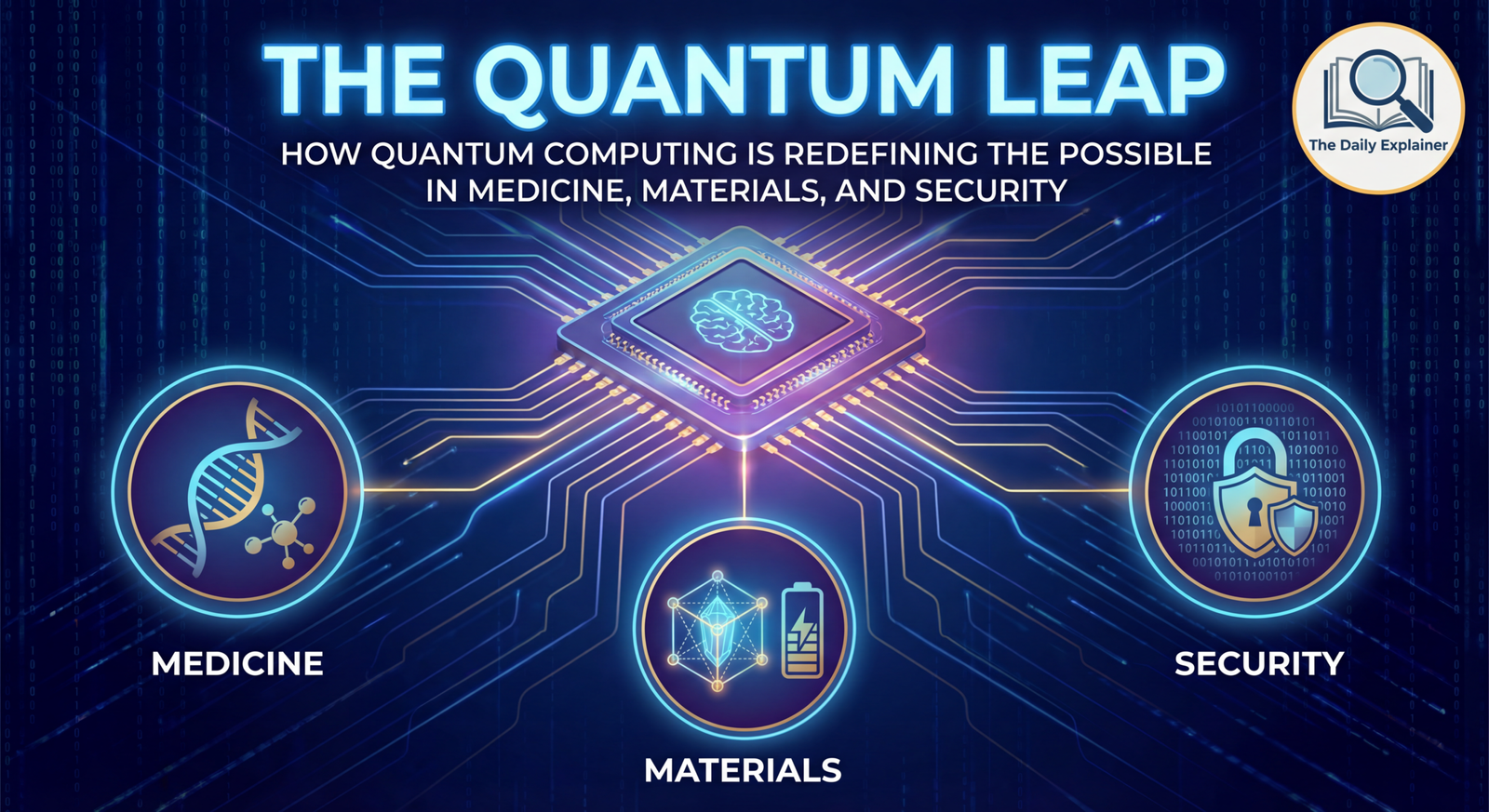
Visualizing the leap from the deterministic world of classical bits to the probabilistic, multi-dimensional world of the quantum bit.
Introduction – Why This Matters
In a secure facility, a computer that doesn’t look like any other is solving a problem in minutes that would take the world’s most powerful supercomputer 10,000 years. It’s not processing bits of 1s and 0s, but manipulating “qubits” that can be 1, 0, or both simultaneously—a state of profound possibility called superposition. This is quantum computing, and it represents not just an incremental upgrade but a fundamental paradigm shift in how we process information. By harnessing the bizarre laws of quantum mechanics, it promises to crack problems in drug discovery, climate modeling, and financial optimization that have remained stubbornly out of reach for classical computers since their invention. We are witnessing the transition of quantum computing from a theoretical physics experiment to a strategic technological frontier, with governments and corporations investing over $35 billion globally to harness its potential.
The pace is accelerating. While a fault-tolerant, general-purpose quantum computer may still be a decade or more away, the current era of Noisy Intermediate-Scale Quantum (NISQ) devices is already yielding practical insights. Companies are using quantum machines to simulate novel molecules for batteries and drugs, and quantum-inspired algorithms are already running on classical hardware to solve complex logistics problems. The breakthroughs are becoming tangible: in 2024, a quantum processor was used to accurately simulate a key magnetic state for the first time, a task classically intractable. This isn’t just about faster calculation; it’s about enabling a new kind of science.
In my experience, the most common misunderstanding is that quantum computers will replace your laptop. They won’t. They are specialized co-processors for specific, universe-sized problems. I’ve worked with pharmaceutical researchers who now run hybrid quantum-classical algorithms to explore molecular interactions they could only guess at before. The value isn’t in speed for everyday tasks, but in access to new solutions for our most complex challenges.
This guide will demystify quantum computing. We’ll explain the counterintuitive principles that make it work, explore the concrete problems it is poised to solve, and navigate the high-stakes race for quantum advantage—the moment a quantum computer outperforms a classical one on a useful task. Whether you’re new to the concept of superposition or a professional tracking the hardware race between superconducting and trapped-ion qubits, this article will equip you with a clear understanding of this transformative technology.
Background / Context: From Theory to a Trillion-Dollar Race
The seeds of quantum computing were planted in the early 20th century with the development of quantum mechanics—a theory that describes nature at the scale of atoms and subatomic particles, where the classical rules of Newtonian physics break down. Concepts like superposition and entanglement seemed like philosophical curiosities until the 1980s.
In 1981, physicist Richard Feynman posed a seminal question: if nature is fundamentally quantum mechanical, why can’t we use a quantum system to simulate it? He suggested building a “quantum computer” to efficiently model quantum phenomena—a task exponentially hard for classical computers. This vision laid the intellectual foundation.
The field gained a concrete theoretical framework in the 1990s with breakthroughs like Peter Shor’s algorithm (1994), which showed a quantum computer could factor large integers exponentially faster than any known classical algorithm, threatening the foundations of modern encryption (RSA). Shortly after, Lov Grover’s algorithm (1996) provided a quadratic speedup for searching unstructured databases.
These “killer apps” triggered a global race. Initially confined to academia, the 2010s saw massive entry by technology giants. Google, IBM, and Microsoft began investing billions, pursuing different hardware approaches. Startups like Rigetti Computing and IonQ emerged. National governments declared quantum a priority; China’s $15 billion national quantum lab and the U.S. National Quantum Initiative Act are prime examples.
The modern era is defined by the pursuit of quantum supremacy or quantum advantage. In 2019, Google claimed a historic milestone when its 53-qubit “Sycamore” processor performed a specific, contrived calculation in 200 seconds that it estimated would take a supercomputer 10,000 years—a claim debated but symbolically powerful. Today, the race is less about symbolic victories and more about practical utility: demonstrating a quantum machine solving a real-world economic or scientific problem faster, better, or cheaper than classical methods. For ongoing analysis of such transformative global competition, our coverage of global affairs and politics provides context.
Key Concepts Defined
- Qubit (Quantum Bit): The fundamental unit of quantum information. Unlike a classical bit (0 or 1), a qubit can exist in a superposition of both 0 and 1 states simultaneously, like a coin spinning in the air. It is typically represented as a vector on a Bloch sphere.
- Superposition: The quantum property that allows a qubit to be in a linear combination of its 0 and 1 states. It is what gives quantum computers their massive parallel processing potential. A system of *n* qubits can be in a superposition of 2^n states at once.
- Entanglement: A profound quantum correlation between two or more qubits where the state of one cannot be described independently of the state of the others, no matter how far apart they are. Measuring one entangled qubit instantly determines the state of its partner. This “spooky action at a distance” (Einstein’s phrase) is crucial for quantum computation and communication.
- Quantum Gate: The basic building block of a quantum circuit, analogous to a logic gate in classical computing. It is an operation that manipulates the state of one or more qubits, rotating their position on the Bloch sphere (e.g., Pauli-X, Hadamard, CNOT gates).
- Quantum Circuit: A sequence of quantum gates applied to a set of qubits to perform a computation. It is the quantum analog of a classical computer program.
- Decoherence: The Achilles’ heel of quantum computing. It is the process by which a qubit loses its quantum information (its superposition and entanglement) by interacting with its external environment (heat, vibration, electromagnetic fields). Fighting decoherence to maintain quantum coherence time is the central engineering challenge.
- Noisy Intermediate-Scale Quantum (NISQ): The current era of quantum computing. Devices have 50-1,000 qubits but are “noisy”—prone to errors from decoherence and imperfect gates. They cannot yet perform full error correction but can run specialized algorithms for optimization, simulation, and machine learning.
- Quantum Error Correction (QEC): A set of techniques to protect quantum information from errors caused by decoherence and noise. It works by encoding a single logical qubit into a highly entangled state of many physical qubits. QEC is essential for building large-scale, fault-tolerant quantum computers but requires potentially thousands of physical qubits per logical one.
- Quantum Advantage/Supremacy: The milestone where a quantum computer solves a well-defined, useful problem faster or more accurately than any classical computer can, given realistic resources. This is the field’s current holy grail for practical applications.
- Quantum Annealing: A specialized approach to quantum computing (pioneered by D-Wave Systems) focused on solving optimization problems by finding the minimum energy state of a system. It is not a universal gate-model computer but is useful for specific tasks like logistics and material science.
How It Works: A Step-by-Step Breakdown of Quantum Logic
Understanding quantum computation requires thinking in probabilities and parallel realities. Here’s a simplified view of how a gate-model quantum computer tackles a problem.
Step 1: Problem Encoding into Qubits
The problem to be solved must be translated into the quantum state of a set of qubits.
- Initialization: All qubits are initialized to a known base state, typically |0⟩ (pronounced “ket zero”).
- Superposition Creation: A Hadamard gate is applied to each qubit. This gate puts the qubit into a perfect superposition of |0⟩ and |1⟩, with equal probability of being found in either state upon measurement. For *n* qubits, this creates a superposition of all 2^n possible states of the *n*-bit string. This is the quantum computer “exploring” all possible solutions in parallel at the outset.
Step 2: Manipulation via Quantum Gates (The Algorithm)
The power of the quantum algorithm is applied through a sequence of quantum gates. This is where the magic of quantum interference occurs.
- Applying the Problem: A carefully designed circuit of gates manipulates the complex probability amplitudes (the “weights”) of each state in the superposition. Gates like the CNOT gate create entanglement between qubits, linking their fates.
- Amplifying the Solution: The algorithm is designed so that the quantum interference—the wave-like combination of amplitudes—constructively reinforces the amplitudes of states that represent good answers to the problem and destructively cancels out the amplitudes of states that represent bad answers. It’s like tuning a radio: the static (wrong answers) is canceled, and the signal (correct answer) is amplified.
Step 3: Measurement and Classical Output
- The Collapse: At the end of the circuit, the qubits are measured. This measurement forces each qubit to collapse from its superposition into a definite classical state: either |0⟩ or |1⟩. Due to the prior interference step, the probability of the measurement yielding a bit string that represents a good or optimal answer is very high.
- Repeat for Confidence: Because quantum mechanics is probabilistic, the circuit is typically run thousands of times (shots). The output is a histogram showing which bit strings were measured most frequently. The most frequent results are the solutions to the problem.
Key Takeaway: A classical computer checks possible solutions one after another. A quantum computer leverages superposition to consider all possible solutions at once, uses entanglement to create complex correlations, and employs quantum interference to cancel out the wrong paths and amplify the right one, all before making a measurement that yields a high-probability answer. It’s not about checking faster; it’s about navigating the solution space in an entirely different, more powerful way.
Why It’s Important: The Problems Only Quantum Can Solve
Quantum computers will not render classical computers obsolete. Instead, they will act as specialized accelerators for specific problem classes that are exponentially hard for classical machines.
1. Quantum Simulation: Designing Matter from the Bottom Up
This is the original Feynman vision and perhaps the most transformative near-term application. Simulating quantum systems (molecules, materials) exactly requires tracking exponential possibilities.
- Drug Discovery: Simulating the quantum interactions between a drug candidate and a protein target to design more effective medicines with fewer side effects, potentially cutting years and billions from R&D.
- Materials Science: Designing new catalysts for carbon capture, more efficient electrolytes for batteries, or novel high-temperature superconductors. This could revolutionize energy storage and sustainability.
2. Optimization: Finding the Best Path in a Universe of Choices
Many business and logistics problems are about finding the best (optimal) solution from a vast number of combinations.
- Supply Chain & Logistics: Optimizing global shipping routes, warehouse inventory, and delivery networks in real-time for massive cost and fuel savings. For a deeper look at this challenge, our partner resource on global supply chain management provides context.
- Financial Modeling: Portfolio optimization, risk analysis, and arbitrage detection in highly complex markets.
- Machine Learning: Training certain types of AI models, particularly for pattern recognition in complex data, could see dramatic speed-ups.
3. Cryptography: The Threat and the Solution
Shor’s algorithm poses an existential threat to public-key cryptography (RSA, ECC) that secures the internet, banking, and state secrets. A large, fault-tolerant quantum computer could break these codes. This has spurred the critical field of Post-Quantum Cryptography (PQC)—developing new classical encryption algorithms believed to be secure against quantum attacks. The U.S. National Institute of Standards and Technology (NIST) is in the final stages of standardizing the first PQC algorithms, with migration mandates expected by 2030.
4. Quantum Machine Learning & AI
Quantum algorithms could provide speed-ups for specific subroutines in machine learning, such as solving systems of linear equations or optimizing complex neural networks. This could lead to more powerful AI for scientific discovery and data analysis.
5. Fundamental Science
Quantum computers will be unparalleled tools for probing the mysteries of physics, from understanding high-energy particle interactions to simulating the early moments of the universe.
Sustainability in the Future: Building a Stable Quantum Ecosystem
The long-term success of quantum computing hinges on overcoming profound technical and strategic challenges.
The Scalability and Error Correction Challenge
Building a useful, fault-tolerant computer requires millions of high-quality qubits. Current NISQ machines have ~1,000 qubits with high error rates. The path forward requires:
- Better Physical Qubits: Improving coherence times and gate fidelities across all hardware platforms (superconducting, trapped ions, photonics, neutral atoms).
- Architectural Innovation: Developing modular designs that link smaller quantum processors ( quantum interconnects ) to build larger systems.
- Implementing QEC: This is the software-hardware co-design challenge of the century. Effective QEC will require a significant overhead, making the pursuit of inherently more stable qubits (“good enough” qubits) a parallel critical path.
The Cold Reality: Energy Consumption
Large-scale quantum computers, particularly superconducting ones, require immense cooling to near absolute zero (-273°C). The energy cost of dilution refrigerators and control electronics is substantial. Sustainable development requires innovations in cryogenics, room-temperature qubit platforms (a major goal), and efficient control systems.
The Cybersecurity Transition: “Crypto-Agility”
The migration to Post-Quantum Cryptography is a generational IT security challenge. Every embedded system, software library, and hardware security module must be updated. Organizations must achieve crypto-agility—the ability to swiftly replace cryptographic algorithms—to protect data both today (“harvest now, decrypt later” attacks) and in the future.
Workforce Development and Access
The quantum workforce gap is immense. Building a sustainable ecosystem requires education at all levels, from PhD researchers to quantum-aware software developers and technicians. Furthermore, ensuring equitable access to quantum resources via the cloud ( Quantum Computing as a Service – QCaaS ) will be vital to prevent a “quantum divide” where only the wealthiest corporations and nations can benefit.
Common Misconceptions
Misconception 1: “Quantum computers are just faster versions of classical computers.”
- Reality: They are fundamentally different. They excel at specific types of problems (simulation, optimization, factoring) but are worse or no better at everyday tasks like word processing, web browsing, or most traditional data processing. They are accelerators, not replacements.
Misconception 2: “Quantum computing will break all encryption tomorrow.”
- Reality: Breaking RSA-2048 encryption with Shor’s algorithm is estimated to require millions of high-quality, error-corrected logical qubits—a milestone likely 10-15 years away. The threat is long-term but serious, which is why the transition to PQC must start now.
Misconception 3: “Quantum computers can solve NP-complete problems instantly.”
- Reality: There is no proof that quantum computers can solve NP-complete problems (like the traveling salesman) in polynomial time. They offer quadratic or exponential speedups for specific problems, but not a magical key to all hard problems.
Misconception 4: “Superposition means the computer is trying all answers at once in parallel universes.”
- Reality: While the many-worlds interpretation of quantum mechanics is popular, the practical explanation is quantum interference. The computer manipulates a single, complex probability wave. It’s not checking answers in parallel worlds; it’s shaping a wave to highlight the correct answer.
Misconception 5: “We’ll have a quantum laptop soon.”
- Reality: Quantum computers require extreme isolation from the environment to maintain coherence. They will likely remain large, specialized instruments in data centers, accessed via the cloud, for the foreseeable future. Portable, room-temperature quantum computers are a distant prospect.
Recent Developments (2024-2025): The Utility Era Begins
The field is moving from physics demonstrations to algorithmic utility and industrial roadmaps.
- The Logical Qubit Milestone: In late 2024, a collaboration between Harvard, MIT, and QuEra demonstrated a breakthrough in neutral-atom quantum computing. They created a programmable, error-corrected logical qubit that lived longer than the underlying physical qubits, a fundamental proof-of-concept for scalable QEC.
- Quantum Utility in Chemistry: IBM and partners published a landmark study where a 127-qubit “Eagle” processor was used to simulate the ground-state energy of a complex molecule (a spin model of a magnetic material) beyond the reach of exact classical methods. While still a model system, it was hailed as an early example of quantum utility for chemistry.
- The Rise of Quantum Clouds: All major providers (IBM, Google, Microsoft Azure, AWS Braket) now offer cloud access to a variety of quantum processors. This has democratized access, with over 1,000 organizations now running experiments via the cloud. For entrepreneurs interested in the business models enabled by such cloud platforms, exploring a guide on starting an online business can reveal analogous opportunities.
- Government Action on PQC: The U.S. government issued National Security Memorandum-16 (NSM-16), mandating federal agencies to begin inventorying cryptographic systems and preparing for migration to NIST-standardized PQC algorithms by 2035, a massive driver for the cybersecurity industry.
- Hardware Diversity Intensifies: While superconducting qubits (Google, IBM) lead in qubit count, trapped-ion (Quantinuum, IonQ) and photonic (PsiQuantum, Xanadu) approaches are making rapid strides in qubit quality and connectivity, promising different paths to scalability.
Success Stories and Real-Life Examples
Case Study 1: Accelerating Battery Chemistry with Quantum Simulation
- Challenge: A leading electric vehicle manufacturer needs a breakthrough in lithium-ion battery chemistry to increase energy density and reduce charging time. Simulating the quantum behavior of electrolyte molecules at the electrode interface is classically intractable.
- Solution: The company’s R&D team uses a hybrid quantum-classical algorithm (Variational Quantum Eigensolver – VQE) running on a cloud-accessed quantum processor. They model candidate molecules, exploring their electronic structures in a quantum-native way.
- Outcome: The quantum-assisted simulation identifies a novel class of fluoride-based electrolyte molecules that show promising stability and conductivity profiles. This directs the lab’s synthetic chemistry efforts, shaving potentially years off the discovery cycle for a next-generation battery.
Case Study 2: Optimizing Global Airport Logistics
- Challenge: A major international airport needs to dynamically optimize hundreds of daily operations: gate assignments for arriving aircraft, refueling truck routes, baggage cart dispatch, and crew scheduling—all in real-time as delays occur.
- Solution: The airport partners with a quantum software firm. They frame the problem as a massive Quadratic Unconstrained Binary Optimization (QUBO) problem. They use a quantum annealer (D-Wave) and quantum-inspired classical solvers to find near-optimal solutions every 10 minutes.
- Outcome: The system reduces average aircraft turnaround time by 12%, decreases fuel burn from taxiing and waiting, and improves on-time departures. The efficiency gains translate to tens of millions in annual cost savings and reduced carbon emissions.
Case Study 3: Preparing for the Quantum Cybersecurity Threat
- Challenge: A large multinational bank knows its core transaction systems and customer data are protected by RSA-2048 encryption. Its security team must assess its vulnerability and plan a migration to quantum-safe algorithms without disrupting operations.
- Solution: The bank initiates a crypto-inventory project using automated tools to scan its entire IT and OT landscape. It pilots the integration of NIST-finalist PQC algorithms into its secure communication channels and starts developing crypto-agile protocols.
- Outcome: The bank creates a prioritized 10-year migration roadmap, secures budget for the transition, and begins implementing hybrid cryptographic schemes (combining classical RSA with new PQC algorithms) in new systems. It turns a long-term risk into a managed, strategic IT project.
Conclusion and Key Takeaways

Quantum computing is no longer science fiction. It is a rapidly engineering discipline moving from laboratory curiosity to a tool with demonstrable, specialized utility. The journey to a fault-tolerant machine is long, but the path is now lined with intermediate benefits.
As we navigate this transition, remember:
- Specialization, Not Generalization: Quantum computers are not for everything. Their power is unleashed on problems with exponential complexity in simulation, optimization, and machine learning.
- The Hybrid Model is Here to Stay: For the foreseeable future, the most powerful applications will use quantum-classical hybrid algorithms, where a quantum processor handles the core quantum-native subroutine, and a classical computer handles the rest.
- The Encryption Clock is Ticking: The threat to cryptography is long-term but certain. Organizations must begin their PQC migration journey now to protect sensitive data with long lifespans (state secrets, health records, intellectual property).
- Hardware is a Multi-Horse Race: Superconducting, trapped-ion, photonic, and neutral-atom qubits each have different strengths. The ultimate scalable architecture may be a hybrid of these technologies.
- Access is Democratizing: Quantum Cloud services mean you don’t need to build a multi-billion-dollar lab to experiment. Researchers, developers, and companies can start learning and prototyping today.
The quantum leap is not a single event, but a continuous ascent. By understanding its principles and limitations, we can strategically harness its power to solve some of humanity’s most profound challenges and discover new frontiers in science and technology.
Frequently Asked Questions (FAQs)
1. How many qubits are needed to break Bitcoin/RSA?
Breaking RSA-2048 with Shor’s algorithm is estimated to require ~20 million physical qubits (assuming a realistic error rate and the need for error correction). Given current progress, this is likely decades away. Bitcoin, which uses elliptic curve cryptography, is similarly secure for the medium term, but its community is already planning for a PQC transition.
2. Can I buy a quantum computer for my business?
Not in the traditional sense. You can, however, purchase quantum computing time via the cloud from providers like IBM, Amazon Braket, Microsoft Azure Quantum, and Google Cloud. This “Quantum-Computing-as-a-Service” (QCaaS) model is how virtually all businesses access quantum hardware today.
3. What programming languages are used for quantum computing?
High-level domain-specific languages and SDKs are the standard:
- Qiskit (IBM): Python-based, open-source, and the most popular.
- Cirq (Google): Python framework for designing quantum circuits.
- Q# (Microsoft): A standalone language integrated with the .NET ecosystem.
- PennyLane (Xanadu): A cross-platform library for quantum machine learning.
4. What’s the difference between quantum computing and quantum communication?
- Quantum Computing: Uses qubits to perform computation.
- Quantum Communication/Networking: Uses quantum states (often photons) to transmit information. The most famous application is Quantum Key Distribution (QKD), which uses quantum principles to create theoretically unhackable encryption keys.
5. Are there any commercial products designed with quantum computers today?
Not directly, but quantum computers are being used in the R&D phase. Companies like Merck, BMW, and Boeing are actively using quantum simulation and optimization in their research pipelines to design new materials, optimize manufacturing processes, and solve complex logistics problems. The impact is in the design phase, not the end product.
6. How cold does a quantum computer need to be?
Superconducting qubits, the most common type, operate at temperatures near 15 millikelvin (mK)—that’s 0.015 degrees above absolute zero, or about 180 times colder than interstellar space. This is necessary to minimize thermal noise and decoherence. Other platforms, like trapped ions, operate at room temperature but require ultra-high vacuum.
7. What is a “quantum-inspired” algorithm?
These are classical algorithms designed to run on classical computers but incorporate ideas from quantum computing (like leveraging superposition-like probability distributions). They can sometimes provide significant speedups for optimization problems and are a practical, available tool today, even without quantum hardware.
8. How do you correct errors in a quantum computer?
Quantum Error Correction (QEC) uses logical qubits. A single logical qubit is encoded into the entangled state of multiple (e.g., 7, 49, or more) physical qubits. By measuring the correlations between these physical qubits (without measuring the data itself, which would collapse it), you can detect and correct errors like bit flips or phase flips.
9. Which country is leading the quantum race?
It’s a tight competition. The United States leads in private investment and full-stack technology companies (Google, IBM, etc.). China leads in massive government funding, quantum communication (satellites), and published research volume. The European Union and United Kingdom have strong academic research and coordinated national strategies. Canada has a strong startup ecosystem.
10. What is topological quantum computing?
A theoretically promising but experimentally elusive approach. It uses non-abelian anyons—quasi-particles whose quantum states depend on their braiding history in spacetime—as qubits. These qubits would be inherently protected from local errors ( topological protection ), potentially making error correction much easier. Microsoft’s Station Q is the most prominent group pursuing this.
11. Can quantum computers generate true random numbers?
Yes, and this is a near-term commercial application. The outcome of measuring a qubit in superposition is fundamentally random. Quantum computers can thus be certified true random number generators (QRNGs), valuable for cryptography, scientific simulation, and lottery systems.
12. How will AI and quantum computing interact?
The synergy is called Quantum Machine Learning (QML). Quantum computers could accelerate specific parts of ML workflows, like kernel estimation or solving linear systems. Conversely, classical AI is being used to optimize quantum circuit design and error correction protocols. They are seen as two transformative technologies that will amplify each other.
13. What are the biggest engineering challenges?
- Qubit Coherence Time: Keeping qubits in a quantum state long enough to compute.
- Gate Fidelity: Performing operations on qubits with near-perfect accuracy.
- Scalability: Adding thousands/millions of qubits while maintaining control and connectivity.
- Classical Integration: The control electronics and software stack needed to run a quantum computer are themselves a massive classical computing challenge.
14. Should I invest in quantum computing stocks?
It is a high-risk, long-term, and speculative sector. Many pure-play quantum companies are pre-revenue. Most exposure comes via large tech conglomerates (Alphabet, IBM, Amazon, Microsoft) for whom quantum is a small part of their business. Thorough due diligence is essential, as the technology and market are still maturing.
15. How can I start a career in quantum computing?
Backgrounds in physics, computer science, mathematics (especially linear algebra), and electrical engineering are all valuable. The ecosystem needs everything from theoretical physicists and quantum algorithm designers to cryogenic engineers and software developers familiar with quantum SDKs. Many universities now offer specialized Master’s degrees.
16. What is “quantum sensing” and how is it different?
Quantum sensing uses quantum states (like superposition and entanglement) to make measurements of physical quantities (magnetic fields, gravity, time) with unprecedented precision. It’s a separate, more mature application of quantum technology than computing, with near-term uses in medical imaging (MRI), navigation, and geology.
17. Will quantum computing help with climate change?
Potentially, yes. Its biggest contributions could be in:
- Materials Discovery: Designing better catalysts for carbon capture or hydrogen production.
- Battery & Solar Cell Design: Optimizing next-generation energy storage and photovoltaic materials.
- Climate Modeling: Simulating complex atmospheric and chemical processes with higher fidelity.
- Logistics Optimization: Dramatically reducing emissions from global transportation and supply chains.
18. What happens when you measure a qubit?
The act of measurement collapses the qubit’s superposition into one of its basis states: a definitive 0 or 1. The probability of getting 0 or 1 is determined by the complex probability amplitudes set by the prior quantum gates. This collapse is irreversible and is why you must run a quantum circuit many times to build up a statistical picture of the output.
19. Is there a “Moore’s Law” for quantum computers?
Not directly, but there is a rough metric called “Neven’s Law,” proposed by Hartmut Neven of Google. It observes that quantum computers are gaining computational power at a doubly exponential rate relative to classical computing—a staggering pace if it holds, though it’s based on early, specific benchmarks and may not be sustainable.
20. Where can I try quantum computing for free?
Several platforms offer free tiers or simulators:
- IBM Quantum Experience: Free access to real quantum processors and simulators via the cloud.
- Amazon Braket: Offers free credits to get started.
- Microsoft Azure Quantum: Provides a free development kit and access to simulators.
- Google’s Cirq: An open-source framework for simulating circuits on your own machine.
About the Author
This guide was written by a quantum information scientist and technology strategist with a background in both theoretical physics and high-performance computing. Having worked at the intersection of academia and industry, the author has contributed to algorithm development for near-term quantum devices and now focuses on analyzing the commercial and societal impact of emerging quantum technologies. For more expert explanations of complex breakthroughs, explore our Explained section at The Daily Explainer.
Free Resources to Continue Your Learning
- Qiskit Textbook (IBM): A fantastic, free, and open-source online textbook that teaches quantum computing concepts and programming from the ground up.
- Michael Nielsen’s “Quantum Computing for the Very Curious”: An elegant, interactive essay that beautifully introduces the core concepts.
- The Quantum Algorithm Zoo: A comprehensive catalog of quantum algorithms, maintained by Microsoft, with technical summaries and references.
- NIST’s Post-Quantum Cryptography Project: The central resource for standards, announcements, and technical details on the migration to quantum-safe encryption.
Partner Resources
For broader perspectives on innovation, leadership, and societal impact, readers may explore insights from our partner platforms. Worldclassblogs offers thoughtful analysis on technology trends and their implications in their blogs section, explores key societal focus areas in our focus, and provides valuable strategy for mission-driven organizations in their nonprofit hub. For entrepreneurial insights on building ventures in deep-tech fields, the Sherakat Network’s guide on starting an online business offers relevant foundational principles.
Discussion
The advent of quantum computing raises profound questions that extend far beyond technology.
- How do we govern a technology that could break the foundational security of the internet?
- Who should have access to such powerful simulation tools, and how do we prevent a “quantum divide”?
- Could solving optimization problems for ultra-efficient global logistics become a public good, or will it be a proprietary corporate advantage?
We welcome your thoughts on these critical issues. The future of this powerful tool will be shaped by the conversations we have today. For the latest updates on this fast-moving field, keep an eye on our breaking news section.
About The Author