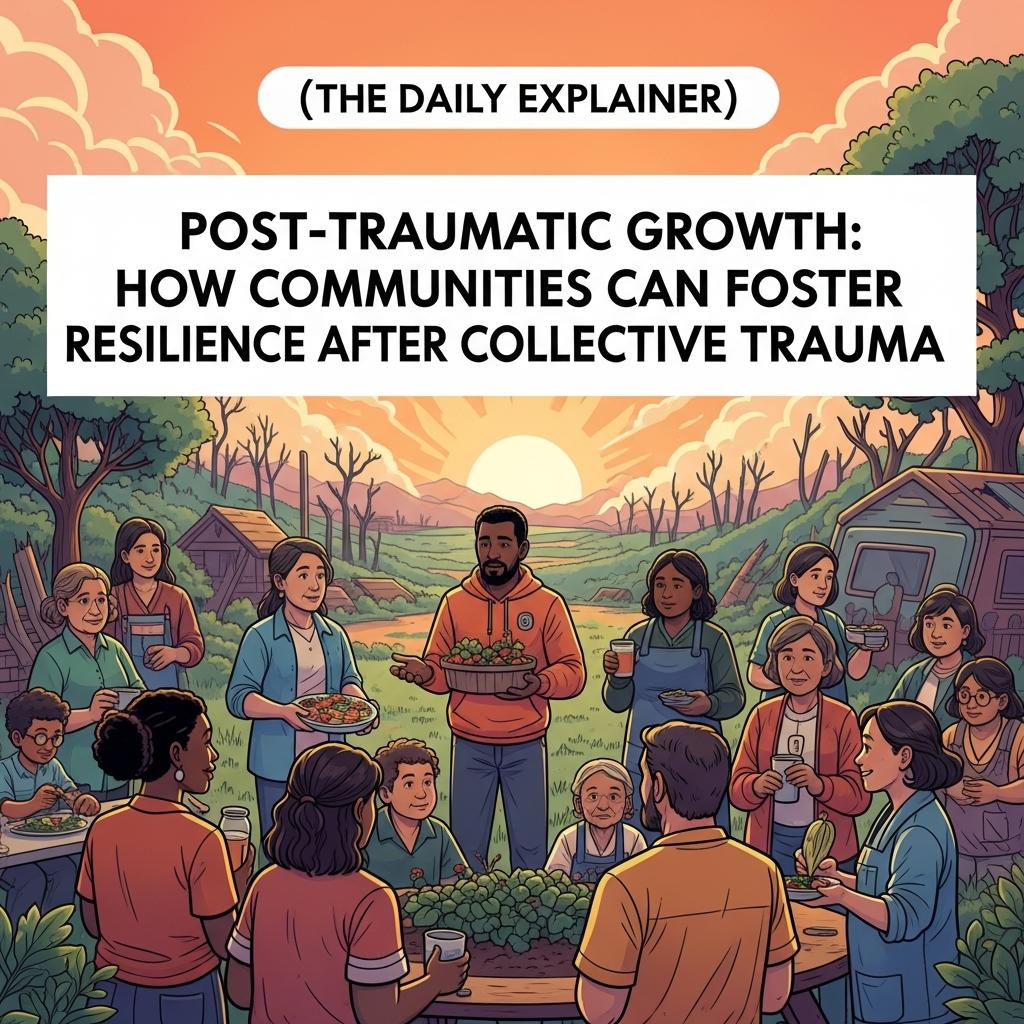
The Landscape of Growth: Post-traumatic growth in communities manifests across five key interrelated domains, transforming the social and psychological fabric.
Introduction – Why This Matters
In the aftermath of a natural disaster, a community-wide act of violence, or a protracted crisis like a pandemic, the narrative is often dominated by loss, damage, and post-traumatic stress. These are real and devastating. But there exists a parallel, profoundly hopeful phenomenon that often goes untold: the story of communities that do not just recover, but transform. They emerge not merely restored to their old selves, but reconfigured—stronger, more connected, and with a renewed sense of purpose. This is the power of Post-Traumatic Growth (PTG) at a collective scale.
First identified by psychologists Richard Tedeschi and Lawrence Calhoun in the 1990s, PTG describes positive psychological change experienced as a result of the struggle with highly challenging life circumstances. For years, it was studied in individuals. Now, in 2026, a growing body of interdisciplinary research is validating what we’ve intuitively witnessed: groups, neighborhoods, and even entire societies can experience growth collectively. A 2025 meta-analysis in Nature Human Behaviour found that communities with structured social infrastructures were 60% more likely to report collective PTG markers (like increased civic engagement and shared purpose) after a disaster than those without.
This guide is for community leaders, organizers, mental health professionals, and anyone who has lived through a shared crisis with others and senses the potential for something more than just “getting back to normal.” We will explore the neuroscience and sociology of collective resilience, define the five core domains of PTG as they manifest in groups, and provide a practical, phase-based framework for intentionally cultivating post-traumatic growth within a community. This is not about minimizing pain or promoting toxic positivity. It is about recognizing that within the fissures created by trauma, the seeds of a stronger future can take root—if we know how to nurture them.
Background / Context: From Individual Suffering to Collective Transformation
The concept of individual Post-Traumatic Growth emerged as a vital correction to the pathology-focused model of trauma response. While Post-Traumatic Stress Disorder (PTSD) rightly addresses the debilitating wounds, PTG acknowledges the possibility of “positive disintegration.” The old, assumptive world (“The world is safe, I am invulnerable, life is predictable”) is shattered by trauma. In the painful process of rebuilding their worldview, some individuals forge a new, often more nuanced and appreciative framework for living.
Collective trauma operates similarly but on a social scale. It is a shared psychological wound that damages the bonds linking a community together and shatters its shared sense of safety, identity, and meaning. Events like the COVID-19 pandemic, the wildfire destruction of a town, or a school shooting fracture the social fabric.
However, this shared rupture also creates a unique social crucible. The old norms and hierarchies are destabilized. A sense of “common fate” emerges, breaking down pre-existing social barriers. In this liminal space—between the old world that’s gone and a new one not yet formed—the conditions for collective growth can emerge. The community is forced to answer fundamental questions together: Who are we now? What truly matters to us? How will we take care of each other?
We’ve seen glimpses throughout history: The solidarity and civil rights advancements following wars, the innovation in public health spurred by pandemics, the fierce localism and environmental stewardship born in rebuilt towns. Today, with our understanding of both trauma and social dynamics, we can move from leaving this growth to chance to actively facilitating it. This aligns with a broader understanding of societal health explored in resources like those from Sherakat Network.
Key Concepts Defined
- Post-Traumatic Growth (PTG): Positive psychological change experienced as a result of the struggle with highly challenging, traumatic life circumstances. It is not the trauma itself that causes growth, but the individual’s or group’s struggle with the new reality in the aftermath.
- Collective Trauma: A traumatic event shared by a group of people that damages the social tissues of a community, destroying bonds, eroding shared values, and breaking down trusted institutions.
- Collective Resilience: The capacity of a community to withstand, adapt to, and recover from adversity, while also potentially transforming to create a new, more robust normal. It is a process, not a static trait.
- Common Fate Identity: A shared social identity that emerges when a group faces a collective threat or challenge together, often overriding previous in-group/out-group divisions (e.g., “We are all survivors of this flood”).
- Assumptive World / Shattered Assumptions: The deeply held, often unconscious beliefs about the world’s predictability, fairness, and safety. Trauma “shatters” these assumptions, creating a crisis of meaning that necessitates rebuilding.
- Expert Companion: A term from PTG therapy describing the ideal role of a supporter—not a “fixer” who provides answers, but a compassionate witness who listens, validates, and helps the traumatized person or group make sense of their experience. For communities, this role can be filled by skilled facilitators, spiritual leaders, or elders.
- Trauma-Informed Community: A community whose policies, practices, and culture are grounded in an understanding of trauma’s prevalence and impact, and that seeks to resist re-traumatization and foster resilience.
- Meaning-Making: The cognitive and emotional process of reconstructing a shattered worldview. At a collective level, this involves creating a shared narrative that integrates the traumatic event into the community’s story in a way that acknowledges loss but also points toward purpose and future direction.
How It Works (Step-by-Step Breakdown): The Community PTG Framework
Facilitating Post-Traumatic Growth in a community is a deliberate, phased process that respects the necessity of grief while creating containers for transformation. This framework adapts individual PTG therapy models for collective application.
Phase 0: The Pre-Conditions – Laying the Groundwork for Growth
Growth cannot be forced, but conditions can be set.
- Step 0.1: Ensure Immediate Safety & Stabilization. PTG cannot begin amidst ongoing crisis. The first priority is meeting basic human needs: physical safety, shelter, food, medical care, and crisis counseling. This establishes a baseline of security from which growth can be contemplated.
- Step 0.2: Normalize the Spectrum of Response. Publicly acknowledge that responses will vary widely—from debilitating PTSD to resilient coping to early signs of growth—and that all are normal. Combat stigma around both suffering and hope.
- Step 0.3: Identify and Empower “Expert Companions.” Identify trusted, emotionally stable individuals within the community—faith leaders, respected teachers, wise elders, mental health professionals—and train them in the basics of psychological first aid, active listening, and PTG principles. They will be the guides.
Phase 1: The Rupture – Creating Space for the Seismic Shift
This phase is about acknowledging the death of the “old normal” without rushing to fill the void.
- Step 1.1: Facilitate Collective Mourning & Lament. Create formal and informal spaces for the community to grieve together. This could be memorial services, communal art projects (a memory wall), or designated “storytelling circles” where people can share what and whom they have lost. The shared expression of pain is the first stitch in the torn social fabric.
- Step 1.2: Shatter the Taboo of Silence. Use public figures and leaders to model vulnerability. When a mayor says, “I am heartbroken and scared too,” it gives everyone permission to feel their own emotions. Break the isolation that trauma creates.
- Step 1.3: Suspend “Business as Usual” Rituals. Temporarily halt routines that feel meaningless or dissonant. This creates a psychological container for the disruption, signaling that something profound has happened and the old ways are on hold.
Phase 2: The Rumination & Processing – Making Sense of the Mess
This is the painful, essential work of cognitive processing. The community must “chew on” the event.
- Step 2.1: Host “Sense-Making” Dialogues. Organize small, facilitated group discussions centered not on solutions, but on questions: “How has this changed how we see our town?” “What did this reveal about our strengths and weaknesses?” “Why do you think this happened to us?” The goal is not consensus, but shared exploration.
- Step 2.2: Encourage Constructive Narrative Building. Guide the community away from simplistic, disempowering narratives (“We are victims of pure bad luck”) or blame-focused ones. Help them develop a complex, nuanced narrative that acknowledges external factors, internal resilience, and randomness.
- Step 2.3: Identify “Selective Rumination.” Watch for and gently challenge destructive rumination—looping on unanswerable “why” questions or worst-case scenarios. Gently steer conversation toward constructive rumination: “Given that this happened, what can we learn? How might we prepare or help others?”
Phase 3: The Reconstruction – Forging the New Normal
With the old worldview dismantled, the community begins to consciously build a new one.
- Step 3.1: Elicit and Map Emergent Values. Through surveys, forums, and art, ask: “What has become most important to us now? What do we want to carry forward from this experience?” Values like interdependence, compassion, preparedness, or authenticity often surface. Make these values explicit and visible.
- Step 3.2: Redefine Roles and Identity. The trauma will have changed how people see themselves and their community. Acknowledge this: “We are no longer just ‘the town by the river’; we are ‘flood survivors and rebuilders.'” Create new, positive identity-affirming roles for people: not just “victim,” but “neighborhood check-in volunteer,” “memory-keeper,” “community gardener.”
- Step 3.3: Initiate Small, Symbolic “Rebuilding” Projects. Start with tangible, achievable projects that symbolize renewal: planting a community garden on scarred land, painting a mural on a rebuilt wall, creating a digital archive of stories. These concrete wins provide hope and evidence of agency.
Phase 4: The Integration & Growth – Living the Change
The insights and new values are woven into the community’s ongoing life.
- Step 4.1: Institutionalize the Lessons. Translate emergent values into new policies, rituals, and institutions. Did the crisis reveal a need for better mental health support? Fund a permanent community wellness center. Did neighbors rely on each other? Formalize a “block connector” program. Embed the growth into the community’s structure.
- Step 4.2: Develop a “Growth-Informed” Shared Story. Co-create a public narrative about the community’s journey. This story should honestly acknowledge the trauma and loss (“In 2025, the fire took our forests and homes…”) but also highlight the struggle, learning, and transformation (“…and in wrestling with that loss, we discovered a deeper commitment to each other and our environment, leading us to create…”). This becomes part of the community’s official history.
- Step 4.3: Foster “Altruism Born of Suffering.” Channel the community’s pain into purpose by helping others facing similar trauma. This is a powerful PTG driver. A town rebuilt after a tornado might create a guidebook for other disaster-struck communities. This transforms pain into a gift, completing the growth cycle.
Phase 5: The Legacy & Forward Transmission – Ensuring Sustainability
- Step 5.1: Create Intergenerational Transmission Rituals. Establish annual days of remembrance that focus not just on loss, but on resilience and values. Have elders who lived through the event share stories with schoolchildren about how the community came together.
- Step 5.2: Build a “Resilience Charter.” Document the principles, policies, and social networks that contributed to the community’s recovery and growth. This becomes a living document to guide responses to future adversity.
- Step 5.3: Celebrate Growth, Not Just Survival. Publicly celebrate the anniversaries of rebuilding milestones, the launch of new community-led initiatives born from the crisis, and the stories of individual and collective strength. Make growth a part of the community’s proud identity.
What I’ve found is that communities that skip Phase 1 (Rupture) and Phase 2 (Rumination) in a rush to “fix” things often end up with a brittle, superficial recovery. The pain goes underground, only to resurface later as chronic conflict, substance abuse, or civic apathy. You cannot build a strong new structure on un-grieved ground.
Why It’s Important: The Transformative Power of Collective PTG
Cultivating Post-Traumatic Growth in communities is not a feel-good option; it is a critical public health and civic strategy.
- Builds Deeper, More Cohesive Social Fabric: Communities that process trauma together often develop stronger, more trusting, and more interconnected social networks. The crisis breaks down barriers of class, race, or politics, fostering a “common fate identity” that can outlast the immediate event.
- Creates More Adaptive and Prepared Communities: A community that has consciously rebuilt itself is more psychologically and logistically prepared for future challenges. It has a “resilience muscle memory”—tested protocols, trusted leaders, and a culture of mutual aid.
- Mitigates Long-Term Public Health Costs: Unprocessed collective trauma leads to cascading public health issues: chronic mental illness, substance abuse, domestic violence, and physical health problems. Investing in facilitated PTG processes can prevent these downstream costs and reduce the burden of PTSD across the population.
- Unlocks Latent Civic Potential and Innovation: Trauma forces a re-evaluation of the status quo. In this space, communities often discover new leaders, create innovative local solutions (e.g., community-owned renewable energy after a grid failure), and develop a more empowered, engaged citizenry.
- Provides a Pathway from Pain to Purpose: It offers a hopeful, evidence-based roadmap that validates suffering while pointing toward a possible future where that suffering contributes to greater strength, wisdom, and connection. This is a powerful antidote to despair and nihilism.
- Strengthens Democratic and Social Institutions: When communities learn to navigate complex, painful processes together through dialogue and shared decision-making, it reinforces democratic habits and trust in collective action—a vital counter to polarization and disengagement.
Sustainability in the Future: Embedding Growth into Social Infrastructure
The future of resilient societies lies in baking PTG principles into our community infrastructures.
- “Resilience Hubs” in Urban Planning: Future city planning will include designated, multipurpose “Resilience Hubs” in every neighborhood—spaces that are community centers in normal times but are equipped to become immediate shelters, communication nodes, and processing centers after a trauma, with trained staff.
- Digital Platforms for Collective Sense-Making: Secure, local digital platforms could be activated post-trauma to facilitate the “rumination” phase at scale—allowing for moderated, town-wide dialogues, shared story repositories, and collaborative timeline/mapping of the event and response.
- PTG Training for “First Receivers”: Just as we train first responders (police, firefighters, EMTs), we will train “first receivers”—school counselors, clergy, community organizers, librarians—in psychological first aid and basic PTG facilitation skills, creating a distributed network of “expert companions.”
- Policy Based on “Trauma-Informed” and “Growth-Informed” Principles: Grants for community rebuilding (from FEMA or other agencies) will increasingly require evidence of plans not just for physical reconstruction, but for psychosocial recovery and resilience-building, favoring communities that integrate PTG frameworks.
- Inter-Community “Resilience Mentoring” Networks: Communities that have undergone growth will formally mentor those newly struck by disaster, sharing their hard-won blueprints for recovery and transformation, creating a global web of resilience knowledge.
Common Misconceptions
- Misconception: Post-Traumatic Growth means you’re glad the trauma happened.
- Reality: This is a profound misunderstanding. No one would choose the trauma. PTG is about valuing the growth that emerged despite the trauma, not valuing the trauma itself. It’s the distinction between “I’m glad I got cancer” and “The ways I grew while fighting cancer are precious to me.”
- Misconception: If you experience PTG, you won’t have PTSD or pain.
- Reality: PTG and PTSD are not opposites; they can and often do coexist. A community can be deeply grieving and suffering from collective PTSD symptoms while simultaneously building new connections and discovering new purpose. The growth happens alongside the pain, not in its absence.
- Misconception: PTG is just being resilient or bouncing back.
- **Reality: Resilience is about returning to baseline—”bouncing back.” PTG is about transcending the baseline—”bouncing forward.” A resilient community recovers to its pre-trauma state. A community that experiences PTG transforms into a new state, often with greater capacities and a revised sense of priorities.
- Misconception: Leaders should promote positive thinking immediately after a tragedy.
- **Reality: Premature positivity (“Look on the bright side!”) is a form of spiritual bypassing that silences genuine grief and impedes true growth. Effective leaders first create space for mourning and validation. Growth emerges from working through the darkness, not from trying to leap over it.
- Misconception: PTG is a guaranteed outcome for all communities.
- Reality: It is a potential outcome, not a guarantee. It depends on many factors: the severity of the trauma, pre-existing community resources and cohesion, the quality of leadership, and the availability of supportive processes. Without intentional facilitation, communities can just as easily fracture into conflict, apathy, or chronic distress.
Recent Developments (2025-2026)
- The WHO “Collective Resilience” Framework: The World Health Organization has published its first operational framework for building collective resilience in communities, explicitly incorporating PTG principles and emphasizing the role of social connection and meaning-making as public health interventions.
- “Adversity Capital” in Community Investing: Impact investors and philanthropic foundations are now evaluating communities based on “Adversity Capital”—a metric assessing their social infrastructure, leadership networks, and historical capacity to transform past trauma into collective assets. This capital influences where recovery and development funds are directed.
- VR for Collective Memory and Empathy: Communities are using Virtual Reality (VR) archives to preserve immersive memories of both the trauma and the rebuilding process. These are used not for sensationalism, but for intergenerational education and to foster empathy in outsiders, helping to sustain the growth narrative.
- The Formalization of “Community Trauma Practitioners”: A new professional certification is emerging for “Community Trauma and Resilience Practitioners,” combining skills in social work, conflict mediation, public health, and community organizing to professionally guide the PTG process.
- Litigation and “Duty of Care” for Collective Psychosocial Recovery: In a landmark case in New Zealand, a class-action settlement following a major industrial disaster included not just financial compensation, but a legally mandated, funded 10-year program for facilitated community PTG, setting a precedent for recognizing psychosocial recovery as a right.
Success Stories
Christchurch, New Zealand: From Earthquakes to an “Innovative, Green, Connected” City
After the devastating 2010-2011 earthquakes that destroyed its city center, Christchurch embarked on a uniquely community-led recovery. Instead of a top-down rebuild, the government initiated “Share an Idea,” gathering over 106,000 ideas from citizens for the new city. This process, though messy and slow, forged a powerful common fate identity. The trauma shattered the old city, but the reconstruction embedded new values: community participation, green space, and innovation. The result is a city that now brands itself as a testbed for sustainable urban living and social innovation. The trauma is integral to its story, but the dominant narrative is one of co-creation and transformation—a classic case of institutionalized PTG.
The L’Aquila, Italy “Social Reconstruction” Project
After the 2009 earthquake, alongside physical rebuilding, a coalition of psychologists, anthropologists, and community activists launched a long-term “Social Reconstruction” project. They focused on:
- Recreating “Third Places”: Setting up temporary community cafes and squares in shipping containers to restore informal social interaction.
- “Memory Workshops”: Facilitating groups where elders and youth co-created maps and stories of the lost city and envisioned the new one.
- Skill-Sharing Circles: Harnessing the latent skills of displaced residents to teach each other and rebuild social capital.
A decade later, studies showed that neighborhoods that participated deeply in these psychosocial programs had significantly higher social cohesion and lower rates of depression than those that focused solely on physical rebuilding.
Real-Life Examples
- A Small Town After a Factory Closure (Economic Trauma): Rivertown lost its major employer, a factory that had operated for 80 years. The initial trauma was economic and identity-based. A local minister and a teacher formed a “Future Committee.” They hosted “grief and gratitude” dinners for stories about the factory era, then “dreaming workshops” for what could come next. From this process emerged a worker-owned cooperative making specialty goods, using the skills of the former workforce. The town’s identity shifted from “factory town” to “maker town,” with a stronger sense of self-reliance.
- A School Community After a Student’s Death: After a beloved student died by suicide, a high school was plunged into trauma. The principal resisted the urge to just bring in outside counselors for a day. Instead, with training, teachers facilitated advisory periods as “circle talks” for months. Students created a memorial garden and a peer support program they named “The Listeners.” The school culture permanently shifted to prioritize mental health check-ins and vulnerability. The tragedy became a painful but pivotal chapter in the school’s commitment to student wellbeing.
- A Online Fandom After a Platform Collapse: When a major fan fiction archive was suddenly taken offline, a global community of writers and readers experienced a collective digital trauma—losing years of creative work and community space. They didn’t just rebuild a replica. They used the rupture to co-design a new, non-profit, community-owned archive with better tagging, inclusion policies, and preservation tools. The loss forced a conversation about values (ownership, accessibility, diversity) that led to a stronger, more intentional community.
In my experience, the communities that grow most powerfully are those that find a way to externalize their processing—to turn their internal struggle into an external project, a new ritual, or a physical space. The act of making the growth visible and tangible is what solidifies it.
Conclusion and Key Takeaways

Collective trauma is an unwelcome teacher, but it can be a profound one. The concept of Post-Traumatic Growth provides a map through the wilderness of suffering, pointing toward a destination where communities are not just patched up, but fundamentally upgraded—more compassionate, connected, and purposeful.
This journey is not automatic. It requires courageous leadership that can tolerate uncertainty and pain, skilled facilitation that can guide difficult conversations, and a communal willingness to engage in the slow, non-linear work of meaning-making. The framework provided here is a starting point, a set of principles that must be adapted to the unique culture, history, and needs of each community.
The ultimate takeaway is one of realistic hope. We cannot prevent all trauma, but we can dramatically influence what grows in its aftermath. By choosing to invest in our social infrastructure and our capacity for collective sense-making, we can build communities that are not fragile, but anti-fragile—capable of becoming stronger, wiser, and more bonded because of the challenges they face together.
Key Takeaways:
- PTG is Collective and Possible: Positive transformation can occur at the community level after shared trauma, leading to stronger bonds, revised priorities, and renewed purpose.
- Growth is a Process, Not an Event: It follows a nonlinear path through rupture, rumination, reconstruction, and integration. Each phase is necessary and cannot be rushed.
- Facilitation is Key: Spontaneous growth is rare. Intentional processes—led by trusted “expert companions”—are needed to create containers for grief, dialogue, and meaning-making.
- Pain and Growth Coexist: PTG does not eliminate suffering or PTSD. It is about building something valuable alongside the enduring pain of loss.
- Narrative is Power: The story a community tells about its trauma and recovery is crucial. Cultivating a “growth-informed” narrative that acknowledges loss but highlights learning and transformation is essential for integration.
- Action Follows Insight: True growth is cemented when new values are institutionalized in policies, rituals, and community projects, turning insight into lasting change.
- Legacy is the Goal: The work is complete when the lessons of the trauma are transmitted to future generations, making the community more resilient and prepared for whatever comes next.
By understanding and applying these principles, we can honor those we’ve lost not only through remembrance, but through the creation of a more vibrant, compassionate, and resilient world—a living legacy forged in the fire of shared adversity.
FAQs (Frequently Asked Questions)
1. Q: How long does the process of collective Post-Traumatic Growth typically take?
A: There is no standard timeline. It is measured in years, not weeks or months. The initial intense phases (Rupture, Rumination) may last 6-18 months, while the full integration of growth into community identity and institutions can take a decade or more. It’s a generational project, not a quick fix. Patience and long-term commitment are essential.
2. Q: Can a community experience PTG if the trauma was caused by human malice (e.g., a hate crime, terrorism) rather than a natural disaster?
A: Yes, but the process is often more complex and requires additional steps. The shattering of trust and the presence of a perpetuator add layers of anger, desire for justice, and intergroup tension. The sense-making must address the reality of human evil, and growth often involves a conscious commitment to counter hate with solidarity, and to build institutions that promote justice and inclusion to prevent future harm.
3. Q: What’s the role of art and creativity in fostering collective PTG?
A: It is indispensable. Trauma often overwhelms linear, verbal processing. Art, music, theater, and ritual provide non-verbal, symbolic languages for communities to express the inexpressible, mourn collectively, and imagine new futures. A community mural, a memorial song, or a participatory theater piece can achieve deeper integration than a hundred town hall meetings.
4. Q: How do we deal with community members who are stuck in anger or blame and resist moving toward growth-oriented discussions?
A: First, validate the anger. It is often a justified and necessary part of the response to injustice or loss. Don’t try to talk people out of it. Second, channel it constructively. Ask: “What would justice or accountability look like to you? What action could we take that would honor this anger in a productive way?” Sometimes, forming a dedicated “justice and accountability” working group can contain this energy and allow other groups to focus on reconstruction and meaning-making.
5. Q: Is it ethical to “facilitate” growth? Doesn’t that risk manipulating people’s grief?
A: Ethical facilitation is non-coercive and consent-based. It is about creating the conditions and offering the tools for growth, not demanding it. The facilitator’s role is that of an “expert companion”—a guide who walks alongside, points out potential paths, and holds a safe space. The community itself must own the pace and direction of its journey. Transparency about the process and its voluntary nature is key.
6. Q: How does social media impact collective PTG?
A: It’s a double-edged sword. Positive: It can help maintain connections, spread accurate information, mobilize help, and create digital memorial spaces. Negative: It can amplify misinformation, spread trauma imagery, foster toxic blame cycles, and create performative grief that replaces deep, shared processing. The key is for communities to create their own moderated, private digital spaces for genuine dialogue and to collectively agree on norms for public social media use during recovery.
7. Q: Can a fragmented or divided community still experience PTG?
A: It is harder, but the shared trauma can sometimes become a catalyst for reconciliation. The “common fate identity” (“We are all in this disaster together”) can temporarily override old divisions. Skilled facilitators can use this window to build new, shared experiences and goals that begin to heal old rifts. However, if pre-existing conflicts are severe, addressing them may need to be a parallel, explicit part of the process.
8. Q: What if some community members don’t want to “grow” or talk about the trauma—they just want to forget and move on?
A: Respect that. Forcing processing is re-traumatizing. Growth cannot be mandated. Provide multiple pathways for engagement: some may process through action (volunteering to rebuild), others through private reflection, others by supporting from the sidelines. The community’s growth is the aggregate shift, not a requirement for every individual. Ensure those who wish to engage more deeply have the opportunity without shaming those who don’t.
9. Q: How is this different from standard crisis counseling or disaster mental health?
A: Standard crisis counseling (Psychological First Aid) focuses on immediate stabilization, safety, and symptom reduction. It’s essential first aid. The PTG framework is the long-term rehabilitation and training program. It starts after stabilization and focuses not on reducing pathology, but on cultivating positive change, meaning, and transformed identity at a systems level. They are complementary, sequential approaches.
10. Q: Who should fund and lead these community PTG processes?
A: It requires a coalition. Public health departments can fund and provide expert guidance. Local government can provide legitimacy and logistical support. But grassroots community organizations, faith groups, and indigenous leaders must be in the lead, as they hold the trust and cultural understanding. The most effective model is a partnership where outside experts serve as consultants to community-led efforts.
11. Q: Can PTG happen after a slow-moving, chronic trauma (like economic decay, a long drought, or a pandemic)?
A: Absolutely. The principles are the same, though the “rupture” phase is less a single event and more a creeping realization of irrevocable change. The process may be even more drawn out. The key is to consciously mark the transition—to collectively acknowledge that the old era is over—and then begin the deliberate work of sense-making and building a new normal for the changed reality.
12. Q: What are the signs that a community is not on a path to PTG, but towards chronic dysfunction?
A: Warning signs include: Pervasive silence and denial about the event, escalating internal blame and scapegoating, leadership that promotes simplistic or divisive narratives, withdrawal of civic engagement, and a lack of any new, positive community-led initiatives years after the event. These indicate stuckness that requires intervention.
13. Q: How do you measure collective PTG?
A: Researchers use mixed methods:
- Surveys: Adapted versions of the individual PTG Inventory, measuring perceived changes in community relationships, new possibilities, personal strength, etc.
- Social Network Analysis: Mapping changes in the density and strength of community connections.
- Civic Metrics: Tracking changes in volunteer rates, voting, membership in local organizations.
- Narrative Analysis: Studying how the community’s shared story (in media, speeches, school curricula) evolves over time to include themes of growth and learning.
14. Q: What is the biggest mistake well-intentioned leaders make after a community trauma?
A: Rushing to “solutioneering” and “reassurance.” Leaders often feel pressure to have all the answers and project strength immediately. This cuts short the essential phases of shared grief and questioning. The most helpful early leadership is humble, vulnerable, and focused on listening and containing emotion, not on providing premature closure or blueprints.
15. Q: How does this relate to concepts like “ubuntu” or indigenous ways of knowing about community?
A: The modern psychology of PTG is often rediscovering ancient wisdom. Concepts like ubuntu (“I am because we are”) in Southern Africa, or the emphasis on community ceremony and storytelling in many Indigenous cultures, are sophisticated systems for processing collective hardship and maintaining social cohesion. Modern PTG frameworks should be applied with humility and in partnership with these existing cultural resilience practices.
16. Q: Can a workplace or organization be considered a “community” for PTG purposes?
A: Yes. Organizations can experience collective trauma (e.g., a workplace accident, a scandal, a brutal round of layoffs). The same framework applies: creating space to process the shock, re-examining the organization’s values and purpose, and rebuilding culture in a way that integrates the lessons learned. This is critical for organizational health, as discussed in business-focused resources like those on WorldClassBlogs.
17. Q: What about communities that face recurrent traumas (e.g., flood-prone regions, neighborhoods with frequent violence)?
A: For these communities, the concept of “chronic” or “cumulative” PTG is more relevant. The growth is not from a single event but from the ongoing struggle. The focus shifts to building a permanent culture of mutual aid, advocacy, and political agency to change the underlying conditions. The growth is in their organized resilience and power, not just their internal narrative.
18. Q: How do children fit into this process?
A: They are central. Children both experience the trauma and absorb the community’s narrative about it. Involve them in age-appropriate ways: through art projects, helping with symbolic rebuilding (planting trees), and listening to their questions. Most importantly, model for them how adults process difficulty with honesty, emotion, and hope. Their recovery is tied to the health of the adult community.
19. Q: Is there a risk of creating a hierarchy of “good” vs. “bad” victims based on who shows growth?
A: Yes, this is a serious ethical risk. It must be actively guarded against by repeatedly emphasizing that growth is a potential path, not a moral obligation. The community must honor and support those who are deeply, chronically wounded without implying they have failed. The measure of a community’s growth is partly in how well it cares for its most vulnerable members, not just in its shiny new projects.
20. Q: Where can our community find trained facilitators or consultants for this work?
A: Look to university departments of community psychology, social work, or public health. Organizations like the International Society for Traumatic Stress Studies (ISTSS) or the Community Resilience Initiative have directories. Also, reach out to other communities that have been through similar events—they are often the best sources of peer mentorship and can recommend who helped them.
21. Q: How does collective PTG interact with individual therapy?
A: They support each other. Individual therapy can help a person process their unique pain and PTSD symptoms, giving them the personal stability to then engage in the collective work. Conversely, being part of a growing, supportive community provides a healing environment that can accelerate individual recovery. They are different levels of intervention that should be coordinated.
22. Q: Can a community grow from a trauma it indirectly witnessed (e.g., through media), not directly experienced?
A: This is vicarious or shared cultural trauma (e.g., a nation witnessing a terrorist attack on TV). It can spur collective growth, but often in a more diffuse way—sparking national conversations about security, values, or unity. The process is similar but may require media and cultural leaders to facilitate the sense-making on a larger scale.
23. Q: What if the “new normal” we build feels inadequate compared to what was lost?
A: This is almost inevitable. Growth does not mean the new reality is better than the old one free of trauma. It means it is richer in meaning, connection, or purpose because of the struggle. There will always be grief for what was lost. The goal is not to replace it, but to build a life alongside the loss that is still worth living, informed by the depth the loss revealed.
24. Q: How do we prevent burnout among the facilitators and community leaders guiding this long process?
A: This is critical. Implement mandatory peer support and supervision for facilitators. Rotate leadership roles. Celebrate small milestones to maintain momentum. Secure funding to pay community leaders for their emotional labor. Remember, the process should distribute the healing work across the community, not concentrate it on a heroic few. A facilitator’s burnout is a sign the model isn’t sustainable.
25. Q: Where can I find stories of communities that have grown from trauma to inspire our own?
A: Explore the “Voices of Resilience” project by the Disaster Resilience Leadership Academy. Read case studies from the Post-Traumatic Growth Research Group at the University of North Carolina Charlotte. Documentaries like “The Year After” (about a town after a flood) or “Wisdom of Trauma” (though individual-focused) can be catalysts for discussion. Start by searching for your specific type of trauma + “community resilience case study.”
About Author
Sana Ullah Kakar is a writer and researcher focused on the intersection of psychology, community, and societal change. Drawing from both academic literature and real-world case studies, his work seeks to provide practical frameworks for building resilience and fostering growth in the face of collective challenges. He believes that understanding our capacity for post-traumatic growth is key to navigating an uncertain future with hope and agency. For more in-depth explanations of complex societal dynamics, visit the Explained section of The Daily Explainer.
Free Resources
- Community PTG Process Checklist (PDF):
- A phase-by-phase checklist for community leaders and facilitators, outlining key tasks, potential pitfalls, and reflective questions for each stage of the framework outlined in the article.
- Access: Direct download link from the article page or our main Blog.
- “Sense-Making Dialogue” Facilitator Guide:
- A detailed guide with sample questions, ground rules, and facilitation techniques for hosting constructive community conversations after a trauma, focusing on the Rumination phase.
- Access: A downloadable PDF available through our partner’s resource library at Sherakat Network Resources.
- Collective Narrative Workbook:
- A workbook for a small community group to use in collaboratively drafting their “growth-informed” story—helping them structure the narrative of their trauma, struggle, and emerging strengths.
- Access: A fillable PDF or online form template.
- Resource List: Models of Community Resilience:
- An annotated list of books, documentaries, academic papers, and organizations worldwide that specialize in community trauma recovery and resilience building, serving as a deeper dive for practitioners.
- Access: A permanent, curated page on The Daily Explainer website.
- “Caring for the Facilitators” Peer Support Protocol:
- A simple, structured protocol for establishing a peer support circle among those leading the community’s healing work, to prevent burnout and sustain their efforts.
- Access: A guide available upon request via our Contact Us page for verified community leaders or organizations.
Discussion
The story of growth after trauma is one we write together. Your community’s experience matters.
We invite you to share insights, questions, and stories from your own context.
- For Community Members: What is one small sign of growth or connection you’ve witnessed in your community after a difficult time? What made it possible?
- For Leaders & Facilitators: What has been the most challenging part of guiding a community through hardship? What advice would you give others starting this work?
- For Skeptics & Realists: What concerns you about the idea of “post-traumatic growth” for communities? How can we acknowledge real pain while still holding space for hope?
Let’s learn from each other’s journeys.
Please share with empathy and respect for the profound nature of this topic. We ask that comments focus on principles and shared learning rather than graphic details of specific traumatic events. All discussions are moderated in line with our site’s Terms of Service.
About The Author