
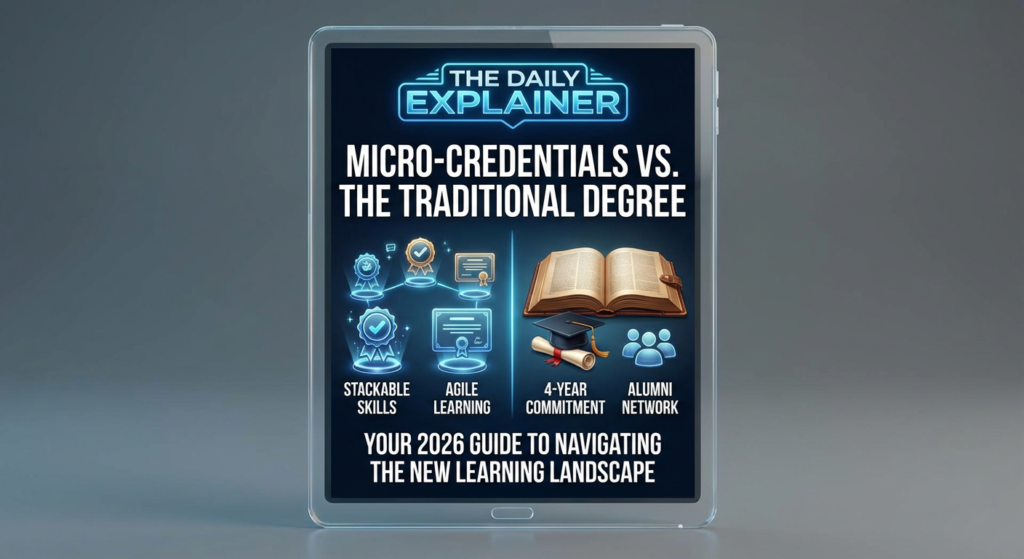
Visualizing the "stackable" future of learning: Combining targeted micro-credentials can create a customized career pathway.
Introduction – Why This Debate Matters for Your Career
The landscape of learning and career advancement is undergoing its most radical transformation in a century. The once-unquestioned path—high school, four-year degree, lifelong career—is now just one of many routes on the map. In its place, a dynamic ecosystem of micro-credentials, digital badges, bootcamps, and nano-degrees has exploded, promising faster, cheaper, and more targeted skill acquisition.
Why does this matter to you? Whether you’re a student choosing your path, a professional feeling the sting of skills obsolescence, or a hiring manager sifting through resumes, understanding this shift is critical. The cost of a traditional university education continues to climb, with student loan debt in the U.S. reaching $1.77 trillion in 2025 (Federal Reserve). Simultaneously, a 2026 report by the World Economic Forum indicates that 44% of workers’ core skills will be disrupted in the next five years. The gap between what traditional education provides and what the modern economy demands has never been wider or more costly.
In my experience, as someone who has hired for tech and marketing roles, the resume with a perfect Ivy League degree but no portfolio often loses to the one with a compelling GitHub profile and a series of verified, specialized credentials from platforms like Coursera. The currency of credibility is changing.
Background / Context: From Diplomas to Digital Badges
For generations, the university degree served as a powerful signaling mechanism. It told employers that an individual possessed a baseline of knowledge, discipline, and the ability to complete a multi-year program. Its value was in its scarcity and standardization.
The digital revolution dismantled the monopoly on knowledge. High-quality courseware from institutions like MIT and Stanford became free online. The pace of technological change accelerated, rendering many textbook curricula outdated before graduation. Industries like technology and digital marketing prioritize demonstrable skills over pedigree.
This created the perfect conditions for alternative credentials to thrive. Born from a need for agility, specificity, and affordability, micro-credentials are compact, focused certifications that validate a specific skill or competency. They are often offered online, can take weeks or months to complete, and are frequently created in direct partnership with industry leaders like Google, Meta, and IBM.
Key Concepts Defined
Let’s demystify the terminology:
- Micro-credential: An umbrella term for a certification or endorsement in a specific, focused skill area. It’s the super-category.
- Digital Badge: A visual, online representation of a micro-credential. It’s clickable, contains metadata about the issuer, criteria, and evidence, and can be shared on LinkedIn and digital resumes. Think of it as the “icon” for your credential.
- Nano-degree / Professional Certificate: A larger, more comprehensive series of courses that culminate in a credential (e.g., Google Data Analytics Certificate, IBM Data Science Professional Certificate). These often mimic a full university course’s scope but are more streamlined.
- Bootcamp: An intensive, short-term training program (often 3-6 months) designed to make students job-ready in fields like coding, data science, or UX design. They are a primary source of micro-credentials.
- Skills-Based Hiring: A practice where employers prioritize assessed skills and competencies over traditional proxies like degrees. It’s the driving philosophy behind the rise of micro-credentials.
How It Works: A Step-by-Step Breakdown of the Micro-Credential Ecosystem

Step 1: Identifying the Skill Gap
A professional realizes they need expertise in, say, “Python for Data Analysis.” They don’t need a full computer science degree; they need a targeted, applicable skill.
Step 2: Choosing the Right Platform & Program
They explore platforms:
- Coursera / edX: Often partner with universities (e.g., “Python for Everybody” from University of Michigan).
- LinkedIn Learning / Udacity: Focus on business and tech skills, with paths designed with industry.
- Industry-Specific Platforms: Like HubSpot Academy for marketing or AWS Educate for cloud computing.
They compare curriculum, instructor credibility, time commitment, cost, and whether the credential is recognized in their target industry.
Step 3: Learning and Assessment
Learning is modular and on-demand. Crucially, assessment is often project-based or hands-on. Instead of just a final exam, the learner might build a small data dashboard using Python. This creates a tangible artifact for their portfolio.
Step 4: Earning and Sharing the Credential
Upon passing, the platform awards a digital badge. The learner can push this badge with one click to their LinkedIn profile, where it appears in a dedicated “Licenses & Certifications” section, providing instant verification to recruiters.
Step 5: Stacking Credentials
This is the powerful part. A learner can “stack” related badges: “Python Fundamentals” + “Data Visualization with Python” + “SQL for Data Science” to build a composite, compelling skills profile that rivals a traditional transcript.
Key Takeaway Box:
The Micro-Credential Journey: Identify Gap → Choose Platform → Learn via Projects → Earn Digital Badge → Share & Stack. This creates a continuous, agile learning loop, unlike the linear, monolithic degree path.
Why It’s Important: The Real-World Impact
For Individuals:
- Career Pivoting: Allows for efficient mid-career shifts without returning to school for 4 years.
- Upskilling: Keeps current employees relevant. A 2025 survey by SheraKat Network found that 78% of professionals who pursued micro-credentials reported increased job security.
- Democratization: Lowers financial and geographic barriers to high-quality education.
For Employers:
- Better Skills Matching: Credentials are tied to specific, needed skills, reducing hiring misfires.
- Diverse Talent Pools: Opens doors to non-traditional candidates (self-taught, career-changers) who possess the exact skills required.
- Faster Onboarding: New hires with micro-credentials often require less baseline training.
For Society:
- Addresses Skills Gaps: More rapidly aligns workforce training with economic needs.
- Promotes Lifelong Learning: Normalizes continuous education as a career necessity.
Sustainability in the Future: A Blended Model Emerges
The future is not a wholesale replacement of degrees with badges. It is a hybrid, stackable ecosystem. We are moving toward a model where:
- The traditional degree remains valuable for foundational knowledge, critical thinking, and fields with strict licensure (e.g., medicine, law).
- Micro-credentials act as the perpetual “top-up” system for specialized, evolving skills throughout a career.
- Record of Learning: A portable, digital wallet (like a “skills passport”) will hold all credentials—degrees, badges, work projects—giving individuals control over their verifiable career narrative.
As noted by WorldClassBlogs in their 2026 trends report, “The most successful educational institutions will become hubs that offer both deep foundational degrees and a lifetime subscription to micro-credential top-ups for their alumni.”
Common Misconceptions Debunked
- Misconception 1: “Micro-credentials will completely replace degrees.”
- Reality: They are complementary. A degree provides breadth and theory; micro-credentials provide depth and current practice. For complex, interdisciplinary fields, the foundational knowledge of a degree is irreplaceable.
- Misconception 2: “They are easy and lack rigor.”
- Reality: High-quality micro-credentials from reputable issuers (e.g., Google, Stanford, Microsoft) have rigorous, project-based assessments. Their value comes from demonstrating application, not just recall.
- Misconception 3: “Employers don’t value them.”
- Reality: This is changing rapidly. A 2026 LinkedIn Talent Solutions report shows that job postings mentioning skills or credentials over degrees have grown by 120% since 2022. Major companies like Apple, IBM, and Google have publicly dropped degree requirements for many roles.
Recent Developments (2025-2026)
- Government Endorsement: The U.S. Department of Education expanded its EQUIP program in 2025, allowing federal financial aid to be used for certain approved micro-credential programs from non-traditional providers.
- University Adoption: Over 70% of major universities now offer some form of micro-credential, either as standalone offerings or as “digital minors” bundled with degrees.
- The “Credential Transparency” Movement: Initiatives like Credential Engine are creating a common language for all credentials, making it easier for learners and employers to compare value.
Success Stories & Real-Life Examples
- Case Study: The Career Changer. Maria, a former teacher, used the Google Data Analytics Professional Certificate on Coursera (completed in 6 months part-time) to build a portfolio of projects. She earned her credential, shared the badge on LinkedIn, and was hired as a Junior Data Analyst at a mid-sized tech firm, bypassing the need for a second degree.
- Case Study: The Corporate Upskilling Initiative. A major bank partnered with Udacity to create a custom “AI for Finance” nanodegree for 500 of its analysts. This internal upskilling allowed the bank to build AI capabilities in-house at a fraction of the cost of external hiring.
- Real-Life Example: Platforms like SheraKat Network’s resources section now prominently feature articles on “Which Digital Badge is Right for Your Non-Profit Career?”, showing the penetration of this trend across sectors.
Conclusion and Key Takeaways

The debate isn’t “micro-credentials vs. degrees.” It’s about building a personalized, responsive, and continuous learning strategy for a volatile economy. The university model is not obsolete, but its role is evolving from the sole gatekeeper of opportunity to a foundational node in a lifelong learning network.
Your Action Plan:
- Audit Your Skills: Honestly assess your gaps against your career goals.
- Think in Modules: Don’t ask, “Do I need another degree?” Ask, “What specific skill do I need next?”
- Research Credentials: Look for programs with industry recognition, project-based work, and verifiable outcomes.
- Showcase Your Learning: Integrate digital badges into your LinkedIn and resume. Build a public portfolio of your project work.
- Never Stop Stacking: View your career as a portfolio of skills that you continuously refine and expand.
The future belongs to the agile learner. Start building your stack today. For more insights on navigating modern career paths, explore our other guides at The Daily Explainer’s blog.
Frequently Asked Questions (FAQ)
Q1: What exactly is the difference between a certificate and a micro-credential?
A: “Certificate” is a broader term. A micro-credential is a type of certificate that is specifically digital, focused on a narrow skill, and often represented by a shareable badge. All micro-credentials are certificates, but not all certificates are micro-credentials.
Q2: Are micro-credentials accredited?
A: They are not accredited in the same way universities are by regional bodies. Instead, they gain credibility through industry validation. A credential from Google Cloud is “accredited” by the job market’s demand for Google Cloud skills. Some are now seeking formal quality assurance through bodies like the Quality Assurance Agency.
Q3: How much do they typically cost?
A: Costs vary widely, from free (with optional paid certificates) to a few thousand dollars for intensive bootcamps. Most on platforms like Coursera range from $39-$99 per month, with the total cost depending on your pace.
Q4: Can I get a job with only micro-credentials and no degree?
A: In many tech, digital marketing, and design roles, yes—if your skills and portfolio are strong. In fields like engineering, healthcare, or academia, a foundational degree is still typically a non-negotiable entry requirement. Always research your target industry.
Q5: How do I list micro-credentials on my resume?
A: Create a dedicated “Certifications & Credentials” section. List the credential name, issuing organization (e.g., “Google Career Certificates”), date earned, and if space allows, 1-2 key skills or projects it validated. Include the URL to your digital badge if applying digitally.
Q6: Do employers actually check these digital badges?
A: Yes. The metadata behind a verifiable digital badge (like those from Credly) allows an employer to click and instantly verify its authenticity, the issuing criteria, and even see evidence of your work, making fraud much harder than with a self-listed credential on a resume.
Q7: What’s the biggest downside to micro-credentials?
A: The market is fragmented and can be confusing. The lack of universal standards means the value of a credential is only as good as the reputation of its issuer. There is also a risk of “credential clutter” – collecting too many low-value badges.
Q8: How do I choose a reputable program?
A: Look for: 1) Issuer reputation (industry leader or top university), 2) Clear learning outcomes and project descriptions, 3) Job placement or career outcome data, 4) Reviews from past learners on sites like Course Report, and 5) Partnerships with real companies.
Q9: Can micro-credential credits be transferred to a degree program?
A: This is growing but not universal. Many universities now have “prior learning assessment” (PLA) policies. Some, like Purdue University and Arizona State University, have explicit pathways to count certain nano-degrees toward a bachelor’s. Always check with the specific institution.
Q10: Is this just a trend for young people in tech?
A: Absolutely not. From project management (PMI) and human resources (SHRM) to healthcare compliance and construction safety, nearly every profession has a growing micro-credential ecosystem for ongoing licensure and specialization.
Q11: How much time should I commit per week?
A: Most programs are designed for 5-10 hours per week for part-time learners. Intensive bootcamps may require 20+ hours. It’s crucial to be realistic about your time to avoid burnout and ensure completion.
Q12: What is “credential stacking”?
A: It’s the process of combining multiple related micro-credentials to demonstrate broader competency, effectively building your own “modular degree.” For example, stacking credentials in “SEO Fundamentals,” “Content Marketing,” and “Google Analytics” builds a composite profile for a Digital Marketer.
Q13: Are there free micro-credentials?
A: Yes. Many platforms (like Coursera, edX, FutureLearn) allow you to audit courses for free. However, you typically must pay to access graded assignments, receive the final credential, and get the shareable digital badge. Some, like Google Career Certificates, offer financial aid.
Q14: How does this relate to “skills-based hiring”?
A: They are two sides of the same coin. Skills-based hiring is the employer practice; micro-credentials are the tool learners use to visibly, verifiably prove those specific skills. They provide the evidence for the new hiring philosophy.
Q15: Will my micro-credential expire?
A: Some do, especially in fast-changing tech fields (e.g., a specific cloud certification may require re-certification every 2 years). Others do not. Always check the credential’s policy, as this speaks to its commitment to current relevance.
Q16: Can I negotiate a higher salary with micro-credentials?
A: They provide a strong foundation for negotiation because they are proof of specific, often high-demand skills. When combined with demonstrable application (e.g., “I earned this credential and used the skill to improve X process, resulting in Y”), they can directly justify a salary increase or promotion.
Q17: Where is the best place to share my earned badges?
A: LinkedIn is the primary professional platform. Add them to your “Licenses & Certifications” section. You can also share them on Twitter/X, embed them in your personal website or digital resume, and include them in your email signature.
Q18: What’s the role of community colleges in this space?
A: Community colleges are becoming vital hubs for micro-credentials, often offering low-cost, non-credit “workforce training” programs developed directly with local employers to fill immediate regional skills gaps.
Q19: How do I avoid getting scammed by a low-quality program?
A: Be wary of programs that promise a job “guarantee” (no one can guarantee this), have overwhelmingly negative reviews, lack transparency about instructors or curriculum, or pressure you to sign up for high-interest loans. Trust established platforms and providers.
Q20: What’s the single most important factor for success with micro-credentials?
A: The portfolio project. The credential gets you an interview; the tangible project you built to earn it proves you can do the work. Never treat the project as a mere homework assignment—treat it as the first entry in your professional portfolio.
About the Author
Sana Ullah Kakar is a career strategist and learning consultant with over 15 years of experience at the intersection of education and technology. Having worked as a hiring manager for Fortune 500 companies and later advising universities on curriculum development, they bring a unique dual perspective to the future of work. They are a passionate advocate for lifelong learning and accessible career pathways. You can find more of their writing on The Daily Explainer’s blog or connect with them via The Daily Explainer’s contact page.
Free Resources to Get Started
- Class Central (classcentral.com): A search engine and reviews aggregator for thousands of free and paid online courses and credentials.
- Credential Engine’s Registry: Explore and compare different credentials across providers.
- The U.S. Department of Labor’s CareerOneStop (careeronestop.org) has a “Find Training” tool that includes non-degree programs.
- SheraKat Network’s Start Online Business 2026 Guide: While focused on business, it contains excellent sections on essential digital skills and credible credentialing paths.
- WorldClassBlogs Nonprofit Hub: Offers insights on valuable credentials for mission-driven careers.
Join the Discussion
What’s been your experience with micro-credentials? Are you considering one to pivot your career or upskill in your current role? What hurdles are you facing? Share your thoughts and questions in the comments below. Let’s build a community of lifelong learners. For more discussions on global trends impacting work, check out our Global Affairs & Politics section.
About The Author

Youre so cool! I dont suppose Ive read something like this before. So good to seek out anyone with some unique thoughts on this subject. realy thank you for beginning this up. this web site is something that’s needed on the web, somebody with somewhat originality. helpful job for bringing one thing new to the internet!
Hi, Neat post. There’s a problem together with your website in web explorer, might check thisK IE nonetheless is the marketplace chief and a big portion of folks will pass over your great writing because of this problem.