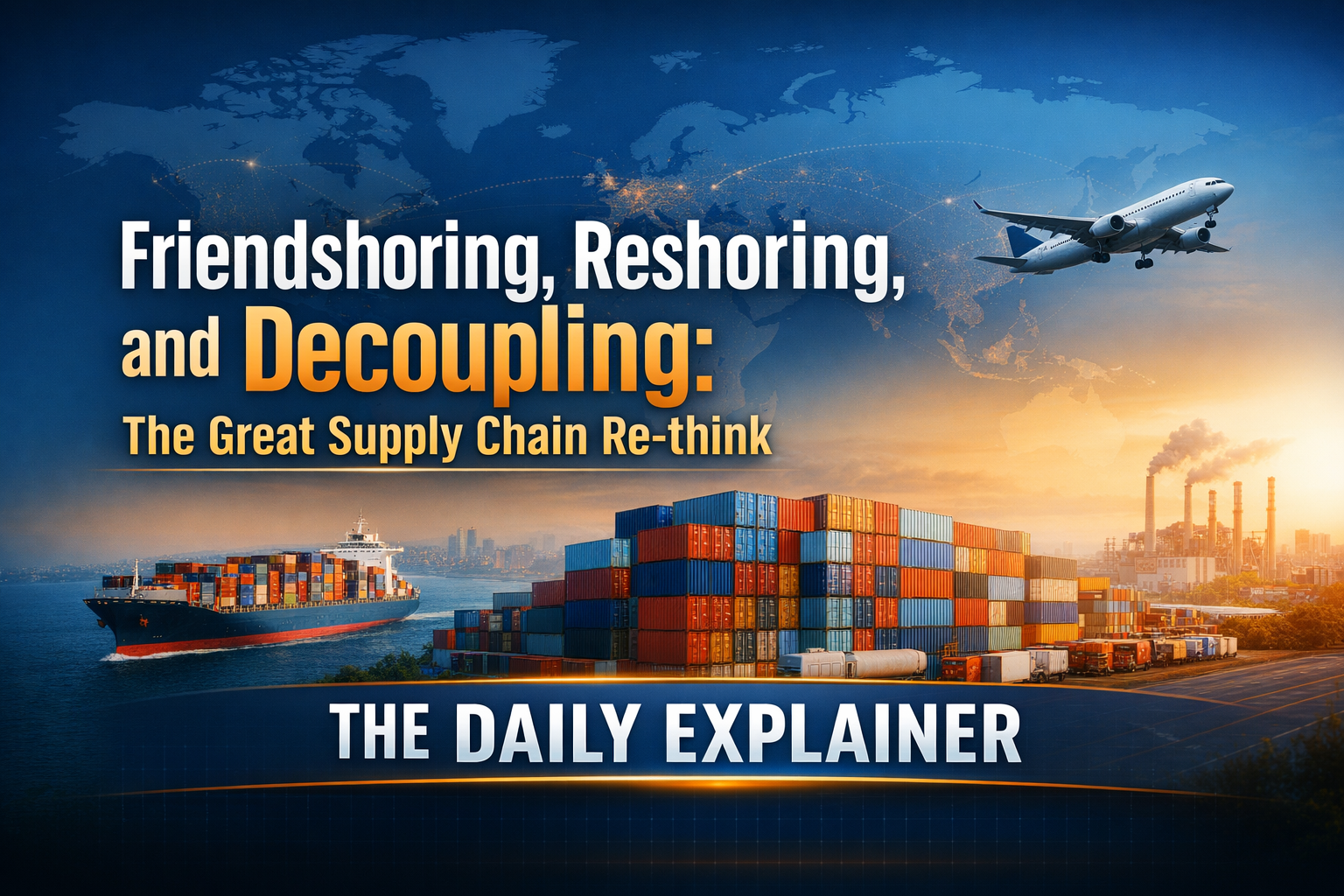
The strategic shift from efficiency-centric globalization to resilient, multi-regional supply chain networks.
Introduction – Why This Matters
The invisible network that delivers everything from smartphones to groceries to your doorstep is undergoing its most significant transformation in decades. For years, the mantra of global trade was simple: efficiency above all. Companies scoured the world for the lowest costs and fastest production, weaving a complex, interlinked global supply chain. This system gave us affordable goods and powered economic growth, but its fragility was laid bare by the pandemic, geopolitical tensions, and sudden disruptions. Today, a new vocabulary—friendshoring, reshoring, and decoupling—dominates boardrooms and government policy, signaling a historic pivot from pure efficiency toward security, resilience, and strategic alignment.
This shift matters because it touches every aspect of our lives. It influences the price and availability of cars and electronics, determines where new factories and jobs are created, and reshapes the geopolitical landscape. For the curious beginner, understanding these terms is key to deciphering economic news. For the professional, it’s a critical framework for strategic planning. As we move through 2025 and into 2026, this great supply chain re-think is no longer a theoretical discussion; it’s an operational reality with winners, losers, and a new set of rules for participating in the global economy. In my experience consulting with mid-sized manufacturers, the companies that are proactively mapping their supply chain vulnerabilities and exploring alternative sourcing options are the ones securing long-term contracts and investor confidence today.
Background / Context
The story of modern globalization began in the late 20th century, driven by container shipping, communication technology, and trade liberalization. The dominant model was the “China+1” strategy, where companies centralized mass production in China—the “world’s factory”—for its unparalleled scale, skilled workforce, and infrastructure, while maybe having one backup elsewhere. This created hyper-efficient but incredibly lengthy and opaque supply chains. A single product might have components crossing international borders a dozen times before final assembly.
This system delivered immense benefits in the form of low consumer prices and corporate profits. However, it concentrated risk. The COVID-19 pandemic was the first major shock, causing factory closures, port gridlock, and revealing a crippling dependency on single sources for critical goods like medical equipment and semiconductors. This was quickly followed by geopolitical fractures, most notably between the U.S. and China, leading to tariffs, export controls (especially on advanced tech), and national security concerns. The war in Ukraine further exacerbated energy and food supply crises, proving that geopolitical events could instantly disrupt far-flung economic networks.
Governments responded with policy pushes for supply chain sovereignty. The U.S. passed the CHIPS and Science Act and the Inflation Reduction Act, offering massive subsidies to bring semiconductor and clean energy manufacturing home. The European Union announced its own Green Deal Industrial Plan. These policies aren’t just nudges; they are powerful financial engines actively redirecting private investment. As noted in analyses from Sherakat Network’s Blog on international business trends, this represents a fundamental recalibration where strategic imperatives are now as influential as market prices in corporate decision-making. For broader context on these global shifts, you can explore related coverage in our Global Affairs & Politics section.
Key Concepts Defined
To navigate this new landscape, we must precisely understand its core terminology:
- Globalization: The process by which businesses and other organizations develop international influence or operate on an international scale, characterized by free trade, capital mobility, and the global integration of supply chains.
- Supply Chain: The entire network of entities, from raw material suppliers to end consumers, involved in creating and distributing a product. It encompasses production, shipment, and distribution.
- Reshoring (or Onshoring): The practice of bringing manufacturing and other business processes back to a company’s country of origin. The primary drivers are often reducing strategic risk, shortening lead times, leveraging automation, and responding to government incentives.
- Nearshoring: Relocating business processes to a nearby or neighboring country. For the United States, this often means moving production from Asia to Mexico or Central America. The goals are to reduce transit time and complexity while maintaining lower cost structures than the home country.
- Friendshoring (or Allieshoring): The strategy of shifting supply chains to politically allied or low-risk countries. This is less about geographic proximity and more about geopolitical alignment and shared values. It aims to build resilience within a trusted network of nations. A 2025 report from the International Monetary Fund highlighted that trade between geopolitical blocs is growing slower than trade within them, a direct result of friendshoring.
- Decoupling: A broad, often politically charged term describing a deliberate process of reducing economic interdependence between two nations, particularly the U.S. and China. It involves erecting barriers like tariffs, investment screens, and export controls to separate technological and industrial bases.
- De-risking: A more nuanced term favored by policymakers, especially in Europe. It acknowledges that complete decoupling is impractical and economically damaging. Instead, it focuses on identifying and mitigating specific vulnerabilities in critical sectors (e.g., rare earth minerals, advanced chips, pharmaceuticals) while maintaining trade in non-sensitive areas.
How It Works (Step-by-Step Breakdown)

The shift from a globalized to a re-organized supply chain isn’t a single event but a strategic process. Here’s how a company typically navigates this transition:
Step 1: The Risk Assessment & Mapping Audit
A company begins by moving beyond a simple supplier list to create a detailed multi-tier supply chain map. This involves identifying not just direct suppliers (Tier 1), but their suppliers (Tier 2) and further down, often into raw materials (Tier 3+). They then overlay this map with geopolitical risk data, natural disaster probabilities, and transportation chokepoints. The goal is to answer: “If conflict, pandemic, or policy change disrupts Region X, which of our product lines fail, and how quickly?”
Step 2: Strategic Categorization of Products and Components
Not every part needs the same level of security. Companies categorize their inventory:
- Strategic/Critical: Items essential for national security, product functionality, or that have no easy substitute (e.g., advanced semiconductors, battery cells, certain APIs for drugs). These become the top candidates for reshoring or friendshoring.
- Bottleneck: Specialized items from single or few sources that could severely disrupt production. The goal here is to diversify through nearshoring or friendshoring.
- Leverage: Commoditized items available from many global suppliers. These may remain in the globalized, efficiency-first model.
- Non-Critical: Low-value, generic items. Sourcing strategy here is purely cost-driven.
Step 3: Evaluation of Alternative Scenarios
For critical and bottleneck items, the company models different sourcing scenarios:
- Scenario A (Reshoring): Calculate total cost of ownership (including automation, labor, energy, and government subsidies) in the home country vs. abroad. Analyze impact on lead time and carbon footprint.
- Scenario B (Friendshoring/Nearshoring): Identify viable allied/nearby nations. Assess their infrastructure stability, trade agreement benefits, labor skills, and political relationship. For example, a U.S. firm might compare Mexico, Vietnam, and Poland.
- Scenario C (Diversification): Develop a “China+2 or +3” strategy, splitting production among several geographically and politically distinct regions to create redundancy.
Step 4: Phased Implementation and Supplier Development
A full, immediate shift is usually impossible and prohibitively expensive. Companies implement a phased, multi-year transition.
- Pilot Phase: They might reshore or nearshore the final assembly stage first, keeping some components global but reducing finished goods transit risk.
- Capacity Building: They work with new suppliers in friend-shored locations to develop technical capacity, often through joint ventures or long-term partnerships.
- Gradual Component Shift: Over 3-7 years, they incrementally move the production of sub-assemblies and key components into the new, trusted network.
Step 5: Technology Investment for Flexibility
The end-state is not just a relocated supply chain, but a more agile one. This requires investment in:
- Supply Chain Control Towers: AI-powered software platforms that provide real-time visibility and predictive analytics across the entire, now-more-complex network.
- Advanced Manufacturing: Deploying robotics and 3D printing (“additive manufacturing”) in new locations to offset higher labor costs and enable smaller, more responsive production runs.
For entrepreneurs and businesses looking to build agility into their operations from the start, exploring foundational guides like How to Start an Online Business in 2026 from our partner Sherakat Network can provide valuable digital-first strategies that complement physical supply chain resilience.
Why It’s Important
This strategic pivot is crucial for economic stability, national security, and corporate longevity.
- For Nations & Economic Security: It reduces vulnerability to coercion or sudden supply cuts from adversarial states. Securing supplies of critical minerals, medicines, and defense-related technology is now seen as a core government function, akin to energy or food security. It also aims to rebuild domestic manufacturing capacity in strategic sectors, creating skilled jobs and fostering innovation ecosystems. This is a frequent topic of analysis in our Explained section, where we break down complex economic policies.
- For Corporations & Operational Resilience: The cost of a shutdown—lost sales, reputational damage, stock devaluation—now often outweighs the few percentage points saved on unit cost from ultra-low-cost countries. A more regionalized supply chain allows for faster response to market changes, reduced inventory carrying costs (as safety stocks can be lower with shorter, reliable lead times), and better alignment with consumer preferences for sustainability and ethical production. As explored in resources like Sherakat Network’s guide on digital transformation, technology is key to managing this new complexity.
- For Consumers & Societal Stability: In the long run, more resilient supply chains mean greater stability in the availability and pricing of essential goods. It also aligns with growing consumer demand for transparency and ethical sourcing. However, in the short to medium term, this transition contributes to “greenflation” (the cost of transitioning to secure, clean energy) and may keep consumer prices structurally higher than in the pure globalization era.
Sustainability in the Future

The intersection of supply chain reorganization and environmental sustainability is complex but pivotal.
- The Potential Synergy: Shorter, regional supply chains can significantly reduce greenhouse gas emissions from transportation. Moving a container from Shanghai to Los Angeles emits vastly more carbon than moving it from Monterrey, Mexico, to Texas. Reshoring to countries with stricter environmental regulations can also lead to cleaner production processes. Furthermore, building new, modern factories is an opportunity to embed circular economy principles—like designing for repairability and using recycled materials—from the ground up. This aligns with the growing global focus areas highlighted by platforms like Worldclassblogs.com.
- The Tension and Challenge: Not all shifts are inherently greener. If production moves to a country with a coal-dependent grid, the net carbon footprint could worsen. The extraction and processing of critical minerals for EVs and batteries, often central to friendshoring plans, carry high environmental and social costs if not managed responsibly. The key is conscious design. Future supply chains must be evaluated on a dual axis: Resilience and Sustainability. Governments can steer this by tying subsidies and trade preferences not just to location, but to verifiable green manufacturing standards.
- A Data-Driven Approach: Truly sustainable reshoring requires lifecycle analysis. Companies will need to measure and disclose the full carbon and environmental impact of their new supply chain designs, using this data to make informed trade-offs rather than assuming regionalization is always the greenest choice.
Common Misconceptions
- Misconception: “This means everything will be made at home again.”
Reality: Full-scale reshoring is neither economically feasible nor desirable for most industries. The goal is strategic rebalancing—securing the most critical items and creating redundant capacity, while non-essential goods will continue to be sourced globally for efficiency. The future is multipolar and regionalized, not fully localized. - Misconception: “It’s just a political trend that will fade.”
Reality: While politics ignited the shift, the drivers are now deeply embedded in corporate risk management. Supply chain resilience has become a permanent line item on the balance sheet. The billions in committed private investment for new semiconductor fabs in the U.S. and EU represent 20-30 year bets, not fleeting reactions. - Misconception: “It will automatically create millions of high-paying factory jobs.”
Reality: New factories, especially in advanced sectors, are highly automated. They create some high-skilled jobs in engineering and maintenance, but not the mass employment of mid-20th-century manufacturing. The broader job creation is in the ecosystem: construction, logistics, professional services, and maintenance. - Misconception: “Decoupling means no more trade with China.”
Reality: De-risking is the more accurate term. China remains a massive consumer market and a producer of mid-level goods. The aim is to reduce dependency and vulnerability in critical areas, not eliminate all trade, which would be economically catastrophic for all parties. - Misconception: “It will quickly make products cheaper and more available.”
Reality: The transition period is inflationary and complex. Building new supplier networks takes time and capital, which increases costs initially. The benefit is long-term stability and predictability, not immediate cost savings. Cheaper, faster shipping may be sacrificed for reliability.
Recent Developments (2024-2026)
The pace of this shift has accelerated dramatically, with concrete developments shaping the landscape:
- The Semiconductor Race Intensifies: Beyond the initial CHIPS Act announcements, 2025 has seen TSMC’s second Arizona fab and Samsung’s Texas facility move toward mass production, while facing challenges in finding specialized local talent. The EU’s first major subsidy under its Chips Act was awarded to STMicroelectronics and GlobalFoundries for a new France-based fab. Meanwhile, China is pouring resources into achieving self-sufficiency in legacy chips, creating a potential global glut in that segment.
- EV and Battery “Alliance” Networks Solidify: The U.S. Inflation Reduction Act’s requirements for battery minerals and components to be sourced from Free Trade Agreement partners has effectively drawn a friendshoring map for the auto industry. Massive investments are flowing into lithium processing in Australia and Canada, cathode plants in South Korea (a U.S. ally), and battery gigafactories across North America by all major automakers. The EU is pursuing a similar strategy with its Critical Raw Materials Act.
- Mexico’s Meteoric Rise as the Nearshore Hub: Mexico has surpassed China as the United States’ top trading partner in goods. This isn’t just about cheap labor; it’s about high-value “nearshoring” of automotive, aerospace, and appliance manufacturing. Companies are building sophisticated engineering centers alongside factories. However, this boom is straining Mexico’s infrastructure, particularly energy and water supply, creating a new set of challenges.
- AI-Driven Supply Chain Optimization: As networks become more regionalized but also more numerous, companies are turning to next-generation AI not just for visibility, but for dynamic optimization. These systems can simulate disruptions, recommend real-time rerouting of components, and optimize production schedules across a portfolio of factories in different friend-shored locations. This tech is a crucial enabler of the new model’s complexity.
- The “Slowbalization” Metric Becomes Mainstream: Major institutions like the World Bank and McKinsey now track “friend-shored trade intensity.” Early 2026 data suggests that while total global trade growth has slowed (“slowbalization”), trade within geopolitical blocs—like U.S.-EU-Mexico or intra-Asia—is growing robustly, confirming the structural shift. For the latest on such economic developments, keep an eye on our Breaking News feeds.
Success Stories (if applicable)
While the full transition is ongoing, early movers provide compelling proof points:
Case Study 1: Intel’s “Geographically Balanced and Resilient” Supply Chain
Under CEO Pat Gelsinger, Intel embarked on its IDM 2.0 strategy just as the CHIPS Act was forming. The plan involves building massive new “mega-fab” complexes not just in Arizona, but also in Ohio (USA), Magdeburg (Germany), and Wrocław (Poland). This is friendshoring in action: securing leading-edge chip manufacturing capacity within allied territories. Intel is not abandoning Asia but creating a diversified, resilient manufacturing network. Their success is pulling hundreds of supplier companies into these new regions, creating entire ecosystems. In my experience visiting one of these new sites, the scale of the supporting infrastructure build—from specialty chemical plants to housing—is a clear indicator of a permanent, structural shift, not a temporary fix.
Case Study 2: The “Allied” Critical Minerals Corridor
A consortium of Australian mining companies (e.g., Lynas Rare Earths), Korean battery makers (LG Energy Solution), and U.S. automotive firms (GM, Ford) is building an integrated, non-China rare earths supply chain. Lynas processes ore from Australia in a facility in Malaysia (with a new one being built in Texas with Pentagon funding). The separated rare earth oxides are then sent to Korea for magnet production, which then supply U.S. EV plants. This end-to-end friendshoring of a critical material, backed by government Memorandums of Understanding, is a blueprint for other strategic sectors. Such collaborative, cross-border business models are a core interest of platforms like Sherakat Network, which focuses on building successful partnerships.
Real-Life Examples

- Apple’s Gradual Pivot: While still deeply reliant on China, Apple is making its most significant supply chain diversification in decades. It has ramped up iPhone production in India (hitting over 15% of total volume in 2025) and is moving some MacBook and Apple Watch assembly to Vietnam. This “China+2” strategy is a direct response to both operational risk and geopolitical pressure.
- Toyota’s “Multi-Pathway” Approach: The auto giant, stung by past chip shortages, is pursuing what it calls a “multi-pathway approach.” It is investing in EV battery plants in North Carolina (with Panasonic) and Japan, while also developing alternative battery chemistries (like solid-state) with different material requirements. It’s a hedging strategy that spreads risk across technologies and geographies.
- European Pharma’s API Shift: Following the painful dependence on India and China for Active Pharmaceutical Ingredients (APIs) during the pandemic, the EU has launched an API “Re-Platforming” initiative. Companies like Sanofi and Novartis are receiving support to reshore the production of essential generic drug ingredients to sites in Italy, France, and Spain, blending public health security with industrial policy.
Conclusion and Key Takeaways
The great supply chain re-think marks the end of a singular, cost-driven globalization model and the beginning of a more complex, nuanced era of strategic globalization. The drive for efficiency is now balanced—and sometimes overruled—by the imperatives of resilience, security, and sustainability.
Key Takeaways:
- The Paradigm Has Shifted Permanently: Resilience is now a KPI (Key Performance Indicator) on par with cost. This is driven by corporate risk management and government policy, making it a durable trend.
- Different Strategies for Different Needs: Reshoring, nearshoring, and friendshoring are tools for different parts of the supply chain. The future is “right-shoring”—placing production in the optimal location based on a mix of strategic importance, risk, cost, and sustainability.
- Expect Higher Structural Costs, But Greater Stability: Consumers and businesses should anticipate somewhat higher prices as the premium for reduced risk and more ethical production. The return is less volatility and fewer empty shelves.
- Technology is the Essential Enabler: Only with advanced AI, robotics, and data analytics can companies hope to manage the increased complexity of multi-regional supply networks profitably.
- Geopolitics is Now a Core Business Input: Companies can no longer afford to be apolitical. Understanding trade alliances, sanctions, and industrial policies is essential for long-term planning.
For businesses, the time for assessment is now. As highlighted in resources like the guide on Sherakat Network’s Start Online Business 2026, even small and medium enterprises must map their critical dependencies and explore contingency plans. For individuals, understanding these forces provides clarity on job markets, investment trends, and the economic news shaping our world. The network that connects us all is being rewired, and its new architecture will define global trade for the coming generation.
FAQs (Frequently Asked Questions)
1. What’s the simplest way to explain the difference between reshoring and friendshoring?
Reshoring means bringing production back to your home country. Friendshoring means moving it to a country that is a trusted political ally, which may or may not be geographically close.
2. Is “deglobalization” the right word for this trend?
Not exactly. It’s more accurately described as “re-globalization” or “strategic reshuffling.” Global trade isn’t disappearing; it’s reorganizing into tighter regional blocs and ally-based networks. The flow of data and services also continues to grow globally.
3. Won’t this just make everything more expensive?
In the short to medium term, yes, it is inflationary as new capacity is built and networks are duplicated. However, the goal is to avoid the catastrophic costs of a total supply chain collapse. Long-term, automation and efficiency in new production may offset some cost increases.
4. Which industries are most affected by this shift?
Strategic industries are at the forefront: semiconductors, pharmaceuticals (especially APIs), critical minerals, batteries, electric vehicles, defense equipment, and telecommunications infrastructure (5G/6G).
5. How long will this transition take?
It’s a multi-decade process. Major moves in semiconductors and EVs have 5-10 year construction timelines. Full diversification of complex supply chains (like electronics) could take 10-15 years. It’s a gradual evolution, not a sudden flip.
6. Is China being completely cut out of global supply chains?
No. De-risking, not decoupling, is the goal. China will remain a major player in consumer goods, mid-level manufacturing, and as a massive market. The shift is about reducing over-dependence in areas critical to national security and economic stability.
7. What are the biggest obstacles to friendshoring?
Key obstacles include: 1) Lack of infrastructure (power, ports, roads) in some allied nations; 2) Skills gaps in the local workforce; 3) Higher costs than established Asian hubs; and 4) Complex regulatory differences between allied countries.
8. How does this impact developing countries that aren’t in “allied” blocs?
This is a major concern. Countries in Africa, parts of Southeast Asia, and Latin America not seen as strategic partners risk being left out of new investment flows, a phenomenon some call “supply chain fragmentation.” This could worsen global economic inequality.
9. Can automation make reshoring to high-wage countries cost-competitive?
Yes, but with limits. Advanced robotics and AI can offset labor costs for complex, high-value assembly. However, for labor-intensive, low-margin goods (e.g., textiles, simple plastic goods), full reshoring often remains economically challenging without heavy protectionism.
10. What role do free trade agreements (FTAs) play now?
They are more important than ever, but their nature is changing. Newer FTAs (like the U.S.-Mexico-Canada Agreement – USMCA) include strict rules of origin to incentivize regional sourcing. Future agreements will likely have chapters on digital trade, labor standards, and environmental protection, reflecting the friendshoring logic.
11. How should a small business with a global supplier think about this?
Start with a vulnerability audit. Identify your single points of failure. For your most critical component, can you find a second source in a different region? Even having a vetted backup supplier, even if slightly more expensive, is a form of micro-friendshoring that builds resilience.
12. Does friendshoring help with climate change goals?
It can, but it’s not automatic. Shorter shipping routes cut emissions. However, if production moves to a country with a coal-based grid, the net effect could be negative. The key is to pair location decisions with a commitment to power new facilities with clean energy.
13. Are stockpiles and inventories making a comeback as a resilience strategy?
Yes. The “just-in-time” inventory model is being supplemented by “just-in-case” stockpiling for critical items. This increases working capital costs but provides a crucial buffer against shocks.
14. What’s an example of a successful nearshoring move?
The automotive industry in Mexico is a prime example. It has evolved from simple wire harnessing to producing complex engines, transmissions, and now EV components for the North American market, leveraging the USMCA trade agreement.
15. How are governments incentivizing this shift?
Through a mix of carrots and sticks: Carrots include massive subsidies (like the CHIPS Act grants), tax credits, and low-interest loans. Sticks include tariffs, export controls on sensitive technology, and local content requirements for government procurement.
16. Will this lead to a “Cold War” style division of the world economy?
There is a clear risk of economic bloc formation, often described as a split between a U.S./Europe-led bloc and a China/Russia-led bloc, with many nations in the “Global South” trying to navigate between them. However, complete economic separation is seen as undesirable and unlikely by most major economies.
17. How can professionals skill up for this new era?
Demand is soaring for supply chain analysts with risk modeling skills, trade compliance specialists who understand complex new regulations, sustainability managers who can track carbon footprints across networks, and diplomats/business developers who can forge cross-border partnerships in allied nations.
18. What’s the “butterfly effect” of moving a semiconductor fab from Asia to Arizona?
It triggers a ripple effect of supporting industries: construction firms build the fab, specialty gas and chemical companies set up local plants, tooling manufacturers open service centers, housing developments rise for workers, and community colleges create specialized technician programs. It transforms a local economy.
19. Is friendshoring causing a “subsidy war” between the US and EU?
There is undeniable subsidy competition, as seen in the incentives offered for battery plants and chip fabs. While there’s friction, both sides also coordinate through the U.S.-EU Trade and Technology Council (TTC) to align standards and avoid a purely zero-sum race.
20. What’s the single most important thing for a curious person to remember about this trend?
That the “cheapest” option is no longer the “best” option when it comes to how our world makes and moves things. Security, stability, and ethics are now fundamental parts of the price equation in global trade.
About Author
Sana Ullah Kakar is a supply chain strategist and economic analyst with over 15 years of experience consulting for Fortune 500 companies and government agencies on trade policy and logistics. They have led projects to redesign global supply networks across the automotive, electronics, and pharmaceutical sectors. Their writing aims to demystify complex economic forces for a broad audience. They are a frequent contributor to The Daily Explainer and other publications dedicated to clear analysis. You can find more of their insights on our Blog or reach out with questions through our Contact Us page.
Free Resources
To deepen your understanding of global trade dynamics, we recommend exploring these high-quality free resources:
- The Daily Explainer: Global Affairs & Politics Archives: For ongoing analysis of the geopolitical forces shaping trade.
- Sherakat Network Category: Blog: Features case studies on international business strategy and market entry, offering practical insights into navigating new trade realities.
- U.S. International Trade Commission (ITC) DataWeb: A free portal to analyze U.S. trade statistics by product and country.
- World Trade Organization (WTO) Global Trade Outlook and Statistics Reports: Biannual free reports providing data and analysis on trade flows.
- McKinsey Global Institute: “The Future of Supply Chains”: A seminal free report detailing the shift toward resilience.
Disclaimer: This article is for informational purposes only and does not constitute professional financial or business advice. For specific guidance, please consult a qualified professional. Please review our full Terms of Service for more information.
Discussion
What do you think? Is the move toward friendshoring and reshoring a necessary step for stability, or is it a costly overreaction that will stifle growth and innovation? Have you seen the effects of supply chain reorganization in your industry or local community? Share your thoughts and experiences. For the latest updates on this evolving story, keep an eye on our Breaking News section.
About The Author