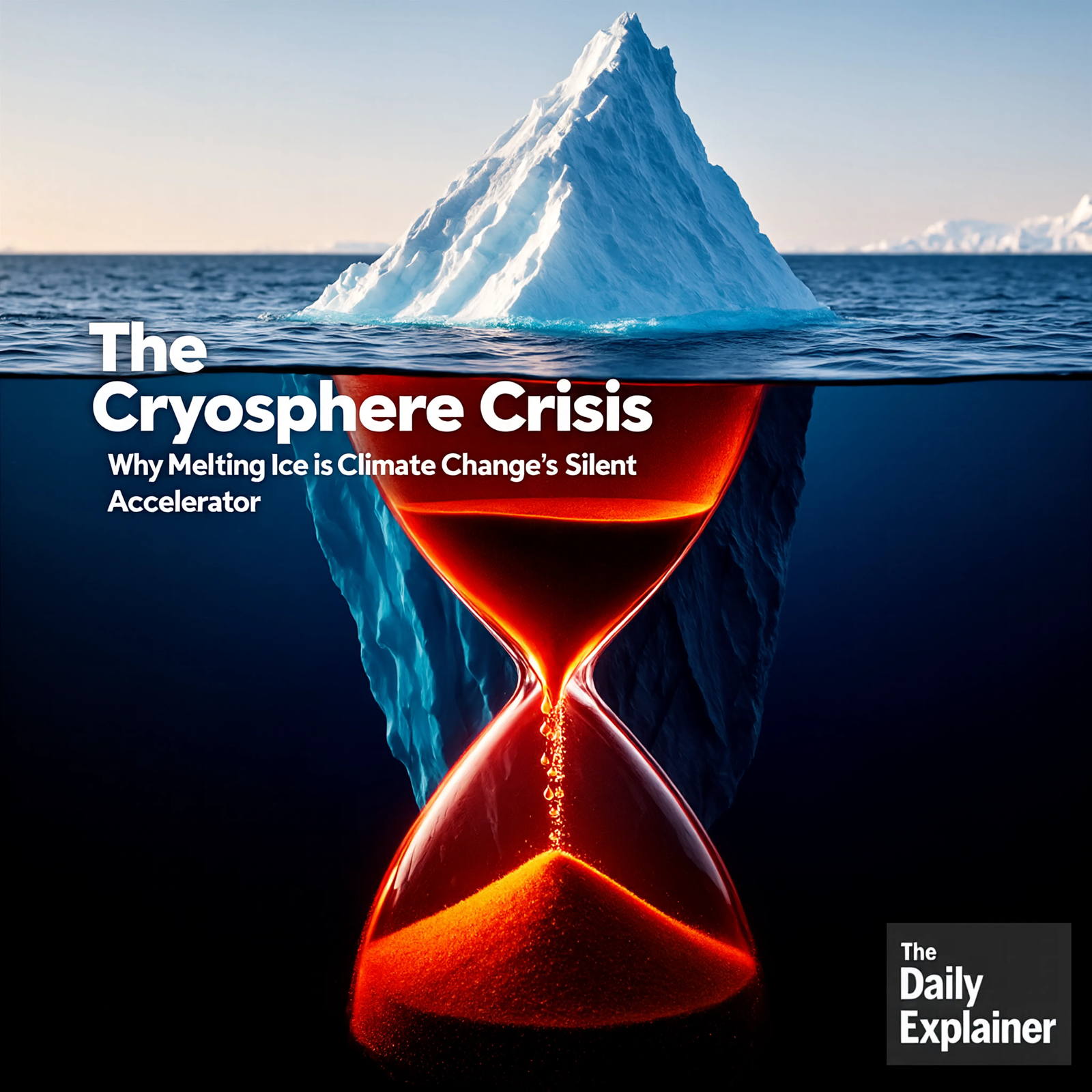
The state of the cryosphere in 2026: Polar and glacial ice continues to melt at an accelerated rate, driving sea-level rise and disrupting global weather patterns.
Table of Contents
Introduction – Why This Matters
In my experience traveling across the Alps and speaking with local community leaders in mountain towns, there is a palpable sense of grief that is hard to describe. They point to glaciers that have retreated thousands of feet up valleys, exposing bare rock where, just a generation ago, there was ancient ice. What I’ve found is that most people living in temperate climates view ice loss as a distant problem—a tragedy for polar bears, but not something that affects their daily lives. That is the most dangerous misconception of all.
The cryosphere—Earth’s frozen realms of ice sheets, glaciers, sea ice, and permafrost—is not a remote, inert sculpture on the wall of our planetary home. It is an active, global thermostat and a massive reservoir of fresh water. When it breaks, the entire climate system breaks with it. As of early 2026, the warnings from scientists at the British Antarctic Survey are the loudest they have ever been: “We cannot negotiate with the melting point of ice” . The Earth’s frozen regions are sending a clear warning, and in this article, we will decode exactly what that warning means for you, your city, and your future.
Background / Context
To understand the crisis, we must first understand the patient. The cryosphere includes all the places on Earth where water is frozen: the massive Greenland and Antarctic ice sheets, sea ice in the Arctic and Southern Oceans, mountain glaciers on every continent, and permafrost—the permanently frozen ground that underlies nearly a quarter of the Northern Hemisphere’s landmass.
For millions of years, these frozen regions have existed in a relatively stable state, going through natural warming and cooling cycles . They act as Earth’s cooling system. Their bright white surfaces reflect solar radiation back into space—a phenomenon known as the albedo effect. Think of it as the planet wearing a giant, reflective white hat. The more ice there is, the more sunlight is bounced away, keeping the planet cool.
However, the rapid warming caused by human activity—specifically the burning of fossil fuels—has thrown this system into chaos. The Intergovernmental Panel on Climate Change (IPCC), the UN body responsible for assessing climate science, has been tracking these changes for decades. But the pace of change is now outstripping even their worst-case scenarios from just ten years ago.
In 2025, global sea ice extent reached a new all-time minimum in the 47-year satellite record. This wasn’t just a new record; it was a dramatic plunge, smashing previous lows. This is the context for our current moment: we are leaving the realm of gradual change and entering an era of rapid, visible transformation.
Key Concepts Defined
Before we dive into the mechanics, it’s essential to have a clear vocabulary. These aren’t just academic terms; they are the building blocks of the crisis.
- Cryosphere: Derived from the Greek word kryos, meaning cold, this is the collective term for all of Earth’s frozen water.
- Albedo Effect: The measure of how much light a surface reflects without absorbing it. Ice and snow have high albedo (reflective); dark ocean water has low albedo (absorptive).
- Feedback Loop: A process where the outcome of an action feeds back into the system to either amplify (positive feedback) or diminish (negative feedback) the initial action. In climate science, positive feedback loops are the “accelerators.”
- Permafrost: Ground that has been continuously frozen for at least two consecutive years. It contains vast amounts of frozen organic matter (dead plants and animals).
- Methane (CH₄): A potent greenhouse gas, roughly 80 times more effective at trapping heat than carbon dioxide over a 20-year period. It is released when permafrost thaws and organic matter decomposes.
- Ice Sheet: A mass of glacial land ice extending more than 50,000 square kilometers (20,000 square miles). Only two exist today: Greenland and Antarctica.
- Glacier: A persistent body of dense ice that is constantly moving under its own weight. Found in mountain ranges and polar regions.
- Sea-Level Rise Acceleration: The rate at which sea levels are rising is not constant; it is increasing. Currently, the rate is 4.5mm per year, but scientists project this could double or triple by 2100.
How It Works (Step-by-Step Breakdown)
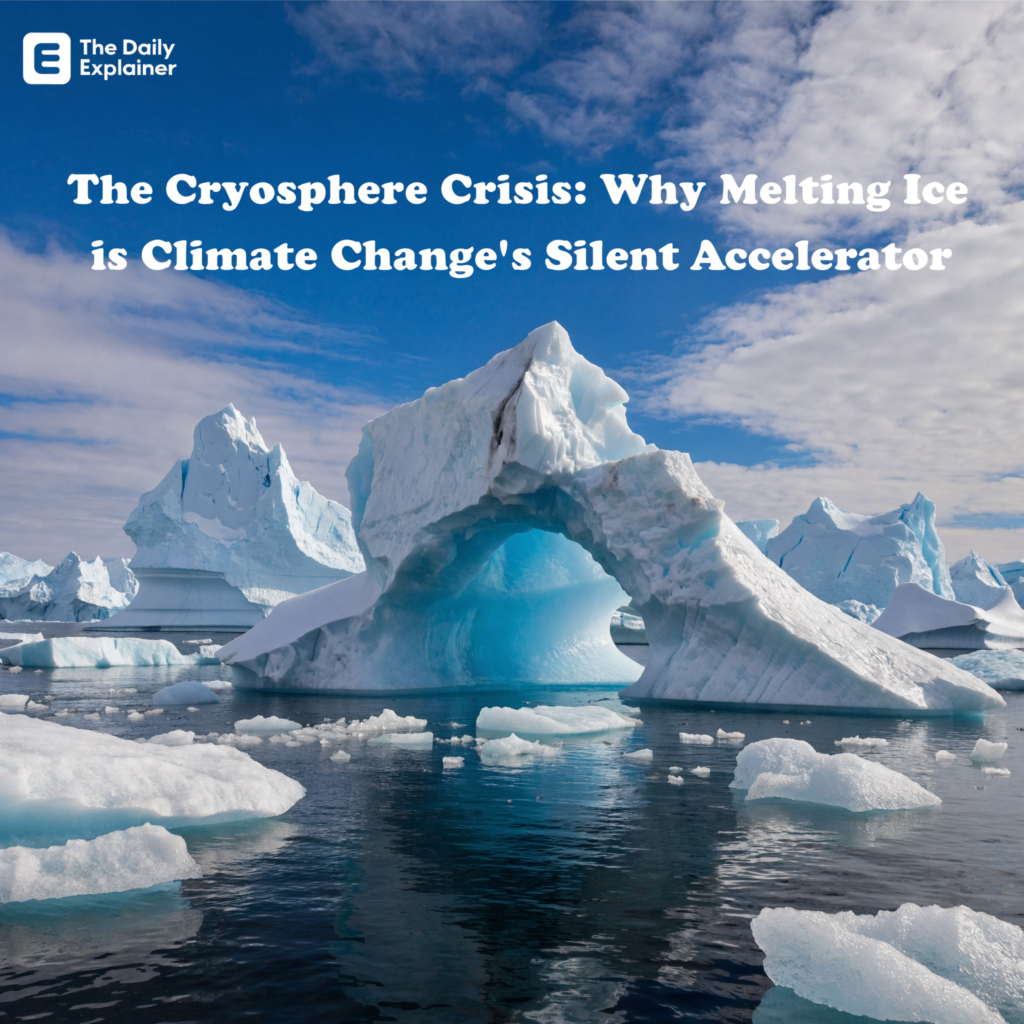
The cryosphere crisis is driven by a series of terrifying feedback loops. Here is a step-by-step breakdown of how melting ice doesn’t just reflect warming, but actively accelerates it.
Step 1: The Initial Warming Push
Human activities release greenhouse gases (CO2, methane) into the atmosphere. These gases trap heat, raising the planet’s average temperature. The Arctic, due to atmospheric and oceanic circulation patterns, is warming nearly four times faster than the global average. This is known as Arctic amplification.
Step 2: The Albedo Flip (The Amplifier)
As Arctic sea ice melts, it exposes the dark ocean surface beneath it. This dark water absorbs about 90% of the incoming solar energy, whereas the ice reflected most of it. The ocean warms, which in turn melts more ice. This is a classic positive feedback loop: less ice -> more absorption -> more warming -> even less ice.
Step 3: The Land Ice Destabilization
On land, the Greenland and Antarctic ice sheets are massive— miles thick in some places. Warming air and warming ocean waters (which melt the ice from below, at the “grounding line” where the ice meets the sea) cause these ice sheets to become unstable.
- Marine Ice Sheet Instability: In Antarctica, much of the ice sheet sits on bedrock that is below sea level. As warm water melts the ice from the front, the ice retreats inland and downhill. The more it retreats, the thicker the ice front becomes, leading to even faster flow and discharge into the ocean.
Step 4: The Permafrost Thaw (The Methane Bomb)
Step back on land to the permafrost regions of Siberia, Alaska, and Canada. As the Arctic air warms, this frozen ground thaws for the first time in hundreds of thousands of years. When it thaws, microbes begin to decompose the organic material (ancient plants and animals) that have been preserved in a freezer-like state.
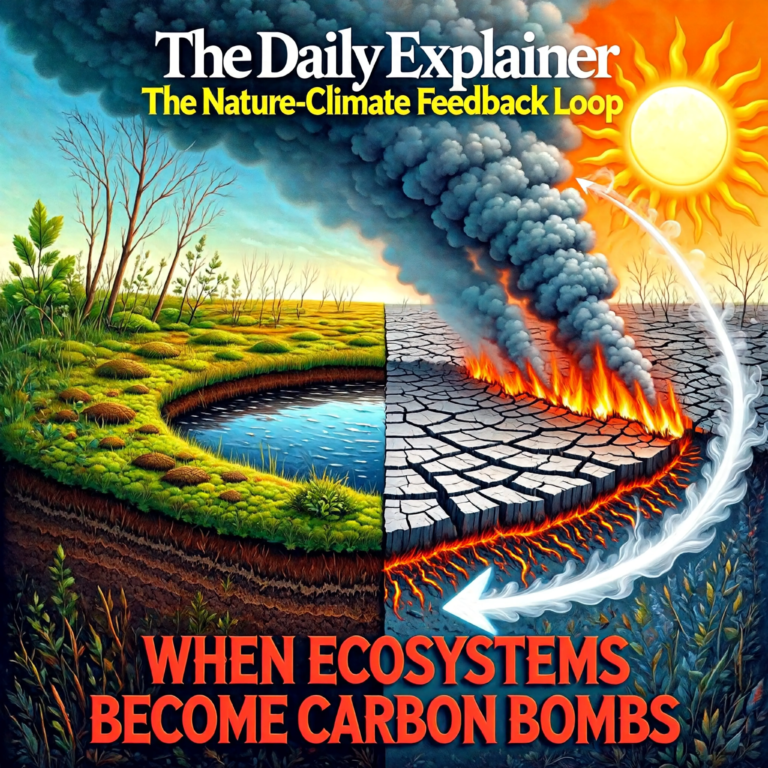
This decomposition releases carbon dioxide and methane. This is another massive feedback loop: warming thaws permafrost -> thaw releases greenhouse gases -> more warming -> more permafrost thaw .
Step 5: The Glacial Water Towers Drain
In high mountain ranges like the Himalayas, the Andes, and the Alps, glaciers act as “water towers.” They store winter snow and ice and release meltwater slowly throughout the summer, providing a consistent water supply to billions of people. As these glaciers shrink rapidly, they initially release more water (increasing flood risk), but eventually, they cross a tipping point where they can no longer sustain the flow, leading to long-term drought for the rivers they feed .
Key Takeaways Box:
- Ice is an active climate regulator, not a passive victim.
- Feedback loops are the accelerators—they turn gradual warming into runaway change.
- The Arctic is warming 4x faster than the rest of the planet.
- Thawing permafrost threatens to release potent greenhouse gases, creating a self-perpetuating cycle.
Why It’s Important
The importance of the cryosphere crisis extends far beyond the polar bears and penguins. The World Economic Forum’s Global Risks Report 2026 lists “Extreme weather events” as the number one long-term risk, directly linked to the state of the cryosphere, and highlights that infrastructure built decades ago is now failing because it cannot cope with the new climate reality .
- Sea-Level Rise and Coastal Infrastructure: The melting of the Greenland and Antarctic ice sheets is the single largest contributor to sea-level rise. The rate of rise has doubled to 4.5mm per year over the last three decades . This isn’t just about beach erosion. It’s about “sunny day flooding” in Miami and Jakarta. It’s about the $182 billion (USD) in damage to Arctic infrastructure from permafrost thaw expected by 2050 . It’s about saltwater intruding into freshwater aquifers that supply drinking water to coastal cities. “Infrastructure Endangered” is a key finding of the 2026 report, noting that our ports, railways, and power grids were built for a climate that no longer exists .
- Water Security for Billions: Nearly 2 billion people depend on meltwater from mountain glaciers for drinking water, agriculture, and hydropower. The loss of these “water towers” threatens political stability and food security across entire continents, from South Asia to South America.
- Disruption of Global Supply Chains: When the Greenland ice sheet melts, it dumps cold, fresh water into the North Atlantic. This can destabilize major ocean currents like the Atlantic Meridional Overturning Circulation (AMOC). While a total collapse is unlikely in the immediate term, any slowdown has profound effects on weather patterns in Europe and North America. Furthermore, as the 2026 report notes, droughts and heatwaves—made worse by a destabilized climate system—are causing key waterways like the Panama Canal to run dry, directly impacting global shipping and supply chains .
- Accelerating Global Warming: The feedback loops described above mean that the melting cryosphere is actively making the entire job of climate mitigation harder. The permafrost is releasing carbon that we didn’t directly emit. It’s like we are trying to fill a bathtub (the atmosphere) with a plug that is actively leaking more water in.
Sustainability in the Future
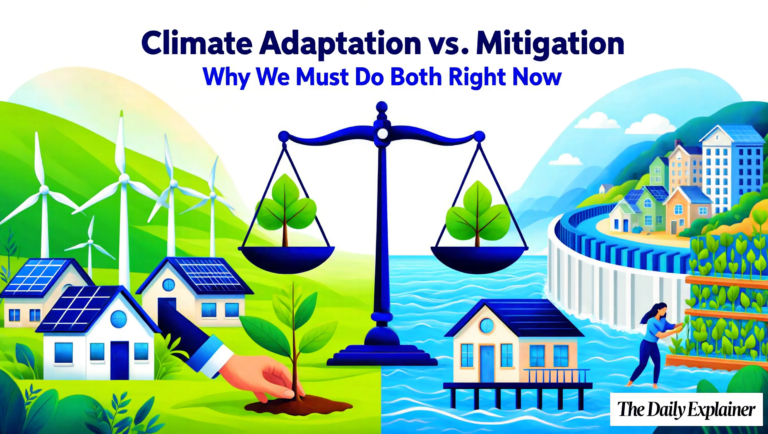
Looking ahead, our relationship with the cryosphere must fundamentally change. We cannot “save” all the ice; some changes are now locked in. Sustainability in this context means two things: mitigation and adaptation.
Mitigation: This is the only way to save the remaining ice. We must aggressively cut greenhouse gas emissions. The 2026 Global Risks Report urges that future construction must prioritize “Climate-adaptive Design” . While this refers to building resilience, the most adaptive design for the cryosphere is a rapid transition away from fossil fuels. The goal is to limit the temperature overshoot as much as possible. If we can peak warming at 1.7°C and bring it back down, we might save a significant portion of the Greenland ice sheet and some mountain glaciers.
Adaptation: For the changes we can no longer avoid, we must adapt.
- Relocation: Some coastal communities cannot be protected by sea walls. Managed retreat—moving people and infrastructure inland—will become a necessary, if painful, strategy.
- Infrastructure Overhaul: Buildings, roads, and pipelines in the Arctic must be redesigned for “thawing ground,” not permanently frozen ground. This includes using thermosyphons to keep the ground cool or building on piles rather than directly on the soil.
- New Water Management: Regions dependent on glacial meltwater must invest in new reservoirs, water-efficient agriculture, and desalination plants to prepare for the “peak water” tipping point when glacier runoff begins its permanent decline.
Common Misconceptions
There is a lot of confusion about ice and climate. Here are the biggest myths debunked.
Misconception 1: “Cold weather outside disproves global warming.”
This is one of the most persistent and politically charged myths. In January 2026, as a massive winter storm hit the US, President Trump used the cold temperatures to mock the idea of global warming. Climate scientist Robert Kopp was invited on CNN to explain why this is wrong. He stated simply: “The United States is not, in fact, the world, and global warming is a global phenomenon. Just because it’s cold where I am … doesn’t mean it’s cold everywhere” . While parts of the US were freezing, Greenland and southern Australia were experiencing unusually warm conditions. Weather is short-term and local; climate is long-term and global.
Misconception 2: “Melting sea ice raises sea levels, like an ice cube melting in a glass.”
This is a classic physics misunderstanding. An ice cube floating in a glass displaces its weight in water. When it melts, the water level stays exactly the same. Sea ice is floating, so its melting does not directly contribute to sea-level rise. The danger of melting sea ice is the albedo loss, not the direct volume contribution. The real threat to sea levels comes from the ice sheets on land (Greenland and Antarctica) and mountain glaciers, which add new water to the ocean, just like adding more ice cubes to an already full glass.
Misconception 3: “It’s just a natural cycle.”
While the Earth has had natural warming and cooling cycles over millions of years (driven by changes in Earth’s orbit, or Milankovitch cycles), the current warming phase is happening at a rate that is hundreds of times faster than those natural shifts. Scientists can use isotopic analysis to determine the source of carbon in the atmosphere. The “fingerprint” of the current CO2 matches that of fossil fuels—not volcanic activity or natural outgassing.
Recent Developments (2025-2026)
The past 12 months have been a watershed moment for cryosphere science, policy, and public awareness.
- COP30 and the “Cryosphere Obfuscation”: At the UN climate summit in Brazil in November 2025 (COP30), scientists observed a disturbing trend. While the final “Mutirão decision” referenced the IPCC, some countries pushed back on language endorsing the “best available science.” Alarmingly, specific observations about the complete loss of glaciers in Slovenia and Venezuela were removed from the final draft text. Wording about “irreversible changes to the cryosphere” was diluted. This shows that the science is not just being ignored; it is being actively suppressed in international negotiations.
- Record Ice Loss: In the past year, the polar ice sheets in Greenland and Antarctica likely shed around 370 billion tonnes of ice, with another 270 billion tonnes lost from mountain glaciers. To put that in perspective, one billion tonnes of ice is a cube of ice measuring one kilometer on each side.
- Permafrost as a Major Emitter: New analysis confirms that the thawing permafrost is now releasing greenhouse gases roughly equivalent to the world’s eighth-highest-emitting country. This is a significant and growing source that was not fully accounted for in earlier climate models.
Real-Life Examples
The science is abstract without faces and places. Here are three real-life examples of the cryosphere crisis in action.
1. The Vanishing Glaciers of Slovenia and Venezuela
As noted at COP30, two countries—Slovenia and Venezuela—have effectively lost their glaciers. The last glacier in Venezuela, the Humboldt Glacier in the Sierra Nevada de Mérida, was declared gone. This makes Venezuela the first nation in the Andes and only the second in the Americas (after Mexico) to lose all its glaciers. These aren’t just scientific data points; they represent a loss of culture, tourism, and water security for local communities.
2. The $182 Billion Thaw: Infrastructure in the Arctic
In Norilsk, Russia, one of the world’s most northerly cities, buildings built on permafrost are collapsing. Walls are cracking, foundations are buckling, and entire apartment blocks are being condemned. This is happening across Alaska, Canada, and Siberia. The $182 billion estimated cost by 2050 covers repairing roads, railways, airports, and pipelines, as well as dealing with environmental disasters like oil spills from ruptured storage tanks whose foundations have given way .
3. Greenland’s “Zombie Ice”
Scientists are increasingly focusing on “zombie ice”—ice that is still attached to the ice sheet but is no longer being replenished by snow. It is committed to melting, regardless of future emissions cuts. A recent study highlighted that the Greenland ice sheet has enough of this zombie ice to raise sea levels by at least 10 inches (27 cm) on its own, separate from any further melting .
Success Stories
While the news is dire, there are victories in the fight to protect the cryosphere, proving that action is not futile.
- The Montreal Protocol’s Unexpected Gift: The Montreal Protocol, signed in 1987 to phase out ozone-depleting substances (CFCs), is a massive success story. Not only is the ozone layer healing, but it has also had a profoundly positive effect on the climate. Many CFCs are also potent greenhouse gases. The Paris Climate Agreement built on this momentum, and while we are off track for 1.5°C, the Montreal Protocol shows that global, unified action on a scientific threat is possible and effective.
- Mountain Protection in the Alps: Local initiatives are making a difference. In the Alps, ski resorts and municipalities are investing in “glacier protection schemes.” While they cannot reverse the warming, they are using giant white fleece blankets to cover small sections of glaciers to reduce summer melting. More importantly, there is a growing movement to protect glacier-fed rivers through the EU’s Water Framework Directive, limiting pollution and water extraction to help ecosystems survive the changing conditions.
- Indigenous-Led Stewardship: In the Arctic, Indigenous communities are leading the way in combining traditional knowledge with modern science to monitor permafrost thaw and adapt their hunting and building practices. Organizations like the Inuit Circumpolar Council are powerful voices at international climate negotiations, demanding that the rights and knowledge of people who live on the front lines of the crisis be respected.
Conclusion and Key Takeaways
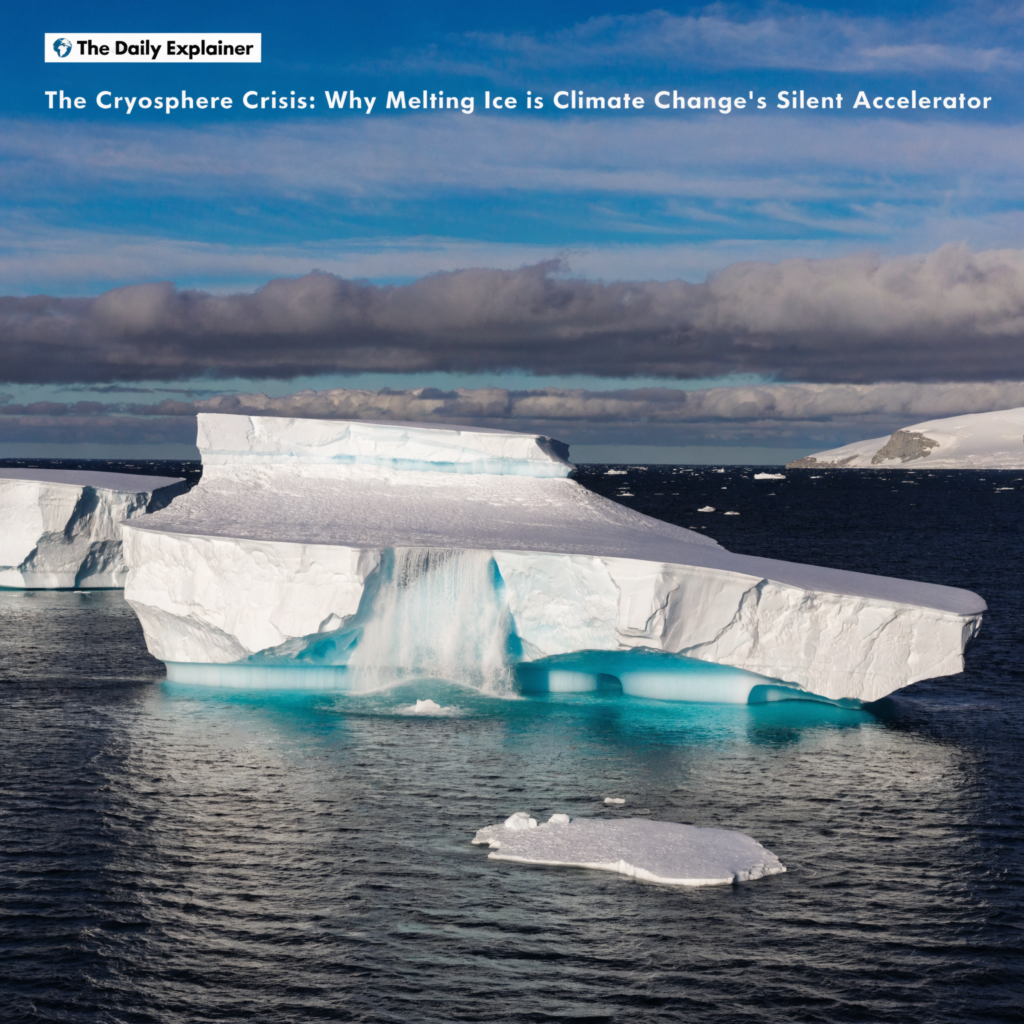
The cryosphere crisis is the clearest signal we have that climate change is not a distant, future problem. It is here, and it is accelerating. The ice that humans have taken for granted for millennia is disappearing before our eyes, and its disappearance is actively speeding up the very process that is killing it.
The story of the cryosphere is a story of feedback loops, tipping points, and interconnectivity. It shows us that in nature, everything is connected. A rise in temperature in a Chinese coal plant eventually contributes to the thaw of permafrost in Siberia, which releases methane, which warms the planet further, which melts more ice in Greenland, which raises sea levels in Miami.
Key Takeaways:
- The Cryosphere is Our Shield: It keeps the planet cool by reflecting sunlight and stores vast amounts of water. Its degradation leaves us exposed.
- We’ve Passed Some Tipping Points: Zombie ice in Greenland and the loss of glaciers in Venezuela are irreversible on human timescales.
- Feedback Loops are the New Normal: The melting ice itself is now a major driver of climate change, not just a symptom.
- Politics is Failing the Science: The removal of cryosphere data from COP30 texts is a dangerous sign of “science obfuscation” .
- Action is Still Possible: Every fraction of a degree of warming we prevent saves more ice, protects more communities, and reduces the risk of total system collapse.
FAQs (Frequently Asked Questions)
- What exactly is the cryosphere?
The cryosphere encompasses all of Earth’s frozen water, including sea ice, ice sheets, glaciers, snow cover, and permafrost. It is a critical component of the global climate system. - Why is melting sea ice a problem if it doesn’t raise sea levels?
While melting sea ice doesn’t directly raise sea levels (like a melting ice cube in a glass), it removes a highly reflective white surface (high albedo) and exposes dark ocean water (low albedo) that absorbs solar heat, accelerating global warming. - How much ice are we losing annually?
According to the British Antarctic Survey, in the past year, the Greenland and Antarctic ice sheets likely lost around 370 billion tonnes of ice, with mountain glaciers losing another 270 billion tonnes. - What is permafrost, and why should we care about it thawing?
Permafrost is ground that has been frozen for at least two years. It contains vast stores of organic carbon. When it thaws, microbes decompose this material, releasing carbon dioxide and methane—potent greenhouse gases—into the atmosphere, creating a dangerous feedback loop. - Is it too late to save the glaciers?
For many smaller mountain glaciers, yes, it is too late. They are committed to melting. For the large ice sheets in Greenland and Antarctica, it is not too late to prevent total collapse. Every fraction of a degree of warming we prevent will save a significant portion of the ice. - Does cold weather in my hometown disprove global warming?
No. Weather is local and short-term; climate is global and long-term. As Dr. Robert Kopp explained, a cold snap in one region often coincides with record heat elsewhere . Global warming refers to the average temperature of the entire planet rising. - What is the albedo effect?
It is the measure of a surface’s reflectivity. Ice and snow are very reflective (high albedo), sending solar energy back to space. Dark surfaces like ocean water or bare ground absorb that energy as heat (low albedo). - How does melting ice in Greenland affect the weather in Europe?
The massive influx of cold, fresh meltwater from Greenland into the North Atlantic can disrupt the Atlantic Meridional Overturning Circulation (AMOC), a major ocean current that brings warm water to Europe. A slowdown could lead to cooler, stormier weather in Europe and sea-level rise on the US East Coast. - What happened at COP30 regarding the cryosphere?
Scientists reported that specific language about the complete loss of glaciers in Slovenia and Venezuela was removed from the final draft text, and warnings about irreversible changes were diluted—a tactic they called “science obfuscation” . - What are “zombie ice” or “committed ice”?
This is ice that is still attached to a glacier or ice sheet but is no longer being fed by new snow. It is essentially dead and will melt away regardless of future emissions, contributing a fixed amount to sea-level rise. - How will melting glaciers affect my water supply?
If you live in a region fed by snowmelt (like much of the western US, South America, or South Asia), you initially get more water (increased flood risk), followed by a long-term decline in river flow as the glaciers disappear, leading to potential water scarcity. - What is marine ice sheet instability?
This occurs in Antarctica, where the ice sheet sits on bedrock below sea level. As warm ocean water melts the ice front, the ice retreats inland and downhill, exposing thicker ice which flows even faster into the sea, accelerating ice loss. - What is the “Global Risks Report 2026” saying about the environment?
The WEF report states that environmental risks dominate the long-term outlook, with extreme weather as the top risk. It specifically highlights that our infrastructure is “endangered” and not built for the current climate reality. - Are there any international laws protecting the cryosphere?
There is no single treaty for the cryosphere, but it is covered under the UNFCCC and the Paris Agreement. The International Court of Justice reaffirmed in July 2025 that the 1.5°C target is a legally binding guide for climate policies under the Paris Agreement. - Can technology save the ice (e.g., geoengineering)?
Ideas like reflecting sunlight (solar radiation management) or building underwater walls to protect glaciers are being explored, but they are highly controversial, unproven at scale, and do not address the root cause (ocean acidification, for example). The safest solution is emissions reduction. - How does the melting cryosphere contribute to supply chain issues?
A destabilized climate leads to extreme events. For example, droughts made worse by warming cause major shipping canals (like the Panama Canal) to run out of water, disrupting global trade . - What is the difference between an ice sheet and a glacier?
An ice sheet is a massive (over 50,000 sq km) continental glacier, like those covering Greenland and Antarctica. A glacier is generally smaller and found in mountains, though both are rivers of ice flowing downhill. - How do scientists know ancient CO2 levels from ice cores?
Scientists drill deep into ice sheets and glaciers to extract ice cores. Trapped within the ice are tiny bubbles of ancient atmosphere. By analyzing the chemical composition of these bubbles, they can measure CO2 and methane levels from hundreds of thousands of years ago. - What is the “methane bomb”?
This term refers to the fear of a sudden and massive release of methane from thawing permafrost and underwater methane hydrates. While a single “bomb” is unlikely, the gradual but significant increase in emissions is a serious concern. - What can I do to help the cryosphere?
The most important actions are to reduce your carbon footprint (use less energy, choose renewable energy, eat a lower-impact diet, use public transport) and, crucially, to vote and advocate for policies that put a price on carbon and accelerate the energy transition. Individual action is necessary, but systemic political change is essential. - What does “climate-adaptive design” mean for cities?
As highlighted in the 2026 Global Risks Report, it means building infrastructure that can withstand the new climate—such as flood-resistant buildings, fire-resistant materials, and cooling centers—rather than relying on historical climate data . - Will the Gulf Stream really stop?
A total shutdown of the AMOC (often called the Gulf Stream system) this century is considered low probability but high impact. However, a significant slowdown is more likely and would still have drastic consequences. Scientists are monitoring it very closely. - Is there any good news about the cryosphere?
Yes. The success of the Montreal Protocol shows we can solve global environmental problems. Furthermore, the rapid drop in the cost of renewables gives us the tools to decarbonize faster than ever before. The more we cut emissions now, the more ice we save.
About Author
This article was written by the editorial team at The Daily Explainer, in consultation with climate science communicators and data sourced from the British Antarctic Survey, the World Economic Forum Global Risks Report 2026, and the World Resources Institute. The content is designed to translate complex scientific findings into actionable, understandable insights for a global audience.
Free Resources
- UN CC:Learn: Offers free courses like “Climate Change: From Learning to Action” and “Climate 101: An Interactive Dictionary” to build foundational knowledge.
- Global Forest Watch: An online platform providing data and tools for monitoring forests, managed by the World Resources Institute.
- The Initiative for Climate Action Transparency (ICAT): Provides tools and methodologies for understanding GHG projections and climate policies.
Discussion
What questions do you still have about the melting ice and its impact on your life? Are you seeing changes in your local environment that you suspect are linked to the cryosphere? Join the discussion in the comments below or reach out to us via our contact page.
About The Author

4 thoughts on “The Cryosphere Crisis: Why Melting Ice is Climate Change’s Silent Accelerator”