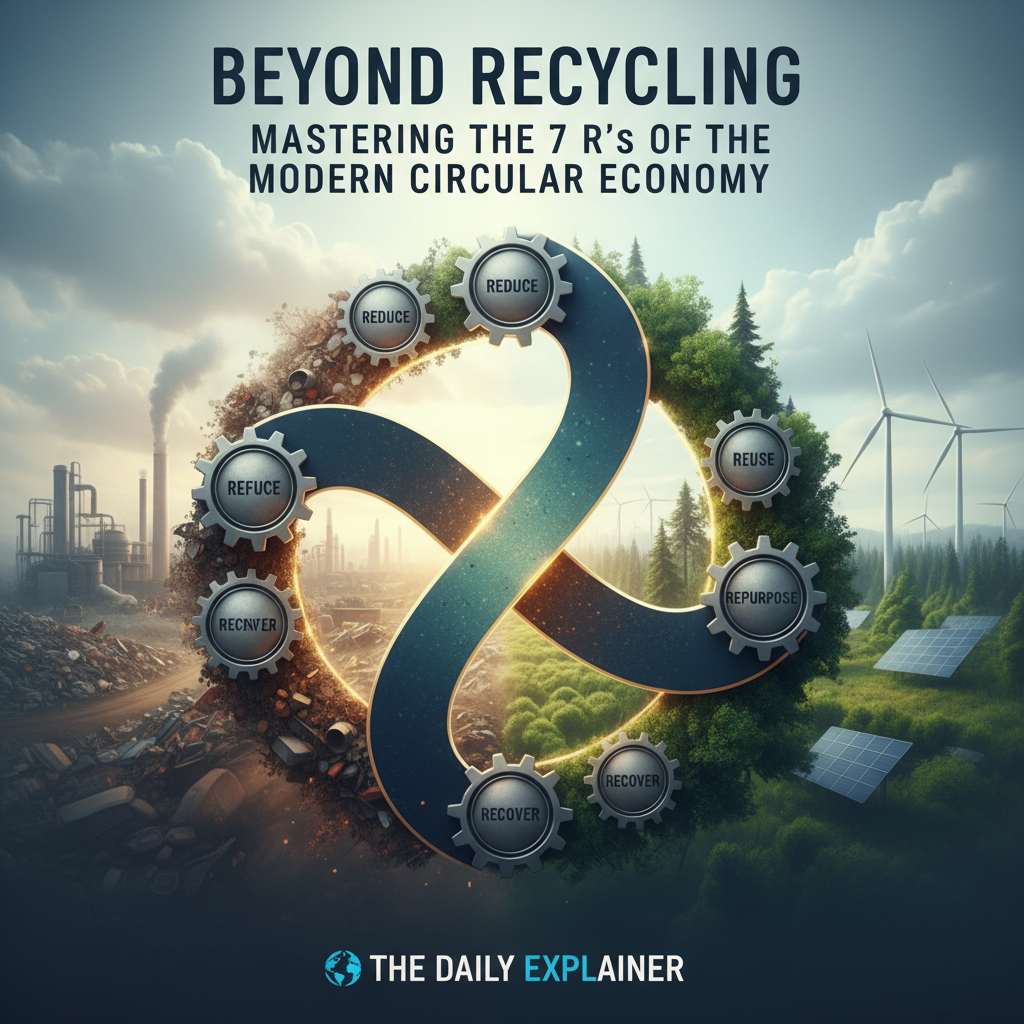
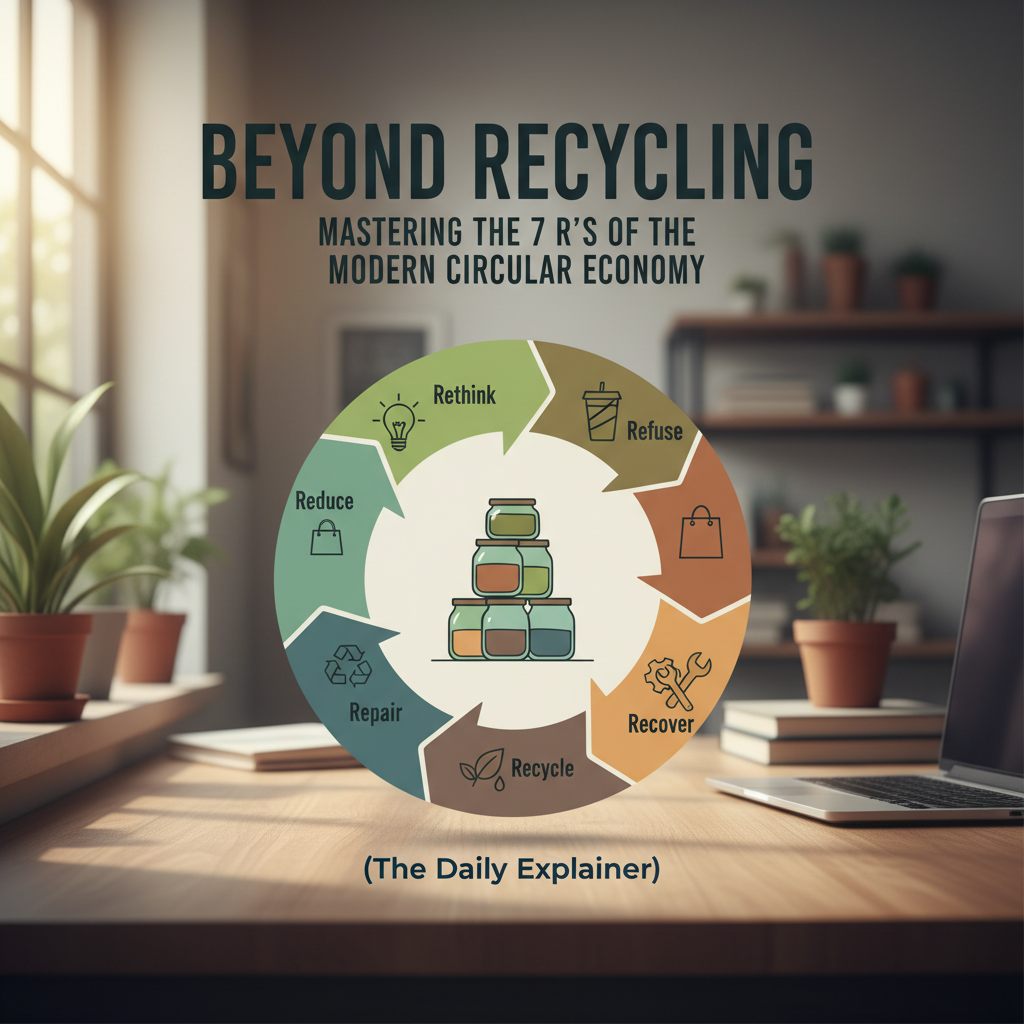
The 7 R's Hierarchy. This pyramid visualizes the order of impact. Your most powerful actions start at the top by rethinking needs and refusing waste before it enters your home.
Why This Journey Matters More Than Ever
In my experience, the moment you truly understand the difference between recycling and the other R’s is the moment you stop feeling guilty about waste and start feeling empowered by systems. I used to be a proud, meticulous recycler, feeling a small jolt of virtue every time I rinsed a tin can. But during a local creek cleanup, I pulled a perfectly intact “recyclable” plastic bottle from the mud, its familiar chasing arrows symbol looking like a sad joke. That bottle, even if it made it to a bin, had a slim chance of actually becoming a new bottle. It was then I realized I was treating a last resort—recycling—as my primary environmental action. I was focused on managing my waste rather than preventing its creation.
This matters because, as 2025 reports from bodies like the Ellen MacArthur Foundation starkly illustrate, the global recycling system is overwhelmed and insufficient. Only about 9% of all plastic ever produced has been recycled. We are drowning in single-use items, and recycling alone cannot save us. For the curious beginner, this is not a cause for despair, but for a shift in perspective. For the professional needing a refresh, the framework has evolved from the simple “Reduce, Reuse, Recycle” mantra you learned as a child into a more nuanced, powerful hierarchy: The 7 R’s of the modern circular economy. This isn’t just about waste management; it’s a philosophy for designing waste out of our lives, conserving precious resources, and building resilience. It’s about moving from a linear “take-make-dispose” mindset to a circular one where everything has continuous value.
The Context: From a Linear World to a Circular Mindset
Our industrial system was built on a linear model: extract raw materials, manufacture a product, sell it, and then have the consumer throw it “away”—a magical place that doesn’t exist. This model relies on infinite resources on a finite planet. The “away” is a landfill, an incinerator, or our oceans. The environmental cost is catastrophic, but there’s a personal cost, too: it makes us perpetual consumers, constantly buying new things to replace the ones we thoughtlessly discard, draining our wallets and cluttering our homes.
The circular economy is the antidote. It’s an economic system aimed at eliminating waste and the continual use of resources. Imagine if, at the end of its life, a product’s components were designed to be effortlessly disassembled and reborn as something new of equal value. The 7 R’s are your personal, everyday entry point into this systemic shift. They are a practical ladder, guiding you from the most impactful actions (Rethink, Refuse) to the least impactful (Rot, Recycle). By mastering each step, you become an active participant in this new economy, creating demand for better products and taking control of the resources that flow through your life. To stay updated on the broader systemic shifts, including policy changes, a visit to the global affairs and politics section at The Daily Explainer can provide valuable context.
Unpacking the 7 R’s: A New Vocabulary for Conscious Living
Let’s move beyond vague terms and define what each “R” truly means in a practical, modern context.
- Rethink (The Most Powerful): This is the foundational mindset shift. Before any purchase or action, you pause and question the underlying need. Do I need this, or just want it? Could I borrow, rent, or find it secondhand? Is there a durable, repairable version? In my own life, rethinking meant canceling a subscription for monthly snack boxes (packaging waste!) and instead learning to make two simple, healthier snacks in bulk.
- Refuse (The Proactive Barrier): This is saying “no” to the unnecessary waste that is pushed onto you. It’s refusing the plastic straw, the single-use cutlery with delivery, the free promotional trinket, the junk mail (you can opt-out via services like DMAchoice), and the fast-fashion impulse buy. It’s the most direct way to stop waste before it enters your home.
- Reduce (Doing More With Less): This is about streamlining and minimizing your overall consumption of stuff and resources. It’s not about deprivation, but about optimization. Reducing means buying higher-quality items less often, choosing concentrated products to cut packaging, shrinking your wardrobe to a versatile capsule, and cutting energy and water use in your home. A practical step I took was to audit my cleaning supplies and reduce them to three multi-purpose ingredients (vinegar, baking soda, castile soap), which I purchase in large, recyclable containers.
- Reuse (Extending the Lifespan): This is the act of keeping items in circulation for their original purpose. It’s choosing a reusable water bottle, coffee cup, grocery bags, and food containers. It’s mending a torn shirt, resoling shoes, or using glass jars for storage. It’s shopping secondhand at thrift stores or using platforms like Facebook Marketplace. The key is seeing items as durable assets, not disposable conveniences.
- Repair (The Art of Restoration): When reuse reaches its limit because something breaks, repair is the next heroic act. It’s fixing the toaster, replacing the smartphone battery, or darning a sock. It challenges the planned obsolescence built into so many products. I’ve saved hundreds by learning basic sewing and following iFixit repair guides for electronics, turning a frustrating breakdown into a satisfying project.
- Repurpose (Creative Rebirth): Also called Upcycling. This is giving an item a new life when its original function is over. That worn-out t-shirt becomes cleaning rags. A cracked mug becomes a pen holder. An old ladder becomes a bookshelf. It requires creativity and seeing objects not for what they were, but for what they could be. My favorite repurpose was turning a discarded wooden pallet from a local business (always ask first!) into a vertical herb garden for my balcony.
- Rot (Returning to the Earth): This is composting your organic waste—food scraps, yard trimmings, paper towels. By composting, you transform “waste” into nutrient-rich soil, closing the loop for organic materials. It reduces landfill methane (a potent greenhouse gas) and completes the natural cycle. Even in an apartment, worm bins (vermicomposting) or small electric composters are fantastic options.
- Recycle (The Final, Flawed Resort): This is the industrial process of converting waste materials into new materials. It’s important, but it’s last on the list because it’s energy-intensive, plagued by contamination issues, and markets for recyclables are volatile. Think of it as the safety net, not the goal. The goal is to ensure very little ever needs to be caught by that net.
Your Action Plan: How to Live the 7 R’s, Step-by-Step
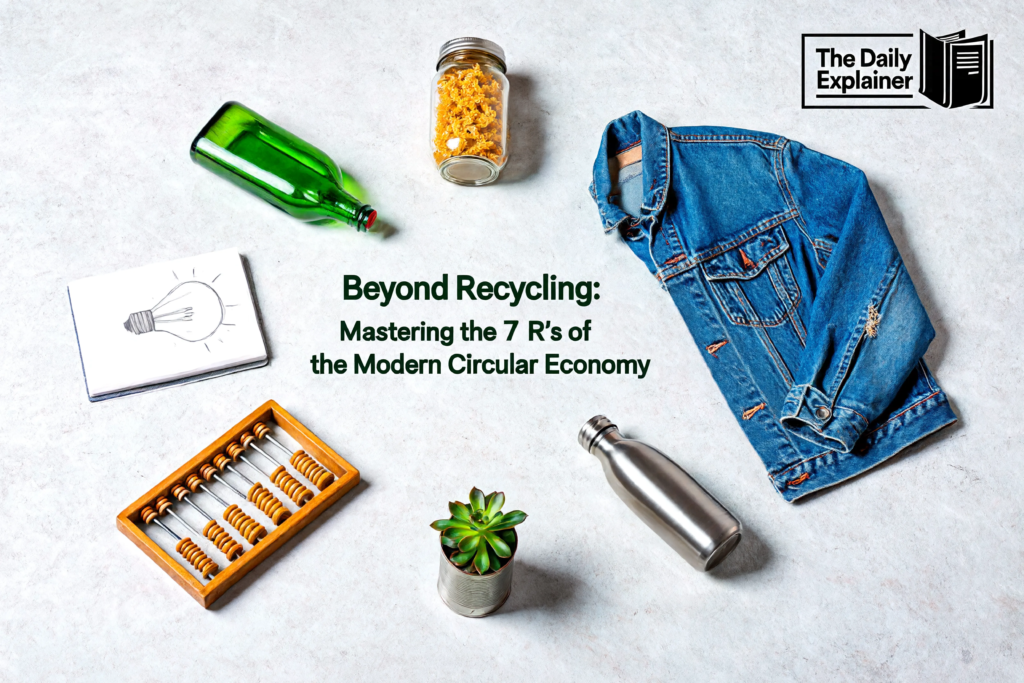
Adopting this framework is a journey, not an overnight transformation. Here’s how to integrate it into your life without overwhelm.
Phase 1: The Mindset Audit (Weeks 1-2)
Carry a small notepad or use your phone. For one week, write down every single item you throw away or recycle. At week’s end, categorize it. How much is the packaging? How much is food waste? How many items broke prematurely? This list is your personal waste map, revealing your biggest “leaks.” Don’t judge, just observe. This data is gold.
Phase 2: Mastering Refuse & Rethink (Weeks 3-4)
With your waste map in hand, tackle the easiest “Refusals.” Get a “No Junk Mail” sticker. Tell the cashier “I don’t need a bag.” Choose “no cutlery” on delivery apps. Simultaneously, implement a 24-hour “Rethink” rule for any non-essential purchase. This cooling-off period breaks impulse cycles. I found that 80% of my “wants” faded after a day.
Phase 3: Building Systems for Reuse & Reduce (Months 2-3)
Create your “Zero-Waste Kit”: a reusable bag, bottle, cup, container, and cutlery set. Keep it by the door or in your car. For reducing, pick one area: your wardrobe, your pantry, or your digital subscriptions. A fantastic resource for building systematic habits, especially for entrepreneurs, can be found in the detailed guides over at the SheraKat Network’s blog section. For example, apply the same lean principles to your home as you would to a start-up.
Phase 4: Embracing Repair & Repurpose (Ongoing)
Identify your local resources. Find the cobbler, the tailor, the repair cafe, or the tool library. Start with one simple repair project. For repurposing, dedicate a “creative reuse” box in your home for interesting containers or items. When you need something, check that box first.
Phase 5: Closing the Loop with Rot & Recycle (The Final Layer)
Research composting options for your living situation. Start small—a countertop bin for scraps you can later take to a community garden. For recycling, know your local rules. Contamination (like greasy pizza boxes or plastic bags in the bin) can doom entire batches of recyclables. Visit your municipality’s waste department website and print their guidelines.
Why This Hierarchy is Non-Negotiable
The order of the R’s is a deliberate hierarchy of impact. Let’s be clear: Refusing one plastic bag is infinitely better than recycling 100 plastic bags. Recycling is a downstream solution for a problem that needs upstream fixes. By focusing on the higher R’s, you:
- Conserve Virgin Resources: You directly reduce the demand for new logging, mining, drilling, and water extraction.
- Save Massive Amounts of Energy: Manufacturing a new aluminum can from recycled content saves 95% of the energy compared to making it from raw bauxite. But refusing a single-use beverage altogether saves 100%.
- Build Community Resilience: Repair cafes, tool libraries, and buy-nothing groups foster local connections and skills-sharing, making neighborhoods more self-sufficient.
- Save Significant Money: Buying less, buying secondhand, and repairing what you own is the ultimate personal finance hack. I tracked my spending and found that after the initial investment in reusables, my household “consumables” budget dropped by nearly 30% in a year.
- Drive Market Change: Every time you choose a package-free product, a durable good, or a repair service, you cast a vote for the kind of economy you want. Businesses follow demand.
The Future is Circular: Beyond the Kitchen Jar
The future of the 7 R’s is integrated into the very fabric of product design and business models. We’re moving towards a world where:
- Products-as-a-Service: You’ll lease your phone, your washing machine, even your jeans. The company maintains, repairs, and ultimately takes them back to harvest parts for the next generation. Performance, not ownership, is the goal.
- Digital Product Passports: A scannable QR code on a product will tell you its entire life story—materials, repair instructions, and where to return it for disassembly. This transparency is key.
- Advanced Material Recovery: Chemical recycling and advanced sorting AI aim to make the final “Recycle” step more efficient, but this is a complement to, not a replacement for, the higher R’s.
- Regenerative Design: Products will be designed from the start to either safely biodegrade (“Rot”) or be technically disassembled for infinite recycling.
For insights into how innovative businesses are building these models from the ground up, exploring a platform focused on entrepreneurial excellence, such as WorldClassBlogs, can be incredibly illuminating. Their focus on scalable, impactful ventures often highlights these very principles.
Busting the Myths: Clearing the Confusion
- Myth: “Recycling is enough.” We’ve covered this: the numbers prove it isn’t. It’s a broken crutch we lean on too heavily.
- Myth: “Living the 7 R’s is expensive and time-consuming.” The initial setup (buying quality containers, tools) can have a cost, but it pays for itself quickly. As for time, it shifts time from frequent shopping trips to occasional repairs and planning. It’s a reallocation, not an increase.
- Myth: “My individual actions don’t matter.” This is the most pernicious myth. Individual actions create cultural norms, which drive political will and corporate strategy. The massive growth of the refillable grocery section didn’t happen in a vacuum; it happened because thousands of individuals brought their own jars.
- Myth: “It’s all or nothing.” This is a recipe for burnout. Embrace the concept of “progress, not perfection.” Mastering one “R” before moving to the next is a perfect strategy.
- Myth: “Composting is gross and complicated.” Modern systems are incredibly clean and simple. A sealed worm bin under my sink produces no odor and only requires minimal care. The resulting “black gold” for my plants is magical.
What’s New in 2025-2026: The Landscape Shifts
- Right-to-Repair Gains Global Momentum: The EU’s strong right-to-repair regulations are now in effect, and several U.S. states have passed their own laws, forcing manufacturers to make parts, tools, and manuals available. This is a huge win for the “Repair” R.
- Reuse Systems Scale Up: Large retailers like IKEA and Loop are piloting and expanding take-back and refill systems for everything from furniture to food and cleaning products. The infrastructure for “Reuse” is being built at corporate scale.
- Digital Platforms for Circularity Boom: Apps like OLIO (for sharing surplus food and goods) and Trove (for brands to resell their own returned items) are seeing user growth in the millions, making “Rethink” and “Reuse” easier than ever.
- Policy Pushes “Extended Producer Responsibility (EPR)”: Laws are holding packaging producers financially responsible for the end-of-life of their products, forcing them to Rethink design and invest in recycling systems.
A Personal Success Story: From Overflowing Bins to One Bag a Month
My journey wasn’t linear. Five years ago, my family of two filled a large wheelie bin with trash every week. The recycling bin was equally full. Overwhelmed, we started with Refuse. We got off mailing lists, bought silicone lids to replace plastic wrap, and started saying “no” to every freebie. The bin was slightly less full.
Then came Reduce and Reuse. We did a massive declutter, selling or donating anything we didn’t love or use. We instituted a one-in, one-out rule. We swapped paper towels for a stack of cotton cloths. The weekly trash bag count dropped to two.
Repair and Repurpose were game-changers. A broken blender wasn’t trash; a $15 replacement part from an online video tutorial fixed it. Old bedsheets became produce bags. The biggest win was Rot. A simple backyard compost bin took all our food scraps, coffee grounds, and paper towel alternatives. Our organic waste went to zero.
Today, we produce about one 13-gallon bag of true landfill trash per month. It’s mostly plastic film that can’t be recycled locally and broken bits of things beyond repair. Recycling is a tiny stream. The feeling isn’t one of deprivation, but of profound abundance—more space, more money, more satisfaction, and a deep connection to the resources we use. It’s a constant learning process, and I share my ongoing experiments and findings on my own page, which you can find through our website’s contact portal if you have specific questions.
Real-World Examples You Can Try This Week
- Rethink & Refuse: Before your next grocery trip, plan meals to avoid food waste and take your own bags and produce bags. At the store, choose loose fruits and vegetables over pre-packaged ones.
- Reuse & Repair: Got a hole in a sock? Look up “visible mending” on YouTube. It’s a relaxing, creative way to extend the life of clothing with character.
- Repurpose: Turn a used glass pasta sauce jar into a stylish water glass or a container for bulk-bought grains.
- Rot: If you have a yard, start a simple pile in a corner. If you’re in an apartment, research if your farmers’ market or a community garden has a compost drop-off.
- Recycle Right: Crush your aluminum cans to save space, but never crush plastic bottles or jugs, as it can confuse the sorting machines. Always check your local rules—they are the final authority.
Conclusion: Your Invitation to a Fuller, Lighter Life
The 7 R’s are more than a waste hierarchy; they are a lens through which to see the world. They encourage mindfulness, creativity, and resilience. They reconnect us to the material world, teaching us the value of things and the cost of carelessness. This journey has taught me that sustainability isn’t about having less; it’s about needing less, appreciating more, and designing a life of intention. It starts not with a dramatic declaration, but with a quiet “no, thank you” to a plastic straw, a decision to fix a beloved item, or the simple act of composting a banana peel.
Your key takeaway is this: Start at the top of the ladder. Master Rethink and Refuse. Let those actions naturally pull you down to the others. Each step you take makes the next one easier and the system stronger. You are not just reducing your trash; you are prototyping a better future in your daily life. For a deeper dive into explaining complex systems in simple terms, our core mission at The Daily Explainer is captured in our “Explained” series, which breaks down topics just like this one.
Frequently Asked Questions (FAQs)
- I want to start composting in my apartment. What’s the absolute easiest method?
- Look for a community compost drop-off nearby (libraries, gardens, farmers markets often have them). Use a sealed container in your freezer to store scraps odor-free until drop-off day.
- What are the most common items people think are recyclable but usually aren’t?
- Plastic bags & film (take to store drop-offs), greasy pizza boxes (compost the lid, recycle the clean bottom), disposable coffee cups (plastic lining makes them non-recyclable), and small plastic items (under 2 inches jam machinery).
- How do I convince my family/roommates to get on board without being pushy?
- Lead by example, not lecture. Make it easy: set up a recycling station, put reusable bags by the door. Share the benefits they care about: “Using these cloth towels saves us $200 a year on paper ones.”
- Is buying biodegradable plastic a good alternative?
- Be very cautious. Most “biodegradable” plastics only break down in industrial composting facilities, not in landfills or your backyard pile. They often contaminate recycling streams. Reuse is always superior.
- What’s one “R” I can focus on at work?
- Refuse and Reuse. Bring your own lunch in a container, use a real mug, set your printer to double-sided by default, and refuse single-use items at work meetings.
- Where can I find reliable repair guides?
- iFixit.com is the gold standard for electronics and appliances, with free, detailed teardowns and guides for thousands of devices.
- How do I handle medical or hygiene waste that can’t be refused or reduced?
- This is a valid challenge. Focus on what you can control in other areas. For some items, like contact lens blister packs, some brands (like TerraCycle with Bausch + Lomb) have free mail-back recycling programs. Research specific programs for tricky waste streams.
- Does shopping secondhand online (e.g., eBay, ThredUp) still count as “Reuse”?
- Absolutely! It keeps items in circulation. Just be mindful of packaging—choose consolidated shipping if possible, and reuse or recycle the mailers.
- What’s the deal with “wishcycling”—tossing questionable items in the bin hoping they’ll be recycled?
- Please stop! Wishcycling is a major problem. It increases processing costs and can contaminate whole batches of good recyclables. When in doubt, find out your local rules or throw it out.
- How do the 7 R’s apply to digital life?
- Rethink your cloud storage and streaming habits (data centers use huge energy). Reduce email subscriptions and digital clutter. Repair means fixing old devices, not replacing them. Digital waste has a very real physical footprint.
- Are there any good apps to help me track or improve on the 7 R’s?
- JouleBug turns sustainability actions into a fun game. ShareWaste connects you with people who need compost for their gardens. BuyNothing app connects you with hyper-local gifting and borrowing communities.
- What’s a simple “Rethink” question I can ask for every purchase?
- “Where will this be in one year?” Visualizing the item’s future life—in a landfill, in a drawer, or still being loved—is a powerful filter.
- I see the term “circular economy” everywhere. How is it different from just recycling?
- Recycling is one small tactic in a circular economy. A circular economy is the entire strategic system designed to eliminate waste from the outset through better design, business models, and material recovery. The 7 R’s are the consumer-side expression of that system.
- How can I encourage my favorite brands to adopt circular principles?
- Contact them! Use social media or email. Ask about take-back programs, repair options, or packaging reductions. Consumer feedback is a powerful signal. You can also support brands that are already leading the way, many of which are featured and analyzed on platforms dedicated to business excellence.
- Is it better to use a reusable cotton tote bag or a plastic grocery bag?
- This is a classic lifecycle question. A cotton tote must be used 50-150 times to have a lower environmental impact than a single-use plastic bag used once. The key is Reuse. Use whatever bag you already own, hundreds of times.
- What do I do with clothes that are too worn for donation?
- See if your community has a textile recycling drop-off (often at stores or transfer stations). They can be downcycled into insulation or rags. Some brands like Patagonia and For Days also have take-back programs.
- How do I start a “Repair Cafe” or sharing initiative in my community?
- The Repair Cafe Foundation provides excellent starter kits. Often, local libraries, maker spaces, or community centers are eager to host such events.
- Does reducing consumption hurt the economy?
- It shifts the economy. It moves spending from disposable goods to services (repair, sharing), experiences, and higher-quality, longer-lasting goods. It fosters local, resilient economic networks rather than extractive, global ones.
- What’s the most overrated “green” product?
- Any single-use item marketed as “eco” or “biodegradable.” A bamboo disposable cutlery set that you use once and toss is still a wasteful, linear product. The truly green product is the durable metal cutlery set you use for years.
- I feel overwhelmed by the scale of the waste problem. How do I stay motivated?
- Connect with others. Join a local environmental group or online community. Focus on your sphere of control. Your home, your habits, your voice. Celebrate your wins, however small. Remember, a drop of water may seem insignificant, but enough drops can carve a canyon. Your actions, combined with millions of others, are that powerful, persistent force.
A Final Word from Someone Who’s Still Learning
This path is a practice, not a purity test. I still make mistakes. I still sometimes accept a plastic fork when I forget my kit. The goal isn’t to be a perfect “zero-waster” but to be a conscious, engaged participant in a broken system, actively working to mend it. The 7 R’s have given me a framework for that mending, one thoughtful choice at a time. It has made my life richer, simpler, and more aligned with my values. I invite you to take that first step up the ladder. Start by rethinking one thing you were going to buy today. The rest will follow.
About the Author:
Sana Ullah Kakar is a writer and practical environmentalist whose journey into sustainable living began not in a textbook, but in a muddy creek. Through years of trial, error, and dedicated practice, they have transformed their household’s relationship with stuff, reducing their landfill waste by over 90%. They now focus on making circular economy principles accessible, actionable, and even joyful for everyday people. They believe that the most powerful solutions are often the simplest, and that true sustainability is found in rebuilding our connection to what we own and consume. You can explore more of their writings and other insightful content on our main blog page.
Free Resources to Continue Your Journey:
- The Story of Stuff Project: Brilliant short films explaining our material economy.
- Ellen MacArthur Foundation’s Circular Economy Introduction: The definitive source for systems-level understanding.
- Your Local Government Waste & Recycling Website: The single most important resource for local rules and programs.
- The “Buy Nothing Project” (find your local group on Facebook): Experience the joy and community of hyper-local reuse and sharing.
- The Composting for Beginners Guide from EPA: A straightforward government resource to start composting right.
- For a broader perspective on how nonprofits are driving systemic change in this space, the Nonprofit Hub over at WorldClassBlogs often features organizations at the forefront of the circular economy movement.
Let’s Discuss:
Which of the 7 R’s are you already practicing without realizing it? Which one feels the most challenging or exciting to tackle next? Have you had a “lightbulb moment” where you saw waste in a new way? Share your stories, struggles, and tips in the comments below. Your experience is a valuable guide for others on this path, and our ongoing community discussion is vital. You can also reach out directly through our website’s contact page for a more personalized conversation. And as we navigate these complex issues, it’s important to remember the foundational principles that guide our community, which you can review in our terms of service.
About The Author