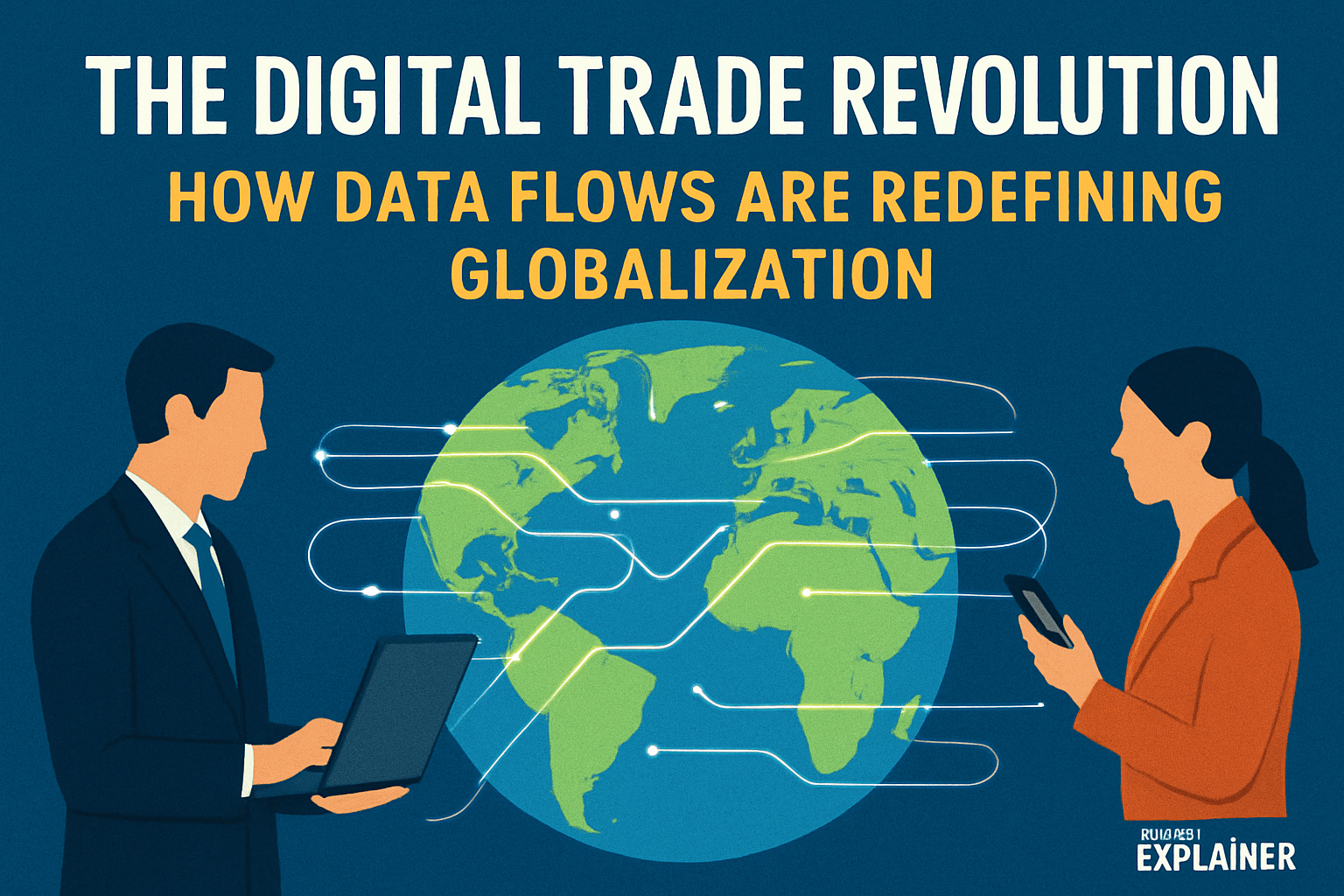
How digital trade differs from traditional trade in speed, tangibility, barriers, and business models.
Introduction – Why This Matters
When we think of “global trade,” images of container ships, cargo planes, and physical goods often come to mind. But there is a faster, less visible current powering the modern global economy: the cross-border flow of data. This is the realm of digital trade—the exchange of goods, services, and information enabled by digital technologies. This revolution is fundamentally redefining what it means to be a “global” business and consumer, creating unprecedented opportunities while raising complex new questions about privacy, security, and regulation.
From a small designer in Lisbon selling digital templates to customers in Tokyo, to a multinational corporation using cloud-based AI to manage supply chains across three continents, digital trade is the backbone of the 21st-century economy. It allows even the smallest entrepreneurs to become “micro-multinationals” overnight. For professionals, understanding this shift is no longer optional; it’s critical for strategic planning in marketing, operations, and compliance. What I’ve found is that the companies thriving today are those that view data not just as an IT concern, but as their most valuable tradable asset. This article will demystify digital trade, explore its profound impact on traditional globalization, and examine the new rules being written to govern it.
Background / Context
The story of digital trade is inextricably linked to the evolution of the internet and global connectivity. Its roots lie in the 1990s with the commercialization of the web and the dawn of e-commerce. However, the World Trade Organization (WTO), established in 1995, was designed for a world of physical goods. Its foundational agreements barely contemplated the internet, leaving a significant regulatory vacuum for the digital age.
The first major phase was the rise of e-commerce platforms like Amazon and eBay, which digitized the sale of physical goods. The second phase, fueled by broadband and mobile adoption, saw the explosive growth of digitally-delivered services—streaming media (Netflix, Spotify), software (SaaS like Salesforce), and online marketplaces for freelance work (Upwork). The current, third phase is characterized by data-driven value creation. Here, data itself is the commodity—whether it’s used to personalize advertising, train AI models, or optimize logistics in real-time.
This evolution has outpaced traditional trade governance. While trade in goods faces tariffs at the border, how do you tax a stream of data? How do you apply customs duties to a software download or a cloud storage subscription? The old rules don’t fit, creating friction and a pressing need for new frameworks that enable growth while protecting citizens’ rights. For more context on how traditional trade systems are adapting, you can read our analysis on global affairs at The Daily Explainer’s Global Affairs & Politics section.
Key Concepts Defined
- Digital Trade: The broader ecosystem of trade enabled by digital technology. It includes both the online sale of physical goods and, more crucially, trade in digitally-enabled services and data.
- Data Localization: Laws or regulations that require data about a nation’s citizens or residents to be collected, processed, and/or stored inside the country’s borders before being transferred internationally.
- Cross-Border Data Flows: The movement of data (personal, commercial, machine-generated) across national jurisdictional boundaries. This is the lifeblood of digital trade.
- Digital Services Tax (DST): A levy imposed by some countries on the revenue generated by large digital companies (like social media platforms and search engines) from users in that country, regardless of the company’s physical presence.
- Platform Economy: Economic and social activity facilitated by digital platforms that connect providers and users (e.g., Uber, Airbnb, Amazon Marketplace, App Stores).
- Digital Protectionism: The use of domestic regulations (like data localization, restrictive standards, or censorship) to favor local digital firms over foreign competitors, effectively creating digital trade barriers.
- Data Governance: The collection of policies, standards, and practices used to manage data throughout its lifecycle, with a focus on privacy, security, and ethical use. This is now a key area of international negotiation.
How It Works (Step-by-Step Breakdown)
Let’s follow the journey of a real-world digital trade transaction: A small business in Canada purchasing cloud-based accounting software from a U.S. SaaS provider.
Step 1: Discovery & Agreement
The Canadian business owner researches solutions online. She visits the U.S. company’s website, hosted on a server that could be physically located in Oregon, Ireland, or Singapore. She reads the terms of service and clicks “Subscribe.” This contract is formed digitally, without a single piece of paper changing hands.
Step 2: The Digital Handshake & Data Flow Initiation
Upon subscription, her business information (name, email, payment details) is transmitted securely to the U.S. company’s servers. The payment is processed by a third-party gateway (which may be in another country). This step involves immediate cross-border data flows of personal and financial data, governed by privacy laws in both Canada and the U.S.
Step 3: Service Delivery & Continuous Data Exchange**
She logs into the software through her web browser. The software’s code and interface are delivered as a continuous data stream from the provider’s cloud servers. As she uses the software, her company’s financial data is entered and stored. This operational data likely resides on a distributed cloud network—her invoices might be processed on a server in Virginia, while backup copies are stored in a data center in the Netherlands. The seamless functionality depends on the free flow of this data across borders.
Step 4: Value-Added Services & Analytics
The U.S. SaaS provider uses aggregated, anonymized data from all its global users to improve its software, develop new features, and train its AI-powered forecasting tools. This creates a feedback loop where the data generated by using the service improves the service for all users, a core value proposition of digital trade.
Step 5: The Regulatory Overlay
At every step, this transaction intersects with multiple legal frameworks:
- Privacy Law: Is the U.S. company compliant with Canada’s PIPEDA when handling Canadian customer data?
- Taxation: How does the U.S. company remit taxes on this digital sale to the Canadian government? Does a Digital Services Tax apply?
- Security: What cybersecurity standards protect the data in transit and at rest?
- Trade Law: Are there any hidden digital trade barriers, like a local server requirement, that would have prevented this sale?
This process, repeated millions of times a second globally, is the engine of the digital trade revolution. For a business looking to start participating in this digital economy, understanding the landscape is key. You can find practical steps in guides like “How to Start an Online Business in 2026” on Sherakat Network.
Why It’s Important
The rise of digital trade is transforming economies and societies with profound implications:
- Democratization of Global Commerce: Digital platforms have dramatically lowered the barriers to international trade. An artisan, freelancer, or startup can now reach a global market with minimal upfront investment. This fosters innovation and economic inclusion. Our Explained section often highlights how such technological shifts empower individuals and small businesses.
- The New Fuel for Economic Growth: Data flows are now more economically valuable than traditional flows of physical goods. A 2025 report by the McKinsey Global Institute estimated that cross-border data flows added more value to global GDP than the trade in physical merchandise. They enable efficiency gains, innovation in products and services, and entirely new business models.
- Transformation of Traditional Industries: Digital trade isn’t just about tech companies. It’s about a manufacturer using IoT sensors to sell “predictive maintenance” as a service to overseas clients, or a farmer using satellite data and blockchain to prove the provenance of crops to foreign buyers. It’s the servitization of everything.
- Strategic and Geopolitical Significance: Control over data and digital infrastructure is now a central pillar of national power. Nations are competing to lead in key areas like artificial intelligence, semiconductors, and telecommunications standards (e.g., 5G/6G). The rules governing digital trade will shape technological leadership for decades to come.
- Consumer Benefit and Choice: Consumers enjoy unprecedented access to a global selection of goods, services, information, and entertainment, often at lower prices and with greater convenience.
Sustainability in the Future
The sustainability of the digital trade boom hinges on solving three critical tensions:
- The Privacy vs. Innovation Dilemma: How do we foster the data flows that drive innovation while protecting individual privacy? Strict data localization laws can fragment the internet into “splinternets” or “digital sovereign zones,” increasing costs and reducing efficiency. The future lies in developing interoperable privacy frameworks (like the EU-U.S. Data Privacy Framework) that allow data to flow between trusted regimes with high protection standards.
- The Environmental Footprint: The digital economy has a physical cost. Vast data centers consume enormous amounts of energy and water. The production and disposal of electronics contribute to e-waste. Sustainable digital trade requires a push for green cloud computing, energy-efficient hardware, and circular economy principles for tech hardware. This aligns with the broader sustainability goals often discussed by platforms focused on impact, such as Worldclassblogs.com.
- Inclusive Development: The digital divide remains a stark reality. The benefits of digital trade risk being concentrated in advanced and digitally-enabled economies. Sustainable growth requires global investment in digital infrastructure (broadband, data centers) and digital skills in developing nations to ensure they can participate in and benefit from the digital global economy, not just be consumers of it.
Common Misconceptions
- Misconception: “Digital trade is just buying stuff on Amazon.”
Reality: E-commerce for physical goods is just one subset. The larger and faster-growing segment is trade in digital services, content, and data—everything from software subscriptions and cloud computing to architectural designs sent via CAD files and financial analysts providing reports remotely. - Misconception: “If it’s digital, it’s free from borders and regulations.”
Reality: Digital trade faces a growing thicket of non-tariff barriers: data localization laws, conflicting privacy regulations (GDPR vs. others), censorship, intellectual property challenges, and digital taxes. These can be more restrictive than traditional tariffs. - Misconception: “Data localization protects my privacy.”
Reality: While often sold as a privacy measure, data localization does not, by itself, guarantee better security or privacy. Strong encryption and comprehensive data protection laws are more effective. Localization can often make data more vulnerable to domestic surveillance and can increase costs, which are often passed to consumers. - Misconception: “Only big tech companies benefit from digital trade.”
Reality: SMEs (Small and Medium-sized Enterprises) are arguably the biggest beneficiaries. Digital tools and platforms allow them to compete globally, access cloud-based enterprise software, and market themselves at a fraction of the traditional cost. They are the backbone of the micro-multinational trend. - Misconception: “Digital trade is killing local jobs.”
Reality: It is dramatically reshaping the labor market. While it may displace some traditional roles, it creates massive demand for new digital skills—in coding, data analysis, digital marketing, cybersecurity, and platform management. The challenge is less about job quantity and more about workforce reskilling and geographic distribution of opportunity.
Recent Developments (2024-2026)
The regulatory and technological landscape is moving rapidly:
- The AI Integration Inflection Point: The proliferation of generative AI tools is turbocharging digital trade. Services built on top of large language models (LLMs) are being offered globally, raising urgent questions about AI governance, copyright, and liability in a trade context. Can an AI-generated report be considered an exported service?
- The Rise of “Digital Free Trade Zones”: Countries like Singapore, the UAE, and Saudi Arabia are establishing ambitious regulatory sandboxes and digital economy agreements that create frictionless environments for digital trade, acting as test beds for next-generation rules.
- The WTO E-Commerce Negotiations: Over 90 WTO members are in advanced negotiations on a plurilateral agreement on e-commerce. Key sticking points include whether to permanently ban customs duties on electronic transmissions, rules on data flows, and the treatment of source code. A conclusion is targeted for 2026.
- The Battle Over Digital Taxes: The OECD’s global tax reform, which includes a plan for a coordinated Digital Services Tax, is being implemented unevenly. This remains a major point of contention, particularly between the U.S. and European nations, threatening to spark digital trade disputes.
- The Semiconductor Re-shaping: The global scramble for semiconductor sovereignty, driven by the CHIPS Act and similar initiatives, is fundamentally a battle over the physical hardware that underpins all digital trade. Secure, advanced chip supply chains are now recognized as a prerequisite for digital economic security.
For the latest breakthroughs and disputes in this fast-moving space, staying informed is crucial. Our Breaking News section frequently covers major developments in tech policy and international digital economy agreements.
Success Stories
Case Study: Shopify – The Operating System for Micro-Multinationals
Shopify, a Canadian e-commerce platform, exemplifies how digital trade infrastructure can empower millions. It doesn’t sell goods itself; it provides the digital tools (website builder, payment processing, inventory management, shipping logistics) that allow over 2 million merchants—from single-person operations to large brands—to sell online.
- The Digital Trade Enabler: A ceramic artist in Portugal can set up a professional online store in an afternoon, accept payments in multiple currencies, and ship to customers worldwide. Shopify handles the complex cross-border compliance, payments, and data flows in the background.
- Impact: In 2025, merchants on Shopify sold to buyers in over 175 countries. The platform has democratized access to global markets, proving that with the right digital tools, any business can participate in international trade. This story aligns with the entrepreneurial spirit and partnership focus found in resources from Sherakat Network.
Case Study: Estonia’s Digital Nation
Estonia offers a state-level success story. After rebuilding its society in the 1990s, it chose a “digital-first” strategy. It created a secure digital identity for all citizens (the e-Residency program), enabling them to establish and run EU-based businesses entirely online from anywhere in the world.
- The Model: Estonia treats digital service delivery as a core export. Its government services are digital by default, and it actively markets its e-Residency program to global digital nomads and entrepreneurs.
- The Result: It has created a thriving ecosystem of location-independent digital businesses and positioned itself as a global thought leader in digital governance, showing how national policy can actively foster digital trade.
Real-Life Examples
- A Freelancer on Upwork: A graphic designer in Argentina completes a logo project for a startup in Sweden. The design files (data) are delivered digitally, and payment is processed through the platform. This is a pure export of digital services.
- Netflix Streaming: When you watch a Spanish series on Netflix in the United States, you are importing a digital entertainment service. The value is in the content data stream, not a physical DVD.
- Tesla’s Over-the-Air (OTA) Updates: When Tesla pushes a software update that improves the battery range or adds new features to cars globally, it is engaging in digital trade. It’s exporting a digital upgrade to a physical product already in the customer’s possession, blending the physical and digital worlds.
- Agricultural IoT: A winery in Chile uses soil moisture sensors connected via satellite. The data is analyzed by an AI platform hosted in Germany, which sends optimized irrigation instructions back to the Chilean vineyard. This trade in machine data and analytics services directly improves physical output.
Conclusion and Key Takeaways
The digital trade revolution is not a future trend; it is the present reality of globalization. It has irrevocably shifted the foundations of international commerce from a primary focus on moving things to an increasingly critical focus on moving bits and ideas.
Key Takeaways:
- Data is the New Trade Commodity: The most valuable flows in the global economy are often intangible streams of data that enable services, innovation, and efficiency.
- The Rules Are Being Written Now: A complex patchwork of national regulations on data, privacy, and digital taxes is emerging. The shape of future international digital trade agreements will determine whether we have an open, interoperable internet or a fragmented digital world.
- Every Company is a Digital Trader: Regardless of industry, businesses must understand how data flows impact their operations, supply chains, and customer relationships. Digital trade competency is now a core business skill.
- The Micro-Multinational is Here to Stay: Technology has democratized global reach. The smallest entrepreneur can source, sell, and collaborate across borders with ease, reshaping traditional notions of corporate scale.
- Balance is Paramount: The great challenge for policymakers is to strike a balance: fostering the innovation and growth unleashed by free data flows while protecting privacy, national security, and fair competition.
Navigating this new landscape requires continuous learning and adaptation. For ongoing insights and analysis on these transformative economic forces, be sure to follow our Blog at The Daily Explainer.
FAQs (Frequently Asked Questions)
1. What’s the difference between e-commerce and digital trade?
E-commerce typically refers specifically to the buying and selling of physical goods online. Digital trade is the broader umbrella term that includes e-commerce plus the trade of digitally-delivered services, content, and data itself.
2. How are digital services taxed internationally?
This is a major area of conflict. The OECD has been working on a two-pillar solution: Pillar One aims to reallocate some taxing rights to countries where users are located (not just where the firm is headquartered). Pillar Two proposes a global minimum corporate tax. Individual countries are also implementing their own Digital Services Taxes (DSTs) in the interim, causing trade tensions.
3. What is the “moratorium on customs duties on electronic transmissions”?
Since 1998, WTO members have temporarily agreed not to impose customs duties on purely digital products (like e-books, software, music) sent electronically. This moratorium is periodically renewed but is now under pressure as countries seek new revenue streams and question its impact on developing nations.
4. How do data localization laws hurt businesses?
They force companies to build or rent expensive local data infrastructure, duplicating systems they may have elsewhere. This increases costs, complicates operations, slows down services (due to latency), and can stifle innovation by preventing the use of global cloud platforms and data analytics.
5. Can small businesses really compete globally through digital trade?
Absolutely. Platforms like Shopify, Etsy, Amazon Handmade, and freelance marketplaces provide the storefront, payment, logistics, and translation tools that small businesses lacked in the past. Their main challenge is now digital marketing and discovery in a crowded global marketplace.
6. What is “digital sovereignty” and why is it trending?
Digital sovereignty refers to a country’s desire to assert control over the digital infrastructure, data, and technological ecosystems within its borders. It’s driven by concerns over privacy, security, economic competitiveness, and geopolitical influence. The EU’s GDPR and digital policy are prime examples.
7. How does digital trade affect developing countries?
It offers a huge opportunity to leapfrog traditional development stages. A farmer with a smartphone can access global market prices, and a artisan can sell globally. However, the risks include becoming dependent on foreign digital platforms, losing local data, and facing a “brain drain” of digital talent.
8. What are the biggest security risks in digital trade?
Cybersecurity threats are paramount: data breaches, ransomware attacks on supply chains, and intellectual property theft. Ensuring the integrity and security of cross-border data flows is a top priority for businesses and governments alike.
9. How is artificial intelligence changing digital trade?
AI is both a product and an enabler. AI software is a traded digital service. More importantly, AI algorithms power the personalization, logistics optimization, fraud detection, and customer service that make digital trade platforms efficient and scalable.
10. Who is winning in the digital trade revolution?
Currently, countries and companies that lead in digital infrastructure, innovation ecosystems, and flexible regulation are winning. This includes the U.S. (tech platforms, SaaS), China (digital platforms, e-commerce), the EU (regulation and privacy standards), and agile digital hubs like Singapore and Israel.
11. What is a “data free flow with trust” (DFFT)?
A concept championed by Japan and others at international forums like the G20 and G7. It proposes creating a framework where countries can agree on common rules (for privacy, security) that allow data to flow freely between them based on mutual trust, avoiding restrictive localization.
12. How can I make my business more ready for digital trade?
Ensure your online presence is global-ready (multi-currency, multilingual).
Understand the data privacy laws (like GDPR) of your target markets.
Utilize cloud-based services for scalability.
Consider using global digital platforms for payments, logistics, and marketing.
Stay informed on changing digital trade rules.
13. What is the role of blockchain in digital trade?
Blockchain can increase transparency and trust in digital transactions. It’s being used for smart contracts that auto-execute upon conditions, verifying the provenance of goods in supply chains, and creating secure, immutable records for digital assets and intellectual property.
14. Are there “digital trade wars”?
Yes. Disputes over digital taxes, bans on foreign apps (like TikTok, WeChat), and requirements for technology transfers are modern forms of digital trade conflict. These can lead to retaliatory tariffs and sanctions, just like traditional trade wars.
15. What happens if global digital trade rules fail to materialize?
We risk a “splinternet”—a fragmented global internet divided into regional blocs with different rules (a U.S.-led bloc, a Chinese-led bloc, a European-led bloc). This would increase costs for businesses, limit choice for consumers, and slow global innovation.
16. How does digital trade relate to sustainable development goals (SDGs)?
It can significantly advance goals like Decent Work and Economic Growth (SDG 8) and Industry, Innovation and Infrastructure (SDG 9). However, it also poses challenges for Reducing Inequalities (SDG 10) if the digital divide is not addressed.
17. What is a “digital trade agreement”?
Modern free trade agreements now almost always include dedicated digital trade or e-commerce chapters. These chapters set rules on data flows, prohibit data localization, promote consumer trust in e-commerce, and address issues like digital signatures and online consumer protection.
18. How do I protect my intellectual property in digital trade?
Use clear copyright notices and licensing terms on your digital products. Utilize digital rights management (DRM) tools where appropriate. Register trademarks and patents in your key markets. Understand that enforcement across borders remains complex and often requires local legal counsel.
19. Is my personal data part of “digital trade”?
Indirectly, yes. Your data, when aggregated and anonymized, is a key resource that fuels the platform economy and digital advertising, which in turn enables many “free” digital services. Your attention and data are effectively exchanged for access to services.
20. Where can I learn more about the regulations affecting my digital business?
Consult official government trade and digital economy websites. Follow reputable industry publications. Consider joining trade associations for your sector. For a starting point on building a compliant online business, resources like the Sherakat Network Contact page can guide you to relevant expertise.
About Author
Sana Ullah Kakar is a digital economy strategist with over 12 years of experience at the intersection of technology, trade policy, and business innovation. They have advised governments on digital trade frameworks and helped companies of all sizes navigate the complexities of cross-border digital expansion. Their work focuses on making the often-technical rules of the digital economy accessible and actionable. They regularly contribute analysis to The Daily Explainer. For more insights, explore our Blog, or to propose a topic, visit our Contact Us page.
Free Resources
- The Daily Explainer: Explained: For foundational primers on complex tech and economic topics.
- OECD Digital Economy Outlook: Biennial report providing comprehensive data and analysis on digital trends and policies.
- International Trade Centre (ITC) SME Trade Academy: Offers free online courses on e-commerce and digital export strategies for small businesses.
- World Economic Forum – Centre for the Fourth Industrial Revolution: Research and initiatives on governing emerging technologies and data flows.
- Sherakat Network Category: Blog: Features practical case studies and guides on leveraging digital tools for global business growth.
Disclaimer: This article is for informational purposes only and does not constitute professional legal, financial, or trade advice. For specific guidance, please consult a qualified professional. Please review our full Terms of Service for more information.
Discussion
What do you think? Should data flow freely across borders like traditional goods, or do nations have a right to lock down their citizens’ data? How can we ensure the benefits of digital trade are shared widely and not just concentrated in tech hubs? Share your thoughts and experiences below. For real-time updates on pivotal digital trade negotiations and tech policy shifts, follow our Breaking News coverage.
About The Author