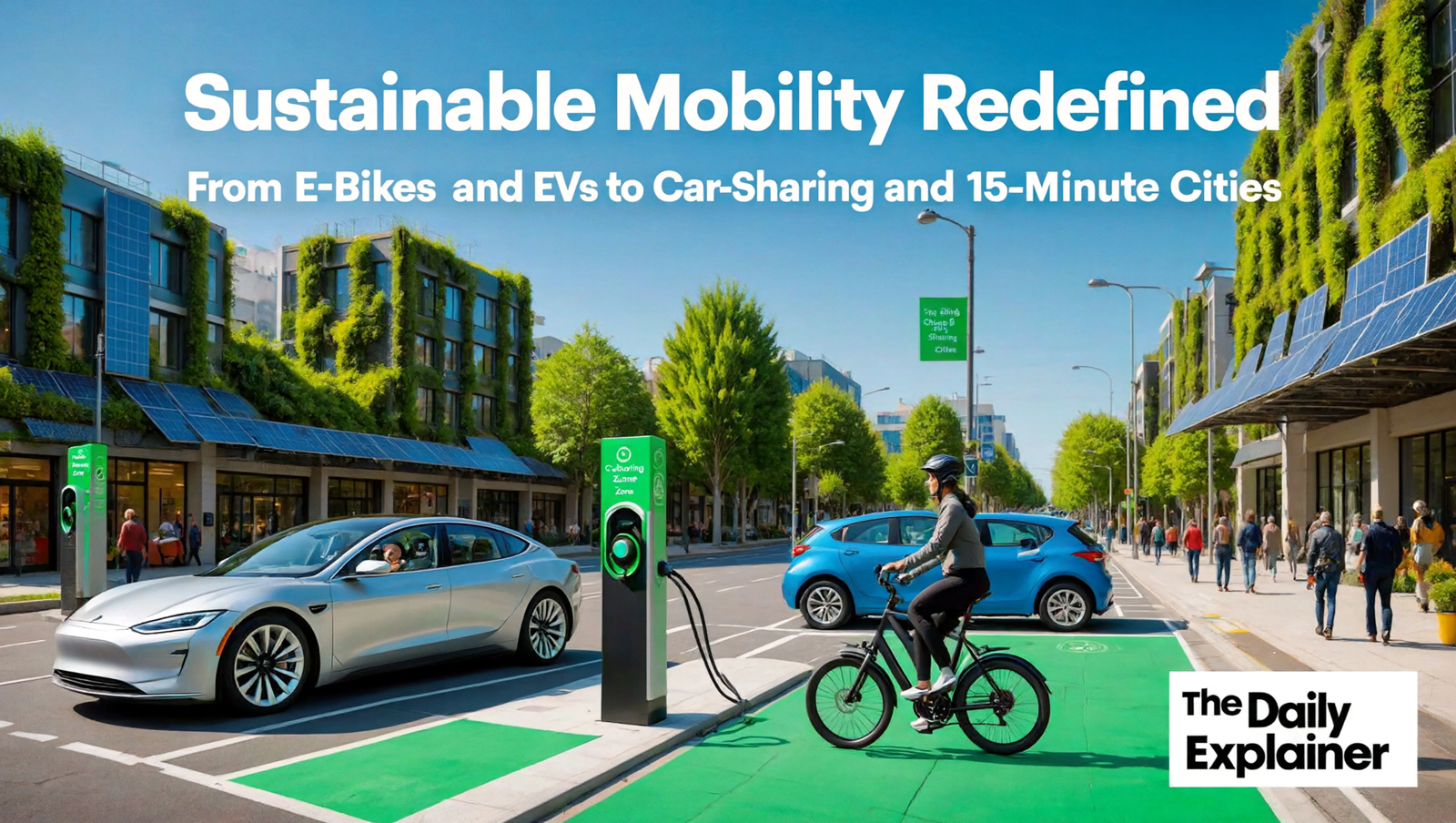
The Sustainable Mobility Hierarchy. This visual guide ranks transportation options by their environmental and space efficiency, helping you choose the right tool for each trip.
Why How We Move Defines Our Communities and Climate
In my experience, transportation is the skeleton of daily life—it shapes our routines, our budgets, and our sense of freedom. For years, my identity was tied to my car; it was a symbol of independence. Then, I moved to a city and calculated the true cost: the car payment, insurance, parking, fuel, maintenance, and the 12 hours a month I spent circling for parking or stuck in traffic. That “freedom machine” was costing me over $900 monthly and 150 hours of my life annually, all while making me part of a congested, polluting system I claimed to dislike. The moment of redefinition came when I sold it, invested in an e-bike and a transit pass, and discovered a new kind of liberty—freedom from car ownership.
This matters profoundly because transportation is now the largest source of greenhouse gas emissions in the United States, edging out electricity generation according to 2025 EPA data. For the curious beginner, rethinking mobility is the most impactful personal climate action after home energy, with immediate co-benefits for health and wealth. For the sustainability professional, it’s a complex puzzle of technology, urban design, and behavioral economics. Sustainable mobility isn’t just about swapping a gas car for an electric one; it’s a holistic reimagining of how we access people, places, and opportunities. It’s about having the right tool for the trip—whether that’s your own two feet, a shared vehicle, or a high-speed train—and designing communities where those tools are abundant, safe, and integrated. For foundational insights into how such systemic changes take shape, our Explained series breaks down complex transitions into understandable concepts.
The Context: Beyond the Electric Car—A Multi-Modal Revolution
The 20th century was the century of the private automobile. Cities were redesigned around it, leading to sprawl, segregation, pollution, and staggering public health costs from sedentary lifestyles and air pollution. The “sustainable mobility” conversation often gets trapped in a binary: gas vs. electric car. But true sustainability exists on a spectrum of efficiency, measured in energy and space consumed per person moved.
The new mobility hierarchy, from most to least sustainable, looks like this:
- Active Mobility (Walking, Cycling): Zero emissions, maximum health benefits, minimal infrastructure cost.
- Micro-mobility (E-scooters, E-bikes): Low-energy, space-efficient, and extending the range of active travel.
- Shared & Public Transit (Buses, Trains, Ride-Sharing): High-occupancy vehicles that maximize the utility of each trip.
- Shared Personal Vehicles (Car-share, Carsharing): Reducing the number of vehicles needed overall.
- Personal Electric Vehicles: A cleaner replacement for the final leg of necessary car trips.
- Personal Internal Combustion Vehicles: The legacy technology to be phased out.
The goal isn’t to eliminate cars overnight but to make them one option among many, and often not the most convenient default. This shift is being accelerated by converging trends: the electrification of everything, the digital platform economy enabling sharing, and a post-pandemic reevaluation of urban space. These global trends are influenced by policy and cultural shifts, a dynamic we often analyze in our Global Affairs & Politics coverage.
Key Concepts Defined: The New Mobility Lexicon
- Sustainable Mobility: A transportation system that meets current mobility needs without compromising the ability of future generations to meet theirs, balancing environmental, social, and economic goals.
- Multi-Modal / Inter-Modal: Using multiple modes of transport for a single journey (e.g., bike to train, train to e-scooter). Seamless integration is key.
- 15-Minute City: An urban planning concept where all residents can meet most of their daily needs—work, shopping, education, healthcare, recreation—within a 15-minute walk or bike ride from their home.
- E-Bike (Pedelec): A bicycle with an electric motor that assists only when the rider is pedaling, typically capping assistance at 20-28 mph depending on class. A game-changer for hills, cargo, and longer commutes.
- Vehicle-to-Grid (V2G): Technology allowing electric vehicles to discharge energy from their batteries back to the electrical grid during peak demand, turning EVs into mobile energy storage assets.
- Mobility as a Service (MaaS): A digital platform (like an app) that integrates and offers planning, booking, and payment for multiple transport modes (public transit, ride-hail, bike-share, etc.) in one interface.
- Complete Streets: Streets designed and operated to enable safe access and travel for all users—pedestrians, bicyclists, motorists, and transit riders of all ages and abilities.
- Induced Demand: The observed phenomenon where increasing road capacity (adding lanes) reduces travel times only briefly, as the new capacity encourages more people to drive, leading to the same or worse congestion.
- Carsharing vs. Ride-Hailing: Carsharing (Zipcar, Turo) is renting a vehicle by the hour. Ride-hailing (Uber, Lyft) is hiring a driver and vehicle for a point-to-point trip.
How It Works: Redesigning Your Mobility Lifestyle, Step-by-Step

Transitioning is a personal journey of experimentation and system-building.
Phase 1: The Trip Audit & Mindset Shift (The “Why Do I Drive?”)
- Step 1: The Driving Log. For two weeks, log every car trip: destination, purpose, distance, and alternatives considered. My log revealed 40% of my trips were under 3 miles—prime for biking or walking. I also saw I drove to the gym to run on a treadmill, a cognitive dissonance that spurred change.
- Step 2: Calculate Your True Cost of Ownership. Use an AAA Driving Cost Calculator or simply tally: car payment/lease + insurance + fuel + maintenance + parking + tolls + depreciation. Divide by 12 for your monthly “mobility budget.” This number funds your new multi-modal system.
Phase 2: Building Your Active & Micro-Mobility Foundation
- Step 3: Optimize for Walking & Biking. For short trips, can you walk? Invest in good shoes, a backpack, and a folding cart for groceries. For the 1-5 mile range, consider a bicycle. For longer or hillier commutes, an e-bike is transformative. I bought a Class 1 commuter e-bike; my 7-mile commute went from a sweaty, 45-minute ordeal to a pleasant, 25-minute breeze. Many employers now offer e-bike purchase programs.
- Step 4: Gear Up for All Weather. This is crucial. Get quality rain gear, panniers (bike bags), lights, and a secure lock. All-weather biking is a skill that builds confidence and makes the mode shift permanent.
Phase 3: Mastering Shared & Public Options
- Step 5: Decode Your Public Transit. Download your local transit agency’s app. Get a pass. Take a practice ride on a weekend to key destinations. Understand the schedule and connections. Pair it with a folding bike or scooter for the “last mile” problem.
- Step 6: Integrate Carsharing. Join a service like Zipcar or a peer-to-peer platform like Turo. This is for the weekly grocery haul, the IKEA trip, or the weekend getaway. Instead of a fixed monthly cost, you pay per use. I budget $150/month for carshare, a fraction of my old ownership cost.
Phase 4: The Vehicle Purchase Decision (If Necessary)
- Step 7: Right-Size Electrically. If you genuinely need a personal vehicle (e.g., for rural living, specific work tools, family needs), buy the smallest EV that meets 90% of your needs. For the other 10%, rent a larger vehicle. The 2026 market offers compelling small EVs and plug-in hybrids. Calculate total cost of ownership, factoring in lower “fuel” and maintenance costs. The principles of making strategic, data-driven investments apply broadly, a topic often explored in-depth on platforms like SheraKat Network’s blog.
Why This Multi-Modal Approach is the Path to Freedom
The benefits are liberation in multiple dimensions:
- Massive Financial Savings: The average annual cost of owning a new car in 2026 exceeds $12,000. A multi-modal system (e-bike, transit pass, occasional carshare) can cut that by 50-75%. That’s $500-$750 monthly back in your pocket.
- Reclaimed Time & Reduced Stress: Time in traffic is wasted. Time on a bike or train can be for exercise, reading, or relaxation. My “commute” is now my daily workout and podcast time.
- Improved Health: Active transportation builds exercise into your day. Studies show e-bike riders get meaningful moderate-intensity physical activity. Reduced air pollution exposure benefits everyone.
- Community Connection: Moving at human speed—walking or biking—you notice your neighborhood, interact with neighbors, and support local businesses. You become part of the street life, not sealed away from it.
- Disproportionate Climate Impact: Transportation emissions are personal and direct. Shifting from a 25 MPG car to an e-bike for a 10-mile commute saves about 2,500 lbs of CO2 annually. Do that and switch to an EV, and you’re a climate leader.
The Future of Mobility: Autonomous, Integrated, and On-Demand
The next decade will blur the lines between modes.
- Autonomous Electric Shuttles (AEVs): Small, slow-moving, self-driving pods will provide first/last-mile connections from transit hubs and circulate within 15-minute city districts, ordered via MaaS apps.
- Modular Vehicle Design: Imagine an electric “skateboard” chassis. You dock a 2-person pod for commuting, swap it for a cargo pod for moving day, or a camper pod for weekends. One base, multiple purposes.
- Urban Air Mobility (UAM) / eVTOLs: While hype-heavy, electric vertical take-off and landing aircraft may serve as premium, point-to-point transit for specific corridors (airport to downtown) by the late 2030s, but will not solve ground-level congestion.
- Dynamic Road Pricing & Zoning: Cities will implement smart congestion pricing (like London or New York), charging drivers to enter dense cores, and reallocating street space from parking to bike lanes, parks, and café seating in real-time.
- Biometric & Seamless Payment: Your MaaS app will know your schedule, suggest optimal routes, and handle all payments across modes with a single monthly bill, making multi-modal travel as simple as streaming music. For a look at how technology is reshaping industries and creating new opportunities, the comprehensive guide on starting an online business in 2026 delves into similar digital transformations.
Common Misconceptions: Shifting Gears on Old Ideas
- “Electric cars will solve everything.” While critical, they don’t solve congestion, sprawl, road deaths, or sedentary lifestyles. A traffic jam of EVs is still a traffic jam. They are a necessary but insufficient solution.
- “Biking/E-biking is too dangerous.” This is a design problem, not a biking problem. Protected bike lanes reduce cyclist injuries by over 90%. The danger is mixing high-speed cars with vulnerable users. Advocacy for safe infrastructure is part of the solution.
- “I need a car for emergencies.” This is a powerful psychological barrier. In reality, ride-hail services provide near-instant emergency trips. For true medical emergencies, you call an ambulance, not drive yourself.
- “Public transit is unreliable or doesn’t go where I need.” This is often true due to underinvestment—a self-fulfilling prophecy. The solution is to advocate for and use the service to increase its funding and frequency. Even using it for 20% of trips creates political demand for improvement.
- “Sustainable mobility is only for young, single urbanites.” The tools are expanding. Cargo e-bikes are revolutionizing school runs and grocery trips for families. Adaptive cycles are available for those with disabilities. The 15-minute city concept specifically supports seniors and children.
Recent Developments (2025-2026): The Tipping Point
- E-Bike Sales Surpass Electric Car Sales in Europe: In 2025, for the first time, more e-bikes were sold in the EU than electric passenger cars, signaling a massive shift toward micro-mobility.
- The U.S. E-Bike Act Revival: A renewed push for a federal e-bike purchase tax credit (up to $1,500) gained significant bipartisan traction in early 2026, mirroring successful state-level programs.
- “Car-Lite” Development Ordinances: Cities like Minneapolis and Portland passed laws requiring new residential developments to provide far fewer parking spaces (or none) and instead contribute to shared mobility funds or transit passes.
- V2G Pilot Programs Go Mainstream: Major utilities across North America launched V2G programs in 2025, paying EV owners to plug in and stabilize the grid during peak hours, creating a new revenue stream.
- The Rise of the “Mobility Budget”: Progressive companies are ditching free parking subsidies and instead offering employees a monthly stipend to spend on any combination of transit, bike-share, e-bike purchases, or ride-hail—a powerful behavior-changer.
A Success Story: From Two-Car Suburb to One-Car, Multi-Modal Family

The Chen family in a suburban-ring community felt trapped by their two cars. Both parents commuted 15 miles in opposite directions, and their kids needed shuttling. They felt the financial and time strain deeply.
Their Reimagined System:
- The E-Bike Experiment: One parent swapped their car commute for a cargo e-bike with a child seat. The 15-mile commute became a 45-minute, enjoyable ride. They dropped one gym membership.
- The EV Transition: They replaced their remaining gas SUV with a used, long-range EV for the other parent’s commute and weekend trips. Home charging cut “fuel” costs by 70%.
- The Community Solution: They organized a “walking school bus” with neighbors for the kids and used the cargo e-bike for local errands and library trips.
- The Carshare Backstop: They joined a local carshare co-op for the rare times both needed a car simultaneously.
The Result: They eliminated one car payment, insurance policy, and most maintenance costs—saving over $8,000 annually. They gained hundreds of hours of family time back from chauffeuring duties. Their carbon footprint from transport plummeted by over 60%. They are healthier, wealthier, and more connected to their community. This model of community-based problem-solving is at the heart of many initiatives featured in the Nonprofit Hub at WorldClassBlogs.
Real-Life Examples and Actionable Shifts
- The “E-Bike + Transit” Super-Combo: For longer commutes, take your e-bike on the train (many have bike cars) to extend your range without breaking a sweat. I do this for meetings across the metro area.
- The Grocery Run Revolution: A standard car trunk holds about 8 grocery bags. A good set of bike panniers plus a backpack can carry 6. For a big haul, use a cargo e-bike or schedule a carshare van for 2 hours monthly.
- The “Mobility Challenge”: Try going car-free for one month. Use the money saved on gas and parking for ride-hail or carshare when absolutely necessary. You’ll discover your true needs and build new habits.
- Advocate for a Bike Bus: If your child’s school is within 2 miles, work with the school and parents to create a supervised “bike bus”—a group of kids and adults cycling together on a set route. It builds independence and community.
- Negotiate a Remote Work Stipend: If you work from home part-time, ask your employer to convert your unused parking space or commuting subsidy into a home office or mobility stipend to fund your e-bike or transit costs.
Conclusion and Key Takeaways: Your Journey to Mobility Freedom
Sustainable mobility is a return to choice. It’s about escaping the monopoly that car ownership has held over our geography, finances, and time. It requires seeing yourself not as a driver, but as a traveler with a toolkit, and seeing your community not as a map of roads, but as a network of accessible destinations.
Key Takeaways:
- Audit First, Act Second: Understand your actual travel patterns and the true cost of your current system before making any change.
- Start with the Easiest Trip: Replace one recurring short car trip with walking or biking. Build from that success.
- An E-Bike is a Car Replacement for Many: It is the single most effective tool for transforming urban and suburban transportation, offering car-like range with bike-like benefits.
- Think in Systems, Not Silver Bullets: No single mode solves everything. Build a resilient portfolio of options: your own feet, a bike, transit access, and shared vehicle access.
- Advocate for Better Infrastructure: Support Complete Streets policies, protected bike lanes, and better transit funding. Your voice as a resident and voter shapes the system.
Your journey begins with a question: “Do I need to drive for this?” From that simple query, a new world of mobility—healthier, wealthier, cleaner, and more connected—can unfold. For more practical guides on navigating complex modern systems, our main Blog is continually updated with actionable insights.
Frequently Asked Questions (FAQs)
- What type of e-bike should I get?
- Class 1: Pedal-assist only, up to 20 mph. Allowed on most bike paths. Best for general commuting and fitness.
- Class 2: Has a throttle (can go without pedaling), up to 20 mph. Good for those who need a break from pedaling.
- Class 3: Pedal-assist only, up to 28 mph. Faster, but often restricted from bike paths; best for road commuters.
- Cargo E-Bikes: Designed to carry heavy loads or children. The ultimate family car replacement for local trips.
- Is it safe to charge an EV in my apartment/condo?
- It’s the biggest hurdle. Solutions include: advocating for landlord/ HOA to install chargers, using public charging networks (apps like PlugShare), or utilizing workplace charging. New “right-to-charge” laws are emerging in many states.
- How does car insurance work for a multi-modal lifestyle?
- If you own a car but drive less, ask for low-mileage or pay-per-mile insurance (like MetroMile). If you are car-free, a non-owner auto policy is cheap and provides liability coverage when you drive a carshare or rental.
- What is the environmental impact of manufacturing an e-bike or EV?
- All vehicle manufacturing has a footprint. However, the operational efficiency is so high that both e-bikes and EVs break even on emissions compared to their alternatives within 6-18 months of use, then deliver decades of low-carbon travel.
- Can e-bikes handle hills and bad weather?
- Yes. The motor makes hills trivial. For weather: fenders, good lights, rain pants/jacket, and studded tires for winter ice make them viable year-round in most climates.
- What’s the difference between a PHEV (Plug-in Hybrid) and a BEV (Battery Electric Vehicle)?
- A PHEV has a smaller battery (20-50 mile range) and a gas engine. It’s a good “gateway” EV for those with range anxiety or inconsistent charging. A BEV is fully electric. For most new buyers, BEV technology and charging networks are now sufficient.
- How do I find safe biking routes?
- Use apps like Strava Heatmaps (shows where cyclists actually ride), Google Maps (biking layer), or Komoot for route planning that prioritizes bike paths and quiet streets.
- Are shared e-scooters sustainable?
- They have a short lifespan and can create clutter, but they fill a niche for short, spontaneous trips and reduce car use. The most sustainable option is your own e-bike or scooter, followed by well-managed shared systems with swappable batteries and durable designs.
- What is “transit-oriented development” (TOD)?
- Dense, walkable, mixed-use development (housing, shops, offices) built within a 5-10 minute walk of a high-quality transit station. It’s the physical embodiment of the 15-minute city around transit nodes.
- How can I advocate for safer streets in my town?
- Join local groups like your chapter of Strong Towns or America Walks. Attend city council meetings. Support “road diet” projects that convert car lanes to bike lanes. Push for traffic calming measures on your street.
- Is it realistic to be completely car-free in the suburbs?
- It’s challenging but becoming more feasible with e-bikes, improved transit (where advocated for), and carshare. The most practical goal for many suburbs is “car-light”—reducing from 2 cars to 1, and using that car far less.
- What are the health benefits of active transportation?
- Reduced risk of heart disease, stroke, type 2 diabetes, depression, and some cancers. The CDC recommends 150 minutes of moderate activity per week; a 30-minute bike commute each way meets this.
- How do I handle long-distance travel without a car?
- Inter-city trains (Amtrak), buses (Greyhound, FlixBus), and plane travel exist. For destinations where you need a vehicle, rent one. For a 2-week vacation, renting is still far cheaper than owning a car year-round for that one trip.
- What is the “last mile” problem?
- The difficulty of getting from a transit stop to your final destination. Solutions include: walking, bike-share, e-scooter share, micro-transit shuttles, and of course, your own folding bike or e-scooter.
- Are electric motorcycles a good option?
- For some, yes. They offer motorcycle fun and efficiency with zero emissions. However, they lack the safety and cargo/ passenger utility of a car or e-bike and still contribute to congestion.
- How do I secure an expensive e-bike?
- Use a high-quality U-lock (like Kryptonite New York) through the frame and rear wheel. Add a secondary cable lock for the front wheel. Never lock just by the wheel. Use removable batteries and take them with you. Consider GPS trackers (like Apple AirTag hidden on the frame).
- What’s the future of hydrogen cars?
- For passenger vehicles, the race is largely over, and battery electric has won due to lower costs and more developed infrastructure. Hydrogen may play a role in long-haul trucking, shipping, and aviation.
- Can I get tax credits or rebates for sustainable mobility?
- Yes! Federal tax credits for new and used EVs. Many states have additional EV rebates, e-bike vouchers (like Colorado’s), and transit benefit programs where you can use pre-tax dollars for passes.
- How do delivery services fit into sustainable mobility?
- They can reduce individual car trips for errands. The impact depends on how the delivery is made—a cargo e-bike making multiple deliveries is excellent; a gas van delivering one item is not. Support local businesses that use bike delivery.
- Where can I learn more about urban planning and mobility?
- Follow Not Just Bikes on YouTube. Read “Walkable City” by Jeff Speck and “Confessions of a Recovering Engineer” by Charles Marohn. Listen to podcasts like The War on Cars and The Overhead Wire.
About the Author
Sana Ullah Kakar is a recovered car-dependent and certified urban planner who now advocates for people-centered streets. After selling their car a decade ago, they have navigated life in cities and suburbs using a combination of e-bikes, trains, and carshare, documenting the financial, health, and social benefits along the way. They believe that access, not ownership, is the future of freedom, and that the most sustainable trip is the one you enjoy enough to make again. For more from our team of explainers, feel free to get in touch via our Contact Us page.
Free Resources

- Bike Map by PeopleForBikes: An interactive map rating city bike networks.
- PlugShare App: The definitive map for public EV charging stations, with user reviews.
- Transit App: Real-time public transit planning and tracking for cities worldwide.
- Carsharing Market Comparison: Websites like Carsharing.us provide directories and comparisons of services in your area.
- Project Drawdown Transportation Solutions: A ranked list of the most impactful climate solutions for transportation, with detailed analysis.
- Your Local Metropolitan Planning Organization (MPO): Attend meetings or review their long-range transportation plans to understand and influence your region’s future.
Discussion
What’s the one car trip you could most easily replace tomorrow, and with what? Have you tried an e-bike, and what was your experience? What’s the biggest barrier to using transit in your community? Share your mobility hacks, success stories, and frustrations below. Let’s build a community navigating the path to sustainable movement together. For deeper dives into how communities are innovating in transportation and other sectors, the projects and discussions in the Our Focus section at WorldClassBlogs offer a wealth of inspiration.
About The Author