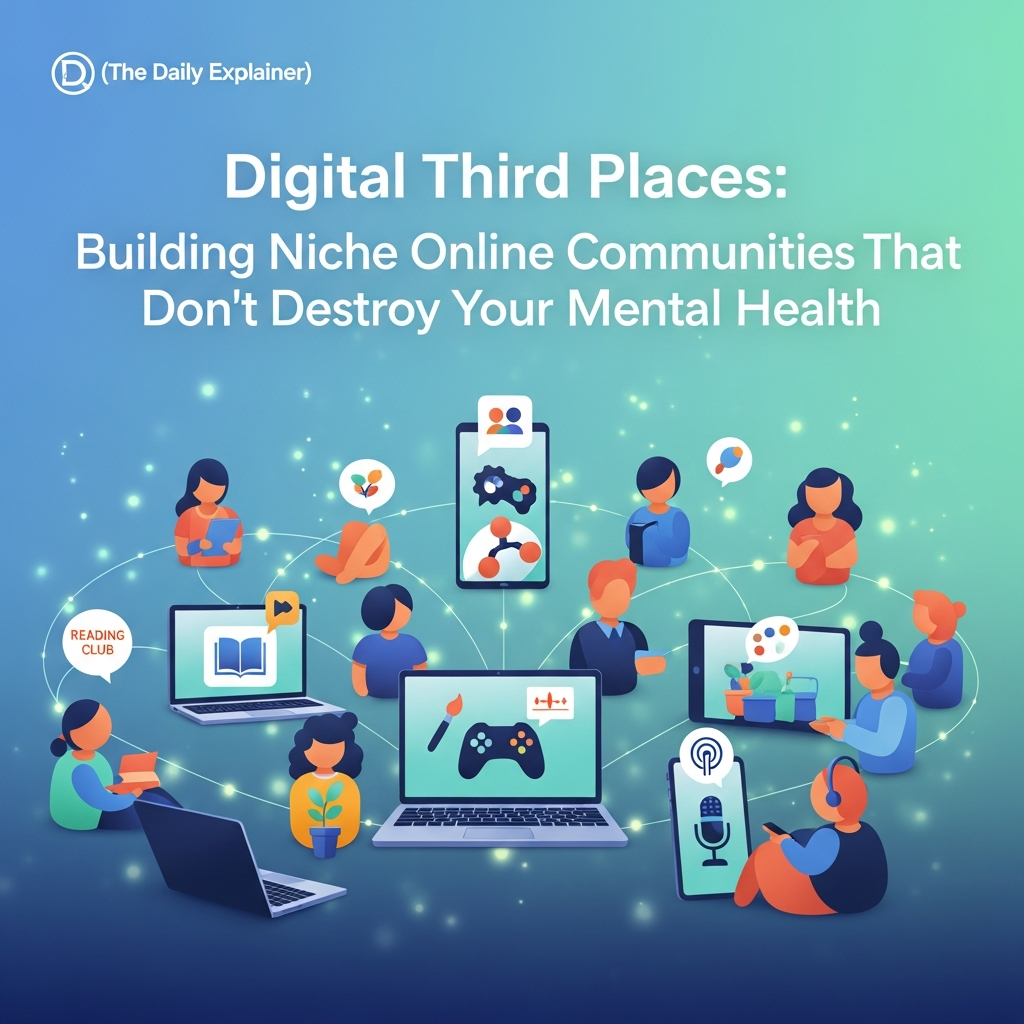
The Ecosystem of Trust: A healthy Digital Third Place is a carefully balanced system of purpose, rules, safety, and ritual.
Introduction – Why This Matters
You know the feeling. You close a tab after scrolling through a vitriolic comment thread, your heart racing slightly. You leave a popular social media platform feeling more isolated than when you logged on, having consumed an hour of perfectly curated, subconsciously agonizing comparison material. The digital “public square” has become a dystopian marketplace of anger, algorithms, and anxiety. Yet, the human yearning for connection persists. Where do we go to find our people, to discuss niche passions, to find support, without the toxicity?
The answer lies in the intentional creation of Digital Third Places. This concept, adapted from sociologist Ray Oldenburg’s crucial work on physical “third places” (the cafes, pubs, and parks that aren’t home or work), represents the future of healthy online life. A Digital Third Place is a purpose-built, bounded online community centered around a shared interest, identity, or goal, designed explicitly for psychological safety and meaningful interaction, not passive consumption or viral growth.
In 2026, the data underscores a massive shift. A recent Pew Research study found that 58% of frequent social media users report their primary positive interactions now happen in small, private, or niche group chats and forums, not on public feeds. Meanwhile, the U.S. Surgeon General’s 2025 Advisory on Digital Youth Mental Health explicitly recommends the promotion of “pro-social, curated digital environments” as a public health intervention against loneliness and anxiety. The market is responding: the “community-in-a-box” platform industry is projected to be worth over $2.5 billion by 2027, growing at 24% annually.
This guide is for the curious beginner wondering where to find these havens, the professional community manager seeking a sustainable model, and anyone who believes the internet can be better. We will dissect the sociology and psychology behind successful digital third places, provide a comprehensive, step-by-step blueprint for building or cultivating one, and explore how to safeguard both your community’s and your own mental health in the process. This is not about abandoning the internet; it’s about rewilding parts of it with intention.
Background / Context: From Geocities to Discord—The Evolution of Online Gathering
To understand the necessity of Digital Third Places, we must look at the devolution of our digital commons.
The Early Web (1990s – Early 2000s): The Proto-Third Place
The early internet was built on Digital Third Places: forums, newsgroups, and chat rooms like those on AOL or independent bulletin board systems (BBS). These were inherently niche, slow, and text-based. Moderation was often hands-on, by dedicated hobbyists. Your username was an identity you built over the years. These spaces were flawed but had clear boundaries and a shared sense of ownership.
The Social Media Monolith (Mid 2000s – 2020s): The Enclosure of the Commons
Platforms like Facebook, Twitter, and Instagram arrived with a promise of connection but built on an attention-economy business model. The “town square” was enclosed. Your interactions became fuel for an algorithmic feed designed to maximize engagement—often by promoting outrage and conflict. The “Like” button commodified social validation. These spaces became “second places” (extensions of work/personal branding) or chaotic, performative arenas, not relaxed third places. The community sense gave way to broadcast dynamics.
The Great Fragmentation & The Niche Renaissance (2020s – Present)
A counter-reaction is in full swing. Disillusioned users are fleeing monolithic platforms for bounded, intentional spaces. This is powered by:
- Technology: Platforms like Discord, Slack, Circle.so, and Geneva provide robust, accessible tools for creating private communities with multiple channels, roles, and moderation controls.
- Cultural Shift: The rise of the “passion economy” and remote work has created populations hungry for identity-based connection beyond geography.
- Mental Health Awareness: People are consciously diagnosing why mainstream social media makes them feel awful and seeking alternatives that align with wellbeing.
The modern Digital Third Place consciously rejects the metrics of the attention economy (virality, infinite scroll) in favor of metrics of health: depth of conversation, member retention, supportive exchanges, and collaborative output. It’s a return to the community ethos of the early web, armed with far better tools and a deeper understanding of social psychology.
Key Concepts Defined
- Digital Third Place: An online environment that serves the social function of Oldenburg’s third place: neutral ground, conversation is the main activity, accessible and accommodating, with regulars who set the tone. It is characterful, playful, and feels like a “home away from home” for its members.
- Psychological Safety: A belief that one will not be punished or humiliated for speaking up with ideas, questions, concerns, or mistakes. It is the single most critical condition for a healthy Digital Third Place. Without it, vulnerability and genuine connection are impossible.
- Community Moderation vs. Governance: Moderation is the day-to-day enforcement of rules (removing spam, de-escalating conflict). Governance is the higher-level process of how rules are made, how leaders are chosen, and how the community steers its own future. Sustainable third places need both.
- Lurker / Lurking: A member who observes but does not actively participate. Lurking is a normal and valuable stage of onboarding. A healthy community has a balance of active participants and respectful lurkers.
- Tragedy of the Commons (Digital): The degradation of a shared online resource (a community’s culture) when individuals act in their own self-interest (posting flamebait, spamming) to the detriment of the whole, especially when governance is weak.
- Community-Led Growth: A growth model where new members are primarily recruited through the authentic advocacy and invitation of existing members, as opposed to paid advertising or viral discovery. This ensures cultural fit and preserves the community’s ethos.
- Digital Burnout (Community-Induced): A state of emotional, mental, and often physical exhaustion caused by prolonged involvement in the emotional labor of managing or intensely participating in online communities, often characterized by cynicism, feelings of ineffectiveness, and detachment.
- Niche Down: The strategy of defining a community’s focus extremely specifically to attract a highly aligned, passionate, and cohesive member base (e.g., not “photography,” but “film photography for hiking and backpacking in the Pacific Northwest”).
How It Works (Step-by-Step Breakdown): The Blueprint for a Healthy Digital Third Place
Building a thriving, healthy community is a deliberate act of social architecture. Follow this seven-phase blueprint.
Phase 0: The Pre-Work – Self and Purpose Audit
Before creating anything, ask:
- Why does this community need to exist? Is it to solve a specific problem, foster a rare interest, or provide unparalleled support? Your “Why” is your foundation.
- Do you have the capacity to steward it? Community building is a marathon of emotional labor. Be honest about your time, energy, and emotional resources.
- What is your “Niche of One”? Define your community’s focus so specifically that you can clearly say who it is not for. This creates a strong boundary.
Phase 1: Foundation & Design – Setting the Container
- Step 1.1: Choose the Right Platform. Match the platform to the activity.
- Discord/Slack: Best for real-time, chat-based conversation, sub-groups, and voice/video.
- Circle/Fediverse instances (like Lemmy): Excellent for asynchronous, forum-style discussion with a cleaner, calmer UI.
- Mighty Networks/Kajabi: Suited for communities centered around courses or paid memberships with integrated content.
- Avoid trying to force a community onto a platform designed for broadcasting (like public Instagram or Twitter).
- Step 1.2: Draft Your Foundational Documents.
- Community Purpose & Values: A clear, inspiring statement of why you exist and the principles you uphold (e.g., “Curiosity over certainty,” “Support, don’t shame”).
- Code of Conduct (CoC): This is your constitution. It must go beyond “be nice.” Define unacceptable behavior (dogpiling, subtle -isms, unsolicited DMs) and the escalation path for violations. Crucially, state the consequences (warning, temporary mute, permanent ban).
- Welcome & Onboarding Guide: A pinned post or channel that explains how to get started, norms (e.g., “introduce yourself here”), and where to find key resources.
- Step 1.3: Architect the Initial Space. Create a simple, clear channel/forum structure. Start minimalist:
- #welcome-and-rules
- #introductions
- #general-chat (the main “living room”)
- #specific-topic-1 (e.g., #project-help, #resource-share)
- #off-topic (a crucial pressure valve)
- Avoid channel sprawl which leads to fragmentation and emptiness.
Phase 2: Seed & Launch – Cultivating the First Circle
- Step 2.1: Invite Your “Seed Members.” Handpick 10-20 people who deeply embody the desired culture. These are not just friends, but respected peers in the niche. Personally onboard them, explaining the vision and their role as culture-setters.
- Step 2.2: Host the First Gatherings. Don’t just open the doors. Schedule a live “Opening Town Hall” (voice/text) to discuss the purpose and values. Facilitate early introductions. The first conversations set the cultural tone for years.
- Step 2.3: Model the Behavior. As the founder/leader, you must consistently model the norms: vulnerability, curiosity, gratitude, and respectful disagreement. Your actions will be amplified.
Phase 3: Cultivation & Moderation – Growing the Garden
- Step 3.1: Empower a Moderation Team. You cannot do this alone. Recruit 2-3 trusted, level-headed seed members as moderators. Ensure they reflect community diversity. Provide them with clear guidelines and your unwavering support when they make tough calls.
- Step 3.2: Practice “Benevolent Transparency.” When you have to make a hard moderation decision (e.g., banning someone), announce it to the mod team with context (respecting privacy). For the community, you can have a transparent policy: “We do not discuss individual moderation actions publicly to protect privacy, but our CoC outlines our process.” Have a private #mod-log channel.
- Step 3.3: Foster Rituals and Rhythms. Create predictable moments of connection:
- Weekly “Win Wednesday” threads.
- Monthly “Ask Me Anything” with an expert member.
- Quarterly community retrospectives to discuss what’s working and what’s not.
- Rituals build anticipation and belonging.
Phase 4: Governance & Evolution – Sharing the Keys
- Step 4.1: Establish a Feedback Loop. Create a permanent, low-stakes channel like #meta-feedback where members can suggest improvements to the community itself.
- Step 4.2: Develop a Governance Model. As the community grows past ~150 active members, consider formalizing.
- Advisory Council: Rotating group of elected members who advise on major decisions.
- Transparent Roadmap: A public document (like a GitHub project) showing planned changes.
- The goal is to move from a benevolent dictatorship (necessary at start) to a participatory democracy or steward-owned community.
- Step 4.3: Codify Role Progression. How does a member become a trusted helper? A moderator? Create clear, merit-based pathways for leadership. This distributes labor and investment.
Phase 5: Sustainability & Health – Preventing Toxicity and Burnout
- Step 5.1: Implement Pro-Social Design.
- No Public Like/Upvote Counts: Consider hiding upvote numbers to reduce performative posting.
- Slow Mode/Threaded Replies: On chat platforms, use slow mode in busy channels to calm pace. Encourage threaded replies to keep conversations coherent.
- “No @everyone” Rule: Strictly limit mass pings to true emergencies.
- Step 5.2: Actively Promote Digital Wellbeing.
- Have channels like #quiet-space or #slow-chat for calmer interaction.
- Post reminders about taking breaks. Normalize “digital detox” announcements.
- As a leader, model boundaries. Post your “office hours” for community management and stick to them.
- Step 5.3: Monitor Community Health Metrics.
- Signal-to-Noise Ratio: Is valuable discussion being drowned out by memes or spam?
- Churn Rate of Valued Members: Are your best contributors quietly leaving?
- Moderator Burnout: Check in regularly with your mod team’s energy levels.
- Sentiment Analysis: Periodically, how does the overall “mood” feel?
Phase 6: Integration & Legacy – Beyond the Digital
- Step 6.1: Facilitate Sub-Group Formation. Healthy communities spawn smaller “breakout” groups (book clubs, project teams, local meetups). Encourage this; it deepens bonds.
- Step 6.2: Create “Off-Ramps” to Real Life. Where safe and desired, facilitate local meetups, annual conferences, or collaborative IRL projects. This solidifies bonds.
- Step 6.3: Plan for Succession. No community should be eternally tied to one founder. Document everything. Train successors. Consider a legal structure (non-profit, co-op) to ensure the community’s survival beyond your direct involvement.
What I’ve found is that the communities that thrive long-term are those where the founder’s ego is subservient to the community’s purpose. Your goal is not to be the star, but to be the gardener who tends the soil so others can bloom.
Why It’s Important: The Multifaceted Value of Digital Third Places
The impact of well-run Digital Third Places extends far beyond casual chat.
- A Mental Health Lifeline: For individuals with rare conditions, marginalized identities, or niche passions, these communities can be the only place they find true understanding and peer support. They counteract the loneliness epidemic by providing belonging based on shared identity, not just geography.
- Incubators of Innovation and Skill: From open-source software projects (like those on GitHub) to fan-fiction archives and citizen science collectives, small, passionate groups collaborating in a trusted environment are engines of cultural and technical creation. The “messy middle” of learning and creating happens best in safe, supportive spaces.
- Antidote to Polarization: In a world of algorithmic outrage, bounded communities focused on a shared practice (e.g., gardening, woodworking, coding) can bring together people of wildly different political backgrounds who find common ground in their craft. This rebuilds the social fabric torn by broadcast media.
- Professional Resilience & Opportunity: Niche professional communities (like those for indie marketers, UX researchers, or solopreneurs) provide not just networking, but real-time troubleshooting, job referrals, and emotional support through career turbulence, acting as a decentralized guild system.
- Preservation of Cultural Memory: They act as living archives for subcultures, hobbies, and knowledge systems that are ignored or misunderstood by the mainstream. The detailed FAQs, wikis, and conversation histories become invaluable repositories.
- Reclaiming Agency Online: Participating in or building a Digital Third Place is an act of digital sovereignty. It is a conscious choice to spend one’s attention and social energy in a human-scaled environment one can influence, rather than being a passive consumer in a corporatized attention farm. For more on taking agency in your digital life, explore related topics on our partner’s site, Sherakat Network.
Sustainability in the Future: The Next Evolution of Digital Gathering
The future of Digital Third Places will be shaped by several converging trends:
- The Interoperability Imperative: The walled-garden model will strain. We’ll see the rise of protocols over platforms (following the fediverse model of Mastodon and Lemmy). Users may have a portable “community identity” and reputation that they can bring across different, interconnected spaces, reducing platform lock-in and risk.
- AI-Powered Community Stewards: Ethical AI will move beyond spam filters to become “Community Health Assistants.” These tools could gently nudge conversations back on topic, privately flag potential conflicts to human mods based on sentiment analysis, auto-generate summaries of long threads, and personalize onboarding for new members—handling administrative load so humans can focus on connection.
- Hybrid Physical-Digital as Standard: Digital Third Places will increasingly have physical anchors. A community for urban planners might have a partnered co-working space in major cities. A hiking community might organize local meetups via its digital hub. The digital space coordinates the IRL connection.
- Monetization & Ownership Models: To ensure longevity beyond volunteer burnout, sustainable models will mature:
- Platform Cooperatives: The community members own the platform itself.
- Value-Adding Paid Tiers: Not paywalling core community, but offering extra features (extended archives, expert office hours, curated job boards).
- Micro-patronage: Transparent tipping for moderators and core contributors.
- Quantified Social Value: As the mental health and innovation benefits become undeniable, we may see “Social Impact Certifications” for healthy digital communities, or even grants and sponsorships from institutions recognizing their public good.
Common Misconceptions
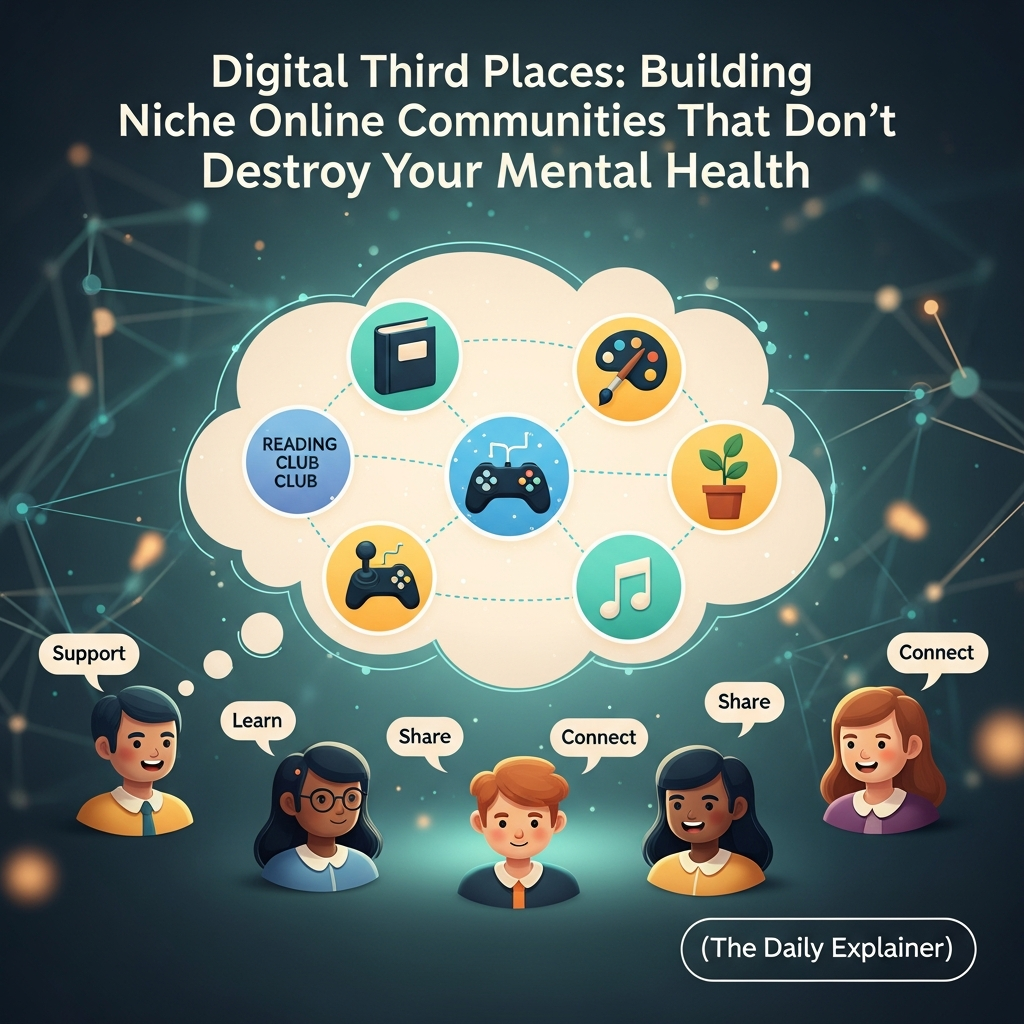
- Misconception: If you build it, they will come.
- Reality: This is the number one cause of community ghost towns. A platform is just an empty room. You must first gather the people, then provide them with the room. Start with a pre-existing network (Twitter list, email newsletter, small group chat) and migrate it.
- Misconception: More members = more successful community.
- Reality: Quality and engagement density trump sheer size. A hyper-engaged, supportive community of 300 is infinitely more valuable and sustainable than a silent, chaotic group of 30,000. Focus on the health of the core, not vanity metrics.
- Misconception: A Code of Conduct is a “set and forget” document.
- Reality: A CoC is a living document that must be enforced consistently to have meaning. Inconsistent enforcement is worse than having no rules, as it breeds perceptions of bias and unfairness. Revisit and revise it annually with community input.
- Misconception: The founder/leader should be the most active participant in all conversations.
- Reality: This is a path to burnout and can create a culture of dependency. The leader’s role should evolve from host to facilitator to gardener. Your goal is to create spaces where great conversations happen between members, not just with you. Step back and let the community breathe.
- Misconception: Digital Third Places are just escapism from the “real world.”
- Reality: For millions, these communities are a profoundly real part of their social and professional world. The relationships, support, and opportunities forged there have tangible impacts on careers, mental health, and life outcomes. They are not a substitute for offline life, but a vital and valid supplement to it.
Recent Developments (2025-2026)
- The “Right to Community” in Digital Law: The EU’s Digital Services Act (DSA) is being tested in cases where large platforms shut down niche communities without clear due process. Legal scholars are arguing for a “proportionality principle” for community takedowns, recognizing their social value.
- Corporate “Internal Third Places”: Forward-thinking remote-first companies are intentionally creating non-work-focused digital spaces for employees (e.g., #parenting, #gardening, #gaming channels) to foster informal connection and combat the loneliness of remote work, directly linking community to productivity and retention.
- The “De-Platforming” of Toxicity: Niche platforms like Circle and Mighty Networks are competing by offering superior, baked-in moderation tools and explicitly marketing “healthy communities” as a core feature. They are becoming the WordPress for community builders who prioritize safety.
- Academic Research Validation: Major universities are now establishing “Digital Community Health” research labs, studying the biomarkers of positive vs. negative online interaction and producing evidence-based guidelines for community design, lending scientific weight to best practices.
- Generative AI Community Forks: Communities centered on AI art or writing are grappling with and establishing nuanced norms around disclosure, plagiarism, and the ethics of training data, serving as real-time ethics committees for emerging technology.
Success Stories
The /r/AskHistorians Subreddit: A Bastion of Quality Through Rigorous Moderation
Despite existing on the often-chaotic platform of Reddit, /r/AskHistorians is a sterling example of a Digital Third Place. Its success is built on an uncompromising commitment to its purpose: providing in-depth, well-sourced answers to historical questions. It achieves this through:
- Extremely strict moderation that removes any answer not meeting a high bar of depth and citation.
- Clear, detailed, and transparent rules that are consistently enforced.
- A culture that values expertise and effort over hot takes or speed.
- A vibrant community of “flaired” experts who are vetted and recognized.
The result is a space trusted by academics, students, and the casually curious alike—a proof that even on a large platform, intentional design can create a world-class Third Place.
The “Writers’ Haven” on Discord: A Paid, Niche Community for Serious Writers
This is a smaller, paid community ($20/month) for novelists working on commercial fiction. Its success factors:
- Ultra-Niche Focus: Not “writing,” but “genre fiction writers aiming for traditional or successful self-publishing.”
- Structured Rituals: Daily word-sprint voice channels, weekly critique partner matching, monthly query-letter workshops.
- Professional Curation: It’s run by a published author who provides office hours and industry insights.
- High Barrier to Entry: The paywall and a short application ensure members are serious, reducing noise and increasing mutual commitment.
It thrives not in spite of its small size and cost, but because of them.
Real-Life Examples
- The “Plant Rescue” Local Group: A WhatsApp group started by a plant enthusiast in one city to facilitate giving away and adopting unwanted houseplants. It has strict rules: no sales, location-specific, photos required. It spawned local “plant swap” meetups in parks, creating both a digital and physical third place that combats waste and fosters local connection.
- The “Data Visualization for Social Good” Slack Workspace: A free community for non-profit analysts and journalists. It has channels for tool help (#ggplot-help), dataset requests, and project feedback. A strong Code of Conduct enforced by a diverse mod team ensures it remains a supportive, not competitive, space. It’s where junior analysts find mentors and collaborative projects emerge.
- The “Retro Gaming Preservation” Forum: An old-school phpBB forum dedicated to repairing and maintaining 1990s gaming hardware. It’s slow, text-heavy, and has a “no memes” rule in the technical sections. Its treasure is a 15-year archive of solved technical problems, a knowledge base created entirely through patient, collaborative troubleshooting. The sense of legacy and shared purpose is palpable.
In my experience, the most vibrant communities often have a tangible, external output—whether it’s answered questions, rescued plants, finished novels, or repaired hardware. This shared mission beyond mere socializing provides a cohesive force and a sense of collective accomplishment.
Conclusion and Key Takeaways
The degradation of our mainstream digital spaces is not an inevitability; it is a design choice. The rise of intentional Digital Third Places is the counter-design—a collective effort to reclaim the internet’s potential for genuine human connection, learning, and support. Building or finding such a space is one of the most impactful actions you can take for your digital wellbeing and sense of belonging in the 21st century.
This guide has provided a framework, but the essence is philosophical: you must choose depth over scale, safety over virality, and people over platforms. Whether you are a founder, a moderator, or a seeking member, your mindset determines the health of the space.
Key Takeaways:
- Purpose is Paramount: A strong, specific “Why” is the bedrock of any lasting community. Niche down fiercely.
- Psychological Safety is Non-Negotiable: It is the oxygen of a healthy community. It must be actively designed for and protected through clear, consistently enforced guidelines.
- Platforms are Tools, Not Destinations: Choose the tool that fits the type of interaction you want to foster (real-time chat vs. async forum). The community’s culture is what matters, not the logo on the app.
- Community is a Verb, Not a Noun: It requires ongoing cultivation, moderation, and adaptation. It is a living system, not a static product.
- Leadership Means Stewardship, Not Stardom: The founder’s role is to set the stage, empower others, and tend to the health of the ecosystem, not to be the constant center of attention.
- Sustainable Growth is Community-Led: The best new members come through the authentic invitation of existing members. Prioritize cultural fit over member count.
- Your Wellbeing Matters Too: Community leadership is emotional labor. Model and enforce boundaries—for yourself and your team—to prevent digital burnout. A healthy community requires healthy stewards.
The internet’s next great chapter won’t be written on monolithic platforms. It will be written in the countless, vibrant, human-scaled Digital Third Places where people gather to be themselves, to learn, to create, and to connect. Find yours, or have the courage to build it.
FAQs (Frequently Asked Questions)
1. Q: I’m not a natural leader. Can I really start a successful community?
A: Absolutely. Community building is more about facilitation and service than charismatic leadership. Your strengths might be in organizing information, asking great questions, or quietly connecting helpful people. Start small, be consistent, and empower others who have complementary skills. Many of the best communities are run by introverts who excel at creating safe containers.
2. Q: What’s the biggest difference between a group chat with friends and a Digital Third Place?
A: Scale, purpose, and openness. A group chat is private, bounded by pre-existing strong ties. A Digital Third Place is semi-public or application-based, centered on a shared interest (not just friendship), and designed to welcome weak ties—strangers who share the passion. It has structure, rules, and a goal of fostering new connections.
3. Q: How do I find a good existing Digital Third Place to join?
A: Look beyond Google. Search niche forums, check the “community” links on the blogs of experts you admire, explore curated directories like Discord.me, or search for “[your interest] + Slack/Discord/Circle” on Twitter. When you find one, lurk respectfully to assess the culture before jumping in.
4. Q: My community is becoming cliquey. Regulars have inside jokes that make newbies feel excluded. How do I fix this?
A: This is common. Address it gently but directly. Create structured “on-ramps” like a weekly “New Member Welcome” thread where old-timers are encouraged to ask questions. Encourage the use of public channels over private inside-joke DMs. As a leader, model bridge-building behavior by publicly asking new members for their opinions.
5. Q: Is it ethical to charge for access to a community?
A: Yes, if you provide clear, ongoing value beyond simple access. Charging a fee can increase commitment, improve quality, and fund better tools/events. The key is transparency: what exactly are members paying for? (Moderation, exclusive content, expert access?). A paid community must be demonstrably better than a free one. For business models, consider insights from guides on starting an online business.
6. Q: How do I handle a dominant, knowledgeable but sometimes abrasive member?
A: This “brilliant jerk” is a common challenge. Have a private, empathetic 1:1 conversation. Frame it positively: “Your contributions are incredibly valuable. To make sure everyone feels safe to learn, can we work on how you deliver feedback?” Give specific examples. If behavior doesn’t change, you must prioritize the community’s psychological safety over one person’s contributions.
7. Q: What are the early warning signs that a community is becoming toxic?
A:
- Quality contributors leaving quietly.
- Increase in passive-aggressive or sarcastic comments.
- “Piling-on” in disagreements instead of 1:1 discussion.
- Moderation actions being publicly debated and second-guessed.
- A shift from collaborative to competitive tones. Act at the first sign, not when it’s a crisis.
8. Q: Can I use AI to help moderate my community?
A: Cautiously, yes. Use AI for first-pass filtering: flagging potential spam, hate speech, or blatant CoC violations for human review. Never use AI for final judgment calls on nuanced conflict. The subtlety of human interaction requires human empathy and context. AI is a tool for scale, not a replacement for principled human moderation.
9. Q: How much time does running a small community really take?
A: For a community of ~100 active members, expect a minimum of 5-7 hours per week for basic moderation, engagement, and administration. For a community of 500+, it can easily become a part-time job (15-20 hrs/week). This is why building a moderator team early is critical.
10. Q: My community wants to stay on a big platform like Facebook for convenience. How can I make it healthier there?
A: You can impose structure even on limiting platforms:
- Create a clear “Group Rules” post and pin it.
- Use post-approval and keyword filtering.
- Create “Topic Threads” within the group (e.g., a single weekly thread for promotions).
- Be proactive about moving detailed discussions to dedicated sub-groups or off-platform for deeper work.
- Acknowledge the platform’s limitations and have an exit plan if it becomes necessary.
11. Q: What is “community-led growth” and how do I encourage it?
A: It’s when members naturally invite others because they love the community. Encourage it by:
- Creating shareable moments (great AMA summaries, collaborative project outcomes).
- Having a clear, warm invitation process (not just an open link).
- Recognizing and thanking members who bring in great new people.
- Ensuring the community is so valuable that members want to share it with like-minded peers.
12. Q: How do I deal with my own guilt or fear as a moderator when I have to ban someone?
A: This is the hardest part. Reframe it: you are not banning a person; you are protecting the community space and its purpose from damaging behavior. You have a duty to the hundreds who follow the rules. Document the violations, ensure you’re not acting alone, and have a trusted co-moderator to debrief with afterward. It never feels good, but it is necessary stewardship.
13. Q: Are there legal liabilities in running a community?
A: Potentially, yes. Key risks include: defamation happening in your space, sharing of pirated content, harassment that spills into real-world threats, and data privacy (if you collect info). It is wise to have a lawyer review your Code of Conduct and Terms of Service, and to have a clear process for responding to legal requests (like DMCA takedowns). Our site’s Terms of Service provides a basic framework to consider.
14. Q: What does “psychological safety” look like in practice in an online forum?
A: It looks like:
- Someone posting “This might be a dumb question, but…”
- A member admitting they were wrong and changing their view.
- A beginner sharing their first, imperfect project and receiving constructive, encouraging feedback.
- A disagreement that stays focused on ideas, not personal attacks.
- Leaders admitting their own mistakes publicly.
15. Q: How do I transition a community from “my project” to “our community”?
A: This is the governance shift. Start by soliciting input on small decisions (e.g., “Should we add a new channel for X?”). Move to forming a member advisory committee to give feedback on bigger issues. Delegate ownership of specific areas (e.g., “Sarah now owns the weekly welcome ritual”). Transfer control of key accounts or funds to a shared entity if possible. It’s a gradual process of giving away control.
16. Q: What are good “rituals” for an online community?
A: Rituals create heartbeat. Examples:
- #Monday-Wins: Sharing small victories.
- “Thank-You Thursdays”: Publicly appreciating another member’s help.
- Monthly “State of the Community” update from leaders.
- Annual “Community Birthday” celebration with reflections.
- Weekly “Off-Topic Prompt” (e.g., “What’s the best thing you cooked this week?”).
17. Q: How can I prevent my community from becoming an echo chamber?
A: This is crucial for learning communities. Frame your purpose around rigorous inquiry, not consensus. Encourage members to post evidence that challenges prevailing views. Have rules that mandate respectful engagement with differing perspectives. Feature “Devil’s Advocate” threads or book clubs that intentionally explore opposing viewpoints. Distinguish between safe space (free from harassment) and comfort zone (free from challenge).
18. Q: My community is silent for days, then explodes with activity. Is this normal?
A: This “pulsing” rhythm is very normal, especially in async forums or communities with members in different time zones. Don’t panic during quiet periods. You can gently prime the pump with a question or resource, but avoid forcing artificial activity. The quality of the “explosion” matters more than constant chatter.
19. Q: Should I allow “venting” or negative posts?
A: This requires a nuanced policy. Blanket bans can feel stifling; unfettered venting can turn the space toxic. Allow it within a designated, bounded container (e.g., a #frustrations channel with a rule: “Vents welcome, but no personal attacks or hate speech. Solutions optional but appreciated.”). This acknowledges real emotion while protecting the overall community tone.
20. Q: How do I know if it’s time to shut down a community?
A: Signs include: Chronic, irreversible toxicity that moderation can’t fix. The core purpose has been fulfilled or is obsolete. Founder/moderator burnout with no succession possible. Sustained, low engagement despite revitalization efforts. If shutting down, do it with grace: give ample notice, archive valuable content, and celebrate what was built. A good death is part of a community’s life cycle.
21. Q: Can a Digital Third Place be built around a for-profit business or brand?
A: Yes, but the community must provide non-transactional value to thrive. It should be a place for users of your product to connect, share tips, and give feedback—not a 24/7 sales channel. The business funds and stewards the space, but the community’s value is in peer connections. Be hyper-transparent about your role. This model is explored in business contexts on partner blogs like WorldClassBlogs.
22. Q: What are the unique challenges of audio-based communities (like Discord voice chats)?
A: They require active, real-time moderation, which is more taxing. They can be less accessible to those who are hearing-impaired or anxious about speaking. Recorded sessions raise privacy issues. Counter this by: having a text-based lobby for each voice channel, assigning dedicated “voice moderators,” establishing clear speaking protocols, and never recording without explicit, collective consent.
23. Q: How do I handle conflicts between two valued members?
A:
- Take it private immediately. Move the discussion to DMs or a private mod channel.
- Listen to each separately to understand their perspective.
- Facilitate a mediated conversation if both parties are willing, focusing on impact over intent.
- Focus on future behavior: “What agreement can we make about how you’ll interact moving forward?”
- If resolution is impossible, you may need to limit their direct interaction (e.g., ask them not to reply to each other’s posts).
24. Q: Is it okay to use the community for my own research or to source ideas for my business?
A: Only with explicit, upfront consent and reciprocity. A covertly extractive community is a breach of trust. If you’re a researcher, get approval from mods, explain your project, and allow members to opt-out. If you’re a business, be clear that feedback may inform your roadmap, and give back—share the results, offer discounts, or feature member ideas with credit. The community is not your focus group.
25. Q: Where can I learn more about advanced community strategy and governance?
A: Follow practitioners like David Spinks (CMX), Bailey Richardson (People & Company), and Rosie Sherry (founder of Rosieland). Read books like “The Art of Community” by Jono Bacon and “Get Together” by Bailey Richardson et al. Join communities for community builders (like The Community Club). The field is evolving rapidly, so continuous learning is key.
About Author
Sana Ullah Kakar is a digital anthropologist and community architect with over a decade of experience studying and building online social systems. His work sits at the intersection of technology, sociology, and mental health, focusing on how digital environments can be intentionally designed to foster human flourishing rather than extract attention. Sana has advised startups, non-profits, and large platforms on community design ethics and sustainable moderation practices.
He believes that the quality of our digital spaces is a direct reflection of our values and that building healthy “Digital Third Places” is one of the most important cultural tasks of our time. For more of his writing that explains complex societal shifts, you can explore the archives of The Daily Explainer.
Free Resources
- Digital Third Places “Playbook” Template (Notion):
- A comprehensive, shareable Notion template with frameworks for defining your purpose, drafting a Code of Conduct, planning your launch sequence, and tracking health metrics.
- Access: Public Notion link (e.g.,
thedailyexplainer.notion.site/Digital-Third-Plays-Playbook-...).
- Code of Conduct Generator & Examples Library:
- An interactive tool that walks you through key questions to build a robust CoC, plus a library of exemplary CoCs from various types of communities (support, hobby, professional).
- Access: A micro-site or downloadable PDF pack available via our Contact Us page by requesting “Community Resources.”
- “Platform Selector” Decision Tree:
- A simple flowchart to help you decide between Discord, Circle, Slack, forums, etc., based on your community’s size, desired interaction style, and budget.
- Access: An interactive web tool or downloadable infographic.
- Community Health Check Survey Templates:
- Ready-to-use anonymous survey templates (for Google Forms or Typeform) to periodically gauge member sentiment, sense of safety, and satisfaction.
- Access: Direct template links provided in a resource article on our Blog.
- Moderator Onboarding & Training Toolkit:
- A guide for community founders on how to recruit, train, and support a volunteer moderation team, including sample role descriptions, escalation scripts, and burnout prevention tips.
- Access: A shared Google Drive folder available to members of our own dedicated community-building channel.
Discussion
This guide is a starting point, not an endpoint. The real knowledge lives in your experiences.
We invite you to share your stories, questions, and hard-won lessons about Digital Third Places.
- For Builders & Moderators: What’s the toughest moderation call you’ve ever had to make? What’s a ritual that transformed your community?
- For Members: What was the moment you knew you’d found “your” community online? What subtle design choice makes a space feel safe to you?
- For Skeptics: Can online communities ever truly replicate the value of in-person third places? What’s the irreducible ingredient that can’t be digitized?
Let’s build a repository of collective wisdom.
Post your thoughts below. Remember, this comment section is a micro-community itself—please engage with the same respect, curiosity, and kindness this guide advocates for. All discussions are subject to our site’s Terms of Service.
About The Author