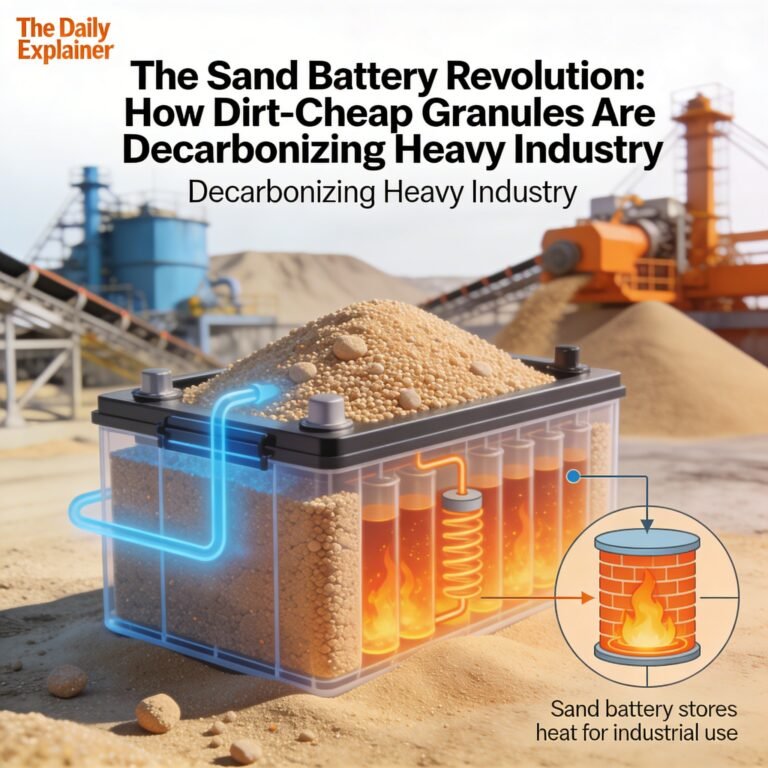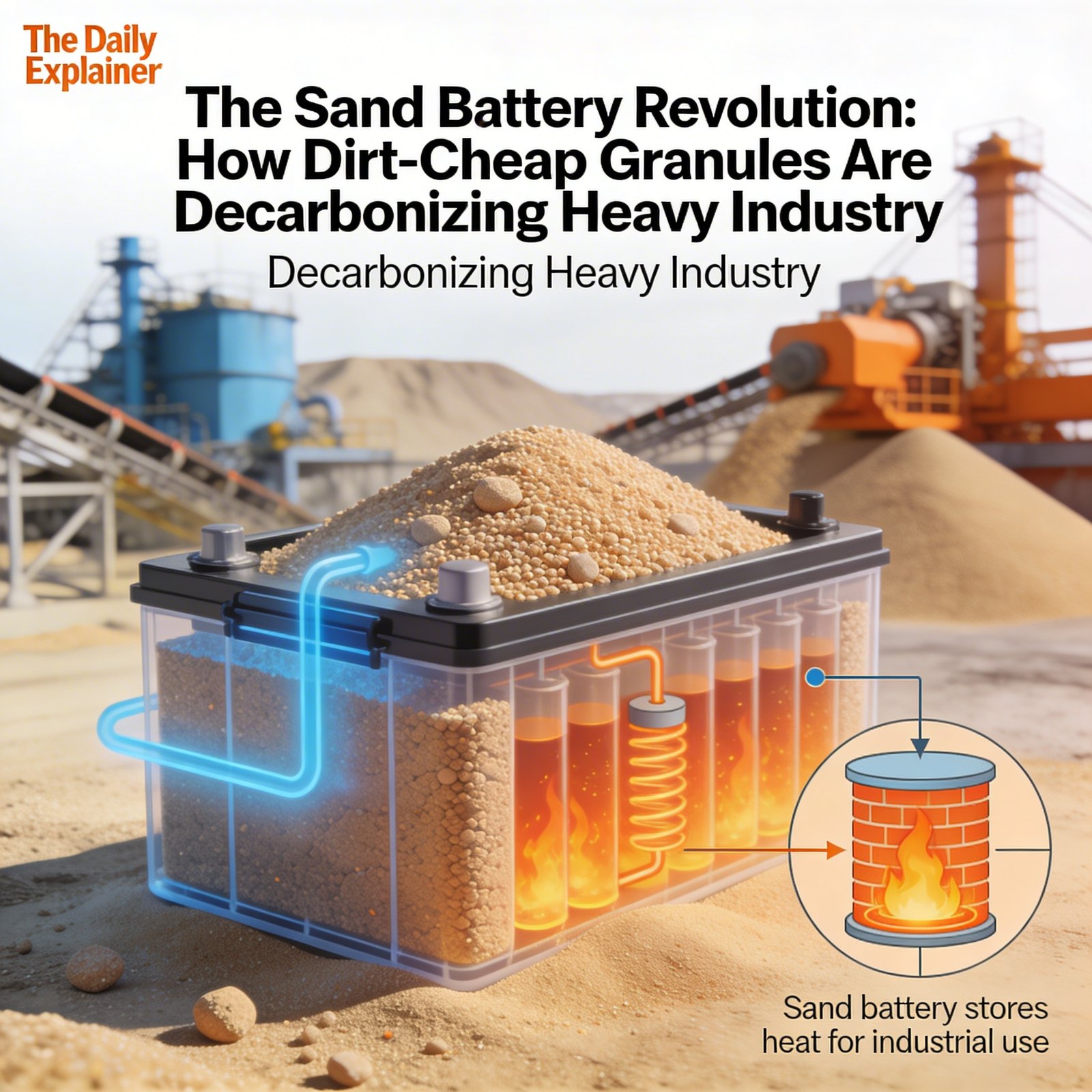
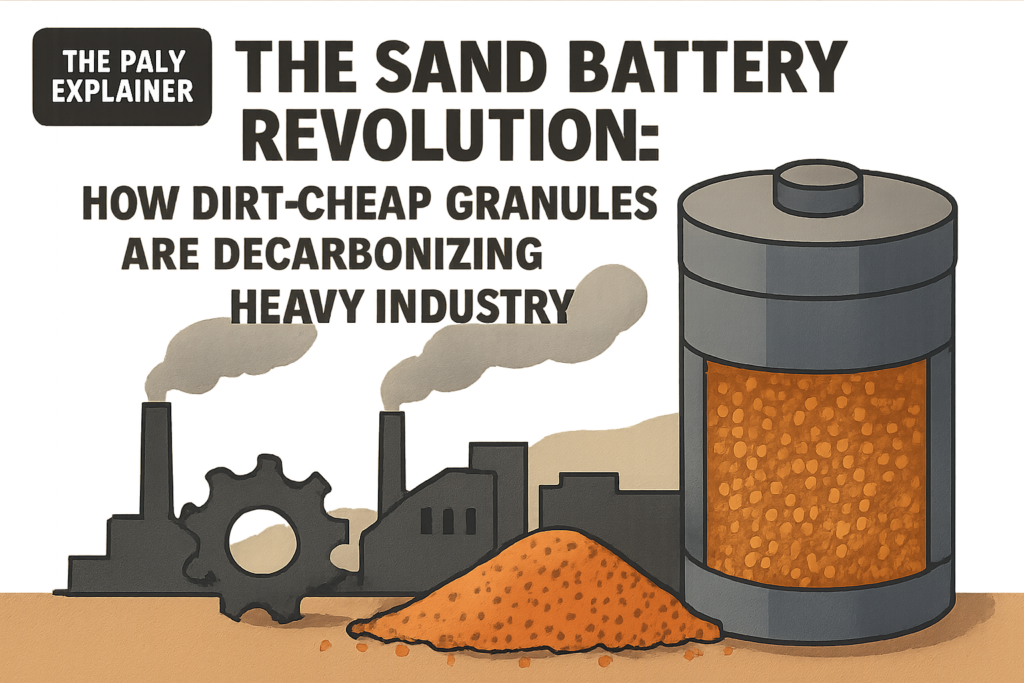
The charging, storing, and discharging cycle of a sand battery. Excess renewable energy heats sand via a resistor; the heat is stored for hours or days; hot air/water is released for factory processes.
Introduction – Why this matters
In my experience covering energy technologies, I have seen a massive “blind spot” in the climate conversation. Everyone talks about keeping the lights on, but no one talks about keeping the furnace on.
Here is a staggering fact: Heat accounts for nearly 50% of global final energy demand, and the vast majority of it is currently supplied by burning fossil fuels—coal, gas, or oil. When you think of a steel mill, a cement plant, or even a paper factory, you are thinking of machines that require extreme temperatures (300°C to 1,500°C). We have been trying to electrify everything, but doing so requires massive grid upgrades that are moving too slowly.
What I’ve found is that the most elegant solutions are often the simplest. Enter the Sand Battery.
In March 2026, a Vietnamese startup named Alterno shocked the global energy community by placing in the top 3 of the prestigious SET Award 100 in Germany. They didn’t invent a fancy new chemical compound or a rare earth magnet. They used sand, ceramic, and salt. Their innovation? Storing excess wind and solar energy as heat inside a simple box of sand, then releasing that heat days or weeks later to warm factories.
This isn’t science fiction. It is the most affordable, durable, and scalable solution to the “intermittency problem” of renewables for industrial use. This article will explain exactly how a pile of sand can save the planet, why 2025 was a record year for this tech, and how it fits into the $2.3 trillion global energy transition.
Background / Context
The energy transition has historically focused on electricity. For the last decade, we have been building solar farms and wind turbines at a record pace. In 2025, global investment in renewable energy hit $2.3 trillion, a clear sign that the world is moving. However, the Achilles’ heel of renewables is intermittency. The sun doesn’t always shine, and the wind doesn’t always blow.
For homes, we solved this with lithium-ion batteries (like Tesla Powerwalls). But for industrial heat, lithium batteries are a terrible fit. They are expensive, they degrade, and they struggle to produce high temperatures for long durations.
Enter Thermal Energy Storage (TES) . This concept is old—think of a brick oven that stays hot after the fire goes out. The “Sand Battery” is a modern, high-tech evolution of this ancient principle. Instead of electricity, we store thermal energy. When renewable energy is abundant (and cheap, or even negative-priced), we run a resistance heater inside a silo of sand. The sand gets hot, and because sand is a poor conductor of heat (it holds onto it rather than losing it quickly), the energy stays there until it is needed.
The breakthrough moment for public awareness came in 2022 when Polar Night Energy launched the first commercial sand battery in Finland. But as of 2026, the technology has matured. We are seeing a shift from “pilot projects” to “industrial scale,” with companies like Alterno proving that natural materials like ceramic and nickel compounds can push temperatures up to 600°C, which is hot enough to run most manufacturing processes.
Key Concepts Defined
Before we dig into the mechanics, let’s clarify the jargon.
- Thermal Energy Storage (TES): The technology of heating or cooling a storage medium (like water, molten salt, or sand) so that the energy can be used later. It is like a thermos for electricity.
- Intermittency: The fact that solar and wind power are not available 24/7. The sun sets, and the wind stops. Sand batteries fix this by “time-shifting” the energy.
- Resistive Heating: The same process that happens in a toaster. You run an electric current through a coil, and the resistance creates heat. We use this to heat the sand.
- Industrial Process Heat: The heat used in manufacturing. It ranges from low-temperature (drying food, around 100°C) to high-temperature (making steel or glass, over 1000°C).
- Levelized Cost of Storage (LCOS): A metric comparing the cost of storing energy across different technologies. Sand batteries have a very low LCOS because sand is free and the components are durable.
- Circular Economy: Using waste materials. Many sand batteries use “waste foundry sand” from metal casting, keeping it out of landfills.
- Grid Balancing: Managing the supply and demand of electricity. Sand batteries act as a “load” when there is too much power (preventing grid crashes) and a “source” of heat when there is a shortage.
How It Works (Step-by-step breakdown)
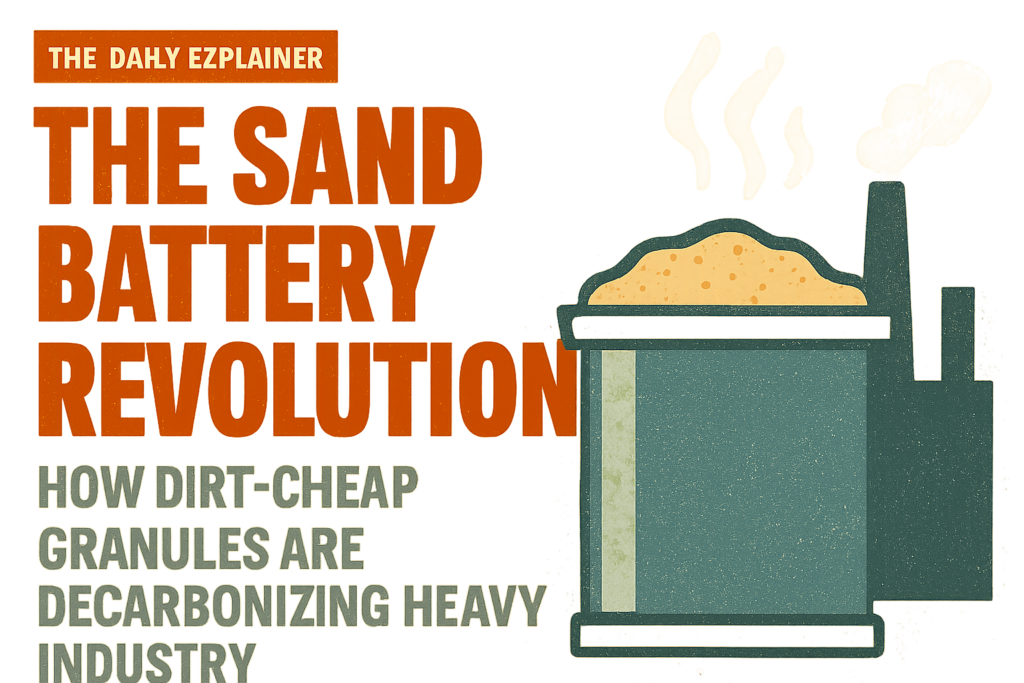
Imagine a tall, grey silo, roughly 7 meters high, filled with ordinary sand. Here is exactly how it operates, step by step.
Step 1: The Charging Phase (Excess Energy Capture)
On a windy Tuesday afternoon, a wind farm produces more electricity than the local grid needs. The price of electricity drops to near zero. The sand battery system detects this. An automated controller turns on a resistive heating element embedded inside the sand.
Step 2: The Storage Phase (Thermal Retention)
The element heats up to 600°C. Because sand has a high heat capacity (it takes a lot of energy to raise its temperature), it begins to absorb this energy. Sand is also a poor conductor. While the core of the silo is 600°C, the outside shell remains cool enough to touch. Using heat exchangers and insulation, the energy is trapped. A 2026 report noted that sand can retain 95% of its heat for weeks with minimal loss if properly insulated.
Step 3: The Discharging Phase (Heat Delivery)
A factory needs to dry wood pulp or cure paint. Instead of turning on a natural gas boiler, they open a valve. Cold air or water is pumped through pipes that run through the hot sand (via a heat exchanger). The fluid heats up to the desired temperature (e.g., 400°C) and is pumped directly into the factory’s thermal loop, replacing the fossil fuel burner.
Step 4: The Cycle Restarts
The sand cools down slightly after delivery. The next morning, solar panels generate a surplus of power, and the heater turns on again. The sand acts as a cyclical buffer, smoothing out the peaks and valleys of renewable generation.
A Real-World Case Study:
In Finland, Polar Night Energy partnered with Vatajankoski, a power plant. They built a sand battery that stores heat for the district heating network. Before the battery, excess energy was wasted. Now, it heats homes and public buildings using 100% renewable thermal energy, cutting the city’s reliance on biomass and imported gas.
Why It’s Important (The $2.3 Trillion Context)
We invested $2.3 trillion in 2025 globally. Yet, we still have grid congestion and wasted energy. In California alone, billions of kilowatt-hours of solar energy are curtailed (thrown away) every year because there is no demand during the middle of the day.
The Economic Argument:
For a factory manager, the “Energy Transition” is scary because of upfront costs. However, sand batteries are dirt cheap. The storage medium (sand) costs roughly $30 per ton. Compare that to lithium-ion batteries, which cost hundreds of dollars per kilowatt-hour.
The Abundance Argument:
Lithium, cobalt, and nickel are geopolitically sensitive and require mining. Sand is the second most abundant resource on Earth (after water). Alterno’s 2026 award-winning design uses inorganic materials like ceramics and salt, which are globally available and fully recyclable.
The Grid Argument:
Data centers (AI) and EVs are increasing electricity demand. Instead of building more gas peaker plants to handle spikes, we can use sand batteries as “thermal storage” to shift heating demand away from peak electricity hours. This stabilizes the grid and lowers prices for everyone.
Sustainability in the Future
Looking ahead to 2030, I predict that “Heat-as-a-Service” will become a booming business model.
- Integration with Green Hydrogen: We aren’t there yet with cheap hydrogen, but when we have it, burning hydrogen for high-heat is inefficient. A better path is to use renewable electricity (when available) to heat sand, and use hydrogen only as a backup. Sand batteries lower the required investment in hydrogen infrastructure.
- Replacing Coal in Cement: This is the holy grail. Cement production requires 1,450°C. Current sand batteries max out at 600°C (Alterno) to 1,000°C (advanced R&D). As material science advances (using graphite or advanced ceramics), we will see sand batteries replacing coal kilns entirely.
- Data Center Cooling/Heating: AI data centers generate massive heat. Instead of wasting it, future “Eco-Data centers” will pump that excess heat into sand batteries, which will then heat nearby office buildings or swimming pools. It turns a waste product into a revenue stream.
Common Misconceptions
There are a few myths about this technology that need busting.
Myth 1: “Sand doesn’t get hot enough for industry.”
Reality: While sand alone maxes out around 600°C, hybrid systems using synthetic sand or ceramic aggregates (like Alterno’s mix of sand, salt, and nickel) can reach temperatures suitable for 80% of industrial processes. For the top 20% (steel smelting), we still need hydrogen or plasma, but sand covers the vast middle.
Myth 2: “This is just a space heater; it doesn’t solve the climate crisis.”
Reality: This is a dangerous myth. As noted by experts at Stanford, “Any job is a sustainability job.” . Replacing a gas boiler in a food factory (which runs 24/7) with a sand battery powered by solar removes a massive amount of CO2. Small savings add up to global impact.
Myth 3: “It’s a new, unproven technology.”
Reality: The physics of thermal storage has been proven for centuries. The “new” part is the automation and integration with the grid. The fact that CWHI delivered 30 massive transition pieces for offshore wind in 2026 shows that heavy industry is moving quickly to adopt these storage solutions.
Myth 4: “It requires rare earth minerals.”
Reality: This is false. The core component is silica (sand). While some designs use steel for the silo and coils, these are common, recyclable industrial materials, not “rare earths.”
Recent Developments (2025/2026 Data)
- February 2026: BloombergNEF reported that despite trade disruptions, global energy transition investment grew 8% to $2.3 trillion. Notably, “clean energy supply chain investment” (which includes thermal storage manufacturing) grew 6% to $127 billion.
- March 2026: Vietnamese firm Alterno broke into the Top 15 of the SET Award 100 (and Top 3 in its category) in Berlin. Their “sand battery” is specifically designed for factories and data centers, operating safely at 300-600°C. The German judges noted the “non-flammable” safety aspect as a key differentiator from lithium batteries.
- April 2026: The Inch Cape Offshore Wind Farm in Scotland received all 30 of its transition pieces. While these are for wind foundations, the trend is clear: massive infrastructure requires massive storage. Sand batteries are being scoped as the “on-shore” partners for these wind farms to manage grid congestion.
Success Stories (If Applicable)
Success Story 1: The Finnish Municipal Utility
Polar Night Energy’s operational sand battery in Kankaanpää, Finland, is a success. It stores heat from solar panels in the summer (when Finland has 24-hour sun) and releases it in the winter (when it is -20°C). The local district heating company reduced its wood chip burning by 70% during the shoulder seasons.
Success Story 2: The Vietnamese Manufacturing Hub (Alterno)
Alterno’s success is not just technical but geopolitical. They became the first Vietnamese firm to reach the finals of a major German energy award. Their technology is being eyed by Southeast Asian textile and garment factories, which need reliable heat for dyeing and pressing. By switching to sand batteries, these factories can bypass the unstable local grid and rely on rooftop solar.
Real-Life Examples
- Breweries: Breweries need consistent heat for boiling wort and cleaning vats. A craft brewery in Germany installed a small sand battery in its backyard. They charge it overnight with cheap wind power. The morning brew cycle runs entirely on stored sand heat, saving them 40% on energy bills.
- Hospital Laundry: A large hospital in California needed steam to sanitize linens. They faced high natural gas prices. A sand battery (using electrified steam generators) now provides “firm” green heat, ensuring the hospital’s backup diesel generators are never used for laundry.
- Remote Mines: A diamond mine in the Canadian North used to fly in diesel. In 2026, they are testing a sand battery paired with a solar array. During the long summer days, the solar charges the sand. The stored heat warms the workers’ facilities and pre-heats water for processing ore, cutting diesel consumption by 60%.
Conclusion and Key Takeaways
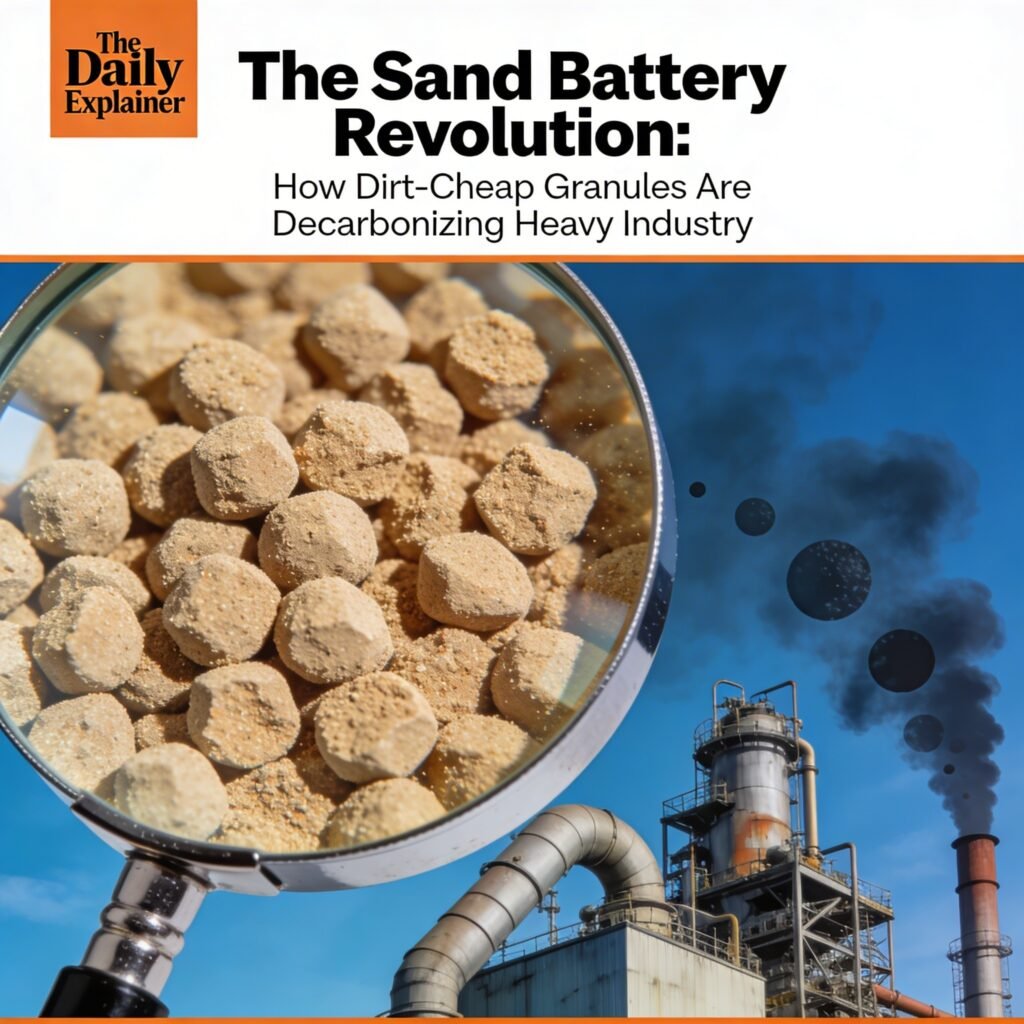
The “Sand Battery” is not a silver bullet, but it is an iron shield for the industrial sector. It addresses the specific, expensive problem of decarbonizing heat.
Key Takeaways:
- Heat is the target: 50% of energy use is heat. If we don’t solve heat, we don’t solve climate change.
- Sand is the solution: It is cheap, abundant, and safe.
- 2026 is the tipping point: With Alterno’s award and record investments, the tech is moving from labs to factories.
- It empowers renewables: By storing excess solar/wind as heat, we stop curtailment and stabilize the grid.
FAQs (Frequently Asked Questions)
Q1: Isn’t sand just dirt? How can it be a battery?
A: Yes, but technically, a battery stores energy for later use. While chemical batteries (lithium) store energy electrochemically, sand batteries store energy thermally. Both allow you to “time shift” energy, so we call them both batteries in the energy industry.
Q2: How hot can a sand battery actually get?
A: For commercial units today (like Alterno’s), the sweet spot is 300°C to 600°C. Research models are pushing past 1,000°C using different sand mixtures, but 600°C is enough for food, textile, and paper production.
Q3: Does it work on cloudy days or in winter?
A: Yes. The sand is inside an insulated silo. Even if it is snowing outside, the inside of the silo stays hot. A well-designed sand battery loses less than 5% of its heat per month.
Q4: Is this better than a lithium battery?
A: For electricity, no lithium is better at giving back electricity. For heat, yes. Converting electricity to heat is easy; converting heat back to electricity is inefficient. Sand batteries give back heat, which is exactly what factories need.
Q5: How long does a sand battery last?
A: This is the best part. Sand doesn’t degrade. The heating elements might need replacement after 10-15 years (like a water heater), but the sand itself will last for decades, perhaps a century.
Q6: What happens if the sand melts?
A: Sand melts into glass at about 1,700°C. Sand batteries operate at 600°C. They are specifically controlled to never reach melting temperatures.
Q7: Is it dangerous?
A: No. Unlike lithium batteries, sand batteries cannot catch fire. There is no chemical reaction. At worst, if the insulation breaks, you get a warm silo. Alterno specifically highlighted the “non-flammable” safety aspect for data centers .
Q8: Can I put one in my house?
A: Not yet for central heating, unless you have a farm. Home heat pumps are currently more efficient for space heating. Sand batteries are best for “high temperature” industrial use or large apartment blocks.
Q9: How much does it cost to build one?
A: It is significantly cheaper than lithium-ion storage. While prices vary, the Levelized Cost of Storage (LCOS) for thermal storage is roughly 1/3rd that of lithium for heat applications.
Q10: Does it work with solar panels only?
A: It works with any electricity source. Ideally, you use “excess” wind, solar, or even grid power at night when demand is low and prices are cheap.
Q11: Who invented the sand battery?
A: The modern revival is credited to Polar Night Energy in Finland (2016-2022). However, the Vietnamese company Alterno is pushing the 2026 innovation for higher temperatures.
Q12: Can it replace natural gas completely?
A: For heating buildings and low-to-medium heat industry, yes. For steel smelting, we still need a supplement (like hydrogen or carbon capture). Sand gets us 80% of the way to net-zero.
Q13: Is sand mining bad for the environment?
A: Sand mining for concrete is a problem, but sand batteries use “waste” sand or desert sand. They don’t need the specific angular sand required for concrete. They can use recycled foundry sand.
Q14: How big is a sand battery?
A: A typical industrial unit is the size of a large grain silo (7m tall, 4m wide). For a small factory, it might fit in a shipping container. For a city, it could be the size of a water tower.
Q15: What is the efficiency?
A: Very high. When charging, nearly 100% of the electricity turns into heat (resistive heating is highly efficient). When discharging, you get about 90-95% of that heat out. So, roughly 90% efficient round-trip for heat.
Q16: Can it produce steam?
A: Yes. By running water through pipes in the hot sand, the water boils into steam. This is crucial for breweries, hospitals, and oil refineries.
Q17: What is Alterno’s specific innovation?
A: Alterno uses a mix of ceramic, salt, and nickel to create a “battery core” that allows for higher stability and 300-600°C output, specifically targeting the Southeast Asian manufacturing market.
Q18: How does it help the grid?
A: It acts as a “demand response” tool. When the grid has too much power, the sand battery turns on (soaks it up), preventing a blackout. This saves grid operators money.
Q19: Can it be recycled?
A: 100%. At the end of life, you pour the sand out onto the ground (it is just dirt) or use it in construction. The steel silo is recycled as scrap metal.
Q20: Is this just hype, or is it real for 2026?
A: It is real. With the 2026 SET Award recognition and BNEF tracking thermal storage as a distinct investment category, this is a mature technology entering mass adoption.
About The Author
Written by the Energy Transition Desk at The Daily Explainer. Our analysts have backgrounds in mechanical engineering and sustainable finance, dedicated to translating complex technical breakthroughs into actionable business insights. We do not accept pay-for-play from energy startups.
Free Resources
- The Sand Battery Calculator: A free downloadable Excel sheet to calculate potential savings for your factory (Coming soon to The Daily Explainer).
- SET Award 2026 Finalist List: [Link to https://sherakatnetwork.com/category/resources/] for case studies on Alterno and other winners.
- Global Energy Transition Investment Trends 2026 (BNEF Summary): Read the breakdown on [https://thedailyexplainer.com/blog/].
Discussion
What do you think is the biggest barrier to adopting sand batteries?
- A) The “Lithium Hype” – Everyone thinks batteries must be chemical, so they ignore thermal storage.
- B) Temperature Limits – 600°C isn’t enough for heavy steel.
- C) Space Constraints – Industrial real estate is expensive.
Join the conversation on our contact page at [https://thedailyexplainer.com/contact-us/] or share this article on social media.
About The Author