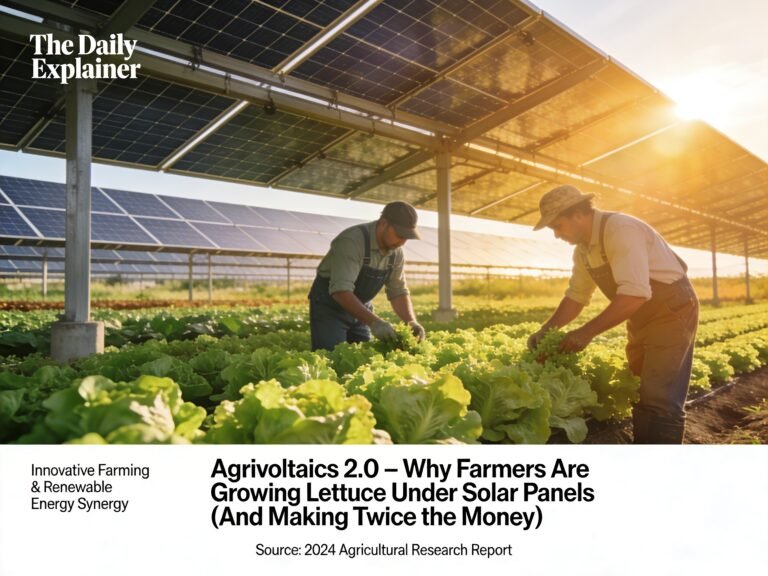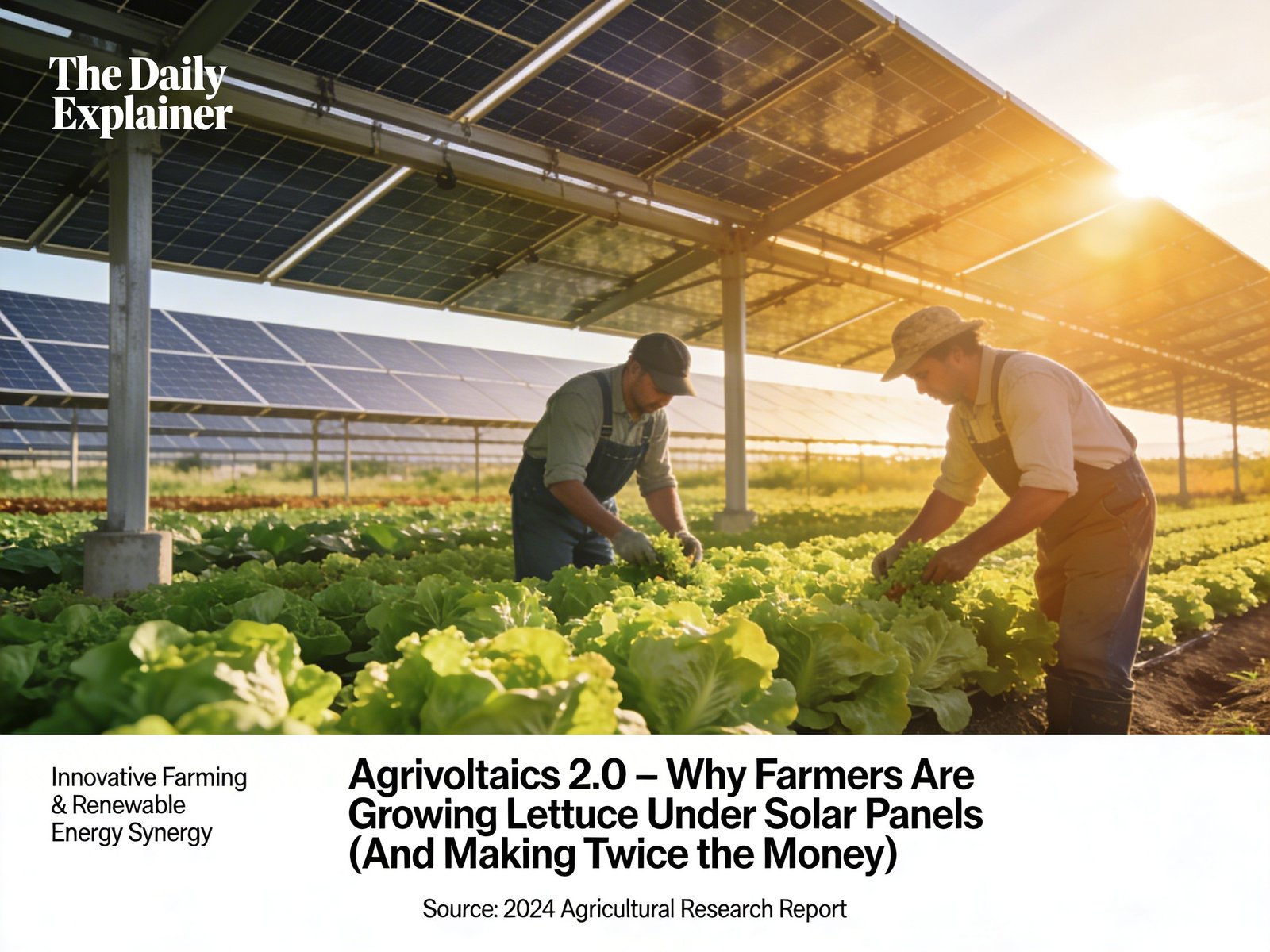
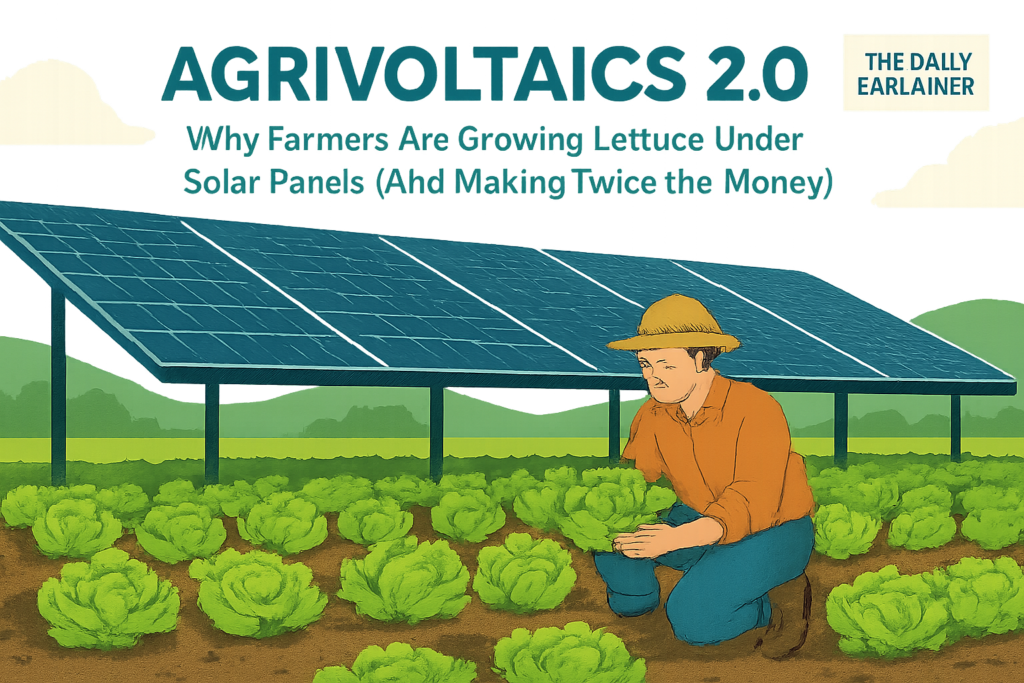
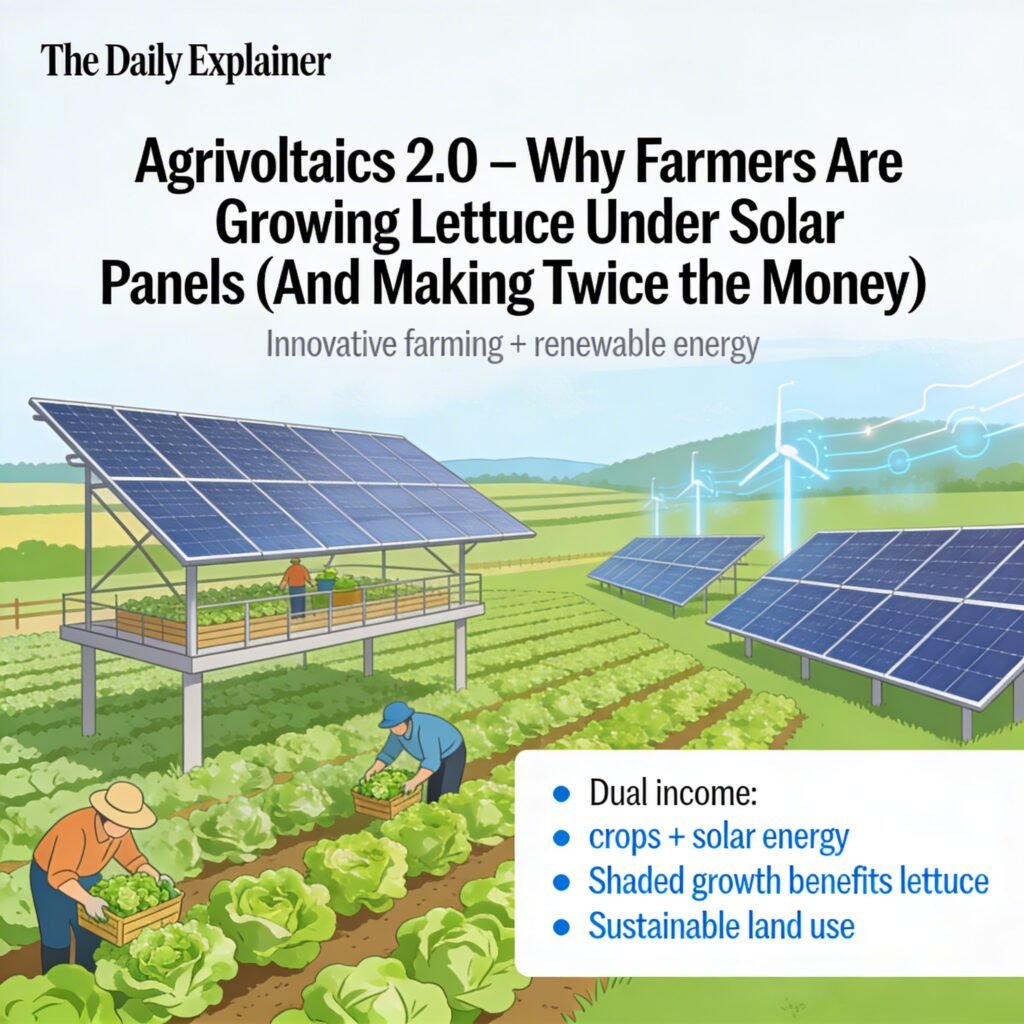
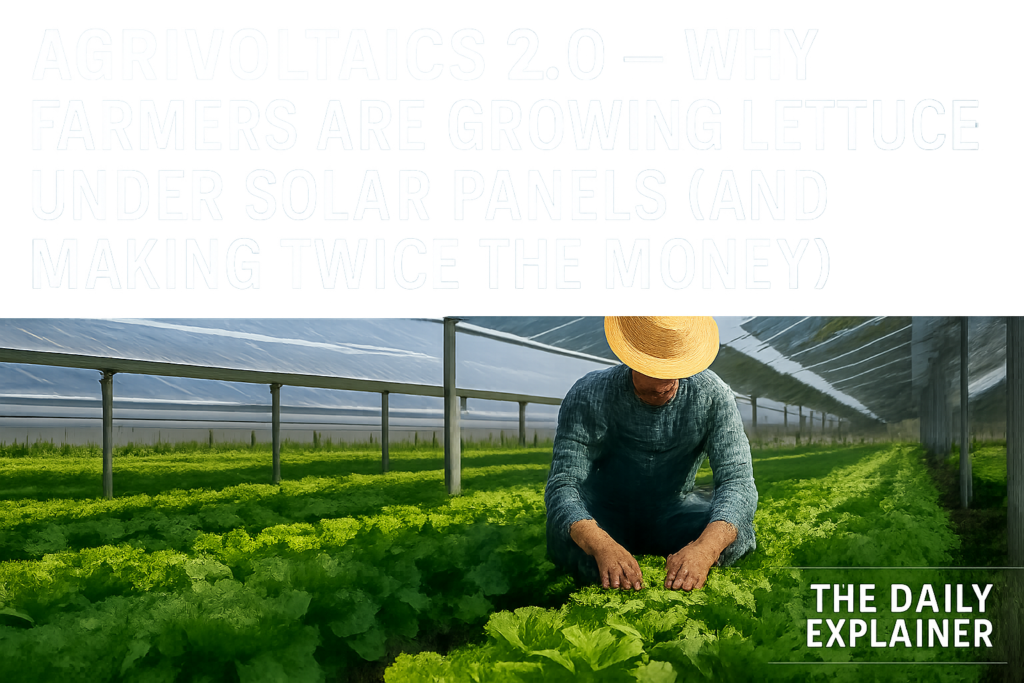
Agrivoltaic systems mount solar panels high enough (8–15 feet) to allow farming underneath, creating a dual-use landscape that produces both food and electricity.
Introduction – Why This Matters
In my experience visiting rural farming communities across the American Midwest and Europe, I have witnessed a deepening tension over the past five years. Farmers are struggling. Crop prices are volatile. Input costs (fertilizer, fuel, seed) keep rising. Younger generations don’t want to take over the family farm. At the same time, solar developers are knocking on farmhouse doors, offering lease payments for land to build solar farms.
The typical farmer reaction? Suspicion. “You want to cover my best farmland with glass and metal? What happens to my soil? What happens to my ability to grow food?”
It’s a fair question. For years, the assumption was that solar farms and agriculture were competing uses of land. You either grew food, or you generated electricity. You couldn’t do both.
What I’ve found is that this assumption is completely wrong.
Enter Agrivoltaics (also called agri-PV or dual-use solar). This is the practice of co-locating solar panels and crops on the same land. The panels are mounted higher off the ground (6 to 15 feet instead of 3 feet). They are spaced further apart. The result? Crops grow underneath. The panels provide shade, reduce water evaporation, and protect plants from extreme heat. Meanwhile, the farmer collects both crop revenue and solar electricity revenue.
In 2026, agrivoltaics is no longer a research curiosity. It is a rapidly scaling commercial reality. According to the National Renewable Energy Laboratory (NREL) 2026 Agrivoltaics Market Report, installed agrivoltaic capacity in the United States reached 12 gigawatts in 2025, up from just 0.5 gigawatts in 2020. Europe has even more, with Germany, France, and Italy leading the way.
This article explains exactly how agrivoltaics works, why 2026 is the breakout year, how farmers are doubling their income per acre, and why this matters for the broader energy transition that we’ve been exploring in our previous articles — including the critical role of grid infrastructure (as discussed in our transformer shortage piece) and thermal storage solutions.
Background / Context
The Land Use Conflict
The energy transition requires a massive amount of land. A typical utility-scale solar farm requires 5 to 10 acres per megawatt of capacity. To reach net-zero emissions by 2050, the world will need to install thousands of gigawatts of solar. That translates to millions of acres of land.
Where does that land come from? In many countries, the most affordable, flat, sunny land is currently used for agriculture. This creates an inevitable conflict: food versus energy.
Environmental groups have raised concerns about “solar sprawl” — the conversion of farmland, forests, and natural habitats to solar development. Farmers have resisted leasing their land, worried about long-term soil health and their identity as food producers.
The Birth of Agrivoltaics
The concept of agrivoltaics was first proposed in 1981 by German physicist Adolf Goetzberger and Armin Zastrow. They suggested mounting solar panels high enough to allow farming underneath. But the idea remained academic for decades.
The first modern agrivoltaic research project was launched in 2011 in France, at the Montpellier SupAgro agricultural school. Researchers planted lettuce, cucumbers, and tomatoes under elevated solar panels. The results were surprising: many crops grew better under partial shade than in full sun, because the panels protected them from heat stress and reduced water loss.
In 2019, the Fraunhofer Institute for Solar Energy Systems in Germany published a landmark study showing that agrivoltaic systems could increase total land productivity by 60% to 80% compared to using land for only crops or only solar. That is, you get 80% of the crop yield plus 80% of the solar yield on the same acre.
The 2026 State of Play
As of early 2026, agrivoltaics has moved from research plots to commercial farms. Major solar developers (NextEra, Enel, Lightsource BP) now offer “dual-use” solar projects as a standard product. Governments have responded with incentives. France requires all new solar farms larger than 10 acres to be agrivoltaic. Japan has over 2,000 agrivoltaic farms. The US Department of Energy launched a $20 million agrivoltaics research program in 2025.
The timing is critical because, as we discussed in our previous article on transformer shortages, the grid interconnection bottleneck means that solar projects need every advantage to pencil out financially. Agrivoltaics improves the economics by adding crop revenue to electricity revenue, making projects more viable even with extended transformer lead times.
Key Concepts Defined
- Agrivoltaics (Agri-PV): The co-location of solar photovoltaic panels and agricultural crops on the same land. Panels are elevated and spaced to allow farming equipment and sunlight penetration.
- Dual-Use Solar: Another term for agrivoltaics. Emphasizes that the land serves two purposes simultaneously.
- Shade Tolerance: The ability of a plant to grow and produce yields under reduced sunlight. Many leafy greens (lettuce, spinach, kale) are shade-tolerant. Many fruiting plants (tomatoes, peppers) are moderately shade-tolerant. Grains (wheat, corn) are not.
- Microclimate: The local climate conditions (temperature, humidity, light, wind) under the solar panels. Agrivoltaic panels create a cooler, wetter, less windy microclimate that benefits many crops.
- Water Evaporation Reduction: A key benefit of agrivoltaics. Panel shade reduces soil temperature, which reduces water evaporation. Studies show 20–50% less irrigation water needed.
- Land Equivalent Ratio (LER): A metric that measures total productivity of dual-use land compared to single-use land. LER of 1.6 means the agrivoltaic acre produces 60% more value than a crop-only acre or a solar-only acre.
- Tracking vs. Fixed-Tilt Panels: Fixed panels stay at one angle. Tracking panels follow the sun. In agrivoltaics, tracking panels can be programmed to “tilt away” during peak sun to give crops more light.
- Pollinator-Friendly Solar: A related practice where solar farms are planted with native wildflowers and grasses to support bees and butterflies. Not the same as agrivoltaics (which grows harvestable crops), but often combined.
- Vertical Agrivoltaics: A newer approach where panels are mounted vertically (like fences) with crops growing between the rows. Works well for narrow-row crops like berries and some vegetables.
How It Works (Step-by-Step Breakdown)
Designing an Agrivoltaic System
An agrivoltaic farm looks different from a conventional solar farm. Here is the step-by-step design and operation process.
Step 1: Site Selection and Crop Matching
Not every crop works with agrivoltaics. The first step is matching the crop to the panel configuration.
- High shade tolerance (works great): Lettuce, spinach, kale, chard, arugula, broccoli, cauliflower, cabbage, carrots, radishes, beets, potatoes, herbs (basil, cilantro, mint).
- Moderate shade tolerance (works with adjustment): Tomatoes, peppers, eggplants, cucumbers, beans, peas, strawberries, blueberries.
- Low shade tolerance (does not work): Corn (maize), wheat, rice, soybeans, sunflowers, cotton.
The farmer and solar developer choose the crop first, then design the panel layout around the crop’s light requirements.
Step 2: Panel Height and Spacing
Conventional solar farms mount panels at 3 to 4 feet above ground. Agrivoltaic systems mount panels at 6 to 15 feet.
- 6–8 feet height: Suitable for hand-harvested crops (lettuce, herbs, strawberries). Workers can walk underneath. Small tractors may not fit.
- 10–12 feet height: Suitable for small tractors and harvesting equipment. Common for tomatoes, peppers, and potatoes.
- 15+ feet height: Suitable for large tracters and combines. Used for crops like wheat and corn (though these are less ideal for agrivoltaics).
Spacing between panel rows is also wider. Conventional solar: 10–15 feet between rows. Agrivoltaic: 20–40 feet between rows. The wider spacing allows sunlight to reach crops between the panel rows.
Step 3: Panel Density and Orientation
Agrivoltaic systems use fewer panels per acre than conventional solar. A conventional solar farm might cover 80–90% of the ground with panels. An agrivoltaic farm covers 40–60% of the ground. The rest is open space for crops and sunlight.
Panel orientation matters. Fixed panels facing south (in the Northern Hemisphere) cast shadows that move north over the day. Some designs use east-west facing panels (like a pitched roof) to create more uniform shading.
Step 4: Mounting Structure Installation
The mounting structures for agrivoltaics are more robust and expensive than conventional solar. They must withstand wind loads at greater heights. The foundation (concrete piers or driven posts) must be deeper. This is the largest cost difference between conventional and agrivoltaic solar.
Step 5: Crop Planting and Management
Once the panels are installed, farming proceeds much as normal, but with adjustments:
- Irrigation: Less water is needed because of shade. Drip irrigation under the panels is common.
- Fertilizer: Similar to open-field farming. Some studies show reduced fertilizer needs because cooler soil retains nutrients better.
- Pest management: The microclimate under panels can reduce some pests (because of cooler temperatures) but increase others (because of higher humidity). Monitoring is essential.
- Harvesting: For taller panel heights (10+ feet), standard harvesting equipment works. For lower heights, hand harvesting or specialized low-profile equipment is required.
Step 6: Solar Electricity Generation
While crops are growing, the panels generate electricity. This electricity can:
- Power the farm itself: Irrigation pumps, cold storage, electric tractors (replacing diesel).
- Sell to the grid: Feed into the local utility via a transformer (subject to the transformer lead time constraints discussed previously).
- Charge on-site batteries: Store excess energy for nighttime use. As noted in our sand battery article, thermal storage can also capture excess heat for greenhouse operations.
Step 7: Seasonal Adjustments
Some advanced agrivoltaic systems use tracking panels that change angle throughout the day and year.
- Summer: Panels tilt to provide more shade during peak heat (reducing crop stress).
- Winter: Panels tilt to allow more sunlight to reach crops (extending the growing season).
- Adjustable panels can also tilt completely vertical during heavy snow or high winds to shed loads.
Why It’s Important
Solving the Food vs. Fuel Debate
The most obvious benefit of agrivoltaics is that it eliminates the land use conflict. You don’t have to choose between growing food and generating clean electricity. You can do both on the same acre.
This is critical as the world adds population (projected to reach 9.7 billion by 2050) and climate change reduces arable land. Agrivoltaics increases total output per acre.
Water Conservation
Agriculture accounts for 70% of global freshwater withdrawals. Climate change is making water scarcer in many farming regions.
Agrivoltaics reduces irrigation needs by 20–50%, according to a 2025 meta-analysis of 56 studies published in Nature Sustainability. The shade from panels reduces soil evaporation. The panels themselves can also capture rainwater (which drips down between panel gaps) and direct it to crops.
Real example: A 2024 study in Arizona compared tomato farming under agrivoltaic panels versus open fields. The agrivoltaic tomatoes used 45% less water and produced 25% higher yield (because of reduced heat stress).
Protecting Crops from Extreme Heat
The summer of 2025 was the hottest on record globally, according to NASA. Heat waves killed crops across Europe, North America, and Asia. Wheat yields in France dropped 30%. Corn in the US Midwest suffered.
Agrivoltaic panels act as a heat shield. The temperature under panels is typically 5–10°F cooler than ambient air. This can mean the difference between a viable harvest and total crop failure.
Farmer Income Diversification
This is the most practical benefit for farmers. Farming is a low-margin, high-risk business. A single drought, flood, or pest outbreak can wipe out a year’s income.
Agrivoltaics adds a second revenue stream: solar electricity. Solar lease payments to farmers typically range from $500 to $2,000 per acre per year, depending on location and panel density. This is guaranteed income for 20–30 years (the life of the solar contract), regardless of crop prices or weather.
In 2025, a survey of agrivoltaic farmers in Germany found that their net income per acre was 2.2 times higher than that of conventional farmers growing the same crops. The solar revenue effectively doubled their profit margin.
Supporting the Broader Energy Transition
As we’ve discussed in our transformer shortage article, renewable energy projects face long delays for grid interconnection. Agrivoltaics can help in two ways:
- Distributed generation: Smaller agrivoltaic systems (1–5 MW) can connect to distribution lines rather than transmission lines, reducing the need for large power transformers.
- On-farm storage: Agrivoltaic electricity can charge on-farm sand batteries or conventional lithium batteries, storing energy for farm use rather than exporting to a congested grid.
Sustainability in the Future
The 2030 Agrivoltaic Vision
By 2030, leading energy models predict that agrivoltaics will account for 20–30% of new solar capacity in temperate and tropical regions. Key trends:
Crop-Specific Panel Designs: Instead of one-size-fits-all panels, manufacturers will offer panels optimized for specific crops. Lettuce panels (higher density, more shade). Tomato panels (adjustable tilt, more light during fruiting). Berry panels (vertical mounting for easy harvesting).
Integrated Water Management: Agrivoltaic systems will incorporate rainwater capture from panel surfaces, storage tanks, and smart drip irrigation. The panels become part of the water management system, not just the energy system.
Solar Grazing: A related practice where solar farms are grazed by sheep or goats instead of mowed. The animals keep vegetation low (reducing fire risk) and provide an additional farm revenue stream. This is already common in Texas and Australia.
Agrivoltaic Greenhouses: Combining agrivoltaics with greenhouse agriculture. Panels on the greenhouse roof provide electricity and partial shade. Inside, crops benefit from controlled temperature and humidity. This is especially promising for water-scarce regions.
Soil Health and Carbon Sequestration
Long-term studies (now entering their 10th year at some research sites) show that agrivoltaic systems improve soil health compared to open-field agriculture. The shade reduces soil temperature, which increases microbial activity. The reduced evaporation prevents salt accumulation in the soil. Organic matter builds up faster.
Some research suggests that agrivoltaic soils sequester 10–20% more carbon than conventional farm soils, making agrivoltaics a carbon-negative technology (the panels displace fossil electricity, and the soil pulls carbon from the air).
Challenges to Scale
Agrivoltaics is not without challenges. The mounting structures cost 20–40% more than conventional solar mounting. The wider panel spacing means fewer panels per acre, so electricity generation per acre is lower (though total land productivity is higher).
Maintenance is more complex. Vegetation can grow up around panel supports. Weeds must be managed without damaging panels. Harvesting equipment must navigate around posts.
And, as with all solar projects, agrivoltaic farms need transformers to connect to the grid. The same transformer shortage that affects conventional solar affects agrivoltaics. However, because agrivoltaic projects are often smaller and can connect at distribution voltage, they may face shorter transformer lead times than large utility-scale projects.
Common Misconceptions
Myth 1: “Shade is always bad for plants.”
Reality: Many crops evolved as understory plants (growing beneath trees) and actually prefer partial shade. Full sun can stress plants, causing them to close their stomata (pores) and stop photosynthesizing. Partial shade keeps stomata open longer. For leafy greens, 50–70% of full sun is optimal.
Myth 2: “Agrivoltaics is only for small organic farms.”
Reality: Commercial agrivoltaic farms exist at scale. The largest agrivoltaic project in the world (as of 2026) is in China’s Qinghai Province: 1.2 gigawatts of solar capacity over 15,000 acres of goji berry farms. The berries are harvested commercially and sold globally.
Myth 3: “The panels will leak chemicals into my soil.”
Reality: Modern solar panels are encapsulated in glass and inert polymers (EVA or POE). They do not leak chemicals under normal conditions. In the rare event of panel breakage (hail, vandalism), the materials are non-toxic. Crystalline silicon panels contain no lead or cadmium (unlike some thin-film panels). Certified agrivoltaic panels meet IEC 61730 safety standards for agricultural use.
Myth 4: “Agrivoltaics is too expensive.”
Reality: The upfront cost is higher than conventional solar (20–40% more for mounting). But the lifetime economics are better because of dual revenue streams. A 2025 NREL study found that agrivoltaic systems had a 15% higher internal rate of return than conventional solar when crop revenue was included.
Myth 5: “You can’t use tractors under panels.”
Reality: You can, if you design for it. Panels mounted at 10+ feet clear most small to medium tractors. Some agrivoltaic farms use autonomous electric tractors that are smaller and lower than conventional diesel tractors. For crops that require large combines (wheat, corn), agrivoltaics is not suitable.
Recent Developments (2025/2026 Data)
- January 2025: The US Department of Energy announced $20 million in funding for agrivoltaics research through its Foundational Agrivoltaic Research for Megawatt Scale (FARMS) program. The funding supports 12 projects across 8 states.
- March 2025: France passed a law requiring all new solar farms larger than 10 acres to incorporate agrivoltaic design or be built on already degraded land (landfills, parking lots, brownfields). The law includes penalties for developers who build on prime farmland without agrivoltaic features.
- July 2025: A 10-year study from the Fraunhofer Institute was published, showing that agrivoltaic potato farming in Germany produced 82% of the yield of open-field potatoes while generating 85% of the solar yield of a conventional solar farm. Land equivalent ratio: 1.67.
- October 2025: Japan’s Ministry of Agriculture reported that agrivoltaic farms now cover 50,000 acres nationwide, up from 10,000 acres in 2020. Most are small (1–5 acres) and grow shiitake mushrooms, tea, or leafy greens under panels.
- February 2026: NextEra Energy announced a $500 million agrivoltaic development fund, targeting 1 gigawatt of dual-use solar capacity in the US Midwest by 2028. The company is partnering with the American Farm Bureau Federation to recruit farmer participants.
- March 2026: The International Energy Agency released its “Renewable Energy for Agriculture” report, identifying agrivoltaics as a “key enabling technology” for decarbonizing the food system. The report notes that agrivoltaics could provide 25% of global agricultural electricity needs by 2035.
Success Stories
Success Story 1: Jack’s Solar Garden, Colorado (USA)
Jack’s Solar Garden is a 1.2 MW agrivoltaic farm on 5 acres in Boulder County, Colorado. The panels are mounted at 8 feet, with 20-foot spacing between rows. The farm grows lettuce, kale, chard, tomatoes, peppers, and herbs under the panels. They also graze sheep between panel rows.
The farm produces enough electricity for 300 homes. The crops are sold to local restaurants and farmers markets. The sheep are sold for meat and wool. The farm hosts educational tours for other farmers interested in agrivoltaics.
In 2025, the farm reported that their agrivoltaic lettuce yields were 15% higher than their open-field control plots, with 40% less irrigation water. The solar lease income covers all farm operating expenses. The crop sales are pure profit.
Success Story 2: BayWa r.e. Raspberry Farm, The Netherlands
German renewable developer BayWa r.e. built a 2 MW agrivoltaic farm over raspberry bushes in the Netherlands. Raspberries are delicate. They bruise easily in hot sun. They also require significant water.
The agrivoltaic panels protect the raspberries from direct sun and hail. The farm reported 30% higher marketable raspberry yields (because fewer berries were sun-damaged) and 50% less irrigation water. The solar electricity powers the farm’s cold storage and irrigation pumps.
The project won the 2025 Intersolar Award for innovation in agrivoltaics.
Success Story 3: The Chinese Goji Berry Mega-Project
The Qinghai Province goji berry agrivoltaic farm is the world’s largest: 1.2 GW of solar capacity over 15,000 acres. The goji berries are harvested by hand (as is traditional) and dried under the panels (the panel shade creates ideal drying conditions). The electricity powers the drying facilities and is exported to the grid.
Local farmers who previously earned $2,000 per acre from goji berries now earn $2,000 from the berries plus $1,500 from solar lease payments. The project employs 5,000 local workers during harvest season.
Real-Life Examples
Example 1: The Vermont Dairy That Added Solar Grazing
A dairy farmer in Vermont with 200 cows and 500 acres of hayfields was approached by a solar developer. The developer wanted to lease 50 acres for a conventional solar farm. The farmer refused — he needed the hay.
The developer proposed an agrivoltaic solution: mount panels at 7 feet, space them widely, and graze sheep (not cows) underneath. The farmer was skeptical but agreed to a 10-acre pilot. The sheep grazed the vegetation under the panels, eliminating the need for mowing. The sheep were healthier because of the shade. The farmer now earns $1,200 per acre from the solar lease plus $500 per acre from sheep meat and wool. He plans to convert another 40 acres in 2027.
Example 2: The French Winery That Shaded Its Grapes
Climate change is threatening French wine regions. Grapes are ripening too quickly, producing wines with higher alcohol and lower acidity. Winemakers are experimenting with shade to slow ripening.
A winery in Bordeaux installed vertical agrivoltaic panels (mounted like fences) between rows of Merlot grapes. The panels provide afternoon shade, reducing grape temperature by 5°C. The 2025 harvest under the panels had 0.8% lower alcohol and significantly higher acidity — a better balance for fine wine. The winery now plans to cover all 50 acres with agrivoltaic panels by 2028.
Example 3: The Indian Farmer Who Beat the Heat
A small-scale farmer in Maharashtra, India, grows eggplants and okra on 2 acres. Summer temperatures regularly exceed 40°C (104°F). His crops often wilted and died.
In 2024, he participated in a government agrivoltaics pilot program. Technicians installed 50 kW of panels on his land, mounted at 8 feet. The shade reduced soil temperature by 8°C. His eggplant yield increased by 60% (because the plants survived the summer). The panels generate enough electricity to power his home, his irrigation pump, and sell excess to the grid. His monthly electricity bill went from $30 to negative $20 (he earns from selling power).
Conclusion and Key Takeaways
Agrivoltaics is one of the most exciting developments in the energy transition because it solves multiple problems at once: land use conflict, water scarcity, farmer income instability, and renewable energy siting opposition.
Key Takeaways:
- Agrivoltaics works. Hundreds of peer-reviewed studies and thousands of commercial farms have proven that many crops grow as well or better under solar panels than in full sun.
- Farmers can double their income. Solar lease payments add a stable, predictable revenue stream that protects farmers from crop price volatility and weather risks.
- Water savings are dramatic. Shade reduces evaporation by 20–50%, a critical benefit in drought-prone regions.
- The technology is scaling rapidly. France, Japan, Germany, and the US are leading the way with supportive policies and commercial investment.
- Agrivoltaics supports the broader grid transition. Distributed, dual-use solar reduces pressure on transmission infrastructure and can pair with on-farm storage solutions like sand batteries.
- But transformers are still needed. As with all solar projects, agrivoltaic farms require transformers for grid connection. The transformer shortage affects agrivoltaics too, though smaller projects may face shorter lead times.
FAQs (Frequently Asked Questions)
Q1: What crops grow best under solar panels?
A: Leafy greens (lettuce, spinach, kale), root vegetables (carrots, potatoes, beets), and many herbs (basil, cilantro, mint). Fruiting vegetables (tomatoes, peppers, eggplants) grow moderately well. Grains (wheat, corn, rice) and soybeans do poorly because they require full sun.
Q2: How much does an agrivoltaic system cost compared to conventional solar?
A: Agrivoltaic mounting structures cost 20–40% more because they are taller and more robust. Total project cost is typically 15–30% higher per megawatt. However, the dual revenue (crops + electricity) usually makes the lifetime economics better.
Q3: How much land does agrivoltaics require compared to conventional solar?
A: Agrivoltaics uses fewer panels per acre (40–60% ground coverage vs. 80–90% for conventional solar). So for the same electricity output, agrivoltaics requires more land. But the land produces both food and electricity, so total land productivity is higher.
Q4: Can I use standard farming equipment under agrivoltaic panels?
A: Yes, if you design for it. Panels mounted at 10+ feet clear most small to medium tractors. For large combines (used for wheat and corn), agrivoltaics is not suitable. Some agrivoltaic farmers use autonomous electric tractors that are smaller than conventional tractors.
Q5: Do solar panels leak chemicals into the soil or crops?
A: No. Modern panels are encapsulated in glass and inert polymers. They do not leak under normal conditions. Certified agrivoltaic panels meet IEC 61730 safety standards for agricultural use.
Q6: How much water does agrivoltaics save?
A: Studies show irrigation water savings of 20–50%, depending on crop and climate. The shade reduces soil evaporation. Some systems also capture rainwater from panel surfaces.
Q7: Can I graze livestock under agrivoltaic panels?
A: Yes. Sheep and goats are commonly grazed under agrivoltaic panels. They keep vegetation low (reducing fire risk and mowing costs). Cows are generally too large and may damage panels. This practice is called “solar grazing.”
Q8: How does agrivoltaics affect crop yield compared to open-field farming?
A: For shade-tolerant crops, yields are often equal or higher (10–20% higher for lettuce and spinach in hot climates). For moderate-shade crops, yields are typically 80–90% of open-field yields. For shade-intolerant crops, yields are significantly reduced.
Q9: Is agrivoltaics profitable for farmers?
A: Yes. A 2025 survey of German agrivoltaic farmers found net income per acre was 2.2 times higher than conventional farmers. The solar lease income is stable and predictable, unlike crop income which varies with weather and prices.
Q10: What is the ideal panel height for agrivoltaics?
A: Depends on the crop and equipment. Hand-harvested crops: 6–8 feet. Small tractors: 10–12 feet. Large equipment: 15+ feet. Higher heights cost more (taller structures) but allow more equipment flexibility.
Q11: Does agrivoltaics work for organic farming?
A: Yes. The panels are inert and do not affect organic certification. In fact, the shade can reduce weed pressure (less sunlight for weeds), reducing the need for organic herbicides.
Q12: How long do agrivoltaic panels last?
A: The same as conventional panels: 25–30 years for the panels themselves, 30–40 years for the mounting structures. Most solar lease agreements are 20–25 years.
Q13: Can I install agrivoltaics on my existing farm without removing crops?
A: No. The mounting structures require digging holes for concrete piers or driving posts. Existing crops would be damaged. Agrivoltaics is installed on fallow land or after harvest, before the next planting season.
Q14: Does agrivoltaics work in cloudy climates (like the UK or Pacific Northwest)?
A: Yes, but the economics are different. In cloudy climates, panels produce less electricity, so solar lease payments are lower. However, crops in cloudy climates don’t need shade as much. The balance shifts. Agrivoltaics is most beneficial in sunny, hot, dry climates.
Q15: What is vertical agrivoltaics?
A: Panels mounted vertically (like fences) rather than horizontally. Rows of vertical panels face east-west. Crops grow between the rows. This works well for narrow-row crops (berries, some vegetables) and allows tractors to drive parallel to the panels.
Q16: How does agrivoltaics affect pollinators and biodiversity?
A: Positively, if managed well. The open space between panel rows can be planted with wildflowers. The shade creates diverse microclimates. Studies show pollinator diversity is higher on agrivoltaic farms than on conventional solar farms (which are often gravel or mowed grass).
Q17: Can I combine agrivoltaics with greenhouse farming?
A: Yes. “Agrivoltaic greenhouses” have solar panels on the roof and crops inside. The panels provide electricity and partial shade. This is especially promising for water-scarce regions because greenhouses reduce evaporation even more than open-field agrivoltaics.
Q18: What happens to agrivoltaic panels during a hailstorm?
A: Modern panels are tested for hail up to 1 inch in diameter at 50 mph. Larger hail can crack panels. Some agrivoltaic systems use tracking panels that can tilt to a steep angle (near vertical) during storms, presenting a smaller target to hail.
Q19: How do I find a solar developer willing to do agrivoltaics?
A: Major developers (NextEra, Lightsource BP, Enel, BayWa r.e.) now offer agrivoltaic projects. Your local utility may also have programs. The American Farm Bureau Federation maintains a list of agrivoltaic-friendly developers.
Q20: Will agrivoltaics solve the transformer shortage?
A: Not directly, but it helps. Agrivoltaic projects are often smaller (1–10 MW) and can connect to distribution lines (12–35 kV) rather than transmission lines (115–765 kV). Distribution transformers have shorter lead times than large power transformers, as discussed in our transformer shortage article.
About The Author
Written by the Sustainable Agriculture & Energy Team at The Daily Explainer. Our analysts combine expertise in crop science, renewable energy development, and agricultural economics. We have visited agrivoltaic farms on three continents and interviewed dozens of farmers who have made the transition.
Free Resources
- Agrivoltaic Crop Suitability Map: An interactive map showing which crops are suitable for agrivoltaics in your climate zone. Available at [https://sherakatnetwork.com/category/resources/].
- Farmer’s Guide to Solar Leases: A 30-page PDF explaining how to negotiate solar lease agreements, including sample contract terms and royalty rates. Download from [https://thedailyexplainer.com/blog/].
- Agrivoltaic System Cost Calculator: An Excel tool that compares the economics of conventional solar, agrivoltaics, and open-field farming for your specific crop and location. Access via [https://worldclassblogs.com/category/our-focus/].
Discussion
What is the biggest barrier to agrivoltaics adoption in your region?
- A) Lack of farmer awareness – Most farmers don’t know it exists.
- B) Higher upfront costs – The taller mounting structures are expensive.
- C) Utility interconnection delays – Grid connection is slow (see transformer shortage).
- D) Crop selection limitations – Many staple crops (corn, wheat, soy) don’t work well.
Share your perspective on our contact page at [https://thedailyexplainer.com/contact-us/] or join the discussion on social media.
About The Author